Transcription, Translation, and Gene Regulation
 Call Kai
 Learn
Learn Practice Test
 Spaced Repetition
 Match
Match Flashcards
 Knowt Play
1/51

There's no tags or description
Looks like no tags are added yet.
Name | Mastery | Learn | Test | Matching | Spaced | Call with Kai | Chat |
|---|
No analytics yet
Send a link to your students to track their progress
52 Terms
transcription
the synthesis of a strand of mRNA (and other RNA); proceeds in same direction as replication (5' --> 3'); forms complementary strand of mRNA
promoter
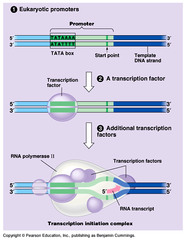
DNA sequence 20-30 base pairs upstream from the beginning of a gene (translational start site) that is recognized by transcription factors and RNA polymerase
polycistronic
mRNA that codes for more than one protein; no splicing (prokaryotes)
monocystronic
mRNA that codes for one protein; splicing and RNA processing occur (eukaryotes)
ATG
start codon
TAA, TAG, TGA
stop codon
TATA box
exact sequence where transcription factors and RNA polymerase bind in eukaryotes; almost all specialized genes that encode cell-type specific proteins have this
TATA-less
types of genes with ________________ promoters are either:
1) constitutively expressed (housekeeping genes)
2) developmentally regulated genes
RNA polymerase I
synthesizes rRNA
RNA polymerase II
synthesizes hnRNA (pre-mRNA) and snRNA
RNA polymerase III
synthesizes some 5S-rRNA (small ribosomal RNA) and tRNA
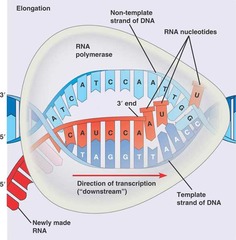
template strand
3' --> 5' strand; strand that enzymes act on and synthesize mRNA; often the leading strand
antisense (-)
the template strand of DNA is the _________________ strand
coding strand
5' --> 3' strand; strand that does not interact with polymerizing proteins; is almost exactly the same (has U instead of T) as the newly synthesized mRNA; often the lagging strand
sense (+)
coding strand of DNA is the ______________ strand
initiation
beginning of transcription in which RNA polymerase causes unwinding of DNA double helix and RNA polymerase joins the first nucleotides via phosphodiester bonds in RNA
elongation
RNA polymerase grows the RNA chain in 5' to 3' direction (reads DNA 3' to 5'); assembles ribonucleotide triphosphates into strand of RNA
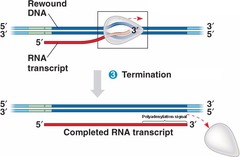
termination
newly formed RNA dissociates from RNA polymerase and transcription stops with pre-mRNA as the finished product
ribosomes
site of protein synthesis; composed of two subunits in eukaryotes: 60S (large) and 40S (small); has binding sites for mRNA and tRNA
80S
eukaryotic ribosome
A (activation)
tRNA binding site on the ribosome where the tRNA first binds
P (polymerization)
tRNA binding site on the ribosome where the peptide bond forms between the amino acids on adjacent tRNA molecules
E (exit)
tRNA binding site on the ribosome where the empty tRNA molecule leaves the ribosome
codons
sequences of three nucleic acids coding for a specific amino acid
first
_____ base in the codon is defining and always important
second
_____ base in the codon is important about 30% of the time
third
_____ base in the codon is almost never important because of the wobble effect
wobble effect
third nitrogenous base in a codon can vary and still code for the same amino acid
release factor protein
contains the anticodon for the stop codon on mRNA, terminating translation
nucleus
transcriptional control and RNA processing regulate gene expression in the _______________
cytosol
RNA transport control, translation control, and protein activity control regulate gene expression in the ______________
transcriptional control
most important form of gene regulation; controls which genes are turned on or off - modification of whether or not RNA polymerase can bind to promotor and transcribe a gene
alternative splicing
gene regulation at the RNA processing level involves __________________________
degredation
gene regulation at the RNA transport level involves the _____________ of mRNA
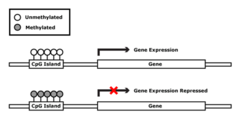
DNA methylation
chromatin modification that decreases gene expression
histone acetylation
chromatin modification that increases gene expression
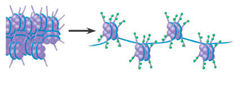
transcription factors
can activate or repress the transcription of adjacent genes; have DNA binding domains - activating domain binds to RNA polymerase and several proteins such as coactivators, enhancers, etc.
constitutive
genes that are always expressed and essential for cell function
inducible
genes in which the protein isn't always needed; certain proteins or chemicals can turn the gene on
activators
proteins that recognize specific short DNA sequences inducing the efficiency of the promoters
co-activators
proteins that are required for more efficient transcription - do NOT bind to DNA
nuclear receptors
function as a ligand-activated transcription factor that regulates gene expression involved in reproduction, development, and general metabolism; only accept lipophilic molecules because they have to pass through the nuclear envelope
CYP3A
enzyme involved in the metabolism of many drugs; certain drugs may increase the expression of this enzyme and cause drugs like estradiol to be metabolized faster (this would prevent birth control from being effective for 24 hours)
DNA methylation
the addition of a methyl group to cytosine, making it look like a thymine residue; decreases RNA polymerase binding and therefore decreases gene expression
HATs (histone acetyltransferases)
transfer acetyl groups to lysine side chains or histone proteins; addition of the acetyl increases gene expression
HDACs (Histone deactyletrasferases)
remove acetyl groups from a histone to decrease transcription of a gene
DNMT
DNA methyltransferase; add methyl groups to cytosines
CpG islands
DNA regions rich in C residues adjacent to G residues. Especially abundant in promoters, these regions are where methylation of cytosine usually occurs.
occur less often in than expected in mammalian genomes, probably due to mutation into TpG dinucleotides over evolution
posttranscriptional
_______________ regulation can control gene expression with siRNA, miRNA, alternative splicing, RNA editing, and mRNA degredation
miRNA (microRNA)
repress genes different from their origin; produced in the nucleus and end in the cytoplasm as a ~22 nucleotide RNA that functions to decrease gene expression; loaded into RNA induced silencing complexes (RISC)
RISC (RNA-induced silencing complex)
targeted to decrease expression of genes based on sequence complementary to the miRNA it is associated with
siRNA (small interfering RNA)
repress genes they were derrived from; target mRNA is degraded