Energetics I
0.0(0)
Studied by 0 people Call Kai
 Learn
Learn Practice Test
 Spaced Repetition
 Match
Match Flashcards
 Knowt Play
Card Sorting
1/27

Last updated 1:27 PM on 11/7/22
Name | Mastery | Learn | Test | Matching | Spaced | Call with Kai | Chat |
|---|
No analytics yet
Send a link to your students to track their progress
28 Terms
1
New cards
enthalpy change
the heat energy change measured at constant
pressure
pressure
2
New cards
standard enthalpy change of reaction
the enthalpy change when the number of moles of reactants as stated in the equation react under standard conditions.
3
New cards
Standard conditions
100kPa and 298K
4
New cards
standard enthalpy change of formation
The enthalpy change when one mole of a compound is formed from its elements, in their most stable states, under standard conditions.
5
New cards
standard enthalpy change of combustion
The enthalpy change when 1 mol of a substance is completely burned in oxygen under standard conditions, all reactants and products being in their standard states.
6
New cards
standard enthalpy change of neutralisation
the enthalpy change when 1 mol of water is produced as a result of the reaction between an acid and an alkali, under standard conditions.
7
New cards
Q=
mcΔT
8
New cards
bond enthalpy
the energy needed to break one mole of bonds in gaseous molecules under standard conditions
9
New cards
mean bond enthalpy
The Enthalpy Change needed to break one mole of bonds, averaged over different molecules
10
New cards
Exothermic
reaction which releases heat energy to the surroundings
11
New cards
Endothermic
reaction which absorbs heat energy from the surroundings
12
New cards
making bonds
exothermic
13
New cards
breaking bonds
endothermic
14
New cards
negative energy change
exothermic
15
New cards
positive energy change
endothermic
16
New cards
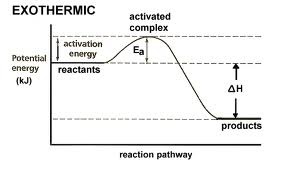
reaction profiles
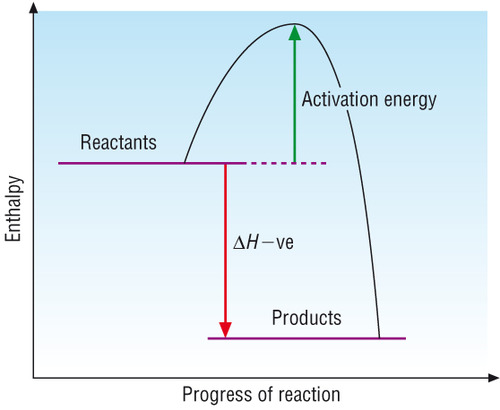
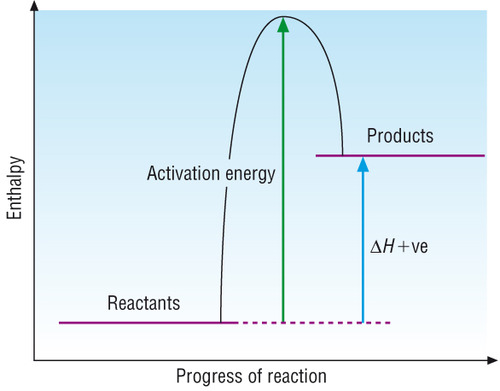
Reaction profiles can be used to show the relative energies of reactants and products, the activation energy and the overall energy change of a reaction.
17
New cards
exothermic reaction profile
reactants are higher than products
18
New cards
endothermic reaction profile
reactants are lower than products
19
New cards
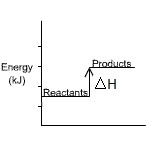
energy level diagrams
do not include activation energy
20
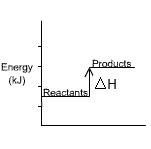
New cards
Endothermic energy level diagram
reactants below products
21
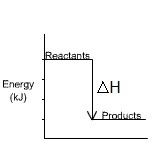
New cards
exothermic energy level diagram
reactants above products
22
New cards
sources of error exothermic displacement reaction
heat lost to environment (energy change is less exothermic as calculated Q is smaller than true value), evaporation of water (takes energy out of solution)
23
New cards
source of error endothermic displacement reaction
heat taken in from environment (temperature change is smaller, so energy change less endothermic)
24
New cards
sources of error combustion of alcohols
not all heat energy transferred to calorimeter (temperature change is smaller so less exothermic energy change), some alcohol evaporates from spirit burner (number of moles burnt is higher so energy change is less exothermic), incomplete combustion (energy change is less exothermic as not all alcohol reacted), water in calorimeter evaporates (removes energy from calorimeter so less exothermic), some of the wick burns = LESS EXOTHERMIC
25
New cards
Hess's law
If a reaction can take place by more than one route and the initial and final conditions are the same, the total enthalpy change is the same for each route.
26
New cards
Dynamic equilibrium
The rate of the forward reaction is equal to the rate of the backward reaction
The concentration of reactants and products remain constant
The concentration of reactants and products remain constant
27
New cards
Conditions of dynamic equilibrium
In a closed system, at a constant temperature, no material lost to surroundings
28
New cards
Homogenous equilibrium
The equilibrium for materials is all in the same state /phase