Diagnosis & Treatment Of Endocrine Disease 2
 Call Kai
 Learn
Learn Practice Test
 Spaced Repetition
 Match
Match Flashcards
 Knowt Play
1/31

Earn XP
Description and Tags
thyroidism & adrenocorticism
Name | Mastery | Learn | Test | Matching | Spaced | Call with Kai | Chat |
|---|
No analytics yet
Send a link to your students to track their progress
32 Terms
Examples of thyroid diseases
Hypothyroidism
Hyperthyroidism
Goitre
How do you test for thyroid function?
TSH levels —> show if thyroid is functioning normally or not
What can be tested for in blood tests to diagnose thyroid disease?
- Total T4
- Free T4
- Canine TSH
- Thyroglobulin autoantibodies
What indicates hyperthyroidism from a blood test?
High serum T4
Common clinical signs of hyperthyroidism
(most common in old cats)
Thin but ravenously hungry
Intermittent V+
Irritated/restless
Seaking heat
Coat sticks up/feels rough or greasy
How can hyperthyroidism be treated?
Remove thyroid tissue
- surgery —> thyroidectomy (risks removal of parathyroid gland also —> can induce hypocalcaemia)
- radioactive iodide
Reduce thyroid hormone synthesis
- restrict iodine
- block iodine synthesis
What are the risks of surgical thyroidectomy?
- upfront cost vs ongoing treatment
- damage to parathyroid gland —> can induce hypocalcaemia
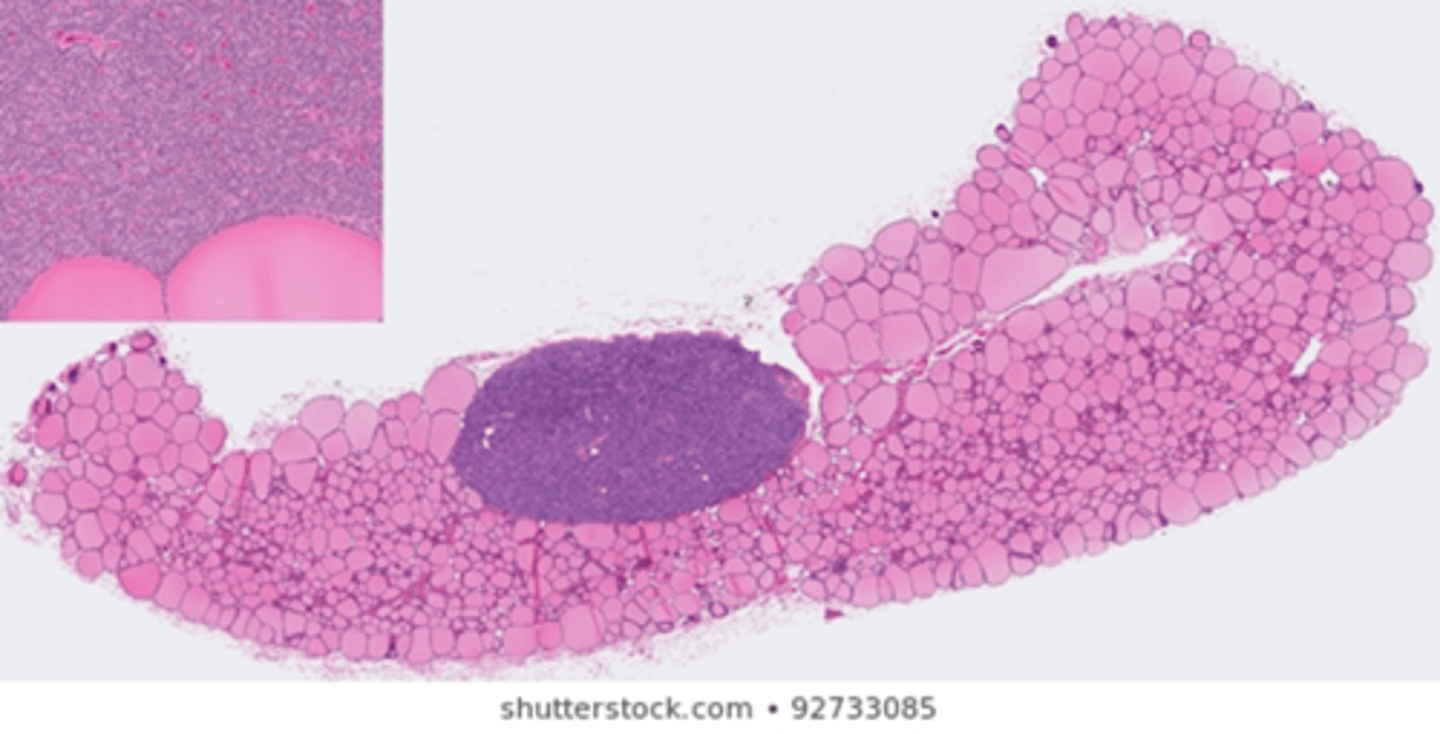
How does radioactive iodine work to treat hyperthyroidism?
- Destroys thyroid follicles —> kills overactive thyroid cells, leaves normal thyroid tissue behind
- T3 & T4 levels normalise after 1-2 weeks
- Animals hospitalised for 1-4 weeks
- Excreta handled carefully (radioactive)
- Very expensive!
no recovery time, special diets or medications needed after
Describe how stopping synthesis of thyroid hormone is achieved
Use medication that prevents T3 & T4 being produced —> Methimazole
Methimazole can be transdermal gel or an oral product
Carbimazole —> used as oral product & metabolised into methimazole in gut —> given 15mins before food, strict dosing, risk of overdose (hypothyroidism)
In what species can you restrict dietary access to iodine to treat hyperthyroidism?
Cats
causes thyroid hormone to not be synthesised
cat needs to ONLY eat this type of food —> not always feasible for outdoor cats
cheapest option
What do thioureylenes do? What is the thioureylene that is licenced in the UK?
Block iodine synthesis
Carbimazole
Clinical signs of hypothyroidism
(most common in dogs)
Inactive
Coat falling out/not re-growing —> thyroid hormone not stimulating fur regrowth
“Tragic look”
Very overweight but don’t eat much
Recurring infections (esp. in ear) due to suppressed immune system
What are the two ways dogs can get hypothyroid?
Lymphocytic thyroiditis —> immune mediated disease
OR
Idiopathic thyroid gland atrophy —> less common
What indicates hypothyroidism on a blood test?
Free T4 —> more sensitive
Endogenous canine TSH —> expected to be increased i.e. trying to get thyroid gland to work
Thyroglobulin autoantibodies —> test for immune mediated disease
Low T4, high TSH is diagnostic
What is sick euthyroid syndrome?
Any patient with acute, severe illness may have abnormal thyroid function tests
- fall in total and free T3 levels
- normal T4
- normal TSH
aka low T3 syndrome
usually starvation, severe respiratory disease or pregnancy without the thyroid being diseased
How can hypothyroidism be treated?
Thyroid hormone replacement therapy (thyroid hormone replaced exogenously)
–Levothyroxine is (T4) —> given orally, 30mins before food
–Liothyronine (T3) —> only given to dogs not responding well to T4
Take time to get dosage correct
Adverse effects of thyroid hormone replacement therapy?
- Hyperthyroidism
- V+ & D+
- Itchy (pruritic)
- Anorexic (not eating anything)
How can disorders of the adrenal gland be diagnosed?
- Specific blood tests
- Non specific blood tests
- Specific dynamic tests
Specific Blood Tests
cortisol
aldosterone
ACTH
Non Specific Blood Tests
electrolytes
glucose
lipids
Specific Dynamic Tests
Dexamethazone suppression test
ACTH stimulation test
What are the types of hyperadrenocorticism (Cushings disease)?
Spontaneous
- Pituitary Dependent Hyperadrenocorticism (PDH)
- Adrenal Dependent Hyperadrenocortcism (FAT; functioning adrenal tumour)
Iatrogenic
overuse of medication
Blood tests for hyperadrenocorticism
Serum biochemistry (increased glucose, increased cholesterol)
Insulin impairment
Lipolysis activation
Haematology (decreased lymphocytes, increased neutrophils, increased monocytes)
Liver enzymes (increased alkaline phosphate)
Clinical signs of hyperadrenocorticism
Fat pads
Dehydration
PUPD
Abnormal bruising/poor healing
Muscle wasting & weakness
Depression
Hyperadrenocorticism causes
Adrenal Tumour
increased cortisol —> decreased ACTH
shrinks unaffected adrenal gland
Pituitary Tumour
ACTH & cortisol increased —> too much cortisol leads to dehydration
doesn't respond to -ve feedback
ACTH stimulation test
Synthetic ACTH injection
Stimulates ACTH levels to increase in healthy animal
Won't increase in dog with Cushing's
Dexamethasone suppression test
Injection of dexamethasone (glucocorticoid steroid)
Levels of cortisol should be suppressed (decreased) in a healthy animal
Increase if -ve feedback not working
slight suppression means hypoadrenocorticism likely
Treating Hyperadrenocorticism
- Adrenal steroid synthesis inhibitors (trilostane)
- Dopamine receptor agonists (only horses)
Adverse effects of using trilostane
- Hypoadrenocorticism (can be fatal)
- Electrolyte abnormalities (can be fatal)
- Inhibits progesterone (don’t use in pregnant animals)
Dopamine receptor agonists cause the overproduction of ___ and are used to treat ___ in horses
ACTH
Pituitary Pars Intermedia Dysfunction (PPID)
caused by loss of dopaminergic inhibition to intermediate lobe of pituitary
'equine cushings' = old terminology
Hypoadrenocorticism is also known as ....
Addison's disease
What causes hypoadrenocorticism
Autoimmune disease or sudden withdrawal of corticosteroid therapy
body attacks & destroys the cortex of the adrenal glands
disrupts metabolism, blood pressure regulation, fluid & electrolyte balance, & stress response
Testing for hypoadrenocorticism
Serum electrolytes —> (decreased calcium & chloride, increased potassium)
Serum biochemistry —> (decreased glucose & cholesterol)
Haematology —> (increased lymphocytes)
How can hypoadrenocorticism be treated?
Replacement therapy of glucocorticoids and/or mineralocorticoids
Adverse effects of corticosteroids
Cushing's syndrome (in overdose)
GI ulceration
Hyperglycaemia
Laminitis
Muscle wastage
Wound healing impaired & opportunistic infections can occur
Osteoporosis
Fluids & electrolyte imbalances
Reduced milk yield in dairy cows
Abortion in late pregnancy