Psych final AOS
 Call Kai
 Learn
Learn Practice Test
 Spaced Repetition
 Match
Match Flashcards
 Knowt Play
1/52

There's no tags or description
Looks like no tags are added yet.
Name | Mastery | Learn | Test | Matching | Spaced | Call with Kai | Chat |
|---|
No analytics yet
Send a link to your students to track their progress
53 Terms
Wellbeing
A state in which an individual is mentally, physically, and socially healthy and secure.
Mental wellbeing
An individual's psychological state, indicating their ability to think, process information, and regulate emotions.
Involves the ability to cope with the normal stresses of life, work productively, and contribute to their community.
Some factors that help to determine this are:
Ability to function and contribute
Social and emotional wellbeing
Ability to cope with setbacks
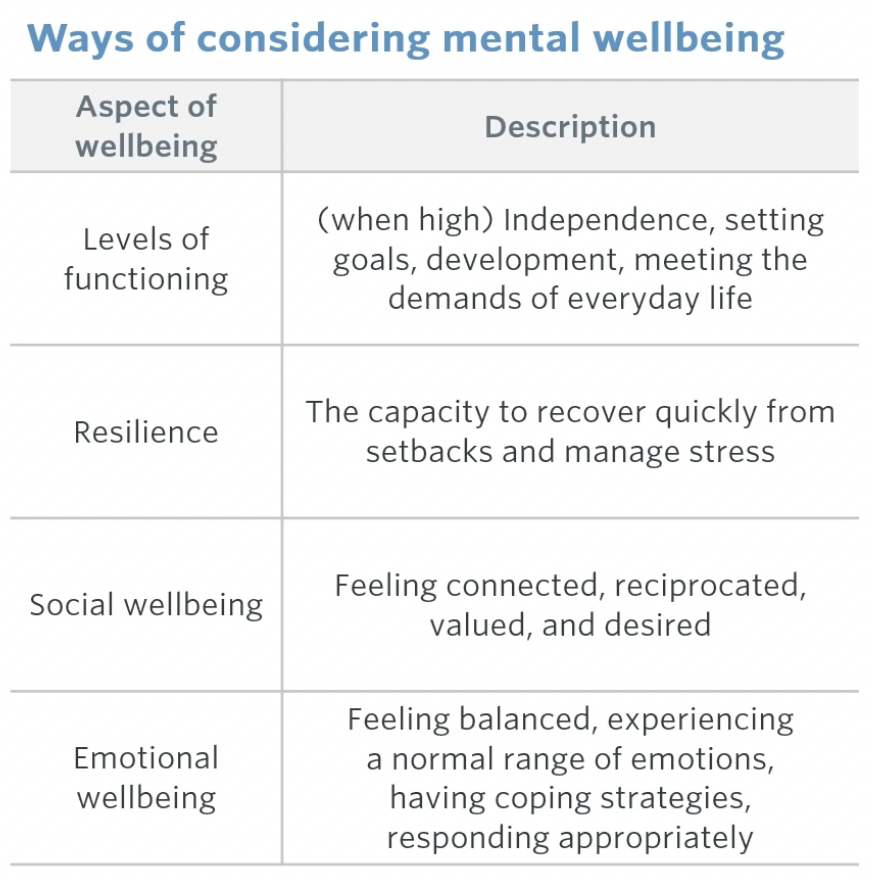
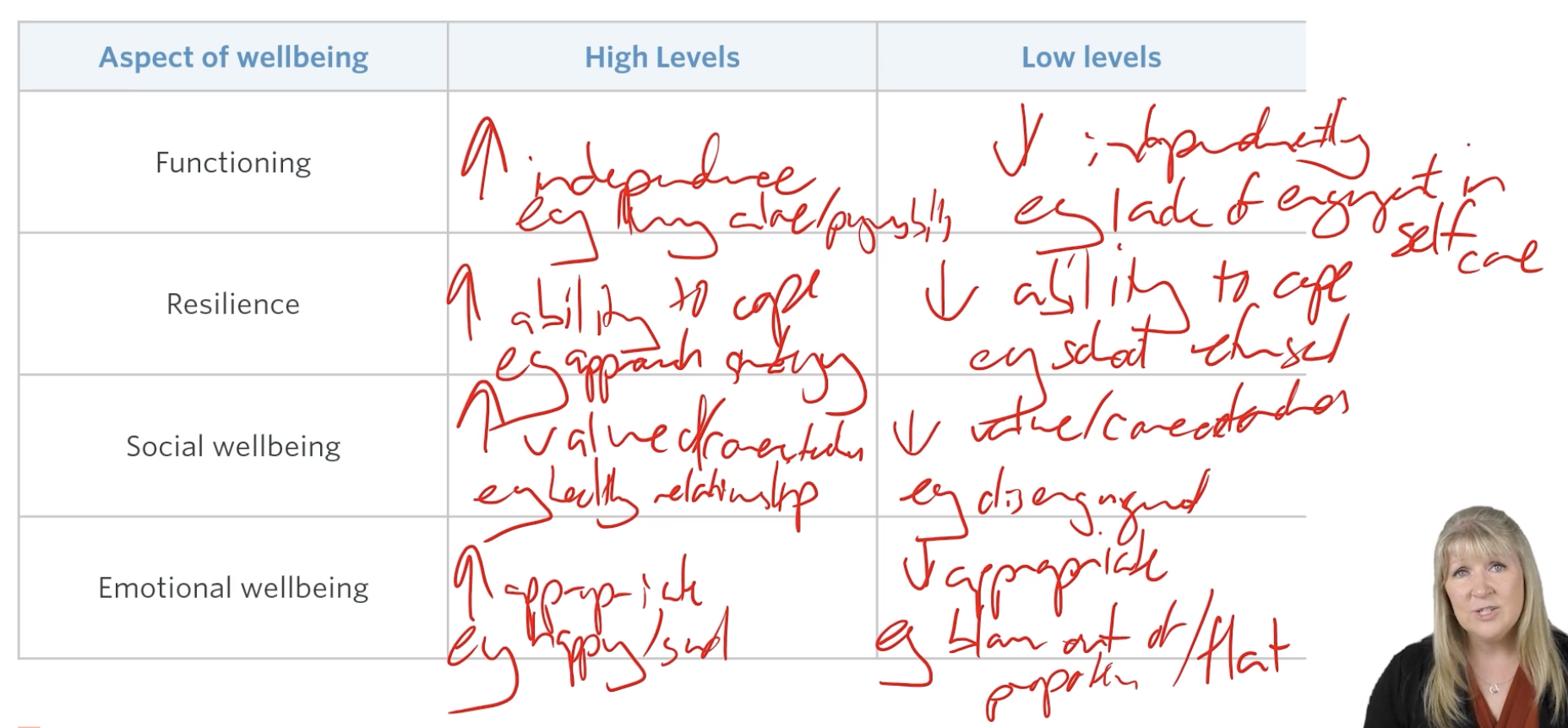
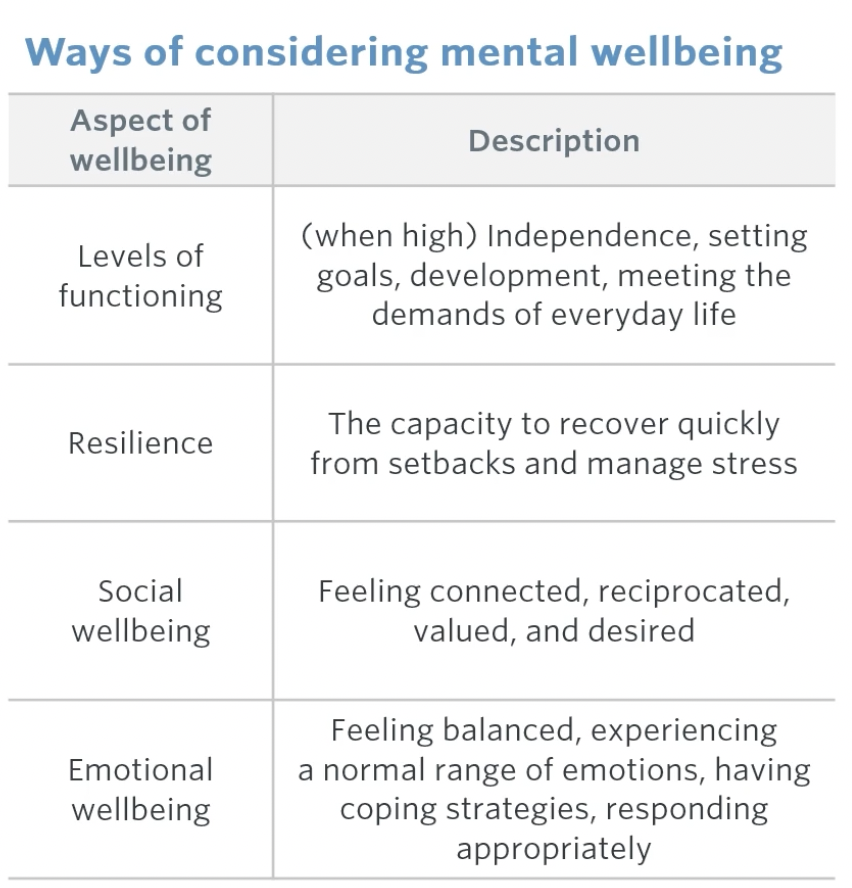
Levels of functioning
The degree to which an individual can complete day-to-day tasks in an independent and effective manner.
Resilience
The ability to cope with and manage change and uncertainty.
High resilience has been linked to greater life satisfaction and happiness.
Social wellbeing
The ability for an individual to form and maintain meaningful bonds with others, and adapt to different social situations.
Emotional wellbeing
The ability for an individual to appropriately control and express their own emotions in an adaptive way, as well as understand the emotions of others.
How is functioning measured
A quantitative measure is through the use of the Global Assessment of Functioning, or GAF, scale.
The GAF measures how much a person's symptoms, behaviours, and challenges affect their day-to-day life.
It is measured on a scale of 0 to 100, and is designed to help ascertain the level of impact to an individual.
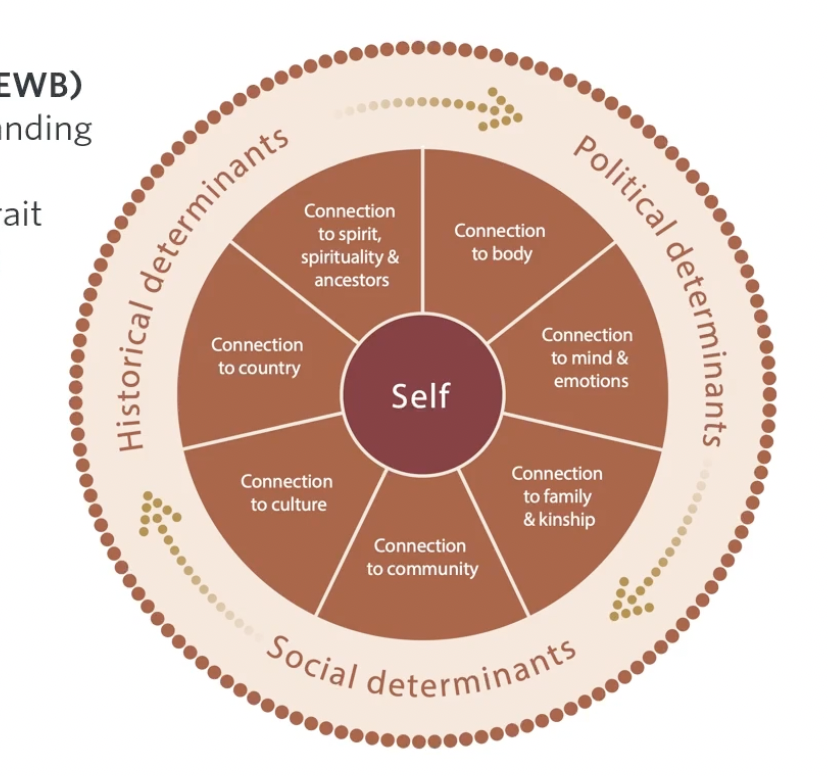
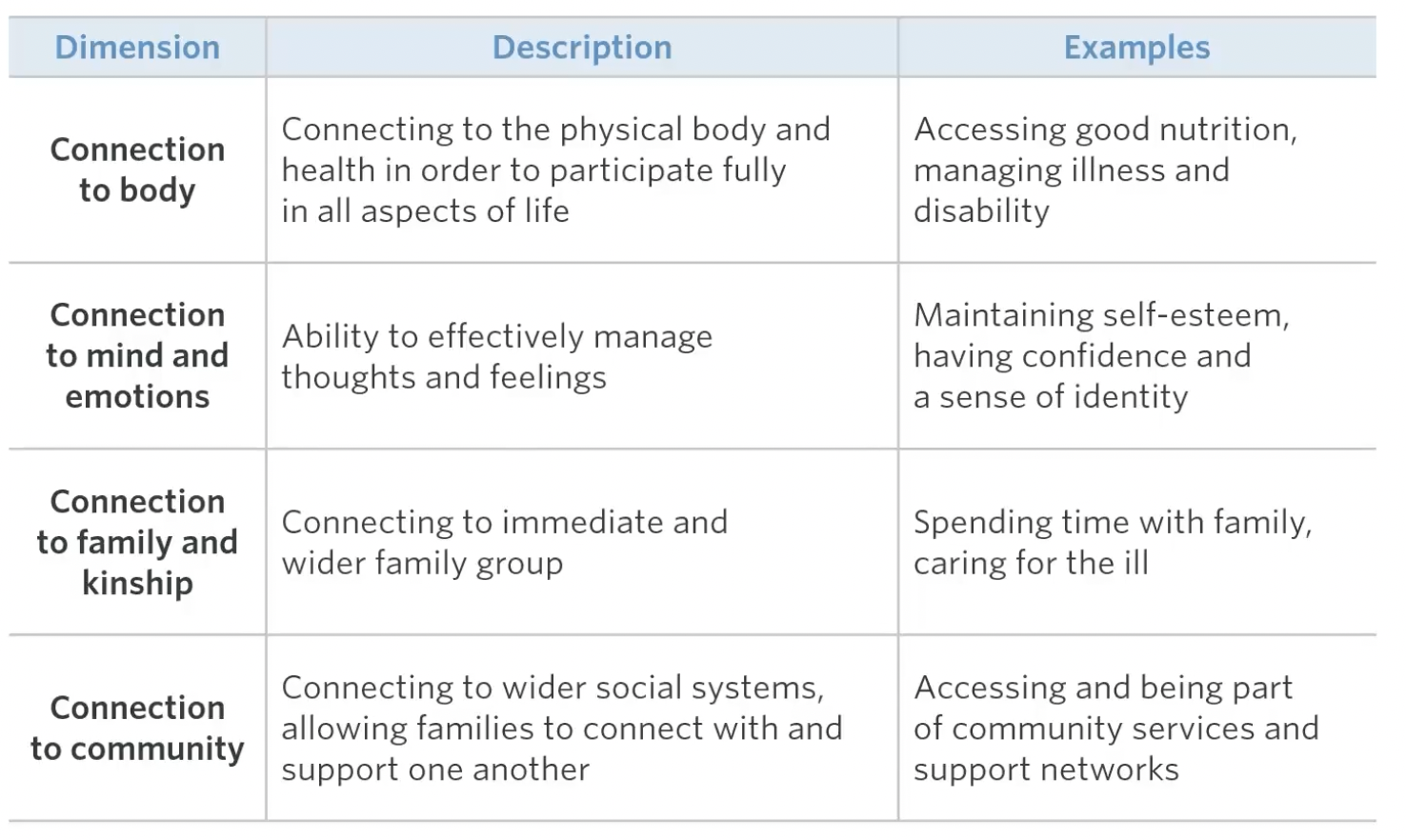
Social and emotional wellbeing (SEWB) framework
A framework that includes all elements of being, and therefore wellbeing, for Aboriginal and Torres Strait Islander peoples.
One approach to understanding all elements of being (and therefore wellbeing) for Aboriginal and Torres Strait Islander peoples.
It is multidimensional (has many different components) and holistic (considers the whole person).

Mental wellbeing continuum
A tool used to track fluctuating mental wellbeing.
Allows us to track this fluctuating mental wellbeing, ranging from high (functioning independently and coping with everyday demands of life) to low (distressed and unable to meet the demands of their environment for long periods of time).
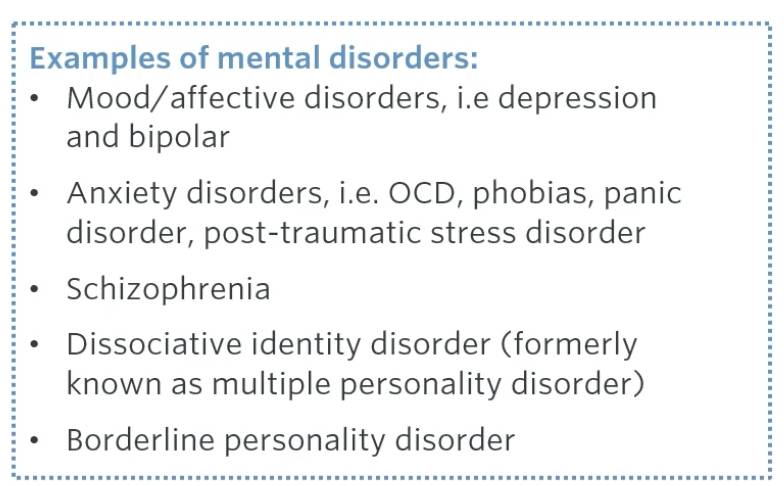
Mental health disorder
Something that can interfere with a person's thoughts, emotions, perceptions, and behaviours, and disrupts normal function.
Pros and cons of continuum
Pros:
Decreased stigma
Increased ability to see if functioning has improved
Increased ability to see if treatment is helping
Cons:
As it is not categorical data there is no guidebook and no way to tell when to treat people
Stress
A state of psychological and physiological tension that occurs when an individual encounters something of significance that demands their attention and/or efforts to cope.
It can be helpful to our performance in certain circumstances. The stress response gives the body the necessary resources to fight or overcome the stressor.
Distress occurs when an individuals feels they do not have the necessary resources to cope with a stressor - in these cases, it can lower mental wellbeing.
Anxiety
A psychological and physiological response associated with feelings of worry or uneasiness that something is wrong or something unpleasant is about to happen.
Severe anxiety is usually accompanied by intense physiological responses, including breathlessness, sweating, dizziness, and psychological responses like feelings of losing control and impending doom.
The experience of anxiety is generally unhelpful to our performance or functioning, and is more likely to negatively impact someone's mental wellbeing, particularly if persisting over a longer period of time.
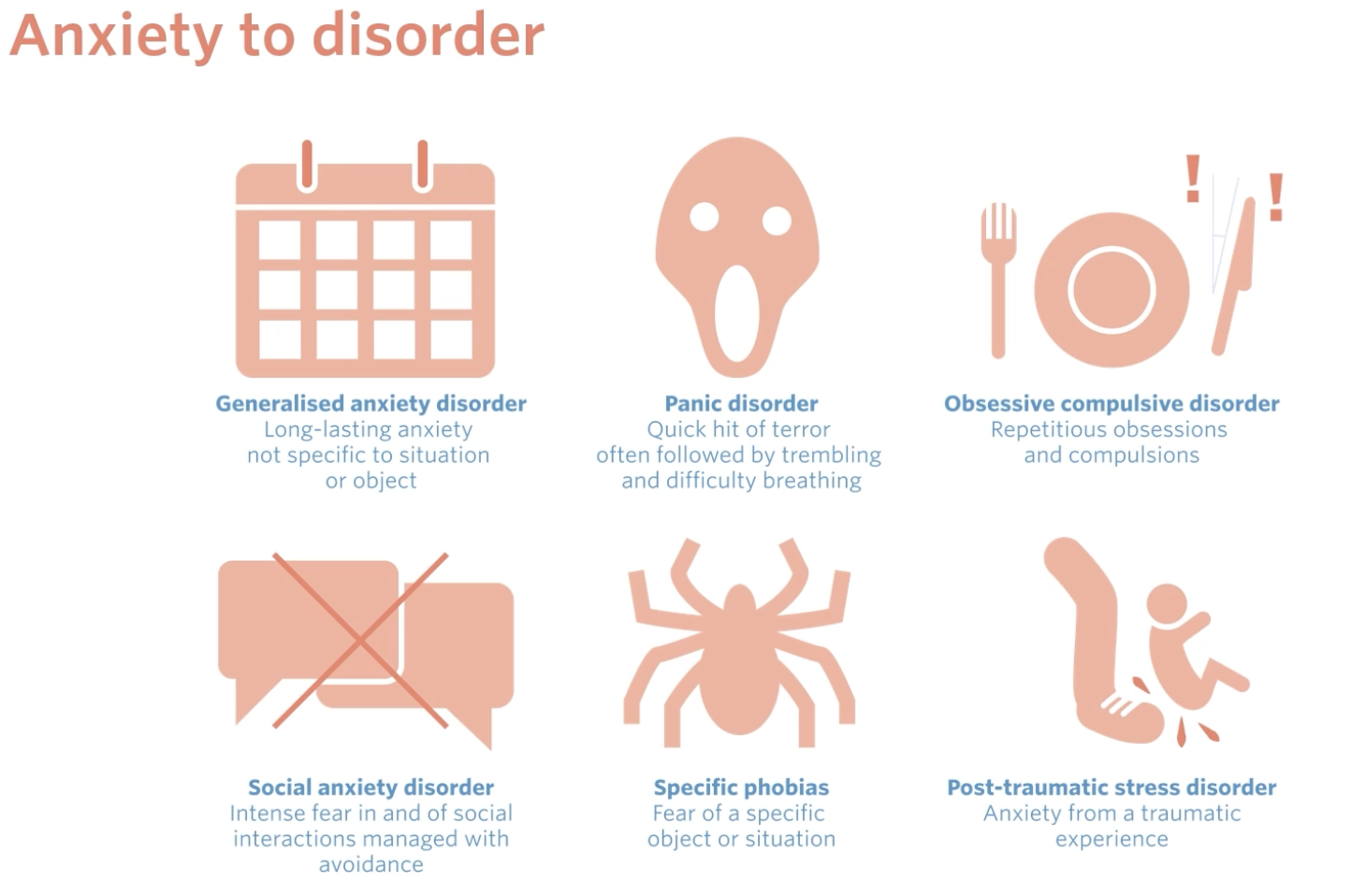
Specific phobia
A type of diagnosable anxiety disorder that is categorised by excessive and disproportionate fear when encountering or anticipating the encounter of a particular stimulus.
Involves a persistent, irrational, and intense fear of a particular object or event.
Exposure to the phobic stimulus triggers an involuntary anxiety response similar to a stress response, for example increased heart and blood pressure, sweating, shortness of breath, dizziness, palpitations, hand tremors, etc.
It involves experiencing such intense fear that an individual is likely to go to great lengths to avoid the object or situation causing the fear, can interrupt daily functioning and cause overwhelming anxiety.
According to the Diagnostic and Statistical Manual of Mental Disorders, a diagnosis should only be made if the fear has persisted for at least six months.
Specific phobia are generally divided into the following categories:
Animals eg. snakes
Situations eg. heights, small spaces
Blood/injections/injuries
Natural environments eg. storm, water, weather
Catastrophic thinking
A type of cognitive bias in which a stimulus or event is predicted to be far worse than it actually is.
Memory bias
A type of cognitive bias caused by inaccurate or exaggerated memory.
Cognitive bias
A predisposition to think about and process information in a certain way.
Operant conditioning
Antecedent eg. Don’t like frogs
Behaviour eg. Avoid frogs
Consequence eg. Negative reinforcement feel calm by removing the unpleasant stimulus of seeing the frog which increases the likelihood that the behaviour of avoiding the frog would be repeated
A phobia may be perpetuated (maintained) through operant conditioning.
Classical conditioning
NS = no response
NS + UCS = UCR
CS = CR
So, a phobia may be precipitated (caused) by classical conditioning.
The biopsychosocial model
The interconnected way that biological, psychological, and social factors influence human behaviour and development.
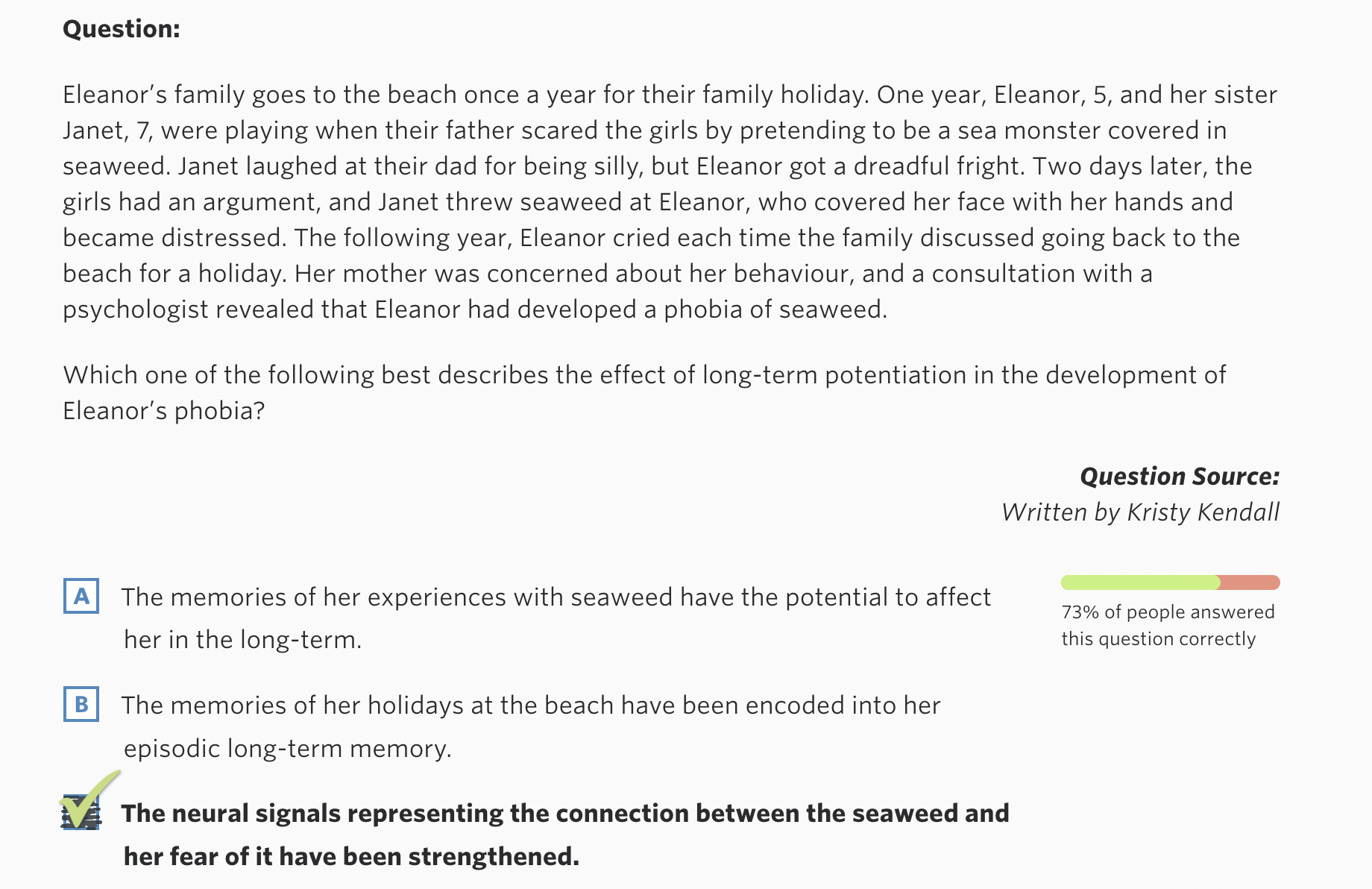
Long-term potentiation
The relatively permanent strengthening of synaptic connections that are activated regularly.
Repeated stimulation of two neurons can strengthen a response.
Therefore, if an individual keeps stimulating this neural pathway, the phobia will strengthen over time.
GABA (Gamma-amino butyric acid)
An inhibitory neurotransmitter that calms the stress response.
If an individual has low levels of GABA, or it cannot be transmitted or received normally across the synapse, their stress response can be activated more easily and they may find it harder to calm down.
So, repeated stress responses to the same stimuli can lead to the development of specific phobia.
They will be provided with opportunities for employment in the future in order to be able to obtain essential health resources such as food, water, clothing and shelter.
Social factors
External factors relating to an individual's interactions with others and their external environment, including their relationships and community involvement.
Environmental triggers
Stimuli or experiences in a person's environment that evoke an extreme stress response, leading to the development of a phobia.
Environmental triggers can include:
Direct confrontation.
Observation.
Learning (or indirect confrontation).
Stigma
The feeling of shame experienced by an individual for a characteristic that differentiates them from others.
Benzodiazepine
A type of medication that depresses central nervous system activity and is often used as a short-acting anxiety medication.
Acts as a GABA agonist by increasing the inhibitory effect of GABA which will allow people to calm down
Benzodiazepine medications can be short acting (i.e. Xanax) or long lasting (i.e. Valium).
Benzodiazepines bind to receptors to inhibit neurotransimitter release.
Agonist
A drug that binds to the receptor of a neuron and causes the same action as the neurotransmitter that usually binds to that receptor (inhibiting or exciting a response).
GABA
An inhibitory neurotransmitter that calms the stress response.
If an individual has low levels of GABA, or it cannot be transmitted or received normally across the synapse, their stress response can be activated more easily and they may find it harder to calm down.
Breathing retraining
A method used to teach breathing control techniques that may reduce physiological arousal.
Slowing breathing can calm the stress response.
Therefore, breathing retraining teaches an individual techniques that they can use when experiencing anxiety in the presence of their phobic stimulus.
Systematic desensitisation
A graded experience where the patient experiencing a specific phobia is gradually exposed to phobic stimuli while using relaxation techniques to calm their response.
The phobic stimulus should be a neutral stimulus (NS), but it is a conditioned stimulus (CS).
In systematic desensitisation, we pair the CS with a pleasant UCS (the relaxation technique), and a new UCR appears.
Eventually, the conditioned stimulus will be no more.
Systematic desensitisation process:
1. The patient learns a relaxation technique.
2. The patient establishes a fear hierarchy.
3. The patient is gradually exposed to stimuli on the hierarchy, starting with the easiest to confront and working up. This is paired with the practice of the newly learnt relaxation technique.
4. This continues until the fear response has been extinguished by the new association of the phobic stimulus with the feeling of relaxation.

Pros and cons of systematic desensitisation
Pros:
People are likely to be very responsive or susceptible as they are using the way the phobia developed to undevelop it
It can be done overtime
It works with the core of the issue that is happening
Cons:
It can take a lot of time to start to work
If the process is done too quickly it can lead to further stimulus generalisation which would make the relaxation techniques produce further fear
Cognitive behavioural therapy
A form of psychotherapy that encourages individuals to substitute dysfunctional cognitions and behaviours with more adaptive ones.
CBT focuses on helping the person change negative thoughts (e.g. catastrophic thinking, memory bias) by replacing them with more positive, realistic ones.
Similarly, it involves identifying and replacing negative behaviours (e.g. avoidance, not seeking help) for more positive and helpful ones.

Psychoeducation
Teaching families and supporters of individuals with mental health disorders how to better understand, deal with, and treat their disorder.
Aids families and supporters of individuals with specific phobia in understanding, dealing with, and treating the phobia.
It involves two key components;
Challenging unrealistic or anxious thoughts of the individual
Not encouraging avoidance behaviours
Protective factors
Influences that enable an individual to promote and maintain high levels of mental wellbeing.
Biological protective factors
Influences that stem from an individual's brain and/or body that can maintain or promote mental wellbeing.
2 of these are:
Sleep
Adequate nutrition and hydration
Psychological protective factors
Influences that relate to mental processes that can maintain and promote mental wellbeing.
2 of these are:
Cognitive behavioural strategies
Mindfulness meditation
Cognitive behavioural strategies
Techniques that utilise traits of cognitive behavioural therapy, particularly recognising and changing dysfunctional thought and behavioural patterns.
This could include:
Unraveling cognitive distortions by identifying and challenging dysfunctional thinking.
Exploring the causes of dysfunctional thinking and reframing these.
Journaling to reflect and help identify thought patterns.
Mindfulness meditation
The practice of meditation in which an individual focuses on their present experience to promote feelings of calm and peace.
It is all about becoming aware and then understanding that you are the one in control of bringing about that state of calm.
Benefits of mindfulness meditation
Reduced stress and anxiety
Improved attention and concentration
Decreased pain sensitivity
Improved empathy, compassion and self-awareness
Physical changes to the brain due to plasticity
Social protective factors
Influences that exist in an individual's social environment that can maintain and promote mental wellbeing.
Support is a social protective factor, and involves the comfort, reassurance, and assistance given by family, friends, and the community.