CEE 3020 Midterm 1
 Call Kai
 Learn
Learn Practice Test
 Spaced Repetition
 Match
Match Flashcards
 Knowt Play
1/86

There's no tags or description
Looks like no tags are added yet.
Name | Mastery | Learn | Test | Matching | Spaced | Call with Kai | Chat |
|---|
No analytics yet
Send a link to your students to track their progress
87 Terms
Accuracy
how closely a computed or measured value agrees with the true value
Inaccuracy
a specific deviation from a given value accepted as known
Bias
a consistent tendency to deviate in a specific direction from a known value
Precision
how closely a group of computed or measured values agrees with each other
Imprecision
a magnitude of scatter in a group of measurements
Normal Distribution (Gaussian distribution)
Describes populations and material properties
Mean
the “center” of the normal distribution (location of the peak)
Variance
the “width” of the distribution
Inherent variability
Composition, manufacture methods, time
Sampling methods
must ensure that a random and representative sample is taken from the population
depends on material variability & tolerance level of results
• more variability dictates a larger sample
Lab errors
human error, machine error, environmental factors, combination
Variability
Inherent variability, sampling methods, test procedures, lab errors
Engineering Stress
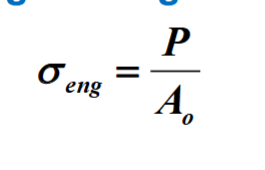
Engineering Strain

Elastic
An instantaneous response (deformation) to load, and the material must return to its original shape (recoverable) when the load is removed
Plastic
Permanent (unrecoverable) deformation when a material is subjected to loads that exceed its yield strength
Viscous
Deformation at a certain rate
Modulus of Elasticity/ Young’s Modulus

Poisson’s Ratio

Elastic Stress-Strain Curve
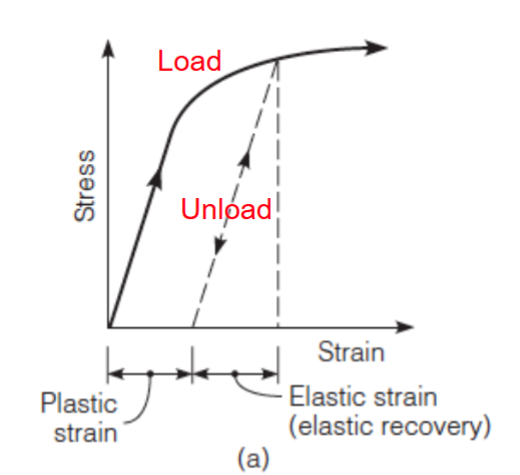
Elasto-Perfectly Plastic stress-strain curve

Elasto-Plastic with strain hardening stress-strain curve

Viscoelastic
creep and relaxation
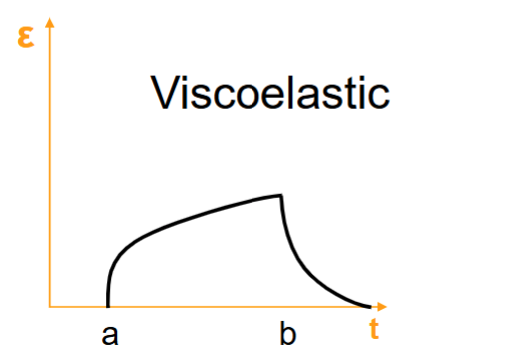
Creep

Relaxation

Factors that influence creep/relaxation
temperation, time, load
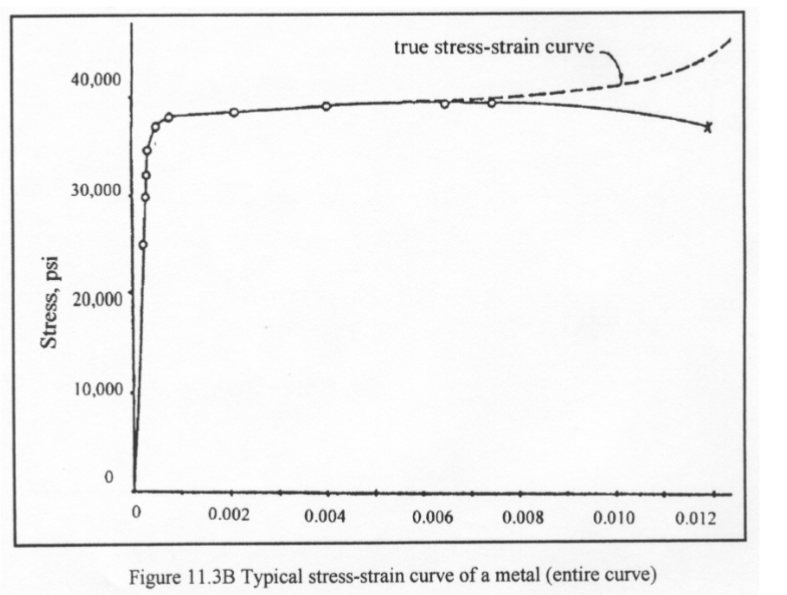
Engineering vs True Stress & Strain
Microstructure
composition and arrangement of atoms, formation of “grains",” nature of micro-level imperfections
Chemical Bonds
Serve to ensure that atoms achieve stable electron configurations by adding, removing, or sharing electrons: Primary vs Secondary
Primary Chemical Bonds
Ionic bonds, Covalent bonds, metallic bonds
Ionic Bonds Examples
ceramics, Gypsum, rock salt, calcite
Covalent Bonds Examples
Diamond, Glasses
secondary chemical bonds
hydrogen(water), van der Waals(thermoplastic polymers)
Ionic Bonds Definition
Certain elements readily lose or gain electrons.
• These elements are referred to as strongly electropositive or strongly electronegative.
• When these elements are brought together, they exchange electrons to form ionic compounds.
• Ionic solids will not conduct electricity unless in molten state or dissolved in water.
• All ionic compounds exist as crystalline solids at room temperature.
Covalent Bonds Definition
Electrons are shared rather than gained or lost
• Electrons are not shared equally – creates a dipole
• Few compounds have primarily covalent bonds
Metallic Bonds Definition
• Elements are electropositive – all wish to lose electrons.
• Electrons are given up to a common “pool”.
• Atoms become positive with a stable electron configuration
Hydrogen Bonds Definition
• Special case of van der Waals bonding.
• Arises from strong electrostatic interactions between the hydrogen atom and oxygen, nitrogen, or fluorine.
• Without this bond, water would freeze and boil at much lower temperatures – no liquid state at room temperature
van der Waals Bonds
Weak attraction between molecules with nonpolar bonds – formed through temporary dipoles.
• Attraction can also occur between atoms of a single type.
• Strength of van der Waals bonds between molecules strongly influences the boiling point of compounds.
• Exist in the presence of other bond forces
3-D Lattice Structures
Body center cubic (9 atoms), face center cubic (14 atoms), hexagonal close pack (17 atoms)
Unit Cell Structure of Metals
the smallest group of atoms that reveal the particular ccrystal structure of a unique metal
Number of equivalent atoms
BCC: 2, FCC: 4, HCP: 6
rate of cooling from liquid state:
slow cooling - large grain, rapid cooling - fine grain
Phase Diagram
shows the phases formed in differing mixtures of elements over a range of temperatures (eutectic point, liquidus line, solidus line, alpha, beta)
Alloys
hvae one or more compounds dissolved in a metal
Interstitial atoms
fit between the metal atoms, must have an atomic radius less than 60% of host metal, can dissolve only about 6% into the host
Substitutional atoms
take the place of host atoms in the lattice, if the atoms are similar enough, the compounds can mix easily
Alloy facts
many alloys are stronger and more ductile than the metals from which they are formed
the greater the mismatch in atomic size, the greater the strengthening effect
Defects in metals
involves movement of dislocations through the metal crystal structure in response to a shear stress (point, line, planar, volume)
Point defects
vacancies, impurities, interstitials
Line Defects
dislocations
Planar imperfections
grain boundaries
volume or bulk defects
voids, inclusions
Elastic deformation
crystal returns to original shape when force is removed
Plastic deformation
crystal does not return to original shape when force is removed
slipping of one plane of atoms over an adjacent plane
twinning- a portion of the crystal forms a mirror image of itself across the plane of twinning
Loading-Unloading-Reloading linear-elastic region
Complete recovery upon unloading
Loading-Unloading-Reloading beyond linear-elastic region
Some irrecoverable or “plastic” deformation occurs - “permanent set”
Uniaxial Tension Test
Most common test performed; most properties are determined using this procedure
Torsion Test
Used to determine shear modulus, shear strength
Charpy V Notch
Measures fracture energy, estimates touchness
Rockwell Hardness Test
Measures metal’s resistance to localized plastic deformation; test uses an indenter that is forced into the surface of the material with a specified force
Stress-strain curve

Ductility
a measure of a material’s ability to undergo sugnificant plastic deformation before rupture or breaking
Toughness
the ability of a material to absorb energy and plastically deform until fracturing (or ability to withstand impact loading).
Hardness
a measure of a material’s resistance to localized plastic deformation, such as a small dent or scratch on the surface of the material
depends on plastic properties
Nothing can be inferred about complete stress-strain curve
several scales: Rockwell, Brinell, Vickers, Knoop
Conversion between scales is empirical and approximate
Iron Facts
mined from earth as ore, metal extracted by:
pyrometallurgy: smelting
Electrometallurgy: uses an electric furnace or electrolytic process to remove metal from ore
hydrometallurgy: ore is subjected to an aqueous solution from which the metal is dissolved and recovered
Iron Products
pig iron: obtained from reducing iron ore in a blast furnace (cast into bars)
cast iron: pig iron that has been melted to be cast in final form
malleable cast iron: cast iron that has undergone special annealing after casting to make it malleable
Wrought iron: least amount of carbon, contains blast furnace slag, will harden quickly when cooled rapidly
Classification of steels
steel c< 2% vs. cast iron c>= 2%
Low carbon steels
contain less than 0.3% carbon, low strength, high ductility, good weldability
Medium-carbon steels
contain 0.3%-0.6% carbon
High-carbon steels
contain more than 0.6% carbon, high strength, low ductility, poor weldability
Stainless steel
used for corrosion resistance; in presence of air, stainless steel develops film of chromium oxide (Cr2O3) that protects metal from corrosion (rust)
Stainless steel types
Austenitic, ferritic, martensitic
Austenitic stainless steels
excellent weldability, not stable at room temp; stabilizer: nickel, carbon, manganese, nitrogen
Ferritic stainless steels
low weldability, 12-27% chromium with small amounts of austenite-forming alloys
Martensitic stainless steels
least amount of chromium, high hardenability, and require both pre- and post-heating when welding to prevent cracking in the heat-affected zone (HAZ)
Weldability
the ability of a metal to perform in a satisfactory manner after being joined by welding
Arc welding or “stick welding”
Flux on the electrode (“stick”) shields the molten metal from atmosphere to prevent oxidation.
Gas Welding or “MIG Welding”
“Metal in Gas” uses shielding gas instead of flux.
Electrochemical process
A chemical reaction involving the transfer of electrons between two electrodes
Electrochemical cell (or corrosion cell)
A device which converts chemical energy into electrical energy.
Fundamental components
Anode - where elctrochemical oxidation takes place
cathode - where electrochemical reduction occurs
electrical conductor - the bar
Aqueous Medium (electrolyte) - water, seawater
steel rusting/corrosion
the transfer of electrons from iron to oxygen
Ductile vs. Brittle failure
ductile: significant strain, yield, before failure
brittle materials: much less/no strain prior to failure
Fracture Mechanics
study of flaws in engineering materials

Fatiguq
continued repetition of these loads can lead to “fatigue failure",” can occur suddenly without prior deformation
Fatigue Life and Fatigue Limit
characterized by S-N curves, life will vary for given material with loading conditions, an “endurance limit” or “fatigue limit” may exist
Miner’s Rule
accounts for variations in stress amplitude over service life
account for cumulative damage