topography of the cardiovascular respiratory tract
 Call Kai
 Learn
Learn Practice Test
 Spaced Repetition
 Match
Match Flashcards
 Knowt Play
1/53

There's no tags or description
Looks like no tags are added yet.
Name | Mastery | Learn | Test | Matching | Spaced | Call with Kai | Chat |
|---|
No analytics yet
Send a link to your students to track their progress
54 Terms
If we want to listen to the heart and lungs where do we listen?
Caudal to triceps and forelimb
What is the costochondral junction?
Where bone and cartilage meet
What happens when the animal breathes in?
Diaphragm flattens and moves caudally and increase space in thorax
What is the cardiac notch?
Indent in lung where heart sits

Whats A?
Cardiac notch

Whats B?
Costochondral junction

During a heart sound auscultation, what are the different valves we can listen to?
Pulmonary
Aortic
Mitral
Where is the loudest heart beat that you can hear?
Place stethoscope on thorax dorsal to point of elbow on left hand side
Stethoscope will be positioned over maximum

Which is inspiration which is expiration?
Red = expiration
Blue = inspiration

Whats A?
Pulmonary trunk

Whats B?
Right valve

Whats C?
Base of heart

Whats D?
Intraventricular arteries and veins

Whats E?
Atrium

Whats F?
Aorta leaving heart

Whats G?
Left ventricle

What’s H?
Heart

Whats I?
Apex of heart

Whats J?
Diaphragm

Whats K?
Phrenic nerve

Why do the lungs appear dark?
Lungs full of air

Whats C?
Trachea/windpipe

Whats D?
Aorta

Whats E?
Pairs of ribs

What’s F?
Caudal vena cava

Whats G?
Diaphragm
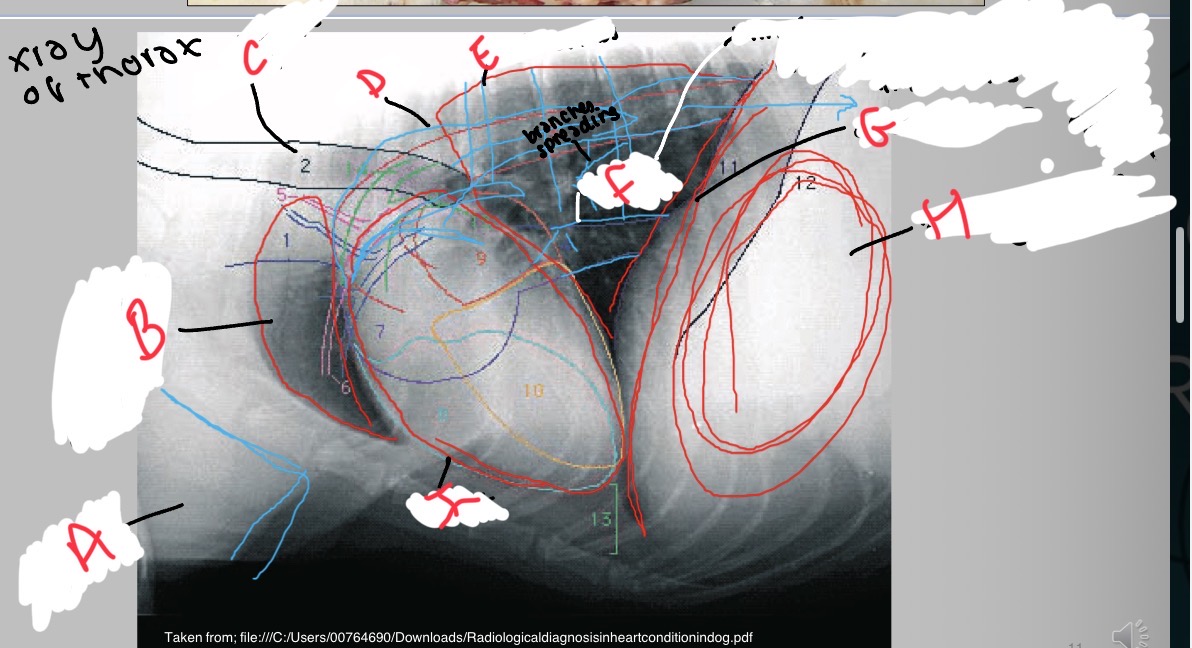
What’s H?
Abdominal contents
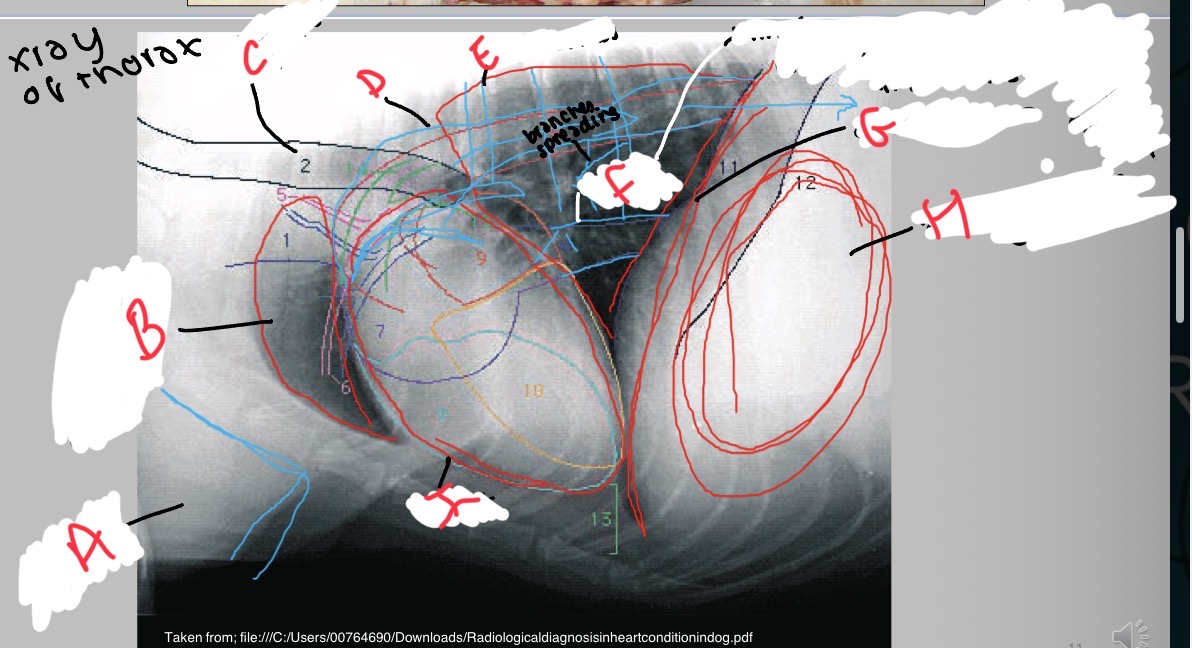
Whats I?
Heart

Why is it opaque at A?
Opaque region where major vessels entering and exiting
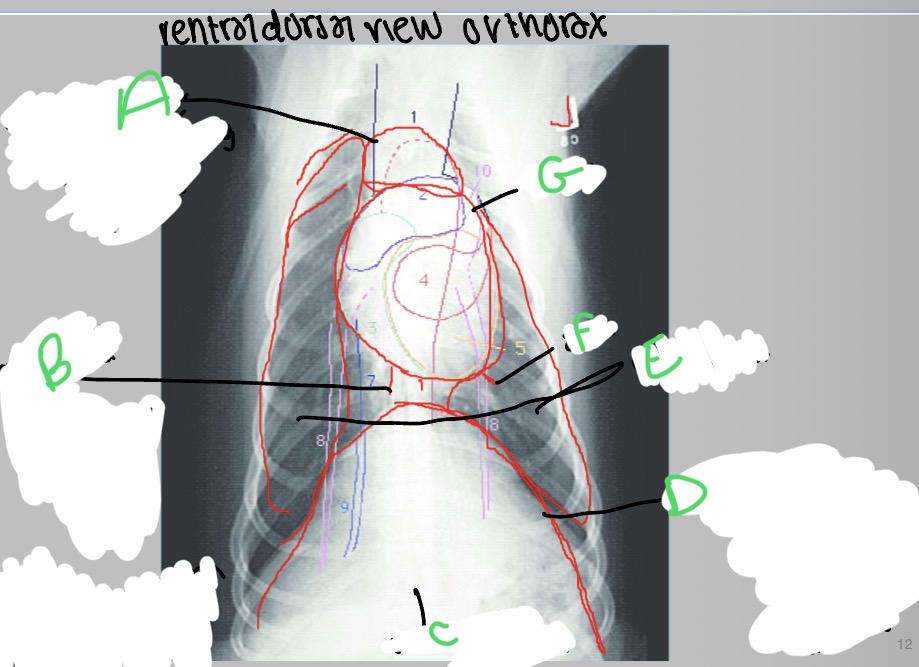
Whats B?
Caudal vena cava
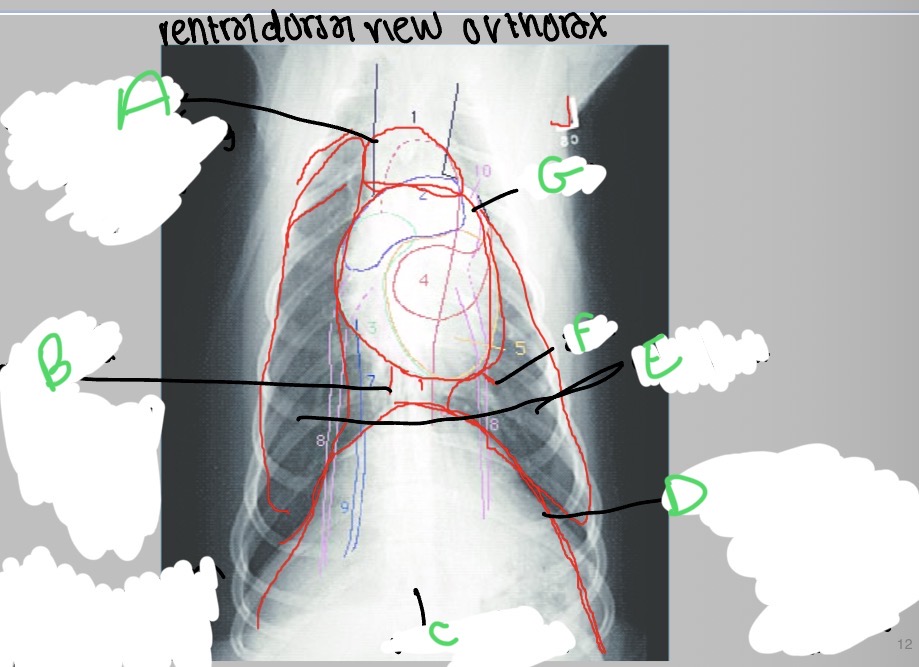
Why is it white at C?
Whiter due to dense viscer eg liver

Whats D?
Diaphragm
Doming forwards, meet apex of heart on expiration, flatten when expire

Whats at E?
Where lungs sit

Whats F?
Apex

Whats G?
Heart

Whats A?
Central tendon

Whats B?
Holes, where structures pass

Whats C?
Where aorta passes (dorsal to diaphragm)
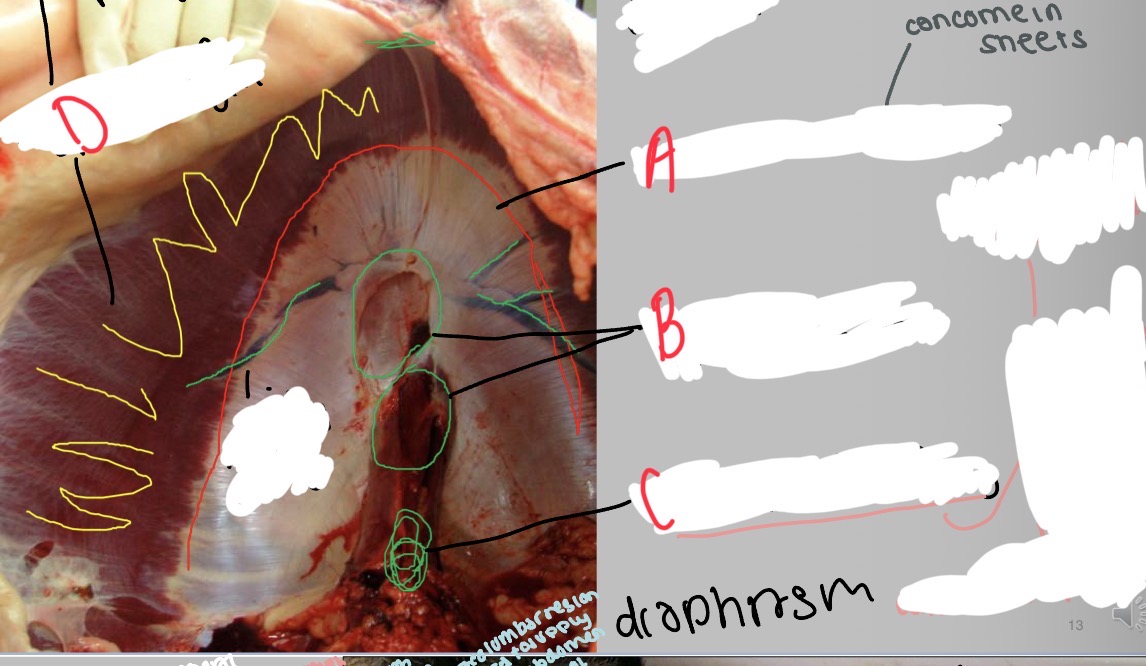
Whats D?
Muscular part of diaphragm
What does the muscular part of the diaphragm do ?
Can cause contraction of diaphragm , flattening diaphragm to draw air into lungs

What structure is this ?
Diaphragm
Why do we want the aorta to pass dorsal to the diaphragm?
Important so that when diaphragm contracts aorta doesnt become restricted by muscle
Don’t want blood flow through when aorta is constricted

Whats A?
Vagus nerve

What is B (what connects the sympathetic trunk to the vagus nerve)?
Antis of clavier
(unsure on spelling)

Whats C?
Phrenic nerve

Whats D?
Vertebral bodies

Whats E?
Sympathetic trunk
What would happen if an animal were to break their neck cranial to the 5th+7th division of the cervical spinal cord?
If an animal breaks their neck cranial to this region, inhibits motor function to the phrenic nerves so animal wont be able to breathe
What is the pathway of parasympathetic and sympathetic through the thorax?
Parasympathetic down from head
Sympathetic coming out of thoracolumbar region of spinal cord to supply thorax, abdomen and some of the head
What is the triangle of auscultation?
Where lungs closest to surface and easiest to hear
How would we know if an animal is healthy from an auscultation?
We don’t want to hear much, only ‘gentle breeze’ if disease, wheeze/crackles
Where is the triangle of auscultation?
Draw line caudal to triceps to point of elbow then from penultimate rib forwards to top of scapula then connect triangle
How can we measure respiratory rate just from looking?
Can be watched by seeing flank rise and fall, first part of clinical exam
Then listen to lungs, see if any congestion within airways or build up of fluid / blood - muffled sounds
Why wouldn’t we be able to hear the lungs in the region of the scapula?
Won’t hear anything here as the tricep muscle is covering , as cranial most part of the forelimb is very dense