MCAT Biochemistry: Nucleotides, Carbohydrates, & Lipids
 Call Kai
 Learn
Learn Practice Test
 Spaced Repetition
 Match
Match Flashcards
 Knowt Play
1/62

There's no tags or description
Looks like no tags are added yet.
Name | Mastery | Learn | Test | Matching | Spaced | Call with Kai | Chat |
|---|
No analytics yet
Send a link to your students to track their progress
63 Terms
how do histones associate with DNA
by forming salt bridges between positively charged amino acid residues and negatively charged phosphate groups
how does acetylation of lysine residues in histones increase gene expression
the salt bridges between charged amino acids and phosphate groups are disrupted
epimers
differ at only one stereocenter
anomers
differ only at the anomeric carbon
what do peptide hormones require
a second messenger
do steriod hormones require a second messenger
no
prostaglandins
20-carbon non-hydrolyzable lipids that act as autocrine and paracrine signals (act only on nearby cells)
terpenes
precursors in the synthesis of cholesterol and steroid hormones
ketone bodies
fuel sources that are produced under low glucose conditions
catecholamines
hormones derived from the amino acid tyrosine, generally act as endocrine signals
reducing sugars
have hemiacetal or hemiketal configurations at their anomeric carbon
nonreducing sugars
have acetal or ketal configurations at their anomeric carbon
where are triglycerides found
adipocytes (not cell membranes or viral envelopes)
palmitic acid
a free fatty acid synthesized by cells
sphingomyelin
a phospholipid with a sphingoside backbone (instead of a glycerol backbone)
chargraff's rules
1. A=T and G=C 2. G + A = C + T
order in which the precursors of steroid hormones are synthesized (cholesterol synthesis)
isoprene --> monoterpene --> squalene --> cholesterol --> steriod hormones
how many isoprene units are in monoterpene
two
how many isoprene units are in triterpene (ex: squalene)
six
what moves the slowest in an agarose gel during electrophoresis
molecules with largest molecular weight
what nucleotide has the greatest molecular weight
guanosine
what is the function of sphingolipids
structural lipids (provide structue to cell membrane)
what type of fatty acid chain provides the greatest flexibility in membranes
short unsaturated fatty acids
what factors would cause the fastest time for DNA to reanneal (3)
short strands, ~physiological pH, highest salt concentration
lipid raft
regions of relatively high order of the cell membrane (have high cholesterol content)
what functional group is abundant in waxes
esters
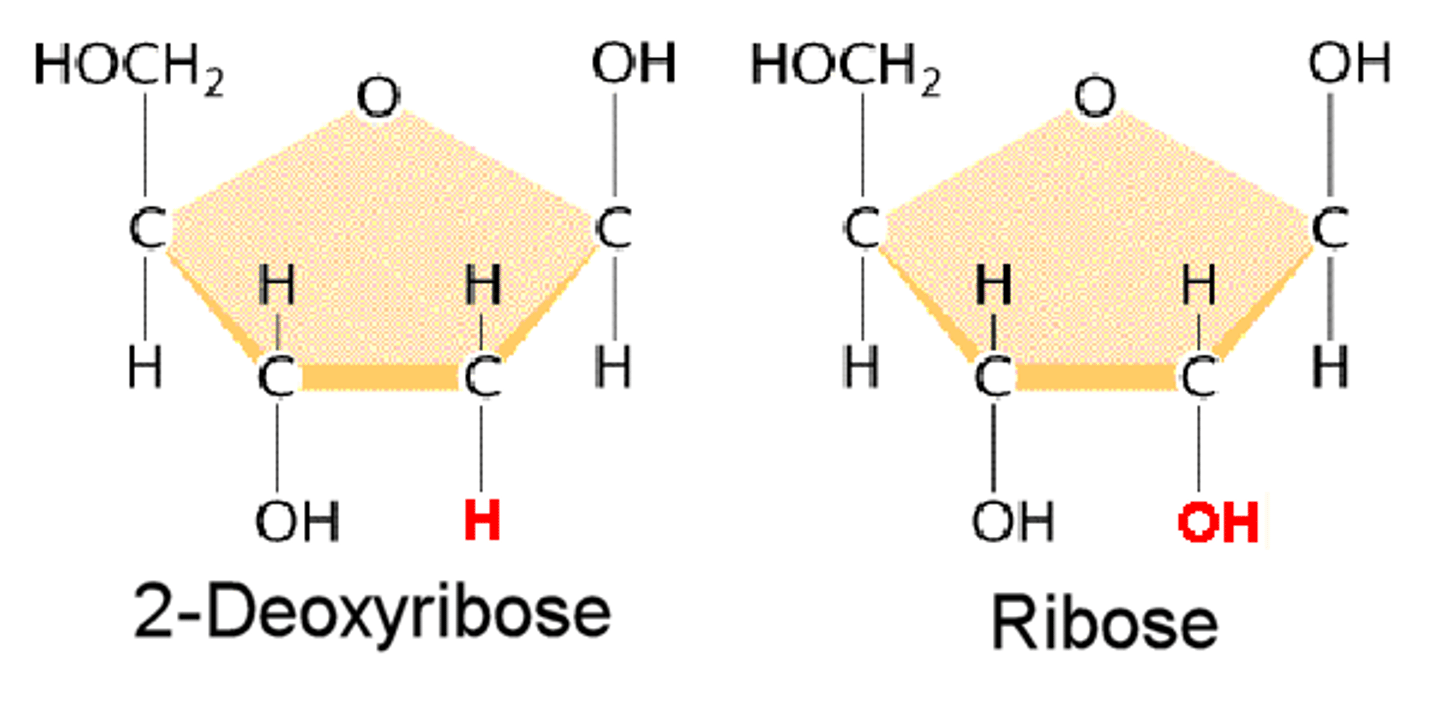
dexyribose structure
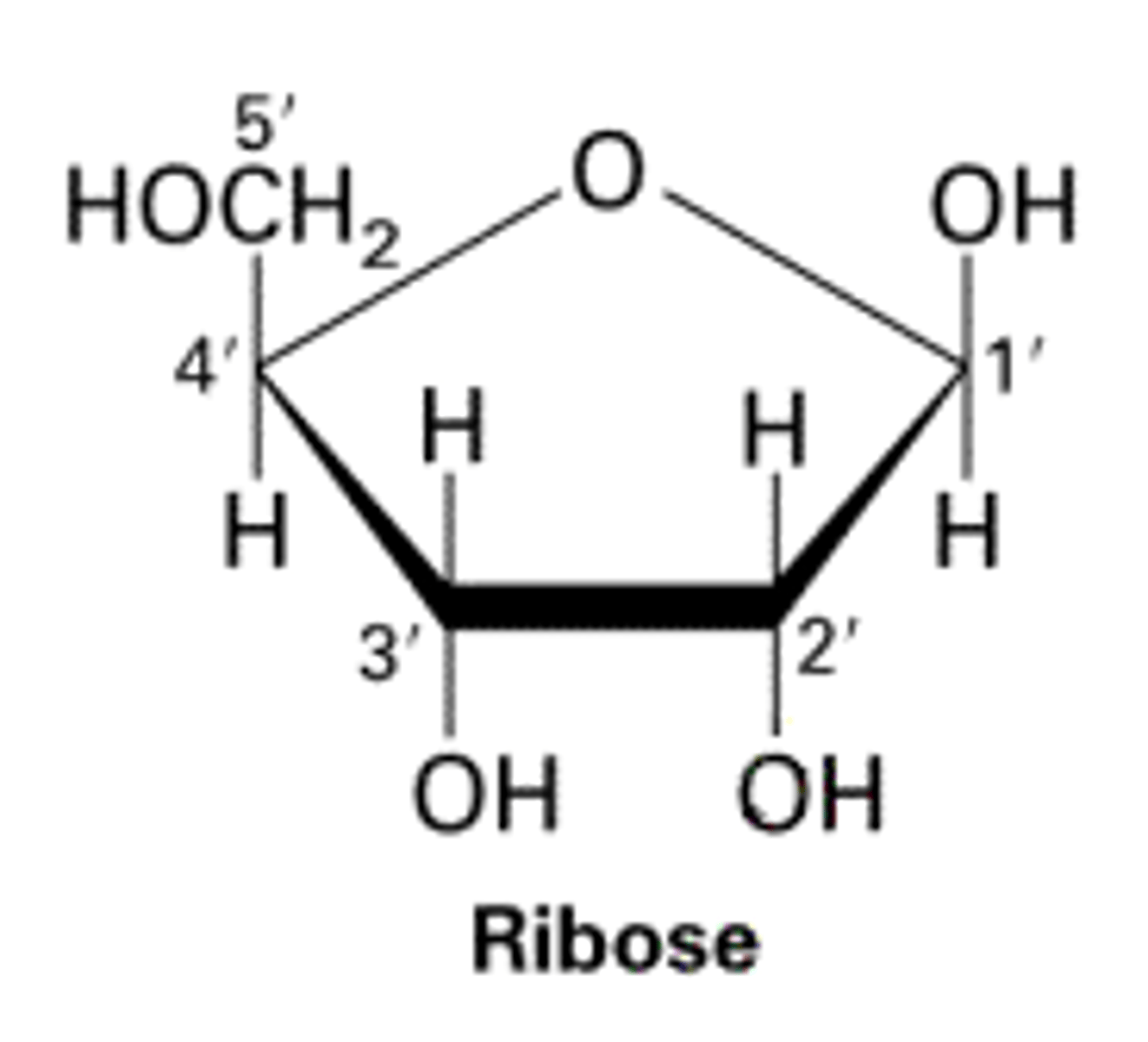
ribose structure
how many hydrogen bond acceptors and donors does thymine or uracil have
1 donor and 1 acceptor
how many hydrogen bond acceptors and donors does adenine have
1 donor and 1 acceptor
how many hydrogen bond acceptors and donors does cytosine have
1 donor and 2 acceptors
how many hydrogen bond acceptors and donors does guanine have
2 donors and 1 acceptors
is ribose a pyranose or furanose
furanose
what is the relationship between D-mannose and D-glucose
epimers
is sucrose a reducing sugar
no (it does not have a free anomeric carbon)
is lactose a reducing sugar
yes (it has a free anomeric carbon)
which type of double bond in a fatty acid most increases fluidity
cis bond
by which properties could phospholipids in the cell membrane be separated (3)
charge, mass, and solubility
differences in structure between sphingophospholipids and glycerophospholipids
glycerophosplolipids have a glycerol head with 2 fatty acid tails, sphingophospholipids have a sphingosine head and one fatty acid tail
hydrolyzable lipids (4)
triaglycerols, emulsifying agents, sphingolipids, waxes
nonhydrolyzable lipids (3)
steroids, prostaglandins, fat-soluble vitamins
how can all lipids be processed in digestion
all lipids can be emulsified
what is the benefit of forming micelles
increases surface area of lipids available for hydrolysis by lipases
fat-soluble vitamins (4)
vitamins A, D, E, and K
what is the mechanism by which DNA polymerase adds a dNTP to a growing DNA strand
the hydroxyl group at the 3' end of the strand attacks the 5' a-phosphate of the dNTP
what is the structure in phospholipids that prevents simple diffusion of hydophilic molecules
H3C-(CH2)14-R1
what does the Tollen's test detect
reducing sugars
major role of triacylglycerols
storage lipids
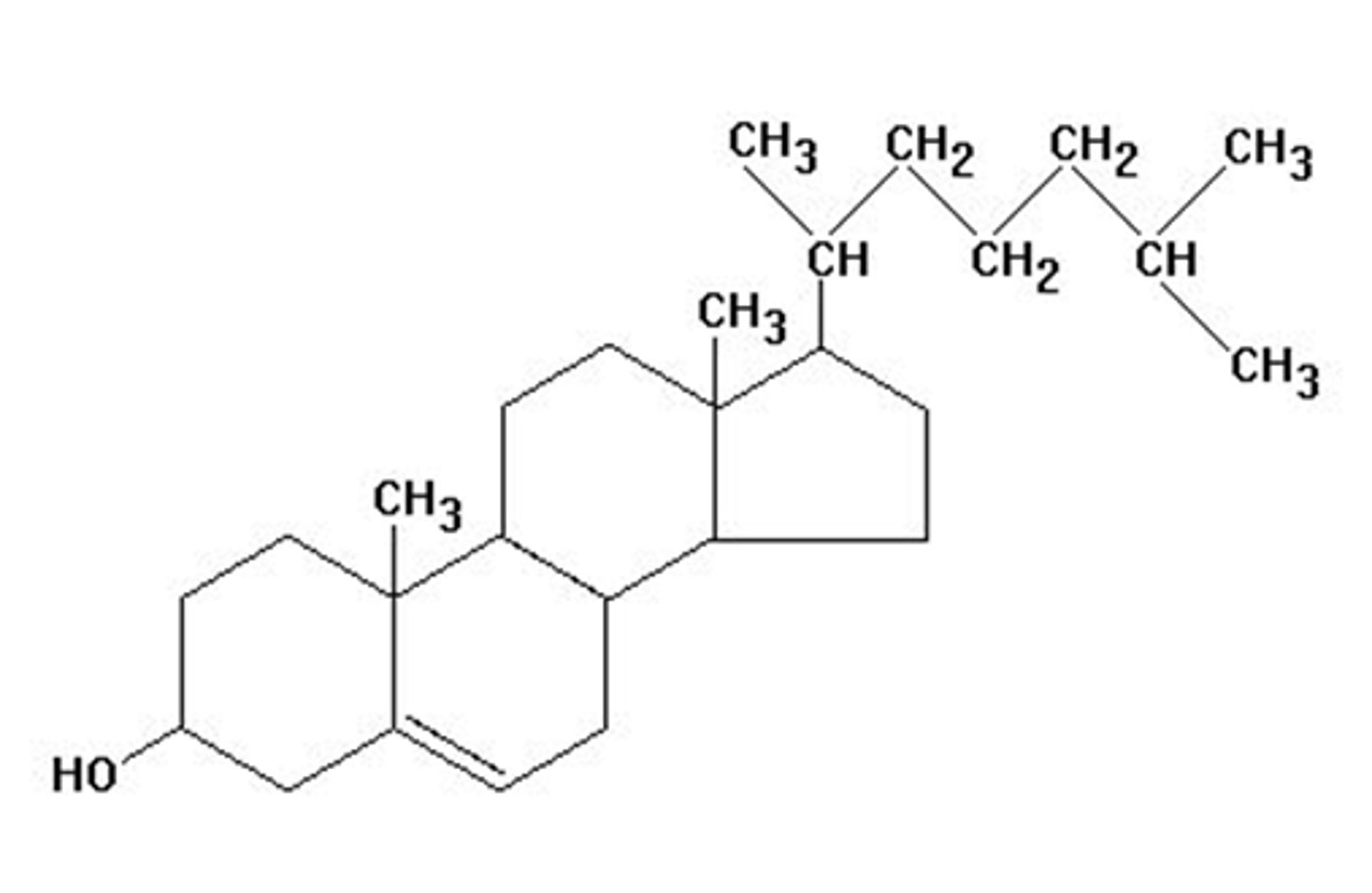
cholesterol structure
what is the product of deamination of cytosine
uracil
what is the result of esterification cholesterol
moves the cholesterol from the lipid particle surface to the core (bc it is much less polar)
what does centrifugation separate molecules by
density
what does precipitation separate molecules by
reactivity
what is the stereochemical configuration of most sugars in the body
D- enantiomer
how to determine stereochemical configuration of a sugar
if the highest number stereocenter is R, the sugar is D; if it is S, the sugar is L
what functional groups are found in galactose (3)
primary alcohol, secondary alcohol, aldehyde
at which carbon does a glycosidic bond form
C1 (anomeric carbon)
in what direction do exonucleases act
3' --> 5' (opposite of DNA synthesis)
what type of fatty acids are increased by cells at low temps
unsaturated (have pi bond)
what is the total number of anomeric carbons in disaccharides linked by B-glycosidic bonds
2 (all disaccharides have 2 regardless of configuration)
how to identify the anomeric carbon in a disaccharide
carbon that has 2 bonds with oxygen
glucosidase function
breaks glycosidic bonds, resulting in greater sweetness
why do animal cells store glucose as glycogen
a glycogen molecule composed of 1,000 glucose units exerts less osmotic pressure than 1,000 free glucose monomers