CRAT Test 3/4
 Call Kai
 Learn
Learn Practice Test
 Spaced Repetition
 Match
Match Flashcards
 Knowt Play
1/32

There's no tags or description
Looks like no tags are added yet.
Name | Mastery | Learn | Test | Matching | Spaced | Call with Kai | Chat |
|---|
No analytics yet
Send a link to your students to track their progress
33 Terms
4/T3
If a patient is experiencing sinus bradycardia and is symptomatic, which of the following would this rhythm not be the cause of?
Chest pain
Shortness of breath
Diarrhea
Hypotension
Diarrhea
symptoms NOT caused by Sinus Brady
5/T3
Which of the following will cause the baseline to have an uneven, coarsely jagged appearance that obscures the waveforms on the ECG?
Telemetry monitoring
Wandering baseline
Electrical interference
Muscle tremors
Muscle tremors (somatic tremors)
coarsely jagged(粗くギザギザした)
obscures (不明瞭な)
6/T3
Of the following, which would not be considered a potential cause for a patient to experience breathlessness?
Severe pulmonary edema
Cardiac arrhythmias
Osteoporosis
Pericarditis
Osteoporosis
Osteoporosis: a condition that cause bones to become weak and brittle
11/T3
Which of the following would be considered concurrent with the end of ventricular systole?
T wave
R wave
Q wave
S wave
QRS is V-depolarization (signal to contract)
Mechanical functions=Ventricular systole
The end of ventricular systole coincides with the beginning of ventricular repolarization, which is marked by the T wave.
Thus, the T wave occurs concurrently(同時に) with the end of ventricular systole.
14/T3
Which of the following controls increases or decreases the size of the EKG tracing on the rhythm paper?
LCD display
Standardization
Speed
Gain
Gain.
It’s about height
20/T3
What is unique about the T wave on a rhythm strip with ventricular tachycardia?
Missing from the waveform
Inverted from normal
Opposite direction from QRS complex
Nothing
Opposite direction from QRS complex
21/T3
Vagal maneuvers and medications, such as which of the following, can be employed to slow the heart rate in symptomatic junctional tachycardia patients?
Adenosine
Amiodarone
Digoxin
Verapamil
Adenosine
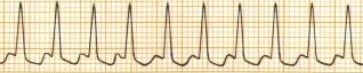
22/T3
Rhythm strip (HR 200, Regular, No P)
Asystole
Atrial flutter
Atrial tachycardia
Atrial fibrillation
Atrial Tachycardia
It’s not A flutter 1:1, because
Presence of P wave (with interval)
HR is too slow. Aflutter 1:1 should be 250-350 bpm
They are not Flutter wave
It’s not A fib RVR, because
Regularity
presence of P wave (with interval)
have’s P wave, not flutter wave.
24/T3
When sinus arrhythmia is related to respiration, there will be which of the following with inspiration?
Increase in heart rate
Decrease in heart rate
Regularity in heart rate
Pause in heart rate
Increase in heart rate
(inspiration=inhale » inhale increase heart rate)
26/T3
The time between the end of depolarization and repolarization of the ventricles would be considered which of the following?
PR interval
QT interval
PP segment
ST segment
ST segment
27/T3
Sinus tachycardia can worsen myocardial ischemia by increasing the heart’s demand for which of the following?
Oxygen
Electrical impulse
Blood
Rest
Oxygen
Heart muscle works harder
More oxygen needed
but can’t get it because HR too fast, so cell begin to die
28/T3
Third-degree AV block is most commonly classified as which of following?
Drug-induced (caused by medication)
Surgery-induced (resulting from surgery or procedural injury)
Congenital (Present at birth)
Acquired degenerative or disease-related (due to progressive conduction)
Acquired degenerative or disease-related
(They all can be cause)
30/T3
Premature Atrial Contractions are rarely dangerous but in a patient with which of the following conditions, they can serve as an early sign of heart failure or electrolyte imbalance?
Nonconductor premature atrial contractions
Hypoxia
Acute myocardial infarction
Pulmonary disease
Acute myocardial infarction
PAC on MI can trigger R-on-T phenomenon, lead to V tach.
On ECG, “Sinus rhythm with acute ST-elevation and frequent PAC”
33/T3
Asystole must be confirmed in more than one lead due to the fact that it closely resembles which of the following?
Fine ventricular fibirillation
Sinus pause
AV block
Artiact
Fine ventricular fibrillation
because its visual similarity to Asystole
34/T3
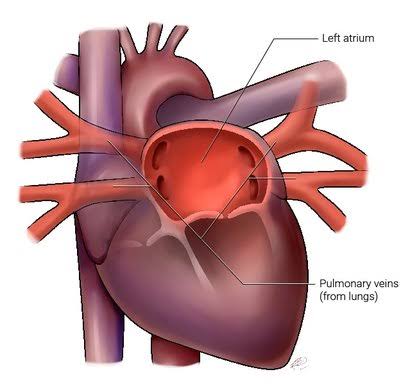
How many pulmonary veins does the huma body contain?
2
3.
4
5
4
4 pulmonary veins connected to the left atrium
Right Superior
Right Inferior
Left Superior
Left Inferior
37/T3
All of the following medications could cause brady cardia except?
Beta-adrenergic blocker
Digoxin
Amiodarone
NSAIDs
NSAIDs
39/T3
Chest lead electrodes always which of the following?
Negative
Neutral
Positive
Horizontal
Positive
Chest leads = V1-V6
45/T3
Which of the following would be NOT considered the most commonly used leads for arrhythmia monitoring?
Lead 2
V1
V4
MCL1
V4
Lead II is the best
46/T3
The atrial relax and fill with blood during which of the following?
Systole
Asystole
Diastole
Cardistole
Diastole
50/T3
Which of the following is the cell’s ability to transmit electrical impulses?
Automaticity
Excitability
Elasticity
Conductivity
Conductivity
conductivity: the ability of nerve and muscle cells to transmit electrical signals across their membranes.
51/T3
The AV node’s primary function is to do which of the following?
Instigate electrical impulse
Redirect impulses
Delay impulses
All of the above
Delay impulse
57/T3
Which of the following leads would have a depression of the ST segment if the patient has experienced a posterior AMI?
V3
aVL
III
V6
V3
Inferior/Posterior = II, III, aVF
61/T3
Cardiac valves which have half-mooned shaped cusps would be considered which of the following?
Pulmonic valves
Tricuspid valves
Mitral valves
Both B and C
Pulmonic valves
AV valves = Tricuspid / Mitral valves
Semilunar = Pulmonic /Aortic valves
62/T3
The recovery period for the ventricle conductive fibers is represented by which of the following?
U wave
T wave
QT interval
QRS complex
U wave
= The recovery period for the Ventricle conductive fibers (=Purkinje fibers and bundle branches)
63/T3
The correct range for the rate for atrial tachycardia would be considered which of the following?
150-250 bpm
80-100 bpm
150-300 bpm
150-180 bpm
150-250 bpm
Atrial tachycardia = 150-250 bpm
67/T3
Which of the following would not be considered a primary characteristic of a cardiac cell?
Conductivity
Automaticity
Communicatability
Contractility
Communicatability
(Primary characteristics relevant to cardiac cells are
conductivity
automaticity
contractility
excitability)
76/T3
The depolarization-repolarization cycle has five phase, during phase 1 and 2 and the beginning of 3, the cardiac cell is said to be in which of the following?
Refractory period
Automaticity
Excitability
Absolute refractory period
Absolute refractory period
Absolute refractory period
=Phase 1,2, beginning of 3 (QRS-first half of T wave)
Complete lock-out, zero response
Relative refractory period
=last half of T wave
79/T3
Increased myocardial irritability typically causes ventricular tachycardia which can be caused by all of the following except?
Pulmonary embolism
Myocardial infarction
Myocardial ischemia
Cardiomyopahy
Pulmonary embolism
(clot in lung)
Myocardial Infarction
Myocardial ischemia
Cardiomyopathy
Ventricular tach reduce blood flow; The heart muscle is damaged or dies because of it.
83/T3
During the cardiac cycle, which of the following events leads to closure of the mitral and tricuspid valves?
Isovolumetric Ventricular contraction
Ventricular ejection
Isovolumetric relaxation
Atrial systole
Isovolumetric ventricular contraction
When ventricles starts contract.
87/T2
Resulting from the blood volume in the ventricles at the end of diastole the passive stretching of the muscle fibers in the ventricles is called which of the following?
Systole
Preload
Afterload
Contractility
Preload
Preload: The influx of blood causes the Ventricular muscle fibers to stretch.
88/T3
Which of the following starts after the S wave and is typically round and smooth?
ST segment
T wave
QT interval
QRS complex
T wave
ST segment starts after the S wave, but it’s not round and smooth.
95/T3
When analyzing a cardiac rhythm strip, how many seconds would 5 large squares equal?
1
5
30
15
1
0.04 sec = 1 small
0.20 sec = 5 small=1 large
0.20 (1 large )× 5 = 1.0 sec
98/T3
If a patient cannot read, but is required to sign a consent form, which of the following is the correct method for obtaining consent?
Explain the procedure and consent form to the patient and a family member or the patient’s legal guardian
Just ask the patient to sign anyway
Read the form to the patient and request their signature
Allow family member to read and sign for the patient
Explain the procedure and consent form to the patient and a family member or the patient’s legal guardian