8-10 Communications, pharmacology, Documentation
 Call Kai
 Learn
Learn Practice Test
 Spaced Repetition
 Match
Match Flashcards
 Knowt Play
1/53

There's no tags or description
Looks like no tags are added yet.
Name | Mastery | Learn | Test | Matching | Spaced | Call with Kai | Chat |
|---|
No analytics yet
Send a link to your students to track their progress
54 Terms
class
can be classfied by body system, mechanism of action (what we use), class of agent, use
therapeutic action
The specific mechanism by which the drug exerts its effect.
what the medication is intended to do. The benefit. The most important aspect to understand.
Indications
evidence based benefit of administering a med to a specific condition.
contraindication
a predictable harmful outcome of administering a medication based upon specific patient condition
absolute- never given in that circumstance (its absolute unless noted otherwise)
relative- some situations requiring clinical judgement, a weighing of the cost versus benefit of giving med (may be precautions in JCCC)
side effects
predictable, non-therapeutic action- may still benefit clinician (Shows its working)
how supplied
medications vary in concentration, always read labels first.
dosage and admin
amount, route, and method (fast or slow)
precaution
actions to be considered and possibly taken to prevent possible complications
what are the pricipals of safe and effective drug admin
know your drug
patient- obtain PMH and med history
know the pathology and how the med treats it
protocols
techniques
storage and security- proper storage based on manufacturer recomendations
The 6 rights
Right patients- if more than 1 pt, make sure it is the right one, do they meet indications and no C/I
Right medication- correct drug, concentration, and not expired or discolored.
Right dose- ensure you are following protocol or standing orders
right route- for efficacy and safety
right time- includes rate of admin (fast/slow, IVP or infusion) amd proper repeat times when more doses needed.
Right documentation- pt presentation, indication, admin, route, dose, time administered, and pt response
paramedics responabilities when administering substances
storage- all federally controlled substances must be kept LOCKED unless on the person of provider.
detailed documentation of admin must occur, including verbal orders
wasting leftover- must be witnessed and signed off (preferably neutral party)
Log- the DEA requires detailed log of use, restock, and inventory checks on monthly basis.
DEA controlled substances info
I-V
I- soley used for research- most “risky”
II-V may be used for medicinal use
meds that stimulate and inhibit SNS and PNS
stim SNS- sympathomimetic, SNS agonist, adrenergic
Inhib SNS- sympatholytic, SNS antagonist, adrenergic blocker
Stim PNS- parasympathomimetic, PNS agonist, cholinergic
Inhib PNS- parasympatholytic, PNS agonist, cholinergic blocker
types of effects of meds
local- exerts therapeutic actions on specific tissues (like albuterol)
systemic- effects entire body (NTG)
systemic
2 main general medication routes
enteral- passes through GI tract
parenteral- does not pass through GI tract, avoids first pass effect, preffered for rapid absorbtion in EMS
What is the first pass effect in enteral route
when a drug is absorbed by the GI tract and travels through the portal vein to the liver, so some med is absorbed before blood stream
pharmacokinetics
the process by which drug is absorbed, distributed, metabolized, and eliminated. What body does to drug
absorption- route of entry to blood stream. Ph, absorbing surface/blood flow, and drug form/concentration can effect
distribution- travels to tissues or target organs via body fluids. Blood flow, plasma binding, cell membrane, pre-existing disease can effect.
bioavailability- the speed with which and the amount of drug left to exert its action. Combo of absorption and distribution
metabolism (biotransformation)- the chemical modification of a drug by the body to convert drug into metabolites for excretion
liver is primary sight for med metabolism
kidneys, intestines, lungs, plasma, and placenta are other sites
excretion- the removal of metabolites from blood stream.
kidneys- most common site
other sites- liver excretes into bile, bile to small intestine into poo, lungs excrete gaseous wastes (anesthetics and alcohol), skin (sweat), breastmilk
pharmacodynamics
the chemical interaction that happens in body after med hits target tissue. What drug does on body.
drug receptor interaction
meds work with certain cells that have unique receptors on membranes. If it works with that cell, it binds and the drug exerts its action.
bioavailability
the speed with which and the amount of drug left to exert its therapeutic action
the amount of non-plasma bound (unbound) drug availble to do its effect. The plasma particles pull some drug onto themselves making the drug unavailble.
how can we modify bioavailability
give sodium bicarb to increase PH making the affinity go up and more drug binds to plasma
affinity
strength of attraction between drug and receptor. If not compatable, no response will occur
efficacy
the ability of a drug to produce a reaction after attaching to receptor, potency of therapeutic effect
agonist and antagonist
agonist- causes physiologic response, has both affinity and efficacy
antagonist- a drug that binds to a receptor and blocks or causes opposite response
competition
multiple drugs or agonist/antagonists competing for a receptor site
plasma-level profile and the different ranges
a description of a drugs activity based on its dosage. Basically the route it takes
sub-therapeutic range- not enough for action
therapeutic range- (window/index)- the ideal blood serum level to ensure a therapeutic effect. Some have a wider window making them safe. Others are narrow making under or overdose likely.
toxic range- above therapeutic range in which 50% of population exhibits signs of OD
lethal range- 50% of pop experience death
half life
the time neccesary for concentration of medication in blood to be reduced by 50 %
used to determine additional doses and times
it is logarythmic each set of time (100, 50, 25, 12.5, 6.25)
how do extremes of age effect drug response
pediatrics are smaller
geriatrics have bad metabolism and cant excrete it as well (liver and kidney disease) so sometimes need less since it does not break down as fast. This problem can also be the reason for a 911 call secondary to prescription med.
factors that determine drug response
extremes of age
general health -obese or anorexic
hepatic and renal function
dosage and admin
routes fastest to slowest
IV/IO 1-3 min
Inhaled and IN
IM
SL buccal
SQ
rectal
PO - 15-20 min
therapeutic action
desired, predictable outcome of med admin
drug interaction
the manner in which one drug and another act on each other- not always bad
synergism/summation- the effect of the 2 drugs is greater when together 1+1=3
potentiation- a prolongation or increase in the effect of a drug by another drug,
side effect
an untoward (unintended) effect of drug
idiosyncratic response
an unexpected, adverse response to drug- usally dtermined by genetics. Cant predict
latrogenic response
an unintentional effect or disease created by a medical treatment \
ex. brusies from backboard
tolerance and cross tolerance
tolerance- decreasing responsiveness to the effect of a drug, larger doses required to obtain effect
cross tolerance- tolerence of drug within same class (narcotics), causing tolerence to multiple drugs within class.
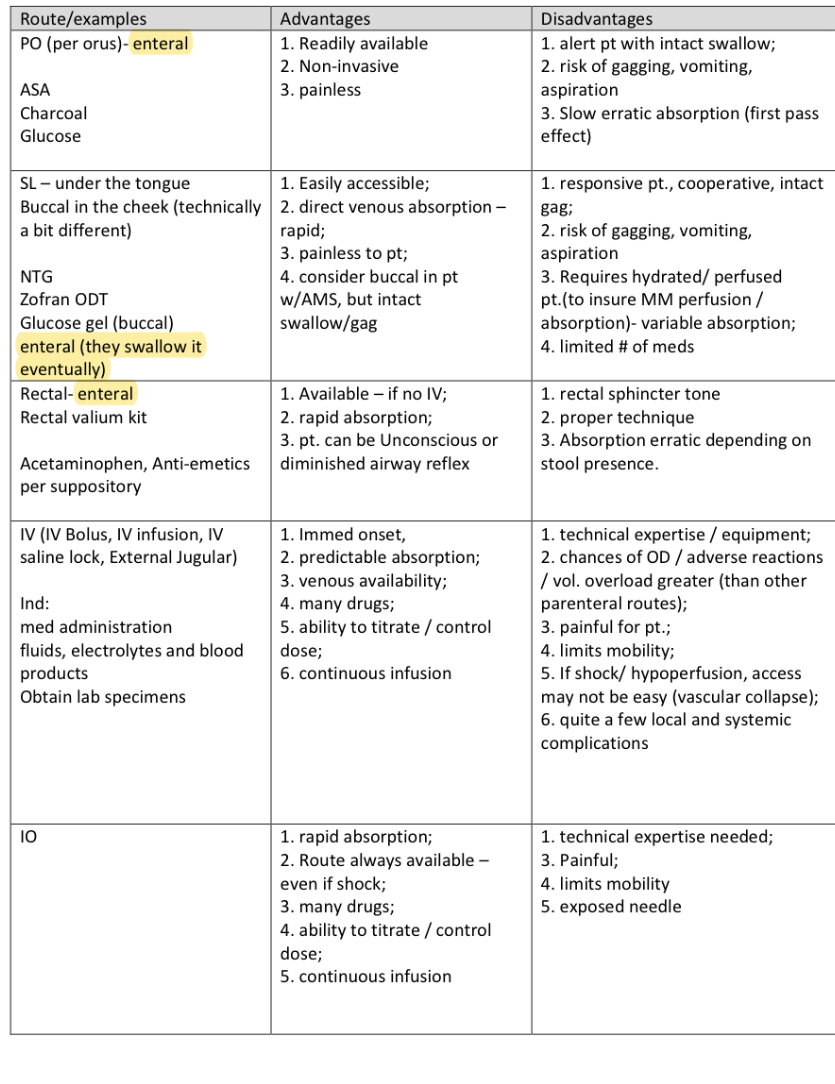
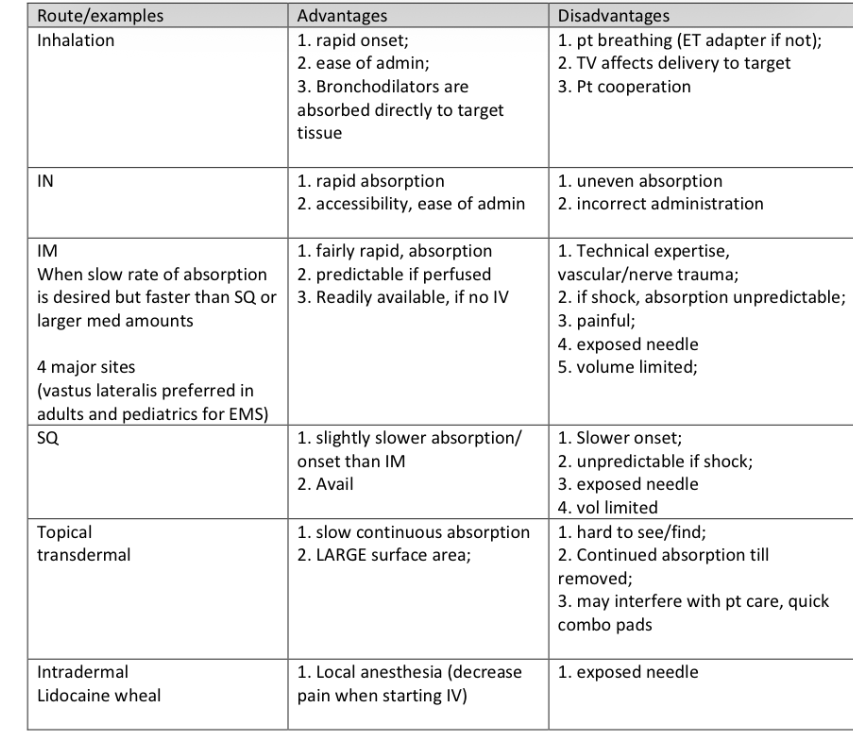
advantages, disadvantages of drug delivery routes
PO
SL/buccal
rectal
IV
IO
Inh
IN
IM
SQ
transdermal
intradermal lidocaine wheel
portable radio
mobile radio
base station radio
repeater
antenna
remote counsel
encoder/decoder
mobile phones/data/GPS
portable radio- low power carried on person
mobile radio- medium power located in vehicle
base station radio- high power, usually in building or station
repeater- low power transmission recieved, repeater amplifies signal on same or different frequency. May be at base station or on towers throughout the service area or in a vehicle on scene.
antenna- centrally located, usually up high
remote counsel
encoder/decoder
mobile phones/data/GPS