microbio: midterm

0.0(0)
Studied by 0 people
call kaiCall Kai
Locked
learnLearn
examPractice Test
spaced repetitionSpaced Repetition
heart puzzleMatch
flashcardsFlashcards
GameKnowt Play
Card Sorting

1/94

encourage image

There's no tags or description

Looks like no tags are added yet.

Last updated 11:50 AM on 8/28/26
Name
Mastery
Learn
Test
Matching
Spaced
Call with Kai
Chat

No analytics yet

Send a link to your students to track their progress

95 Terms

1
New cards

what defines microroganisms?

how abundant are they actually?

  • includes bacteria, archaea, eukarya (unicelluar. eg protists & fungi), and viruses

  • excludes multicell fungi, animals, and plants

  • dominate the tree of life, Earth’s biomass, the human body, etc. found everywhere


2
New cards

what are the 3 important aspects of microbial taxonomy

why is taxonomy so important for microbes?

(aspects)

  • classification (arranging microbes into groups, taxa)

  • nomenclature (naming taxa, and the orgs within)

  • identification (determning which taxa an isolated org belongs to)

(importance)

  • large microbial diversity underpins this. we need ways to distinguish between similar morphology species, either due to evolutionary unrelation, or differnces in function even if related

  • so lots with the same morphology / physiology / function - even if unrelated evolutionary (Eg convergence)

  • eg wastewater treatment, housing microbes with similar morphology & physiology, but simply due to evolutionary paths arising there independently

  • also lots with similar morphology, due to close relation evolutionarily, but with completely different functions & physiologies

  • eg Bacillus cereus (often used in the lab as a model) vs Bacillus anthracis (responsible for Anthrax, dangerous)


<p>(aspects)</p><ul><li><p>classification (arranging microbes into groups, taxa)</p></li><li><p>nomenclature (naming taxa, and the orgs within)</p></li><li><p>identification (determning which taxa an isolated org belongs to)</p></li></ul><p>(importance)</p><ul><li><p>large microbial diversity underpins this. we need ways to distinguish between similar morphology species, either due to evolutionary unrelation, or differnces in function even if related</p></li><li><p>so lots with the same morphology / physiology / function - even if unrelated evolutionary (Eg convergence)</p></li><li><p>eg wastewater treatment, housing microbes with similar morphology &amp; physiology, but simply due to evolutionary paths arising there independently</p></li><li><p>also lots with similar morphology, due to close relation evolutionarily, but with completely different functions &amp; physiologies</p></li><li><p>eg Bacillus cereus (often used in the lab as a model) vs Bacillus anthracis (responsible for Anthrax, dangerous)</p></li></ul><p></p>
3
New cards

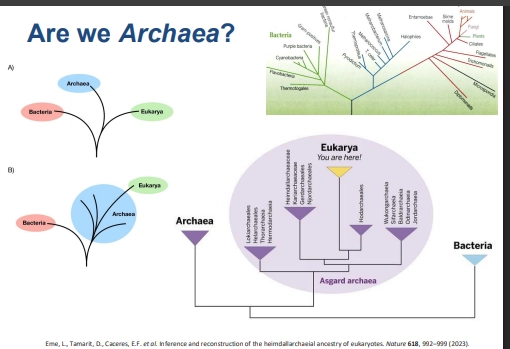
are we archaea?

  • tree of life, essentially a two-branch tree (bacteria & archaea)

  • therefore eukaryotes sit in the middle of the archaea branch - we arent a seperate domain of life (still considered such due to this being relatively new info 2023)

  • all comes down to taxonomy and how you choose to interpret this

<ul><li><p>tree of life, essentially a two-branch tree (bacteria &amp; archaea)</p></li><li><p>therefore eukaryotes sit in the middle of the archaea branch - we arent a seperate domain of life (still considered such due to this being relatively new info 2023)</p></li><li><p>all comes down to taxonomy and how you choose to interpret this</p></li></ul><p></p>
4
New cards

how does microbial nomenclature work

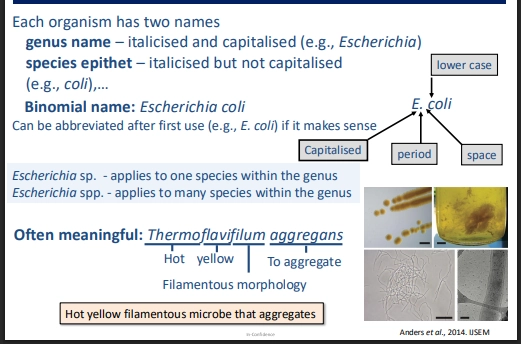
writing the name

  • binomial system (genus name + species)

  • (genus name) italicised & capitalised

  • (species name) italicised & uncaptialised

  • (writing by hand) underline instead of italicise

  • (taxonomic rankings above genus) dont have to italicise but you can

referring to the name

  • write out the full name once, then can abbreviate genus name subsequently, to its first letter (eg H. sapiens)

  • (one species) referring to one species under the genus, write out the genus name + sp (eg Homo sp.)

  • (multiple species) referring to multiple species under the genus, write out the genus name + spp. (eg Homo spp.)

  • cannot refer to a species by the species name itself - as these can be shared between genuses even if different

meanings of the names

  • often meaninfgul about physiology / lifestyle / morphology, similar to others with similarities in these also.

  • eg Thermoflavifilum (thermo = hot, flav = yellow, filum = filamentous morphology), a microbe that is yellow, filamentous, and lives in hot places.

<p>writing the name</p><ul><li><p>binomial system (genus name + species)</p></li><li><p>(genus name) italicised &amp; capitalised</p></li><li><p>(species name) italicised &amp; uncaptialised</p></li><li><p>(writing by hand) underline instead of italicise</p></li><li><p>(taxonomic rankings above genus) dont have to italicise but you can</p></li></ul><p>referring to the name</p><ul><li><p>write out the full name once, then can abbreviate genus name subsequently, to its first letter (eg H. sapiens)</p></li><li><p>(one species) referring to one species under the genus, write out the genus name + sp (eg Homo sp.)</p></li><li><p>(multiple species) referring to multiple species under the genus, write out the genus name + spp. (eg Homo spp.)</p></li><li><p>cannot refer to a species by the species name itself - as these can be shared between genuses even if different</p></li></ul><p>meanings of the names</p><ul><li><p>often meaninfgul about physiology / lifestyle / morphology, similar to others with similarities in these also. </p></li><li><p>eg Thermoflavifilum (thermo = hot, flav = yellow, filum = filamentous morphology), a microbe that is yellow, filamentous, and lives in hot places.</p></li></ul><p></p>
5
New cards

name the hierarchical taxonomic groups

what does this hierarchy represent

  • domain

  • phylum

  • class

  • order

  • family

  • genus

  • species

  • subspecies

(Represent?)

  • each rank includes org sharing a set of specific features

  • they get more specific and narrowed down, including less species, as the ranking decreases.


6
New cards

what are the single & plural….

  • bacteria

  • archaea

  • fungus

  • genus


  • bacteria (multiple) => bacterium (single)

  • archaea (multiple) => archaeum (single)

  • fungi (multiple) => fungus (single)

  • genera (multiple) => genus (single)


7
New cards

what are the 4 important mathematical concepts in microbiology

  • working in magnitudes of 10

  • understanding and rationalising significant figures

  • working out concentrations or rates (eg cells/hr, mg/L, cells/mL)

  • working in base-2 (eg exponential growth, 2^X)


8
New cards

working with microbial concentrations?

  • large numbers?

  • sig figs?


  • multiple cell/mL, by total V, to find cell/total V (convert between mL and L if needed)

(working with large numbers)

  • look at the numbers of zeroes. we can combine magnitudes of 10, with non, by adding the zeroes

  • eg 1×10^11 × 400mL => 4×10^13

(sig figs)

  • will be specified, but most commonly 2dp / sf


<ul><li><p>multiple cell/mL, by total V, to find cell/total V (convert between mL and L if needed)</p></li></ul><p>(working with large numbers)</p><ul><li><p>look at the numbers of zeroes. we can combine magnitudes of 10, with non, by adding the zeroes</p></li><li><p>eg 1×10^11 × 400mL =&gt; 4×10^13</p></li></ul><p>(sig figs)</p><ul><li><p>will be specified, but most commonly 2dp / sf</p></li></ul><p></p>
9
New cards

how can we use microscopy to measure microbe growth


  • the act of counting idnvidual cells, to provide a number for comparing to previous and future cell counts => providing a measure of growth

(method)

  • use a graphical (a microscope slide with a ridge matrix system, overlayed with a grid coverslip)

  • this grid can be used as a reference to count cells in a given area, the grid being of a known area and volume => providing a measure of microbes per volume

  • often counted as cells in the larger grid square, then averaged throughout the smaller known volume grid squares

(units and converting)

  • known volume is in mm³, across a mm² area

  • to convert to mL, 1000 mm³ per mL, so multiply by 1000 to find the volume of the grid squares, in mL

  • => number of microbes per mL


<ul><li><p>the act of counting idnvidual cells, to provide a number for comparing to previous and future cell counts =&gt; providing a measure of growth</p></li></ul><p>(method)</p><ul><li><p>use a graphical (a microscope slide with a ridge matrix system, overlayed with a grid coverslip) </p></li><li><p>this grid can be used as a reference to count cells in a given area, the grid being of a known area and volume =&gt; providing a measure of microbes per volume</p></li><li><p>often counted as cells in the larger grid square, then averaged throughout the smaller known volume grid squares</p></li></ul><p>(units and converting)</p><ul><li><p>known volume is in mm³, across a mm² area</p></li><li><p>to convert to mL, 1000 mm³ per mL, so multiply by 1000 to find the volume of the grid squares, in mL</p></li><li><p>=&gt; number of microbes per mL</p></li></ul><p></p>
10
New cards

how can we use solid media to measure microbe growth

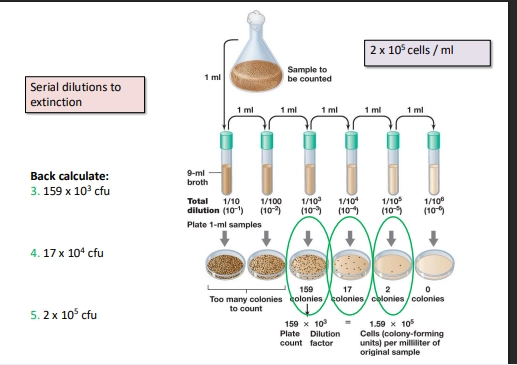
  • via serial dilutions!

  • we can plate a solution of microbes, and backtrack calculations of how much the original sample was diluted, to work out the microbes per mL of a starting solution

(method)

  • dilute the microorganism solution, into an accurately countable number of cfus, so the degree of dilution will differ depending on the cfu/mL in the original sample

  • dilutions occur as a factor of 10 (eg 1:10 ratio of solution to broth).

  • undergo another dilution in plating - this may be a different factor as to the dilutions

  • these are incubated

  • count the colonies (= 1 cfu formed the colony via BinFis = 1 microbe)

  • multiply by dilution factors to find cfu/mL in original sample

(bactrack calculations)

  • multiply the counted number in the final plate, with the DF for each step

  • eg 1/10 dilution = 10 fold dilution = multiply by 10

  • backtracking from differnet countable plates from the same solution, they should relatively align. can average out for a more accurate cfu/mL of original sample

(best plates to count)

  • colonies countable (not toching)

  • often a few will be viable to count, so can do multiple and average them out

<ul><li><p>via serial dilutions!</p></li><li><p>we can plate a solution of microbes, and backtrack calculations of how much the original sample was diluted, to work out the microbes per mL of a starting solution</p></li></ul><p>(method)</p><ul><li><p>dilute the microorganism solution, into an accurately countable number of cfus, so the degree of dilution will differ depending on the cfu/mL in the original sample </p></li><li><p>dilutions occur as a factor of 10 (eg 1:10 ratio of solution to broth).</p></li><li><p>undergo another dilution in plating - this may be a different factor as to the dilutions</p></li><li><p>these are incubated  </p></li><li><p>count the colonies (= 1 cfu formed the colony via BinFis = 1 microbe)</p></li><li><p>multiply by dilution factors to find cfu/mL in original sample</p></li></ul><p>(bactrack calculations)</p><ul><li><p>multiply the counted number in the final plate, with the DF for each step</p></li><li><p>eg 1/10 dilution = 10 fold dilution = multiply by 10</p></li><li><p>backtracking from differnet countable plates from the same solution, they should relatively align. can average out for a more accurate cfu/mL of original sample </p></li></ul><p>(best plates to count)</p><ul><li><p>colonies countable (not toching)</p></li><li><p>often a few will be viable to count, so can do multiple and average them out </p></li></ul><p></p>
11
New cards

how do we categorise microbes based on FUNCTION

why this distinction needed?

(why?)

  • microbes do all sorts of things that are often unrelated to taxonomix name / phylogenical relation to eachother / proximity in tree of life

  • so another way of grouping, is into guilds based on what they do - to communicate their aspects

  • what they do / how they interact with the environment / how to plate them / what conditions they need to survive / what they consume and produce and how

(how?)

  • descriptors, prefixes, suffixes

(major groups)

  • (-troph) based on what they consume

  • (-gen) based on what they produce

  • (an-) opposite to whatever it prefixes, often another sort of group

  • (-phile) loves certain conditions

  • eg Chemotroph. eg Methanogen. eg Anaerobic. eg Thermophile

(within these groups)

  • add on bits to describe a microbe’s source of energy / carbon / electrons for respiration

  • (carbon) = (autotrophs / heterotrophs)

  • autotrophs use CO2.

  • heterotrophs use reduces & reformed organic molecules. automatic vs requiring a previous organism to reform CO2

  • (energy) = (phototrophs / chemotrophs)

  • phototrophs use light.

  • chemotrophs use the oxidation of organic / inorganic compounds

  • (electrons) = (lithotrophs / organotrophs)

  • lithotrophs use reduced inorganic compounds

  • organotrophs use organic molecules

(within these groups)

  • add bits to describe tolerance of different conditions!

  • (oxygen tolerance) = (aerobic / anaerobic / microaerophilic)

  • tolerates all conc vs toxic vs tolerates low conc

  • (mixed or strict metabolism) = (facultative / obligate)

  • faculative can switch metabolic strategies

  • obligate cannot

(combining them all)

  • creates a descriptive label of a microbe, that multiple can share even if not related. describing function & lifestyle rather than taxonomy and phylogeny

  • eg Chemolithoautotroph = carbon source is CO2, energy source is inorganic compounds (chemo), electron source is inorganic compounds (litho)

  • eg Thermoacidophilic hydrogenophilic chemolithoautotroph = Likes hot and acidic conditions & hydrogen. CO2 carbon, energy inorganic, electrons inorganic


<p>(why?)</p><ul><li><p>microbes do all sorts of things that are often unrelated to taxonomix name / phylogenical relation to eachother / proximity in tree of life</p></li><li><p>so another way of grouping, is into guilds based on what they do - to communicate their aspects</p></li><li><p>what they do / how they interact with the environment / how to plate them / what conditions they need to survive / what they consume and produce and how</p></li></ul><p>(how?)</p><ul><li><p>descriptors, prefixes, suffixes</p></li></ul><p>(major groups)</p><ul><li><p>(-troph) based on what they consume</p></li><li><p>(-gen) based on what they produce</p></li><li><p>(an-) opposite to whatever it prefixes, often another sort of group</p></li><li><p>(-phile) loves certain conditions</p></li><li><p>eg Chemotroph. eg Methanogen. eg Anaerobic. eg Thermophile</p></li></ul><p>(within these groups)</p><ul><li><p>add on bits to describe a microbe’s source of energy / carbon / electrons for respiration</p></li></ul><ul><li><p>(carbon) = (autotrophs / heterotrophs) </p></li><li><p>autotrophs use CO2. </p></li><li><p>heterotrophs use reduces &amp; reformed organic molecules. automatic vs requiring a previous organism to reform CO2</p></li><li><p>(energy) = (phototrophs / chemotrophs)</p></li><li><p>phototrophs use light. </p></li><li><p>chemotrophs use the oxidation of organic / inorganic compounds</p></li><li><p>(electrons) = (lithotrophs / organotrophs)</p></li><li><p>lithotrophs use reduced inorganic compounds</p></li><li><p>organotrophs use organic molecules </p></li></ul><p>(within these groups)</p><ul><li><p>add bits to describe tolerance of different conditions!</p></li><li><p>(oxygen tolerance) = (aerobic / anaerobic / microaerophilic)</p></li><li><p>tolerates all conc vs toxic vs tolerates low conc</p></li><li><p>(mixed or strict metabolism) = (facultative / obligate)</p></li><li><p>faculative can switch metabolic strategies</p></li><li><p>obligate cannot </p></li></ul><p>(combining them all)</p><ul><li><p>creates a descriptive label of a microbe, that multiple can share even if not related. describing function &amp; lifestyle rather than taxonomy and phylogeny</p></li><li><p>eg Chemolithoautotroph = carbon source is CO2, energy source is inorganic compounds (chemo), electron source is inorganic compounds (litho)</p></li><li><p>eg Thermoacidophilic hydrogenophilic chemolithoautotroph = Likes hot and acidic conditions &amp; hydrogen. CO2 carbon, energy inorganic, electrons inorganic</p></li></ul><p></p>
12
New cards

what are the important ideas behind microbial growth?

how do microbes ‘grow’?

how does this differ between species?

(important ideas)

  • growth occurs as microbes undergo cell divison to form more units. they increase biomass

  • growth means an organism is alive, but no growth doesnt mean the organism is dead - metabolisim may be occurring without increasing biomass (hibernation - cell maintenance, energy generation, respiration still ongoing.)

(growth?)

  • via binarry fisson. one cell pinches off into two.

  • asexual reproduction, producing a clone

(differences between species)

  • they differ in terms of whether the cell divison products are equal or unequal

  • they differ in the plane of cell dvison

  • they differ in the timing of cell divison (Eg may differentiate first and then divide)


<p>(important ideas)</p><ul><li><p>growth occurs as microbes undergo cell divison to form more units. they increase biomass</p></li><li><p>growth means an organism is alive, but no growth doesnt mean the organism is dead - metabolisim may be occurring without increasing biomass (hibernation - cell maintenance, energy generation, respiration still ongoing.)</p></li></ul><p>(growth?)</p><ul><li><p>via binarry fisson. one cell pinches off into two. </p></li><li><p>asexual reproduction, producing a clone </p></li></ul><p>(differences between species)</p><ul><li><p>they differ in terms of whether the cell divison products are equal or unequal</p></li><li><p>they differ in the plane of cell dvison </p></li><li><p>they differ in the timing of cell divison (Eg may differentiate first and then divide)</p></li></ul><p></p>
13
New cards

how do we mathematically represent bacterial growth

(Exponential growth)

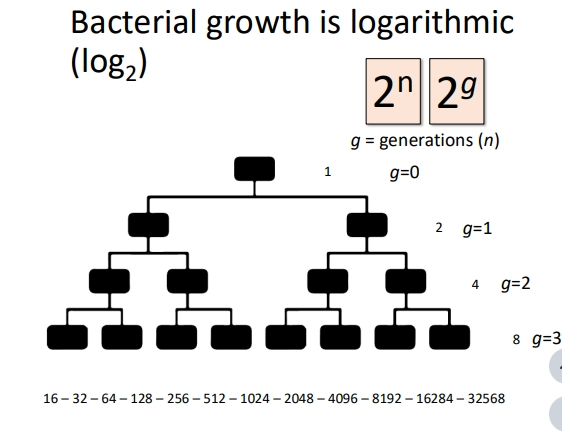
  • binary fisson enables exponential growth (one becomes two, two become four, generations doubling, create double the amount of generations per round of CD)

  • this is logarithmic (log2) so number of cells can be represented by 2^n (n = g = generations) first cell = gen 0

<p>(Exponential growth)</p><ul><li><p>binary fisson enables exponential growth (one becomes two, two become four, generations doubling, create double the amount of generations per round of CD) </p></li><li><p>this is logarithmic (log2) so number of cells can be represented by 2^n (n = g = generations) first cell = gen 0</p></li></ul><p></p>
14
New cards

how do you determine g (number of CD events / geneations)?

(equation)

  • use the final number of cells (N), and number of cells at time 0 (N0), with some logs

  • g = log10 x (N / N0) / log10(2)

  • since N= N0 × 2^g, we reverse the exponent by using log


<p>(equation)</p><ul><li><p>use the final number of cells (N), and number of cells at time 0 (N0), with some logs</p></li><li><p>g = log10 x (N / N0) / log10(2)</p></li><li><p>since N= N0 × 2^g, we reverse the exponent by using log</p></li></ul><p></p>
15
New cards

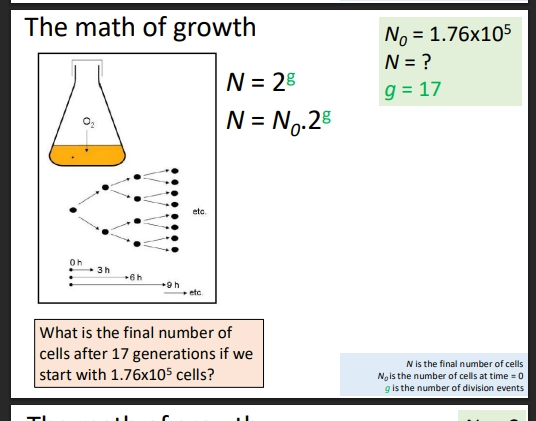
how do you determine N (final number of cells)?

(equation)

  • use the number of cells at time 0 (N0), the number of cell divison events / generations (g) and some logs

  • use the simple initial equation, (N = N0 × 2^g)

  • ** can use super large numbers too (1× 10^7 eg)

<p>(equation)</p><ul><li><p>use the number of cells at time 0 (N0), the number of cell divison events / generations (g) and some logs </p></li><li><p>use the simple initial equation, (N = N0 × 2^g)</p></li><li><p>** can use super large numbers too (1× 10^7 eg)</p></li></ul><p></p>
16
New cards

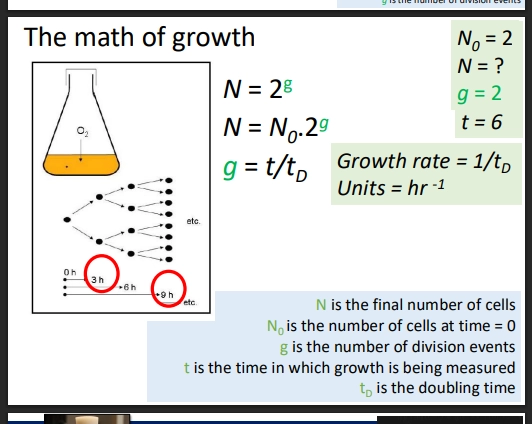
how do you calculate doubling time, or microbial growth rates?

(equation)

  • use a new equation, ( g = t / tD )

  • tD is doubling time (time at which the final N doubled), t is the time now (time measured experimentally), g is number of generations / cell divison events

(converting to growth rate)

  • tD not referred to often, instead use growth rate (mu), in units of hr-1, by converting the calculated tD with another equation

  • ( mu = 1/tD )

  • eg 0.33hr-1 = 0.33 generations of growth per hour

<p>(equation)</p><ul><li><p>use a new equation, ( g = t / tD )</p></li><li><p>tD is doubling time (time at which the final N doubled), t is the time now (time measured experimentally), g is number of generations / cell divison events</p></li></ul><p>(converting to growth rate)</p><ul><li><p>tD not referred to often, instead use growth rate (mu), in units of hr-1, by converting the calculated tD with another equation</p></li><li><p>( mu = 1/tD )</p></li><li><p>eg 0.33hr-1 = 0.33 generations of growth per hour</p></li></ul><p></p>
17
New cards

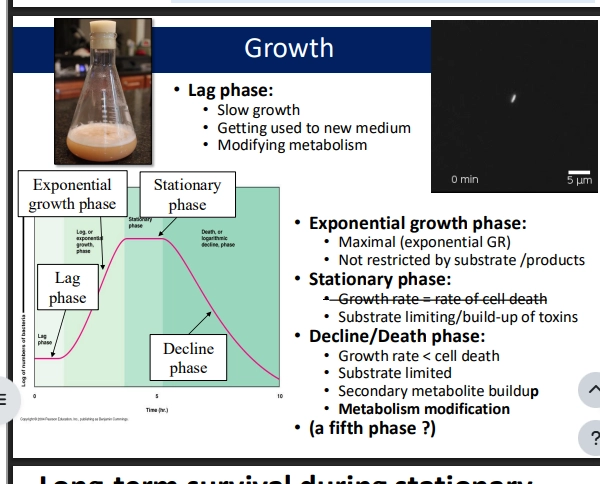
what do the dynamics of microbial growth actually look like?

  • four phases! (in batch growth - an enclosed system, with inflow and outflow of nutrients - eg conical flask)

  • plotted as growth (y axis, log number of cells) over time (x axis)

  • log number of cells as a function of time

(lag phase)

  • not much growth occurring / very slow

  • microbe getting used to its new medium / environment, taking time to make changes to its metabolism to prepare for growth

(log / exponential growth phase)

  • here it has gotten used to its new medium, so can exponentially grow with no limitations for now - is provided abundant nutrients

  • maximal growth rate, no restricting growth compounds / space / competition / toxins

(stationary phase)

  • here the log number of cells plateuas over time. we have a net loss of growth rate (rather than a net growth = death)

  • presumably due to reaching limitations of growth (eg resource limited - used up nutrients / competition for space / growth limiting compounds accumulating)

  • generates a system to prevent growth as this would be unfavorable.

(decline / death phase)

  • this is where net cell loss is actually occurring from the system (growth rate far less than death rate)

  • rather than a stylised straight decline, is often occurring as ups and downs as microbes adjust metabolisms and new nutrients come in etc (& complexities in metabolism)

  • due to growth limiting compound build up / very resource limited / spending energy to modify metabolism to take advantage of another substrate rather than using to grow more

  • eg production of antibiotics to kill neighbouring microbes, using energy to compete for space and nutrients, as this is what matters here rahter than exponential growth (not possible.)

<ul><li><p>four phases! (in batch growth - an enclosed system, with inflow and outflow of nutrients - eg conical flask)</p></li><li><p>plotted as growth (y axis, log number of cells) over time (x axis)</p></li><li><p>log number of cells as a function of time</p></li></ul><p>(lag phase)</p><ul><li><p>not much growth occurring / very slow</p></li><li><p>microbe getting used to its new medium / environment, taking time to make changes to its metabolism to prepare for growth</p></li></ul><p>(log / exponential growth phase)</p><ul><li><p>here it has gotten used to its new medium, so can exponentially grow with no limitations for now - is provided abundant nutrients</p></li><li><p>maximal growth rate, no restricting growth compounds / space / competition / toxins</p></li></ul><p>(stationary phase)</p><ul><li><p>here the log number of cells plateuas over time. we have a net loss of growth rate (rather than a net growth = death)</p></li><li><p>presumably due to reaching limitations of growth (eg resource limited - used up nutrients / competition for space / growth limiting compounds accumulating)</p></li><li><p>generates a system to prevent growth as this would be unfavorable. </p></li></ul><p>(decline / death phase)</p><ul><li><p>this is where net cell loss is actually occurring from the system (growth rate far less than death rate)</p></li><li><p>rather than a stylised straight decline, is often occurring as ups and downs as microbes adjust metabolisms and new nutrients come in etc (&amp; complexities in metabolism)</p></li><li><p>due to growth limiting compound build up / very resource limited / spending energy to modify metabolism to take advantage of another substrate rather than using to grow more</p></li><li><p>eg production of antibiotics to kill neighbouring microbes, using energy to compete for space and nutrients, as this is what matters here rahter than exponential growth (not possible.)</p></li></ul><p></p>
18
New cards

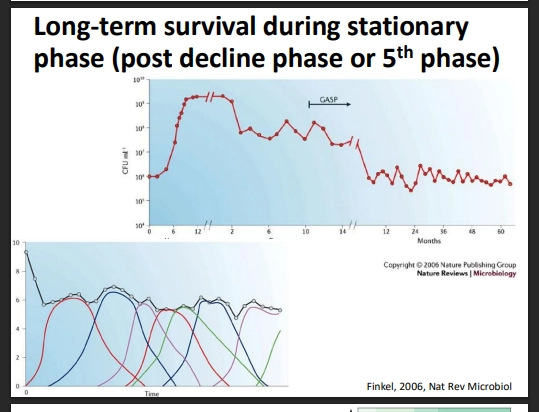
what is the unofficial 5th phase of bacterial growth?

  • the post-decline phase

  • this represents long term survival, where the microbes metabolism is constantly changing as the population is maintained long term

  • here, cell numbers have a slow decline over time

  • due to complexities of metabolism, changes in conditions and nutrients, etc

<ul><li><p>the post-decline phase</p></li><li><p>this represents long term survival, where the microbes metabolism is constantly changing as the population is maintained long term </p></li><li><p>here, cell numbers have a slow decline over time</p></li><li><p>due to complexities of metabolism, changes in conditions and nutrients, etc</p></li></ul><p></p>
19
New cards

how do we mathematically represent the phases of microbial growth using cell numbers?

  • we put cell numbers on a log scale, which creates a straight line when plotted for cell number as time increases, rather than an exponential curve which is hard to investigate the changes over time

  • here we can investigate doubling time, N, N0, time taken to reach N cells, etc
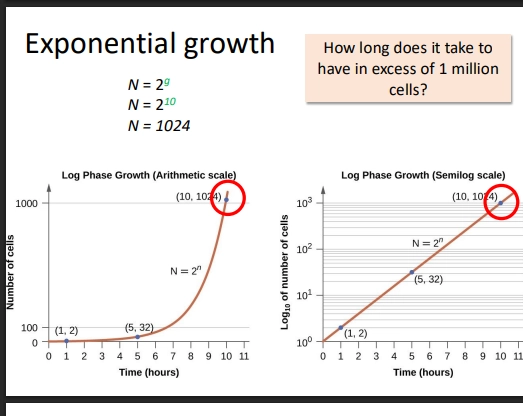

<ul><li><p>we put cell numbers on a log scale, which creates a straight line when plotted for cell number as time increases, rather than an exponential curve which is hard to investigate the changes over time</p></li><li><p>here we can investigate doubling time, N, N0, time taken to reach N cells, etc</p></li></ul><p></p>
20
New cards

how can we compare growth rates between differrent organisms, on the same plot?

  • use log scales, where the classic idea applies - steeper slope = faster growth (greater increase in cell number over time, less generations to reach the same cell count)

  • as before, using (g = log2 (N / N0)


<ul><li><p>use log scales, where the classic idea applies - steeper slope = faster growth (greater increase in cell number over time, less generations to reach the same cell count)</p></li><li><p>as before, using (g = log2 (N / N0)</p></li></ul><p></p>
21
New cards

what are the two methods of measuring cell growthm and the ideas shared behind both?

  • using these methods at two different times, you can compare the biomass between each, and figure out the change in biomass over time (=growth rates)

  • provides N0 and N, to find g & tD & mu

(optical density)

  • the easiest method, which rather than counting directly, uses absorbance with a spectrophotometer

  • passes light through a sample => light reaching the detector is inversely proportional to the number of cells (as the deflection of light represent cell presence) => can figure out number of cells / volume

  • optical density is a measure of this, which therefore is proportional to the number of cells (more optical density = more cells = less light reaching the detector)

  • provides more rough numbers however

(microscope)

  • as mentioned before. applying a grid coverslip over a ridge matrix slide. each square of the grid is a known volume, so counted cells per square provides cell / volume


<ul><li><p>using these methods at two different times, you can compare the biomass between each, and figure out the change in biomass over time (=growth rates)</p></li><li><p>provides N0 and N, to find g &amp; tD &amp; mu </p></li></ul><p>(optical density)</p><ul><li><p>the easiest method, which rather than counting directly, uses absorbance with a spectrophotometer</p></li><li><p>passes light through a sample =&gt; light reaching the detector is inversely proportional to the number of cells (as the deflection of light represent cell presence) =&gt; can figure out number of cells / volume</p></li><li><p>optical density is a measure of this, which therefore is proportional to the number of cells (more optical density = more cells = less light reaching the detector)</p></li><li><p>provides more rough numbers however</p></li></ul><p>(microscope)</p><ul><li><p>as mentioned before. applying a grid coverslip over a ridge matrix slide. each square of the grid is a known volume, so counted cells per square provides cell / volume </p></li></ul><p></p>
22
New cards

when might we see unusual microbe growth curves, deviant from the standard 4 phase model?

(diauxie)

  • eg initial lag phase => exponential growth => another lag phase => another exponential growth phase => then the staionary phase…

  • we know its two lag phases rather than a stationary, as we have exponential growth occurring after it - it doesnt just simply decline

  • however, these exponential growth phases have different slopes - the initial one being faster (greater increase in cells over time)

(why?)

  • may be due to switching to another substrate! switching metabolisms in this second lag phase, to then be able to exponentially grow again, utilising another substrate / nutrient present in the system

  • the reason for the differences in slopes, may be that substrate A provided more energy so was used first, but when used up - better to use the less great substrate then to starve - so it switched to substrate B to continue growth

  • the severe distinction between substrate A metabolism / substrate B metabolism, occurs due to catabolite repression, where substrate A’s presence actively represses the operon for metabolising substrate B (production of the enzymes required is blocked)

(when does this occur?)

  • not in all microbes or systems

  • seen in those with tight operons - metabolising certain substrates specifically, so can easily switch between them distinctly (eg ecoli)


<p>(diauxie)</p><ul><li><p>eg initial lag phase =&gt; exponential growth =&gt; another lag phase =&gt; another exponential growth phase =&gt; then the staionary phase… </p></li><li><p>we know its two lag phases rather than a stationary, as we have exponential growth occurring after it - it doesnt just simply decline</p></li><li><p>however, these exponential growth phases have different slopes - the initial one being faster (greater increase in cells over time)</p></li></ul><p>(why?)</p><ul><li><p>may be due to switching to another substrate! switching metabolisms in this second lag phase, to then be able to exponentially grow again, utilising another substrate / nutrient present in the system</p></li><li><p>the reason for the differences in slopes, may be that substrate A provided more energy so was used first, but when used up - better to use the less great substrate then to starve - so it switched to substrate B to continue growth</p></li><li><p>the severe distinction between substrate A metabolism / substrate B metabolism, occurs due to catabolite repression, where substrate A’s presence actively represses the operon for metabolising substrate B (production of the enzymes required is blocked)</p></li></ul><p>(when does this occur?)</p><ul><li><p>not in all microbes or systems</p></li><li><p>seen in those with tight operons - metabolising certain substrates specifically, so can easily switch between them distinctly (eg ecoli)</p></li></ul><p></p>
23
New cards

why dont microbes just grow exponentally?

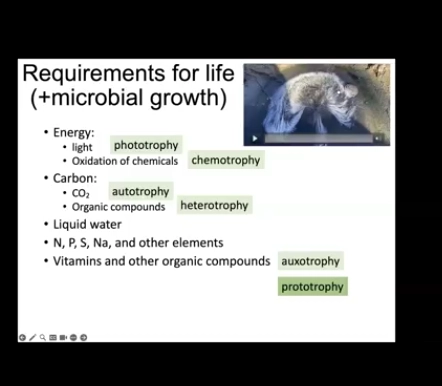
  • due to requirements and limitations for growth

(requirements for growth)

  • requirements for growth, are simply the requirements for life

  • energy (to create biomass & grow) => from light (phototrophy), chemical oxidation (chemotrophy)

  • carbon (to actually form biomass) => from CO2 (autotrophy), from organic compounds (heterotrophy)

  • liquid water

  • nutrients (N, P, Na, S => critical ones. also micronutrients => metals, cofactors, vitamins - those the organism cannot generate)

  • generated nutrients = prototrophy, required through good = auxotrophy

(limitations for growth)

  • space availability

  • nutrient availability for things the organism cannot create itself (subtrate / micronutrients / metals / trace vitamins / organic compounds - available to actually use for biomass, for energy, etc)

  • temperature (both in the environment and as a result of biomass oxidising substrate to release heat) - increase growth up to an optimal, below which is too slow for enzyme activity, above which denatures enzyme folding

  • growth limiting byproducts (eg antibiotics)

  • pH, salinity

  • terminal e acceptor conc (eg O2 conc)

  • above the optimal ranges, key enzymes for growth can be unfolded (Denaturing) and prevent growth / greatly reduce it therefore

(environmental example)

  • hot spring, a green ring around the outside where photosynthetic organisms can tolerate the conditions

  • whereas, no green in the centre of the spring as these organisms wouldnt have availability to the correct nutrients & T exposure / light

(extremes)

  • some microbes can grow at extremes intolerable by most others, as these are in their tolerance ranges.

  • however they also have extremes where their enzyme folding denatures, and lower limits where it is too slow to be efficient

  • seen for all conditions (t, pH, salinity, raidation)…

<ul><li><p>due to requirements and limitations for growth</p></li></ul><p>(requirements for growth)</p><ul><li><p>requirements for growth, are simply the requirements for life</p></li><li><p>energy (to create biomass &amp; grow) =&gt; from light (phototrophy), chemical oxidation (chemotrophy)</p></li><li><p>carbon (to actually form biomass) =&gt; from CO2 (autotrophy), from organic compounds (heterotrophy)</p></li><li><p>liquid water </p></li><li><p>nutrients (N, P, Na, S =&gt; critical ones. also micronutrients =&gt; metals, cofactors, vitamins - those the organism cannot generate)</p></li><li><p>generated nutrients = prototrophy, required through good = auxotrophy</p></li></ul><p>(limitations for growth)</p><ul><li><p>space availability</p></li><li><p>nutrient availability for things the organism cannot create itself (subtrate / micronutrients / metals / trace vitamins / organic compounds - available to actually use for biomass, for energy, etc)</p></li><li><p>temperature (both in the environment and as a result of biomass oxidising substrate to release heat) - increase growth up to an optimal, below which is too slow for enzyme activity, above which denatures enzyme folding</p></li><li><p>growth limiting byproducts (eg antibiotics)</p></li><li><p>pH, salinity</p></li><li><p>terminal e acceptor conc (eg O2  conc)</p></li><li><p>above the optimal ranges, key enzymes for growth can be unfolded (Denaturing) and prevent growth / greatly reduce it therefore </p></li></ul><p>(environmental example)</p><ul><li><p>hot spring, a green ring around the outside where photosynthetic organisms can tolerate the conditions</p></li><li><p>whereas, no green in the centre of the spring as these organisms wouldnt have availability to the correct nutrients &amp; T exposure / light</p></li></ul><p>(extremes)</p><ul><li><p>some microbes can grow at extremes intolerable by most others, as these are in their tolerance ranges.</p></li><li><p>however they also have extremes where their enzyme folding denatures, and lower limits where it is too slow to be efficient</p></li><li><p>seen for all conditions (t, pH, salinity, raidation)… </p></li></ul><p></p>
24
New cards

microbial control definitions….

  • vegetative cells

  • endospores

  • sterilisation

  • disinfection

  • sanitisation

  • antisepsis (& bacteriocidal / bacterostatic / bacteriolytic)

  • chemotherapy


(vegetative cells)

  • cells that are actively growing / dividing, and doing metabolism

(endospores)

  • cells that are not actively growing / dividing, nor doing metabolism

  • in an inert, hibernation state. genomic material & enzymes enclosed in a hard case. unaffected largely by the environment

(sterilisation)

  • destroys both vegetative & endospores (destroys all viable cells)

(disinfection)

  • removes vegetative cells (NOT endospores)

(sanitisation)

  • REDUCES microbial populations, to levels considered safe (not entirely removing them)

(antisepsis)

  • chemicals applied to the body (surface) to destroy / inhibit vegetative (pathogens)

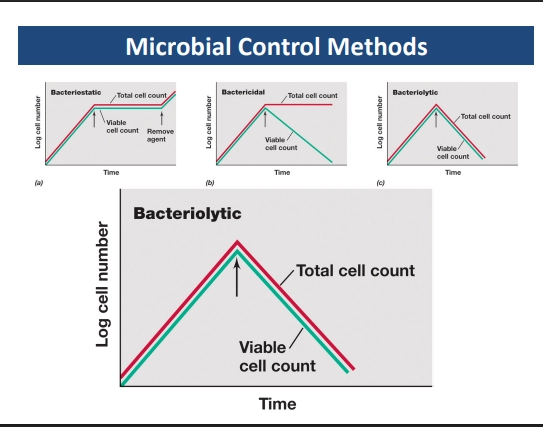
  • can be bacteriocidal (purpose to KILL), or bacteriostatic (purpose to STOP GROWING - to support our immune system), or bacteriolytic (purpose to physically destroy cells)

  • eg - bacteriostatic inhibits growth (cell no plateaus, then can incr over time). bacteriocidal removes viable cells but cell count remains, bacteriolytic removes cells, destroys them, so cell count decreases

(chemotherapy)

  • chemicals applied to the body (within) to destroy / inhibit growth of vegetative cells

<p>(vegetative cells)</p><ul><li><p>cells that are actively growing / dividing, and doing metabolism</p></li></ul><p>(endospores)</p><ul><li><p>cells that are not actively growing / dividing, nor doing metabolism</p></li><li><p>in an inert, hibernation state. genomic material &amp; enzymes enclosed in a hard case. unaffected largely by the environment</p></li></ul><p>(sterilisation)</p><ul><li><p>destroys both vegetative &amp; endospores (destroys all viable cells)</p></li></ul><p>(disinfection)</p><ul><li><p>removes vegetative cells (NOT endospores)</p></li></ul><p>(sanitisation)</p><ul><li><p>REDUCES microbial populations, to levels considered safe (not entirely removing them)</p></li></ul><p>(antisepsis)</p><ul><li><p>chemicals applied to the body (surface) to destroy / inhibit vegetative (pathogens)</p></li><li><p>can be bacteriocidal (purpose to KILL), or bacteriostatic (purpose to STOP GROWING - to support our immune system), or bacteriolytic (purpose to physically destroy cells)</p></li><li><p>eg - bacteriostatic inhibits growth (cell no plateaus, then can incr over time). bacteriocidal removes viable cells but cell count remains, bacteriolytic removes cells, destroys them, so cell count decreases</p></li></ul><p>(chemotherapy)</p><ul><li><p>chemicals applied to the body (within) to destroy / inhibit growth of vegetative cells </p></li></ul><p></p>
25
New cards

what is actually considered microbial death

  • the loss of membrane integrity & electric potential

  • eg lysing a cell

  • losing its ability to make energy, do chemistry in a self sustaining system


26
New cards

name the 4 microbial control methods

name an example for each

  • mechanical

eg air filters, masks

  • physical

eg heating, radiation

  • chemical

eg alcohol, antibiotics

  • biological

eg bacteriophages,


27
New cards

mechanical microbial control

  • describe

  • give some examples

  • limitations and how they are dealt with


  • mechanically excluding microorgranisms

  • not killing them or destroying them (eg physical control), simply providing a mechanical barrier / preventing entry into some space

(filtration)

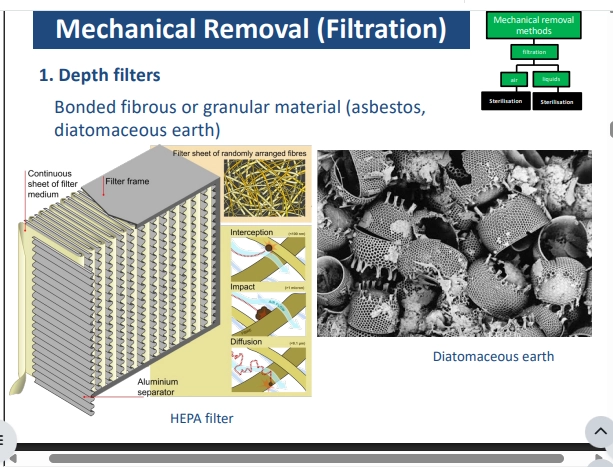
  • most common method - removing microbes by filtering them out. catching them in membranes, preventing entry.

  • (depth filters) in air conditioning / air filters in houses, made of HEPA filters (bonded fibrous material OR diatoms with pores to catch microbes via electrostatic attractions)

  • slows microbes, just air passes through. air moves through top and sides, and filters out through the bottom

  • (masks) same concept, just a fibre

  • good for air & aerosols - poor for liquids (microbes can be pulled through)

  • (membrane filters) same concept, but for liquids. thin substance with many holes, that microbes cant fit through. tiny pore size so wont work for air (not enough vol to move thru)

(limitations?)

  • ultra-small microbes that can still move through the pores, being smaller than most microbes, that the ordinary pore size targets

  • eg <0.3um bacteria, archaea (a group, very small at maturity, tiny genomes <2 Mb) & some viruses

  • relatively undiscovered due to little knowlege, so they are untargetted and escape from typical monitoring methods - simply due to being too small to be caught in samples

  • - Scientist found many new phyla from a secondary 0.1 micron filter of a sample from uranium mine waste (35 new phyla from one site => equiv to 35 groups with backbones)

<ul><li><p>mechanically excluding microorgranisms</p></li><li><p>not killing them or destroying them (eg physical control), simply providing a mechanical barrier / preventing entry into some space</p></li></ul><p>(filtration)</p><ul><li><p>most common method - removing microbes by filtering them out. catching them in membranes, preventing entry. </p></li><li><p>(depth filters) in air conditioning / air filters in houses, made of HEPA filters (bonded fibrous material OR diatoms with pores to catch microbes via electrostatic attractions)</p></li><li><p>slows microbes, just air passes through. air moves through top and sides, and filters out through the bottom</p></li><li><p>(masks) same concept, just a fibre</p></li><li><p>good for air &amp; aerosols - poor for liquids (microbes can be pulled through)</p></li><li><p>(membrane filters) same concept, but for liquids. thin substance with many holes, that microbes cant fit through. tiny pore size so wont work for air (not enough vol to move thru)</p></li></ul><p>(limitations?)</p><ul><li><p>ultra-small microbes that can still move through the pores, being smaller than most microbes, that the ordinary pore size targets</p></li><li><p>eg &lt;0.3um bacteria, archaea (a group, very small at maturity, tiny genomes &lt;2 Mb)  &amp; some viruses </p></li><li><p>relatively undiscovered due to little knowlege, so they are untargetted and escape from typical monitoring methods - simply due to being too small to be caught in samples</p></li><li><p>- Scientist found many new phyla from a secondary 0.1 micron filter of a sample from uranium mine waste (35 new phyla from one site =&gt; equiv to 35 groups with backbones)</p></li></ul><p></p>
28
New cards

physical microbial control

  • describe

  • give some examples


  • physically destroying / removing microbes - rather than simply preventing entry (eg mechanical)

(via temperature)

  • effective as the key limitation of growth-enabling enzymes, is denaturation which occurs at high T

  • various T checkpoints and times heating required to kill microbes of interest / amount of microbial load reduced.

  • high enough T checkpoints & time heating, kill both vegetative and endospores, but not absolutely all. just reduces microbial load

  • (moist heating) uses heat under pressure, or boiling, with different T checkpoints for different microbes of target. water is good for conducting heat, so requires a lower overall T

  • eg autoclave (tends to kill ALL microbes that we know of)

  • eg pasteruisation (heating foods & liquids to high T to reduce microbial load - via liquids, steam, boiling)

  • (dry heating) uses heated air in an enclosed space. requires higher T for killing checkpoints, due to air being poorer at conducting heat

  • eg oven / dry heat autoclave, bunsen burner (a flame)

(via radiation)

  • ionising or non ionising, wavelengths aat opposite sides of visible light, higher (ionising) and lower (non ionising) energies

  • type to use depends on situation (eg sterilising a food product to reduce microbial load - if ionising would change taste & texture => use non ionising instead)

  • (ionising) high energy. ionises everything and creates reactive molecules

  • OH radicals, H radcals, electrons =>DNA / lipids / proteins all damaged, so quite good for most microbes

  • lethal dose (Grays Gy, Jkg-1) varies between microbes (5Gy lethal for humans)

  • eg extremes like Clostridium botullinum (3300Gy for a spore), Deinococcus radiodurans (>2200Gy to reduce vegetative biomass)

  • (non ionising) lower energy (mostly UV 220-300nm). damages DNA by creating pyramidine dimers

  • UV light forces Thymines to covalently bond => Thymine dimers form => DNA kinks => DNA/RNA pol obstructed => microbe cellular process affected => cells killed / growth inhibited / impacts what the cell can do

  • eg proteins can stop productin / misfold / truncated
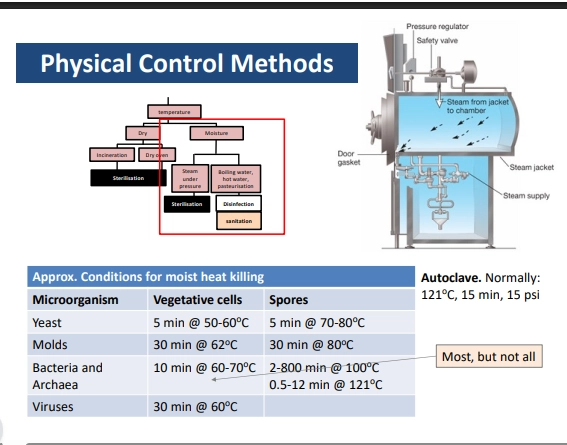

<ul><li><p>physically destroying / removing microbes - rather than simply preventing entry (eg mechanical)</p></li></ul><p>(via temperature)</p><ul><li><p>effective as the key limitation of growth-enabling enzymes, is denaturation which occurs at high T</p></li><li><p>various T checkpoints and times heating required to kill microbes of interest / amount of microbial load reduced.</p></li><li><p>high enough T checkpoints &amp; time heating, kill both vegetative and endospores, but not absolutely all. just reduces microbial load</p></li><li><p>(moist heating) uses heat under pressure, or boiling, with different T checkpoints for different microbes of target. water is good for conducting heat, so requires a lower overall T</p></li><li><p>eg autoclave (tends to kill ALL microbes that we know of)</p></li><li><p>eg pasteruisation (heating foods &amp; liquids to high T to reduce microbial load - via liquids, steam, boiling)</p></li><li><p>(dry heating) uses heated air in an enclosed space. requires higher T for killing checkpoints, due to air being poorer at conducting heat</p></li><li><p>eg oven / dry heat autoclave, bunsen burner (a flame)</p></li></ul><p>(via radiation)</p><ul><li><p>ionising or non ionising, wavelengths aat opposite sides of visible light, higher (ionising) and lower (non ionising) energies</p></li><li><p>type to use depends on situation (eg sterilising a food product to reduce microbial load - if ionising would change taste &amp; texture =&gt; use non ionising instead)</p></li></ul><ul><li><p>(ionising) high energy. ionises everything and creates reactive molecules</p></li><li><p>OH radicals, H radcals, electrons =&gt;DNA / lipids / proteins all damaged, so quite good for most microbes</p></li><li><p>lethal dose (Grays Gy, Jkg-1) varies between microbes (5Gy lethal for humans)</p></li><li><p>eg extremes like Clostridium botullinum (3300Gy for a spore), Deinococcus radiodurans (&gt;2200Gy to reduce vegetative biomass)</p></li><li><p>(non ionising) lower energy (mostly UV 220-300nm). damages DNA by creating pyramidine dimers</p></li><li><p>UV light forces Thymines to covalently bond =&gt; Thymine dimers form =&gt; DNA kinks =&gt; DNA/RNA pol obstructed =&gt; microbe cellular process affected =&gt; cells killed / growth inhibited / impacts what the cell can do</p></li><li><p>eg proteins can stop productin / misfold / truncated</p></li></ul><p></p>
29
New cards

chemical microbial control

  • describe

  • give some examples


  • killing microbes / inhibiting growth / removing cells - via application of chemical compounds

  • good for easily & readily accessible external surfaces (eg benches)

(common chemicals used)

  • (alcohols: ethanol & isopropanol) non polar and polar regions, gets into the lipid membranes of microbe cells, and disrupts it => pulls apart => lyses the cell => cell is killed as it cannot do metabolism

  • (phenols) denature proteins & dissolve membrane lipids (as above)

  • (halogens) oxidise cellular materials

  • (gases: EtO) blocks DNA and protein FGs

(antimicrobial agents)

  • (triclosan) interacts with fatty acid synthesis to kill bacteria. binds and inhibits ENR enzyme

  • used in toothpaste - no health impacts but has potential to affect microbiome & microbes in the wild (readily put back into the environment down the drain) which may incur resistance developing

(antibiotics)

  • interacts with microbes to stop them from doing somethng

  • CROSSOVER WITH BIOLOGICAL CONTROL

  • compounds produced by microbes themselves, for the purpose of killing other microbes - to reduce competition for space / nutrients

  • various functions of all sorts (eg disrupt lipids, block central dogma, block protein synthesis, cell wall synthesis, DNA, RNA pol) - to be effective they block some process to reduce efficiency of microbial growth (cell function)

  • (anti-antibiotics) some microbes evolved ways of combating antibiotics (eg recgonise & pump out / alter their structure to not be harmful / degrade / excluding from targe)
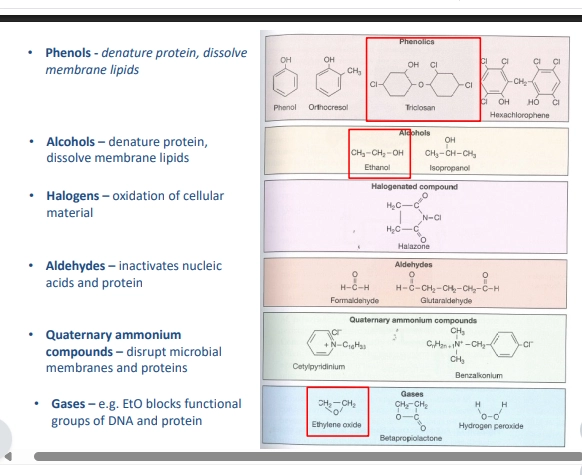

<ul><li><p>killing microbes / inhibiting growth / removing cells - via application of chemical compounds</p></li><li><p>good for easily &amp; readily accessible external surfaces (eg benches)</p></li></ul><p>(common chemicals used)</p><ul><li><p>(alcohols: ethanol &amp; isopropanol) non polar and polar regions, gets into the lipid membranes of microbe cells, and disrupts it =&gt; pulls apart =&gt; lyses the cell =&gt; cell is killed as it cannot do metabolism</p></li><li><p>(phenols) denature proteins &amp; dissolve membrane lipids (as above)</p></li><li><p>(halogens) oxidise cellular materials</p></li><li><p>(gases: EtO) blocks DNA and protein FGs</p></li></ul><p>(antimicrobial agents)</p><ul><li><p>(triclosan) interacts with fatty acid synthesis to kill bacteria. binds and inhibits ENR enzyme</p></li><li><p>used in toothpaste - no health impacts but has potential to affect microbiome &amp; microbes in the wild (readily put back into the environment down the drain) which may incur resistance developing</p></li></ul><p>(antibiotics)</p><ul><li><p>interacts with microbes to stop them from doing somethng</p></li><li><p>CROSSOVER WITH BIOLOGICAL CONTROL</p></li><li><p>compounds produced by microbes themselves, for the purpose of killing other microbes - to reduce competition for space / nutrients</p></li><li><p>various functions of all sorts (eg disrupt lipids, block central dogma, block protein synthesis, cell wall synthesis, DNA, RNA pol) - to be effective they block some process to reduce efficiency of microbial growth (cell function)</p></li><li><p>(anti-antibiotics) some microbes evolved ways of combating antibiotics (eg recgonise &amp; pump out / alter their structure to not be harmful / degrade / excluding from targe)</p></li></ul><p></p>
30
New cards

biological microbial control

  • describe

  • give some examples


  • using other organisms to kill microbes / inhibit / reduce microbial growth

(viruses)

  • bacteriophages, MO viruses in general

  • very specific to the microbe of target - so can be used as medicines (wont do anyhting to the host - eg human)

  • (listeria) terrible bacteria esp when pregnant. one way of transmission is via mouldy cheese like brie, so can add phage to brie to make it safe when pregnant (specifically targets the listeria so humans are fine)

  • (American Fowlbrood) a terrible disease for honeybee hives, due to Penobacillus larvae, bacteria that kill bee larvae. looking at using phages specific to the bacteria, that wont harm the honeybees therefore

(predators)

  • (Bdellovibrio) a bacterial parasite that kills target bacteria by predatory methods.zipping around => ramming => lysing the cell. feeds on proteins & nucleic acids from the hosts

(toxins)

  • use of chemical compounds produced biologically to kill microbes / inhibit growth

  • eg antibiotics (see in chemical contorl) some crossover


<ul><li><p>using other organisms to kill microbes / inhibit / reduce microbial growth</p></li></ul><p>(viruses)</p><ul><li><p>bacteriophages, MO viruses in general</p></li><li><p>very specific to the microbe of target - so can be used as medicines (wont do anyhting to the host - eg human)</p></li><li><p>(listeria) terrible bacteria esp when pregnant. one way of transmission is via mouldy cheese like brie, so can add phage to brie to make it safe when pregnant (specifically targets the listeria so humans are fine)</p></li><li><p>(American Fowlbrood) a terrible disease for honeybee hives, due to Penobacillus larvae, bacteria that kill bee larvae. looking at using phages specific to the bacteria, that wont harm the honeybees therefore</p></li></ul><p>(predators)</p><ul><li><p>(Bdellovibrio) a bacterial parasite that kills target bacteria by predatory methods.zipping around =&gt; ramming =&gt; lysing the cell. feeds on proteins &amp; nucleic acids from the hosts</p></li></ul><p>(toxins)</p><ul><li><p>use of chemical compounds produced biologically to kill microbes / inhibit growth</p></li><li><p>eg antibiotics (see in chemical contorl) some crossover</p></li></ul><p></p>
31
New cards

what can we do in the lab to maintain aseptic conditions?

why is this important?

(importance)

  • when investigating microbes in the lab, its important that media is just growing the microbe of interest. introducing contamination via the wrong techniques, introduces error / bias / inaccuracy (wastes time, money, media)

  • important to keep cultures aseptic (Free of microbes), so the strain of intrest can be applied (and only this strain)

(techniques)

  • good hygiene

  • keeping lids on things (tip boxes, agar plates, broth = mechanical control)

  • not reuising things / using contaminated things touched bioogy (pipettes, syringes, plasticaware)

  • cleaning work surfaces with ethanol (chemical control)

  • sterile gloves with ethanol (chemical control)

  • sterilising inoculating loop (dry heat)

  • sterilising agar in an autoclave (moist heating) & expelling air from the bottle (dry heating)

  • flaming the neck (dry heating)

  • pouring agar / plates close to Bunsen / in laminar hood (physical control via dry heating)


32
New cards

what is the concept of ‘planetary boundaries’

how does this relate to the N cycle, and why

  • the state of biogeochemical cycles compared to natural function. if crossing the boundary, thhey are uncapable of rebounding

  • therefore lots are past these boundaries - human processes have been messing up these cycles

  • eg phosphorus cycle, N cycle, climate change

(N cycle)

  • boundary has been crossed. extremely messed up for a while

(why?)

  • due to human processes - things like fertilisers, fossil fuel combustion - adding N back to the system in unnatural ways. thus its become unbalanced, and the excess cannot be cycled back

  • we cannot support the world population via agriculture via the N cycle naturally. we must infere by adding N via fertiliser

  • however now, if we stopped fertiliser use - the world population would crash. we cannot fix the N cycle back to its natural process, without reducing the population
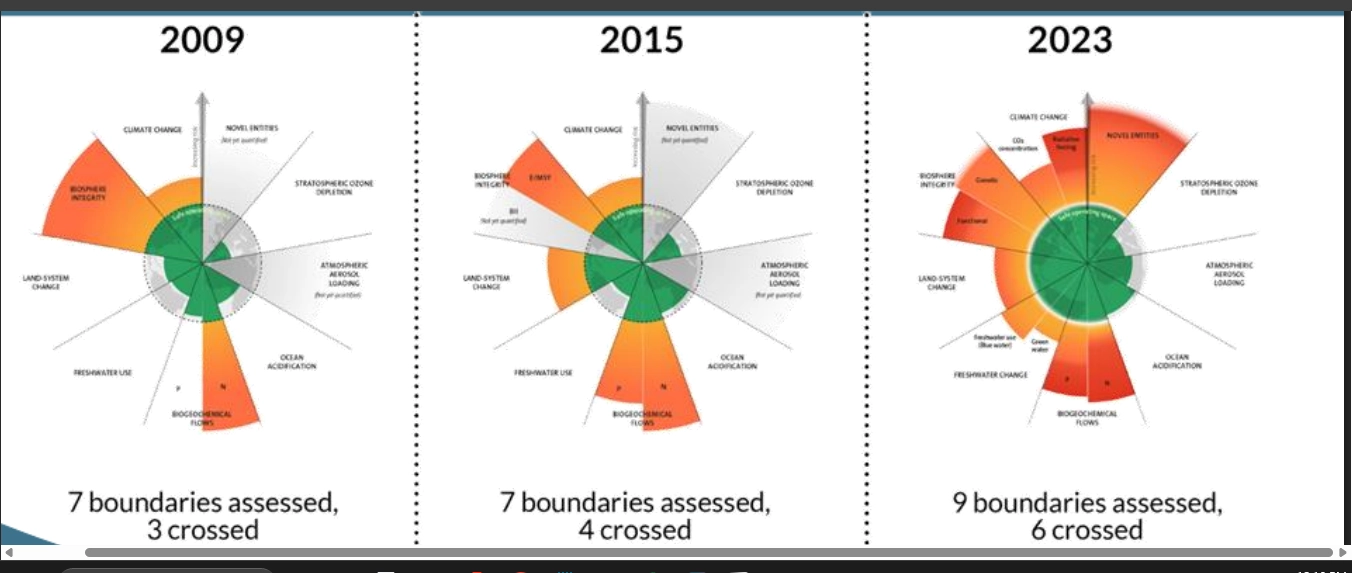

<ul><li><p>the state of biogeochemical cycles compared to natural function. if crossing the boundary, thhey are uncapable of rebounding</p></li><li><p>therefore lots are past these boundaries - human processes have been messing up these cycles</p></li><li><p>eg phosphorus cycle, N cycle, climate change</p></li></ul><p>(N cycle)</p><ul><li><p>boundary has been crossed. extremely messed up for a while</p></li></ul><p>(why?)</p><ul><li><p>due to human processes - things like fertilisers, fossil fuel combustion - adding N back to the system in unnatural ways. thus its become unbalanced, and the excess cannot be cycled back</p></li><li><p>we cannot support the world population via agriculture via the N cycle naturally. we must infere by adding N via fertiliser</p></li><li><p>however now, if we stopped fertiliser use - the world population would crash. we cannot fix the N cycle back to its natural process, without reducing the population</p></li></ul><p></p>
33
New cards

how should the N cycle occur naturally

how has human activity altered it - how does it occur in reality

(naturally)

  • in the natural system, N2 and biologically available N are balanced. Movement between terrestrial / marine (biologically available), and air (N2) - are balanced

  • terrestrially, N fixation (bringing in N2 from atmos) & Denitirfication (releasing N2 gas into atmos) are balanced

  • marine, N fixation is lesser than denitrificataion, but is overalal balanced with land => sea transfer of N

(human interference)

  • heaps more N being added to the system than what is able to be released naturally

  • constant incr into the system without balancing the output of N

  • via haber-Bosch prosses (industrial process for fertilisers, explosives, etc), N-fixation due to cultivation, and fossil fuel combustion

  • eg nitrates in groundwater, higher than natural levels in NZ esp Chch, due to runoff of fertilisers (the system cannot take in and use all this excess N added!)


<p>(naturally)</p><ul><li><p>in the natural system, N2 and biologically available N are balanced. Movement between terrestrial / marine (biologically available), and air (N2) - are balanced </p></li><li><p>terrestrially, N fixation (bringing in N2 from atmos) &amp; Denitirfication (releasing N2 gas into atmos) are balanced</p></li><li><p>marine, N fixation is lesser than denitrificataion, but is overalal balanced with land =&gt; sea transfer of N</p></li></ul><p>(human interference)</p><ul><li><p>heaps more N being added to the system than what is able to be released naturally</p></li><li><p>constant incr into the system without balancing the output of N</p></li><li><p>via haber-Bosch prosses (industrial process for fertilisers, explosives, etc), N-fixation due to cultivation, and fossil fuel combustion</p></li><li><p>eg nitrates in groundwater, higher than natural levels in NZ esp Chch, due to runoff of fertilisers (the system cannot take in and use all this excess N added!) </p></li></ul><p></p>
34
New cards

what are the forms that Nitrogen can be in (during the N cycle)?

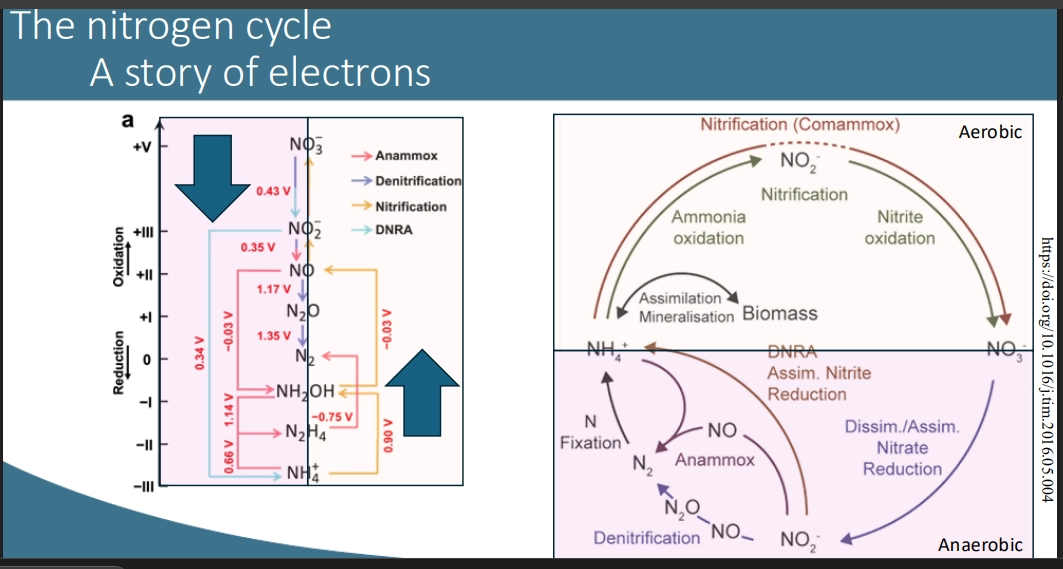
  • N exists over a wide redox range, so various reduced => oxidised forms, based on the associated e (how many can be taken up, how many can be released)

(forms)

  • (NO3-) nitrate = most oxidised. least e

  • (NO2-) nitrite = oxidised, few e

  • (NO) nitric oxide = can replace O2 as a terminal e acceptor

  • (N2O) nitrous oxide = a greenhouse gas (can diffuse off as gas)

  • (N2) dinitrous gas = 0 redox state. above is the oxidised forms, below is the reduced forms. ~78% of the atmos, elemental state. very stable so must be converted into other forms for biological use (biologically available N)

  • (NH2OH) hydroxylamine

  • (N2H4) hydrazine

  • (NH4+) ammonia = most reduced state


<ul><li><p>N exists over a wide redox range, so various reduced =&gt; oxidised forms, based on the associated e (how many can be taken up, how many can be released)</p></li></ul><p>(forms)</p><ul><li><p>(NO3-) nitrate = most oxidised. least e</p></li><li><p>(NO2-) nitrite = oxidised, few e</p></li><li><p>(NO) nitric oxide = can replace O2 as a terminal e acceptor</p></li><li><p>(N2O) nitrous oxide = a greenhouse gas (can diffuse off as gas)</p></li><li><p>(N2) dinitrous gas = 0 redox state. above is the oxidised forms, below is the reduced forms. ~78% of the atmos, elemental state. very stable so must be converted into other forms for biological use (biologically available N)</p></li><li><p>(NH2OH) hydroxylamine</p></li><li><p>(N2H4) hydrazine</p></li><li><p>(NH4+) ammonia = most reduced state</p></li></ul><p></p>
35
New cards

what are the pathways of N conversion (anaerobic & aerobic)

what is the overall model of N conversion

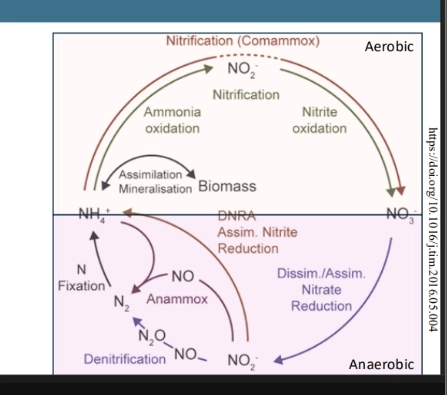
(overall model)

  • only NH4+ can be directly put into biomass, so the biological N cycle involves converting between different forms of N to ultimately reach NH4+ so it can be used for biomass

  • however, different forms can also be converted between to gain energy or electrons (eg oxidising to remove e and use elsewhere), so we see these conversions too

  • in aerobic systems we see oxidation of NH4+ (as oxygen is available, so we can add O and remove e for use)

  • in anaerobic systems we see reduction of oxidised forms of N to ultimately reach NH4+ (the most reduced forms) by adding e

(aerobic pathways)

  • associted with oxidation. removing e.

  • Assimilation = converting NH4 to biomass

  • Mineralisation = converting biomass (dead organic matter) to NH4+

  • Commamox (/ Nitrification) = converting NH4+ to NO3- (nitrate) - via NH4+ oxidation => NO2- nitrite => NO2- oxidation => NO3- nitrate (oxidising it. removing e)

  • these organisms are gaining energy through oxidising NH4+

(anaerobic pathways)

  • associated with reduction. adding e

  • Dissimilation (/Assimilation / Nitrate Reduction) = converting NO3- nitrate to NO2- nitrite (reducing it. adding e)

  • Denitrification = converting NO2- nitrite to N2 (via NO=> N2O => N2)

  • Ammamox = converting NO2- nitrite straight to N2. OR converting NH4+ straight to N2

  • N fixation = converting N2 to NH4+


<p>(overall model)</p><ul><li><p>only NH4+ can be directly put into biomass, so the biological N cycle involves converting between different forms of N to ultimately reach NH4+ so it can be used for biomass</p></li><li><p>however, different forms can also be converted between to gain energy or electrons (eg oxidising to remove e and use elsewhere), so we see these conversions too</p></li><li><p>in aerobic systems we see oxidation of NH4+ (as oxygen is available, so we can add O and remove e for use)</p></li><li><p>in anaerobic systems we see reduction of oxidised forms of N to ultimately reach NH4+ (the most reduced forms) by adding e</p></li></ul><p>(aerobic pathways)</p><ul><li><p>associted with oxidation. removing e.</p></li></ul><ul><li><p>Assimilation = converting NH4 to biomass</p></li><li><p>Mineralisation = converting biomass (dead organic matter) to NH4+ </p></li><li><p>Commamox (/ Nitrification) = converting NH4+ to NO3- (nitrate) - via NH4+ oxidation =&gt; NO2- nitrite =&gt; NO2- oxidation =&gt; NO3- nitrate (oxidising it. removing e)</p></li><li><p>these organisms are gaining energy through oxidising NH4+</p></li></ul><p>(anaerobic pathways)</p><ul><li><p>associated with reduction. adding e</p></li></ul><ul><li><p>Dissimilation (/Assimilation / Nitrate Reduction) = converting NO3- nitrate to NO2- nitrite (reducing it. adding e)</p></li><li><p>Denitrification = converting NO2- nitrite to N2 (via NO=&gt; N2O =&gt; N2)</p></li><li><p>Ammamox = converting NO2- nitrite straight to N2. OR converting NH4+ straight to N2</p></li><li><p>N fixation = converting N2 to NH4+</p></li></ul><p></p>
36
New cards

what are organisms using the electrons gained and donated to and from Nitrogen, through its oxidation (Nitrification) and reduction (Denitrification) for??

  • using N’s reduction potential in order to do things in the cell

  • using to pump H+ out to create an electrochemical gradient, which it can couple movement in to balance - with ATP production to do cell work

  • classic oxidative phosphorylation system (electron transfer chain). combinations of proteins accept and donate protons. either taking or releasing e, but both pumping protons either way, along each step

  • proteins involved, complex I-V. I-IV responsible for transferring e, complex V repsonsible for ATP production coupled with H+ movement

  • entire metabolisms built around trying to make energy from nitirifaction & denitification, to make ATP via the e transfered with N
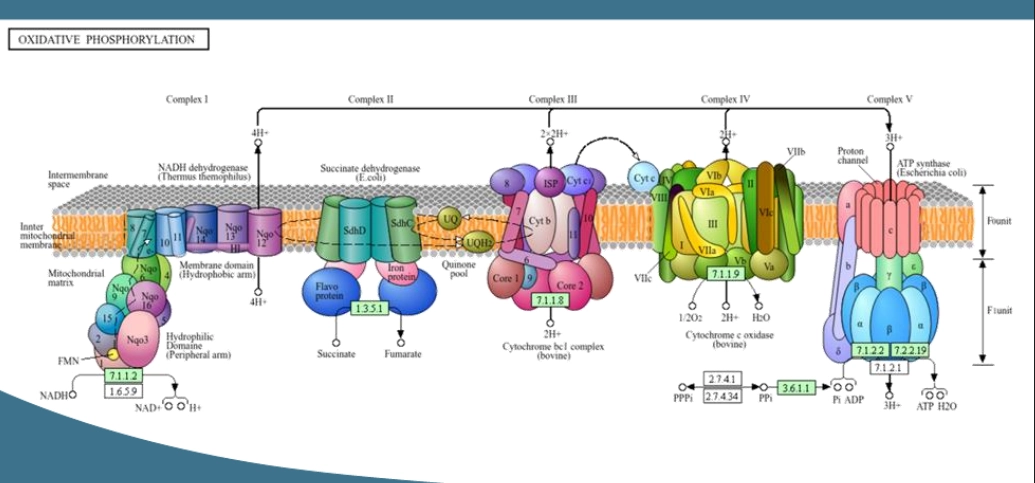

<ul><li><p>using N’s reduction potential in order to do things in the cell</p></li><li><p>using to pump H+ out to create an electrochemical gradient, which it can couple movement in to balance - with ATP production to do cell work</p></li><li><p>classic oxidative phosphorylation system (electron transfer chain). combinations of proteins accept and donate protons. either taking or releasing e, but both pumping protons either way, along each step</p></li><li><p>proteins involved, complex I-V. I-IV responsible for transferring e, complex V repsonsible for ATP production coupled with H+ movement</p></li><li><p>entire metabolisms built around trying to make energy from nitirifaction &amp; denitification, to make ATP via the e transfered with N</p></li></ul><p></p>
37
New cards

how does N fixation (N2 => NH4+) actually occur?

  • the process

  • anaerobic?

  • examples of the organisms themselves


  • a complex process. adding e to N2, reducing it to form NH4+ (entirely reduced form of N2)

  • uses a protein complex, built around the biosynthesis of FeMo-co (Iron Molbdenum Cofactor), which makes up the AS.

  • NifENB complex synthesises => converts to NifHDK complex for catalysis

(anaerobic?)

  • is entirely O2 sensitive - will only occur anaerobically (so in anaerobic environments, in anaerobic pockets, in anaerobic organisms) without a special addition to the system

  • eg some exceptions like cyanobacteria that simulatensously make O2 and fix N2 - but do so in different compartments

  • energy intensive (16ATP+8e to fix a signel N2=> NH4+) as N2 is N///N, entirely stable.

(the organisms themselves)

  • seen in both free living & symbiotic partnerships

  • eg forms long chains of cells (almost multicellular) => becomes a heterocyst (shuts down and forms an impermeable cell layer) => only continues N fixation => lets out NH4+ to neighbouring cells via filaments

  • eg root nodule bacteria, form anaerobic pockets => fix N2 in an aerobic environmnent
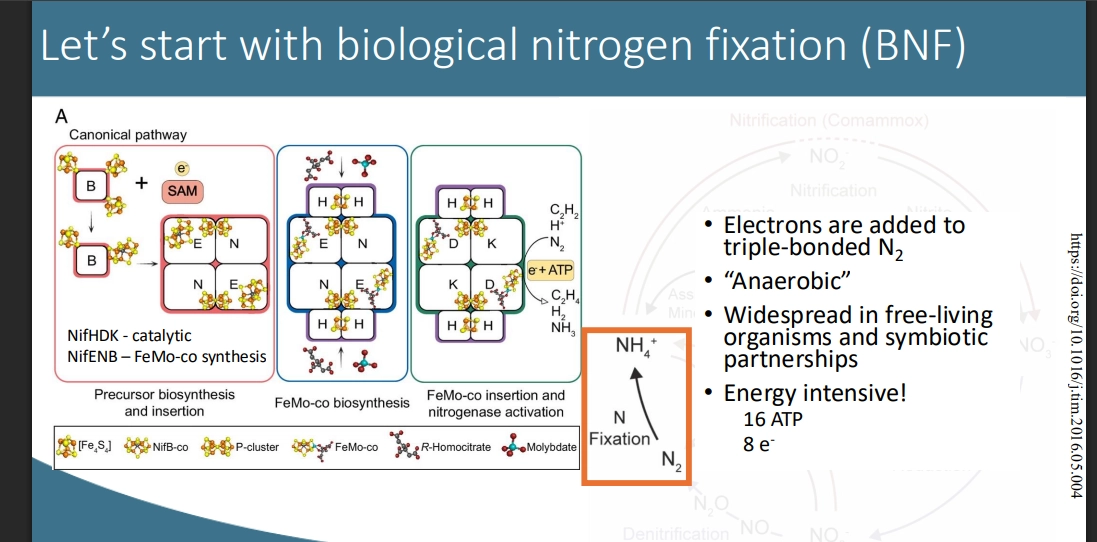

<ul><li><p>a complex process. adding e to N2, reducing it to form NH4+ (entirely reduced form of N2)</p></li><li><p>uses a protein complex, built around the biosynthesis of FeMo-co (Iron Molbdenum Cofactor), which makes up the AS.</p></li><li><p>NifENB complex synthesises =&gt; converts to NifHDK complex for catalysis</p></li></ul><p>(anaerobic?)</p><ul><li><p>is entirely O2 sensitive - will only occur anaerobically (so in anaerobic environments, in anaerobic pockets, in anaerobic organisms) without a special addition to the system </p></li><li><p>eg some exceptions like cyanobacteria that simulatensously make O2 and fix N2 - but do so in different compartments</p></li><li><p>energy intensive (16ATP+8e to fix a signel N2=&gt; NH4+) as N2 is N///N, entirely stable.</p></li></ul><p>(the organisms themselves)</p><ul><li><p>seen in both free living &amp; symbiotic partnerships</p></li></ul><ul><li><p>eg forms long chains of cells (almost multicellular) =&gt; becomes a heterocyst (shuts down and forms an impermeable cell layer) =&gt; only continues N fixation =&gt; lets out NH4+ to neighbouring cells via filaments </p></li><li><p>eg root nodule bacteria, form anaerobic pockets =&gt; fix N2 in an aerobic environmnent </p></li></ul><p></p>
38
New cards

how is NH4+ actually oxidised to NO2- nitrite, in biological systems?

  • anaerobic or aerobic?

  • pathways in differnet organisms

  • genus name prefix


  • aerobic conditions (we add O! remove e)

  • organisms denoted with the Nitroso- prefix

(pathways)

  • restricted to specific bacteria & archaea with a similar but different pathway - nitrifiers

  • bacteria pathway

  • archaea pathway (in the same superfamily as methanotrophs, due to using shared enzymes with different specifitties in enzyme pockets to favor methane or N - with monster O radicals to do so)

(the process itself)

  • a process that uses membrane proteins, and is periplasmic - so whats occurring is external to the cell, rather than facing the cytoplasm.

  • e are harvested from NH4+ => forms Hydroxylamine => forms Nitrous Oxide NO-

  • (with enough O2) NO- => NO2-

  • (not enough O2) NO- is released OR denitrified => NH2 gas (& released)

  • eg in agriculture, adding lots of NH4+ from fertiliser, if its wet and theres not alot of O2 therefore in the soil, itll just bleed out as Nitrifiers cannot actually use it
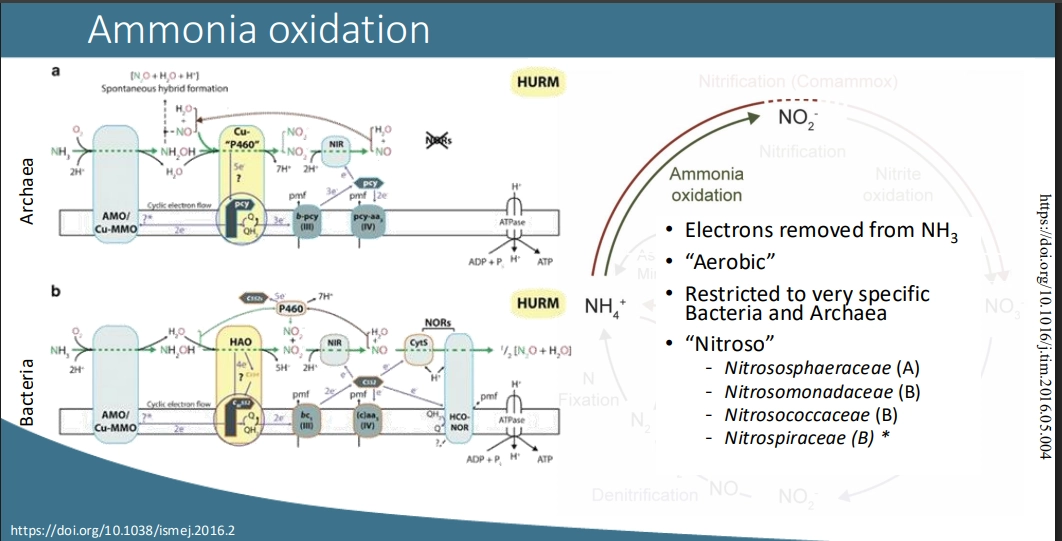

<ul><li><p>aerobic conditions (we add O! remove e)</p></li><li><p>organisms denoted with the Nitroso- prefix</p></li></ul><p>(pathways)</p><ul><li><p>restricted to specific bacteria &amp; archaea with a similar but different pathway - nitrifiers </p></li></ul><ul><li><p>bacteria pathway </p></li><li><p>archaea pathway (in the same superfamily as methanotrophs, due to using shared enzymes with different specifitties in enzyme pockets to favor methane or N - with monster O radicals to do so)</p></li></ul><p>(the process itself)</p><ul><li><p>a process that uses membrane proteins, and is periplasmic - so whats occurring is external to the cell, rather than facing the cytoplasm.</p></li><li><p>e are harvested from NH4+ =&gt; forms Hydroxylamine =&gt; forms Nitrous Oxide NO-</p></li><li><p>(with enough O2) NO- =&gt; NO2-</p></li><li><p>(not enough O2) NO- is released OR denitrified =&gt; NH2 gas (&amp; released)</p></li><li><p>eg in agriculture, adding lots of NH4+ from fertiliser, if its wet and theres not alot of O2 therefore in the soil, itll just bleed out as Nitrifiers cannot actually use it</p></li></ul><p></p>
39
New cards

How is Nitrite NO2- actually oxidised (=> Nitrate NO3-) biologically?

  • anaerobic or aerobic?

  • which organisms?

  • genus name prefix?


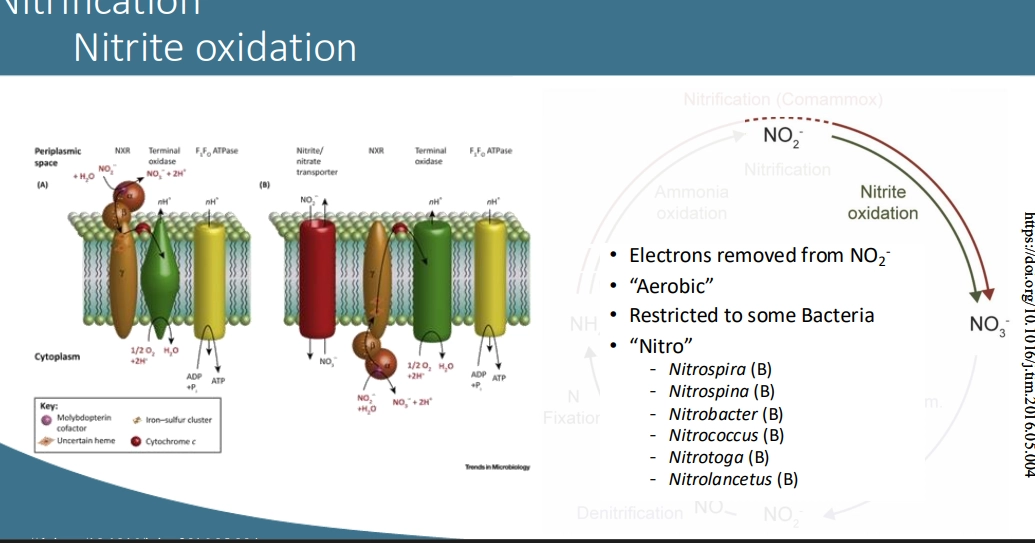
  • aerobic, as it requires adding O2 and removing e, to => Nitrate NO3-

  • can either be periplasmic facing, or facing the inside of the cell - both involving membrane proteins

  • O2 is used as a final e acceptor, as e are removed from Nitrite NO2- to make Nitrate NO3-, by enzymes that pass these e through substrates, along membrane proteins

(organisms)

  • restricted to specific bacteria. (afaik no archaea!)

  • Nitro- prefix on genus name


<ul><li><p>aerobic, as it requires adding O2 and removing e, to =&gt; Nitrate NO3-</p></li><li><p>can either be periplasmic facing, or facing the inside of the cell - both involving membrane proteins</p></li><li><p>O2 is used as a final e acceptor, as e are removed from Nitrite NO2- to make Nitrate NO3-, by enzymes that pass these e through substrates, along membrane proteins</p></li></ul><p>(organisms)</p><ul><li><p>restricted to specific bacteria. (afaik no archaea!)</p></li><li><p>Nitro- prefix on genus name </p></li></ul><p></p>
40
New cards

What is Commamox

  • how does this work

  • anaerobic or aerboic

  • what organisms do so?


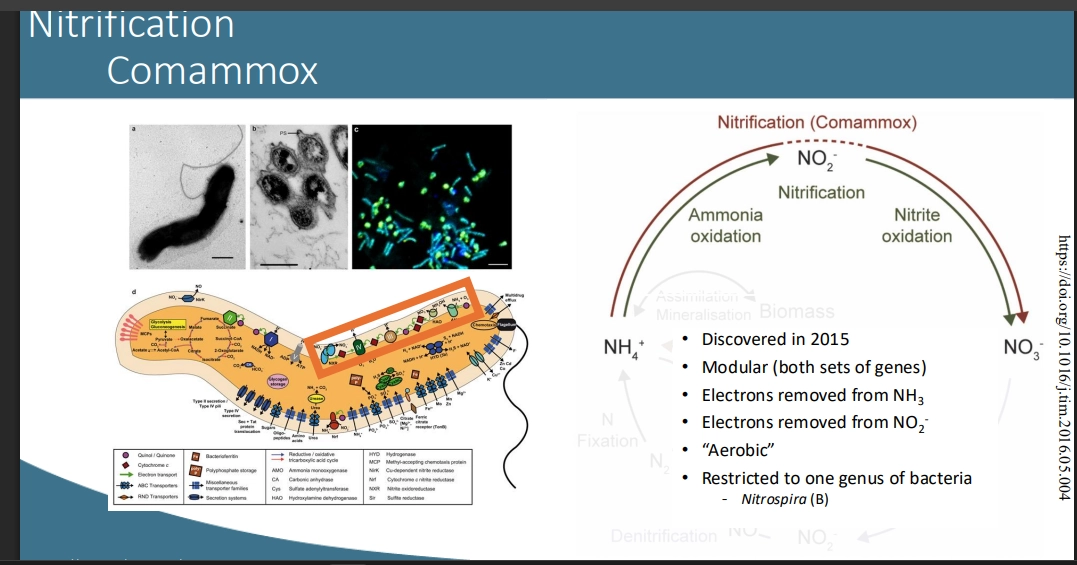
  • organisms that can both oxidise NH4+ => NO2- (Ammonia Oxidation) AND oxidise NO2- => NO3- (Nitrite Oxidation) - doing both processes of e removal

  • organisms typically only have capability for one of the above, thus only one bacterial genus has been found to do so (Nitrospira bacteria - some genus members arent Commamox do note - must do genome trees to even figure out)

  • genes are modular for each process, so either part may be switched on or off, or it may do both.

  • aerobic


<ul><li><p>organisms that can both oxidise NH4+ =&gt; NO2- (Ammonia Oxidation) AND oxidise NO2- =&gt; NO3- (Nitrite Oxidation) - doing both processes of e removal</p></li><li><p>organisms typically only have capability for one of the above, thus only one bacterial genus has been found to do so (Nitrospira bacteria - some genus members arent Commamox do note - must do genome trees to even figure out)</p></li><li><p>genes are modular for each process, so either part may be switched on or off, or it may do both. </p></li><li><p>aerobic</p></li></ul><p></p>
41
New cards

how is Nitrate NO3- reduced to Nitrite NO2- in biology? (Denitrification)

  • the process

  • dissimaltory vs assimilatory

  • organisms that do so

  • anaerboic vs aerobic


  • basically respiration, but what we do with O2, done to Nitrate NO3- - using it as a terminal e acceptor, by membrane proteins

  • is therefore anaerobic. with O2 pressent will use O2 (a better source of energy as a terminal e acceptor)

  • Nap (periplasmic, not widespread) & Nar (both, more widespread) mediated - periplasmic or cytoplasmic, facing for these membrane proteins, creating an e transport chain to eventually add the e to NO3- => reducing it to NO2- Nirtite

  • each movement of e, moves H+ across the membrane against their gradient, forming a proton gradient, whose movement back downhill, is coupled with ATP production, making energy for the cell

(Dissimilatory? Assimilatory?)

  • either using this process simply for energy (Dissimilatory)

  • Or also using the N for biomass (Assimilatory)

  • very different processes, but the same fundamental first step (Oxidising NO3- => NO2-)

(Organisms)

  • genes seen across a variety of bacteria & Archea


<ul><li><p>basically respiration, but what we do with O2, done to Nitrate NO3- - using it as a terminal e acceptor, by membrane proteins</p></li><li><p>is therefore anaerobic. with O2 pressent will use O2 (a better source of energy as a terminal e acceptor)</p></li><li><p>Nap (periplasmic, not widespread) &amp; Nar (both, more widespread) mediated - periplasmic or cytoplasmic, facing for these membrane proteins, creating an e transport chain to eventually add the e to NO3- =&gt; reducing it to NO2- Nirtite</p></li><li><p>each movement of e, moves H+ across the membrane against their gradient, forming a proton gradient, whose movement back downhill, is coupled with ATP production, making energy for the cell </p></li></ul><p>(Dissimilatory? Assimilatory?)</p><ul><li><p>either using this process simply for energy (Dissimilatory)</p></li><li><p>Or also using the N for biomass (Assimilatory)</p></li><li><p>very different processes, but the same fundamental first step (Oxidising NO3- =&gt; NO2-)</p></li></ul><p>(Organisms)</p><ul><li><p>genes seen across a variety of bacteria &amp; Archea</p></li></ul><p></p>
42
New cards

how is Nitrite NO2- reduced => NO- nitrous oxide reduced => N2 gas, biologically? (Denitrification)

  • partial vs full denitirfication

  • anaerboic or aerobic?


  • so we just keeping reducing NO2- to eventually form N2 gas. closing the Nitrogen cycle loop, a full cycle back to atmospheric N2 released as gas

  • organisms may keep reducing it (Full Denitrificaton) or only do certain steps (Partial Denitification, to form NO-)

  • Partial Denitrification, you just pump out NO- greenhouse gas.

  • tends to happen only anaerobically - as it involves using NO2- & NO- as terminal e acceptors in the e transport chain to drive the proton gradient and make ATP - but with O2 present u can gain more energy, so is preferred when possible.

  • common for orgs to be able to switch under changing conditions

  • eg Fungi use a special enzyme (p450nor) to denitify, making O2 available for other processees
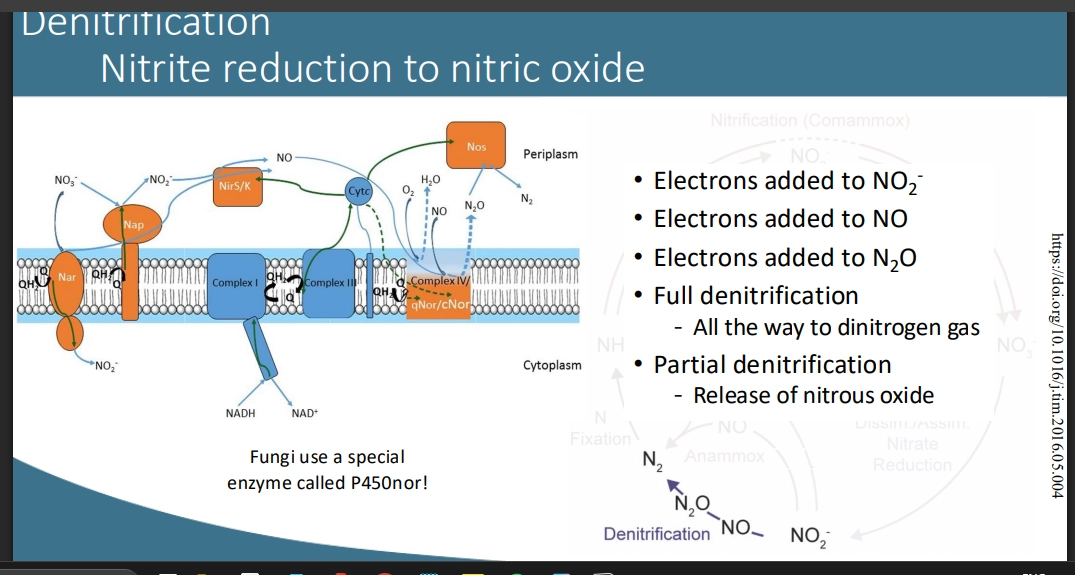

<ul><li><p>so we just keeping reducing NO2- to eventually form N2 gas. closing the Nitrogen cycle loop, a full cycle back to atmospheric N2 released as gas</p></li><li><p>organisms may keep reducing it (Full Denitrificaton) or only do certain steps (Partial Denitification, to form NO-)</p></li><li><p>Partial Denitrification, you just pump out NO- greenhouse gas. </p></li><li><p>tends to happen only anaerobically - as it involves using NO2- &amp; NO- as terminal e acceptors in the e transport chain to drive the proton gradient and make ATP - but with O2 present u can gain more energy, so is preferred when possible. </p></li><li><p>common for orgs to be able to switch under changing conditions </p></li><li><p>eg Fungi use a special enzyme (p450nor) to denitify, making O2 available for other processees</p></li></ul><p></p>
43
New cards

what is the Nitrite NO2- => NH4+ reduction shortcut in the N cycle?

  • two types (dissimilatory & assimilatory)

  • genes involved


  • Dissimilatory Nitrite Reduction to Ammonium (DNRA) OR Assimilatory Nitrite Reduction

  • so reducing Nitrite NO2- to ammonium NH4+ directly, without NO- Nitrous Oxide production (that can potentially be lost from the system and diffuse out)

  • (Assimilatory) N is kept in the system, as the NH4+ is used directly for biomass, along with the NO2- reduction used for energy (terminal e acceptor)

  • (Dissimilatory) N is released from the system as bioavailable NH4+, that is not directly encorporated into biomass of that specific organism, the NO2- is simply used for energy, being a terminal e acceptor

(genes involved)

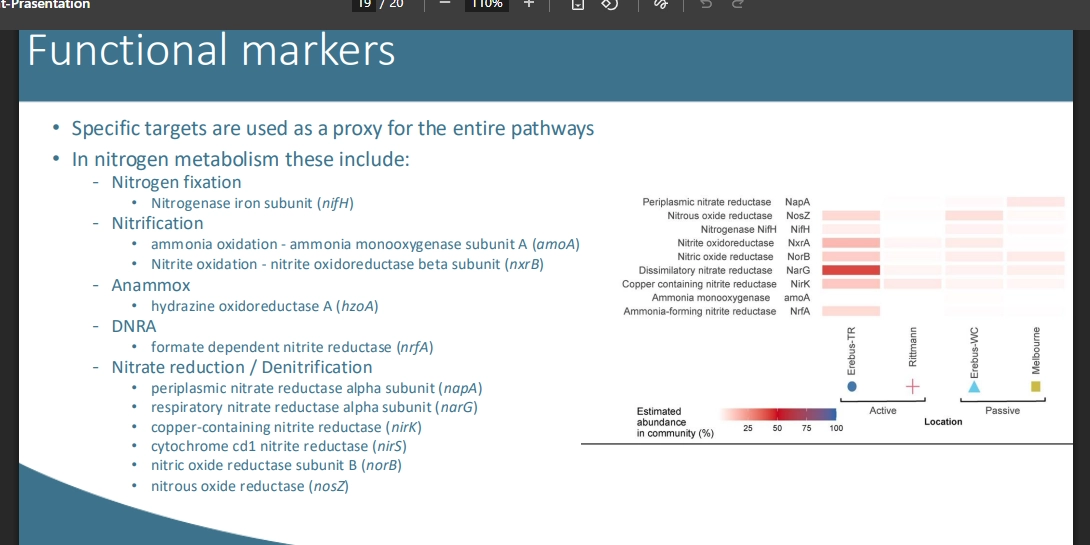
  • nrfA (responsibly for cytochrome)

  • nirA (Responsible for ferrodoxin)

  • correlates to the e carriers involved in the system
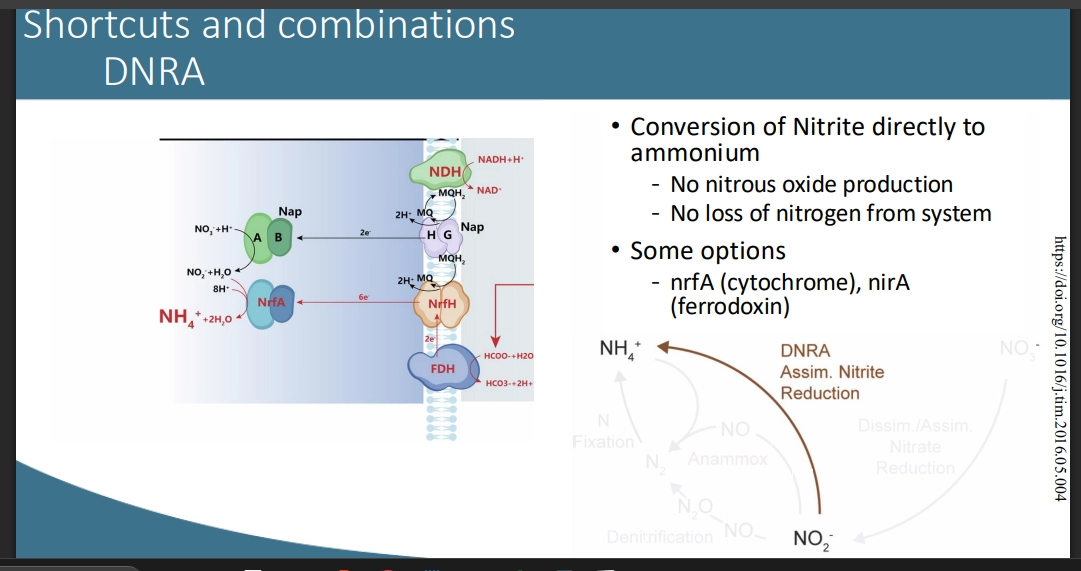

<ul><li><p>Dissimilatory Nitrite Reduction to Ammonium (DNRA) OR Assimilatory Nitrite Reduction</p></li><li><p>so reducing Nitrite NO2- to ammonium NH4+ directly, without NO- Nitrous Oxide production (that can potentially be lost from the system and diffuse out)</p></li><li><p>(Assimilatory) N is kept in the system, as the NH4+ is used directly for biomass, along with the NO2- reduction used for energy (terminal e acceptor)</p></li><li><p>(Dissimilatory) N is released from the system as bioavailable NH4+, that is not directly encorporated into biomass of that specific organism, the NO2- is simply used for energy, being a terminal e acceptor</p></li></ul><p>(genes involved)</p><ul><li><p>nrfA (responsibly for cytochrome)</p></li><li><p>nirA (Responsible for ferrodoxin)</p></li><li><p>correlates to the e carriers involved in the system </p></li></ul><p></p>
44
New cards

what is Ammamox?

  • type of N metabolism occurring

  • the process

  • what organisms


  • Anaerobic Ammonium Oxidation (=> N2)

  • reduces NO2- Nitrite straight to => N2 gas (rather than forming NO- Nitrous Oxide - so no potential loss from the system)

(process)

  • combining DNRA (Dissimilatory Nitrate Reduction to Ammonium) & Nitrite Reduction to Nitric Oixide (NO) => to make Hydrazine (N2H4)

  • uses a complex molecular machine Hydrazine Synthase

  • takes Hydrazine through the Hydrazine Dehydrogenase complex => high energy in Hydrazine compound used to create ATP => uses this energy for cellular processes (so for the purpose of making Energy)

  • to get electrons for the process (e transport chain) requires Ammonium NH4+ to be oxidised in the process (removal of e to create energy), to form N2

  • NO Nitric Oxide is ultimately reduced to form N2 also (removal of e to fuel transport chain)

  • N2 diffuses out of the system (Is cycled).

(location)

  • occurs with membrane proteins but facing a special ‘organelle’ Ammamoxosome, rather than the cytoplasm.

  • thus only occurs in a special group of Planctomycetes (bacteria)


<ul><li><p>Anaerobic Ammonium Oxidation (=&gt; N2)</p></li></ul><ul><li><p>reduces NO2- Nitrite straight to =&gt; N2 gas (rather than forming NO- Nitrous Oxide - so no potential loss from the system)</p></li></ul><p>(process)</p><ul><li><p>combining DNRA (Dissimilatory Nitrate Reduction to Ammonium) &amp; Nitrite Reduction to Nitric Oixide (NO) =&gt; to make Hydrazine (N2H4)</p></li><li><p>uses a complex molecular machine Hydrazine Synthase</p></li><li><p>takes Hydrazine through the Hydrazine Dehydrogenase complex =&gt; high energy in Hydrazine compound used to create ATP =&gt; uses this energy for cellular processes (so for the purpose of making Energy)</p></li><li><p>to get electrons for the process (e transport chain) requires Ammonium NH4+ to be oxidised in the process (removal of e to create energy), to form N2</p></li><li><p>NO Nitric Oxide is ultimately reduced to form N2 also (removal of e to fuel transport chain)</p></li><li><p>N2 diffuses out of the system (Is cycled).</p></li></ul><p>(location)</p><ul><li><p>occurs with membrane proteins but facing a special ‘organelle’ Ammamoxosome, rather than the cytoplasm.</p></li><li><p>thus only occurs in a special group of Planctomycetes (bacteria)</p></li></ul><p></p>
45
New cards

What is Nitrifier Denitrification?

  • Nitrifiers (Oxidising NH4+) Denitification (Reducing NO2-) - a combination of these two pathways

  • so this is the converstion of Ammonium NH4+ => Nitrite NO2- => then we have a shortcut pathway to convert it to Nitrous Oxide N2O via NO conversion

  • so is partial denitirifcation

(when does this occur)

  • with Nitrite NO2- and low O2 conc, it will carry out this partial denitification to form N2O Nitrous Oxide, which will diffuse out of the system

  • this is due to using NO2- as a terminal e acceptor, so it is reduced to for N2O which is not needed anymore then diffuses out

  • Is also a way to offload extra accumulated electrons

(conseqeunces)

  • major source of N2O emissions from farmland & wastewater - as without O2 (eg lots of rain), NH4+ is not used, it is put back as a greenhouse gas

(who?)

  • Bacteria Nitrifiers (Oxidisers of NH4+ Ammonium)
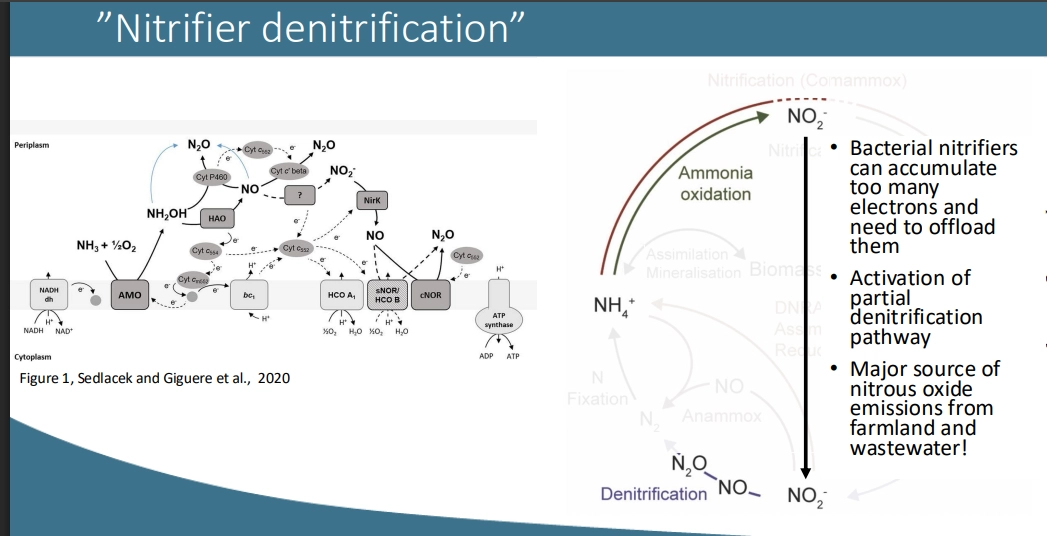

<ul><li><p>Nitrifiers (Oxidising NH4+) Denitification (Reducing NO2-) - a combination of these two pathways </p></li><li><p>so this is the converstion of Ammonium NH4+ =&gt; Nitrite NO2- =&gt; then we have a shortcut pathway to convert it to Nitrous Oxide N2O via NO conversion</p></li><li><p>so is partial denitirifcation </p></li></ul><p>(when does this occur)</p><ul><li><p>with Nitrite NO2- and low O2 conc, it will carry out this partial denitification to form N2O Nitrous Oxide, which will diffuse out of the system</p></li><li><p>this is due to using NO2- as a terminal e acceptor, so it is reduced to for N2O which is not needed anymore then diffuses out</p></li><li><p>Is also a way to offload extra accumulated electrons </p></li></ul><p>(conseqeunces)</p><ul><li><p>major source of N2O emissions from farmland &amp; wastewater - as without O2 (eg lots of rain), NH4+ is not used, it is put back as a greenhouse gas</p></li></ul><p>(who?)</p><ul><li><p>Bacteria Nitrifiers (Oxidisers of NH4+ Ammonium)</p></li></ul><p></p>
46
New cards

What are the relationships between the genes for Nitrogen Metabolism?

What may this help us figure out?

  • complex relationships!

  • for metabolising different N compunds, different sets of proteins are utiliseds, encoded for by certain genes - so these are shared among those carrying out the same process

  • Keg IDs are attached to sets of proteins that carry out certain processes - so looking at an organism’s genome for combinations of genes for thse, we can hypothesise what part of the N cycle they associate with

(figure out?)

  • therefore we can use functional markers of genes that we know are associated wit different parts of N metabolism, and if detected in an organism - we can hypothesise it may be able to do this portion of the N cycle

  • therefore different markers for oxidising NH4+, ammamox, shortcuts or combinations - etc

  • can also look at these in environmental contexts, to tell us abot what the community as a whole is doing (eg Ammamox communitiy, Denitrifying community)

  • Also key to look at the environmental conditions (Eg ANanerboic vs Aerobic) to see if these hypotheses are realistic
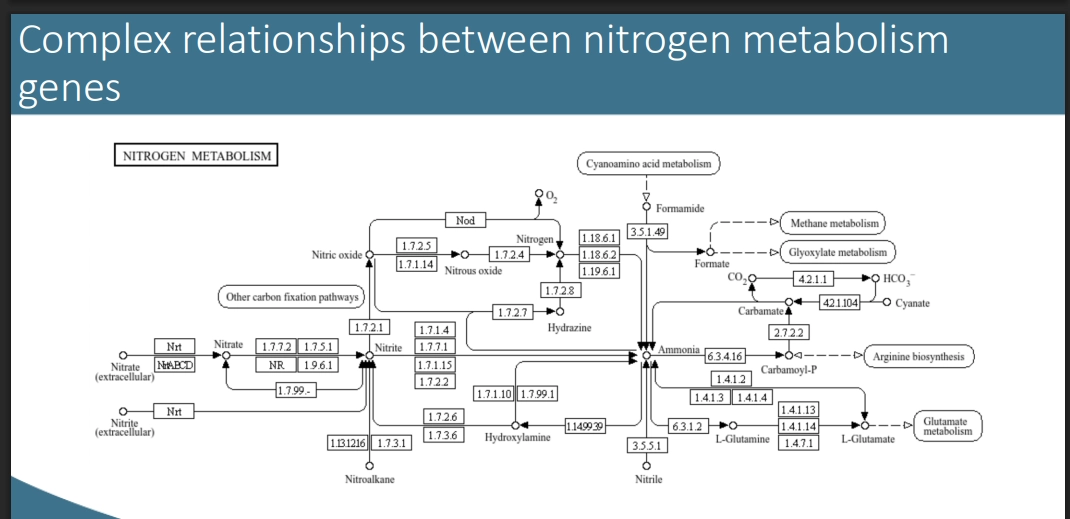

<ul><li><p>complex relationships!</p></li><li><p>for metabolising different N compunds, different sets of proteins are utiliseds, encoded for by certain genes - so these are shared among those carrying out the same process</p></li><li><p>Keg IDs are attached to sets of proteins that carry out certain processes - so looking at an organism’s genome for combinations of genes for thse, we can hypothesise what part of the N cycle they associate with</p></li></ul><p>(figure out?)</p><ul><li><p>therefore we can use functional markers of genes that we know are associated wit different parts of N metabolism, and if detected in an organism - we can hypothesise it may be able to do this portion of the N cycle</p></li><li><p>therefore different markers for oxidising NH4+, ammamox, shortcuts or combinations - etc </p></li><li><p>can also look at these in environmental contexts, to tell us abot what the community as a whole is doing (eg Ammamox communitiy, Denitrifying community) </p></li><li><p>Also key to look at the environmental conditions (Eg ANanerboic vs Aerobic) to see if these hypotheses are realistic</p></li></ul><p></p>
47
New cards

What are the different genetic markers for different parts of Nitrogen Metabolism?

(Nitrogen Fixation)

  • N2 => NH4+

  • nifH

(Nitrification)

  • NH4+ => NO2- => NO3-

  • amoA (NH4+ Oxidation)

  • nxrB (NO2- Oxidation)

(Ammamox)

  • NO2- => N2, NH4+ => N2

  • hzoA

(DNRA)

  • NO2- => NH4+

  • nrfA

(Nitrate reduction / Denitification)

  • NO3- => NO2- => N2O => N2

  • napA

  • narG

  • nirK

  • nirS

  • norB

  • nosZ


<p>(Nitrogen Fixation)</p><ul><li><p>N2 =&gt; NH4+</p></li><li><p>nifH</p></li></ul><p>(Nitrification)</p><ul><li><p>NH4+ =&gt; NO2- =&gt; NO3-</p></li><li><p>amoA (NH4+ Oxidation)</p></li><li><p>nxrB (NO2- Oxidation)</p></li></ul><p>(Ammamox)</p><ul><li><p>NO2- =&gt; N2, NH4+ =&gt; N2</p></li><li><p>hzoA</p></li></ul><p>(DNRA)</p><ul><li><p>NO2- =&gt; NH4+</p></li><li><p>nrfA</p></li></ul><p>(Nitrate reduction / Denitification)</p><ul><li><p>NO3- =&gt; NO2- =&gt; N2O =&gt; N2</p></li><li><p>napA</p></li><li><p>narG</p></li><li><p>nirK</p></li><li><p>nirS</p></li><li><p>norB</p></li><li><p>nosZ</p></li></ul><p></p>
48
New cards

How is thermodynamics (the 1st Law) the key to microbial growth?

  • How do microbes get energy?

  • How do they actually power metabolism to grow?

  • Give an example!


  • deltaG (gibbs free energy) from Redox (Reduction - adding e & Oxidation - removing e) reactions involving various compounds, are exploited to fuel microbial metabolisms

(getting energy)

  • Energy Source Reductant + Oxidant => Energy + Biomass + Waste

  • eg Humans (Chemoheterotrophs): Glucose + O2 => Energy + Biomass + CO2

  • the Oxidant accepts e from the Reductant energy source, carrying out a Redox reaction, that generates heat (Energy) & Biomass (& waste products)

  • done so via Oxidant acting as a Terminal e Acceptor in the e transport chain (transforming Energy but harveating small bits along the way to be captured in usable cellular forms (eg by ATP) - metabolism) => 1st law of TD

  • along with this requires Energy Input (eg Enzyme) to catalyse these rxns, overcome the Ea to actually do Redox with the Energy source & the Oxidant

  • Energy harvested is used for cell maintenance, biosynthesis of enzymes, homeostasis, replication, motility

(metabolism?)

  • these reactions are metabolism. the sum of Catabolic & Anabolic rxns

  • Catabolic reactions break down organic compounds into smaller bits => creates Energy to power cellular processes

  • Dissimilatory rxns (releasing things)

  • Anabolic rxns use Energy to make complex molecules => e.g. DNA & Lipids => Creates biomass

  • Assimilatory rxns (taking things up)

(example)

  • Hydrogenobacter thermophilus

  • O2 oxidant + 2H2 energy source + Enzymes energy input => 2H2O + (heat) Energy + CO2

  • energy is used to power cellular processes

  • some energy is used to fix atmospheric CO2 to C, to be used for biomass generation (eg likely to be around in early Earth, making C bioavailable based on whats around)

  • energy isnt all released at once (=explosion), small bits are taken out along each transformation (e transport chain) and added to E carriers (ATP) for use in cellular processes
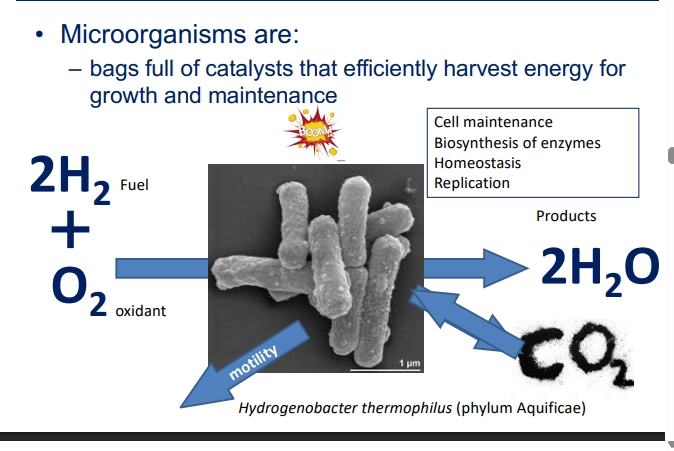

<ul><li><p>deltaG (gibbs free energy) from Redox (Reduction - adding e &amp; Oxidation - removing e) reactions involving various compounds, are exploited to fuel microbial metabolisms</p></li></ul><p>(getting energy)</p><ul><li><p>Energy Source Reductant + Oxidant =&gt; Energy + Biomass + Waste</p></li><li><p>eg Humans (Chemoheterotrophs): Glucose + O2 =&gt; Energy + Biomass + CO2</p></li><li><p>the Oxidant accepts e from the Reductant energy source, carrying out a Redox reaction, that generates heat (Energy) &amp; Biomass (&amp; waste products)</p></li><li><p>done so via Oxidant acting as a Terminal e Acceptor in the e transport chain (transforming Energy but harveating small bits along the way to be captured in usable cellular forms (eg by ATP) - metabolism) =&gt; 1st law of TD</p></li><li><p>along with this requires Energy Input (eg Enzyme) to catalyse these rxns, overcome the Ea to actually do Redox with the Energy source &amp; the Oxidant </p></li><li><p>Energy harvested is used for cell maintenance, biosynthesis of enzymes, homeostasis, replication, motility</p></li></ul><p>(metabolism?)</p><ul><li><p>these reactions are metabolism. the sum of Catabolic &amp; Anabolic rxns</p></li><li><p>Catabolic reactions break down organic compounds into smaller bits =&gt; creates Energy to power cellular processes</p></li><li><p>Dissimilatory rxns (releasing things)</p></li><li><p>Anabolic rxns use Energy to make complex molecules =&gt; e.g. DNA &amp; Lipids =&gt; Creates biomass</p></li><li><p>Assimilatory rxns (taking things up)</p></li></ul><p>(example)</p><ul><li><p>Hydrogenobacter thermophilus </p></li><li><p>O2 oxidant + 2H2 energy source + Enzymes energy input =&gt; 2H2O + (heat) Energy + CO2</p></li><li><p>energy is used to power cellular processes </p></li><li><p>some energy is used to fix atmospheric CO2 to C, to be used for biomass generation (eg likely to be around in early Earth, making C bioavailable based on whats around)</p></li><li><p>energy isnt all released at once (=explosion), small bits are taken out along each transformation (e transport chain) and added to E carriers (ATP) for use in cellular processes</p></li></ul><p></p>
49
New cards

Describe Redox Reactions (with a biological lens)

& What are Standard Reduction Potentials (E0)?

  • What do deltaE0 tell us about a Redox Rxn?


(Redox Rxns)

  • Oxidation-Reduction rxns

  • an Acceptor Compound (Oxidant, is Reduced) accepts e from the Donor Compound (Reductant, is Oxidised) which therefore loses an e

  • eg O2 (terminal e acceptor) is Reduced via gaining an e from the Energy Source (which is Oxidised), via e transport along the transport chain

  • two half rxns therefore. chemicals not directly interacting - instead it is their e that are exchanged and used to transform each compound

(Standard Reduction Potentials)

  • the sum of E in the Redox system = E0

  • E0 measures the tendency for a Donor (Reductant, is Oxidised) to lose its e.

  • more Negative = Likelier to Lose

  • more Positive = Less Likelier to Lose (=Likelier to Act as an Acceptor Compound, an Oxidant which is Reduced)

(deltaE0)

  • deltaE0 = E0 Acceptor - E0 Donor

  • therefore, the greater difference in E0, the greater the value of deltaE0, which means the more tendency to react (negative value = wont react spontaneously)

  • this is due to higher E0 being strong e Acceptors (low tendency to be a donor) & low E0 being strong e Donors (high tendency to be a donor)


<p>(Redox Rxns)</p><ul><li><p>Oxidation-Reduction rxns</p></li><li><p>an Acceptor Compound (Oxidant, is Reduced) accepts e from the Donor Compound (Reductant, is Oxidised) which therefore loses an e</p></li><li><p>eg O2 (terminal e acceptor) is Reduced via gaining an e from the Energy Source (which is Oxidised), via e transport along the transport chain</p></li><li><p>two half rxns therefore. chemicals not directly interacting - instead it is their e that are exchanged and used to transform each compound</p></li></ul><p>(Standard Reduction Potentials)</p><ul><li><p>the sum of E in the Redox system = E0</p></li><li><p>E0 measures the tendency for a Donor (Reductant, is Oxidised) to lose its e. </p></li><li><p>more Negative = Likelier to Lose </p></li><li><p>more Positive = Less Likelier to Lose (=Likelier to Act as an Acceptor Compound, an Oxidant which is Reduced)</p></li></ul><p>(deltaE0)</p><ul><li><p>deltaE0 = E0 Acceptor - E0 Donor</p></li><li><p>therefore, the greater difference in E0, the greater the value of deltaE0, which means the more tendency to react (negative value = wont react spontaneously)</p></li><li><p>this is due to higher E0 being strong e Acceptors (low tendency to be a donor) &amp; low E0 being strong e Donors (high tendency to be a donor)</p></li></ul><p></p>
50
New cards

how does deltaE0 for the Redox between the Oxidant & the Energy Source for biological energy generation, affect efficiency of metabolism?

  • Oxygen vs Sulfur

  • Human example

  • Microbe example


  • the higher the deltaE0 value, the greater E0 difference between the Oxidant & the Energy Source

  • this means there is a higher tendency to react (more favorable), due to the Oxidant having a higher tendency to accept e & the Energy source with a higher tendency to donate e

  • therefore biological metabolisms that utilise Oxidants & Energy sources with greater E0 differences, generate greater deltaE0 values in their Redox rxns for energy, so energy generation is more efficient

(Oxygen vs Sulfur)

  • the above idea explains why despite O2 being toxic for life - mechanisms have been evolved to tolerate it, because its a srong E acceptor which works well alongside Glucose as a strong E donor Energy Source - to provide efficient energy generation in aerobic conditions

  • metabolisms could use S as a terminal e acceptor, but this has a much lower (negative) E0 value than O2 (positive) thus the deltaE0 is much lower (still positive, still spontaneous) so Energy geneation is less favorable (less efficient)

  • O2 isnt always available - but when it is (aerobic) & in environments where it may be available sometimes, organisms have evolved to be able to use it (even if these are secondary rxns)

  • this is due to how efficient it is as a terminal e acceptor

(Humans)

  • chemoheterotrophs. we breathe in O2 to use as our terminal e acceptor

  • for our Energy source, we have options (lipids, carbs, proteins) which have different standard redox potentials E0, so they provide different amounts of energy (via differentially favorable rxns) due to different deltaE0 in their redox with O2

  • different E density per grams

(Microbes)

  • a great variety, so also a great variety of terminal e acceptors & E sources (e donors), evolved to be able to metabolise, based on different niches and environments

  • however, those dominant in the environment, will be utilising the combination that provides the greater deltaE0 value

  • eg differ terminal e acceptor (O2 vs S) but keep the same E source (glucose) => more E generated with O2 redox => more biomass generated => more reproduction => more dominant in the exocystem

  • more favorable rxn, more E geneated, more biomass geneated

  • eg Deferribacter desulfuricans (Sulfur) vs E.coli (Oxygen) => E.coli dominant by far


<ul><li><p>the higher the deltaE0 value, the greater E0 difference between the Oxidant &amp; the Energy Source</p></li><li><p>this means there is a higher tendency to react (more favorable), due to the Oxidant having a higher tendency to accept e &amp; the Energy source with a higher tendency to donate e</p></li><li><p>therefore biological metabolisms that utilise Oxidants &amp; Energy sources with greater E0 differences, generate greater deltaE0 values in their Redox rxns for energy, so energy generation is more efficient</p></li></ul><p>(Oxygen vs Sulfur)</p><ul><li><p>the above idea explains why despite O2 being toxic for life - mechanisms have been evolved to tolerate it, because its a srong E acceptor which works well alongside Glucose as a strong E donor Energy Source - to provide efficient energy generation in aerobic conditions</p></li><li><p>metabolisms could use S as a terminal e acceptor, but this has a much lower (negative) E0 value than O2 (positive) thus the deltaE0 is much lower (still positive, still spontaneous) so Energy geneation is less favorable (less efficient)</p></li><li><p>O2 isnt always available - but when it is (aerobic) &amp; in environments where it may be available sometimes, organisms have evolved to be able to use it (even if these are secondary rxns)</p></li><li><p>this is due to how efficient it is as a terminal e acceptor</p></li></ul><p>(Humans)</p><ul><li><p>chemoheterotrophs. we breathe in O2 to use as our terminal e acceptor </p></li><li><p>for our Energy source, we have options (lipids, carbs, proteins) which have different standard redox potentials E0, so they provide different amounts of energy (via differentially favorable rxns) due to different deltaE0 in their redox with O2</p></li><li><p>different E density per grams</p></li></ul><p>(Microbes)</p><ul><li><p>a great variety, so also a great variety of terminal e acceptors &amp; E sources (e donors), evolved to be able to metabolise, based on different niches and environments</p></li><li><p>however, those dominant in the environment, will be utilising the combination that provides the greater deltaE0 value </p></li><li><p>eg differ terminal e acceptor (O2 vs S) but keep the same E source (glucose) =&gt; more E generated with O2 redox =&gt; more biomass generated =&gt; more reproduction =&gt; more dominant in the exocystem</p></li><li><p>more favorable rxn, more E geneated, more biomass geneated</p></li><li><p>eg Deferribacter desulfuricans (Sulfur) vs E.coli (Oxygen) =&gt; E.coli dominant by far </p></li></ul><p></p>
51
New cards

How do the ideas of Redox & Energy generation, fit into Early Earth evolution?

  • conditions early Earth

  • how were available things utilised


(early earth)

  • very reduced. Nothing had been oxidised => compounds had high Energy, locked in their bonds (lots of electrons. not being released)

  • Low O2 in the atmosphere. Anaerobic conditions

  • some sulfur, iron, and trace minerals critical for enzymes

(utilising these conditions?)

  • without O2, Energy generation required using things at the top of the redox tower (low E0, low tendency to accept e - but they had to) eg Sulfur

  • basically making do with poor redox rxns (less favorable) - as the more favorable higher E0 values were locked away in rocks

  • this provided enough E for metabolism to sustain Microbes, eventually allowing O2 production (via Phototrophy using light E & water => release O2, from oxdising water)

  • this made O2 available in the atmosphere, to be used as a terminal e acceptor

  • it also released all critical materials as rocks started oxidising (reacting with o2)


<p>(early earth)</p><ul><li><p>very reduced. Nothing had been oxidised =&gt; compounds had high Energy, locked in their bonds (lots of electrons. not being released)</p></li><li><p>Low O2 in the atmosphere. Anaerobic conditions</p></li><li><p>some sulfur, iron, and trace minerals critical for enzymes</p></li></ul><p>(utilising these conditions?)</p><ul><li><p>without O2, Energy generation required using things at the top of the redox tower (low E0, low tendency to accept e - but they had to) eg Sulfur</p></li><li><p>basically making do with poor redox rxns (less favorable) - as the more favorable higher E0 values were locked away in rocks</p></li><li><p>this provided enough E for metabolism to sustain Microbes, eventually allowing O2 production (via Phototrophy using light E &amp; water =&gt; release O2, from oxdising water)</p></li><li><p>this made O2 available in the atmosphere, to be used as a terminal e acceptor</p></li><li><p>it also released all critical materials as rocks started oxidising (reacting with o2)</p></li></ul><p></p>
52
New cards

what is the fundamental idea for microbes in different environments?

  • if there is free energy available to be used in a system / environment, a microbe will find a way to use this energy to grow

  • e.g. dirt puddles (Fe2+ terminal e acceptor)

  • eg sea floor Archaea & bacteria

  • eg Yellowstone NP spring, releasing gas as waste


53
New cards

how does Hydrogenobacter thermophilus Bacteria Redox actually occur in the cell?

  • O2 oxidant (terminal e acceptor) + H2 Energy Source (Reductant is oxidised) => Energy + H2O

(half rxns)

  • H2 is oxidised => H2O

  • O2 is reduced => 2H2O

  • these half rxns are seperated within the cell - seperating the Energy into different places, so we dont see a big explosion. enables harvesting along the way for cellular use

  • way too much energy to do in one step, so is broken down into many to be manageable to the cell, providing these bits of energy with each e transfer (thru carriers & intermediates)

(e transport chain)

  • H2 is oxidised (e removed) => e passed onto NAD+ e carrier to form reduced NADH => e passed through various other e carriers => e loses energy sequentially along the way (as more and more Redox occurs with the e carriers)

  • energy from each transfer of electron, is used to pump H+ out of the cell against its concentration gradient

  • this creates an H+ gradient, with higher conc outside of the cell

  • eventually the e is added to O2 => thus acting as the terminal e acceptor => is reduced to 2H2O

(proton gradient)

  • H+ comes in through ATPase via passive movement, to restore the balance of concentration. This movement is coupled with the addition of inorganic Phosphate to ADP => forms ATP

  • the energy harvested along the way (each bit of energy from each e transfer used to move a proton against its gradient) is ultimately used to form ATP (usable form of energy for the cell)
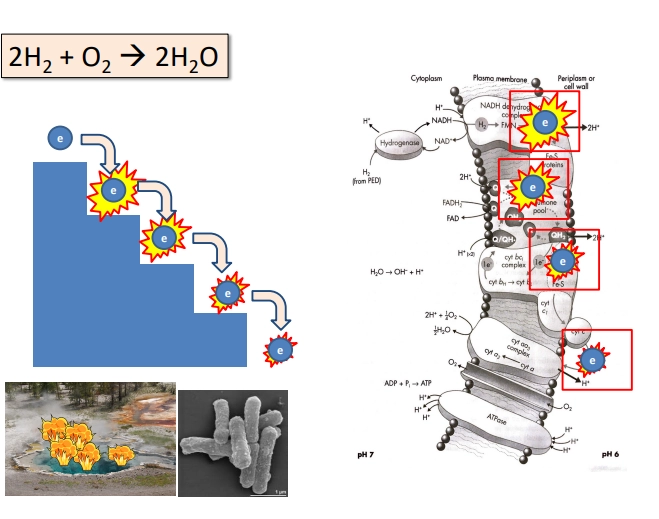

<ul><li><p>O2 oxidant (terminal e acceptor) + H2 Energy Source (Reductant is oxidised) =&gt; Energy + H2O</p></li></ul><p>(half rxns)</p><ul><li><p>H2 is oxidised =&gt; H2O</p></li><li><p>O2 is reduced =&gt; 2H2O</p></li><li><p>these half rxns are seperated within the cell - seperating the Energy into different places, so we dont see a big explosion. enables harvesting along the way for cellular use</p></li><li><p>way too much energy to do in one step, so is broken down into many to be manageable to the cell, providing these bits of energy with each e transfer (thru carriers &amp; intermediates)</p></li></ul><p>(e transport chain)</p><ul><li><p>H2 is oxidised (e removed) =&gt; e passed onto NAD+ e carrier to form reduced NADH =&gt; e passed through various other e carriers =&gt; e loses energy sequentially along the way (as more and more Redox occurs with the e carriers)</p></li><li><p>energy from each transfer of electron, is used to pump H+ out of the cell against its concentration gradient</p></li><li><p>this creates an H+ gradient, with higher conc outside of the cell </p></li><li><p>eventually the e is added to O2 =&gt; thus acting as the terminal e acceptor =&gt; is reduced to 2H2O</p></li></ul><p>(proton gradient)</p><ul><li><p>H+ comes in through ATPase via passive movement, to restore the balance of concentration. This movement is coupled with the addition of inorganic Phosphate to ADP =&gt; forms ATP</p></li><li><p>the energy harvested along the way (each bit of energy from each e transfer used to move a proton against its gradient) is ultimately used to form ATP (usable form of energy for the cell)</p></li></ul><p></p>
54
New cards

what is the idea of Energy Conservation and what are the 3 methods in which microbes achieve this?

  • the ultimate goal of microbes - to convert external Energy sources to cellular Energy (to do work => biomolecules => biomass) as efficiently as possible, minimising any E lost from the system (so little bits are harvested along the way, added to usable E carriers like ATP - etc)

(methods)

  • Oxidative Phosphorylation - oxidising substrates to generate ATP (eg e transport chain, removing e from the E source, and passing it through various carriers, harvesting the E along the way to pump protons, whose movement back is coupled with ADP phosphorylation)

  • Substrate-level Phosphorylation - direct transfer of Pi (PO3-) from substrates to ADP to generate ATP (harvesting the E from one substrate, and adding it to a cellularly available E carrier)

  • Electron Bifurcation - not focused for this course (little known idea). just overall concept is the coupling of exergonic (Spont generates E) & endergonic (nonspon requires E) rxns involving e transfer - to minimise E loss & enabling rxns that wouldnt occur alone (both directions in the redox table)
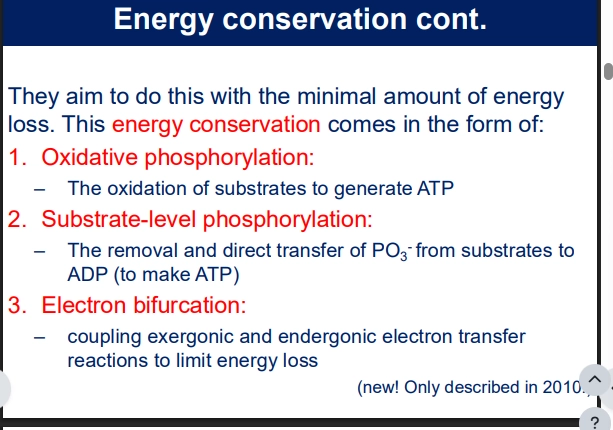

<ul><li><p>the ultimate goal of microbes - to convert external Energy sources to cellular Energy (to do work =&gt; biomolecules =&gt; biomass) as efficiently as possible, minimising any E lost from the system (so little bits are harvested along the way, added to usable E carriers like ATP - etc)</p></li></ul><p>(methods)</p><ul><li><p>Oxidative Phosphorylation - oxidising substrates to generate ATP (eg e transport chain, removing e from the E source, and passing it through various carriers, harvesting the E along the way to pump protons, whose movement back is coupled with ADP phosphorylation)</p></li><li><p>Substrate-level Phosphorylation - direct transfer of Pi (PO3-) from substrates to ADP to generate ATP (harvesting the E from one substrate, and adding it to a cellularly available E carrier)</p></li><li><p>Electron Bifurcation - not focused for this course (little known idea). just overall concept is the coupling of exergonic (Spont generates E) &amp; endergonic (nonspon requires E) rxns involving e transfer - to minimise E loss &amp; enabling rxns that wouldnt occur alone (both directions in the redox table)</p></li></ul><p></p>
55
New cards

what is ATP’s overall role in Microbe metabolism

& how is energy actually put into in this molecule cellularly?

(ATP)

  • used to drive all cellular endergonic (req energy, anabolic, creating molecules) processes - as this is Energy put into a usable cellular form (able to do work)

  • upon hydrolysis (1 or 2 of the triphosphate groups lost) the E inbreaking these high energy, unstable bonds - is used for work (Transport molecules. sythesis molecules. do things against their thermodynamic spontaneity)

  • this forms ADP & Pi

  • then catabolic rxns generate more ATP (respiration, fermentation, phototrophy) , by phosphorylating ADP

  • => the cycle repeats AND THIS IS METABOLISM

  • (Putting energy into ATP)

  • Redox half rxns are seperated within cells, but their Energy from e donation and acception, to allow for maximal energy conservation, is let out little by little, to ultimately be captured to form ATP

  • via electron carriers (coenzymes) that carry electrons, and each movement and transfer (Acception or donation of e) releases a bit of energy (eg pump protons) until this builds up (proton flow into the cell) and is coupled to phosphorylate ATP (puts the energy into ATP with maximum conservation)

  • eg NAD+ /NADH, FAD+/FADH2. reduced or oxidised forms, determines whether they have an e to donate, or space to accept an e (Each have different E0. so relative efficiencies)


<p>(ATP)</p><ul><li><p>used to drive all cellular endergonic (req energy, anabolic, creating molecules) processes - as this is Energy put into a usable cellular form (able to do work)</p></li><li><p>upon hydrolysis (1 or 2 of the triphosphate groups lost) the E inbreaking these high energy, unstable bonds - is used for work (Transport molecules. sythesis molecules. do things against their thermodynamic spontaneity)</p></li><li><p>this forms ADP &amp; Pi </p></li><li><p>then catabolic rxns generate more ATP (respiration, fermentation, phototrophy) , by phosphorylating ADP</p></li><li><p>=&gt; the cycle repeats AND THIS IS METABOLISM</p></li><li><p>(Putting energy into ATP)</p></li><li><p>Redox half rxns are seperated within cells, but their Energy from e donation and acception, to allow for maximal energy conservation, is let out little by little, to ultimately be captured to form ATP</p></li><li><p>via electron carriers (coenzymes) that carry electrons, and each movement and transfer (Acception or donation of e) releases a bit of energy (eg pump protons) until this builds up (proton flow into the cell) and is coupled to phosphorylate ATP (puts the energy into ATP with maximum conservation)</p></li><li><p>eg NAD+ /NADH, FAD+/FADH2. reduced or oxidised forms, determines whether they have an e to donate, or space to accept an e (Each have different E0. so relative efficiencies) </p></li></ul><p></p>
56
New cards

Central Metabolism

  • how is this different from “Metabolism”

  • what are the 4 components


  • central metabolism is the core Metabolic pathways / rxns within a cell fundamentally - within the overall metabolism (all rxns in a cell)

  • makes up a small but important portion. largely largely conserved

  • is fundamentally the same in all organisms - what differs is the terminal e acceptor & energy sourced - based on whats abailable in their environment.

(components?)

  1. Glycolysis

  2. TCA Cycle (Citric Acid Cycle)

  3. Respiration (e Transport Chain)

  4. Fermentation

(everything else?)

  • biomolecule synthesis, cellular component synthesis…
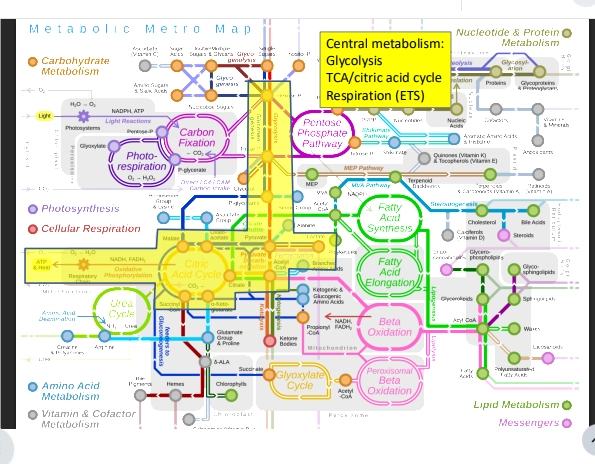

<ul><li><p>central metabolism is the core Metabolic pathways / rxns within a cell fundamentally - within the overall metabolism (all rxns in a cell)</p></li><li><p>makes up a small but important portion. largely largely conserved</p></li><li><p>is fundamentally the same in all organisms - what differs is the terminal e acceptor &amp; energy sourced - based on whats abailable in their environment.</p></li></ul><p>(components?)</p><ol><li><p>Glycolysis</p></li><li><p>TCA Cycle (Citric Acid Cycle)</p></li><li><p>Respiration (e Transport Chain)</p></li><li><p>Fermentation</p></li></ol><p>(everything else?)</p><ul><li><p>biomolecule synthesis, cellular component synthesis…</p></li></ul><p></p>
57
New cards

what is Glycolysis?

  • overall

  • required conditions

  • inputs & outputs

  • fundamental rxn


(overall)

  • breakdown of glucose => pyruvate

  • substrate-level phosphorylation, removing P from glucose phosphate intermediate => add to ADP => forms ATP

  • anoxic (doesnt involve a redox rxn - no terminal e acceptor required)

(rxn)

  • adding P to glucose (substrate level phos) => splitting glycose in half => adding P to ADP to form ATP => breaking bonds and transferring e to NAD+ to form NADH

(inputs & outputs)

  • input glucose => output 2pyruvate (glucose split apart)

  • input 2ATP (1 per pyruvate molecule branch) => output 4ATP (2ATP yield)

  • input 2NAD+ => output 2NADH (e in carriers)
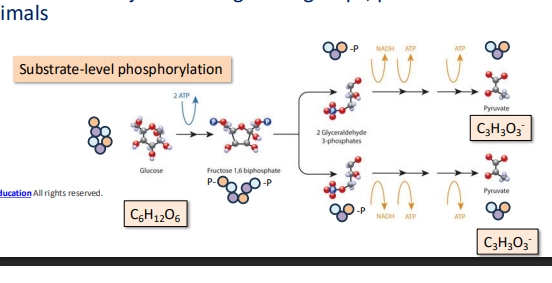

<p>(overall)</p><ul><li><p>breakdown of glucose =&gt; pyruvate </p></li><li><p>substrate-level phosphorylation, removing P from glucose phosphate intermediate =&gt; add to ADP =&gt; forms ATP</p></li><li><p>anoxic (doesnt involve a redox rxn - no terminal e acceptor required)</p></li></ul><p>(rxn)</p><ul><li><p>adding P to glucose (substrate level phos) =&gt; splitting glycose in half =&gt; adding P to ADP to form ATP =&gt; breaking bonds and transferring e to NAD+ to form NADH</p></li></ul><p>(inputs &amp; outputs)</p><ul><li><p>input glucose =&gt; output 2pyruvate (glucose split apart)</p></li><li><p>input 2ATP (1 per pyruvate molecule branch) =&gt; output 4ATP (2ATP yield)</p></li><li><p>input 2NAD+ =&gt; output 2NADH (e in carriers)</p></li></ul><p></p>
58
New cards

what is the Citric Acid / TCA Cycle?

  • overall

  • rxn

  • inputs and outputs


(overall)

  • pyruvate => acetyl CoA => entirely converting to CO2 (glucose complete breakdown)

  • done so to remove its high Energy electrons for use in the cell => added to e carriers to be used in subsequent respiration steps

  • essentially using the glucose remainder, completely breaking it down to diffuse out, and harvesting all its Energy & e to be stored in ATP & e carriers, to be used in the final stage of respiration to generate mass ATP

(rxn)

  • a cyclic process. the starting substrate that reacts with Acetyl CoA input (joined together) Oxaloacetate, is regeneratd in the final step to then react again with another Acetyl CoA input

(inputs & outputs)

  • input pyruvate => output 3CO2

  • input 3NAD+ => output 3NADH

  • input 1NADP+ => output 1NADPH

  • input 1FAD+ => output 1FADH2

  • input 4ADP/GDP => Output 4ATP/GTP


<p>(overall)</p><ul><li><p>pyruvate =&gt; acetyl CoA =&gt; entirely converting to CO2 (glucose complete breakdown)</p></li><li><p>done so to remove its high Energy electrons for use in the cell =&gt; added to e carriers to be used in subsequent respiration steps</p></li><li><p>essentially using the glucose remainder, completely breaking it down to diffuse out, and harvesting all its Energy &amp; e to be stored in ATP &amp; e carriers, to be used in the final stage of respiration to generate mass ATP </p></li></ul><p>(rxn)</p><ul><li><p>a cyclic process. the starting substrate that reacts with Acetyl CoA input (joined together) Oxaloacetate, is regeneratd in the final step to then react again with another Acetyl CoA input </p></li></ul><p>(inputs &amp; outputs)</p><ul><li><p>input pyruvate =&gt; output 3CO2</p></li><li><p>input 3NAD+ =&gt; output 3NADH</p></li><li><p>input 1NADP+ =&gt; output 1NADPH</p></li><li><p>input 1FAD+ =&gt; output 1FADH2</p></li><li><p>input 4ADP/GDP =&gt; Output 4ATP/GTP</p></li></ul><p></p>
59
New cards

what is Respiration

  • overall

  • rxn

  • inputs & outputs

  • purpose


(overall)

  • transferring e between e carriers (eg NADH & FADH2) & membrane protein complexes, to use their energy bit by bit to pump protons out of the cell

  • ultimately transferring them to the terminal e acceptor (eg O2 => H2O)

  • this forms a proton gradient across the membrane - whose energy is harvested upon passive movement back into the cell through ATPase

  • their movement in is coupled with Oxidative Phosphorylation of ADP + Pi => ATP

(inputs & outputs)

  • 32-34 ADP => 32-34 ATP

  • O2 => H2O

  • NADH & FADH2 => NAD+ & FAD+

(purpose)

  • using the e gathered from complete breakdown of glucose and added to e carriers via their reduction (NADH & FADH2) from glycolysis & TCA cycle, to convert their energy into usable cellular energy (ATP) bit by bit to conserve this energy (efficiently harvest it)


<p>(overall)</p><ul><li><p>transferring e between e carriers (eg NADH &amp; FADH2) &amp; membrane protein complexes, to use their energy bit by bit to pump protons out of the cell</p></li><li><p>ultimately transferring them to the terminal e acceptor (eg O2 =&gt; H2O)</p></li><li><p>this forms a proton gradient across the membrane - whose energy is harvested upon passive movement back into the cell through ATPase </p></li><li><p>their movement in is coupled with Oxidative Phosphorylation of ADP + Pi =&gt; ATP </p></li></ul><p>(inputs &amp; outputs)</p><ul><li><p>32-34 ADP =&gt; 32-34 ATP</p></li><li><p>O2 =&gt; H2O</p></li><li><p>NADH &amp; FADH2 =&gt; NAD+ &amp; FAD+</p></li></ul><p>(purpose)</p><ul><li><p>using the e gathered from complete breakdown of glucose and added to e carriers via their reduction (NADH &amp; FADH2) from glycolysis &amp; TCA cycle, to convert their energy into usable cellular energy (ATP) bit by bit to conserve this energy (efficiently harvest it)</p></li></ul><p></p>
60
New cards

what is the importance of the terminal e acceptor

  • this removes the final destination for e to leave the e transport chain, so without one e will back up the system

  • protein complexes & e carriers will fill up and remain reduced, and no more e will be able to enter the system and be transported between them

  • therefore no protons will be able to be pumped out of the cell, as there are no little bits of energy harvested upon their transport (no e transported)


61
New cards

where does respiration actully happen in microbes (vs euks)

  • we think of resp occurring in the mitochondria - but microbes lack organelles

  • they do have compartmentalisation of activity, so resp occurs at the cellular plasma membrane, and e transport chain occurs between the cell interior & exterior


62
New cards

fermentation

  • when does this occur (the decision point)

  • how does it carry out this process

  • what diversity do we see


(the decision point)

  • in absense of the terminal e acceptor, there is no point of continuing on from glycolysis to do the TCA cycle - as substrates & e will simply build up and not be able to go anywhere

  • without the terminal e acceptor, the e transfer chain gets clogged up and all members are stuck in reduced forms. no e movement. no protons moved.

  • furthermore, additional steps must be made to enable glycolysis to continue cycling (so the cell can continue making ATP) - we require NAD+ as an input, so we need extra processes to regeneate this substrate

  • pyruvate must be converted to a waste product additionally, so it doesnt accumulate and potentially cause harm

(the process)

  • pyruvate is produced in glycolysis => NADH reduces pyruvate => forms NAD+ to put through glycolysis again (to generate ATP => also forms throwaway waste product

(diversty)

  • seen in the throwaway / disposable waste products, made via reduction of pyruvate by NADH to regenerate NAD+ for glycolysis

  • eg yeasts (ethanol, CO2) sourdough (various compounds to create unique tastes)

  • eg taking ethanol further => eg butanoyl

  • eg lactic acid (some bacteria, euks)

  • eg porpionate / puss (some bacteria)


<p>(the decision point)</p><ul><li><p>in absense of the terminal e acceptor, there is no point of continuing on from glycolysis to do the TCA cycle - as substrates &amp; e will simply build up and not be able to go anywhere</p></li><li><p>without the terminal e acceptor, the e transfer chain gets clogged up and all members are stuck in reduced forms. no e movement. no protons moved. </p></li><li><p>furthermore, additional steps must be made to enable glycolysis to continue cycling (so the cell can continue making ATP) - we require NAD+ as an input, so we need extra processes to regeneate this substrate </p></li><li><p>pyruvate must be converted to a waste product additionally, so it doesnt accumulate and potentially cause harm </p></li></ul><p>(the process)</p><ul><li><p>pyruvate is produced in glycolysis =&gt; NADH reduces pyruvate =&gt; forms NAD+ to put through glycolysis again (to generate ATP =&gt; also forms throwaway waste product</p></li></ul><p>(diversty)</p><ul><li><p>seen in the throwaway / disposable waste products, made via reduction of pyruvate by NADH to regenerate NAD+ for glycolysis </p></li><li><p>eg yeasts (ethanol, CO2) sourdough (various compounds to create unique tastes)</p></li><li><p>eg taking ethanol further =&gt; eg butanoyl</p></li><li><p>eg lactic acid (some bacteria, euks)</p></li><li><p>eg porpionate / puss (some bacteria)</p></li></ul><p></p>
63
New cards

how can fermentation be used in industry

  • we can make food from fermentation products (or ethanol etc) which is done by forcing the microbe of interest to metabolise in an environment with no terminal e acceptor - so it must do fermentation
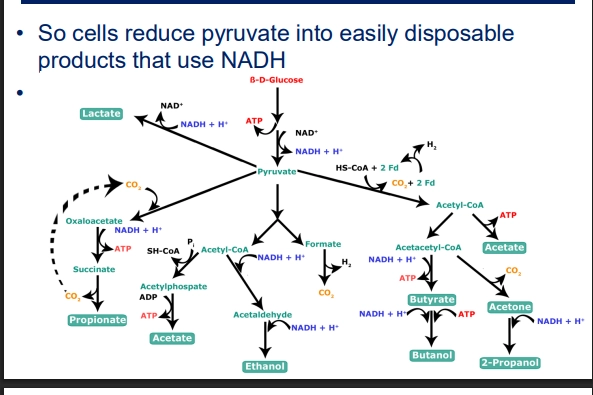

<ul><li><p>we can make food from fermentation products (or ethanol etc) which is done by forcing the microbe of interest to metabolise in an environment with no terminal e acceptor - so it must do fermentation</p></li></ul><p></p>
64
New cards

why isnt fermentation done all the time

so why is it done at all?

(not all the time?)

  • respiration, fully breaking down glucose requring a terminal e acceptor, generates the maximum ATP (32-34) - so when possible it will be done

  • fermentation is far less eficient - generating 2ATP per glucose molecule as the rest of the glucose is thrown away without energy able to be harvested (only done if really requiried)

  • cells want more ATP => can be used to create more biomass => reproduce more, grow more, dominate the ecosystem - etc

(why done at all?)

  • even without a terminal e acceptor, and the possibility to generate maximum ATP, the cell still needs ATP to carry out cellular processes - even if just a skimpy amount
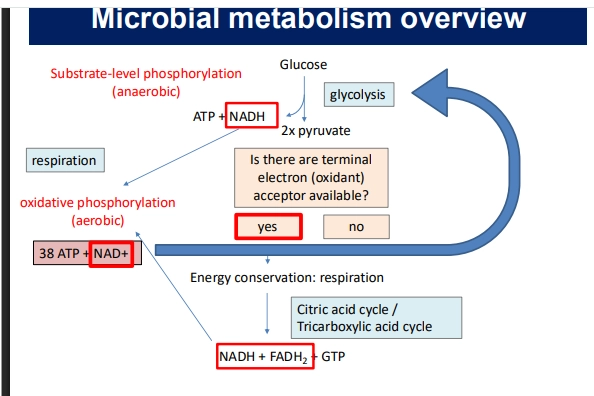

<p>(not all the time?)</p><ul><li><p>respiration, fully breaking down glucose requring a terminal e acceptor, generates the maximum ATP (32-34) - so when possible it will be done</p></li><li><p>fermentation is far less eficient - generating 2ATP per glucose molecule as the rest of the glucose is thrown away without energy able to be harvested (only done if really requiried)</p></li><li><p>cells want more ATP =&gt; can be used to create more biomass =&gt; reproduce more, grow more, dominate the ecosystem - etc</p></li></ul><p>(why done at all?)</p><ul><li><p>even without a terminal e acceptor, and the possibility to generate maximum ATP, the cell still needs ATP to carry out cellular processes - even if just a skimpy amount </p></li></ul><p></p>
65
New cards

how does anaerobic metabolism fit into respiration?

  • some organisms may just do glycolysis &| fermentation

  • others however, may use a different terminal e acceptor besides from O2 (eg Sulphate, Fe3+,) - to similarly carry out respiration

  • less energy efficient & ATP produced (smaller difference in E0 values, smaller deltaE0) but still enables life to function in niches & environments that are anaerboic (lack O2 as a terminal e acceptor)

  • as long as the terminal e acceptor has a lower E0 value than glucose (or whatever energy source is used), the rxn will be spontaneous (efficient for life) - due to its relation to deltaG (deltaG = -nFE0)

  • unlimited combinations of redox pairs, due to evolution in any free niches with free energy present
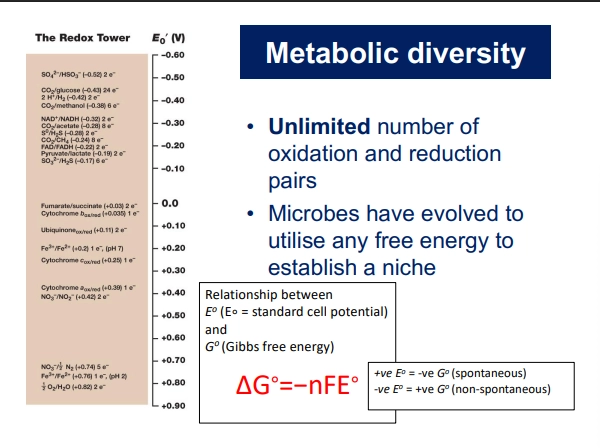

<ul><li><p>some organisms may just do glycolysis &amp;| fermentation</p></li><li><p>others however, may use a different terminal e acceptor besides from O2 (eg Sulphate, Fe3+,) - to similarly carry out respiration</p></li><li><p>less energy efficient &amp; ATP produced (smaller difference in E0 values, smaller deltaE0) but still enables life to function in niches &amp; environments that are anaerboic (lack O2 as a terminal e acceptor)</p></li><li><p>as long as the terminal e acceptor has a lower E0 value than glucose (or whatever energy source is used), the rxn will be spontaneous (efficient for life) - due to its relation to deltaG (deltaG = -nFE0)</p></li><li><p>unlimited combinations of redox pairs, due to evolution in any free niches with free energy present </p></li></ul><p></p>
66
New cards
67
New cards

what are the two ways we see diversity in microbial metabolisms

  • Energy source (carbon source, is oxidised)

  • eg glucose, methane, hydrogen

  • Terminal e acceptor (is reduced)

  • eg O2, Sulfate, Fe3+

  • = redox pair

  • overall delta E0 must be positive for it to be efficient (occur spontnaoeusly, negative delta G)


68
New cards

how do methanotrophs central metabolisms differ

  • methanotroph = methane consuming organisms

  • they use Methane CH4 as their Energy Source (vs Glucose)

  • they use O2 as their terminal e acceptor

  • redox pair has a negative deltaG, so is a spontaneous favorable rxn

  • CH4 is metabolised => CO2. e harvested to generate ATP to use for biomass synthesis, via e transport chain, in the classic fashion (pump H+, ATPase…)

  • various pathways along the way (CH4=> CO2) forming formaldehyde, formate - that can be used to make biomass (assimilation)


<ul><li><p>methanotroph = methane consuming organisms</p></li><li><p>they use Methane CH4 as their Energy Source (vs Glucose)</p></li><li><p>they use O2 as their terminal e acceptor</p></li><li><p>redox pair has a negative deltaG, so is a spontaneous favorable rxn </p></li><li><p>CH4 is metabolised =&gt; CO2. e harvested to generate ATP to use for biomass synthesis, via e transport chain, in the classic fashion (pump H+, ATPase…)</p></li><li><p>various pathways along the way (CH4=&gt; CO2) forming formaldehyde, formate - that can be used to make biomass (assimilation)</p></li></ul><p></p>
69
New cards

how do methanogens central metabolisms differ?

what microbes do this ONLY?

(methanogens)

  • CO2 terminal e acceptor (is reduced)

  • Methanol or Acetate as the Energy source

  • => CH4 + H2O

  • rxn is possible as the redox pair is still negative deltaG (spont & favorable). however much less E per mol of reactant - not supernegative deltaG

  • not very favorable for E genesis - so only seen in a small subset of archaea

(what organisms)

  • only Archea. Methano- genuses(Euryarchaeota / Methanobacteriati kingdom)
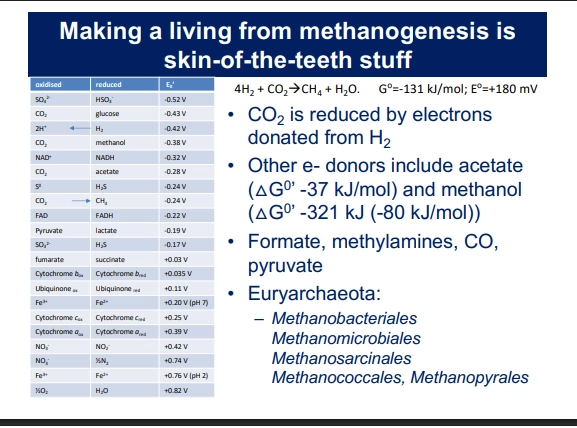

<p>(methanogens)</p><ul><li><p>CO2 terminal e acceptor (is reduced)</p></li><li><p>Methanol or Acetate as the Energy source </p></li><li><p>=&gt; CH4 + H2O</p></li><li><p>rxn is possible as the redox pair is still negative deltaG (spont &amp; favorable). however much less E per mol of reactant - not supernegative deltaG </p></li><li><p>not very favorable for E genesis - so only seen in a small subset of archaea </p></li></ul><p>(what organisms)</p><ul><li><p>only Archea. Methano- genuses(Euryarchaeota / Methanobacteriati kingdom)</p></li></ul><p></p>
70
New cards
<p>what are ANME </p><ul><li><p>how do they do this</p></li><li><p>where is this done</p></li></ul><p></p>

what are ANME

  • how do they do this

  • where is this done


  • ANaerboic MEthane consuming archaea

  • Energy source as Methane CH4

  • for their terminal e acceptor, they partner with a sulfate reducing (=> sulfide) bacteria - so the archea does the oxidation pair of redox, and the bacteria does the reduction pair

  • this enables the Archaea to reverse the MEthanogen pathway, to convert CH4 => HCO3

  • therefore is carried out by Methanogen Archaea, that are able to reverse the pathway + Sulfate reducing bacteria (DSS = DiSimilartory Sulfate-reducing)

  • enables them to both make biomass

(where)

  • forms almost NO energy (-20-40kj deltaG), so is only possible in environments with no other options - no O2 (organism would NOT dominate & be outcompeted)

  • eg underwater systems on frozen masses => forms the start of ecosystems as mussels can consume the bacteria etc
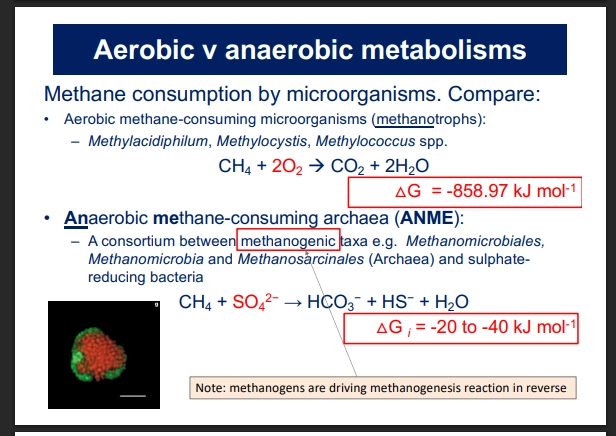

<ul><li><p>ANaerboic MEthane consuming archaea</p></li><li><p>Energy source as Methane CH4</p></li><li><p>for their terminal e acceptor, they partner with a sulfate reducing (=&gt; sulfide) bacteria - so the archea does the oxidation pair of redox, and the bacteria does the reduction pair</p></li><li><p>this enables the Archaea to reverse the MEthanogen pathway, to convert CH4 =&gt; HCO3</p></li><li><p>therefore is carried out by Methanogen Archaea, that are able to reverse the pathway + Sulfate reducing bacteria (DSS = DiSimilartory Sulfate-reducing)</p></li><li><p>enables them to both make biomass</p></li></ul><p>(where)</p><ul><li><p>forms almost NO energy (-20-40kj deltaG), so is only possible in environments with no other options - no O2 (organism would NOT dominate &amp; be outcompeted)</p></li><li><p>eg underwater systems on frozen masses =&gt; forms the start of ecosystems as mussels can consume the bacteria etc </p></li></ul><p></p>
71
New cards

In which conditions may a microbe…

  • use Nitrite NO2- as the terminal e acceptor

  • use CH4 Methane as the energy source

whyis this a special case

  • anaerboic conditions (otherwise O2 would be more favorable)

  • conditions with Nitrite NO2- (eg soil!) => reduce to NO => split into N2 + O => release O via O2!

  • it can then use this o2 produced, to more favorably generate energy

  • thus its converting its own poorer terminal e acceptor to a better one with whats abvaiable

  • => Candidatus Methylomirabillis oxyfera
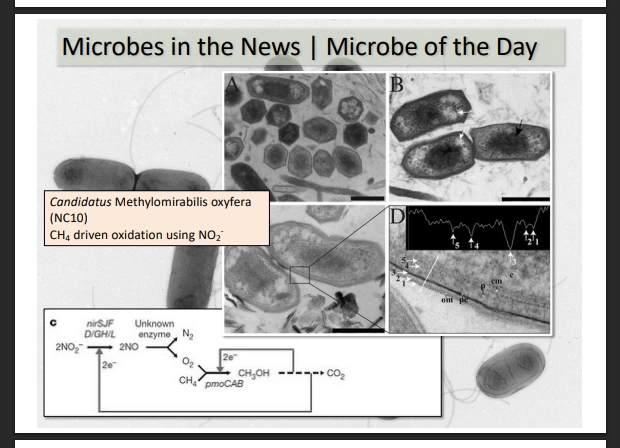

<ul><li><p>anaerboic conditions (otherwise O2 would be more favorable)</p></li><li><p>conditions with Nitrite NO2- (eg soil!) =&gt; reduce to NO =&gt; split into N2 + O =&gt; release O via O2!</p></li><li><p>it can then use this o2 produced, to more favorably generate energy</p></li><li><p>thus its converting its own poorer terminal e acceptor to a better one with whats abvaiable</p></li><li><p>=&gt; Candidatus Methylomirabillis oxyfera</p></li></ul><p></p>
72
New cards

How may a microbe use Hydrogen & Sulphate in its central metabolism?

  • oxidise H2 as its Energy Source

  • reduce Sulphate as its terminal e acceptor

  • this is a redox pair close on the redox table, but E0 is still positive, there is still a difference, so the rxn is still favorable (in conditions where nothing else is more favorable to outcompete them)

  • => Hydrogen Sulphide (reduced form of Sulphate)
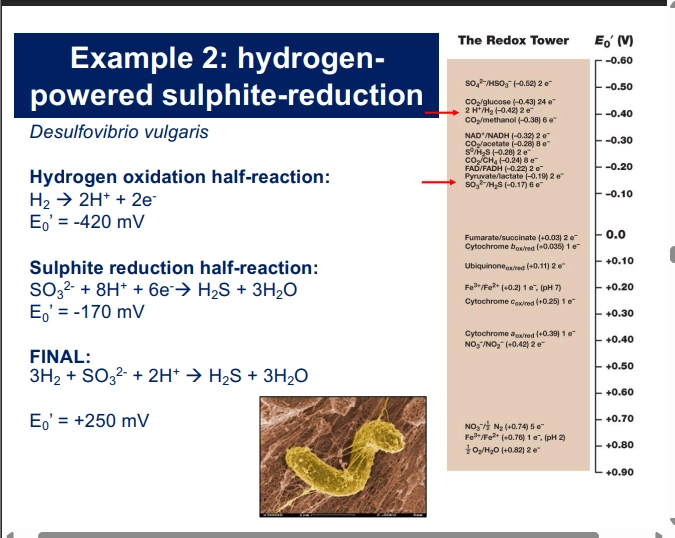

<ul><li><p>oxidise H2 as its Energy Source</p></li><li><p>reduce Sulphate as its terminal e acceptor</p></li><li><p>this is a redox pair close on the redox table, but E0 is still positive, there is still a difference, so the rxn is still favorable (in conditions where nothing else is more favorable to outcompete them)</p></li><li><p>=&gt; Hydrogen Sulphide (reduced form of Sulphate)</p></li></ul><p></p>
73
New cards

how can methanogenesis occur with

  • CO2 & H2


  • oxidising H2 Energy source

  • reducing CO2 terminal e acceptor

  • pumping Na+ and protons to harvest energy from H2 bit by bit, as H2 comes in at various points to donate e

  • eventually thru ATPase to genreate E as ATP

  • complex, less favorable - but enables E generation even in harsh conditions
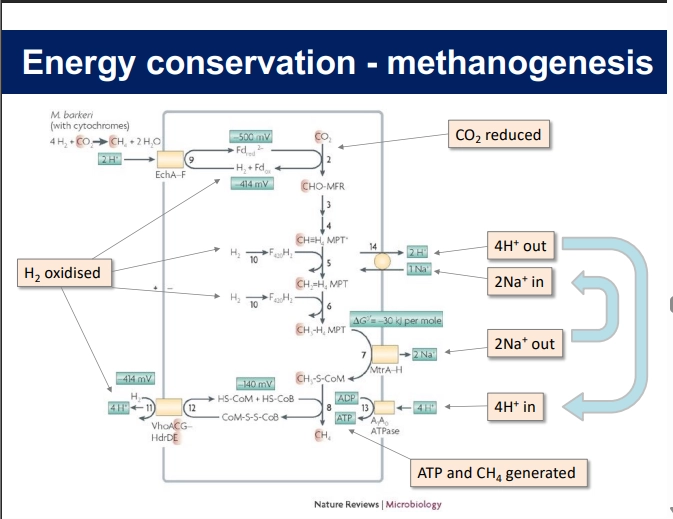

<ul><li><p>oxidising H2 Energy source</p></li><li><p>reducing CO2 terminal e acceptor</p></li><li><p>pumping Na+ and protons to harvest energy from H2 bit by bit, as H2 comes in at various points to donate e</p></li><li><p>eventually thru ATPase to genreate E as ATP</p></li><li><p>complex, less favorable - but enables E generation even in harsh conditions</p></li></ul><p></p>
74
New cards

How would a methanotroph do central metabolism with H2 & Sulphate?

what must it do that is uniqe?

  • reduce Sulphate as the terminal e acceptor

  • forms HSO4 which is released form the cell

  • oxidise H2 as the Energy source

  • does so by putting energy generation first => ATP without doing glycolysis

  • then it puts the ATP into the TCA cycle, along with CO2, dri ving it backwards to make more complex compounds

  • Eventually forms glucose which they can use to make biomass (thru driving glyclysis backwards)

  • using the ATP generated from reduction of the terminal e acceptor.

  • eg Desulfovibrio vulgaris


<ul><li><p>reduce Sulphate as the terminal e acceptor</p></li><li><p>forms HSO4 which is released form the cell</p></li><li><p>oxidise H2 as the Energy source </p></li><li><p>does so by putting energy generation first =&gt; ATP without doing glycolysis</p></li><li><p>then it puts the ATP into the TCA cycle, along with CO2, dri ving it backwards to make more complex compounds </p></li><li><p>Eventually forms glucose which they can use to make biomass (thru driving glyclysis backwards)</p></li><li><p>using the ATP generated from reduction of the terminal e acceptor. </p></li><li><p>eg Desulfovibrio vulgaris </p></li></ul><p></p>
75
New cards

What is a unique method of an autotorph carrying out central metabolism?

  • driving C generation by using ATP to put CO2 into glycolysis backwards, reversing this rxn, then putting it thru TCA in the correct direction

  • from this, nucleic acids, protons, nucleoside sugars (BIOMASS) can be generated!
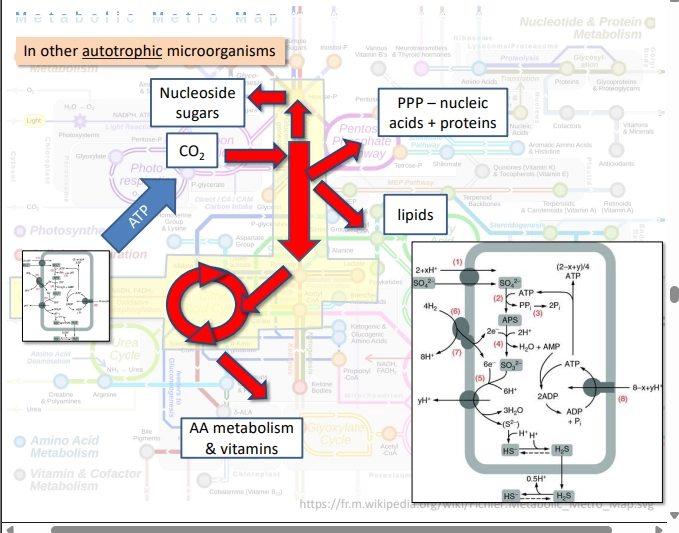

<ul><li><p>driving C generation by using ATP to put CO2 into glycolysis backwards, reversing this rxn, then putting it thru TCA in the correct direction</p></li><li><p>from this, nucleic acids, protons, nucleoside sugars (BIOMASS) can be generated!</p></li></ul><p></p>
76
New cards

what are functional markers?

  • what are they helpful for?

  • what is their limitation?


  • important genes for a microbe to carry out a metabolism / lifestyle / process, that are distinctive to that process

  • based on their coding for enzymes critical to the process - therefore the precense of this gene, tells us they do this process

  • therefore finding them in a microbe, suggests they do this process

  • finding them in an environment sample, suggests the community carries out that process / a member of the community does

(applicable)

  • many major processes have major genes

  • eg Nitrogen Metabolism - distinctive FMs for: N fixation, Nitrification, Ammamox, DNRA, Nitrate Reduction

  • eg Methane Oxidation (Methanotrophy), Sulfate Reduction (terminal e acceptor), Methane production (CO2 terminal e acceptor), Petroleum degradation, Anoxygenic photosynthesis

(limitation)

  • finding the gene doesnt tell us if the gene is actually being used. it may just be present in an organism in case another lifestyle / process / E source / terminal e acceptor source becomes less viable, so they must switch to another for example

  • so a more reliable check is looking at RNA from environmental samples, for RNA corresponding to functional markers - as this clues on the gene actually being used (E put into transcribing it. next step is making the protein to do the process)


<ul><li><p>important genes for a microbe to carry out a metabolism / lifestyle / process, that are distinctive to that process</p></li><li><p>based on their coding for enzymes critical to the process - therefore the precense of this gene, tells us they do this process</p></li><li><p>therefore finding them in a microbe, suggests they do this process </p></li><li><p>finding them in an environment sample, suggests the community carries out that process / a member of the community does</p></li></ul><p>(applicable)</p><ul><li><p>many major processes have major genes</p></li><li><p>eg Nitrogen Metabolism - distinctive FMs for: N fixation, Nitrification, Ammamox, DNRA, Nitrate Reduction</p></li><li><p>eg Methane Oxidation (Methanotrophy), Sulfate Reduction (terminal e acceptor), Methane production (CO2 terminal e acceptor), Petroleum degradation, Anoxygenic photosynthesis</p></li></ul><p>(limitation)</p><ul><li><p>finding the gene doesnt tell us if the gene is actually being used. it may just be present in an organism in case another lifestyle / process / E source / terminal e acceptor source becomes less viable, so they must switch to another for example</p></li><li><p>so a more reliable check is looking at RNA from environmental samples, for RNA corresponding to functional markers - as this clues on the gene actually being used (E put into transcribing it. next step is making the protein to do the process)</p></li></ul><p></p>
77
New cards

how are functional markers actually observed from environmental samples?

  • name the 3 methods


  • PCR

  • qPCR

  • ddPCR


78
New cards

how may u use PCR to observe FMs from a sample?

(PCR)

  • primers designed to be complementary to FM genes - forwards and reverse primers, for the start and ends of specific conserved regions in the gene - as each gene will vary between species and individual despite being for the same process - but a conserved region will stay the same

  • this enables replication to occur between the conserved primer regions, so despite variability in the sequence in between, amplification will still occur

  • run them through PCR cycles to amplify the few numbers of FM gene per sample

  • run on a gel with a ladder, specific to the number of BP we know the conserved region is supposed to be, based on our chosen primers

  • for a community - will produce a presumably wide-ish band, representing a mixed community with variable gene regions between the convesred primers (but still largel the same / similar BP length)

  • (limitations) - no amplification =/= no gene. the primer may be poorly designed, the gene may be in low conc, DNAases may be present, too much sample, inhibitors in environment
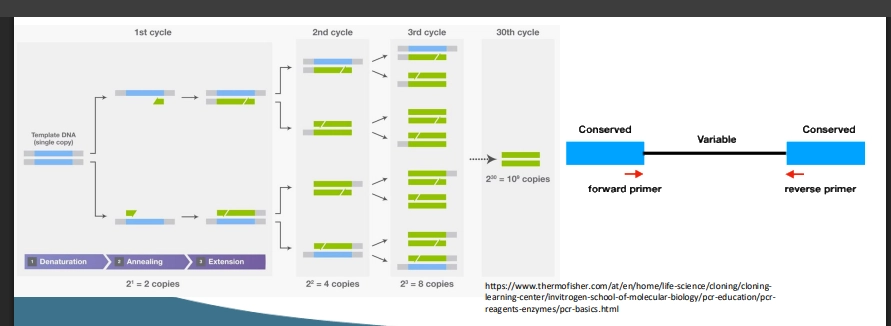

<p>(PCR)</p><ul><li><p>primers designed to be complementary to FM genes - forwards and reverse primers, for the start and ends of specific conserved regions in the gene - as each gene will vary between species and individual despite being for the same process - but a conserved region will stay the same</p></li><li><p>this enables replication to occur between the conserved primer regions, so despite variability in the sequence in between, amplification will still occur</p></li><li><p>run them through PCR cycles to amplify the few numbers of FM gene per sample</p></li><li><p>run on a gel with a ladder, specific to the number of BP we know the conserved region is supposed to be, based on our chosen primers</p></li><li><p>for a community - will produce a presumably wide-ish band, representing a mixed community with variable gene regions between the convesred primers (but still largel the same / similar BP length)</p></li><li><p>(limitations) - no amplification =/= no gene. the primer may be poorly designed, the gene may be in low conc, DNAases may be present, too much sample, inhibitors in environment</p></li></ul><p></p>
79
New cards

how may qPCR be used to look at FMs from a sample?

(qPCR)

  • quantitative PCR, tells us HOW MUCH of a gene is there in a sample

  • counts the copies of DNA of interest existing at each cycle, by measuirng fluroesence of dsDNA-binding molecules, that fluores when binding to amplified DNA

  • however, only measures above a certain fluoresence threshold, which is used with the cycle number, to figure out the original amount of the DNA of interest in the sample

  • for samples with less DNA of interest, it would take more cycles to reach enough DNA for the fluoresence binders to bind and overcome the threshold

  • occurs to a point where it plateaus due to exausting no bases in the PCR tube

  • must keep amplicons tiny (200bp max)

  • cycle no. on X axis, log scale of fluorescence / DNA number on y axis

  • also useful as u may prime 16S rRNA to quantify no bacteria present
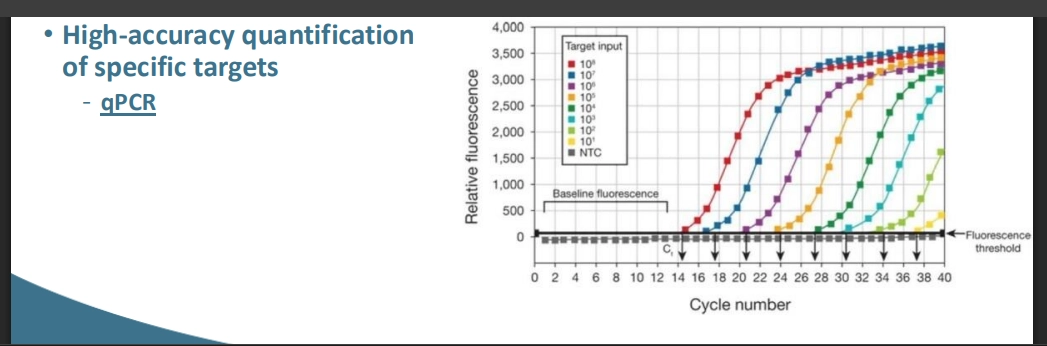

<p>(qPCR)</p><ul><li><p>quantitative PCR, tells us HOW MUCH of a gene is there in a sample </p></li><li><p>counts the copies of DNA of interest existing at each cycle, by measuirng fluroesence of dsDNA-binding molecules, that fluores when binding to amplified DNA</p></li><li><p>however, only measures above a certain fluoresence threshold, which is used with the cycle number, to figure out the original amount of the DNA of interest in the sample</p></li><li><p>for samples with less DNA of interest, it would  take more cycles to reach enough DNA for the fluoresence binders to bind and overcome the threshold</p></li><li><p>occurs to a point where it plateaus due to exausting no bases in the PCR tube</p></li><li><p>must keep amplicons tiny (200bp max)</p></li><li><p>cycle no. on X axis, log scale of fluorescence / DNA number on y axis</p></li><li><p>also useful as u may prime 16S rRNA to quantify no bacteria present</p></li></ul><p></p>
80
New cards

how may ddPCR be used to look at FMs in an environmental sample?

  • process

  • examples of use

  • drawbacks


  • digital droplet PCR

  • like qPCR, is a way to quantify the no. of FM DNA copies in an environmental sample = how much the process is occurring (may also be used to quantify no. bacteria in a sample, w 16s rRNA etc)

  • the various chemical components of PCR are seperated into droplets (e.g. sample DNA, primer)

  • the droplets are amplified, and it is identified whether their was DNA that was amplified or not - the target sequence FM of interest based on the inputted primers

  • these counts are mapped on poisson continuum, to give a number of occurrences of the gene of interest within the sample

  • puts this on a linear scale of 100-1000 copies (more precise than qPCR)

(uses IRL)

  • eg Diagnostic Cancer Markers (in blood samples, uses primers to amplify specific cancer signals from white blood cells gone rogue, to quantify how many WBCs have gone rogue)

  • eg Environmental Microbiology Wastewater Treatments (quantifying the number of different types of mircobes in each treatment, by amplifying a range of FM genes)

  • eg can look at environmental conditions, and counts of organisms that do a particular metabolism, to quantify how what conditions favor what metabolism

(Drabacks)

  • expensive, specific and hard to use, req lots of practice
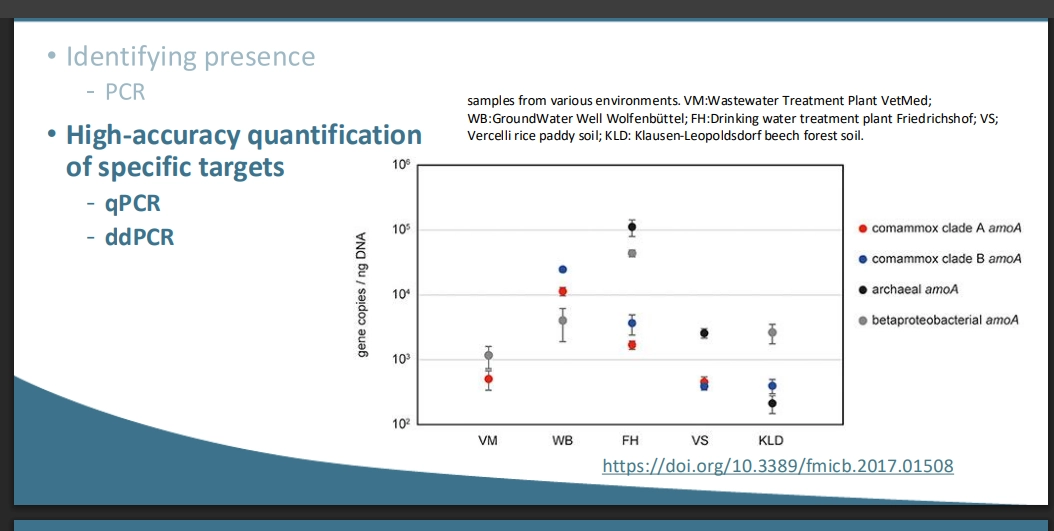

<ul><li><p>digital droplet PCR</p></li><li><p>like qPCR, is a way to quantify the no. of FM DNA copies in an environmental sample = how much the process is occurring (may also be used to quantify no. bacteria in a sample, w 16s rRNA etc)</p></li><li><p>the various chemical components of PCR are seperated into droplets (e.g. sample DNA, primer)</p></li><li><p>the droplets are amplified, and it is identified whether their was DNA that was amplified or not - the target sequence FM of interest based on the inputted primers</p></li><li><p>these counts are mapped on poisson continuum, to give a number of occurrences of the gene of interest within the sample </p></li><li><p>puts this on a linear scale of 100-1000 copies (more precise than qPCR)</p></li></ul><p>(uses IRL)</p><ul><li><p>eg Diagnostic Cancer Markers (in blood samples, uses primers to amplify specific cancer signals from white blood cells gone rogue, to quantify how many WBCs have gone rogue)</p></li><li><p>eg Environmental Microbiology Wastewater Treatments (quantifying the number of different types of mircobes in each treatment, by amplifying a range of FM genes)</p></li><li><p>eg can look at environmental conditions, and counts of organisms that do a particular metabolism, to quantify how what conditions favor what metabolism </p></li></ul><p>(Drabacks)</p><ul><li><p>expensive, specific and hard to use, req lots of practice</p></li></ul><p></p>
81
New cards

how can we use (shotgun) Next-gen Sequencing to measure info about an environmental sample?

how does this differ from methods looking at FMs/

  • shotgun sequencing all genes / genomes in an environment, using no FM target, to provide data on all things present

  • then from this, relying on DNA libraries, genome librariers, known genomes & transcripts of organisms & a variety of other tools - to analyse which organisms are present, what their metabolisms are, so what processes are occurring in the community

  • looking at the environment as a whole rather than a specific target

  • requires more previous knowledge and computing power and time - do note.
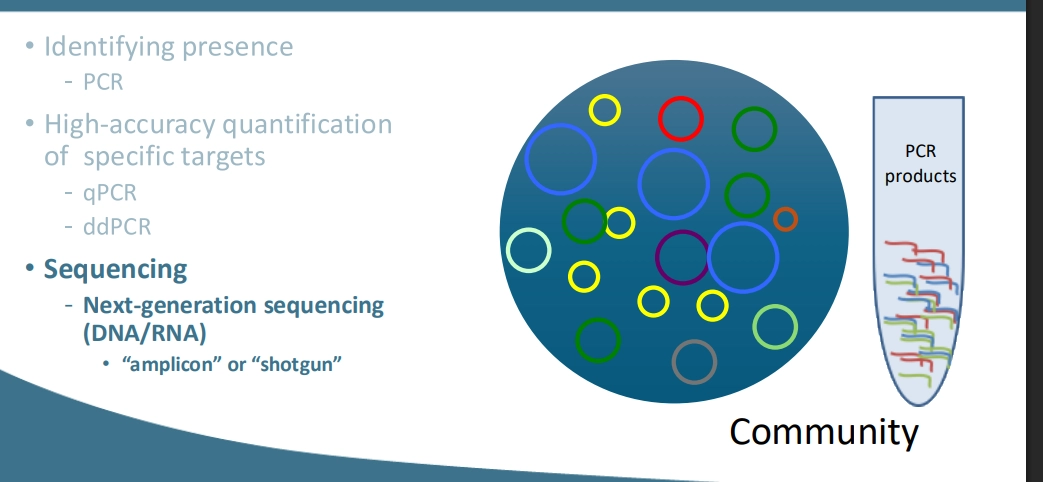

<ul><li><p>shotgun sequencing all genes / genomes in an environment, using no FM target, to provide data on all things present</p></li><li><p>then from this, relying on DNA libraries, genome librariers, known genomes &amp; transcripts of organisms &amp; a variety of other tools - to analyse which organisms are present, what their metabolisms are, so what processes are occurring in the community</p></li><li><p>looking at the environment as a whole rather than a specific target</p></li><li><p>requires more previous knowledge and computing power and time - do note. </p></li></ul><p></p>
82
New cards

what is the idea of Proteonomics

  • difference from PCR & sequencing methods

  • process

  • drawbacks


(difference?)

  • using inference rather than direct observation

  • measuirng proteins - whats actually being USED in the environment / community / organisms, vs what COULD be used from within their genome - so more precise about metabolism right now!

(process)

  • chop up environmental samples into AAs & small peptide chains

  • these are run through mass spec, and spectra are provided (different mass charge ratios, different abundances) that are matched up with databases

  • these databases contain expected spectra for proteins - from ‘in silico’ baseline data

  • these databases include info on proteins and their peptide sequences, so the experimental data is able to be matched up - the chopped up peptide bits are able to be matched up with potential proteins they may have been degrades from, to map the proteins present in the sample

  • peptide sequences matched up to proteins they may be found in => their combinations narrowed down to proteins that contain each combo => can match up to proteins found in specific organisms

  • these can be used with inference, to infer what metabolisms / organisms are present (based on what purpose these proteins are for)

(drawbacks)

  • messy

  • organism / protein may not be represented in the databse - so must be assigned to the next closest thing. for accuracy, requires the thing of interest to allready have been put in the database

  • may overcome some drawbacks by making a metagenome first, and predicting proteins present, to generate a database for use. |(ensuring of interest is represented)

  • but if unknown, unmapped, undiscovered - ur screwed

<p>(difference?)</p><ul><li><p>using inference rather than direct observation</p></li><li><p>measuirng proteins - whats actually being USED in the environment / community / organisms, vs what COULD be used from within their genome - so more precise about metabolism right now!</p></li></ul><p>(process)</p><ul><li><p>chop up environmental samples into AAs &amp; small peptide chains </p></li><li><p>these are run through mass spec, and spectra are provided (different mass charge ratios, different abundances) that are matched up with databases </p></li><li><p>these databases contain expected spectra for proteins - from ‘in silico’ baseline data </p></li><li><p>these databases include info on proteins and their peptide sequences, so the experimental data is able to be matched up - the chopped up peptide bits are able to be matched up with potential proteins they may have been degrades from, to map the proteins present in the sample</p></li><li><p>peptide sequences matched up to proteins they may be found in =&gt; their combinations narrowed down to proteins that contain each combo =&gt; can match up to proteins found in specific organisms </p></li><li><p>these can be used with inference, to infer what metabolisms / organisms are present (based on what purpose these proteins are for)</p></li></ul><p>(drawbacks)</p><ul><li><p>messy </p></li><li><p>organism / protein may not be represented in the databse - so must be assigned to the next closest thing. for accuracy, requires the thing of interest to allready have been put in the database</p></li><li><p>may overcome some drawbacks by making a metagenome first, and predicting proteins present, to generate a database for use. |(ensuring of interest is represented)</p></li><li><p>but if unknown, unmapped, undiscovered - ur screwed</p></li></ul><p></p>
83
New cards

what would each tell us about action in a community?

  • DNA

  • RNA

  • Protein


(DNA)

  • PCR & genomics

  • tells us the capability of a community - the genes they have in their genomes, which processes they can possibly do, what metabolisms they can possibly carry out

  • doesnt necesarily say WHAT they are doing - genes may be switched off, other metabolisms may dominate, etc

  • eg every human body cell has the full set of DNA, but they only switch on specific portions depending on their function

(RNA)

  • PCR & genomics

  • tells us what the community is actively doing. what metabolisms & processes they are eactively carrying out / plan to in the very immediate future

  • this is signalled by them activating TFs to transcribe gene regions of target proteins, to carry out target processes

  • NOW - stimulus response

  • however, still some reserve as additional gene regulation occurs at the level of protein folding, lifespans, microRNA, etc

(Protein)

  • proteonomics

  • tells us what the community has done just previously. what it has successfully done - not indicative of what is doing NOW as it may be aiming to produce new proteins, this may be a day old one subject to degradation

  • but more revealing on metabolisms and processes than DNA or RNA - showing what successfully persists

  • however, may be in dormant state not using the protein

(solution?)

  • use protein & RNA (& DNA for more surface lvl) data together.


<p>(DNA)</p><ul><li><p>PCR &amp; genomics</p></li></ul><ul><li><p>tells us the capability of a community - the genes they have in their genomes, which processes they can possibly do, what metabolisms they can possibly carry out</p></li><li><p>doesnt necesarily say WHAT they are doing - genes may be switched off, other metabolisms may dominate, etc</p></li><li><p>eg every human body cell has the full set of DNA, but they only switch on specific portions depending on their function</p></li></ul><p>(RNA)</p><ul><li><p>PCR &amp; genomics </p></li></ul><ul><li><p>tells us what the community is actively doing. what metabolisms &amp; processes they are eactively carrying out / plan to in the very immediate future</p></li><li><p>this is signalled by them activating TFs to transcribe gene regions of target proteins, to carry out target processes </p></li><li><p>NOW - stimulus response </p></li><li><p>however, still some reserve as additional gene regulation occurs at the level of protein folding, lifespans, microRNA, etc </p></li></ul><p>(Protein)</p><ul><li><p>proteonomics</p></li></ul><ul><li><p>tells us what the community has done just previously. what it has successfully done - not indicative of what is doing NOW as it may be aiming to produce new proteins, this may be a day old one subject to degradation</p></li><li><p>but more revealing on metabolisms and processes than DNA or RNA - showing what successfully persists</p></li><li><p>however, may be in dormant state not using the protein</p></li></ul><p>(solution?)</p><ul><li><p>use protein &amp; RNA (&amp; DNA for more surface lvl) data together.</p></li></ul><p></p>
84
New cards
<p>what is the idea of Taxonomic Markers?</p><ul><li><p>what is</p></li><li><p>what specific ones can be used </p></li><li><p>what can this tell us</p></li></ul><p></p>

what is the idea of Taxonomic Markers?

  • what is

  • what specific ones can be used

  • what can this tell us


  • like FMs, but rather than metabolic processes (FUNCTIONal markers), markers for genes revealling info on taxonomic identity

  • typically 16S rRNA of focus - this does the same thing in every organism, present in every organism, but with distinct differences between taxonomic groups

  • therefore these differences we can use as taxonomic markers (eg same for all bacteria = marker for bacteria), to target single organism groups

  • enables refining of the sample to interest

  • gives info on WHICH TYPES OF ORGANISMS ARE PRESENT rather than WHAT TYPES OF METABOLISMS ARE PRESENT


85
New cards

Antarctica Case Study: how may we look at metabolisms present, and organisms present?

  • this looks at the Nitrogen cycle within specific Antarctic environments

(sampling)

  • collect abiotic metadata on sample sites (can tie genetic data to environmental factors, to rationalise N metabolisms seen, eg anaerobic vs aerbobic)

  • can look at N itself in the environment. isotopic analysis. depositions (eg may say organisms doing N fixation are present here precisely). can tie in to N cycle processes

(DNA)

  • do DNA extraction samples

  • use qPCR of specific targets (FMs of Nitrogen metabolism of interest) => tells us what parts of N metabolism are being doen here (based on the primers added for FMs, that amplify)

  • compare between specific Antarctic environments sampled - soil sample vs lake sediment vs SVL soil (nother piece of land), same vs same vs different N cycle processes based on incr & dcr of genes seen here (qPCR ftw!)

(metagenomic analysis)

  • look at the genes found => try to stitch them together into genomes => use to figure out what organisms have these combinations of genes => list them out to infer what organisms are present in the environment

  • sequence data was assimilated & stitched into long fragments. this creates Metagenome assembled Genomes

  • we can test these - to see if they resemble a genome or are just a mess. if resembling a genome, we can assign to different phylum

  • from this qPCR, we can then measure abundance of each phylum, and plot


<ul><li><p>this looks at the Nitrogen cycle within specific Antarctic environments</p></li></ul><p>(sampling)</p><ul><li><p>collect abiotic metadata on sample sites (can tie genetic data to environmental factors, to rationalise N metabolisms seen, eg anaerobic vs aerbobic)</p></li><li><p>can look at N itself in the environment. isotopic analysis. depositions (eg may say organisms doing N fixation are present here precisely). can tie in to N cycle processes</p></li></ul><p>(DNA)</p><ul><li><p>do DNA extraction samples</p></li><li><p>use qPCR of specific targets (FMs of Nitrogen metabolism of interest) =&gt; tells us what parts of N metabolism are being doen here (based on the primers added for FMs, that amplify)</p></li><li><p>compare between specific Antarctic environments sampled - soil sample vs lake sediment vs SVL soil (nother piece of land), same vs same vs different N cycle processes based on incr &amp; dcr of genes seen here (qPCR ftw!)</p></li></ul><p>(metagenomic analysis)</p><ul><li><p>look at the genes found =&gt; try to stitch them together into genomes =&gt; use to figure out what organisms have these combinations of genes =&gt; list them out to infer what organisms are present in the environment</p></li><li><p>sequence data was assimilated &amp; stitched into long fragments. this creates Metagenome assembled Genomes</p></li><li><p>we can test these - to see if they resemble a genome or are just a mess. if resembling a genome, we can assign to different phylum</p></li><li><p>from this qPCR, we can then measure abundance of each phylum, and plot</p></li></ul><p></p>
86
New cards

what does a metagenome refer to

  • all the genes of all the organisms in a community

  • in a sample, all the DNA / RNA recovered from a sample of an environmental community


87
New cards
88
New cards
89
New cards
90
New cards
91
New cards
92
New cards
93
New cards
94
New cards
95
New cards