Research Methods: Chapter 2
 Note
Note Call Kai
 Learn
Learn Practice Test
 Spaced Repetition
 Match
Match Flashcards
 Knowt Play
1/31

There's no tags or description
Looks like no tags are added yet.
Name | Mastery | Learn | Test | Matching | Spaced | Call with Kai | Chat |
|---|
No analytics yet
Send a link to your students to track their progress
32 Terms
Is psychology a science?
YES
All sciences try to explain the world and uncover reality
Need for use of scientific method to make legit claims
What is the structure of the theory-data cycle? What does the cycle look like?
Theory → Research questions → Research design → Hypothesis → Preregistration of hypothesis → Data
Variables
Things that vary from person to person and place to place (weight, age, intelligence, income, mood, etc.)
Measured variables
Measured as they exist; every study has them (e.g., measuring height, weight, age, personality)
Manipulated variables
Researcher decides who gets what; only some research designs have them (e.g., randomly assigning participants drug dosages)
What are operational definitions?
Definitions of a variable as they are measured in a given study; how a variable operates in a study
No correct options, but one might be better for your research question
“Operationalizing” a variable means…
Choosing how you’re going to define and measure/manipulate your study’s variables; turning an abstract concept into something concrete and measurable
What are the cons and pros of surveys?
Pros: allows you to measure variables that cannot be measured with other methods (e.g., attitudes, memories, personality, emotions)
Cons: people might lie, not be paying attention, not remember, or not know the answer
What are the potential issues with observation?
Reactivity, observer bias, and observer effect
Reactivity
Participants act differently just because they’re being watched
Observer bias
Researcher’s expectations affect their interpretation of what they’re seeing
Observer effect
Researcher’s expectations affect how they interact with participants → changes participants’ behavior
What is the difference between a population and a sample?
Population: the group the researchers wants to make claims about BUT they cannot study everyone in population of interest
Sample: smaller subset of population that we collect data from
What are sampling strategies?
Random sampling and non-random sampling
Why is random sampling better than non-random sampling?
Random sampling: MOST representative and least biased; every population member has equal chance of being selected and results are generalizable
Non-random sampling: usually based on convenience
What are the types of study designs?
Case studies and correlation studies
Case study
In-depth study of a very small sample in a highly unusual situation; provides a deep understanding of an unusual phenomenon
What are the pros and cons of case studies?
Pro: can spark unique insight and new research questions
Con: limited generalizability
Correlation study
Measuring two variables to see if they’re related; shows the strength and direction of a relationship BUT CANNOT establish cause/effect
Does correlation equal causation?
NO, do NOT conclude cause/effect based only on correlation; relationship between two variables is typically caused by a third variable
What is the correlation coefficient r?
Tells you the strength and direction of the relationship between two variables
Ranges from -1.0 (strongest possible negative relationship) to +1.0 (strongest possible positive relationship)
0.0 = no correlation at all
What does it mean to have positive, negative, and no correlation?
Positive: one variable increases ↑, other increases ↑
Negative: one variable increases ↑, other decreases ↓
None: one variable increases ↑, other stays the same =
What are the steps in experimental design?
IV is manipulated (researcher decides who gets what; random assignment)
DV is measured
Compare groups to see if there’s a difference
What does random assignment do?
Allows you to conclude that the change in the DV was due to the IV and not some other variable
What do experiments do?
Conclude cause/effect; experiments must meet the 3 steps to make legit claim
What are confounds?
Alternative explanations for the relationship between the IV and DV; variables that interfere with the experiment’s variables
Why are confounds important in experiments?
Researchers must prevent confounds from affecting results (what-ifs)
What are the types of validity?
Construct validity (how well were the variables measured?)
External validity (how well can the results generalize beyond the study?)
Internal validity (did the study rule out alternative explanations?)
Statistical validity (do the data support the study’s claim?)
Construct validity
How well a study’s variables were defined, measured/manipulated, and operationalized
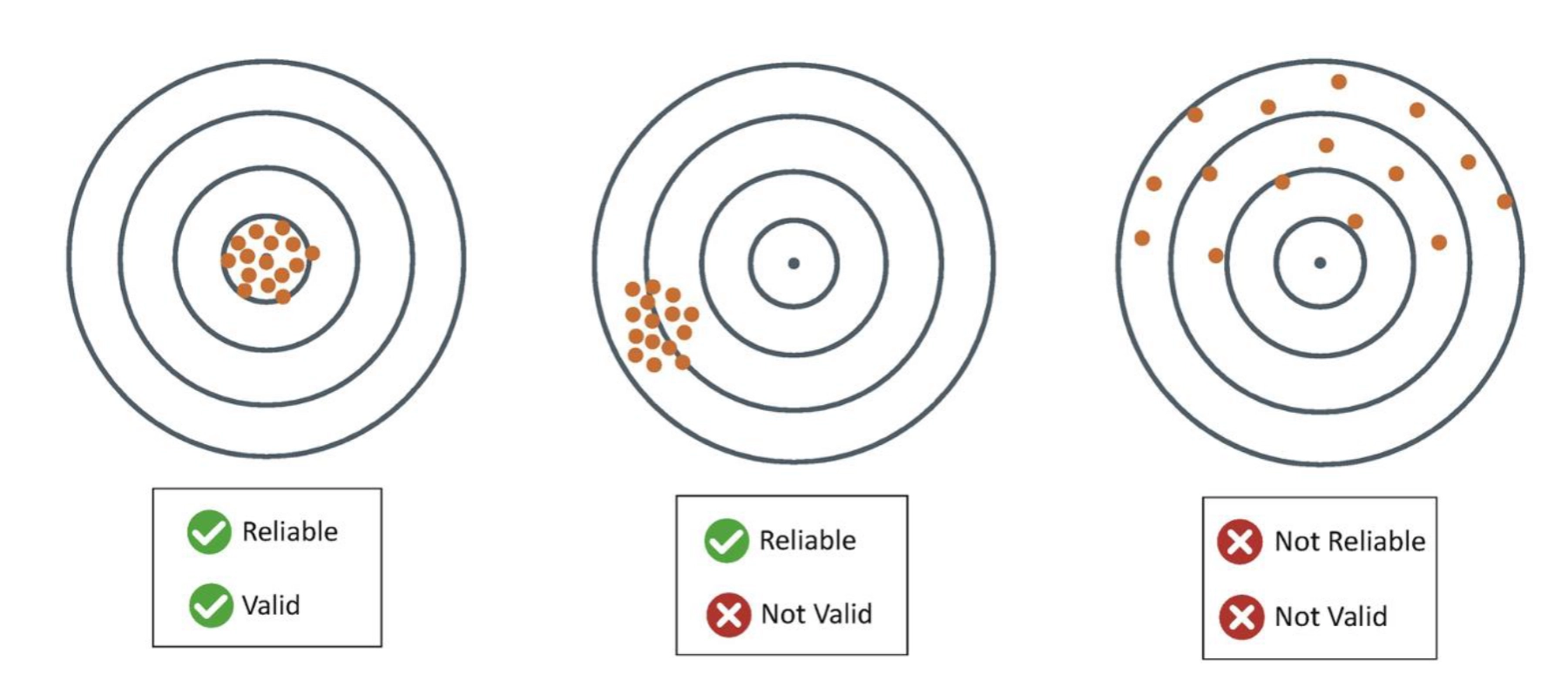
Reliability = consistency
Validity = accuracy
External validity
How well the sample represents + how well the study’s results can generalize the population of interest
Increased by random sampling
Internal validity
Ruling out alternative explanations for a cause/effect conclusion + confounds as an explanation for results
Being able to conclude that any difference in the DV is due to the IV and not some other variable
Increased by experimental design
Random assignment → groups are equal at start
What is the difference between random sampling and random assignment?
Random sampling recruits participants in an unbiased way and leads to greater generalizability of results → higher EXTERNAL validity
Random assignment manipulates an IV, is an experimental feature that allows cause/effect conclusions, and concerns how participants are grouped AFTER sampling → higher INTERNAL validity