Ch14/15 Part 1
 Call Kai
 Learn
Learn Practice Test
 Spaced Repetition
 Match
Match Flashcards
 Knowt Play
1/20

There's no tags or description
Looks like no tags are added yet.
Name | Mastery | Learn | Test | Matching | Spaced | Call with Kai | Chat |
|---|
No analytics yet
Send a link to your students to track their progress
21 Terms
predation
consumption of one living organism by another
true predation
results in the death of the prey, predators function as agents of mortality
parasites
feed on live host organism, usually with the parasite living on or in the host for part of its life cycle, activity is harmful but usually not lethal in the short term
herbivores
consume only part of an individual plant, can harm but usually doesn’t kill the plant, but seed predation is a form of true predation since it kills the organism
parasitoids
attack the prey indirectly by laying eggs on the host’s body, larva hatch inside host and feed on it until it dies
Pred/Prey Relationships Influence: Distribution
predation pressures shape the spatial patterns and habitats of both species (ex: prey goes to where food is abundant and the predators follow)
Pred/Prey Relationships Influence: Abundance
regulate population sizes and keep ecosystems balances; top-down is predators controlling prey pop. while bottom-up is prey availability controlling predator pop
Pred/Prey Relationships Influence: Adaptations
the species adapt to the other’s strategies (prey gets better at defense and predator gets better at offense)
Pred/Prey Relationships Influence: Food Web and Community Structure
predators influence which species dominate a community (ex: sea otters controlling sea urchin populations preserve kelp forests)
Pred/Prey Relationships Influence: Energy Flow
drive the movement of energy through ecosystems (between trophic levels, 10% of energy move up each level and the rest is lost as heat).
Population cycles
Predator and prey populations directly depend on each other (prey decreasing leads to a decrease in predators, a decrease in predators leads to an increase in prey, and increase in prey leads to an increase in predators which leads to a decrease in prey)
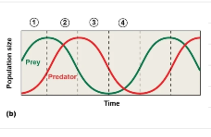
`Real ecosystems remain stable due to: (3 pts)
habitat heterogeneity (diversities in environment)
refuges
immigration
Responses that relate prey consumed to prey density: Functional Responce
increased consumption of prey species by predator when prey pop is larger (eat more food when more is available)
Responses that relate prey consumed to prey density: Numerical Response
increased consumption of prey results in increased predator reproduction (more food means healthier predators)
Responses that relate prey consumed to prey density: Aggregative response
movement or concentration of predators in areas of high prey density (dolphins concentrate where baitfish schools form)
Responses that relate prey consumed to prey density: Developmental Response
intake of prey varies as predator matures (change in diet amount, size, or type through life cycle)
Predator search image:
when a new prey species appears, predators may not recognize it as food right away, a predator may catch one and learn it is prey and then form a search image which helps it get better at finding and killing that prey
prey switching
a predator may strongly prefer a certain prey but may switch to a more abundant species it can hunt more profitably
The foraging behaviors of predators are influenced by the time it takes for these other activities to be done: (5 pts)
defense
finding mates
reproduction'
care for young
predator avoidance
optimal foraging theory
identifies “best” foraging strategy to maximize total energy or energy per unit time for an organism; must balance costs (time/energy expended) and benefit (increased fitness, energy, and nutrient gain)
Foraging considerations: (4 pts)
Energy Content: (size and type/quality of prey)
Search time: time to remain in patch (quality of patches) and vulnerability while searching
Handling Time (capturing, subduing, consuming)
Time for other Activities (breeding, etc)