exam two multiple choice - arterial
 Studied by 1 person
 Call Kai
 Learn
Learn Practice Test
 Spaced Repetition
 Match
Match Flashcards
 Knowt Play
1/45

There's no tags or description
Looks like no tags are added yet.
Name | Mastery | Learn | Test | Matching | Spaced |
|---|
No study sessions yet.
46 Terms
according to bernoulli, what is NOT true about pressure/velocity relationships?
pressure is higher at the region of stenosis
an ABI of 65 places the patient into this category
claudication
all of the following conditions could cause vasculogenic impotence except…
brachial artery disease
atherosclerosis is a disease that begins in the:
tunica intima
a BP cuff is placed on the lower thigh and records a systolic pressure of 180 mmHg. this pressure represents:
the systolic pressure directly beneath the cuff
patients with arterial peripheral vascular disease exhibit which of the following skin changes?
dependent rubor, pallor on elevation, shiny scaly skin
ischemic ulcers have which of the following characteristics?
pain is severe
unilateral claudication in the calf and foot of a young individual should suggest:
entrapment of the popliteal artery
the innominate artery is a branch of the
aortic arch
a high resistance blood flow pattern is normally NOT found in one of the following
post prandial SMA
a patient walks on the treadmill until he is forced to stop at 3 mins due to left calf and thigh pain. the right leg was asymptomatic. the following test results are obtained:
before ex: rt arm 150, rt pt 120, lft pt 120
after: rt arm 160, rt pt 75, lft pt 90
which of the following statements is FALSE?
there is definitely only aorto-iliac disease present
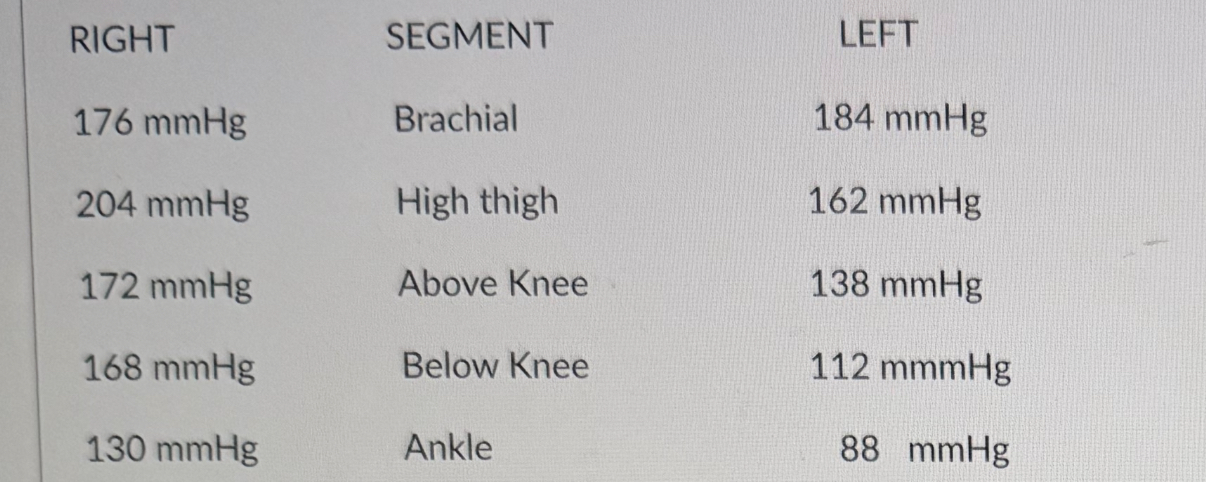
the following segmental pressure measurements are obtained. considering the ABIs for the left leg, how would you grade the severity of occlusive disease in the left leg?
severe
according to poiseuille’s law, which factor has the most dramatic effect on blood flow?
radius of the vessel
a 71 year old male presents with post-op evaluation of his rt femoral-posterior tibial artery reverse saphenous vein bypass graft: at rest the ABI is 0.92. the biphasic Doppler velocities are 85 cm/sec in the native CFA, 100 cm/sec in the prox anastamosis, and 50 cm/s at knee level, and 48-50 cm/s at the distal anastomosis and native PTA. No poststenotic turbulence is noted. These are normal findings for this type of graft:
TRUE
the following are characteristics of an abnormal PVR waveform except:
dicrotic notch present
which is not considered a risk factor for atherosclerosis?
marfans
doppler waveforms compared to PVR waveforms include all of these except
doppler waveforms are analog, PVRs are not
a patient presents with crampy, dull abdominal pain immediately after meals. if a non-invasive vascular test is ordered, the following vessel would be interrogated:
SMA
while on the treadmill for a LE arterial test, a pt complains of left arm and jaw pain. you should:
stop immediately and notify physician
if vasculogenic impotence exists in a pt, the PBI index most expected would be:
0.5
when the external iliac artery passes underneath this structure, it becomes the CFA:
inguinal ligament
RT ARM 180/100 LT ARM: 120/60
RT PT 100 mmHg LFT PT: 90 mmHg
Using the above info, all of the following statements are true except:
the patient probably has no claudication symptoms
the four cuff method is used to perform a lower extremity arterial eval. the high thigh pressure 130 mmHg with an arm pressure of 160 mmHg. All of the following lesions can cause this EXCEPT:
popliteal artery occlusion
aneurysms are most often caused by:
arterial wall weakness and atherosclerosis
a condition that causes non atherosclerotic narrowing of brachiocephalic and/or carotid arteries in young female patients is:
takayasu’s disease
all of the following can apply to a normal high-resistance signal except:
continuous flow
the three branches of the aortic arch are:
rt innominate, lt common carotid, lt subclavian
the following ankle pressures were obtained: PTA 40 mmHg; DP 50 mmHg; ATA 30 mmHg. Which of the following should be used to calculate the ABI?
DP
which of the following conditions contribute to non-laminar flow of blood:
vessel tortuosity
patients found to have ulcerating lesions or gangrene may have which of the following diseases:
neuropathy, arterial insufficiency, vasospasm
in laminar flow, the velocity of the blood is:
lowest at the vessel wall
the renal arteries arise from the aorta:
laterally
a patient presenting with ischemic rest pain complains of:
foot pain when supine, relieved by standing
the correct order of the lower extremity arteries from groin to toes is:
CFA, SFA, POP, ATA
using the following findings, determine what the left ABI is:
brachial pressure: RT 170 mmHg, LT 120 mmHg
ankle pressure: RT 100 mmHg, LT 80 mmHg
0.47
common signs of advanced arterial insufficiency of the lower extremity include which of the following:
thickening of the toenails, dependent rubor, loss of hair growth over the dorsum of the toes and feet
the toe pressure should be this percentage of the ankle pressure
80%
symptoms for a diagnosis of ischemic rest pain may occur in all of the following areas except:
calf
all of the following are characteristics of claudication except:
always in the calf region
a patient with hx of rest pain, calf, and thigh claudication after walking 100 ft and an ulcer on the great toe of the left foot and has a left ankle pressure >300 mmHg. this result is:
erroneous, owing to probable arterial medial calcinosis
this is primarily an occlusive disease of medium-sized and small arteries in the distal upper and lower limbs of young adult heavy smokers:
thromboangitis obliterans
the combination of neuropathy distributed ateriosclerosis makes this diabetic patient especially vulnerable to:
lesions of the foot
tunica intima refers to one of the following in the arterial wall
the inner layer
in a doppler segmental pressure exam (3 cuff method) a patients highest brachial systolic pressure is 168 mmHg. in the asymptomatic extremity of this patients, the thigh pressure would most likely be:
168 mmHg
exercise induces peripheral vasodilation in the microcirculation which:
decreases the distal peripheral resistance
RT ARM: 180/100 LFT ARM: 120/60
RT PT: 100 mmHg LFT PT: 90 mmHg
the left ABI is:
90/180