ATP/ DNA extraction
 Call Kai
 Learn
Learn Practice Test
 Spaced Repetition
 Match
Match Flashcards
 Knowt Play
1/4

There's no tags or description
Looks like no tags are added yet.
Name | Mastery | Learn | Test | Matching | Spaced | Call with Kai | Chat |
|---|
No analytics yet
Send a link to your students to track their progress
5 Terms
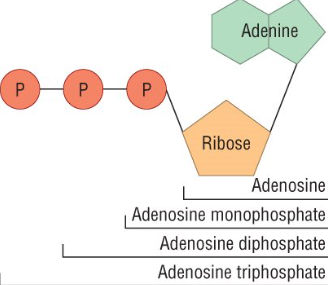
What is adenosine triphosphate (ATP) structure
It contains three phosphate groups, ribose and and adenine
What is the similarities and differences between the structure of ATP and a nucleotide
Similar:
Both contain phosphate, a pentose sugar and a nitrogen base
Differences:
ATP has 3 phosphate groups, ribose instead of deoxyribose and ATP only has base A, adenine
How does ATP provide energy for biological processes
ATP stores energy as chemical potential when it is synthesise by ATP synthase in a condensation reaction.
ATP is hydrolysed to ADP and inorganic phosphate.
The products are more stable and have lower free energy than ATP, so energy is released.

What is phosphorylation
Addition of a phosphate group to a molecule
ADP is phosphorylated to form ATP
How is DNA purified
Using a pestle and mortar break down peas to a powder which breaks down cell walls
Cell lysis detergent or soap is used to dissolve cell membrane and nuclear envelope
Salt can be added to break hydrogen bonds between DNA and water.
Add protease enzymes to remove proteins bound to DNA, do this in a water bath
Add cold ethanol or isopropanol. DNA is insoluble in alcohol so comes out of solution as a stringy white precipitate. Cold ethanol used to reduce enzyme activity
DNA can be spooled out using a glass rod
Note:
Detergent or soap dissolves cell membrane as it is also amphipathic so they also have hydrophilic head and hydrophobic tails like phospholipids. This means when cell membrane and detergent interact the hydrophobic tails of detergent inserts into lipid bilayer disrupting arrangement of membrane. Phospholipids and proteins are pulled a part and cell membrane breaks open releasing DNA and other cellular components.