Humanities Test 2
 Studied by 0 people
 Call Kai
 Learn
Learn Practice Test
 Spaced Repetition
 Match
Match Flashcards
 Knowt Play
1/69

There's no tags or description
Looks like no tags are added yet.
Name | Mastery | Learn | Test | Matching | Spaced |
|---|
No study sessions yet.
70 Terms
Music Ages: Baroque
1600-1750
Music: Romantic
1820-1900
Anti-Romantic/Early 20th Century
1875-1925
Leonin (1135-1200)
A composer from Notre Dame, employed measured rhythm which had time values and precise meters. He developed organum duplum in which the lower voice held long notes and the higher voice moved quickly through the text
Perotin (1170-1236)
1st to use more than two voices in his composition; cantus firmus, fixe melody, a chant used at the base of polyphony
List the characteristics of Baroque Period music. (3 of them)
Reflected needs of the church during time - rationalism, sensuality, materialism and spirituality
Music was lucious, ornate and emotionally appealing → wrote for specific instruments; specified voices used
Strict contrasts through volume, pitch and rhythms; tonality was evolved into major and minor keys and chords were developed through progression
Specific music genres for voice and instrument → violin #1 Antonia Stradivari (1644-1737) → harpsichord
Know composers of the Baroque period.
Johann Sebastian Bach (1685-1750), Antonia Vivaldi, George Frideric Handel (1685-1759)
Johann Sebastian Bach (1685-1750)
When he dies baroque period ends - creates tonality - well-tempered clavier to influence keys among works
Born in Germany chorus member - organist, concertmaster → cantatas, masses, concertos and many emotions
Antonia Vivaldi (1678-1741)
concerto master - 450 concertos, 23 sinfonias, 75 sonatas, 49 opers and many more cantatas
George Frideric Handel (1685-1759)
German-born composer who rose to fame and glory working for the British kings in London. He composed operas, oratorios, suites and sonatas for the entertainment of the London public and the royal court.
Baroque music characteristics
(c. 1600-1750) music is ornate, complex, and polyphonic (multiple melodies), featuring harpsichords and a strong bass line (basso continuo) --> busy, layered, and dramatic
Classical music characteristics
(c. 1750-1820) music is lighter, clearer, more homophonic (melody with accompaniment), focuses on balance, simpler harmonies, and developed the modern orchestra and piano. -->
elegant, structured, and melodic
Classical music appeal
Aristocracy + working class loved
Pleasure was a legitimate artistic purpose + ornamentation and excessive complexity lost its appeal → move toward simplicity + order
3 specific characteristics of classical music
1) variety and contrast in mood - contrast with/ movements and themes - gradual but controlled
2)flexibility of rhythm - unexpected pauses, syncopations, changes from longer to shorter notes that could be sudden or gradual
3)homophonic texture - texture tended to be simpler and flexible - may be polyphic but always go back to homophonic
4)memorable melody - tunes that tend towards balance
5)gradual changes in dynamics - baroque uses sudden changes, while classicalhas many gradual changes - piano replaces harpsichord as a result of this
Know composers of the Classical period
Franz Josef Haydyn (1732-1809), Wolfgang Amadeus Mozart (1756-1791), Ludwig Van Beethoven (1770-1827)
Franz Josef Haydyn (1732-1809)
Long symphonies - 104 ranging in theme and three mvmnt form=fast, slow, fast
Typical, allegro, andante moderato, minuet and trio and allegro
Wolfgang Amadeus Mozart (1756-1791)
Austrian child prodigy @ 6 → wasn't very well like by aristocracy = rude → wrote symphonies, sonatas and operas
Ludwig Van Beethoven (1770-1827)
b/w classical and romantic expanded symphonies → greater emotions + developed themes changing dynamics with emotional effects and the sonata form is expanded (+woodwinds and percussions)
Changed traditional numbers and relationships of the movements as well. He wrote 9 symphonies and many other sonatas and quartets
Know characteristics of music from the music Romantic period
Music can well express emotion
Beautiful everything became expected → pieces longer more complex
Emphasized colorful harmonies → broke rules of classical period
Harmonies were complex and blurred relationships b/w major and minor keys
Beethoven transition
More dissonance → combo of sounds used to suggest unrelieved tension - sometimes key focus - emotional stimulant
Timbre
Composers had to appeal to everyone - general + patrons → composers sell works
timbre
the quality of tone differentiates it from other pitches, tone + color
What is lieder?
Characterized romantic music - solo voice and piano accompaniment + poetic text
Lyrical and dramatic expressions were directly link in the art song
German composers took lead w/ lyric poetry + deep emotional ties
Symphonic Poems
composition comprising and extended movement based on an extramusical theme for orchestra (tone poem). These pieces take form from non abstract ideas, some poetic others visual.
Know famous composers of the Romantic period.
Franz Schubert, Franz Liszt (1811-86), Frederic Chopin (1810-49)
Franz Schubert (1797-1828)
earliest + impt composer of Leider → almost 1000 works but 1 sold before his death
Franz Liszt (1811-86)
→ richer, warmer tones and improvements in the pedal made lyrical potential. Liszt wrote for the piano and was an innovative performer → expressive, dramatic playing and taught many of the pianist of the next generation. He performed with theatricality exaggeration and excessiveness. → "rock star" for the piano
Frederic Chopin (1810-49)
more restraint than Liszt → etudes, preludes, nocturnes, waltzes, polonaises and mazurkas. Writing for piano explored the possibilities and most of his works set the stage for program music. He lived mostly in France but Polish influences are found throughout his music.
Know the 3 characteristics of non-traditional Romantic period music
impressionism and naturalism in music --> Georges Bizet was one of the leading figures in Naturalism in France his Opera "Carmen" is the standard in the field
Versimo - developed in Italy and utilized realistic librettos and production styles. It showcased vitality, violent passions, and common experiences of everyday people. Adultery, revenge and murder are frequent themes. Mascagni, Leoncavallo and Puccini are main composers.
Naturalism
counter-reaction to Romanticism operas in France. It opposed stylization and includes brute force and immorality in its subject matter. It also depicts the world as it is, and with no fantasy --> "Carmen" ex
impressionism
marked by a free use of chromatic tones - free use of chromatic harmonies and key shifts → atonal (absence of a tonal center and of harmonies derived from a diatonic scale corresponding to such a center)
Charles Ives (1874-1954)
was an American composer that was so experimental many of his pieces were considered unplayable and weren't played until after WWII. His melodies spring from folk and popular songs and had irregular rhythms and tone clusters. His work reflected that all music relates to life's experiences and ideas both consonant and dissonant.
George Gershwin (1898-1937)
took pleasure in pleasing the public and wrote songs in a variety of genres, including Broadway and movies. He connected the concert hall and popular music halls with his music. Dressing up the new style of Jazz he was an innovator in the combination of the "Classical" style and the popular music of the time → Porgy and Bess
Leonard Bernstein (1918-1990)
blended popular music with "serious" styles. Bernstein symbolizes American music in the middle and end of the 20th century. He wrote symphonies, ballets, musicals, operas and more. Combining contemporary rhythms with traditional rhythms Bernstein bridges the gap between Classical and Contemporary 20th century music making a uniquely American sound.
Know composers who broke away from the Romantic sounds
Arnold Schoenberg + Igor Stravinsky (1882-1971)
Igor Stravinsky (1882-1971)
The son of an opera singer he started to compose before receiving any training. He went on to train with Nikolai Rimsky-Korsakov and learned traditional techniques. He developed an early liking to Russian folk music and put the tunes into his ballets. He left Russia for France before World War 1 and wrote there. In 1939 Stavinsky left France and moved to the U.S. becoming a citizen in 1945 and remaining until his death.
Arnold Schoenberg
Germany he moved away from Romanticism and moved to atonality. Writing for smaller ensembles and being more contained in tone. He used alternating timbres in contrast with massive orchestral textures. Using complex harmonies and difficult rhythms with fragmented melodies he created a unique style. Using chords without a progression he called his process "the emancipation of dissonance".
→ atonal
Know the difference between Serialism, Minimalism and Aleatoric music.
order - a compositional method where musical elements, primarily pitch but also rhythm, dynamics, and timbre, are organized into a predetermined, repeating series (or "row") to create music, famously developed by Arnold Schoenberg
Minimalism
1960's california - steady pulse, transparent tonality, short melodic practices
Aleatoric
john cage - aleatory (dependent on chance) - 4' 33" piece where the performer makes no sense → influenced Boulez and Stockhausen - weird
--> random
3 types of pluralism
African-American, Asian, Native-American
African-American Pluralism
By the end of the 1950s free jazz is developed that depends on creative improvisation and original compositions. Usually abstract, dense and difficult to follow it went away with regular rhythmic patterns and melodies replacing with high notes, squawks and squeals. Chaotic it lacks the appeal of other jazz forms. In the 1970s and 80's fusion develops combining jazz styles with electronic instruments and large percussion instruments, simplifying harmony. In the 1990s to 2000's early jazz styles have regained popularity.
Asian Pluralism
Japanese composer Toru Takemitsu (1930-96) explored timbre and space with his large orchestral works. He added traditional Japanese sounds and sensibilities with the use of the biwa (lute) and shakuhachi (bamboo flute). He was influenced by Debussy and jazz.
Chinese born composer Tan Dun (1957) bridges East and West sounds. Studying at Beijing Conservatory and Columbia University he uses non-traditional instruments such as bowls of water and multimedia elements in his pieces.
Native American Pluralism
Native American music represents an important aspect of cultural reality. The music of the Inuit developed into a highly sophisticated art form, with complex rhythms and meters. The tonal range was limited but had an undulating quality. Inuits often have a declamatory element.
Northwest coast Native-American music has a number of unique qualities including the concept of ownership of a song, which allows only the owner to perform. Other individuals can buy, inherit, or obtain through murder though if the murder is justified. It requires part singing and parallel harmonies and drone notes.
Songs of southwest Native Americans, especially the Pueblos, reveal complex tonal arrangements. Songs are based on 6 or 7 note scales and keep within the low register. This in contrast to the Plains Indians, who tend to us high pitches for their music. Social occasions, holy days and ceremonies have their own music.
Know what 3 types of shows musical theater came from.
minstrel show: music and comedy??
burlesque: skits, gags, music, scandalous ig
vaudeville: similar to minstrel
Identify why musical theater became a respectable art form.
Victor herbert → sigmund romberg george m cohan —-> 45 minutes from broadway - broke ties from opera tradition
Hammerstein - show boat - political commentary
How does musical theater stay relevant?
Serious yet lighthearted political commentary
Oklahoma - b/w spoken and sung
Musicals became commentary of modern day
Starts talking about mature content
Know the impact of recording studios on today's music.
The recording studio is now common environment for composers and performers in modern styles. All modern performing groups must perform to microphones as well as live audience. The pressure of performance is eased somewhat as errors can be redone, but costly. There is no audience communication and the microphone is an extension of the performer. Some studio musicians never perform life, while some use pre-recorded tracks at live performances. The studio is a controlled environment that give the opportunity for mixing. Or balancing out instruments to be equal.
Be able to list and describe TWO of the elements of Commedia 'Dell Arte and discuss how this form of theatre can UNITE?
use of stock characters
costumes and masks represented the characters
characters were recognized no matter what country or town they traveled to
scripts were improvised and comedic in genre
actors traveled in troupes from town to town
stage set up and set design was basic; able to put up and tear down
quickly and efficiently - temporary stages
SHAKESPEARE WHY: His plays were meant to be seen (& performed), not read.
The emotion and understanding comes from the performance. He wrote them FOR performance, not as a piece of literature --> to be seen and heard to convey emotion, action, and plot through actors, staging, and audience interaction, not just dialogue on a page; reading them misses the performance elements like physicality, vocal delivery, and the shared experience of a live audience, which were crucial for Elizabethan crowds
Audience members shouted approval or disapproval so plays had to be interesting and exciting
ROMEO AND JULIET:
Why were his storylines and characters so popular with its audience? (We talked about a specific reason in class - go back to the google slides for Class #7 and your DR).
Shakespeare's storylines were so popular because they appealed to everyone. Essentially every person can relate to the emotion driven characters in them. He explored enduring human experiences like love, betrayal, and ambition, while also creating memorable characters with complex emotions that audiences could identify with.
How did the filmmaker (Baz Luhrman) and the choreographer (Jerome Robbins, West Side Story) take Shakespeare's story and translate it across a specific genre (film and musical theatre)?
Baz Luhrman translated Romeo and Juliet well for modern day audiences. I liked all of this version in the prologue; they specifically labeled all of the characters because that helped me understand how they were all connected. Also that each "gang" had a different sort of style and look was helpful. The location of a California-esc scene with the mob bosses and the gangsters having guns being the families really helped connect the story to modern-day audiences and was similar to modern day dramas. My favorite adaptation was Jerome Robbins' West Side Story. Obviously, with the more modern day language used instead of directly the Shakespearean play was helpful to understand what was going on. Also, I really enjoyed the prologue. I think the choreography was amazing, even if they did not use words, I could still tell exactly what was happening, such as the fighting and between the two groups. Also in West Side Story, I know they made the groups different racial/ethnic groups, which I also think was an interesting way to differentiate the groups while also commenting on society at the time.
reflects real world issues too like gangs
Be able explain how the following elements from each of the 5 clips enhanced your understanding of what was happening:
Kenneth Olivier - over the shoulder in the mirror in a grand palace + ppl seeing him say this→ calm/subtle acting
Mirror - him looking inward
On cliff looking at sea → mostly voice over (internal) + closing eyes (dramatic)
Could tell more what he was feeling
Dramatic background music
underground/under the castle → very dramatic + close-up → seemed distressed/angry and the face was often under strong lighting to highlight
Over shoulder at first +closeup mostly → standing on balcony and staring out window
Black background - mix of subtle and dramatic acting
What is the term for a "picture-frame" style stage?
Proscenium (like our stage at Nerinx)
What does the term, "the fourth wall" mean?
invisible wall (to the audience)
opaque wall (to the actors)
as if the audience is "spying on the characters" - a form of voyeurism.
Be able to identify some of the characteristics of realism
"True to life" = REALISM
Characters are believable, everyday types / costumes are authentic
Stage settings are usually indoors and believable
The "box set" consists of 3 walls, and the invisible "fourth wall" that faces the audience
Art BAROQUE
emphasis on movement, a slanted dynamic, and emotional and tragic imagery; intense realism; body composition and overall detail within the mythical greek figures is all very human-like and realistic. Additionally, The statue shows movement within their hair and clothing
emphasizing drama, emotion, movement, and intense contrast (chiaroscuro) to create dynamic, awe-inspiring scenes, often serving the Catholic Church's Counter-Reformation.
Middle Ages art
flat, religious, symbolic, unproportional
Renaissance Art
Renaissance art embraced humanism, realism, balance, and classical ideals (like perspective)
Donatello's David picture
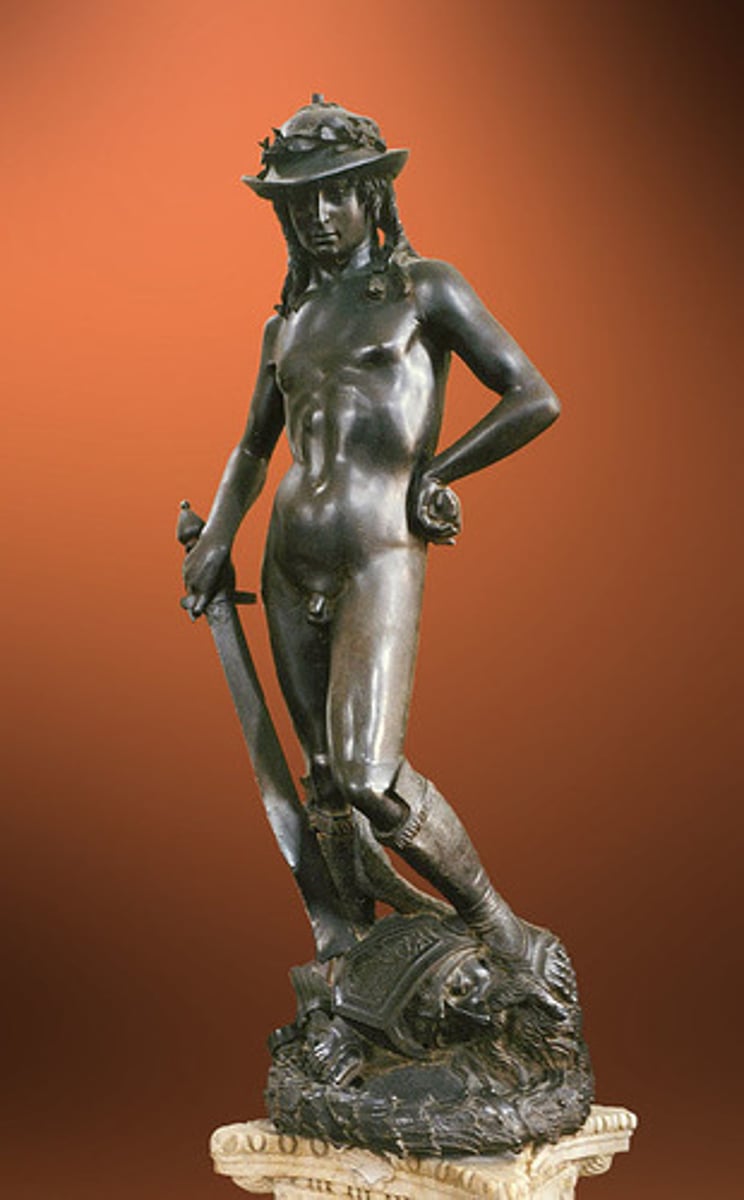
Donatello's David description and what period?
Renaissance --> shows post-battle triumph, youthful and almost effeminate, standing over Goliath --> shows him deep in thought, contemplating the action (thinking) instead of being in motion.
Michelangelo's David
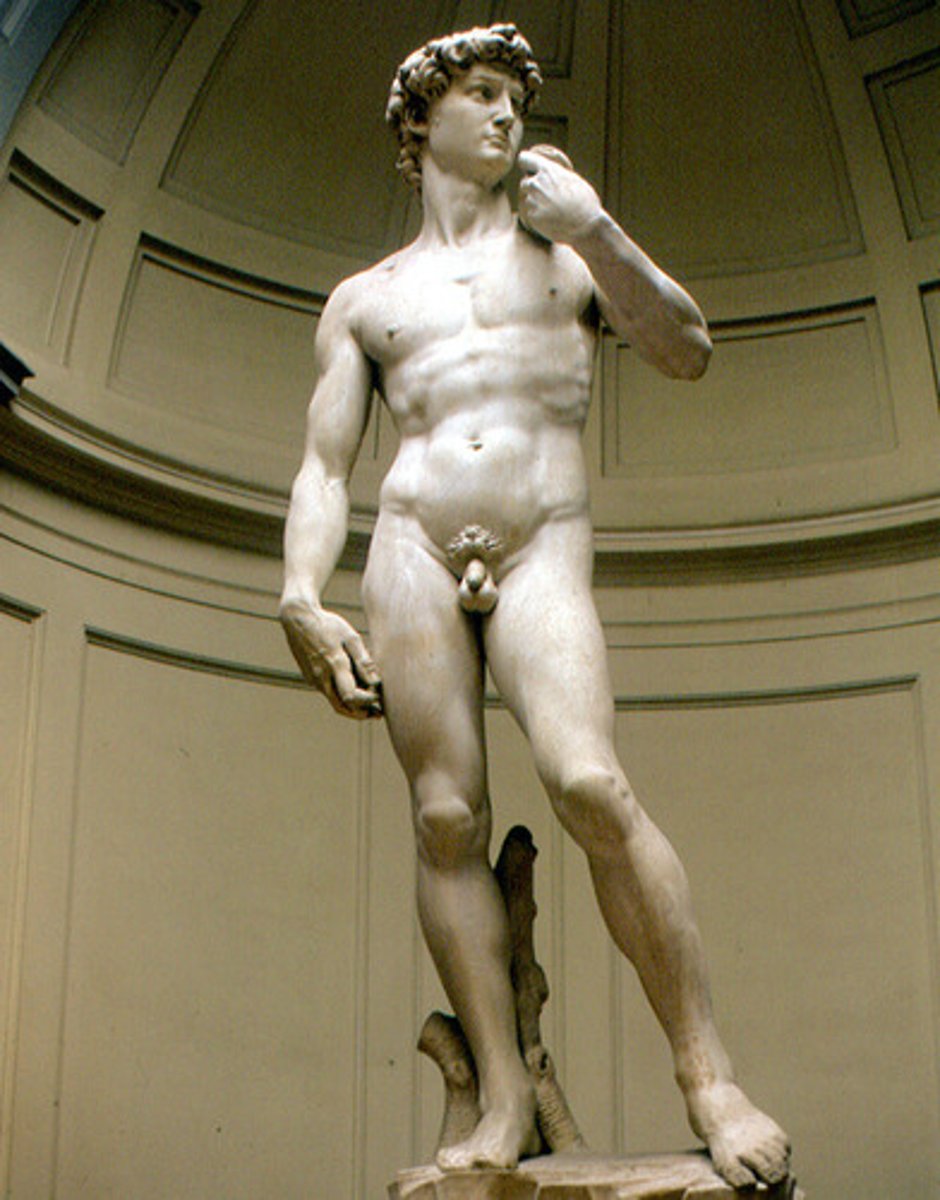
Michelangelo's David description - what period?
Renaissance = Idealized, perfectly proportioned, muscular male nude, intense, focused gaze (furrowed brow, tense neck) but calm, full of potential energy.
Style: looking greek and roman
Key Feature: Contemplative energy, muscular tension, serene yet powerful, embodies ideal beauty and inner resolve.
Bernini's David pic
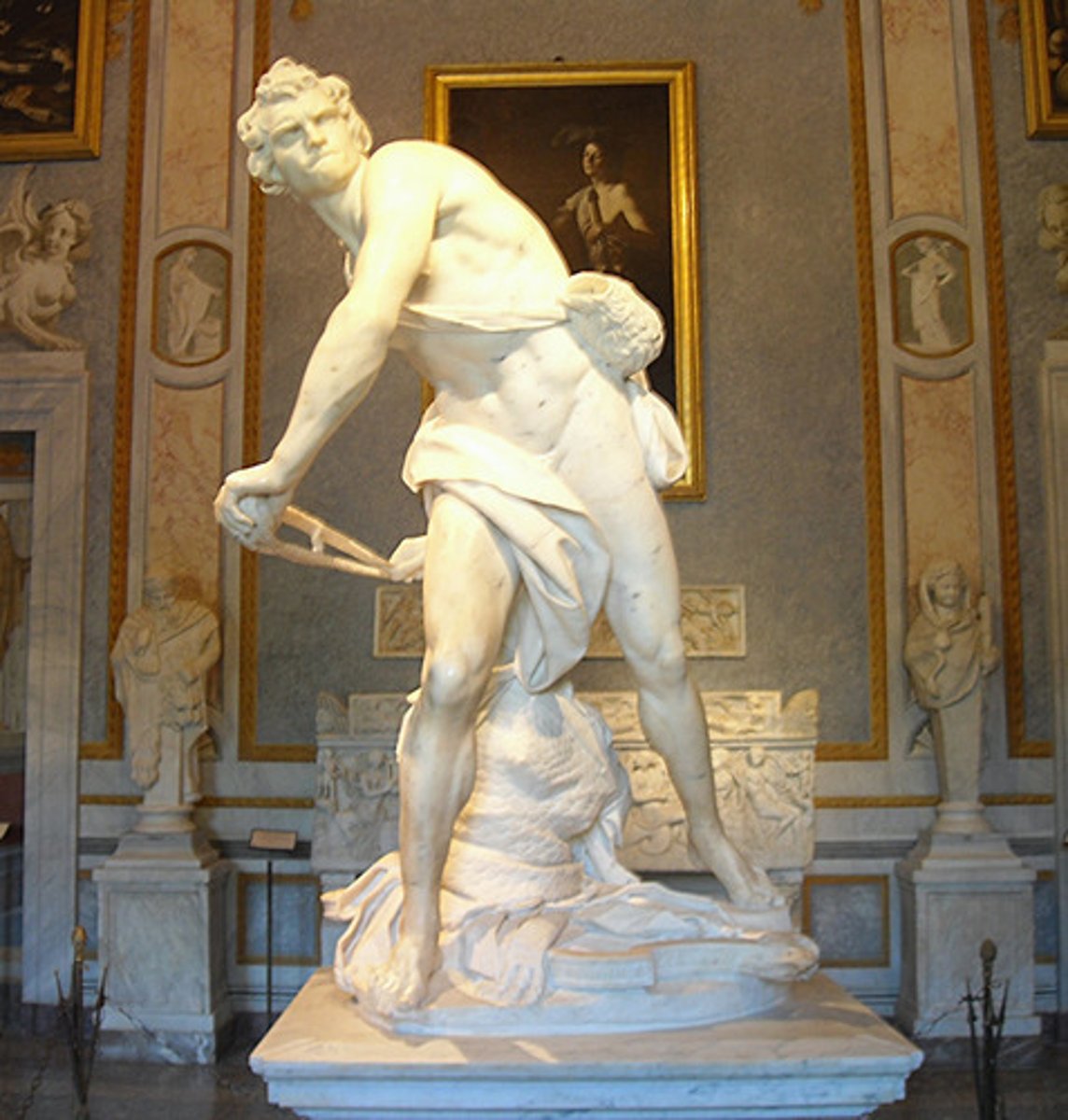
Bernini's David description + era
Baroque; Actively in the middle of the battle, in the motion of swinging the slingshot.
Appearance: Dynamic, twisting body (torsion), intense facial expression (bitten lip, frown), muscles taut, revealing a "bellicose man".
Style: Extreme movement, drama, emotion, breaks out of its space, emotionally engaging the viewer, uses diagonals for energy.
How do the art of the Rococo period reflect the sentiment of those who commissioned the work?
Rococo → commissioned by rich people who wanted to ignore social issues → "pleasure principle" → focused on scandal and just wanted to have a good time → pretty and risque
How is the imagery and technique of the Neo-Classical period a reaction to the Rococo period?
Neoclassicism was a stark reaction to Rococo's frivolity, shifting from Rococo's pastel colors, asymmetry, and sensual themes (aristocratic leisure) to Neoclassicism's sober colors, clear lines, balanced compositions, and moral subjects (civic duty, heroism, reason), inspired by ancient Greece & Rome to promote Enlightenment ideals and serve as a visual language for the French Revolution's call for order, virtue, and sacrifice.
1793 post rococo beheading of king of england + post french rev → return to democracy of ancient greece
neo-classical
It's recalling ancient Greek history which was the key idea of the movement. This piece's composition, with its clear figures with crisp lines, was precise to focus on the ideals of the piece. 18th century artists like David sought to recall ancient Greek ideals such as courage, duty and loyalty to family and the state to their modern time.
romantic art
intense, dramatic nature. It has a strong use of color that adds to the drama of the piece. Compared to the art style of the Neoclassical period, Delacroix's style for the Barque of Dante is less defined. The figures are relatively realistic but the scene is fictional and based on a book, with the background and scenery being obviously fictional. This style moved away from clean lines and order and emphasized strong emotion and in this case terror and chaos → +++ BRUSH STROKES
Realism
represents real world → realistic subjects were considered vulgar; nonglorified life + death → copying; everyday clothes
Sfumato
Italian for "smoky") is a Renaissance painting technique that creates soft, hazy transitions between colors and tones, eliminating harsh outlines for a dreamy, realistic effect, famously perfected by Leonardo da Vinci in works like the Mona Lisa, achieved by applying many thin layers of glaze with subtle blending to mimic how the eye perceives depth and out-of-focus areas.
Chiaroscuro
light-dark") is an art technique using strong contrasts between light and shadow to create dramatic effects, depth, and volume
Absolutism
refers primarily to a political system (like Louis XIV's France) where monarchs held total power, justified by divine right, centralizing control and setting stage for modern states
Definition: A system where a single ruler (monarch) holds supreme, unchecked power, often claiming it comes from God (Divine Right).
Key Figures: Louis XIV of France ("Sun King") → played apollo = dively picked to be king →