2.1 Chemical Bonds, Ionic, Covalent & Metallic
 Call Kai
 Learn
Learn Practice Test
 Spaced Repetition
 Match
Match Flashcards
 Knowt Play
1/30

There's no tags or description
Looks like no tags are added yet.
Name | Mastery | Learn | Test | Matching | Spaced | Call with Kai | Chat |
|---|
No analytics yet
Send a link to your students to track their progress
31 Terms
What are the three types of strong chemical bonds?
Ionic
Covalent
Metallic
For ionic bonding the particles are ________________ ___________ _______.
oppositely charged ions
For covalent bonding the particles are atoms which __________ ________ of ____________.
share
pairs
electrons
For metallic bonding the particles are atoms which _________ _________________ ____________.
share
delocalised
electrons
What does ionic bonding occur in?
Compounds formed from metals combined with non-metals.
What does covalent bonding occur in?
Most non-metallic elements
Compounds of non-metals
What does metallic bonding occur in?
Metallic elements
Alloys
What is a compound?
A substance which contains two or more elements chemically combined in fixed proportions.
When an atom loses electrons it becomes a ____________ ion.
positive
When an atom gains electrons it becomes a ____________ ion.
negative
What is the process of ionic bonding?
A metal atom reactions with a non-metal atom — electrons from outer shell of metal atom are transferred.
metal atoms lose electrons → positively charged ions
non-metal atoms gain electrons → negatively charged ions
The ions produced have a stable electronic structure (like that of a noble gas).
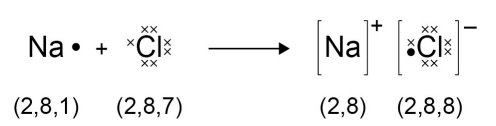
What type of bonding does sodium chloride have? Describe it.
Ionic bonding
The outer shell electron on the sodium atom is transferred to the chlorine atom.
The sodium atom has lost an electron → positively charged ion
The chlorine atom has gained an electron → negatively charged ion
Both of these ions have the stable electronic structure of a noble gas.
What is an ionic compound?
A giant structure of ions.
What are ionic compounds held together by?
Strong electrostatic forces of attraction between oppositely charged ions.
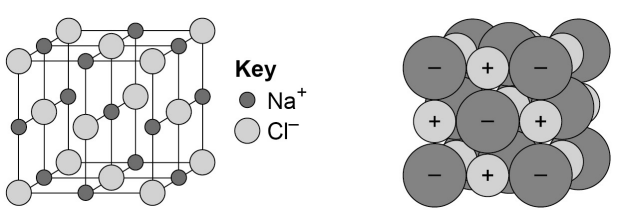
Ionic compounds are held together by strong ____________ forces of _____________ between _____________ __________ ______.
These forces act in ____ __________ in the _________ — this is called ______ __________.
electrostatic
attraction
oppositely charged ions
all directions
lattice
ionic bonding
What are the limitations of using dot and cross diagrams to represent ionic compounds?
Useful for showing how electrons are transferred
Doesn’t show the 3D arrangement of the ions in space
What are the limitations of using 2D diagrams to represent ionic compounds?
Clearly shows how ions are arranged in one single layer
Doesn’t show how the next layers of ions are arranged behind or in front of it
What are the limitations of using 3D ball and stick models to represent ionic compounds?
Shows the 3D arrangement of a larger section
Misleading — uses physical ‘sticks’ for bonds
There are no solid sticks of gaps between ions — strong electrostatic forces of attraction acting in all directions
What are the limitations of using 3D space-filling models to represent ionic compounds?
Misleading if they show lots of free space between individual ions — doesn’t exist in a tightly packed lattice
![<ul><li><p><strong>Figure 3</strong> represents the structure of manganese oxide.</p></li><li><p>Manganese oxide is an ionic compound.</p></li></ul><p>Determine the empirical formula of manganese oxide. [1 mark]</p><p>Use <strong>Figure 3.</strong></p>](https://assets.knowt.com/user-attachments/6ce2086d-c936-4df1-a9fd-1abbfdc0ef02.png)
Figure 3 represents the structure of manganese oxide.
Manganese oxide is an ionic compound.
Determine the empirical formula of manganese oxide. [1 mark]
Use Figure 3.
MnO
What bonds are formed when atoms share pairs of electrons?
Covalent bonds
What may covalently bonded substances consist of?
Small molecules
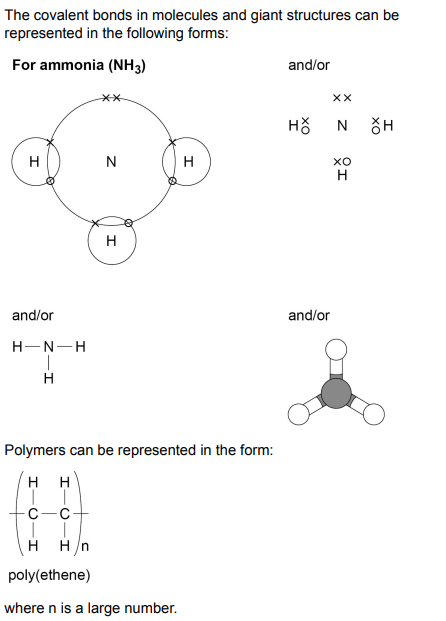
Some covalently bonded substances have very large molecules, such as __________.
Some covalently bonded substances have giant covalent structures, such as __________ and _________ ___________.
polymers
diamond
silicon dioxide
What are the limitations of using dot and cross diagrams to represent molecules of giant structures?
Clearly shows pairs of outer electrons and which atoms they came from
Doesn’t show the 3D shape of how atoms are arranged in space
What are the limitations of using 2D structural formulas to represent molecules of giant structures?
Shows which atoms are connected by bonds
Doesn’t show the 3D structure and which atoms the electrons came from
What are the limitations of using 3D ball and stick models to represent molecules of giant structures?
Shows the 3D arrangement of atoms in space
Misleading — uses physical ‘sticks’ for bonds
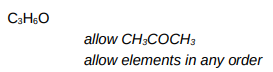
![<ul><li><p>Propanone is a compound of carbon, hydrogen and oxygen.</p></li><li><p><strong>Figure 1</strong> shows the dot and cross for a propanone molecule.</p></li></ul><p>Determine the molecular formula of propanone. [1 mark]</p><p>Use <strong>Figure 1</strong>.</p>](https://assets.knowt.com/user-attachments/140cfee9-9f8a-4da1-9a95-f67914578517.png)
Propanone is a compound of carbon, hydrogen and oxygen.
Figure 1 shows the dot and cross for a propanone molecule.
Determine the molecular formula of propanone. [1 mark]
Use Figure 1.
C3H6O
![<ul><li><p>This question is about citric acid.</p></li><li><p><strong>Figure 1</strong> represents one molecule of citric acid.</p></li></ul><p>Complete the molecular formula of citric acid. [1 mark]</p><p><mark data-color="blue" style="background-color: blue; color: inherit;">C<sub>6</sub>H<sub>__</sub>O<sub>__</sub></mark></p><p>Use <strong>Figure 1</strong>.</p>](https://assets.knowt.com/user-attachments/3ec5738e-00e5-4d6c-8351-bf04b3b97bb5.png)
This question is about citric acid.
Figure 1 represents one molecule of citric acid.
Complete the molecular formula of citric acid. [1 mark]
C6H__O__
Use Figure 1.
8
7
What do metals consist of?
Giant structures of atoms arranged in a regular pattern.
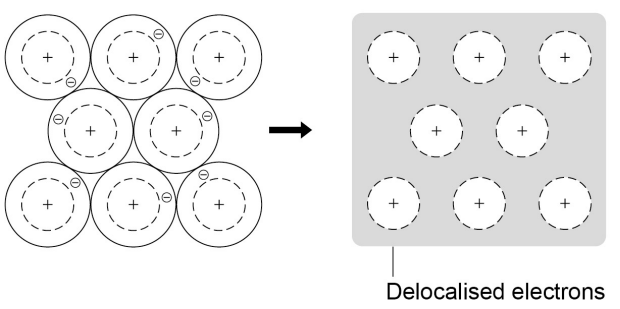
The electrons in the outer shell of metal atoms are ________________ and so are free to move through the whole ____________.
The __________ of ____________ electrons gives rise to strong ____________ bonds.
delocalised
structure
sharing
delocalised
metallic
![<ul><li><p>The table shows the structures of three compounds.</p></li></ul><p>Compare the structure and bonding of the three compounds:</p><ul><li><p>carbon dioxide</p></li><li><p>magnesium oxide</p></li><li><p>silicon dioxide</p></li></ul><p>[6 marks]</p>](https://assets.knowt.com/user-attachments/386e9c31-5970-4179-ae5b-680328cb0fca.png)
The table shows the structures of three compounds.
Compare the structure and bonding of the three compounds:
carbon dioxide
magnesium oxide
silicon dioxide
[6 marks]
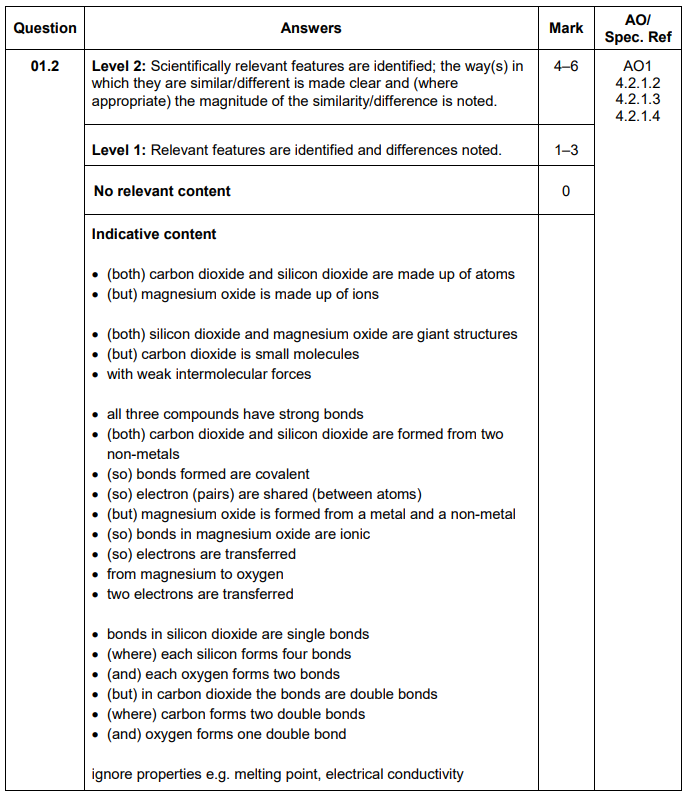
Both carbon dioxide and silicon dioxide are made up of atoms — but magnesium oxide is made up of ions.
Both silicon dioxide and magnesium oxide are giant structures — but carbon dioxide is small molecules with weak intermolecular forces.
All three compounds have strong bonds.
Both carbon dioxide and silicon dioxide are formed from two non-metals
so the bonds formed are covalent
so the electron pairs are shared between atoms
But magnesium oxide is formed from a metal and a non-metal
so the bonds in magnesium oxide are ionic
so electrons are transferred from magnesium to oxygen — two electrons are transferred