Corticosteroids (Week 3, Mod 9)
 Call Kai
 Learn
Learn Practice Test
 Spaced Repetition
 Match
Match Flashcards
 Knowt Play
1/31

There's no tags or description
Looks like no tags are added yet.
Name | Mastery | Learn | Test | Matching | Spaced | Call with Kai | Chat |
|---|
No analytics yet
Send a link to your students to track their progress
32 Terms
What is the definition of bronchial tone?
Bronchial tone:
the dynamic equilibrium between the state of contraction or relaxation of the smooth muscle in the bronchial walls that regulate respiration
Increased bronchial tone = smooth muscle constriction = bronchoconstriction
Decreased bronchial tone = smooth muscle dilation = bronchodilation
Describe the effect of the sympathetic nervous system on bronchial tone…
No innervation but dilated by circulating adrenaline
B2 adrenoceptors
increase cAMP in bronchial smooth muscle
relaxation of bronchial smooth muscle
Adrenaline ALSO inhibits the release of histamine from mast cells in allergic reactions
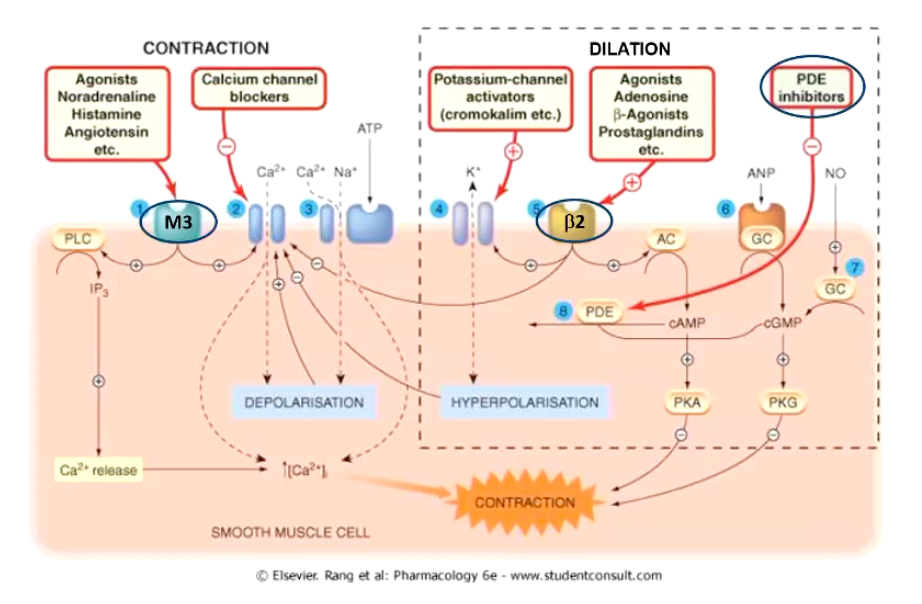
Describe the effect of the parasympathetic nervous system on bronchial tone…
Muscarinic acetylcholine receptors: M3
increase IP3
increase [Ca2+];
CONSTRICTION of bronchial smooth muscle
![<p>Muscarinic acetylcholine receptors: <strong>M3</strong> </p><ul><li><p>increase IP3</p></li><li><p>increase [Ca<sup>2</sup>+];</p></li></ul><p></p><p><strong>CONSTRICTION </strong>of bronchial smooth muscle</p>](https://knowt-user-attachments.s3.amazonaws.com/a3c9f229-73e2-4d17-b294-2286d829e87d.png)
How can we achieve bronchodilation pharmacologically??
Drug Targets
• ß-adrenergic agonists
• Anticholinergic (antimuscarinic) Drugs
• Methylxanthines (PDE inhibitors) i.e. caffeine
Aim is to mimic the sympathetic OR block the parasympathetic nervous system
Need to keep in mind how you deliver the drugs; could help you minimize systemic side effects
What are some ß-adrenergic agonists, and what are they used for? What is their mechanism of action, and their side effects?
Adrenaline (epinephrine)
• Emergency treatment of life threatening bronchoconstriction
B, adrenoceptor specific agonists
e.g. terbutaline, salbutamol, salmeterol, clenbuterol
Mechanism: Stimulate adrenergic pathways
Side effects
• CVS: increased heart rate, palpitations
• Skeletal muscle: tremors
Tolerance
What are some anticholinergic (antimuscarinic) drugs, and what are they used for? What is their mechanism of action, and their side effects?
ATROPINE
comes from nightshade; highly toxic
Mechanism: BLOCKS the endogenous parasympathetic constriction of the bronchi
acts through the M3 receptor
Side effects:
• CNS stimulation
• Gl inhibition
Administration: topical vs systemic
Local effect:
Ipratropium bromide is a quaternary derivative of atropine, limited absorption therefore minimal systemic side effects
What are some methylxanthines, and what are they used for? What is their mechanism of action, and their side effects?
Methylxanthines e.g. theobromine, caffeine, theophylline, etamiphylline
Mechanism of action:
Phosphodiesterase (PDE) inhibitors
Increase CAMP
bronchial smooth muscle relaxation
Decrease inflammatory mediators
Adenosine inhibition
Side effects
GI
Cardiac
CNS
What is one of the major inflammatory mediators that causes bronchoconstriction during an allergic reaction?
Arachidonic acid
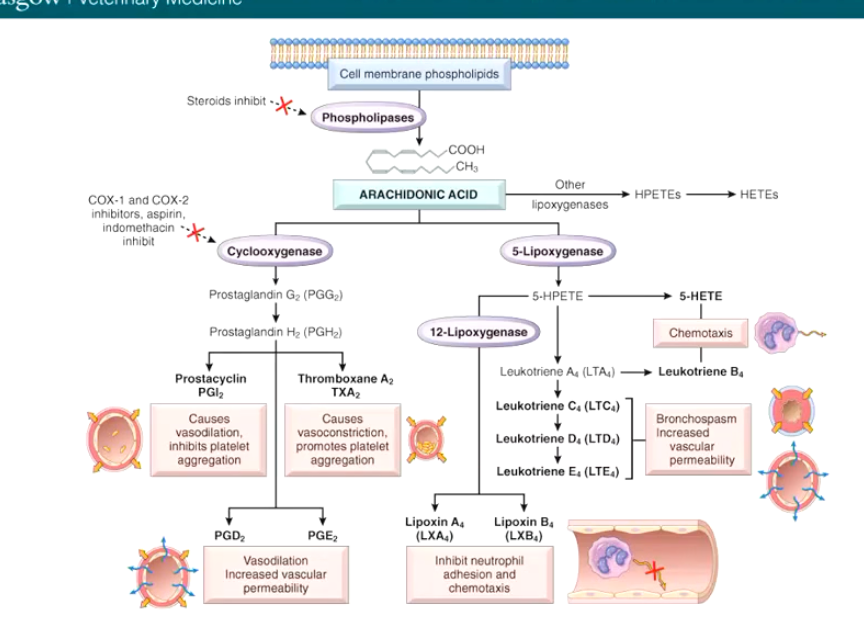
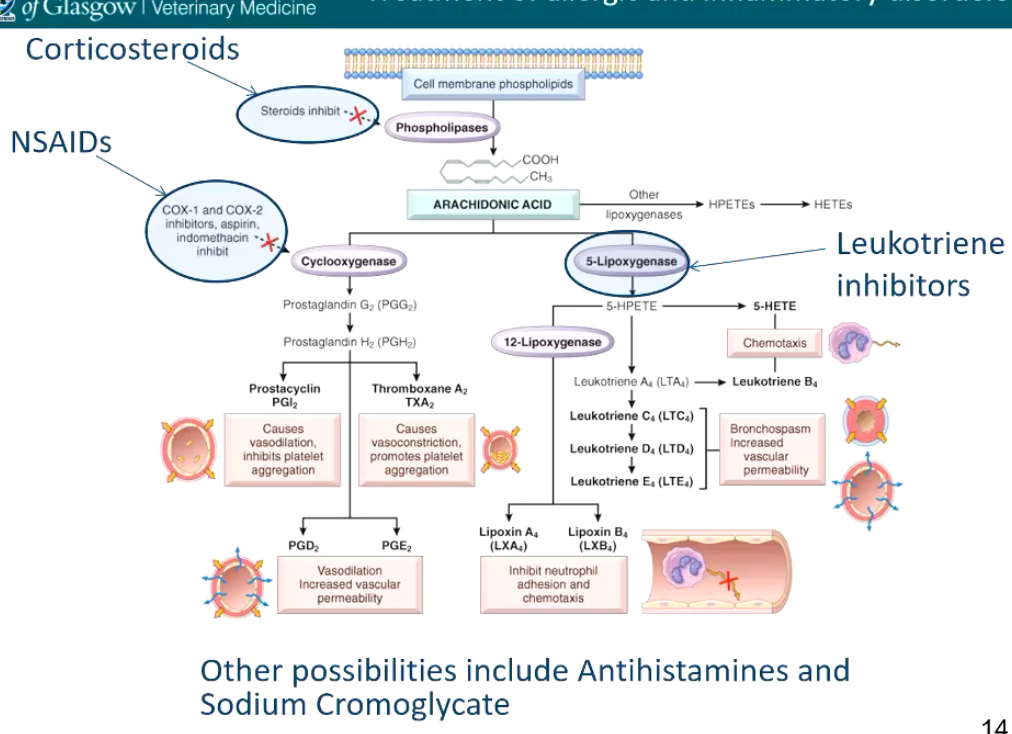
Where in the inflammatory process do NSAIDs inhibit the effects of arachidonic acid? What about corticosteroids?
NSAIDS: COX-1 and COX-2 enzymes
blocks the production of prostaglandins
Corticosteroids: PHOSPHOLIPASES on cell membranes
Blocks the production of arachidonic acids COMPLETELY
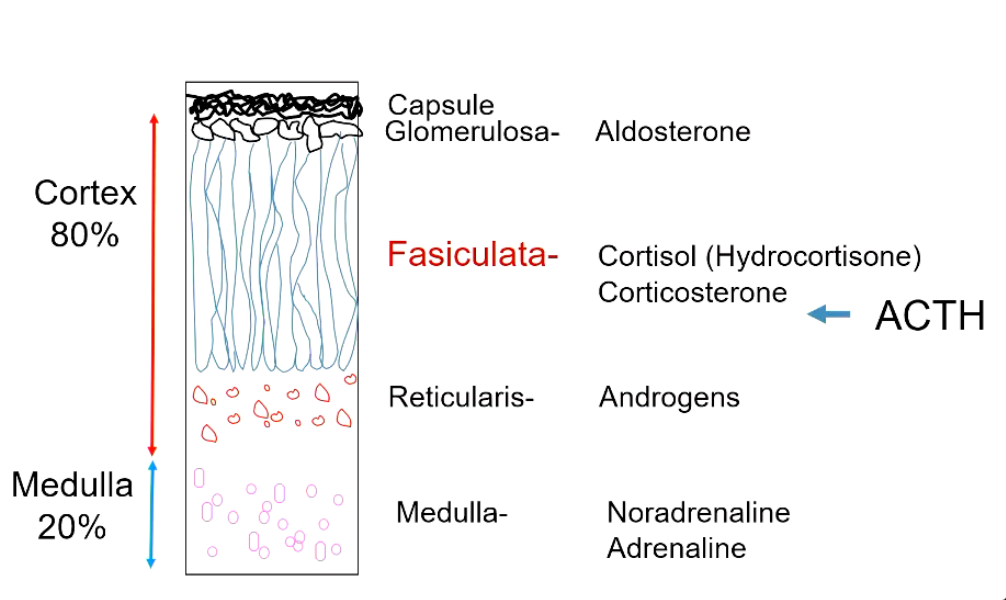
What are the two classes that corticosteroids are divided into? Where are they produced?
Glucocorticoids
Cortisol
Corticosterone
Mineralocorticoids
Noradrenaline
Adrenaline
Formed in different parts of the adrenal glands…
Glucocorticoids = cortex
Mineralocorticoids = medulla
When giving exogenous corticosteroids, does it act as a treatment for the patient?
NO
only treats the SYMPTOMS of conditions
still need to address the underlying cause
Ex: DEXAMETHASONE
helps relieve itch, doesn’t treat the allergic reaction
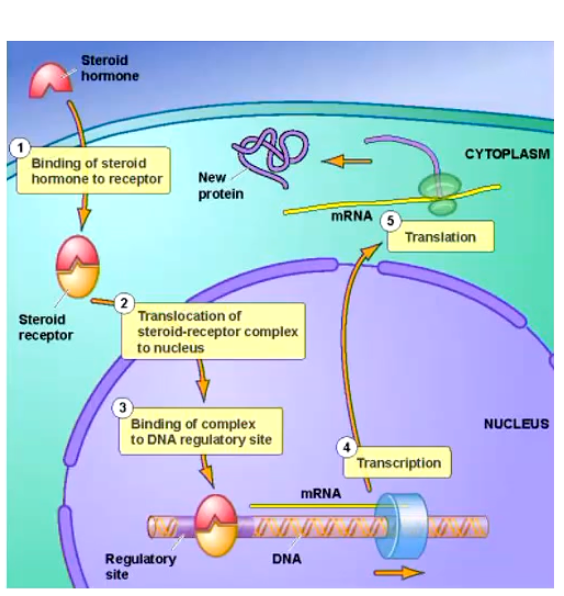
Know the mechanism of action for corticosteroids… Note:
Cell HAS to contain a receptor for that particular steroid… some cells will, some cells won’t
Steroid-receptor complex, as it binds to the DNA, only has effects at SPECIFIC regions of the DNA template
Called motifs
Acts at a signal to that specific steroid receptor… once the complex reaches the motif, the complex will either FACILITATE the transcription of that gene, or INHIBIT it
What are 3 proteins that glucocorticoids INDUCE the transcription of?
1) Angiotensin converting enzyme
2) B2-adrenoceptor - more of these = increased response to endogenous OR exogenous adrenaline
3) Lipocortin 1
(inhibits phospolipase)
What are 4 proteins that glucocorticoids INHIBIT the transcription of?
1) Cytokines
2) Cyclo-oxygenase = less prostaglandins = prevents bronchoconstriction
3) Collagenase
4) Inducible NOS
Which corticosteroids are short acting? Which are long acting?
Short acting: < 24 hrs
Pred (prednisolone AND prednisone)
Methylpred
Long acting: > 24 hrs
Dex
Betamethasone
Triamcinolone
What are the two main formulations corticosteroids come in?
Water Soluble Salts
Insoluble Esters
What are the characteristics of a water soluble corticosteroid? Think of some examples…
Ideal for intravenous administration
Readily absorbed and eliminated within 8-24h (fast acting)
Can give high concentrations, rapid effects
Sodium phosphate salts and soluble esters (eg succinate,) examples include: Betamethasone sodium phosphate (Betsolan ™ soluble); Dexamethasone (Azium M, Colvasone, Dexadreson "™)
Yes, these were listen as long acting, but their composition in this form makes them fast
What are the characteristics of an insoluble ester corticosteroid? Think of some examples…
Useful for more sustained therapy
e.g. acetate, adamantoate, dipropionate, pivalate, phenylpropionate, isonicotinate, adamantoate.
Dexamethasone isonicotinate (Voren 14 M)
Methylprednisolone acetate (Depo-Medrone V Im)
Mixed esters:
Soluble and insoluble compounds eg Dexafort
QUESTION TIME:
Why might it not be a good idea to give a glucocorticoid systemically?
Would activate a widespread response
Multiple systems in the body would be affected
There are multiple glucocorticoid receptors in many different types of cells all throughout the body
If a glucocorticoid were given systemically, all cells of varying tissues that contain the glucocorticoid receptor would respond to it
What are 3 different routes of administration for glucocorticoids? Keeping this in mind, what is one thing you should ALWAYS remember about glucocorticoids?
1) Topical
Ex: hydrocortisone cream
2) Direct (ex: inhalant)
For chronic obstructive pulmonary disease (COPD) or recurrent airway obstruction (RAO
Would reduce inflammation
3) Intra-articular injection
Also reduces inflammation
REMEMBER: glucocorticoids don't treat underlying causes
Simply masks symptoms
What are the 5 different general principles of corticosteroid therapy?
• Minimal mineralocorticoid activity preferred
• Use as low a dose as possible
• Withdraw treatment gradually
• Long acting compounds greater risk of toxicity
• Treat underlying cause of the problem in the meantime
It's a matter of balance!
Why is gradual withdrawal of glucocorticoid treatment essential?
The sudden termination of corticosteroid therapy could result in a life-threatening crisis
The negative feedback that exogenous corticosteroids apply to the hypothalamus leads to suppression of the HPA axis (see image)
Results in expression of ACTH, followed by atrophy of the adrenal glands
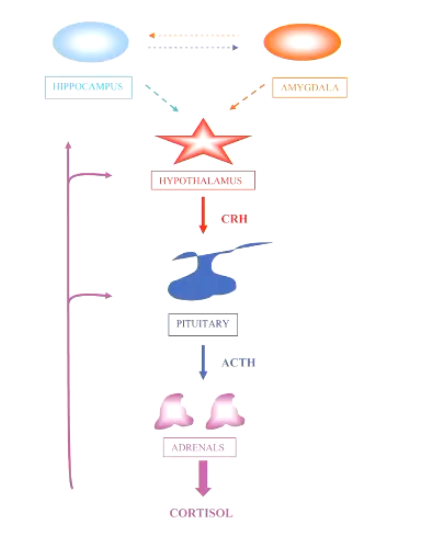
What are three different diseases caused by the abnormal functioning of the adrenal gland and the HPA axis?
• Addisons's Disease
• Cushing's Disease
• Congenital Adrenal Hyperplasia
Describe congenital adrenal hyperplasia… how is it different between males and females?
Congenital Adrenal Hyperplasia (CAH) is a group of inherited genetic disorders that impair the adrenal glands' ability to produce essential hormones—specifically cortisol and often aldosterone
causes excessive testosterone production and adrenal gland enlargement, leading to ambiguous genitalia in females and early puberty in boys
Not too bad for males, but leads to the masculinization of females
Describe Addison's disease (hypoadrenocorticism)… what is it? What causes it?
Deficiency of adrenocortical steroid production
Mineralocorticoid and glucocorticoid deficiency
Underlying pathology: usually immune mediated destruction of adrenal cortices
Spontaneous central hypoadrenocorticism less common
Central hypoadrenocorticism is most commonly iatrogenic
What are the symptoms and clinical signs of Addison’s disease? What breeds are the most susceptible?
Symptoms and clinical signs:
anorexia, vomiting, diarrhoea, weakness, exercise intolerance, polydipsia and polyurea.
may be precipitated by a stressful event (e.g. domestic change).
Breeds predisposed:
Standard poodles
West Highland terriers
Great Danes
Some collies
How do you diagnose Addison’s disease? What medications can be used to treat it?
Diagnosis:
Circulating ACTH concentrations increased in primary (adrenal) Addison's
Not in central hypoadrenocorticism
Important to take sample early in the morning; could lead to a misdiagnosis if blood sample taken late in the day
Treatment:
Acute hypoadrenal crisis is a medical emergency!
Hydrocortisone Sodium succinate (iv).
Chronic therapy requires permanent mineralocorticoid therapy (Fludrocortisone Acetate; oral).
Describe Cushing’s disease (hypERadrenocorticism)… what is it? What causes it?
Cushing's disease = overproduction of glucocorticoids due to a pituitary adenoma (ACTH increased) or due to an adrenal tumour (ACTH very low)
latrogenic Cushing's can result from prolonged treatment with glucocorticoids
Seen more commonly in older dogs (10yrs) and older horses (20yrs)
RARELY in cats, but can happen
BIG SIGN: Coat thickness / texture changes
What are the symptoms and clinical signs of Cushing’s disease? What breeds are the most susceptible?
Common Symptoms:
Polydipsia
Polyurea
Polyphagia
Elevated liver enzymes
Pot belly
Thin skin
Coat changes
Muscle wastage
Susceptible Breeds:
Poodles
Dachshunds
Terriers
German Shepherds
Golden Retrievers
What are the two different KINDS of Cushing’s disease? What are the signs?
PITUITARY
Caused by an adenoma on the pituitary gland
80% of Cushing’s cases are due to this
Signs:
Increased ACTH
Increased cortisol
ADRENAL
Caused by a tumor on the adrenal gland
Makes up 20% of Cushing’s cases
Signs:
DECREASED ACTH
Due to homeostatic balance from hypothalamus… increased cortisol → hypothalamus reduces production of ACTH
Increased cortisol
What are the 3 main pharmacological tests for Cushing’s disease?
1) ACTH test:
Elevated corticosteroids before ACTH and a rise after administration.
2) Low dose Dexamethasone suppression test:
In Cushing's animal this will not suppress cortisol.
3) High dose Dexamethasone suppression test: Sometimes used to differentiate between pituitary and adrenal problem. If pituitary, high dose will suppress cortisol production; if adrenal, it will not.
What are the 3 main pharmacological treatment options for Cushing’s disease? What are their advantages / disadvantages?
Trilostane (Vetoryl °): oral, well tolerated, careful monitoring required
Ketoconazole (antifungal): interferes with synthesis of adrenal steroids
(cP450 enzymes), but expensive.
Mitotane or o,p'-DDD (Lysodren) - Cytotoxic
Advantages:
Easy to use (oral, with food)
Relatively inexpensive
Disadvantages:
Potential very serious side effects
Requires regular monitoring
Give with food to aid absorption