Physics 2/25 test
 Studied by 1 person
 Call Kai
 Learn
Learn Practice Test
 Spaced Repetition
 Match
Match Flashcards
 Knowt Play
1/25

There's no tags or description
Looks like no tags are added yet.
Name | Mastery | Learn | Test | Matching | Spaced | Call with Kai |
|---|
No analytics yet
Send a link to your students to track their progress
26 Terms
What is momentum?
Momentum is a measure of the tendency of an object to remain in motion. It is the product of an object's mass and velocity, and is a vector. Its direction is always in the same direction as the velocity vector.
Momentum symbol
Momentum formula
Momentum unit
p
p=mv
kg*m/s
What is impulse?
Impulse is the product of the net force acting on an object and the time during which the force acts is called. Unbalanced forces cause changes in acceleration, and velocity, and therefore change momentum. Impulse is the change in momentum and it is also a vector quantity.
Impulse symbol
Impulse formula
Impulse unit
J
J=F_net*t
N*s
The Law of Conservation of Momentum
In a system consisting of bodies on which no outside forces are acting, the total momentum of the system remains the same.
Law of Conservation of Momentum formula
p_before = p_after
Other variation of the Law of Conservation of Mass formula
m_1*v_1 = -m_2*v_2
Law of Conservation of Mass formula in a 2 object system
m_1*v_1i + m_2*v_2i = m_1*v_1f + m_2*v_2f
What is work
The transfer of energy to an object when the object moves a certain amount due to the application of a force. Work done on an object produces a change in the object’s total energy. It is a scalar quantity and is independent of time
Work symbol
Work formula
Work unit
W
W = F*d = ∆E_t
Joule (J) of N*m
Remember for Work
Work and energy
Motion
Component of force
Several forces
Work and energy are closely related
The object must move in order for work to have been done (no motion = no work)
You must find the component of the force that is in the same direction as the motion of the object. This is usually the x-component (the horizontal)
If several forces act on an object, you must find the work done by each force separately, and then ass them together for the total work. Same goes for distance
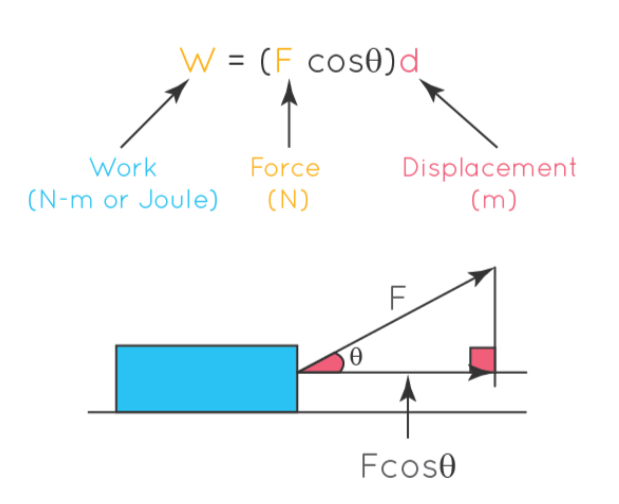
If work is being done at an angle
W = (F*cosø)*d
What is power
Power is the rate at which work is done. It is a scalar quantity. The less time required to do a given amount of work, the greater power is developed. It is also the rate at which energy is transformed.
Power symbol
Power formula
Power unit
P
P = W/t = (F*d)/t = ∆E/t = F*v
Watts(s) (W)
Different types of energy
When work is done on a system, it will gain an amount of energy equal to the work done on it. Each form of energy is measured by the amount of work it can do.
Thermal (Heat): the total kinetic energy possessed by the individual particles that make up an object.
Internal: The total potential and kinetic energy possessed by the particles that make an object up, (excluding the potential and kinetic energies of the system as a whole.)
Nuclear: Energy that is released by nuclear fission or fusion.
Electromagnetic: Energy associated with electric or magnetic fields, (such as visible light, microwaves, x-rays, etc…)
Potential: The energy possessed by an object due to its position or condition.
Kinetic: The energy an object possesses due to its motion.
Potential energy symbol
Potential energy formula
Potential energy unit
PE
∆PE = m*g*∆h
J
Kinetic energy symbol
Kinetic energy formula
Kinetic energy unit
KE
KE = ½ m*v²
J
What is the Law of Conservation of Energy
“energy cannot be created or destroyed” means that energy is conserved. This law states that although the energy within a closed system may be transformed from one type to another, the total energy of the system remains the same. This includes the sum of the PE, KE, and internal energy.
Equation for Law of Conservation of Energy
E_t = PE + KE + Q
Internal energy is caused by a kinetic energy lost to heat it is due to friction or air resistance, and causes the objects in contact to experience an increase in temperature. Q can be disregarded if it is a frictionless surface or there is no air resistance
Remember for Law of Conservation of Energy
System’s total energy
If you know… then you know…
A system’s total mechanical energy E_t will never change
Once you know the kinetic energy and potential energy at any point, you are able to figure out the object’s height and velocity at any point if given the mass (using the KE and PE formulas)
Other formulas that can represent the Law of Conservation of Energy
∆PE = -∆KE
PE_i + KE_i = PE_f + KE_f
½ m*v² + (-)m*g*h = 0
Springs and Elastic Collisions
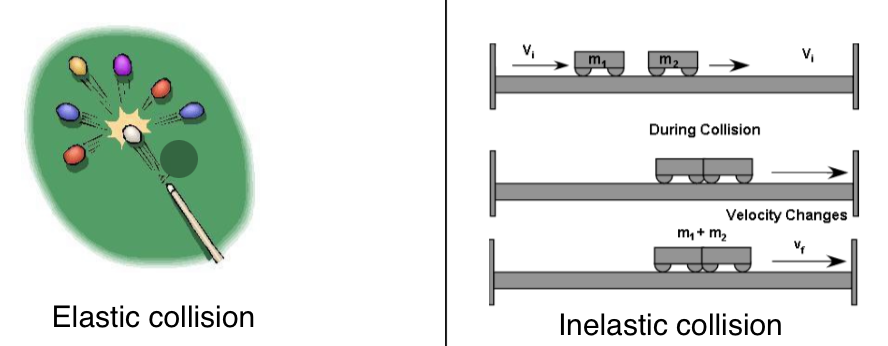
Elastic collision
Inelastic collision
In an elastic collision, the total energy in the system is the same before and after the collision. It will occur when two or more objects collide in such a way that both total momentum and total kinetic energy are conserved. Ex: the collision between billiard balls.In an elastic collision, the total energy in the system is the same before and after the collision. It will occur when two or more objects collide in such a way that both total momentum and total kinetic energy are conserved. Ex: the collision between billiard balls.
In an inelastic collision, there is a loss of energy due to an increase in heat from the collision. Therefore the kinetic energy will decrease, but the total momentum will be conserved. Here, the objects will stick together.
Springs
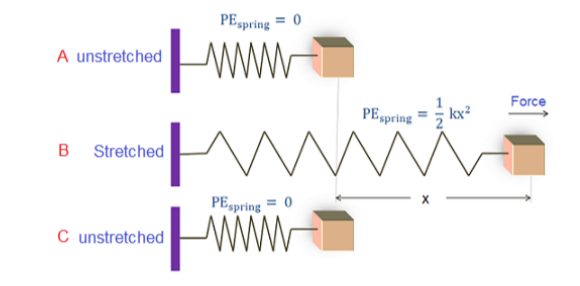
Applied forces cause work to be done. Work is converted to energy. In a spring, this work is converted to potential energy, which can then transfer to kinetic energy.
Imagine a force being applied to a spring. The spring will either stretch or compress depending on The direction of the force. This becomes stored energy in the spring (elastic potential energy).
What is Hooke’s Law
The compression or elongation of a spring is directly proportional to the applied force. It is represented by the formula below. Note that you can find the force on a vertical spring by doing F = m*g
Force on a spring symbol
Force on a spring formula
Force on a spring unit
F_s
F_s = k*x (force on the spring = spring constant * compression/elongation of the spring)
N
Elastic potential energy can be written as:
PE_s = ½ k*x²
 Note
Note  Flashcards (105)