Lecture 2.4: Enzyme Kinetics
 Call Kai
 Learn
Learn Practice Test
 Spaced Repetition
 Match
Match Flashcards
 Knowt Play
1/53

There's no tags or description
Looks like no tags are added yet.
Name | Mastery | Learn | Test | Matching | Spaced | Call with Kai | Chat |
|---|
No analytics yet
Send a link to your students to track their progress
54 Terms
What does rate (V) equal
Rate (V) = K[S]
What is Vmax
The theoretical maximum rate at which an enzyme can catalyze a reaction when the active sites are completely saturated
What is the michealis-menten kinetics equation
V0 = Vmax [S] / Km + [S]
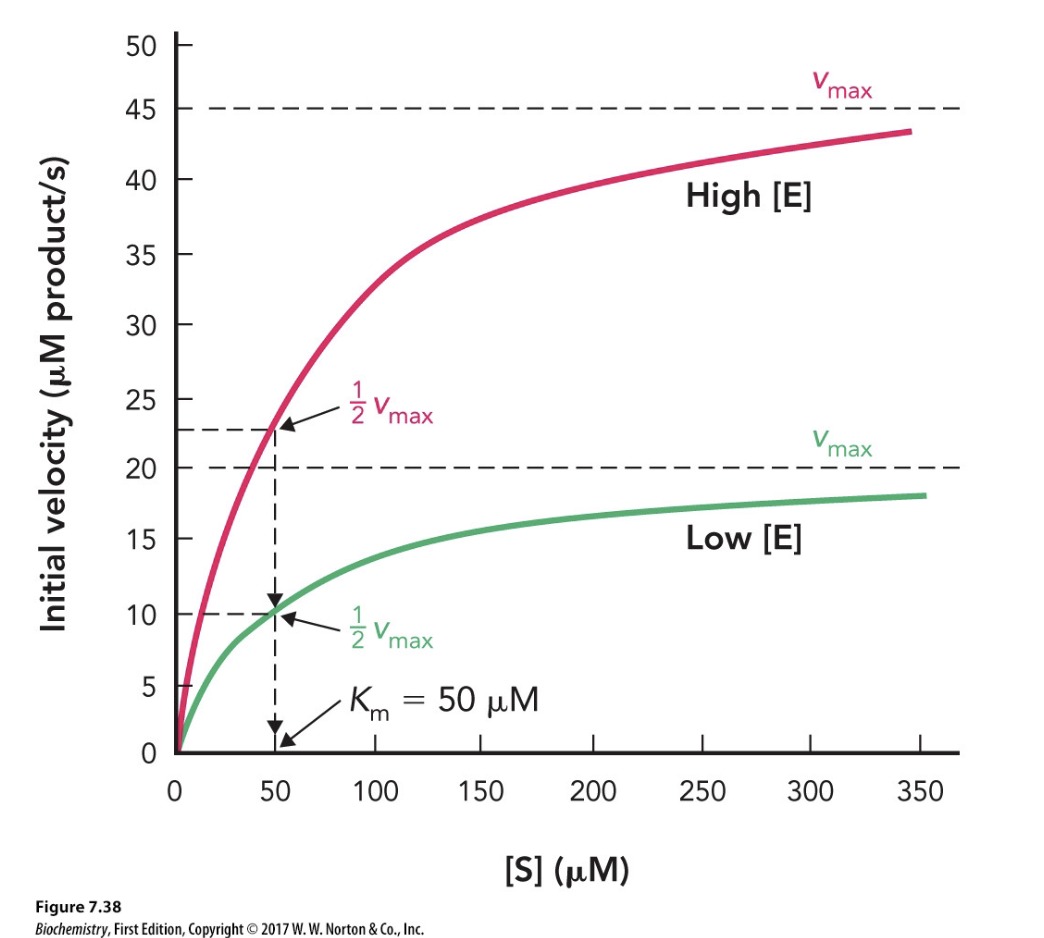
What does increasing [E] do to the Vmax of a reaction
Increases the Vmax
Define Km?
The amount of substrate needed to reach ½ Vmax
What does a low Km tell you about the enzyme?
Low Km = enzyme has high affinity for substrate
What does a high Km tell you about the enzyme?
High Km = enzyme has high affinity for substrate
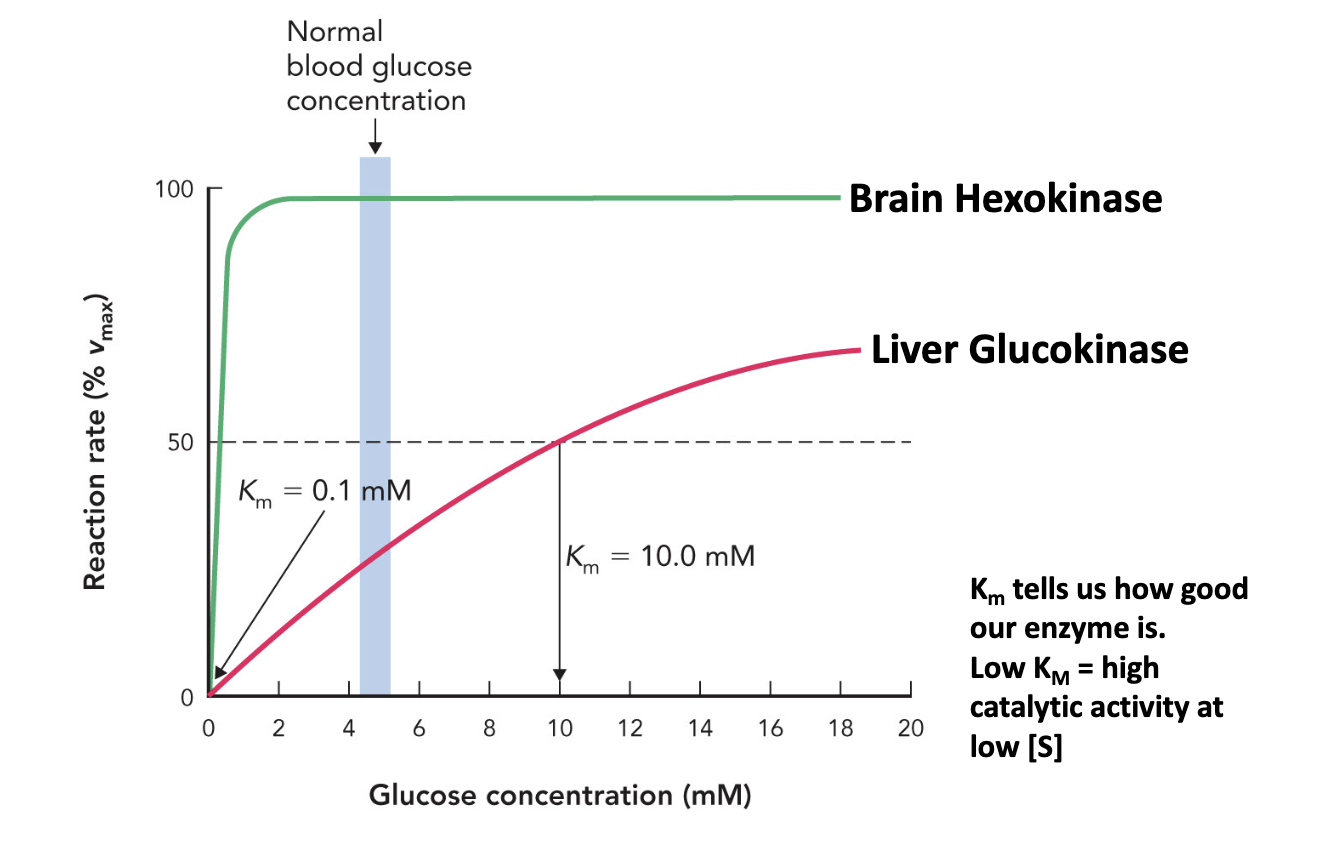
In the case of Hexokinase (brain) and Glucokinase (liver) why is it important that Hexokinase has a very low Km?
Low Km means high affinity which in this case is important for the brain to be able to absorb glucose from the blood even if glucose concentration are very low The brain primarily runs of glucose for energy.
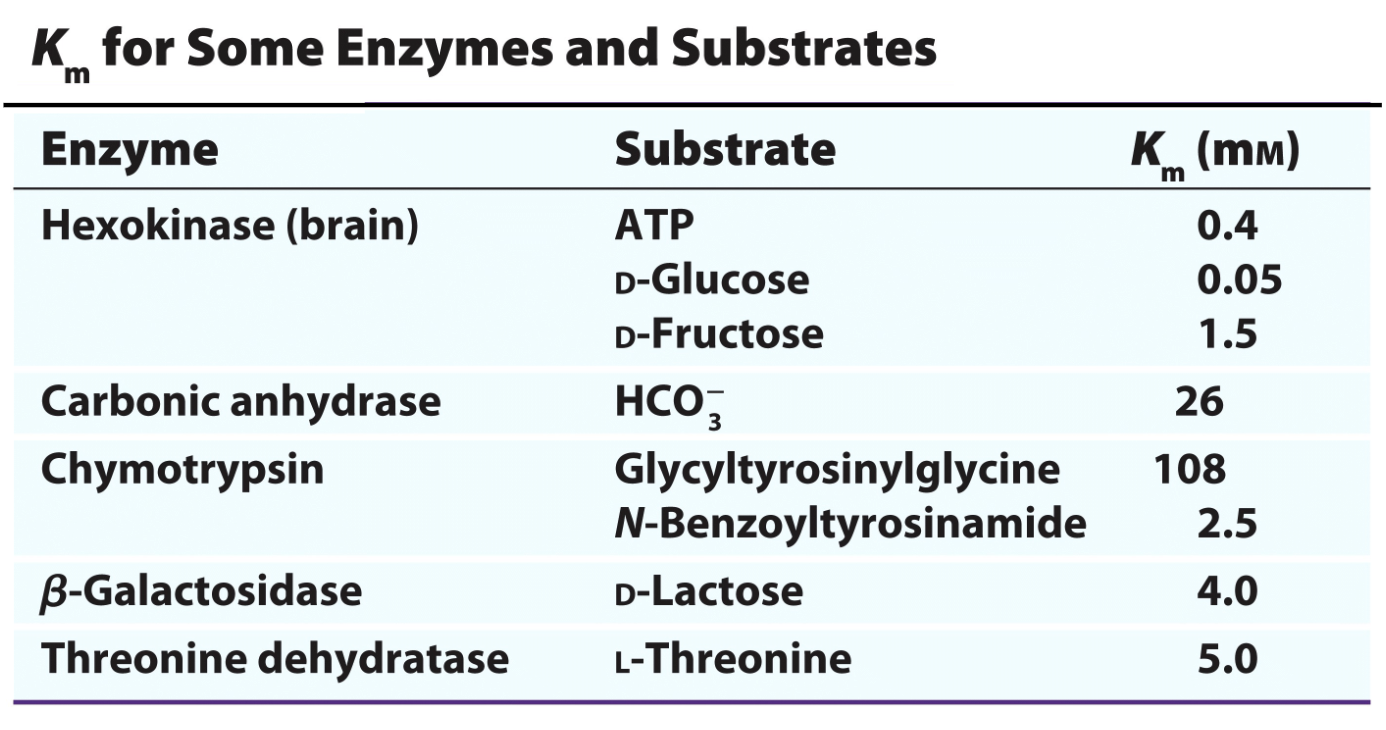
What do the Km values show for the substartes associated with the eznyme Chymotryspin?
N-Benzoyltyrosinmide is much more preferred as a substrate. This can be seen by the low Km (high affinity)
What is the Michealis-Menten equation when Km is much greater than [S]
V0 = [S]
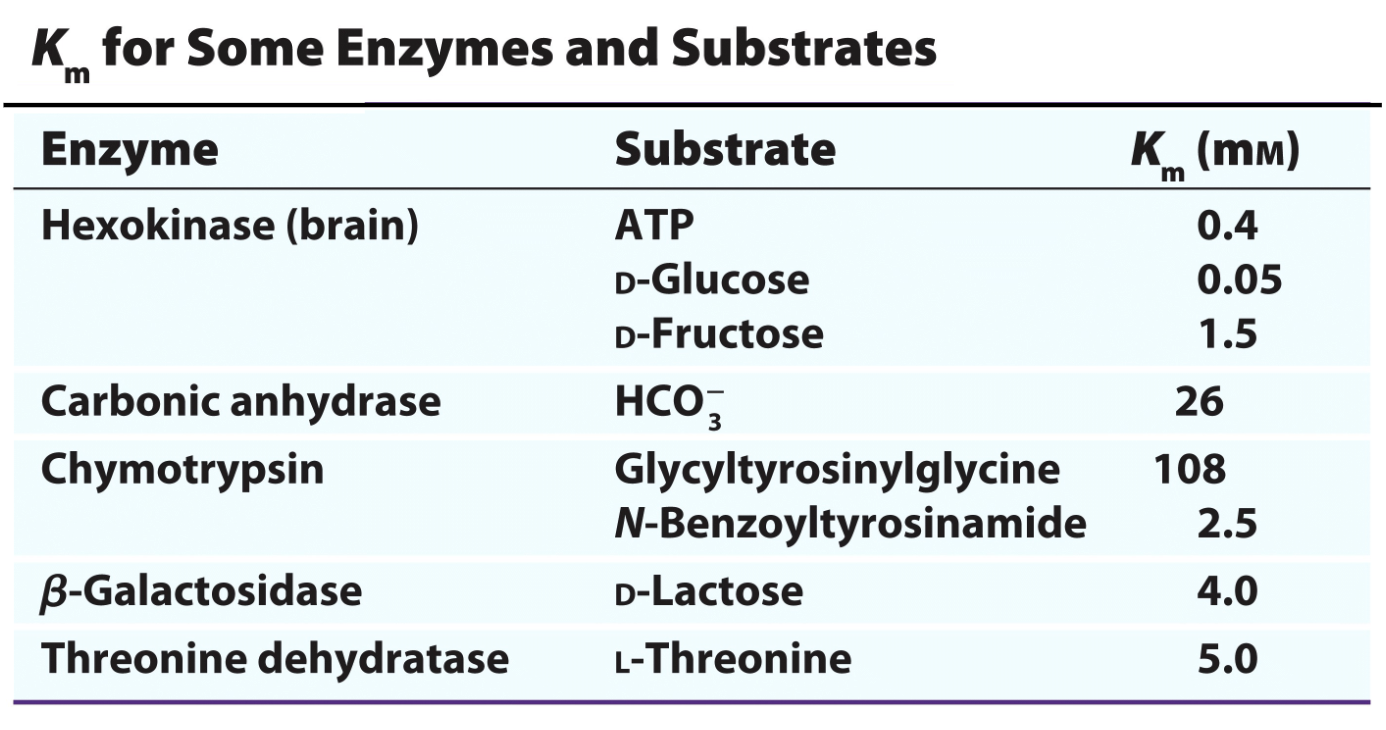
Why doe Glycyltyrosinylglycine have such a high Km
The two glycine amino acids make the substrate very flexible and unfavorable to lock into a strict conformation in the active site
(T/F) Km is effected by [E]
False, enzyme concentration does not effect Km
What is the Michealis-Menten equation when Km is much less than [S]
V0 = Vmax
In a lineweaver-burk plot what is the Y-axis
1 / V0
In a lineweaver-burk plot what is the X-axis
1 / [S]
In a lineweaver-burk plot what is the Y-intercept
1 / Vmax
In a lineweaver-burk plot what is the X-intercept
-1 / Km
In a lineweaver-burk plot what is the slope
Km / Vmax
Define Kcat
amount of turnover for one enzyme at full saturation
What does a high Kcat mean
Faster turnover
What is the equation for Kcat
Kcat = Vmax /[E]T (Units: Sec-1)
Define catalytic efficiency (specificity constant)
The amount of product turnover at a specific concentration
What is the equation for the specificity constant
Kcat / Km
What does a bigger specificity constant mean
Bigger specificity constant = better enzymes
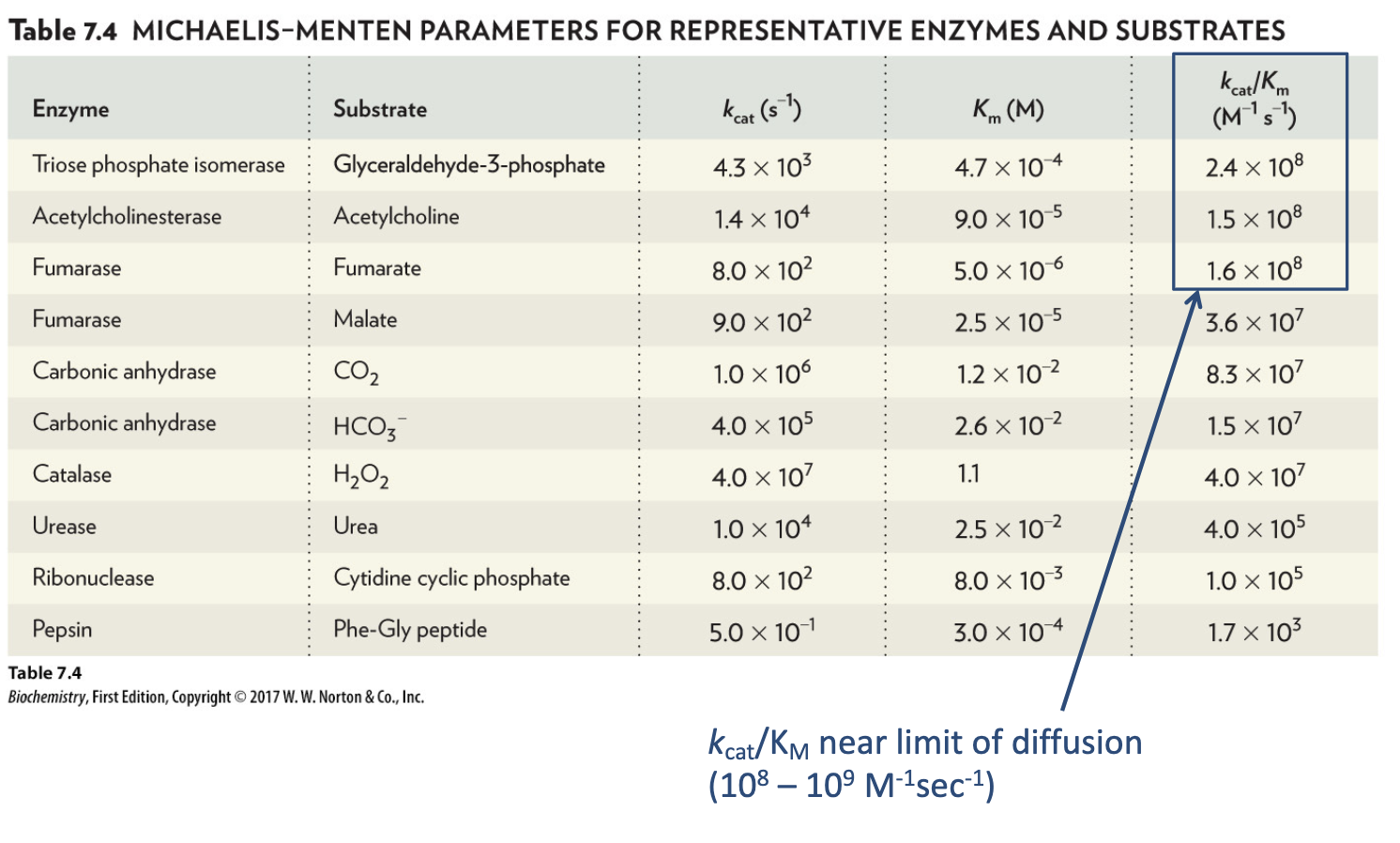
What is the upper limit for Kcat / Km (Catalytic Perfection)
Between 108 - 109
On a plot of [product] versus time for an enzyme-catalyzed reaction, the V0 is equal to the:
a) slope of the line / [S].
b) [P] at the lowest time point.
c) slope of the line.
d) y-intercept.
e) x-intercept
a) slope of the line / [S]
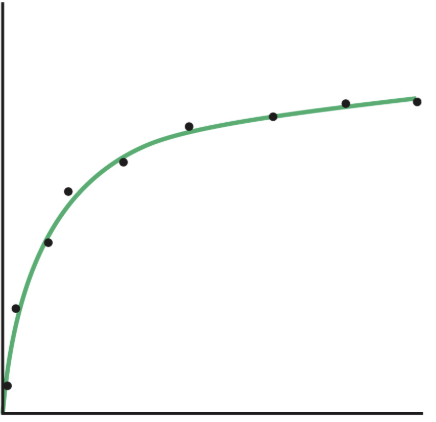
What is the same of this graph
Hyperbolic
Which of the following is NOT TRUE about the graph of V0 vs initial [S]?
a) Initial velocity can be experimentally obtained by measuring the concentration of product formed early in the reaction.
b) At low substrate concentration [S], initial velocity increases as [S] increases.
c) Enzyme concentration [E] is kept constant.
d) At high substrate concentration [S], initial velocity increases as [S] increases.
d) At high substrate concentration [S], initial velocity increases as [S] increases.
In Michaelis-Menten kinetics, k1 is a constant that reflects _______, whereas k2 is a constant that reflects _______.
the rate of ES formation; the rate of product formation
In Michaelis-Menten kinetics, under saturating conditions, _______ is relatively constant.
V0
(T/F): For a given enzyme, the maximum velocity remains constant regardless of enzyme concentration.
Flase
KM is equal to:
[S] when V0 = ½ Vmax
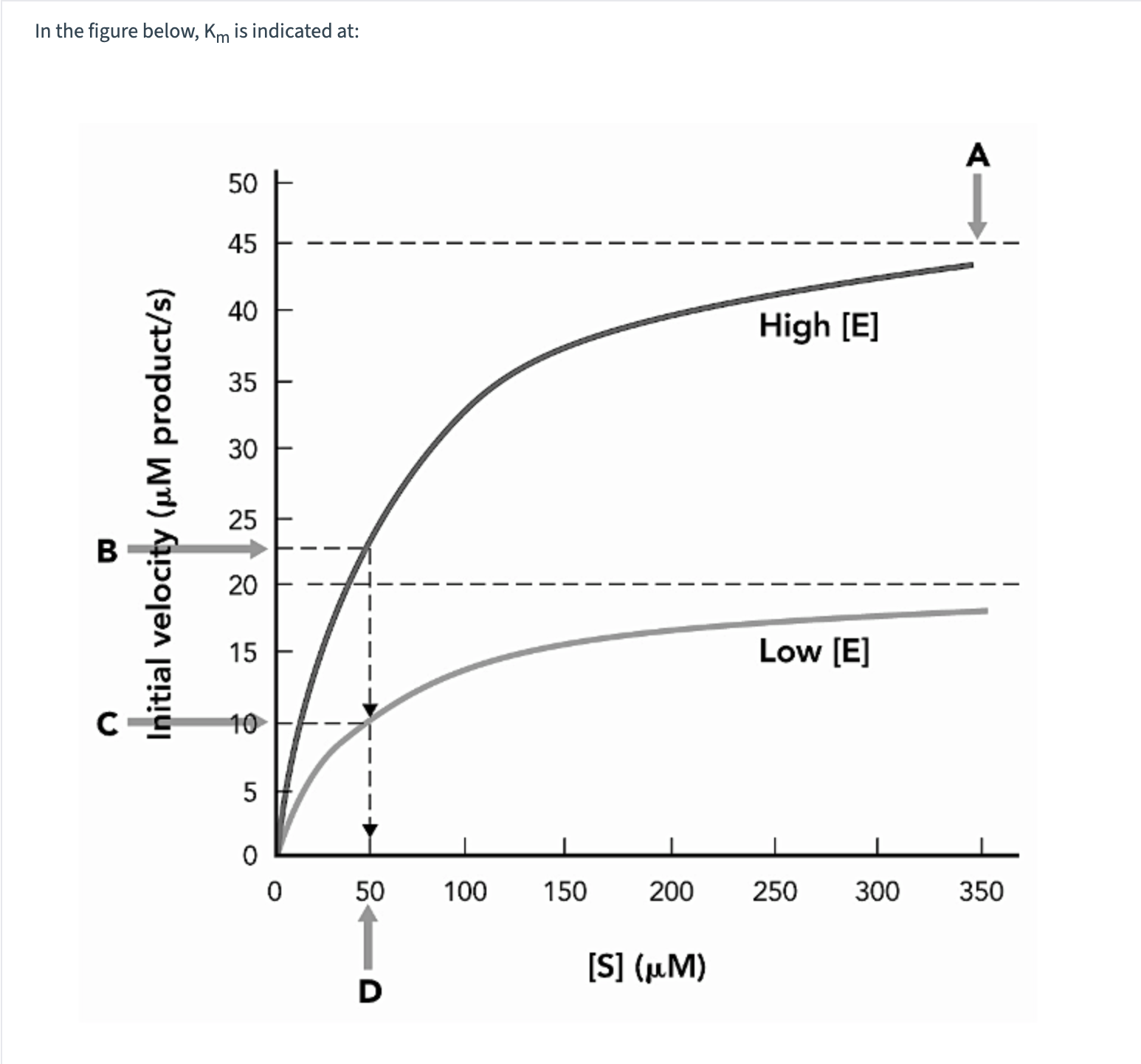
What does each letter represent
A = Vmax
B = ½ Vmax (high [E])
C = ½ Vmax (low [E])
D = Km
Fill in the Blanks: Brain hexokinase has a (higher/lower)Km than liver glucokinase, which means it reaches ½ Vmax at a (higher/lower) [S]. This is physiologically relevant because it means that brain hexokinase works (better/worse) than liver glucokinase
lower; lower; better
(T/F) For a given enzyme, increasing the concentration of enzyme will increase Km.
False
Which of the following is the Michaelis Menten Equation?
a) Vmax = V0[S] / (Km + [S])
b) V0 = Vmax[S] / (Km + [S])
c) Km = Vmax[S] / (V0 + [S])
d) [S] = Vmax[V0] / (Km + [S])
b) V0 = Vmax[S] / (Km + [S])
A plot of 1 / V0 versus 1/[S] is called a ________ plot. Data in this plot have a slope equal to ________ and a y-intercept equal to _______
lineweaver-burk; Km / Vmax; 1 / Vmax
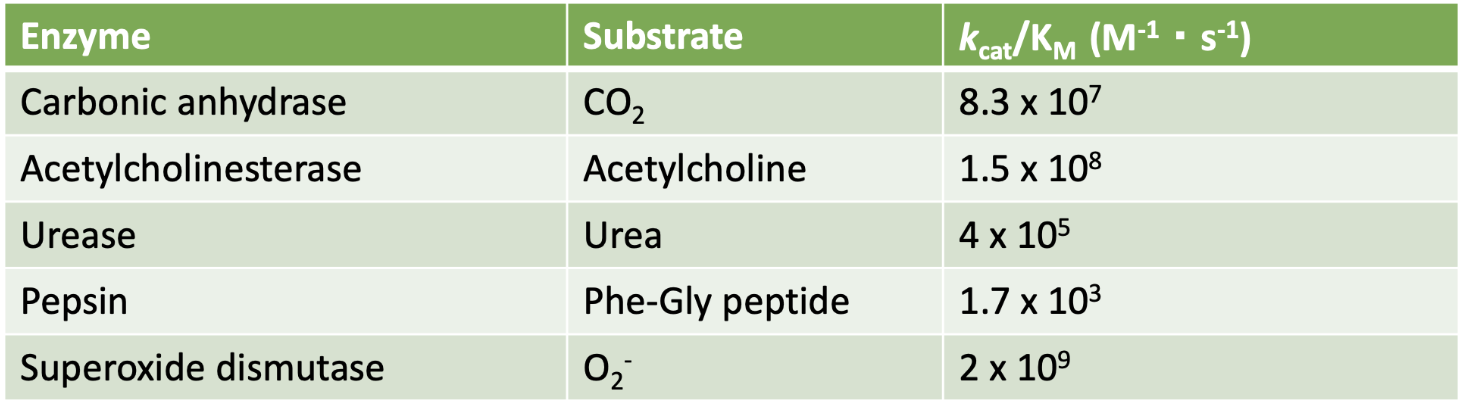
Which of the following enzymes would be considered very highly efficient/near catalytic perfection? Select all that apply.
a) carbonic anhydrase
b) acetylcholinesterase
e) superoxide dismutase
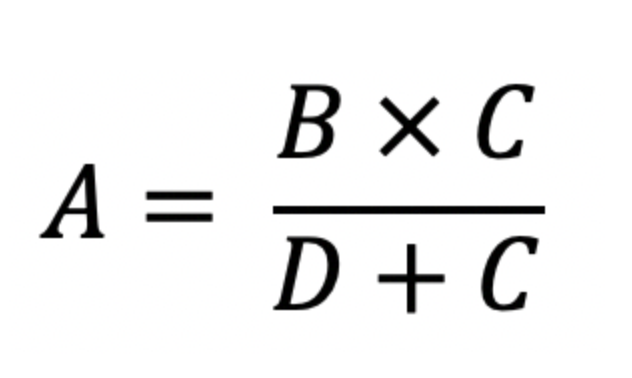
Fill in the Blanks
A =
B =
C =
D =
A = V0
B = Vmax
C = [S]
D = Km
An enzyme-catalyzed reaction has a Km of 1 mM and a Vmax of 5 nM/sec. What is the reaction velocity when the substrate concentration is 0.25mM? Give your answer as a number only in nM/sec.
1.0
An enzyme that follows Michaelis-Menten kinetics has a initial velocity of 300 nM/s at a substrate concentration of 30 μM. The maximum velocity is 400 nM/sec. What is the Km for this enzyme in μM? Give your answer as a number only.
10
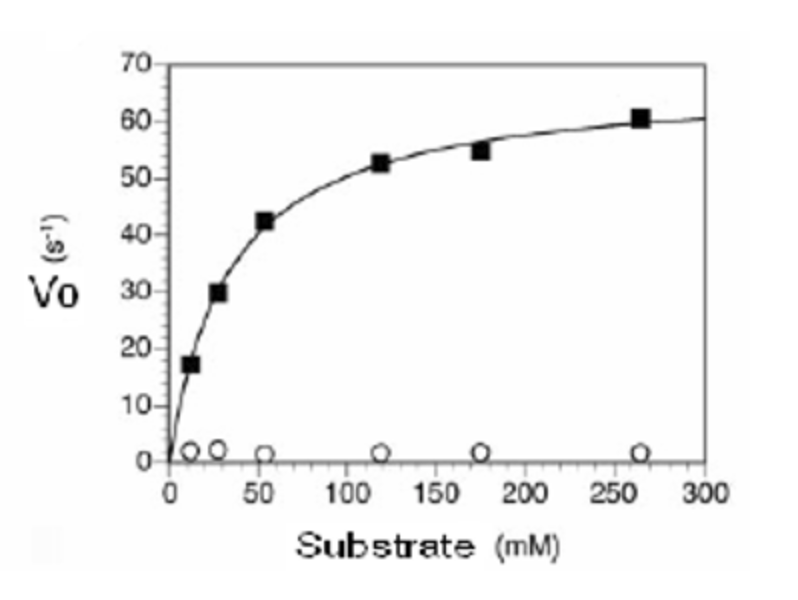
Estimate the Km
30 mM
An enzyme's initial velocity was measured at different substrate concentrations and placed into a Lineweaver-Burk plot. The linear regression of the data yielded the following equation: y = 0.484x + 0.195
What is the Km of the enzyme? Round to 2 decimal places, and do not include units in your answer.
Y-int = 1/ Vmax
0.195 = 1/ Vmax
Vmax = 1/ 0.195 —> 5.128
Slope = Km / Vmax
0.484 = Km / 5.128
Km = .484 × 5.128 —> 2.48
![<p><span>Although graphical methods are available for accurate determination of the Vmax and Km of an enzyme-catalyzed reaction, sometimes these quantities can be quickly estimated by inspecting values of V0 at increasing [S]. Without making a graph, estimate the Vmax and Km of the enzyme-catalyzed reaction for which the data were obtained.</span><br></p><p><span>Vmax = _____ μM/min</span><br></p><p><span>Km = _____ μM</span></p>](https://assets.knowt.com/user-attachments/b5a17372-00ed-471d-bccf-bed62be1c5db.png)
Although graphical methods are available for accurate determination of the Vmax and Km of an enzyme-catalyzed reaction, sometimes these quantities can be quickly estimated by inspecting values of V0 at increasing [S]. Without making a graph, estimate the Vmax and Km of the enzyme-catalyzed reaction for which the data were obtained.
Vmax = _____ μM/min
Km = _____ μM
Vmax = 140 μM/min
Km = 10 μM — Inspection of the table indicates that this Vo occurs at [S] = 1 x 10^-5 M, thus Km ≈ 1 x 10^-5 M or 10 μM.
What is the difference between reaction rate and turnover number?
Reaction rate is how quickly the substrate can be turned into product (speed)
The turnover number is maximum number of substrate molecules a single enzyme active site can convert into product molecules per unit of time (efficiency)
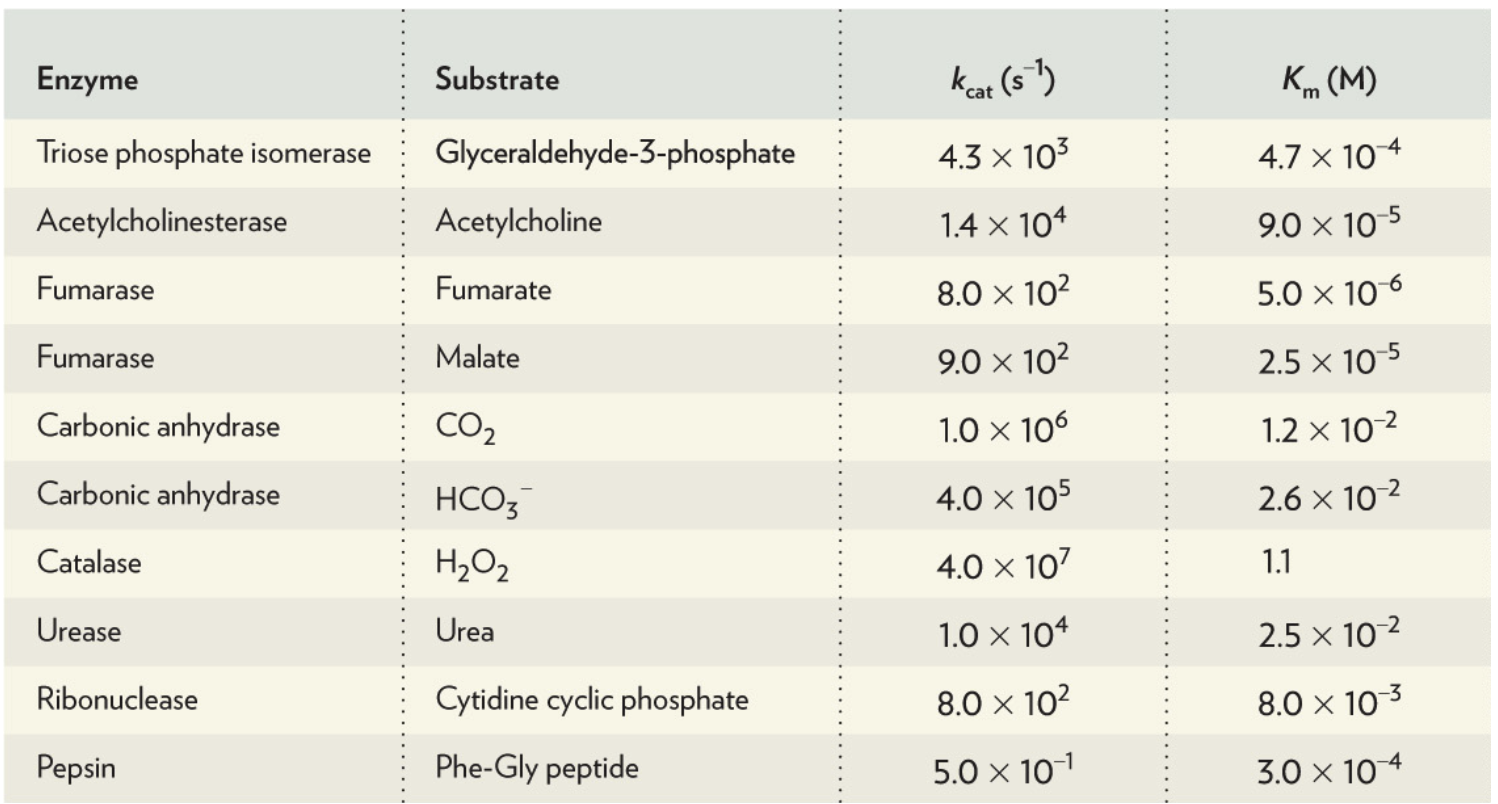
Carbonic anhydrase is a vital enzyme that maintains the buffering capacity of blood. It can use two substrates,
CO2 or HCO3- Using the table below, which would be the best choice for a substrate and why?
CO2; the specificity constant is higher (Kcat/Km)
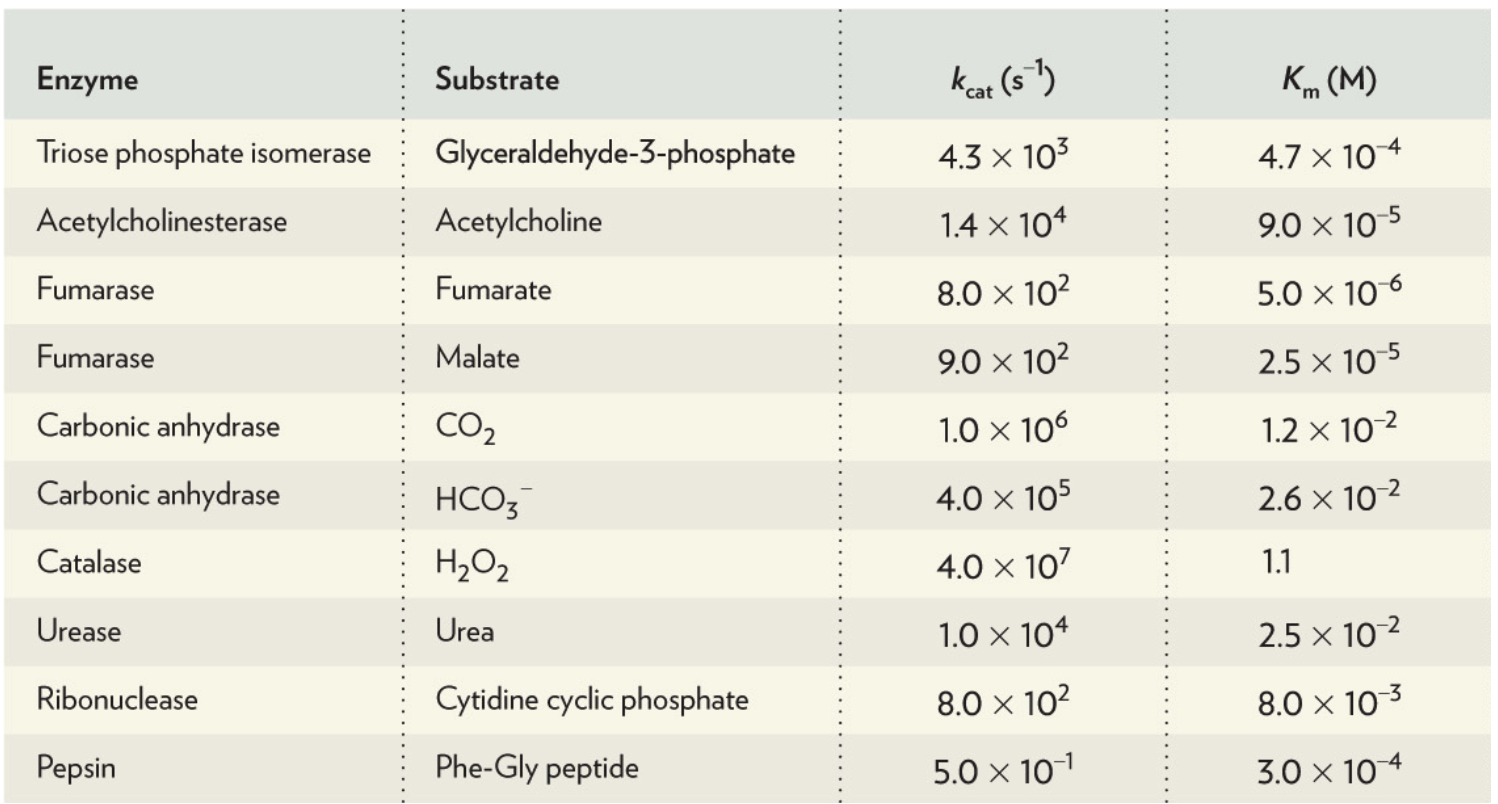
What is the specificity constant of ribonuclease for cytidine cyclic phosphate?
100,000
Define the equation velocity of an uncatalyzed chemical reaction
v = k[S]
Why is it better to use a Lineweaver–Burk plot than a Michaelis–Menten plot
Lineweaver-Burk plots allow for a more precise measurement of the values and express the data as a linear relationship
Explain how Vmax and Km from a Lineweaver-Burk plot.
Vmax:
Find the y-intercept — the point where the line crosses the y-axis (where 1/[S] = 0)
This intercept equals 1 / Vmax
So: Vmax = 1 / (y-intercept)
Km:
Find the x-intercept — the point where the line crosses the x-axis (where 1/v₀ = 0)
This intercept equals −1/Km
So: Km = −1 / (x-intercept)
What is the BEST measurement for analyzing enzyme efficiency
Specificity constant (Kcat / Km)
What is the slope equation for a Michealis-Menten plot
Slope = V0 / [S]