3.2 Internal Energy & Energy Transfers
 Call Kai
 Learn
Learn Practice Test
 Spaced Repetition
 Match
Match Flashcards
 Knowt Play
1/20

There's no tags or description
Looks like no tags are added yet.
Name | Mastery | Learn | Test | Matching | Spaced | Call with Kai | Chat |
|---|
No analytics yet
Send a link to your students to track their progress
21 Terms
What is the definition of internal energy?
The energy stored inside a system by the atoms and molecules (particles) that make up the system.
What is internal energy?
The total kinetic energy and potential energy of the particles that make up a system.
Heating changes the energy stored within the system by increasing the energy of the particles that make up the system.
What does this do? (2)
Raises the temperature of a system
Produces a change of state
Heating changes the energy __________ within the __________ by increasing the _________ of the particles that make up the __________.
stored
system
energy
system
If the temperature of the system increases, what does the increase in temperature depend on?
Mass of substance heated
Type of material
Energy input into the system
What is the specific heat capacity of a substance?
The amount of energy required to raise the temperature of 1 kg of the substance by 1°C.
What is the equation for the amount of energy stored in or released from a system as its temperature changes (change in thermal energy)? State the units.
change in thermal energy = mass × specific heat capacity × temperature change
ΔE=mcΔθ
change in thermal energy — joules (J)
mass — kilograms (kg)
specific heat capacity — joules per kilogram per degree Celcius (J/kg°C)
temperature change — degrees Celcius (°C)
What is the definition of latent heat?
The energy needed for a substance to change state.
When a change of state occurs, what does the energy supplied change?
Internal energy (energy stored)
Not the temperature
What is meant by the specific latent heat of a substance?
The amount of energy required to:
change the state of 1 kg of the substance
no change in temperature
What is the equation for specific latent heat? State the units.
energy for a change of state = mass × specific latent heat
E=mL
energy — joules (J)
mass — kilograms (kg)
specific latent heat — joules per kilogram (J/kg)
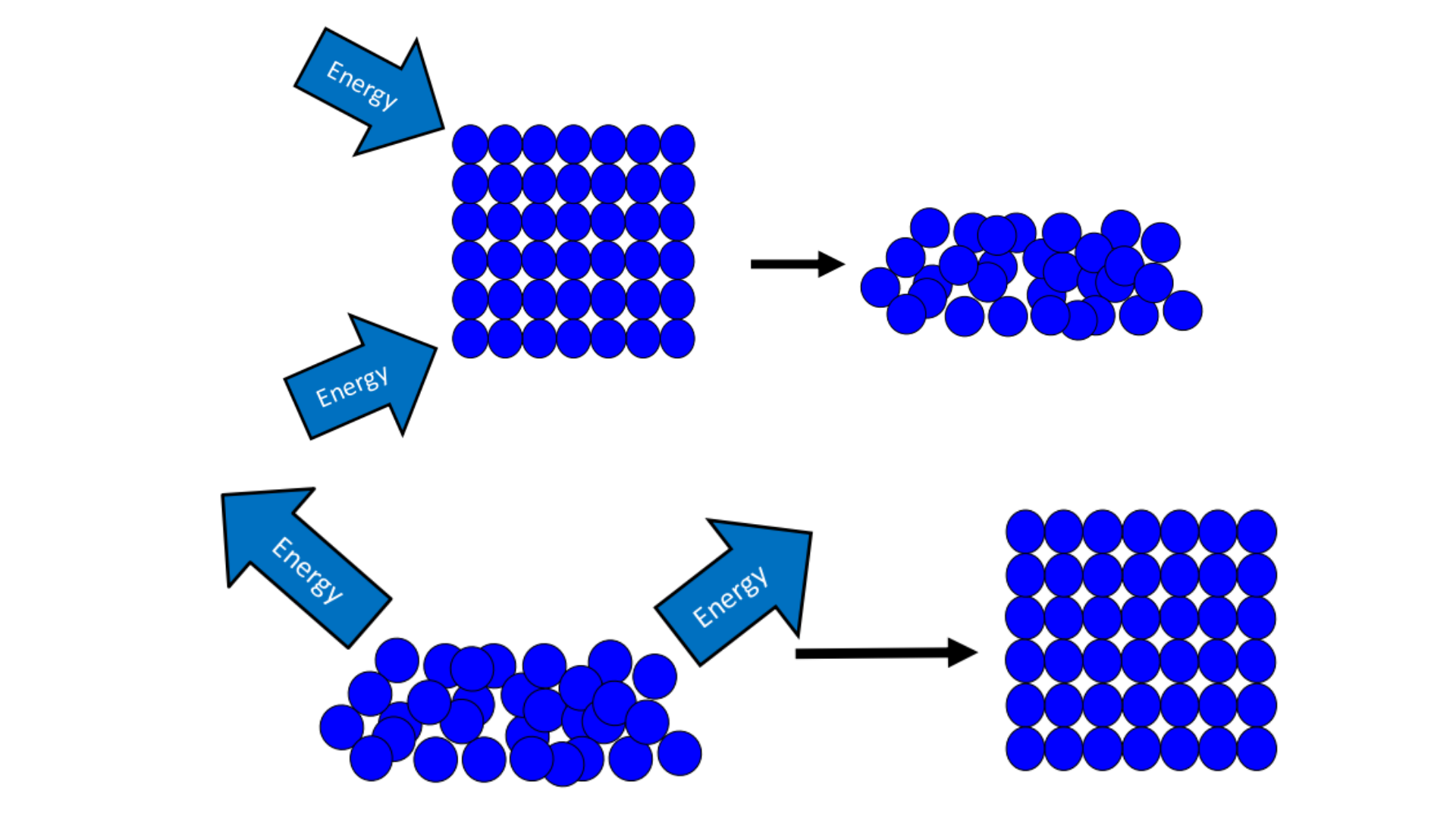
What is the specific latent heat of fusion?
The amount of energy required to:
change the state of 1 kg of the substance (solid → liquid)
no change in temperature
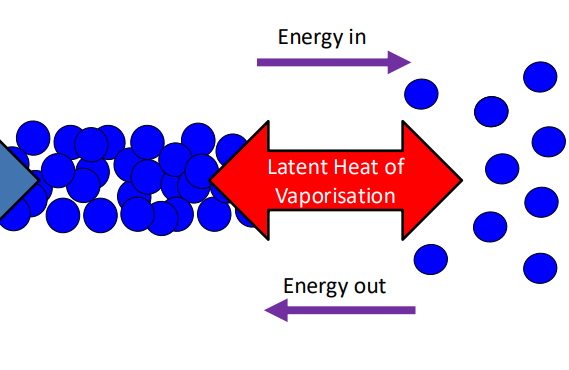
What is the specific latent heat of vaporisation?
The amount of energy required to:
change the state of 1 kg of the substance (liquid → vapour)
no change in temperature

Label the graph.
A — Melting
B — Boiling
C — Gas
D — Liquid
E — Solid

![<ul><li><p>A student determined the specific latent heat of vaporisation of water.</p></li><li><p>The figure shows some of the equipment used.</p></li></ul><p>This is the method used:</p><p>1. Put 50 cm<sup>3</sup> of water in a beaker.</p><p>2. Measure the mass of the beaker and water.</p><p>3. Use a heater to boil the water and keep it boiling for 600 seconds.</p><p>4. Measure the mass of the beaker and water after 600 seconds.</p><p>What measuring instrument should be used to measure the volume of water? [1 mark]</p>](https://assets.knowt.com/user-attachments/c7518929-d7b6-434b-866b-e84463f42f0b.png)
A student determined the specific latent heat of vaporisation of water.
The figure shows some of the equipment used.
This is the method used:
1. Put 50 cm3 of water in a beaker.
2. Measure the mass of the beaker and water.
3. Use a heater to boil the water and keep it boiling for 600 seconds.
4. Measure the mass of the beaker and water after 600 seconds.
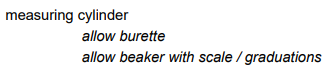
What measuring instrument should be used to measure the volume of water? [1 mark]
Measuring cylinder
![<p>A student determined the specific latent heat of vaporisation of water.</p><ul><li><p>The figure shows some of the equipment used.</p></li></ul><p>This is the method used:</p><p>1. Put 50 cm<sup>3</sup> of water in a beaker.</p><p>2. Measure the mass of the beaker and water.</p><p>3. Use a heater to boil the water and keep it boiling for 600 seconds.</p><p>4. Measure the mass of the beaker and water after 600 seconds.</p><p>What is a hazard in the student's investigation? [1 mark]</p>](https://assets.knowt.com/user-attachments/11a1abfc-4366-434e-ae59-c1c8b5d98885.png)
A student determined the specific latent heat of vaporisation of water.
The figure shows some of the equipment used.
This is the method used:
1. Put 50 cm3 of water in a beaker.
2. Measure the mass of the beaker and water.
3. Use a heater to boil the water and keep it boiling for 600 seconds.
4. Measure the mass of the beaker and water after 600 seconds.
What is a hazard in the student's investigation? [1 mark]
boiling water
![<ul><li><p>A student determined the specific latent heat of vaporisation of water.</p></li><li><p>The figure shows some of the equipment used.</p></li></ul><p>This is the method used:</p><p>1. Put 50 cm<sup>3</sup> of water in a beaker.</p><p>2. Measure the mass of the beaker and water.</p><p>3. Use a heater to boil the water and keep it boiling for 600 seconds.</p><p>4. Measure the mass of the beaker and water after 600 seconds.</p><ul><li><p>The student calculated the latent heat of vaporisation as 2.8 × 10<sup>6</sup> J/kg.</p></li></ul><ul><li><p>Some thermal energy was transferred to the surroundings while the water was being heated.</p></li></ul><p>Explain how this affected the student's value for the specific latent heat of vaporisation of water. [2 marks]</p>](https://assets.knowt.com/user-attachments/b5b5c0c0-37fa-49c4-b728-91c8a00e29c0.png)
A student determined the specific latent heat of vaporisation of water.
The figure shows some of the equipment used.
This is the method used:
1. Put 50 cm3 of water in a beaker.
2. Measure the mass of the beaker and water.
3. Use a heater to boil the water and keep it boiling for 600 seconds.
4. Measure the mass of the beaker and water after 600 seconds.
The student calculated the latent heat of vaporisation as 2.8 × 10⁶ J/kg.
Some thermal energy was transferred to the surroundings while the water was being heated.
Explain how this affected the student's value for the specific latent heat of vaporisation of water. [2 marks]
Less energy than 25 200 J was transferred to the water
So the student’s value of L is too high

![<ul><li><p>A student determined the specific latent heat of vaporisation of water.</p></li><li><p>The figure shows some of the equipment used.</p></li></ul><p>This is the method used:</p><p>1. Put 50 cm<sup>3</sup> of water in a beaker.</p><p>2. Measure the mass of the beaker and water.</p><p>3. Use a heater to boil the water and keep it boiling for 600 seconds.</p><p>4. Measure the mass of the beaker and water after 600 seconds.</p><ul><li><p>The student calculated the latent heat of vaporisation as 2.8 × 10<sup>6</sup> J/kg.</p></li></ul><ul><li><p>Some of the water evaporated before its temperature reached 100 °C.</p></li></ul><p>Explain how this affected the student's value for the specific latent heat of vaporisation of water. [2 marks]</p>](https://assets.knowt.com/user-attachments/0fbd1744-10fd-4fae-b359-db8e8c1effe8.png)
A student determined the specific latent heat of vaporisation of water.
The figure shows some of the equipment used.
This is the method used:
1. Put 50 cm3 of water in a beaker.
2. Measure the mass of the beaker and water.
3. Use a heater to boil the water and keep it boiling for 600 seconds.
4. Measure the mass of the beaker and water after 600 seconds.
The student calculated the latent heat of vaporisation as 2.8 × 10⁶ J/kg.
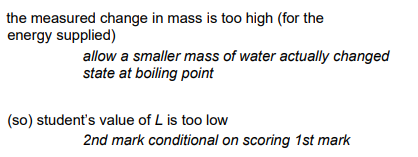
Some of the water evaporated before its temperature reached 100 °C.
Explain how this affected the student's value for the specific latent heat of vaporisation of water. [2 marks]
The measured change in mass is too high for the energy supplied
So the student’s value of L is too low
![<ul><li><p>A student investigated how the temperature of a lump of ice varied as the ice was heated. </p></li><li><p>The student recorded the temperature until the ice melted and then the water produced boiled. </p></li><li><p>The figure shows the student’s results. </p></li><li><p>The power output of the heater was constant.</p></li><li><p>The specific heat capacity of ice is less than the specific heat capacity of water. </p></li></ul><p>Explain how the figure shows this. [2 marks]</p>](https://assets.knowt.com/user-attachments/bcc85dc0-65ce-4bd0-b4dd-4832486dfbfb.png)
A student investigated how the temperature of a lump of ice varied as the ice was heated.
The student recorded the temperature until the ice melted and then the water produced boiled.
The figure shows the student’s results.
The power output of the heater was constant.
The specific heat capacity of ice is less than the specific heat capacity of water.
Explain how the figure shows this. [2 marks]
The gradient for ice is steeper than the gradient for water
Which means that less energy is needed to increase the temperature by a fixed amount

![<ul><li><p>A student investigated how the temperature of a lump of ice varied as the ice was heated. </p></li><li><p>The student recorded the temperature until the ice melted and then the water produced boiled. </p></li><li><p>The figure shows the student’s results. </p></li><li><p>The power output of the heater was constant.</p></li><li><p>The specific latent heat of fusion of ice is less than the specific latent heat of vaporisation of water.</p></li></ul><p>Explain how the figure above shows this. [2 marks]</p>](https://assets.knowt.com/user-attachments/05548929-4ca4-4785-b279-bd090a73b6b5.png)
A student investigated how the temperature of a lump of ice varied as the ice was heated.
The student recorded the temperature until the ice melted and then the water produced boiled.
The figure shows the student’s results.
The power output of the heater was constant.
The specific latent heat of fusion of ice is less than the specific latent heat of vaporisation of water.
Explain how the figure above shows this. [2 marks]
Water took more time to vaporise than the ice took to melt
Which means that less energy is needed to change the state from solid to liquid than from liquid to vapour

![<ul><li><p>A student investigated how the temperature of a lump of ice varied as the ice was heated. </p></li><li><p>The student recorded the temperature until the ice melted and then the water produced boiled. </p></li><li><p>The figure shows the student’s results. </p></li><li><p>The power output of the heater was constant.</p></li><li><p>A second student did the same investigation and recorded the temperature until the water produced boiled. </p></li><li><p>In the second student’s investigation more thermal energy was transferred to the surroundings. </p></li></ul><p>Describe two ways the results of the experiment in the figure above would have been different. [2 marks]</p>](https://assets.knowt.com/user-attachments/a41edf4a-9a4b-45ee-b0ed-c871f3ddeaa6.png)
A student investigated how the temperature of a lump of ice varied as the ice was heated.
The student recorded the temperature until the ice melted and then the water produced boiled.
The figure shows the student’s results.
The power output of the heater was constant.
A second student did the same investigation and recorded the temperature until the water produced boiled.
In the second student’s investigation more thermal energy was transferred to the surroundings.
Describe two ways the results of the experiment in the figure above would have been different. [2 marks]
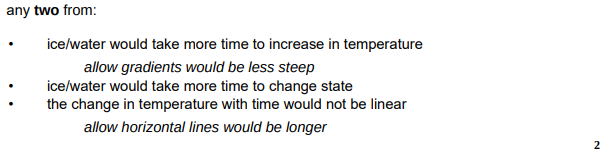
Ice/water would take more time to increase in temperature
Ice/water would take more time to change state