Art History Midterm 1 (Art only)
 Call Kai
 Learn
Learn Practice Test
 Spaced Repetition
 Match
Match Flashcards
 Knowt Play
1/23

Earn XP
Description and Tags
Stone Age - Prehistoric Aegean
Name | Mastery | Learn | Test | Matching | Spaced | Call with Kai | Chat |
|---|
No analytics yet
Send a link to your students to track their progress
24 Terms

Nude Women (Venus of Willendorf), Paleolithic 25000 BCE, possibly a representation of fertility; very small and portable

Hall of Bulls, Caves at Lascaux, France, Paleolithic 16000-14000 BCE, almost exclusively animals, was very far back in cave possibly used for ceremonial/shamanistic practices

Stonehenge, England, Neolithic 3000 BCE, post-and-lintel funerary structure for primarily the male elite

Corbel Vault and Passage Grave, Newgrange, Ireland, Neolithic 3200-2500 BCE. Funerary site, has a corbeled dome,

White Temple and Ziggurat, Uruk Sumerian, Uruk Period 3300 BCE. Temple dedicated to sky God Anu, made from mud brick (not durable). Very sacred, few can visit

Warka Vase, Uruk Period 3300 BC, carved alabaster. Presentations of offerings to Inanna = goddess of love, fertility, and war. Relief sculpture, decorated in horizontal registers

Statuettes of Two Worshippers, Square Temple at Eshnunna, Early Dynastic Period 2900-2750 BCE. Votive figures representing patrons which are offered to gods at a sacred space. Hands are holding “offering”

Standard of Ur, Royal Cemetery, Early Dynastic Period 2550-2400 BCE. read bottom to top, War side: reg 1 fighting defeating enemy, reg 2 capturing enemies, reg 3 slaves being brought to king. Peace side: feast celebrating agriculture and peace. Covered in Lapis Lazuli, hierarchal scale (king taller than everyone else)

Bull-Headed Harp, Royal Cemetery, Early Dynastic Period 2550 BCE. Musical instrument, had lapis lazuli (rare blue stone)

Victory Stele of Naram-Sin, Akkadian period 2254-2218. Battle scene narrative of King Naram-sin. Heirarchal scale, writing engraved telling the story

Gudea seated, Third Dynasty of Ur 2150 BCE. Gudea was a Temple builder and made votive figures of himself and put in all the temples he made

Stele with the Laws of Hammurabi, Old Babylonian 1780 BCE. Top: Hammurabi (left) and Shamash (right) showing Hammurabi as King. Bottom: first written law codes of Babylon

Assyrian Archers Pursuing Enemies, Neo-Assyrian 875-860 BCE. Relief sculpture in palace of Ashurnasirpal II, depicting battle scene (this was a highly militarized society)

Lamassu, Assyrian 720 BCE. Protective guardians placed at gateway throughout palaces. Has 5-Legs: looks stationary from front, but walking from side.

Ishtar Gate, Neo-Babylonian 575 BCE. Gate is covered with animals representing babylon gods (ishtar, marduk, abad), located on the processional walkway, and frames entrance to ritual area.

Columns with animal protomes, Persepolis, Achaemenid 500 BCE. Protomes: partial figures (head, neck, part of torso) usually of animals

Persepolis Processional Frieze, Achaemenid 500 BCE. Stairways lined with processional scenes and hunting scenes. Also people carrying offerings for Gods

Arch of the Palace of Khosrow I, Sassanian 531-579 CE. Built from mud brick. Big vaulted space is the audience hall (iwan)

Palette of King Narmer, Predynastic 3000-2920 BCE. Votive object (makeupt palette) showing the uniting of Upper and Lower Egypt. Side 1: King wearing crown of upper egypt and slaying enemy, Side 2: King wearing crown of lower egypt surrounded by defeated enemy.

Imhotep, Early Dynastic Period: Third Dynasty 2630-2611BCE. Funerary complex that combined all the funerary buildings in complex. Had dummy structures for the buried’s Ka to reside. First instance of columns

Fourth Dynasty Pyramids (Khufuf, Khafre, Menkaure) & Great Sphinx, Old Kingdom 2550-2470 BCE. Funerary monuments. Khafre: 2nd son of Khufu, sculptures of Khafre placed inside other temples in complex (where homes for his Ka). Khufu: largest pyramid. Sphinx: face is a possible representation of Khafre or Khufru. Menkaure: smallest pyramid, has 3 smaller pyramids for wives

Khafre Enthroned, Old Kingdom: Fourth Dynasty 2520-2490 BCE. Perfect idealized body, trying to appear timeless, immortal king (not a true representation of him), funerary object
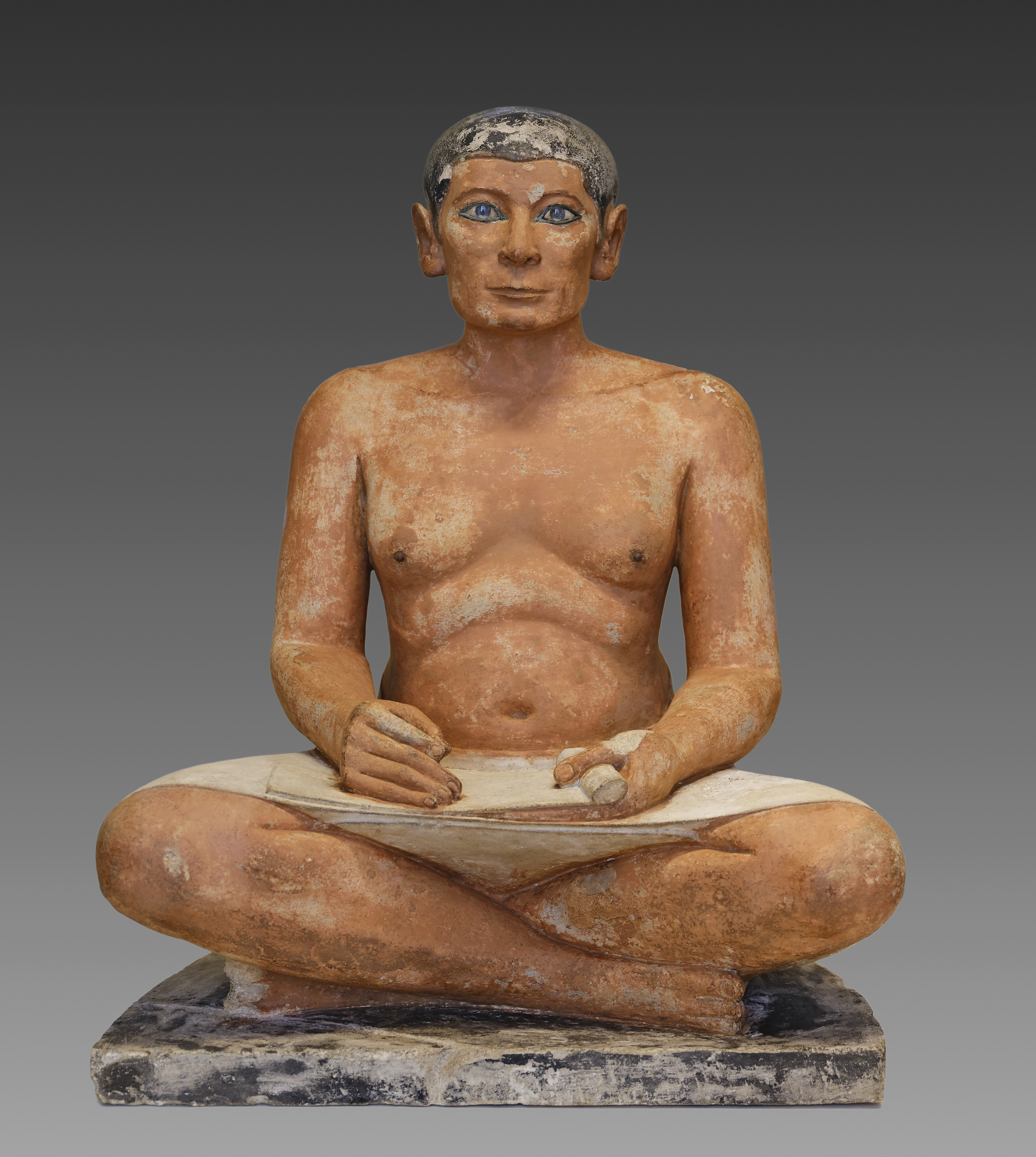
Seated Scribe, Middle Kingdom: 12th Dynasty 2500 BCE. Representation of a regular person (different conventions/idealization than those of rulers), a still a funerary object (scribe for the king’s Ka). Sense of stillness, very generic, sense of informality

Head of Senusret III, 12th Dynasty 1860-1850 BCE. Breaks conventions for royals: more expressive though still somewhat idealized. Big ears: symbolic of listening abilities (good quality for a ruler)