6. Retinal Disparity - Eye Movements & Binocular Vision Summer 2026
 Call Kai
 Learn
Learn Practice Test
 Spaced Repetition
 Match
Match Flashcards
 Knowt Play
1/90

There's no tags or description
Looks like no tags are added yet.
Name | Mastery | Learn | Test | Matching | Spaced | Call with Kai | Chat |
|---|
No analytics yet
Send a link to your students to track their progress
91 Terms
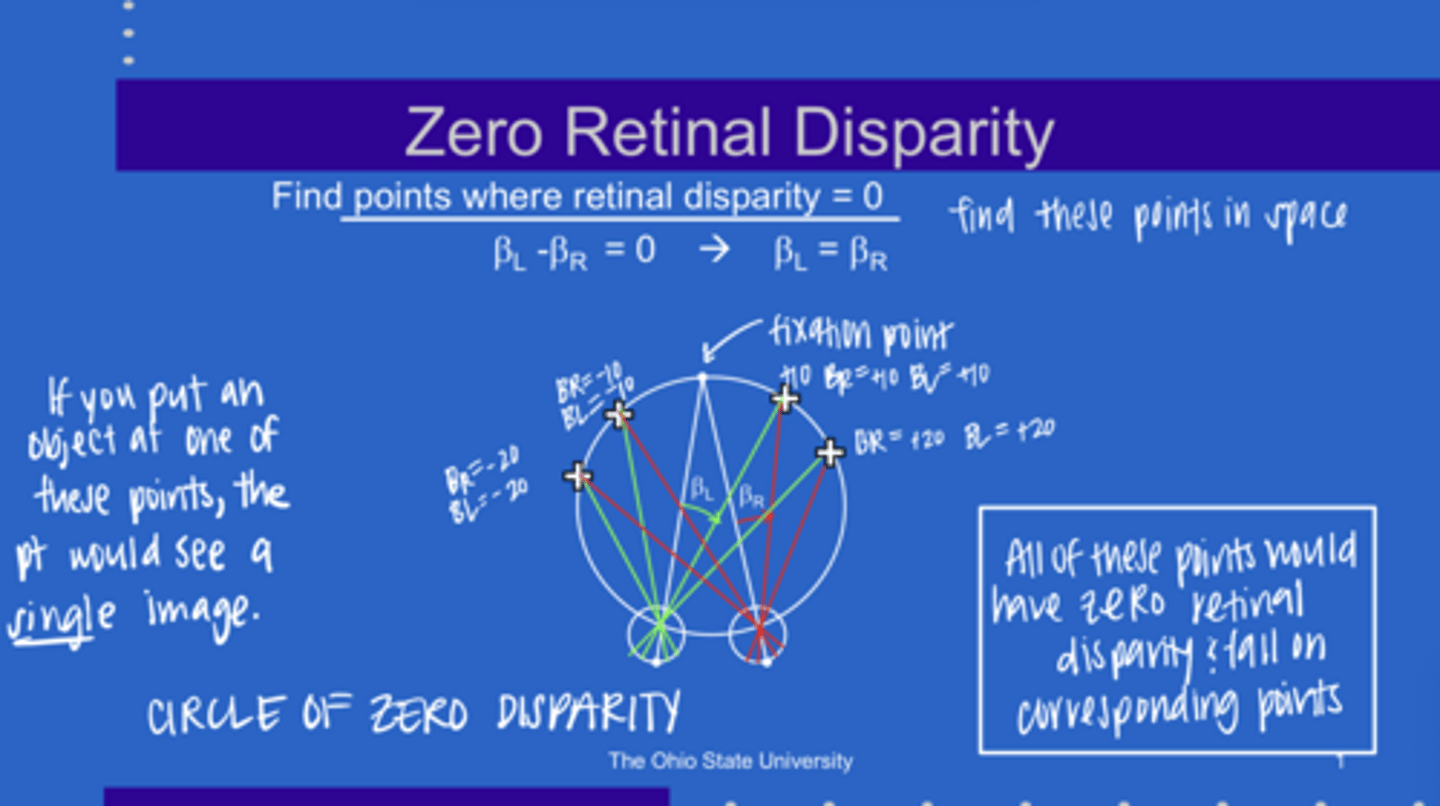
How to find points with zero retinal disparity?
-βL = βR
-βL - βR = 0
What is the Vieth Muller Circle?
the circle including the fixation point and the two entrance pupils
What does the Vieth Muller Circle show?
location in space where objects have equal oculocentric angles (βL = βR)
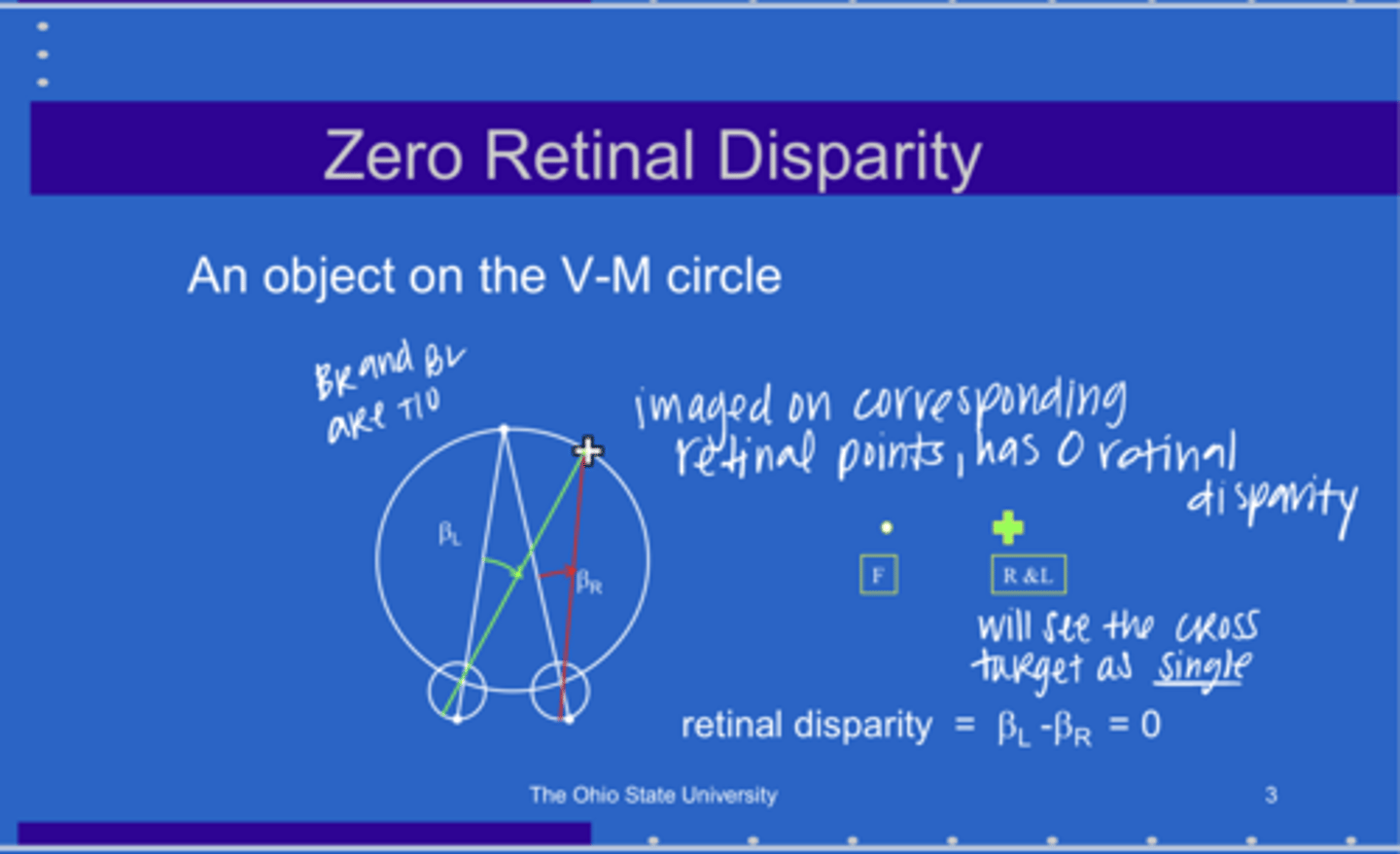
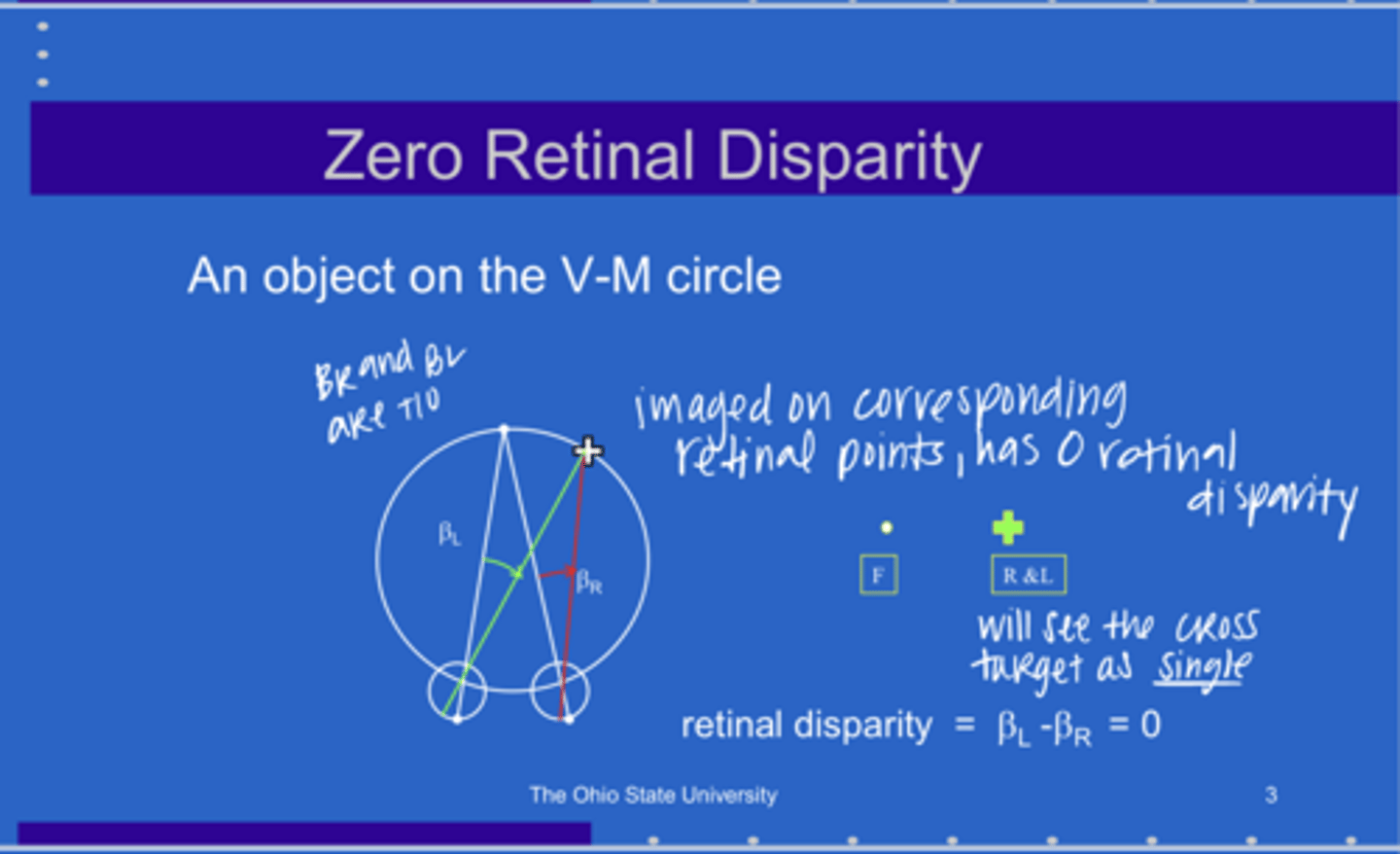
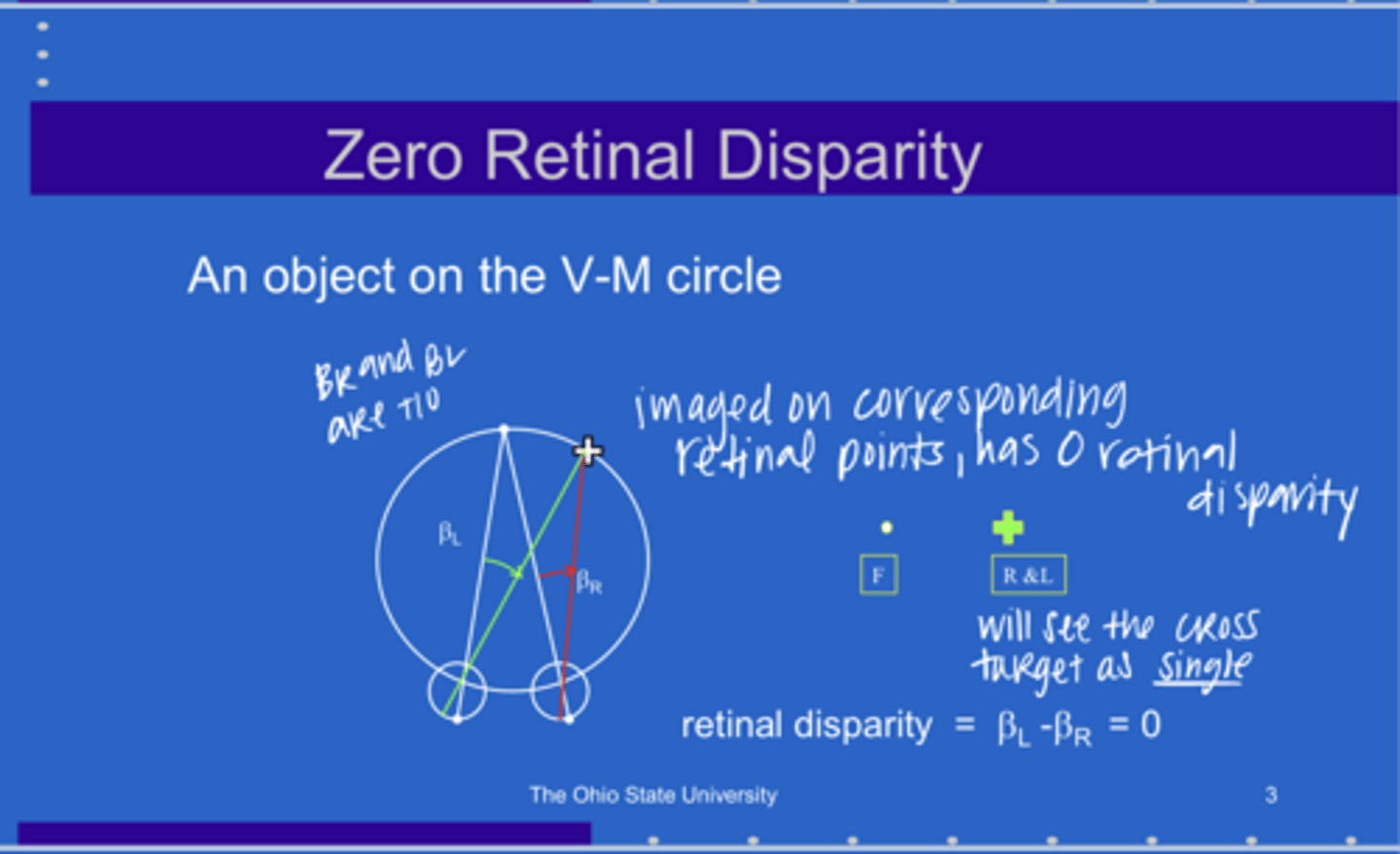
Objects on the V-M circle have _____ retinal disparity
zero
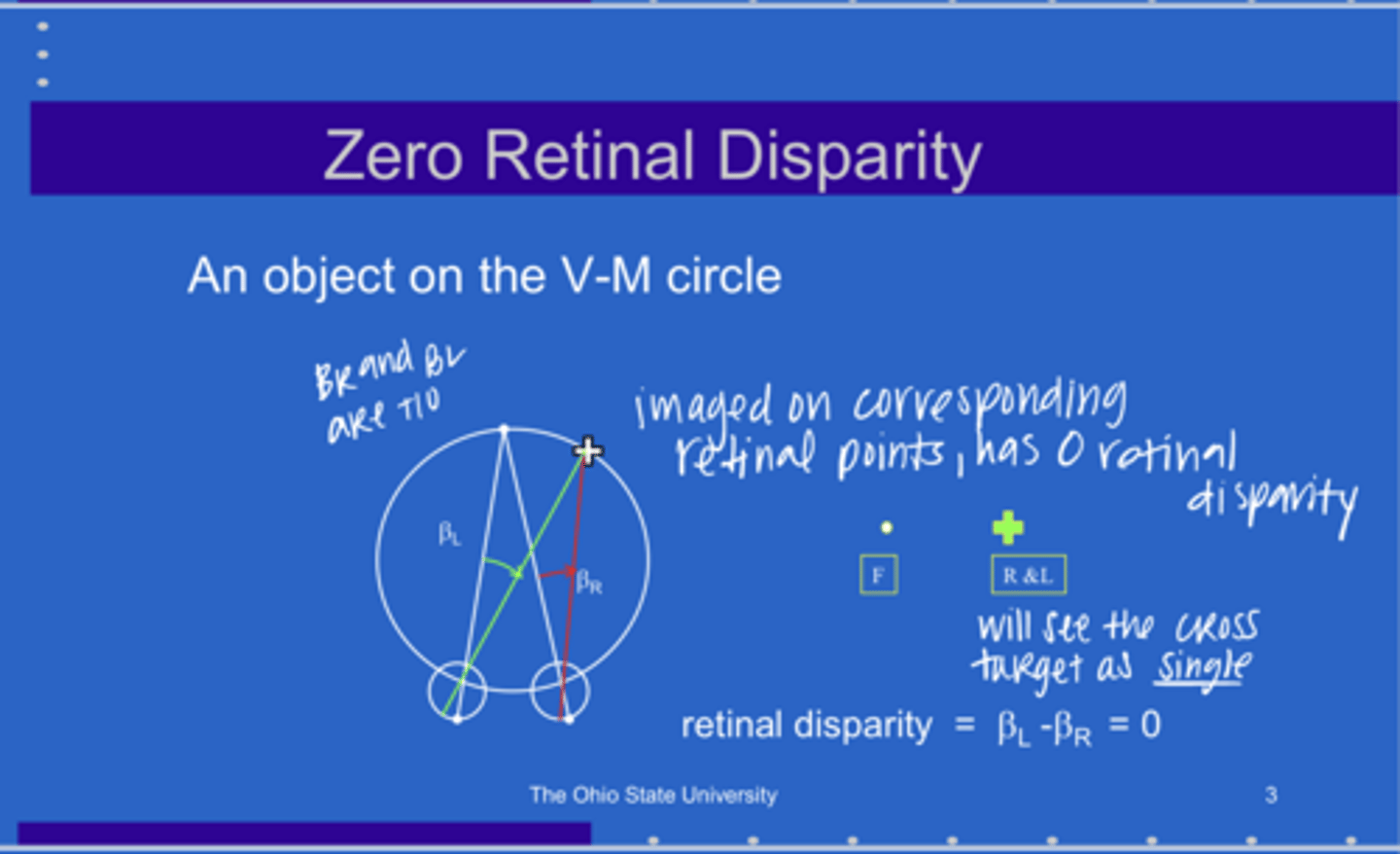
Objects on the V-M circle will be (single/double)
single
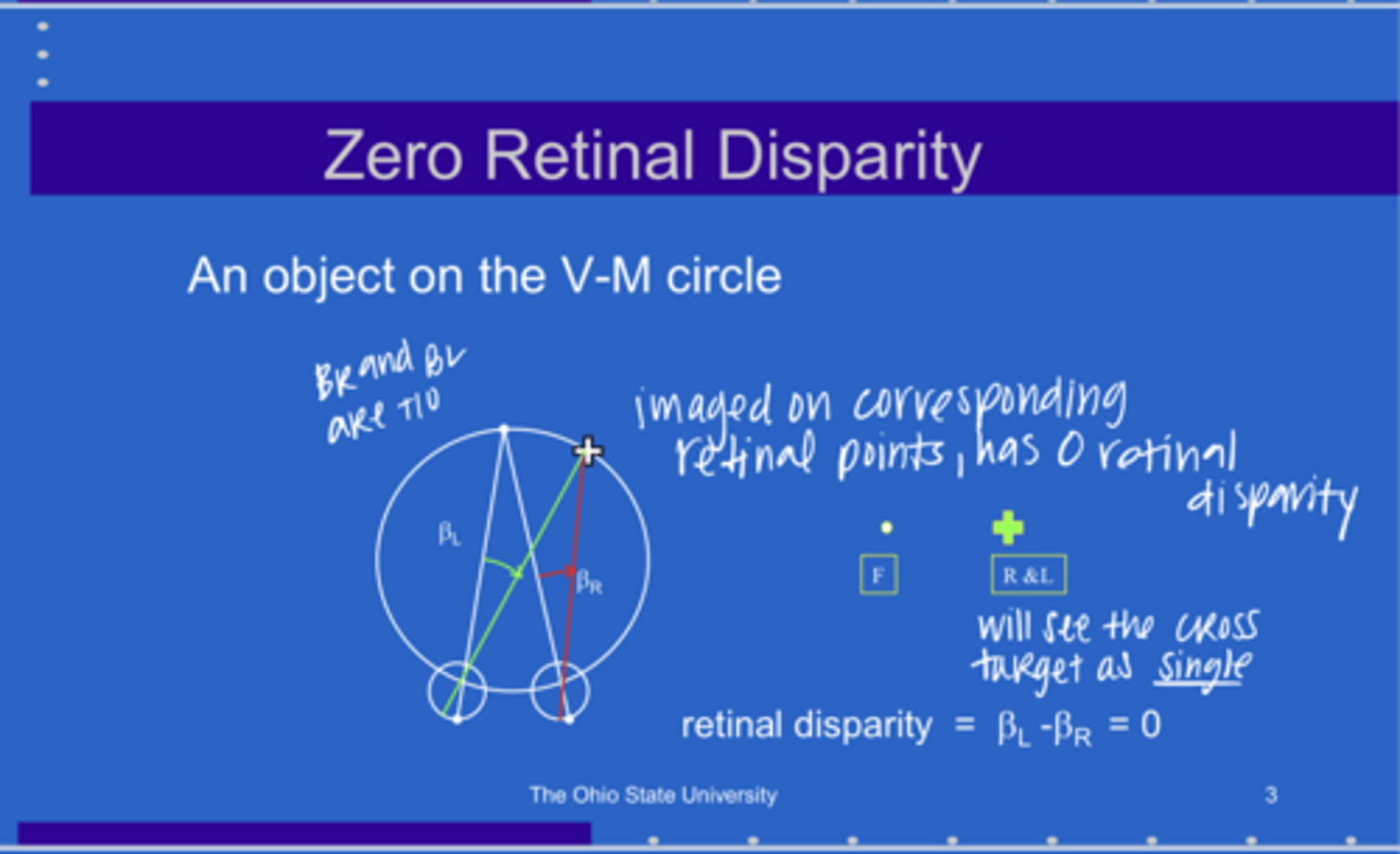
When an object falls on the V-M circle, it will be imaged on _______ retinal points
corresponding
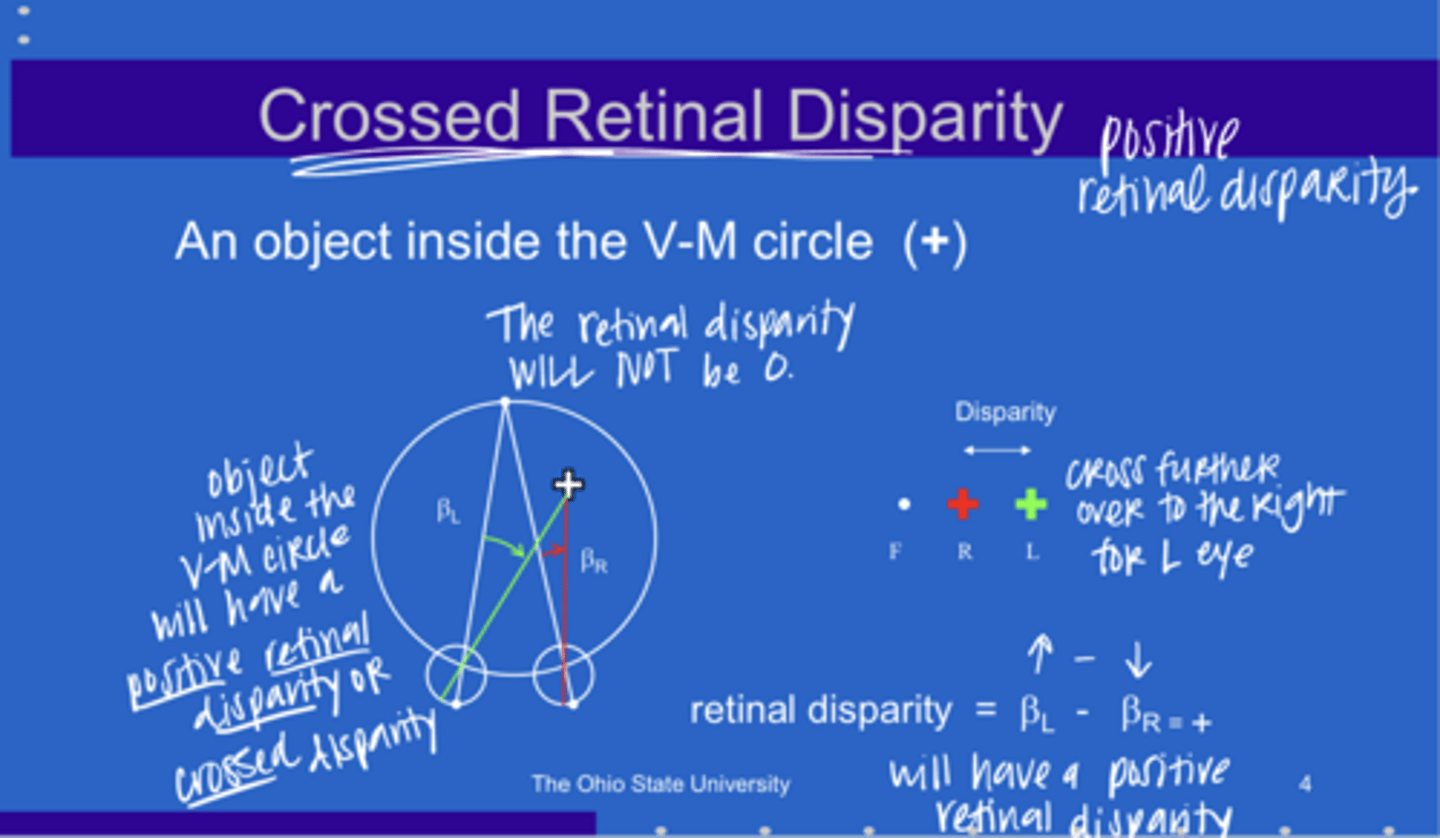
An object inside the V-M circle will have (crossed/uncrossed) retinal disparity
crossed
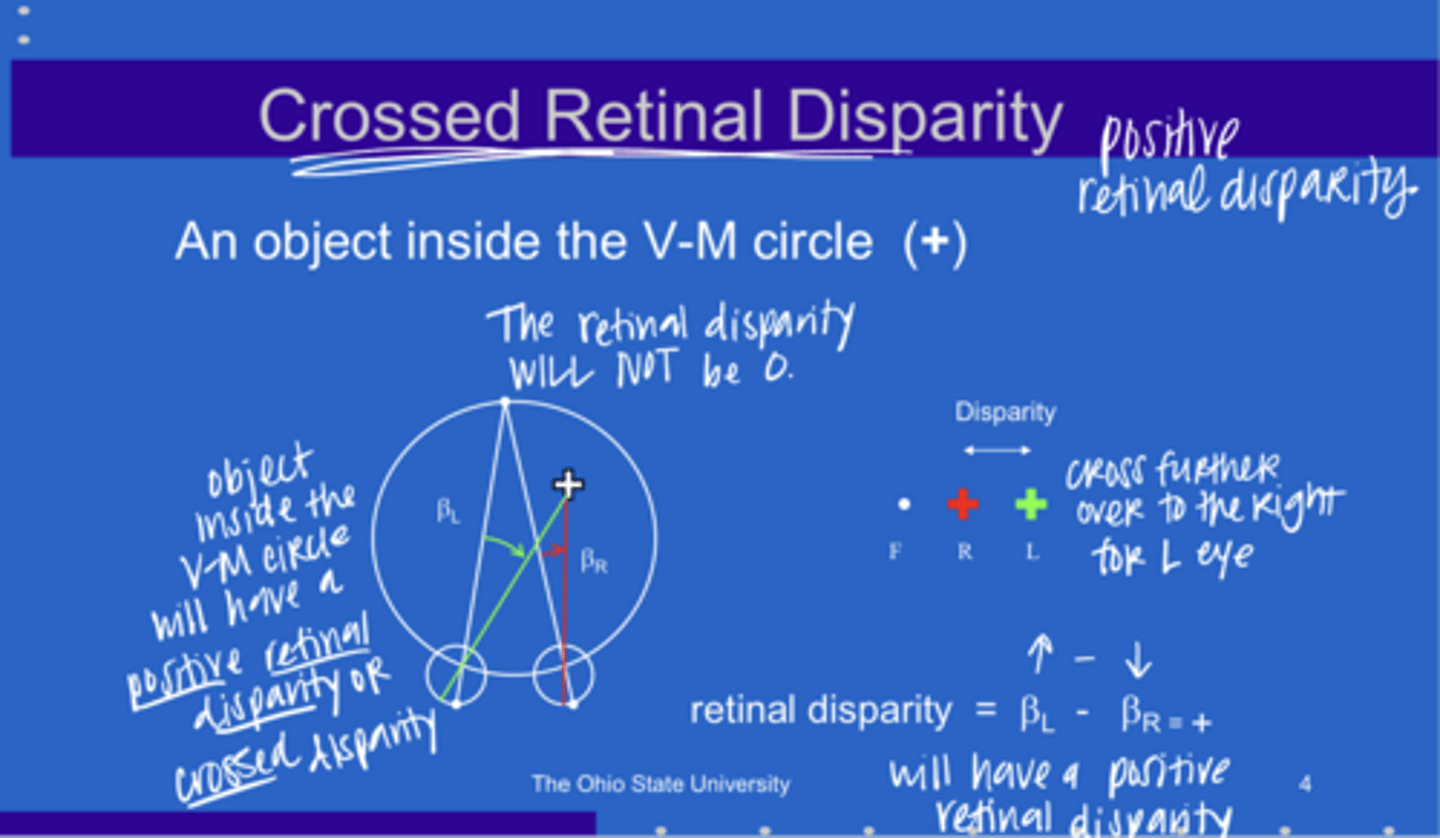
An object inside the V-M circle will have (positive/negative) retinal disparity
positive
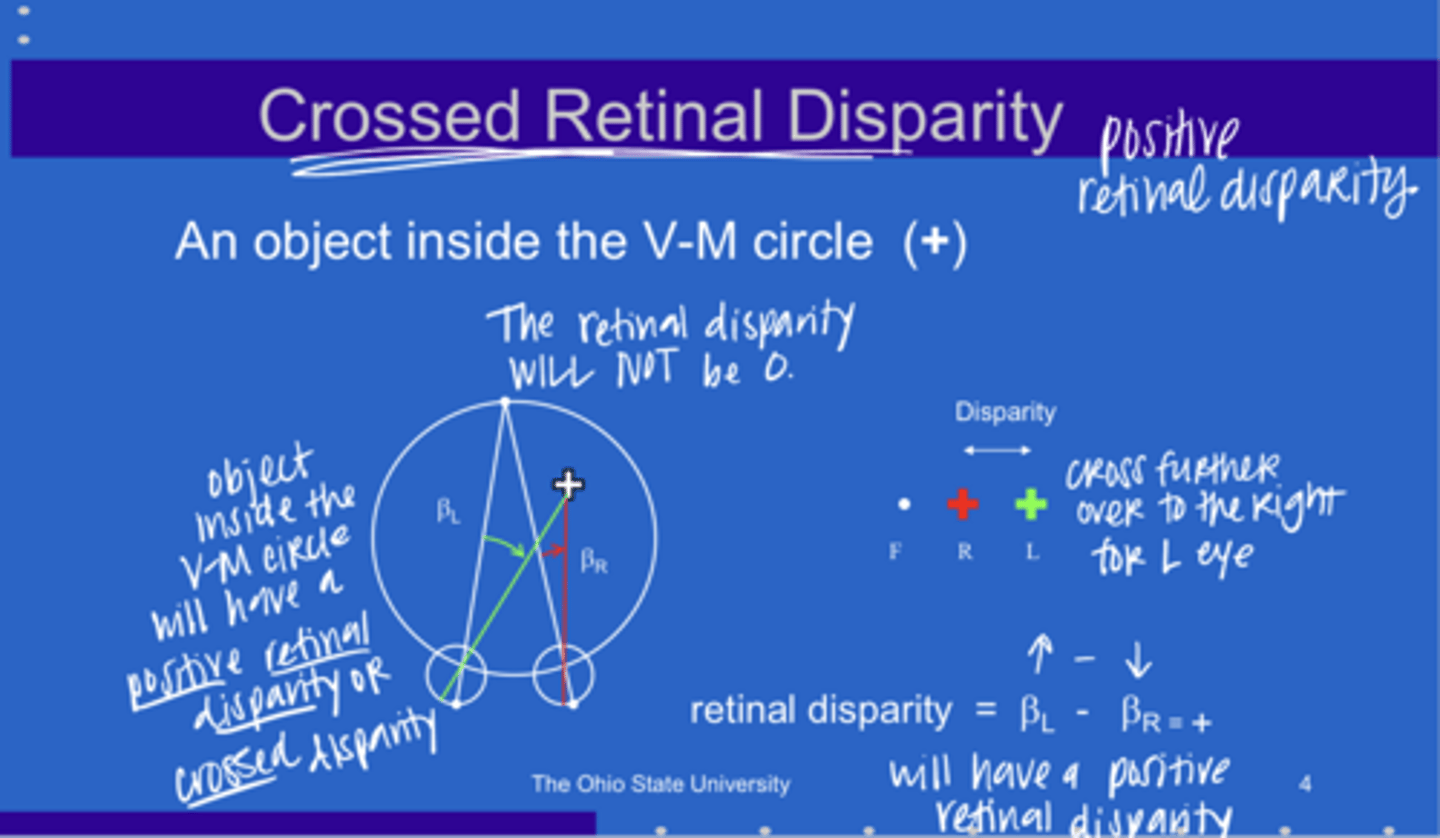
When an object is INSIDE the V-M circle, will the retinal disparity be 0?
No
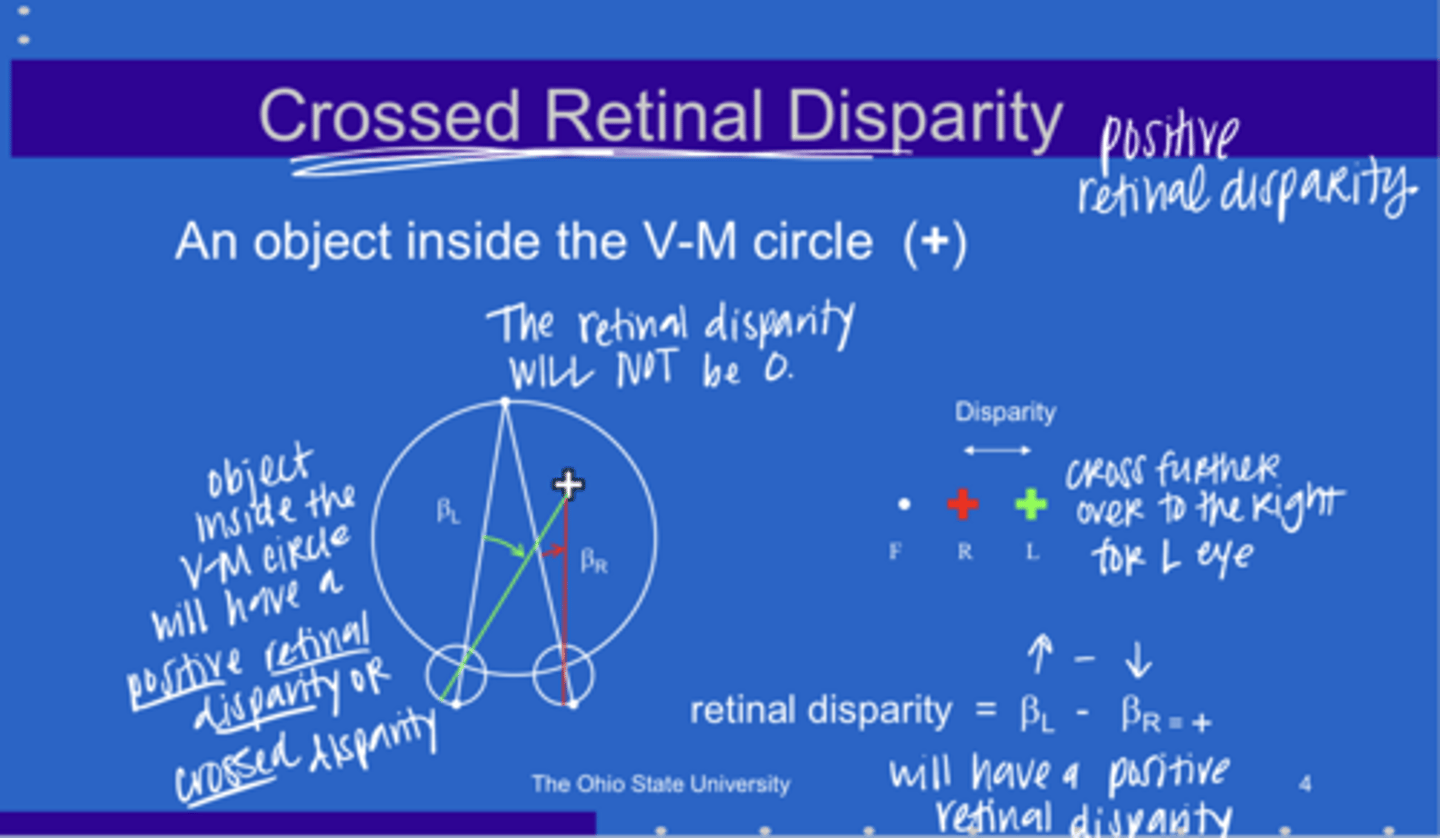
Will a patient see single if an object is INSIDE the V-M circle?
No -- Will see double since retinal disparity is NOT 0
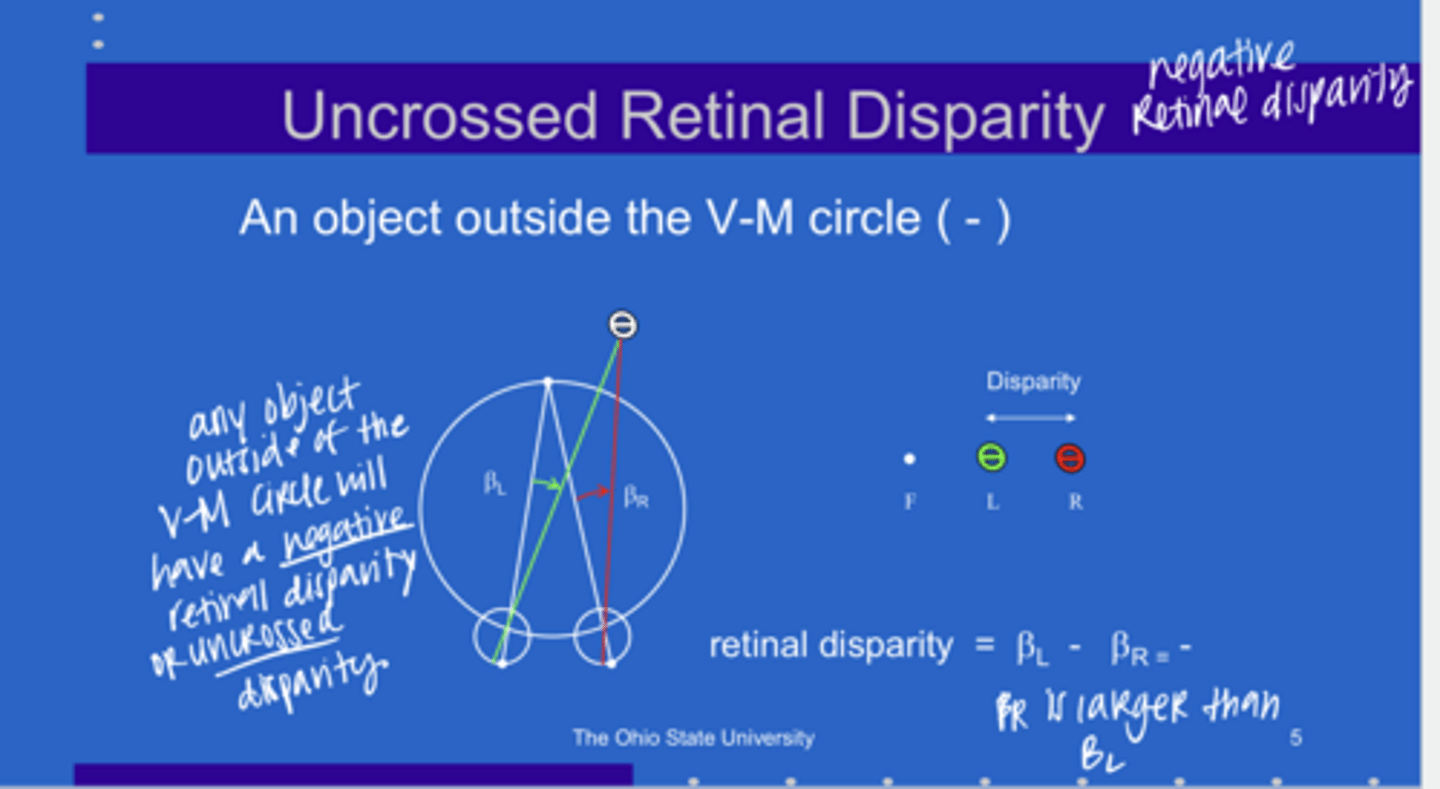
An object outside the V-M circle will have (crossed/uncrossed) retinal disparity
uncrossed
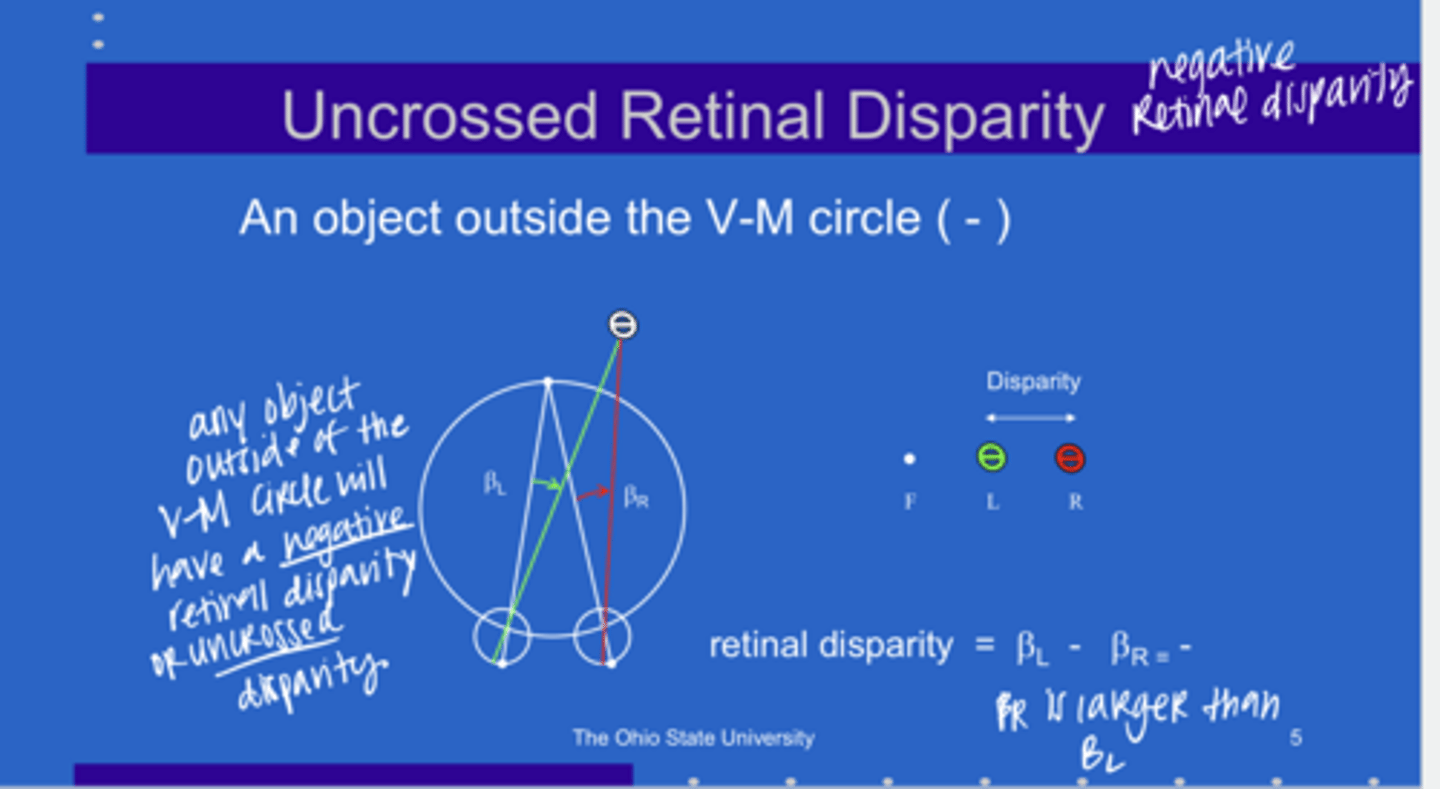
An object outside the V-M circle will have (positive/negative) retinal disparity
negative
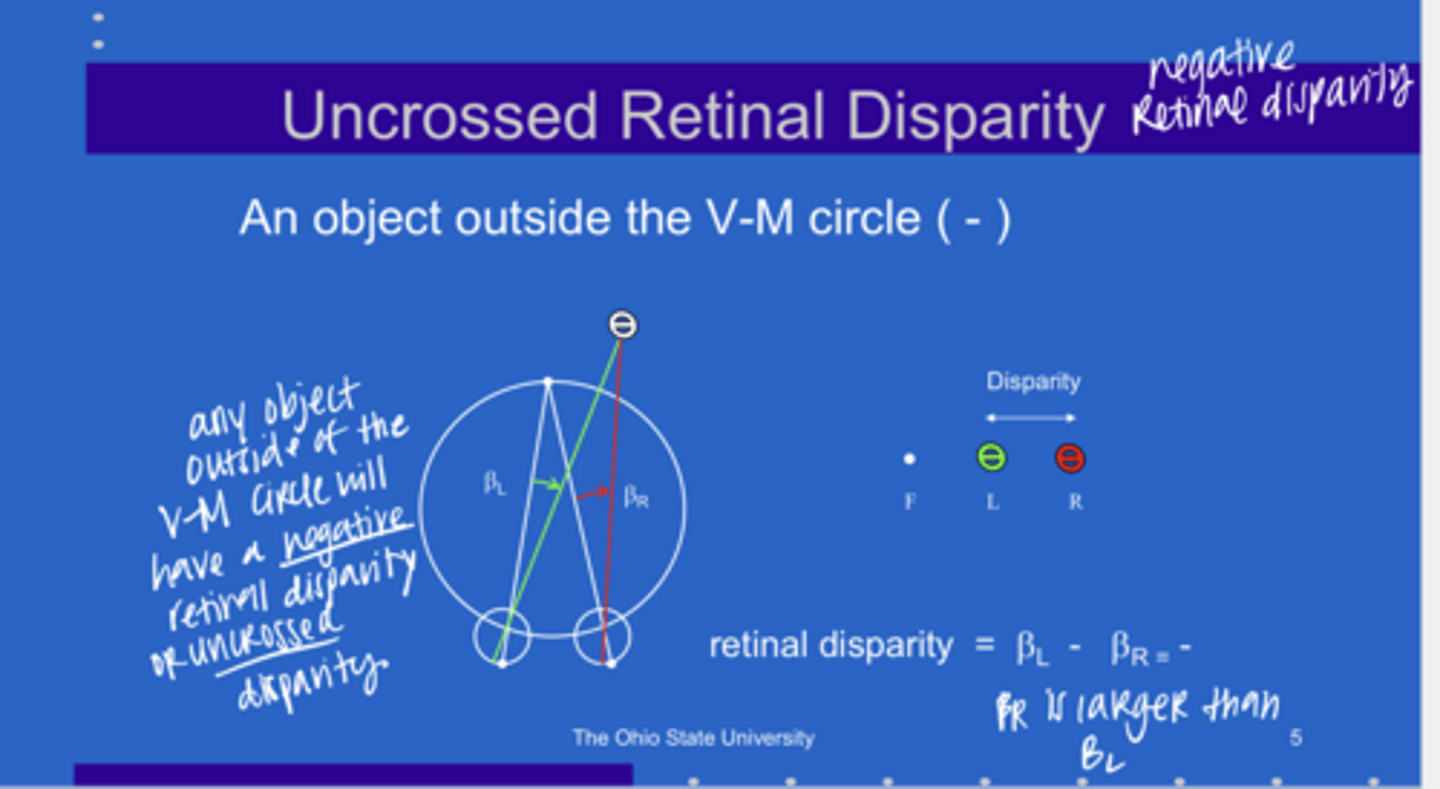
When an object is OUTSIDE the V-M circle, will the retinal disparity be 0?
no
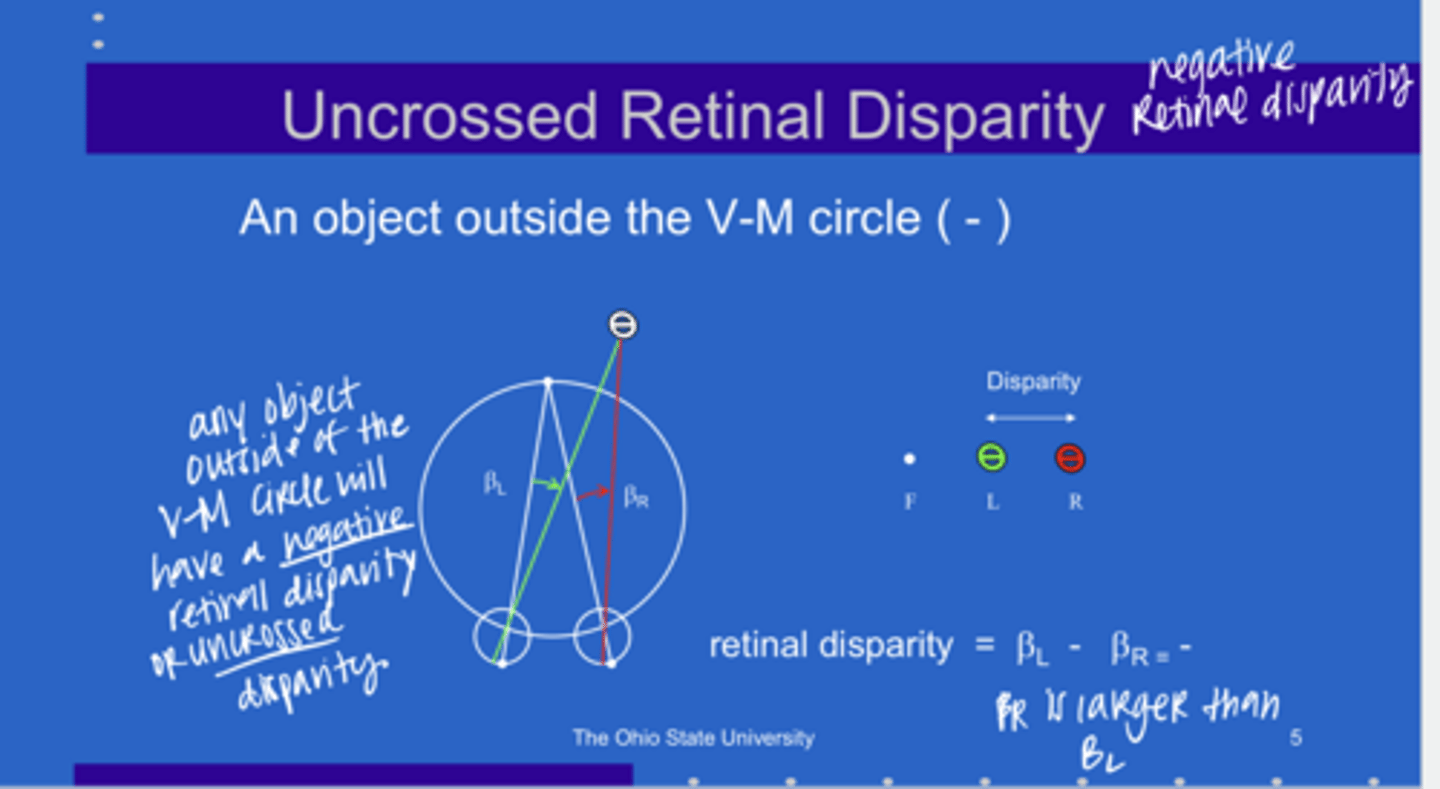
Will a patient see single if an object is OUTSIDE the V-M circle?
no -- the retinal disparity of the object will not be 0
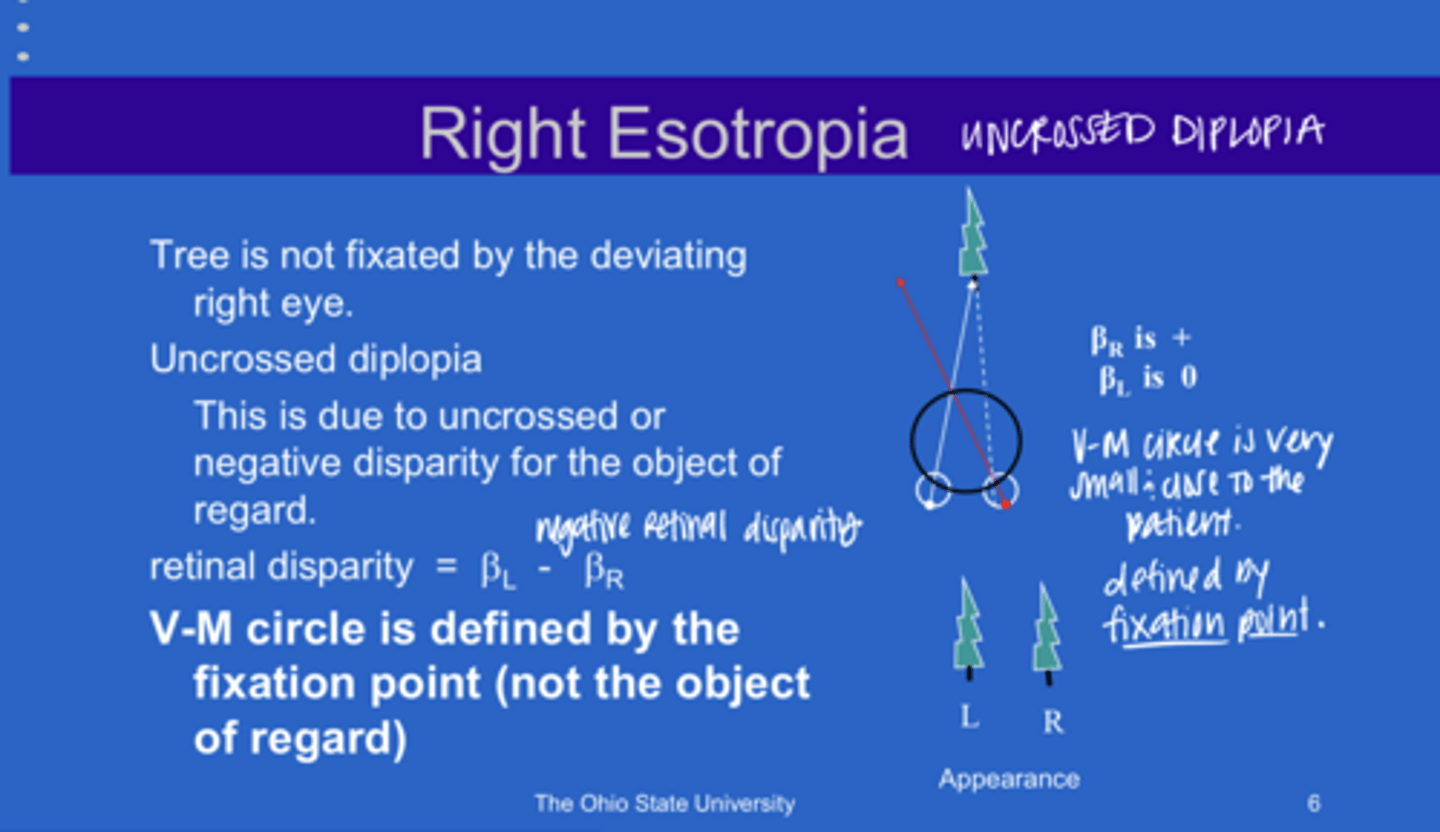
When a patient has a R esotropia, is the object will be fixated by the deviating right eye?
no
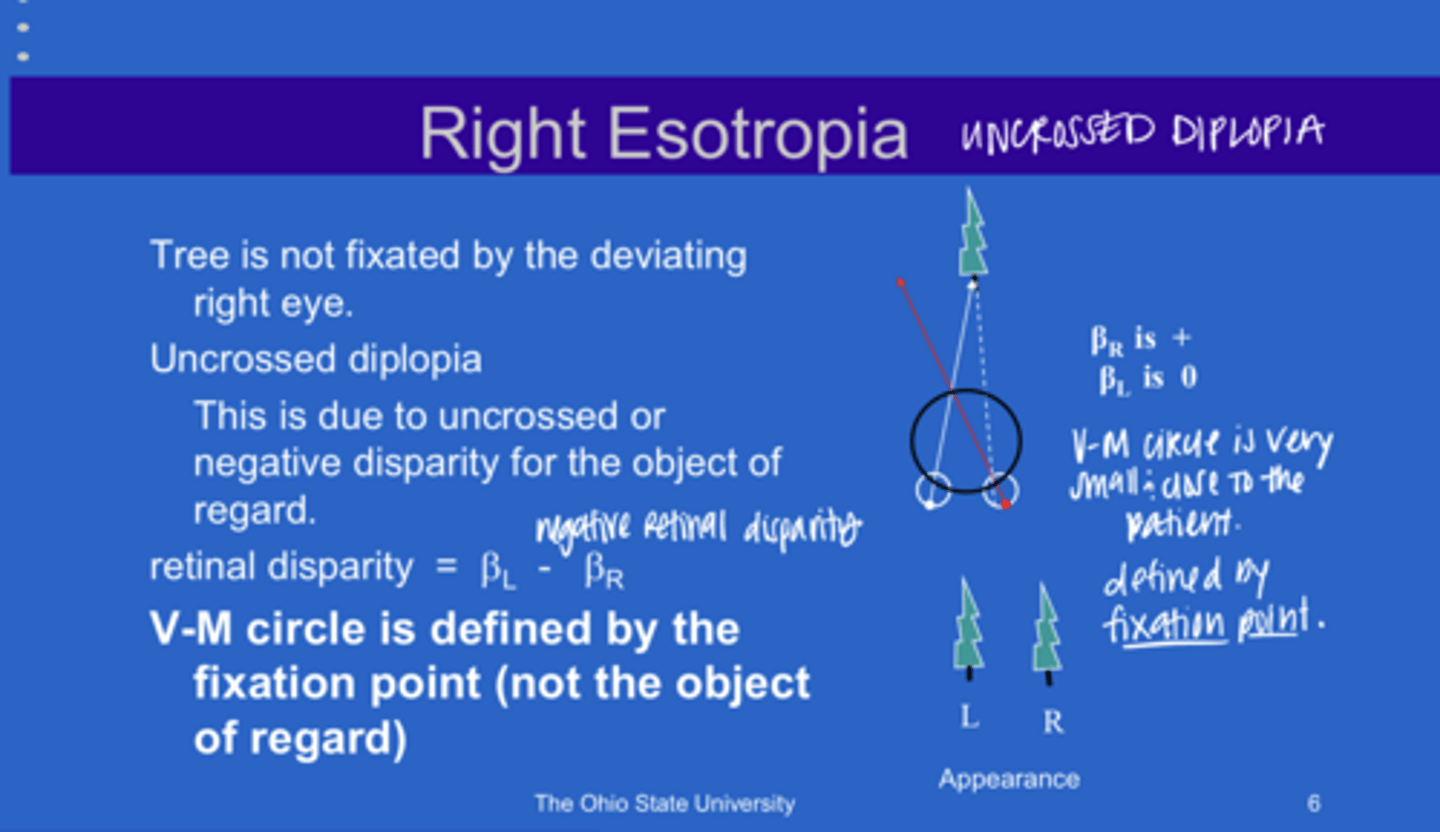
When a patient has a R esotropia, they will have (crossed/uncrossed) diplopia
uncrossed
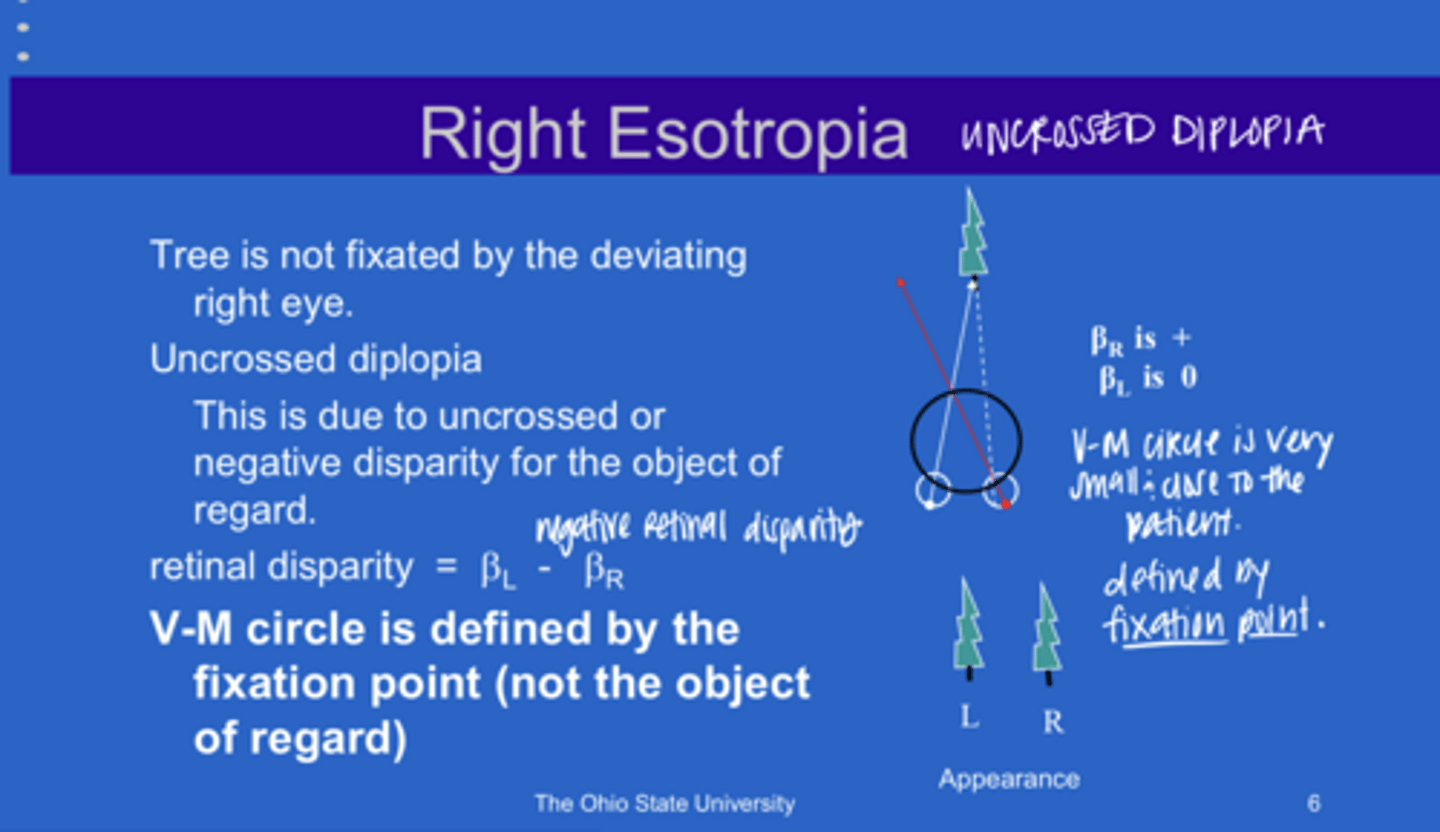
Why does a R esotropia lead to uncrossed diplopia?
-D/t negative disparity for the object of regard
-Retinal disparity = βL - βR
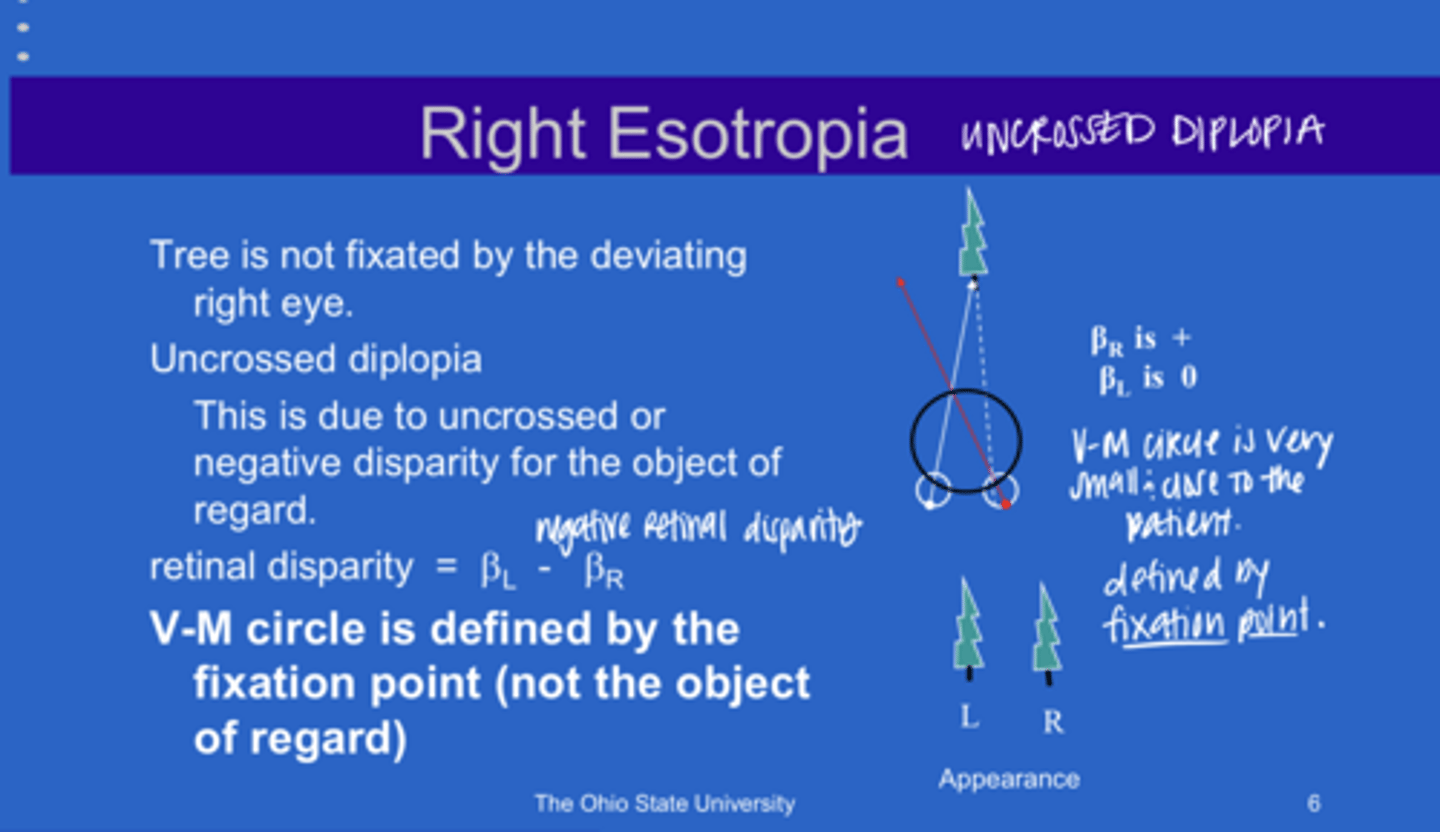
The V-M circle is defined by the _____ point
fixation
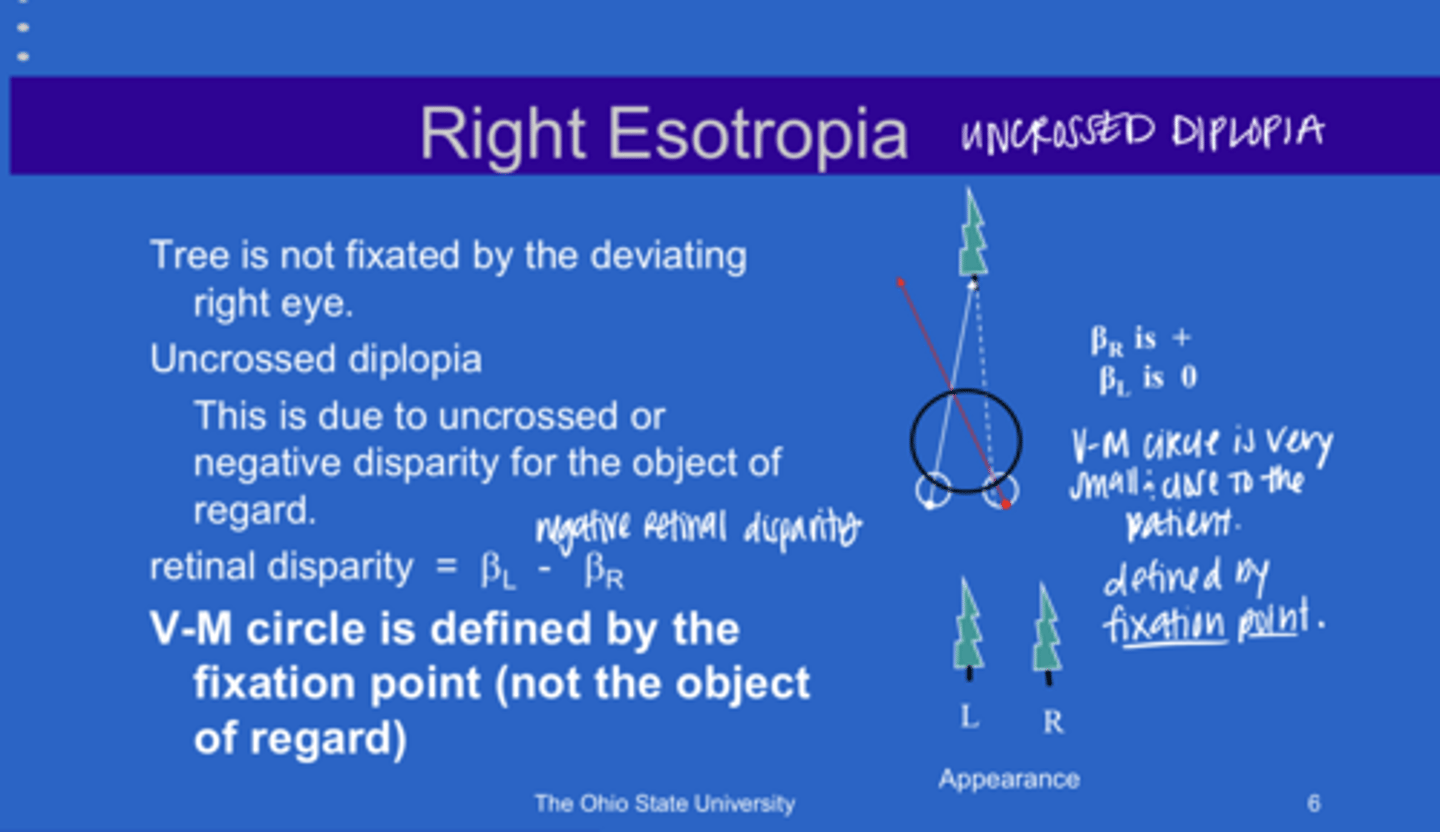
Is the V-M circle defined by the object in regard?
No
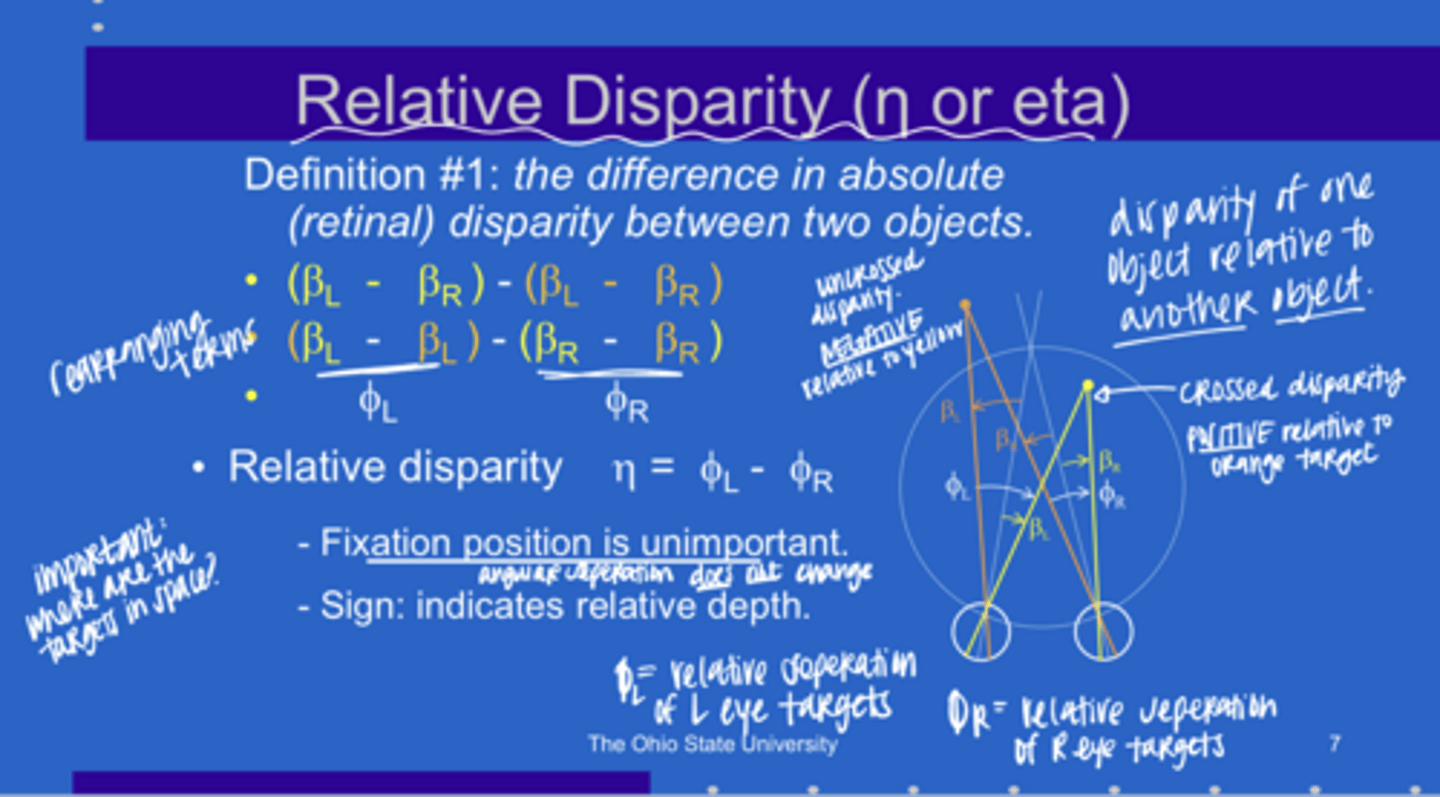
The difference in absolute (retinal) disparity between two objects (relative to another object)
relative disparity
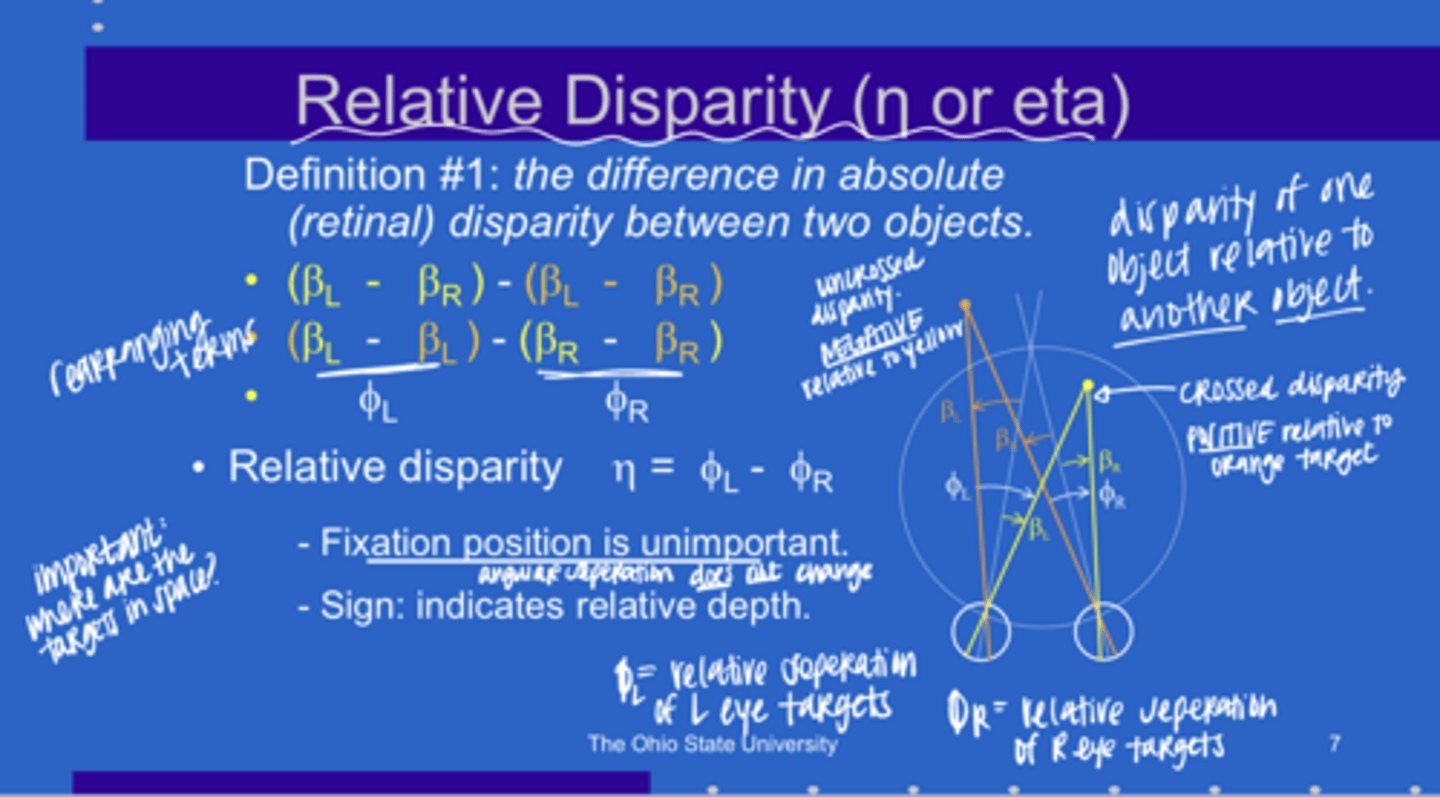
What is the equation for relative disparity?
-Relative disparity = φL - φR
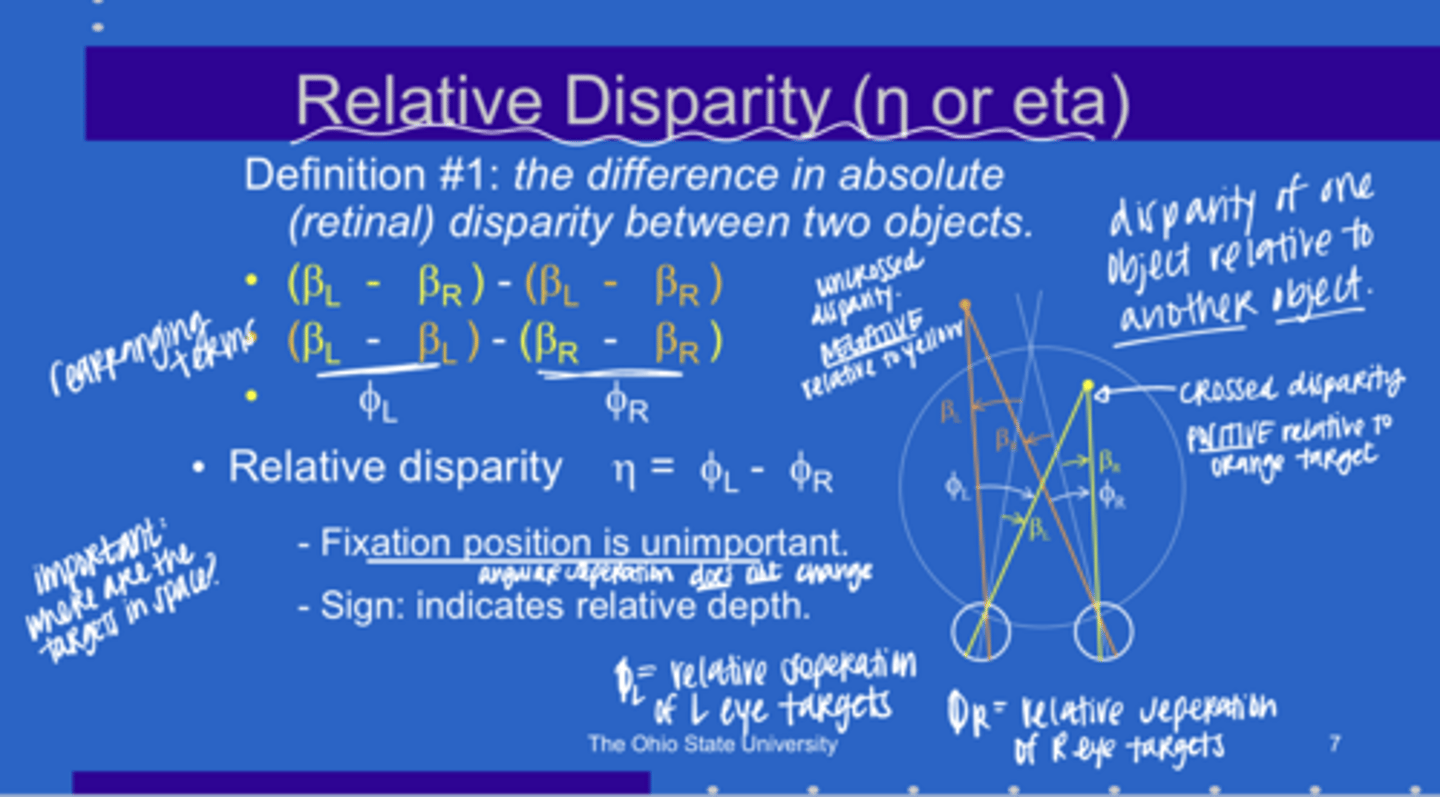
Is fixation point important when calculating relative disparity?
No
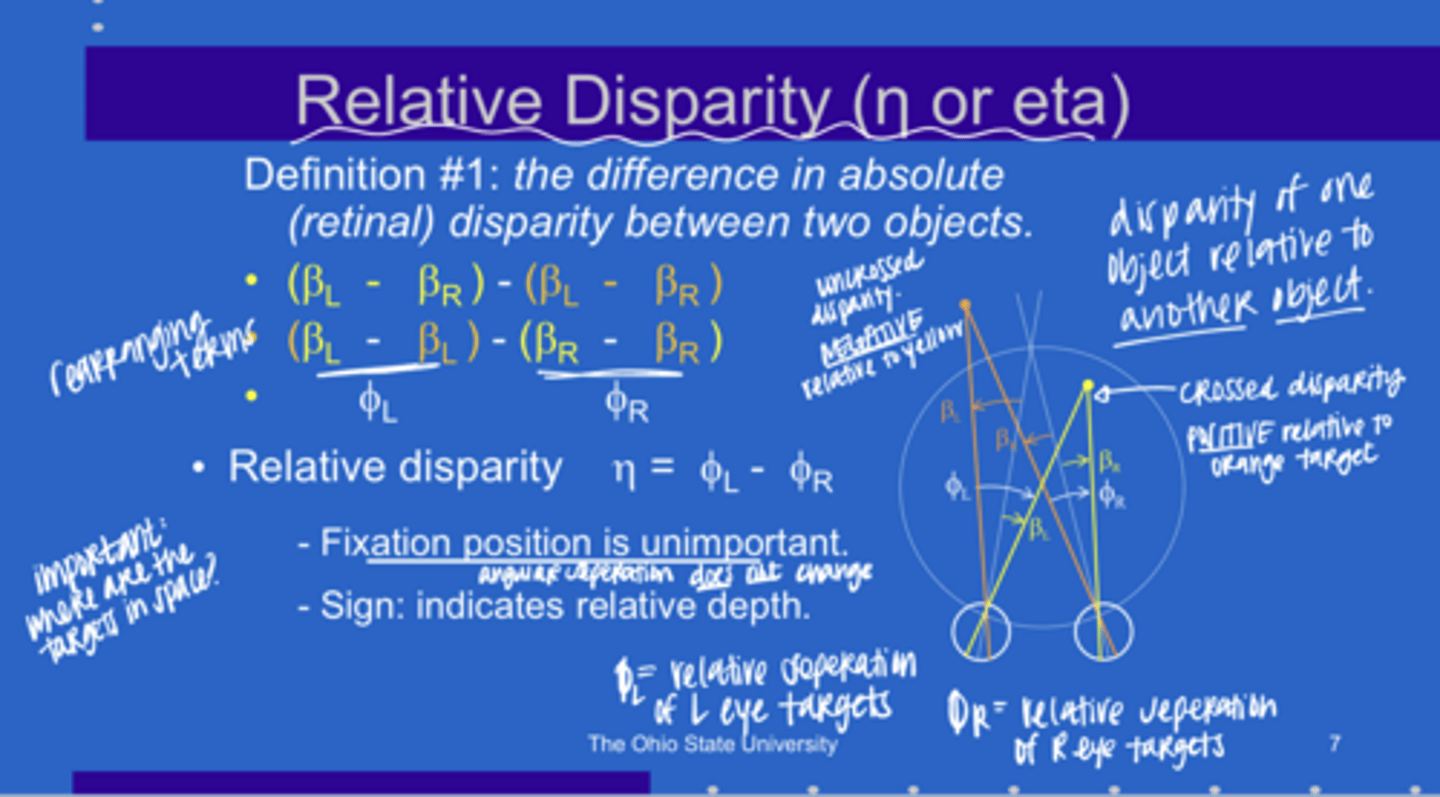
The difference in the angles of binocular parallax
Relative disparity (again)
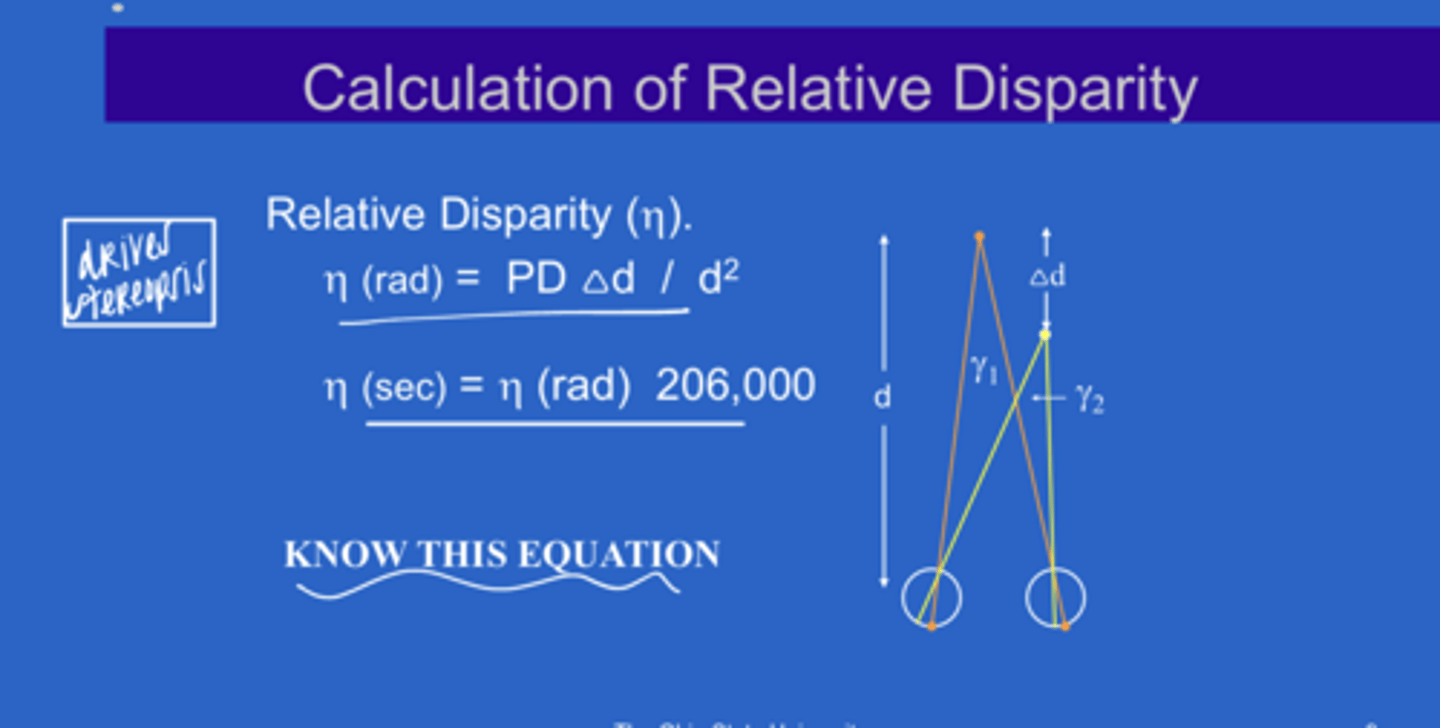
Equation to Know for Relative Disparity when there are 2 real world targets Separated by a distance, d
η = PD Δd / d^2
What is dioptic stimulation?
a target is seen simultaneously by both eyes
What is dichoptic stimulation?
separate targets presented one to each eye
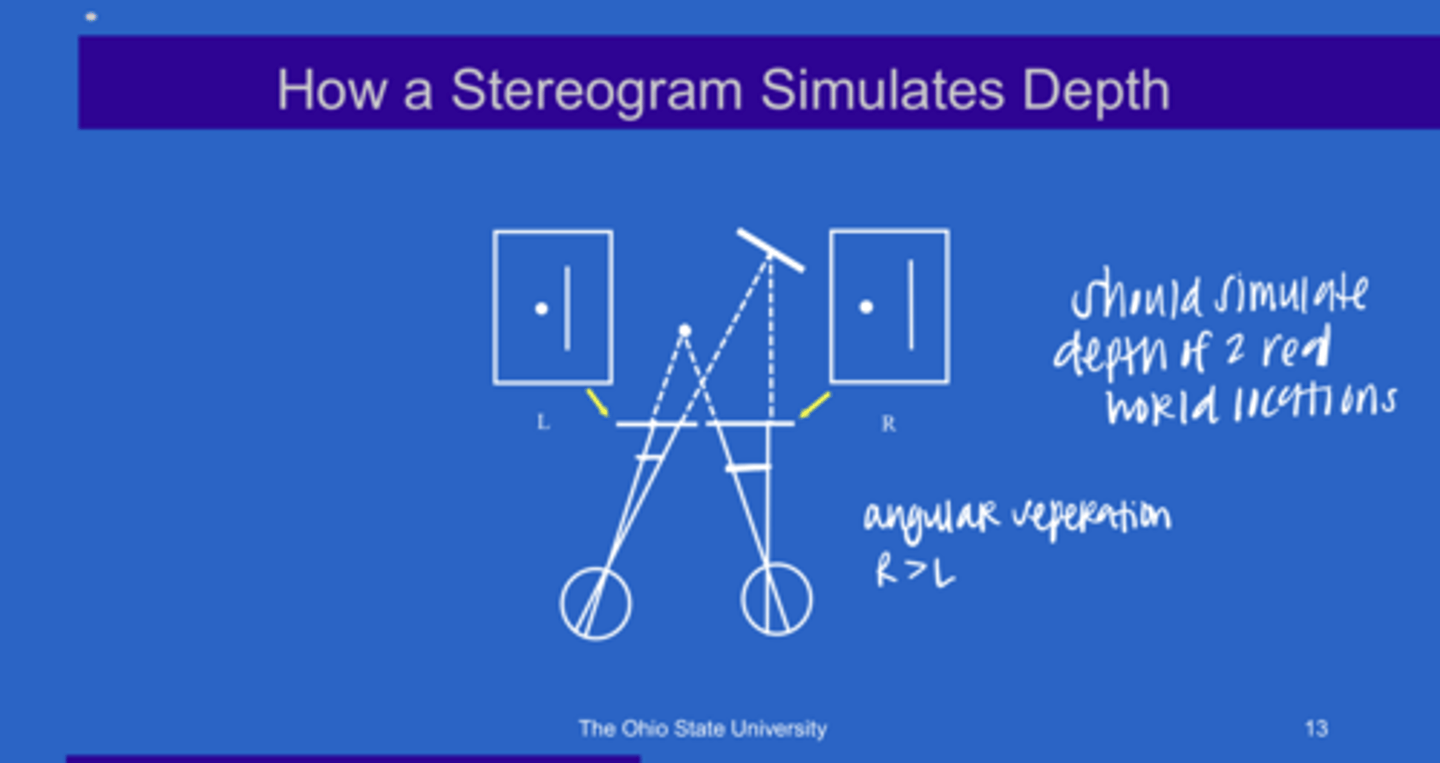
How a Stereogram Stimulates Depth (Pic)
How a Stereogram Stimulates Depth (Pic)
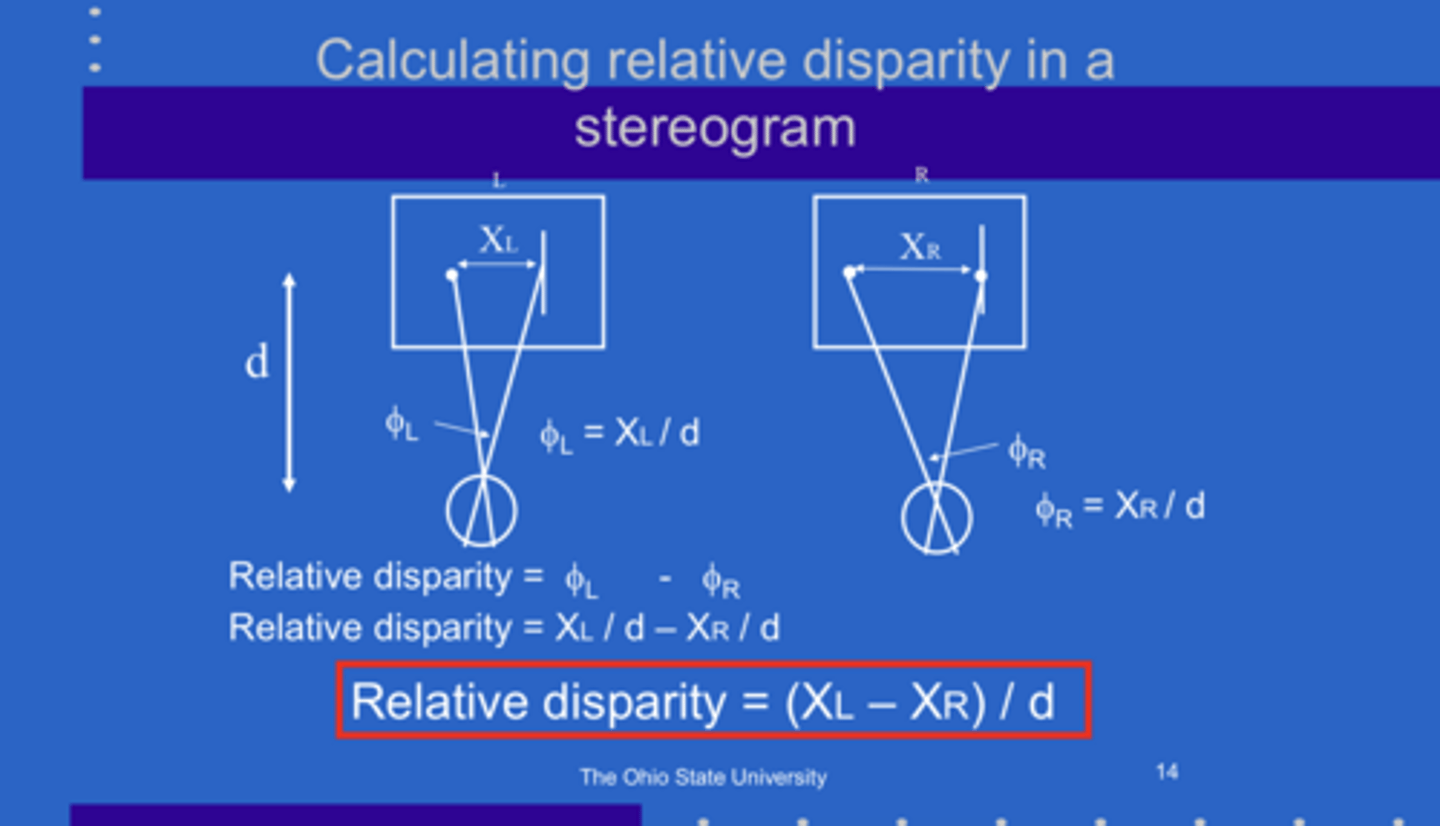
Equation for Relative Disparity in a Stereogram
Relative disparity = (XL - XR) / d
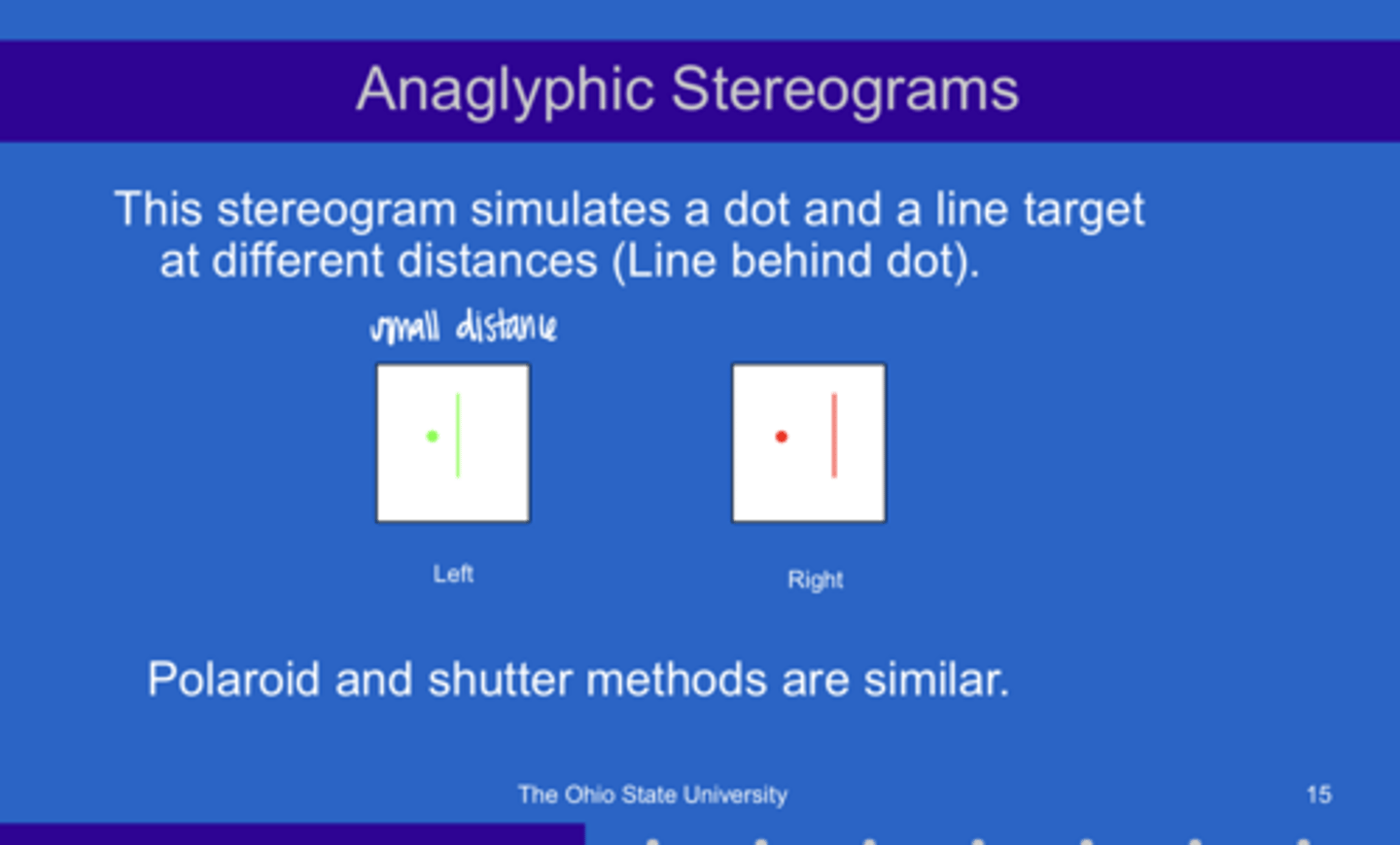
What does an anaglyphic stereogram simulate?
simulates a dot and a line target at different distances (Line behind the dot)
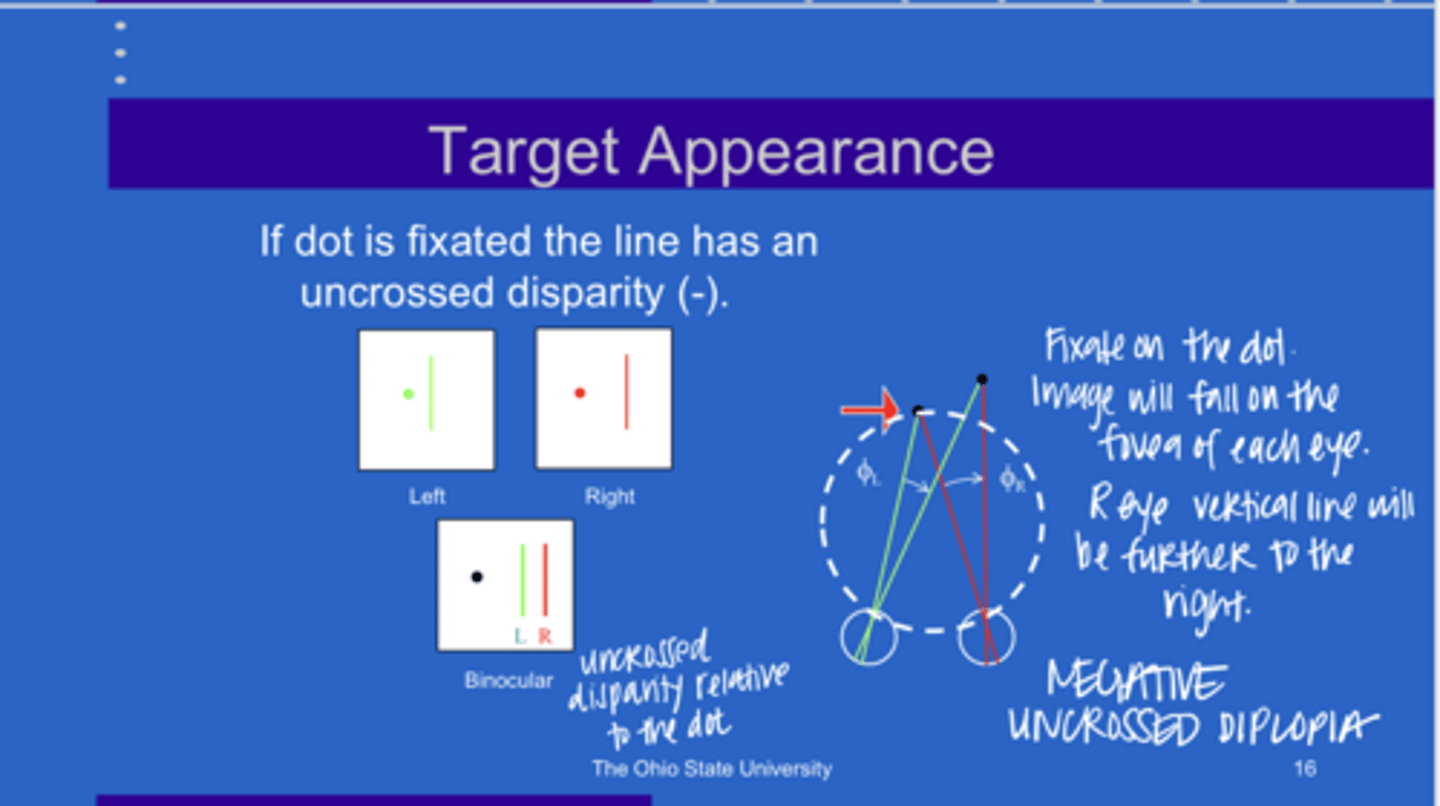
In this example (see pic), when the DOT is fixated, the line will have (uncrossed/crossed) disparity
uncrossed -- negative disparity
**the line is OUTSIDE V-M circle
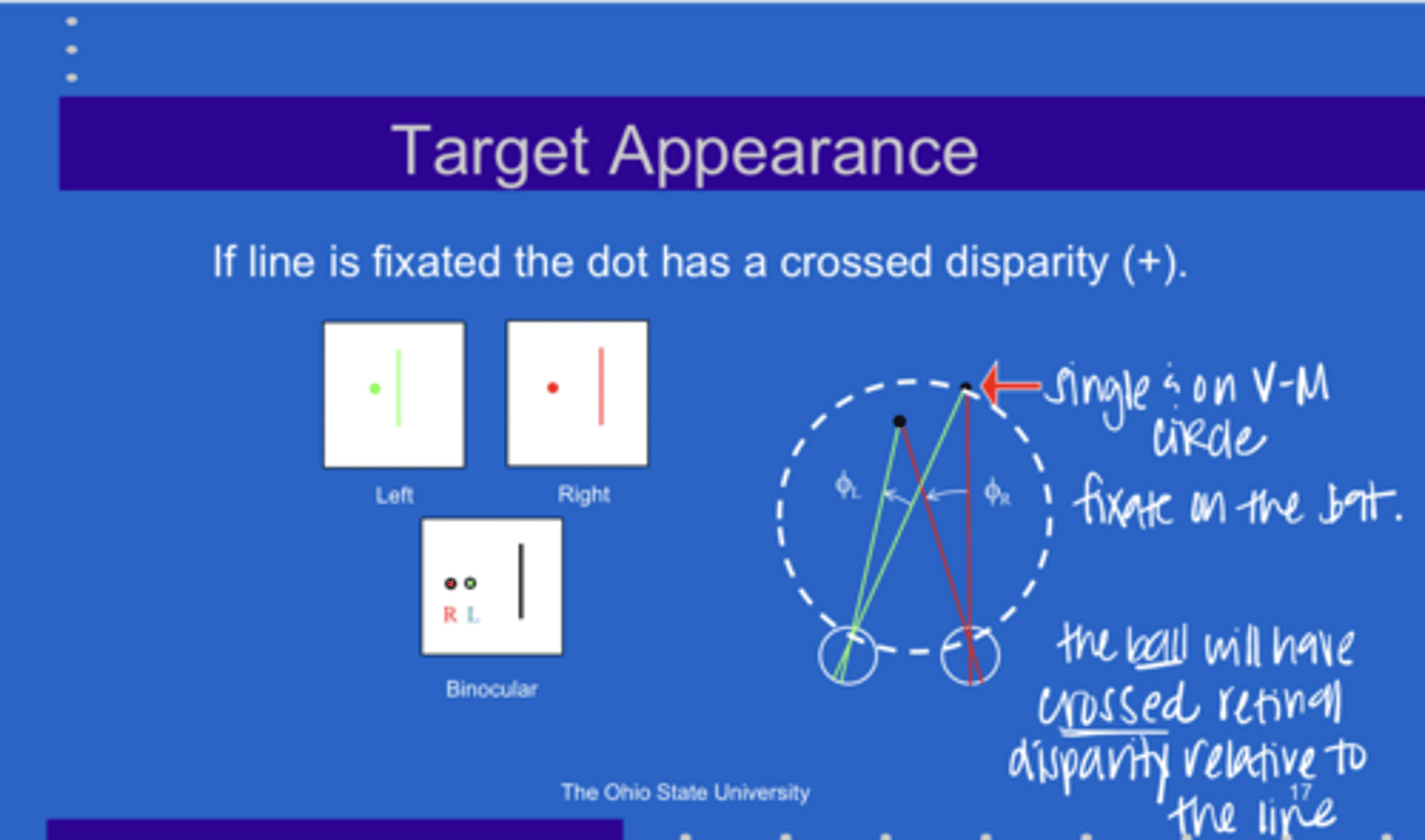
In this example (see pic), when the LINE is fixated, the dot will have (uncrossed/crossed) disparity
crossed -- positive disparity
**the line is INSIDE V-M circle
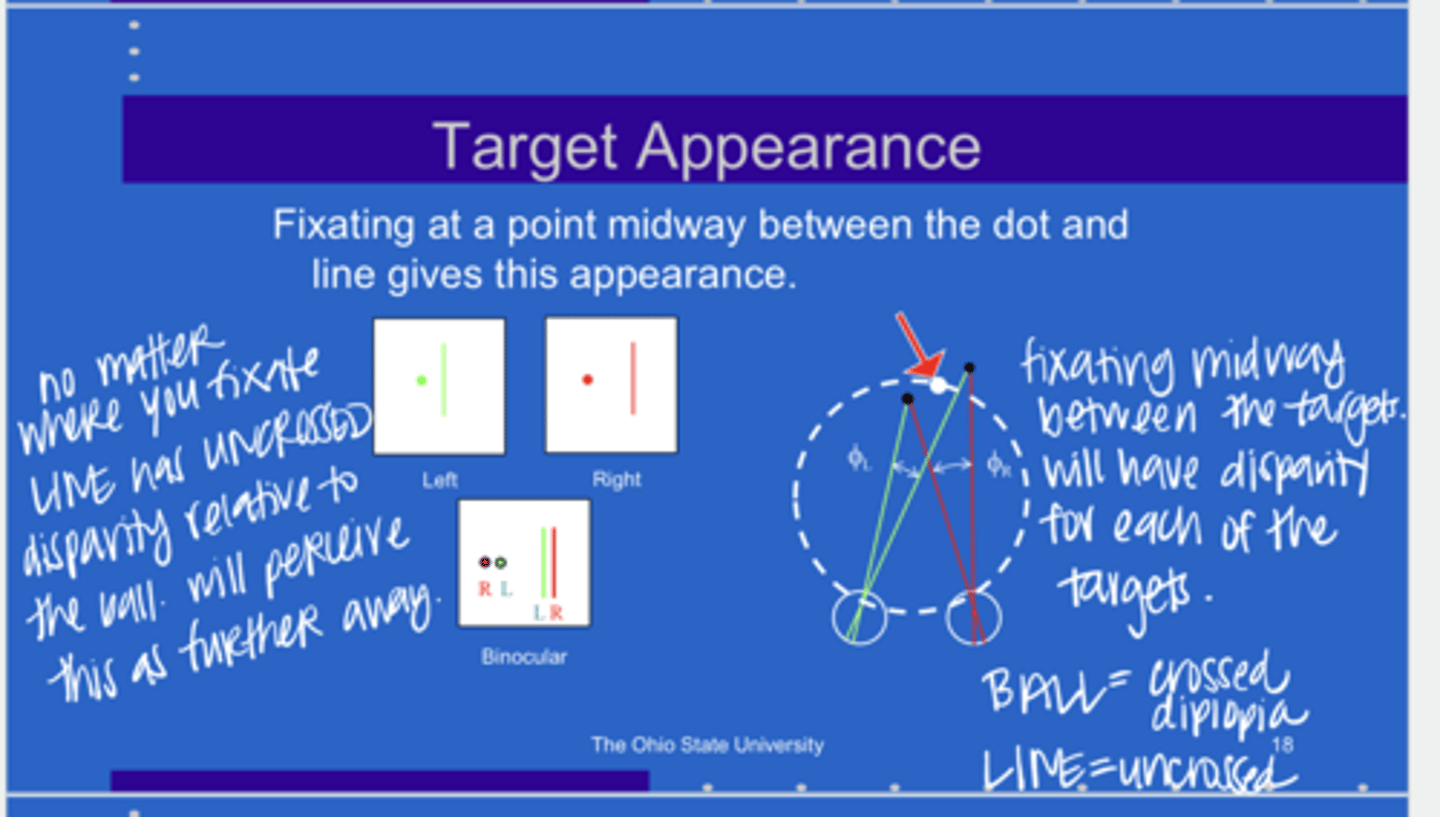
In this example (see pic), when the patient fixates on a point midway between the dot and the line, both line/dot will be seen as (single/double)
double -- each of the targets will have retinal disparity
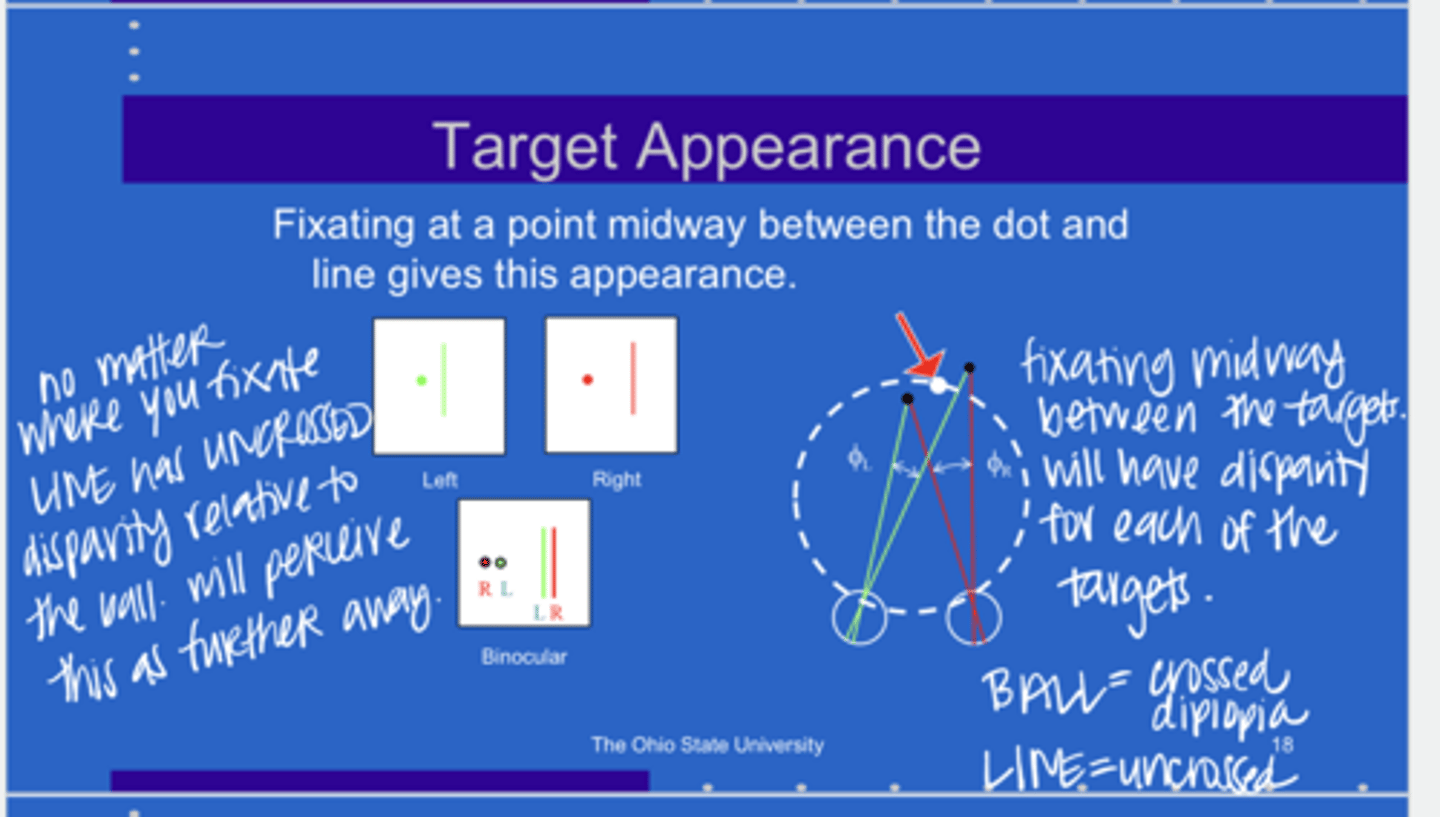
In this example (see pic), when the patient fixates on a point midway between the dot and the line, the LINE will have (crossed/uncrossed) disparity
uncrossed -- negative
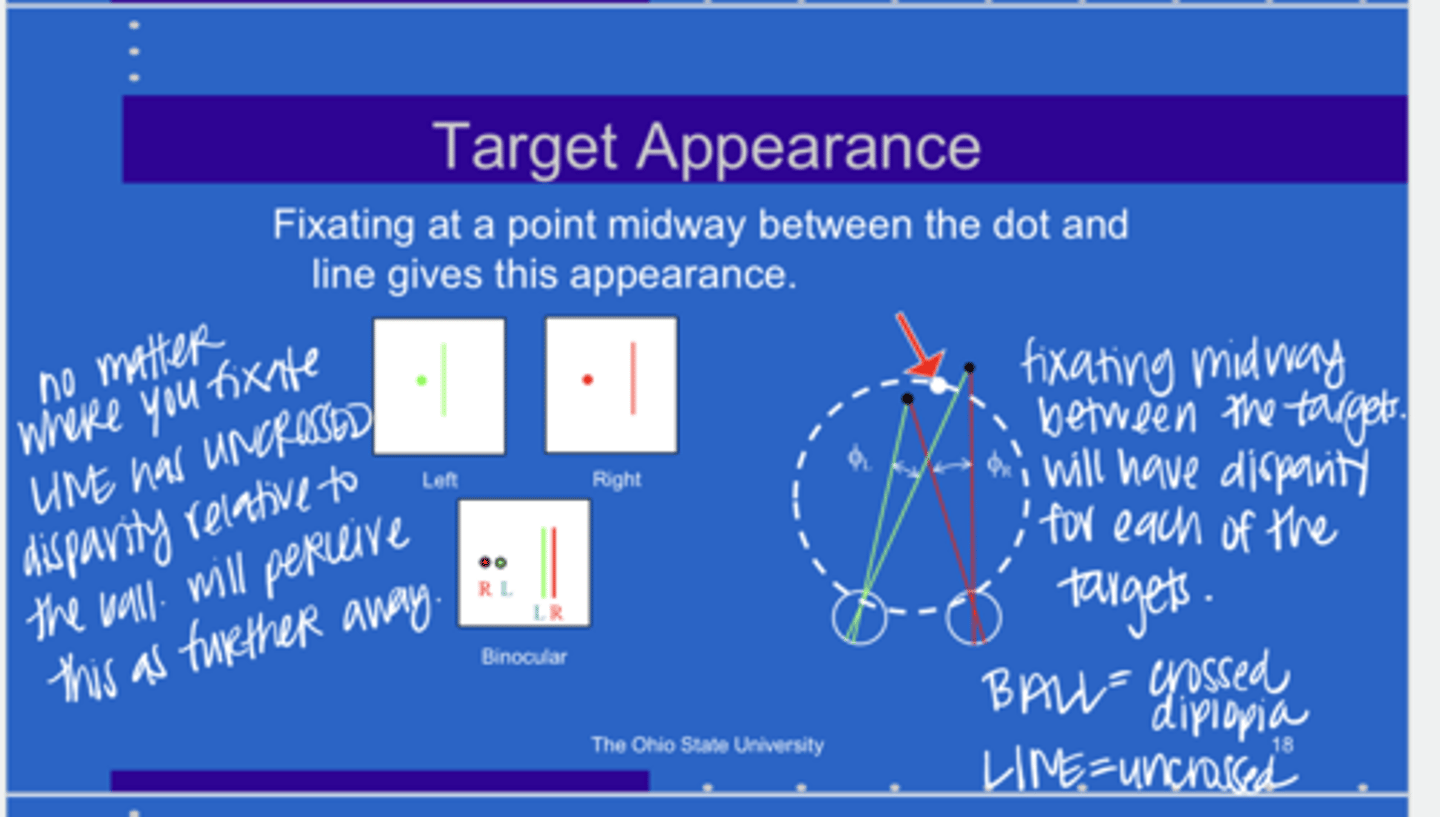
In this example (see pic), when the patient fixates on a point midway between the dot and the line, the BALL will have (crossed/uncrossed) disparity
crossed -- positive
When you present disparate images to the two eyes, what is the result?
-physiological diplopia
-fusion
What are the 2 forms of fusion that are BOTH needed in order to see an object single and clear?
-motor
-sensory
What is motor fusion?
movement that adjusts eye position so object of regard is imaged on both foveas
What is sensory fusion?
Cortical mechanism in which images from two eyes are integrated into a single perceptual whole
Monocular sensations MUST BE ___________ otherwise will NOT have sensory fusion
suitably related to each other
If monocular sensations are not suitably related to each other, what is the consequence of this?
rivalry will be present (alternate suppression)
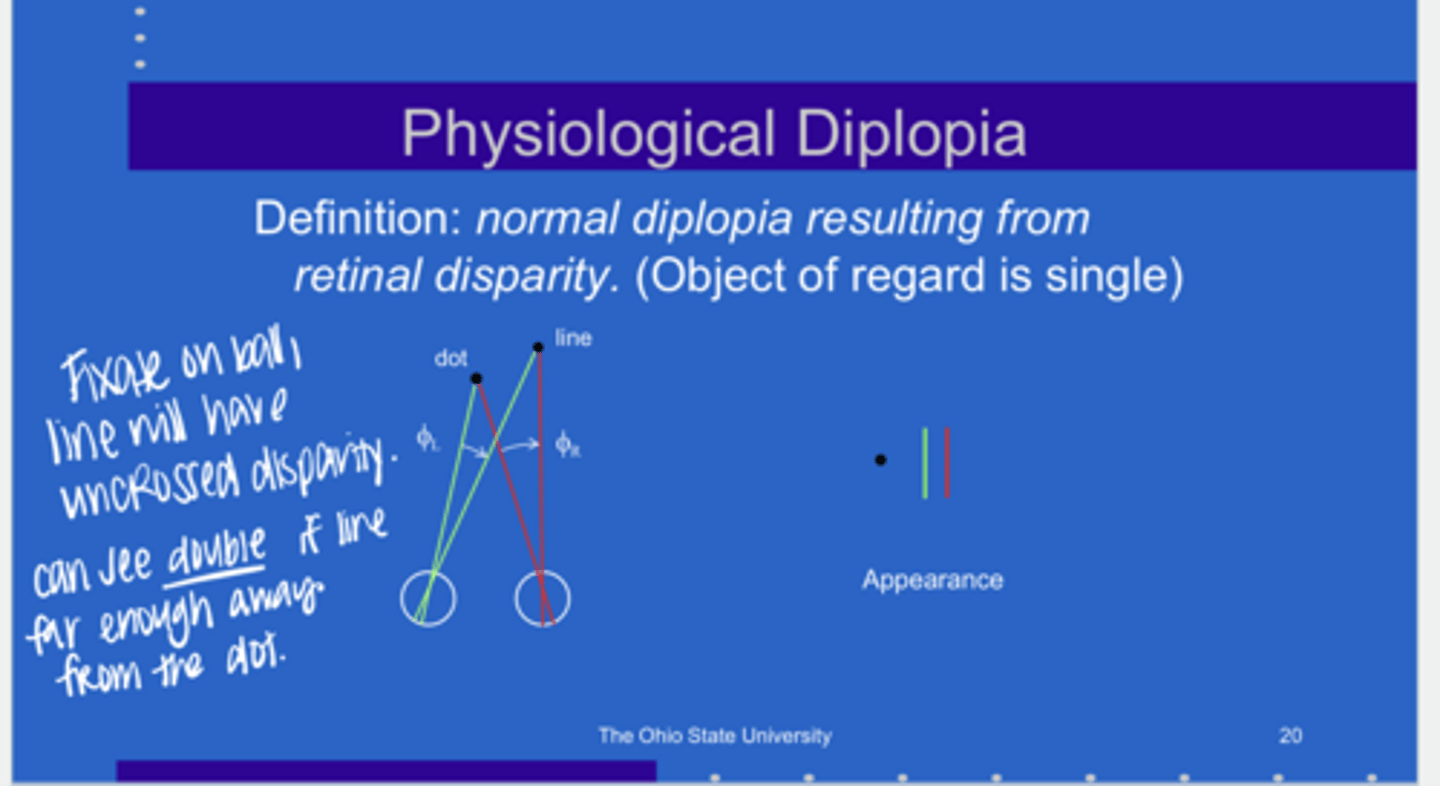
What is the definition of physiological diplopia?
normal diplopia resulting from retinal disparity (object of regard is single)
Do all small disparities cause diplopia?
No
Why do all small disparities NOT cause diplopia?
A normal physiological process eliminates diplopia for small disparities
What is the diplopia threshold?
the critical retinal disparity for double vision
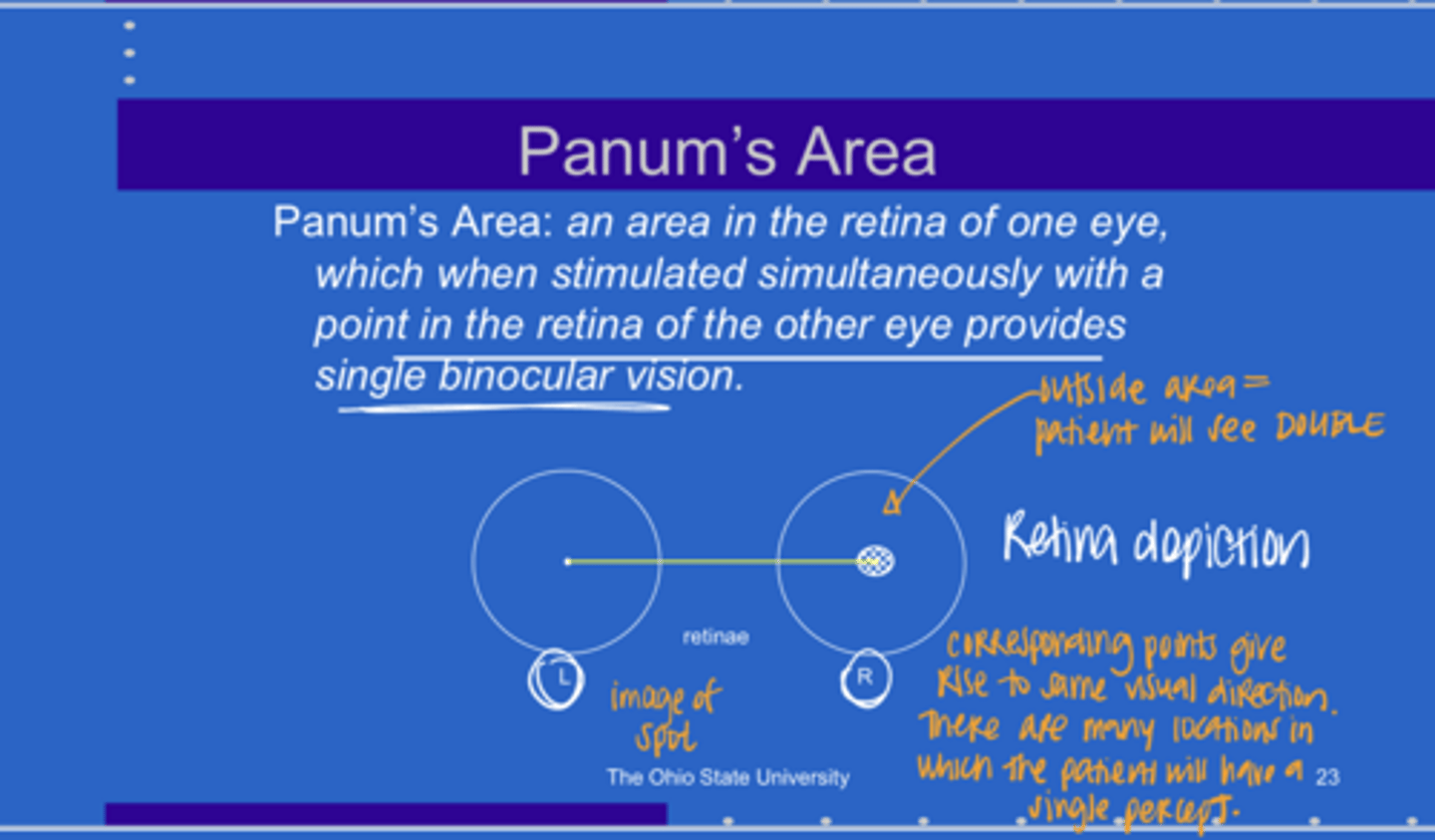
What is Panum's Area?
an area in the retina of one eye, which when stimulated simultaneously with a point in the retina of the other eye provides single binocular vision
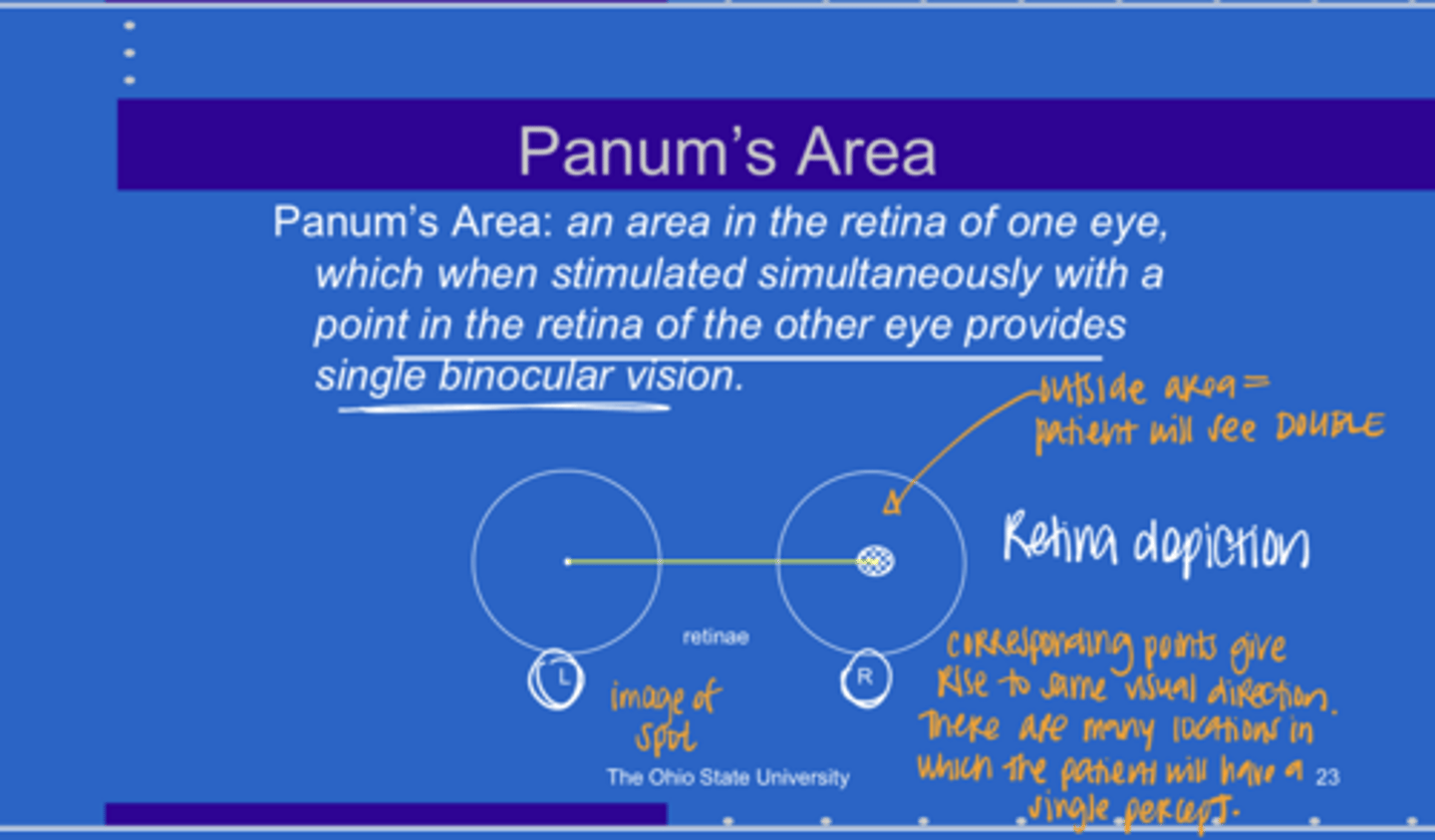
If an object is OUTSIDE Panum's Area, what will the patient see?
double
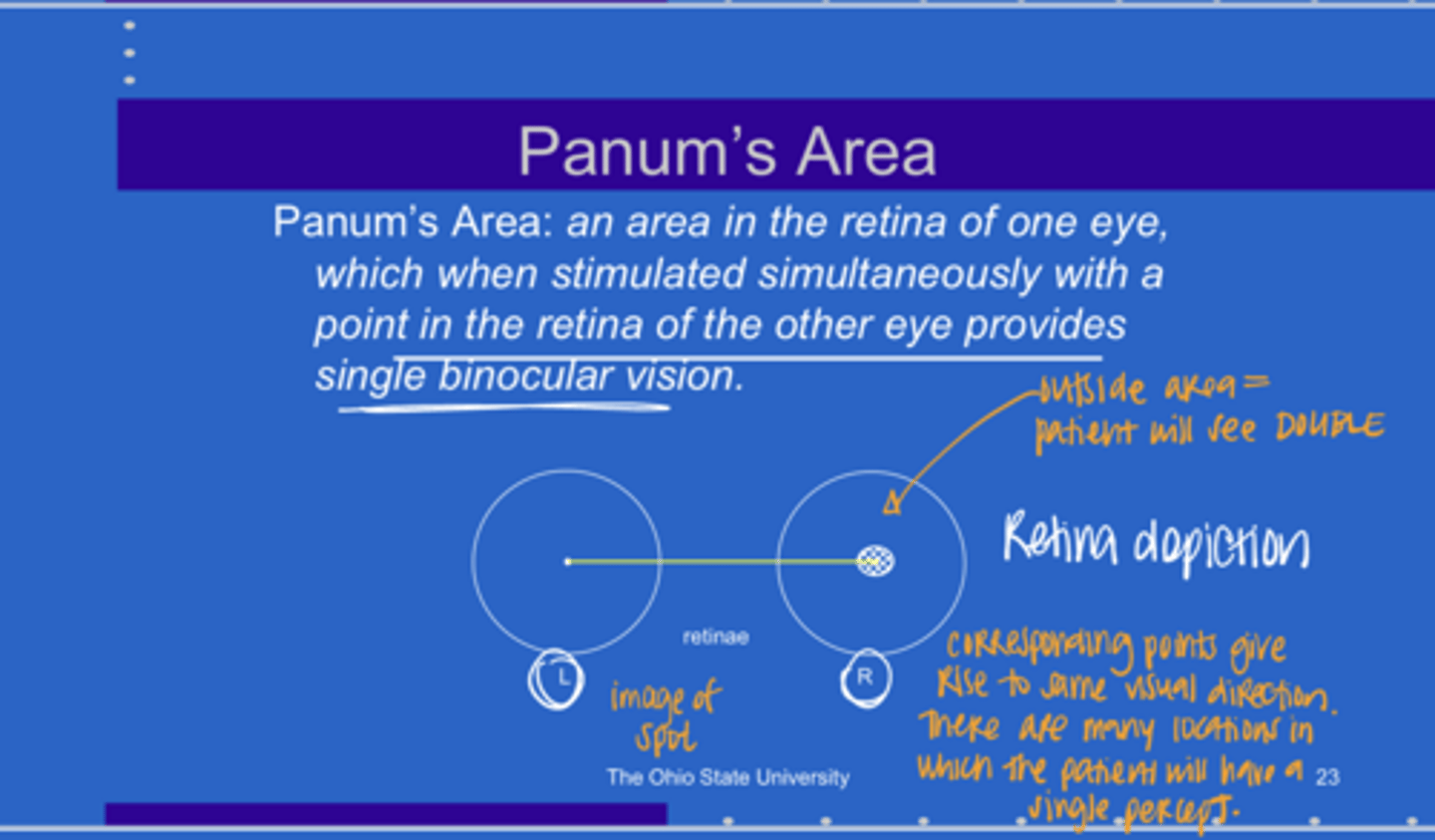
What does Panum's area allow for?
fusion of small disparities & allows single vision for all 3 circles on the Randot even though there is disparity present
What is the definition of stereopsis?
the specific sensation of depth arising from relative disparity
Stereopsis is _____ and develops by 4 months of age
innate
What does stereopsis provide?
relative depth info
What is the stimulus for stereopsis?
lateral disparity
Can stereopsis tell info about ABSOLUTE depth?
No
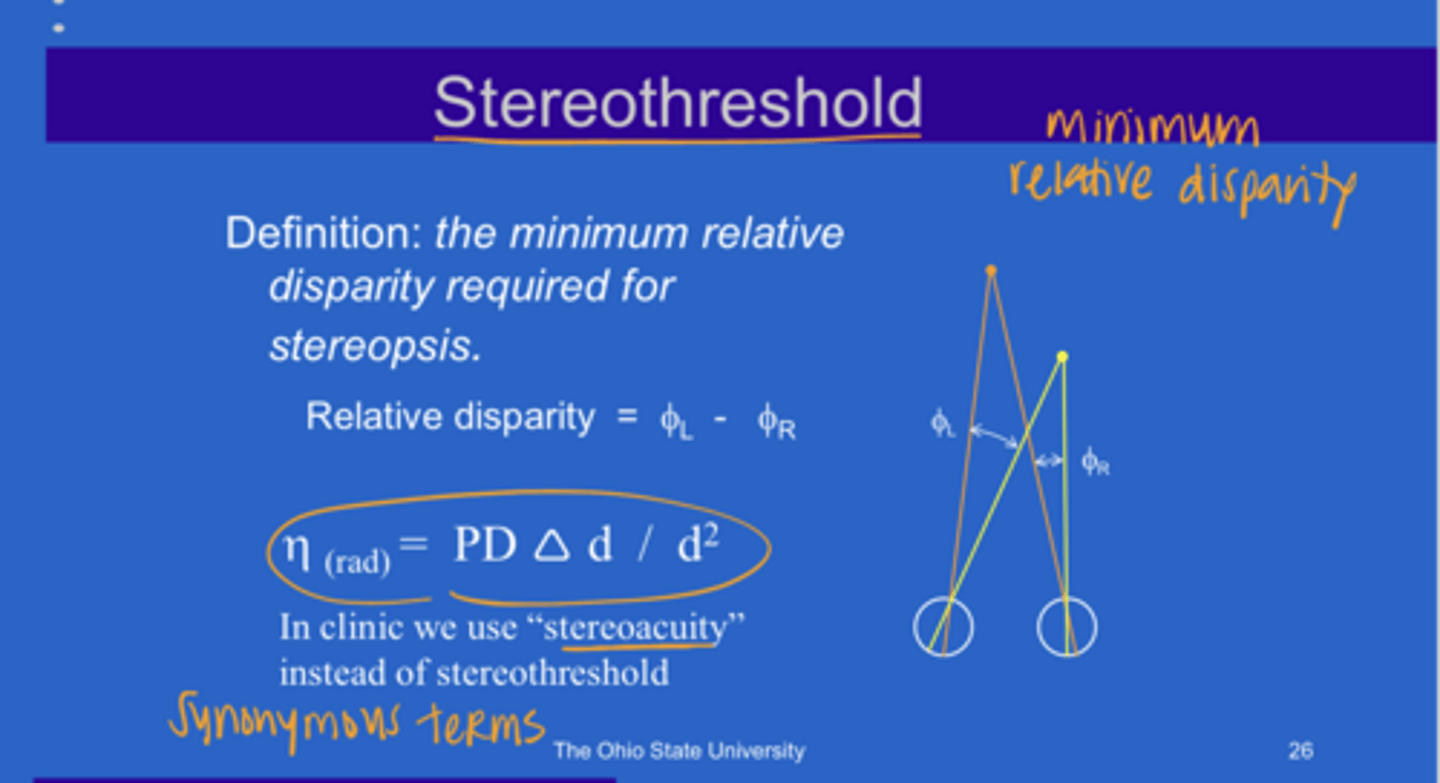
What is the definition of stereothreshold?
the minimum relative disparity required for stereoposis
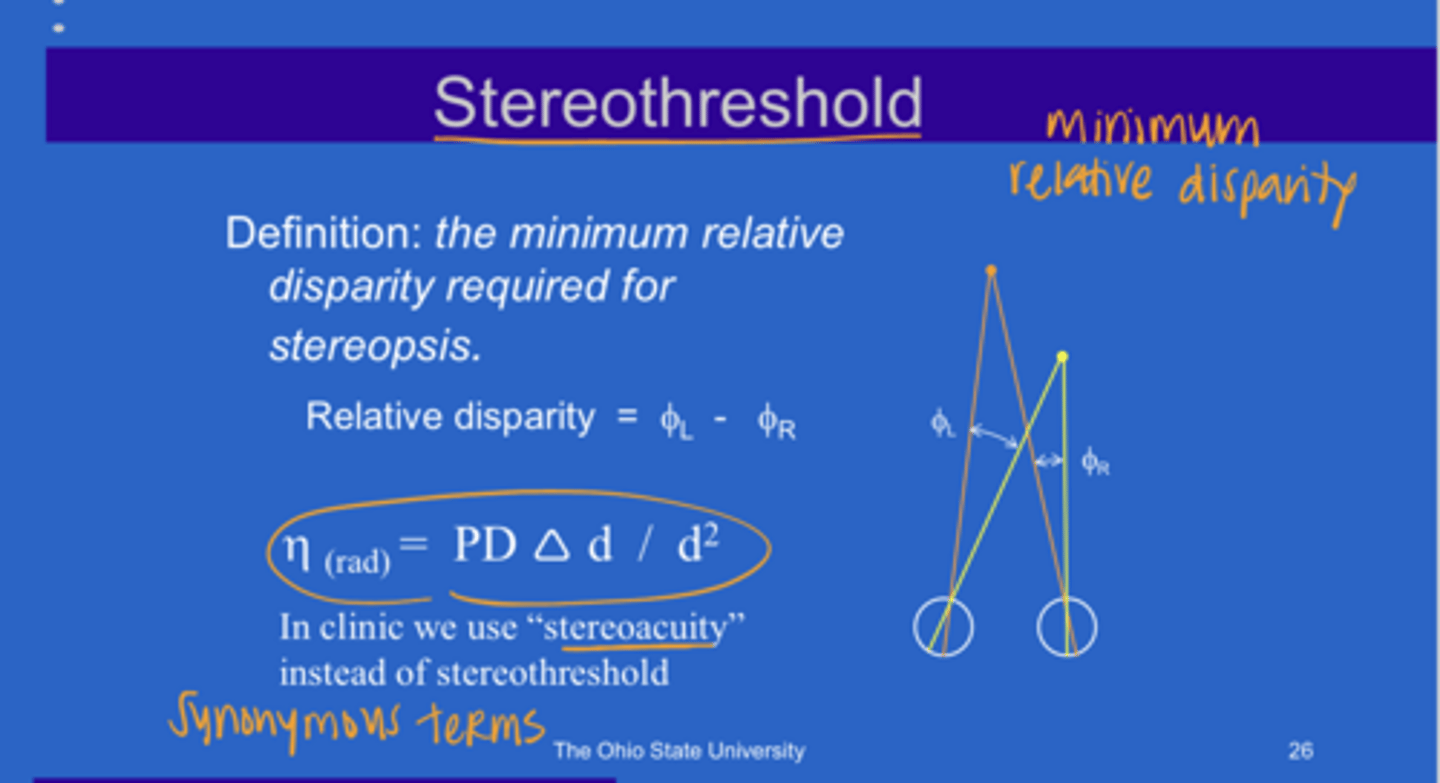
What is the equation for stereothreshold?
PD Δd / d^2
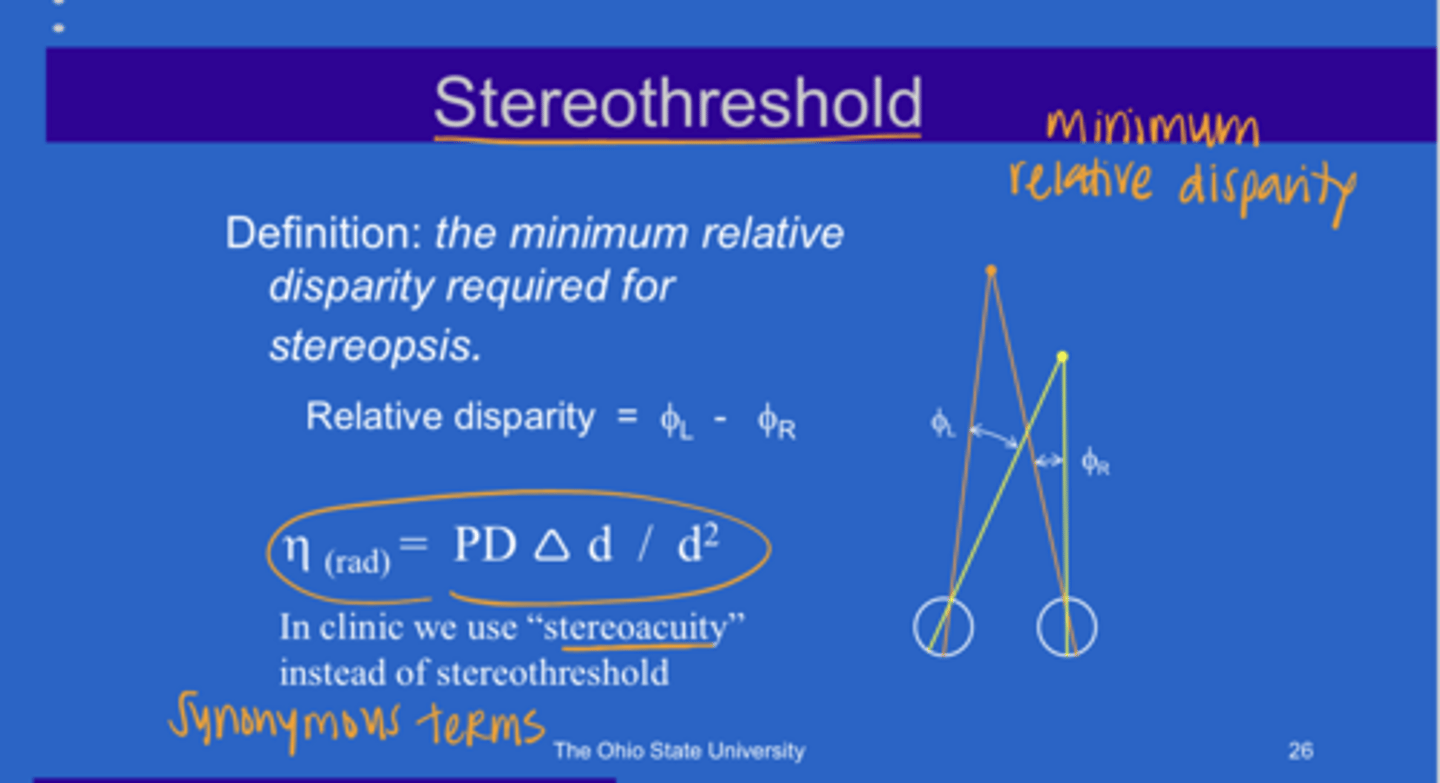
In clinic we use ______ instead of stereothreshold
stereoacuity
EXAMPLE RETINAL DISPARITY:
A car 6 m away is parked in front of a tree that is 7m away. What is the disparity of the tree relative to the car in seconds of arc? (PD = 6 cm)
-η = PD * Δd / d^2
-η = 0.06m (1m) / (7m)^2
-η = 0.00122 radians
-η = 0.00122 rad * 206,000
-η = 252"
-The tree has uncrossed disparity (negative) relative to the car and will be seen further away.
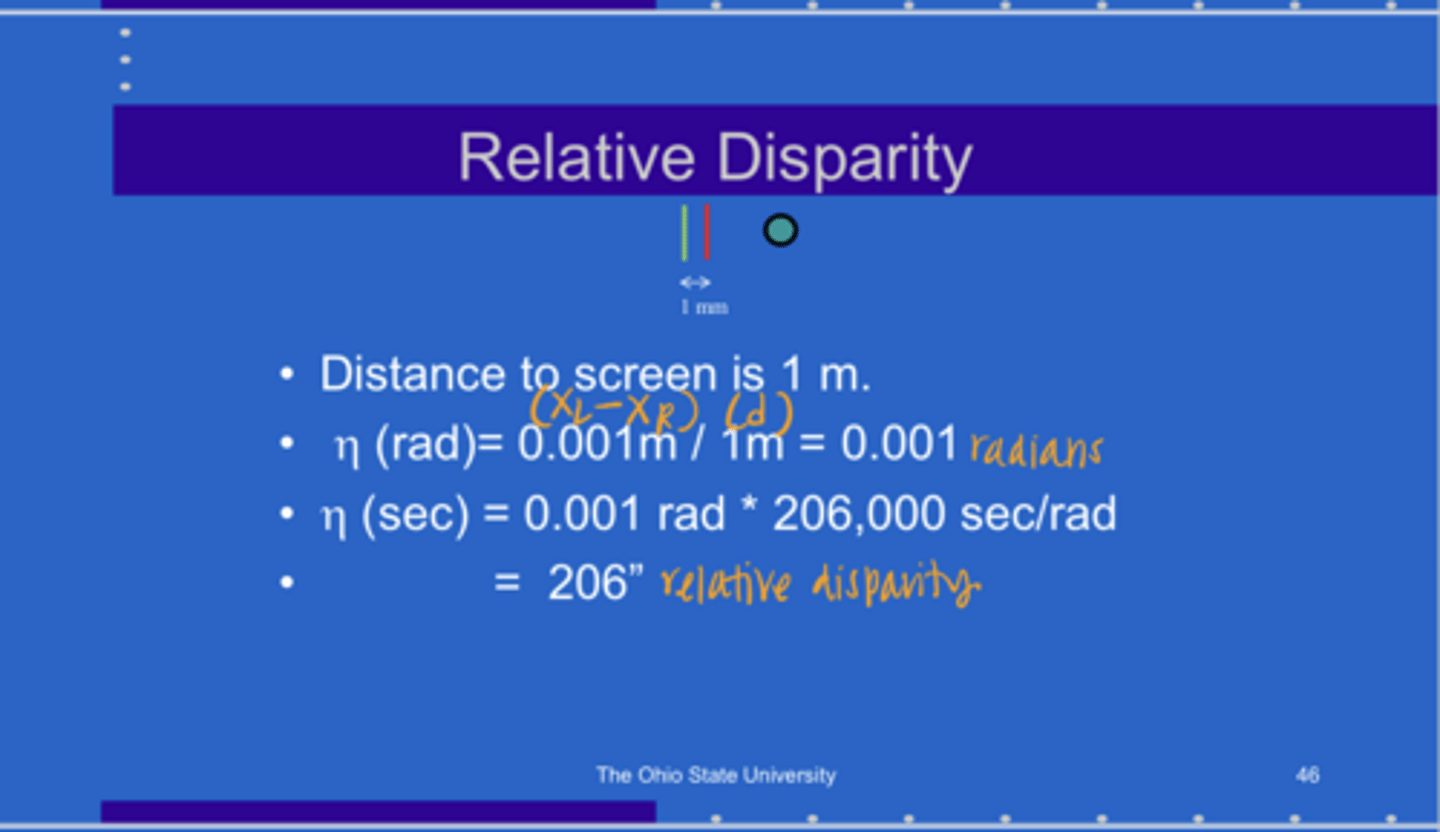
EXAMPLE RETINAL DISPARITY:
Circle and line targets are displayed on a synchronous shutter computer display at a distance of 1m. The right eyes image has a line 2mm to the left of the circle. The left eyes image has the line 3mm to the left of the circle. What is the disparity of the line relative to the circle?
-This is a dichoptic presentation
-η = (XL - XR) / d
-Distance to screen is 1m
-η = (0.001m) / 1m
-η = 0.001 radians
-η = 0.001 rad * 206,000
-η = 206"
-The image for the right eye is to the right = uncrossed disparity
-The line has uncrossed (negative) disparity relative to the circle
How are images presented to two eyes in clinic?
-dioptic
-dichoptic
What are the dioptic ways in which images are presented to the 2 eyes in clinic?
-standard VA charts
-near point cards
What are the dichoptic ways in which images are presented to the 2 eyes in clinic?
-stereoscopes
-anaglyph (R/G)
-polaroid
-alternating shutters
What is a stereoscope?
a device that presents different images to the 2 eyes with mirrors and lenses
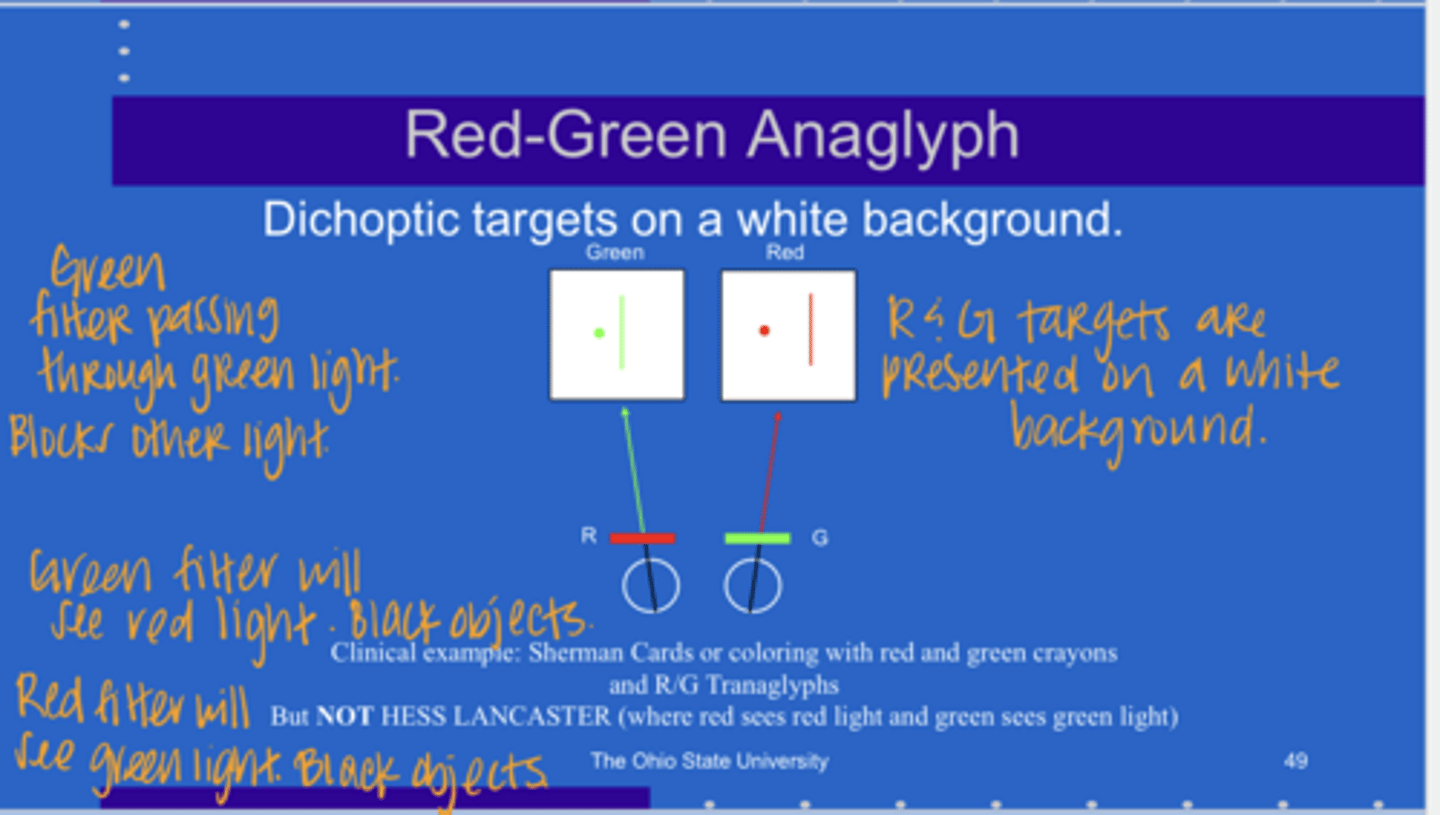
How a R/G Anaglyph Works
What is the stimulus that is presented?
dichoptic targets on a white background
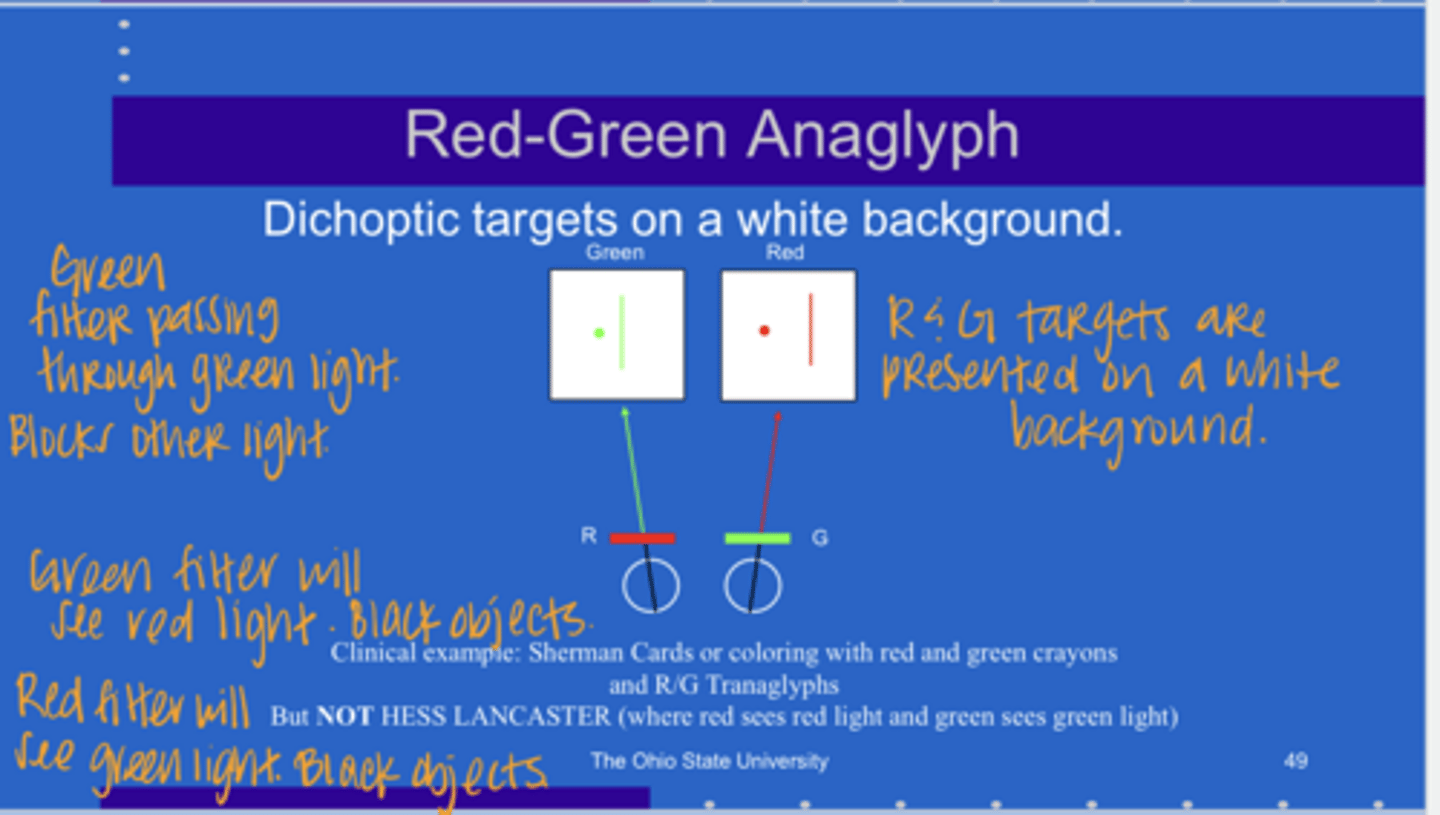
How a R/G Anaglyph Works
What eye will see the Red targets?
the eye that is covered by the green lens
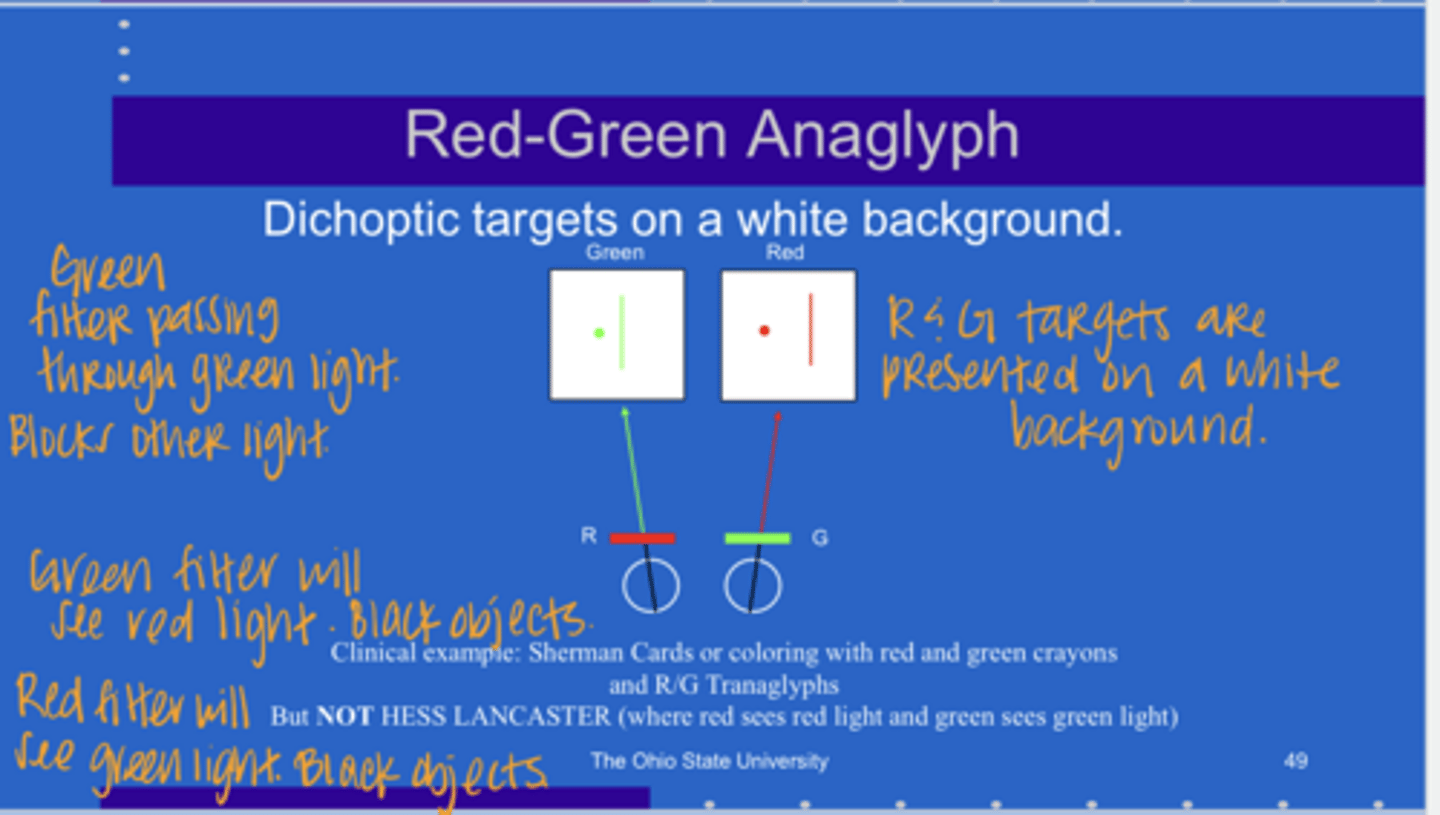
How a R/G Anaglyph Works
What eye will see the green targets?
the eye that is covered by the red lens
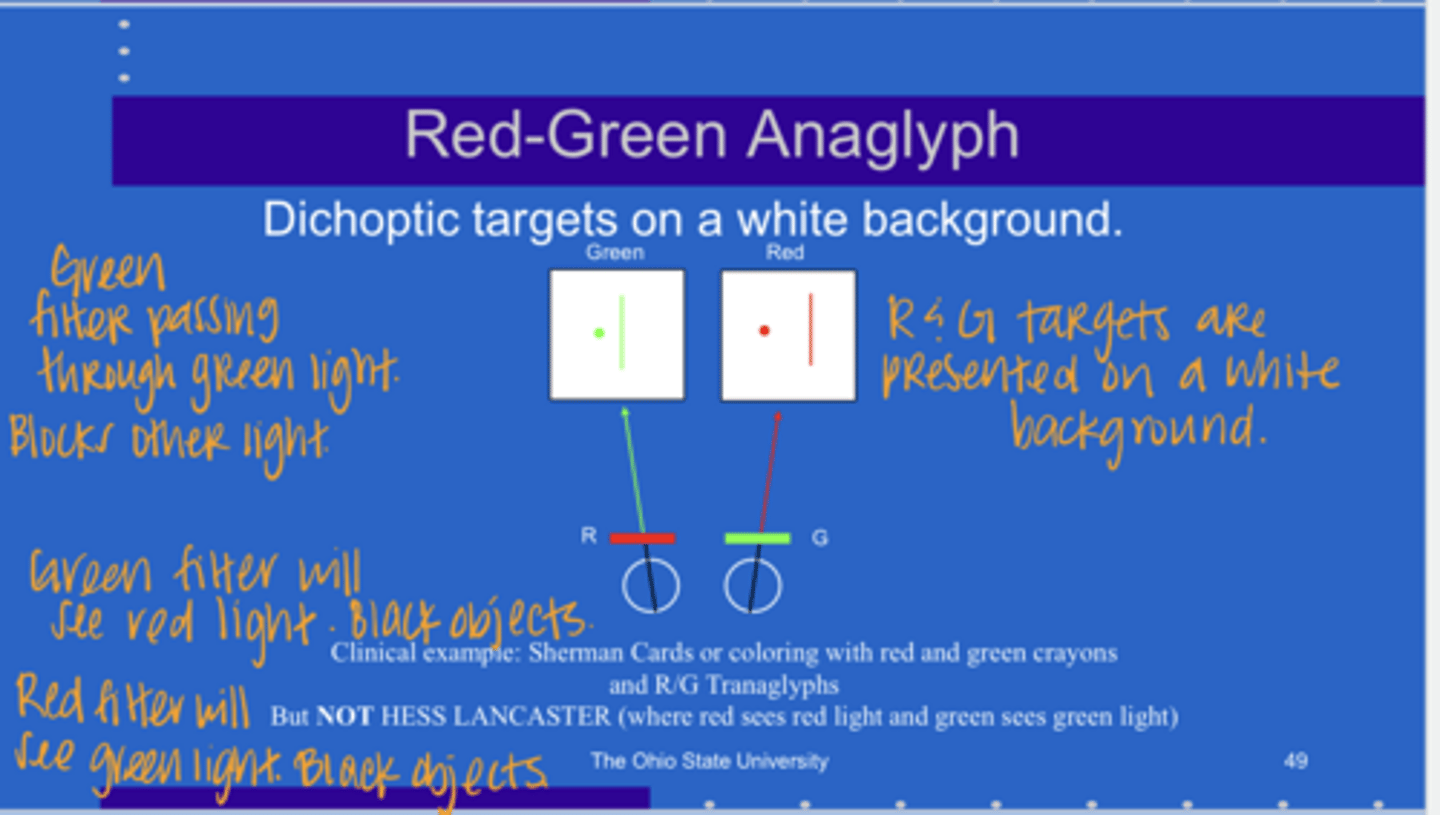
How a R/G Anaglyph Works
What is a clinical example of a R/G Anaglyph that presents R/G targets on a white background?
-Sherman Cards
-Coloring with R/G crayons
-R/G Tranaglyphs
What is Hess Lancaster Screen used for in clinic?
to subjectively determine deviation of the eyes in multiple positions of gaze
Set-Up of Hess Lancaster Screen
-White screen with patient wearing R/G glasses (red over right eye)
-Doctor shines red light in nine positions of gaze
-Patient overlays green light on top of the red light
In the Hess-Lancaster Screen, the right eye, with the red filter, will see the (Red/green) light
Red
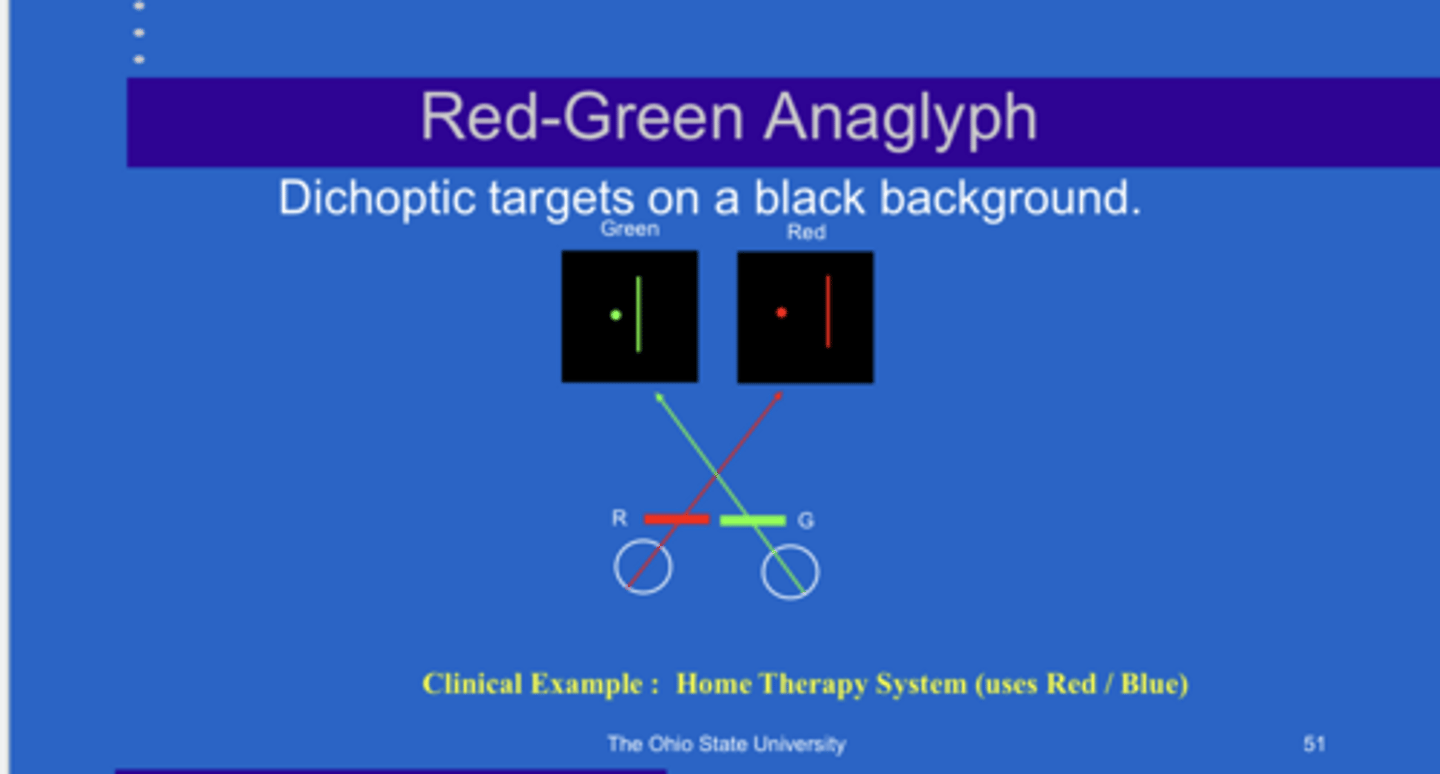
Can a R/G Anaglyph use a black background instead of white?
Yes
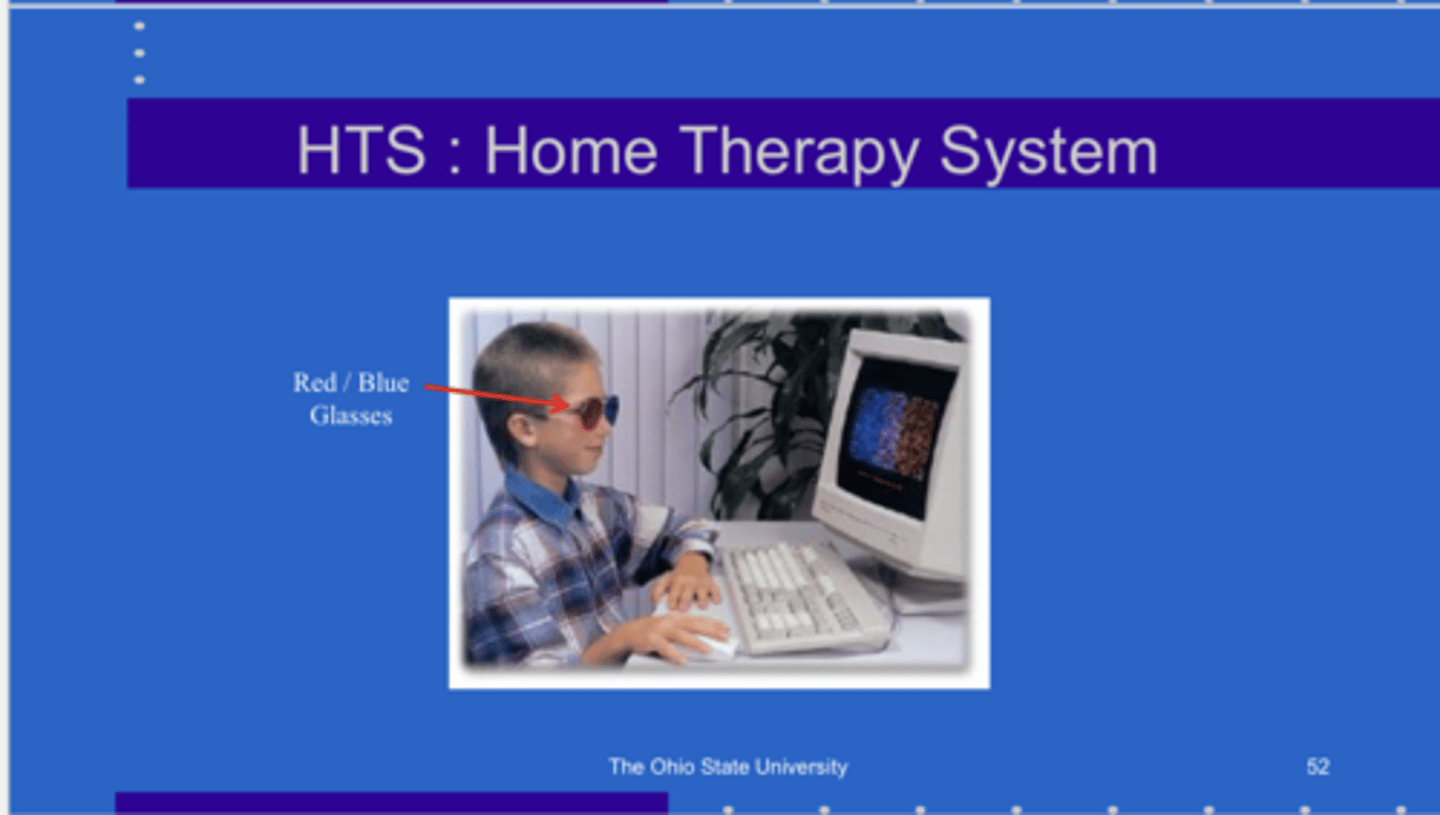
HTS: Home Therapy System (Pic)
HTS: Home Therapy System (Pic)
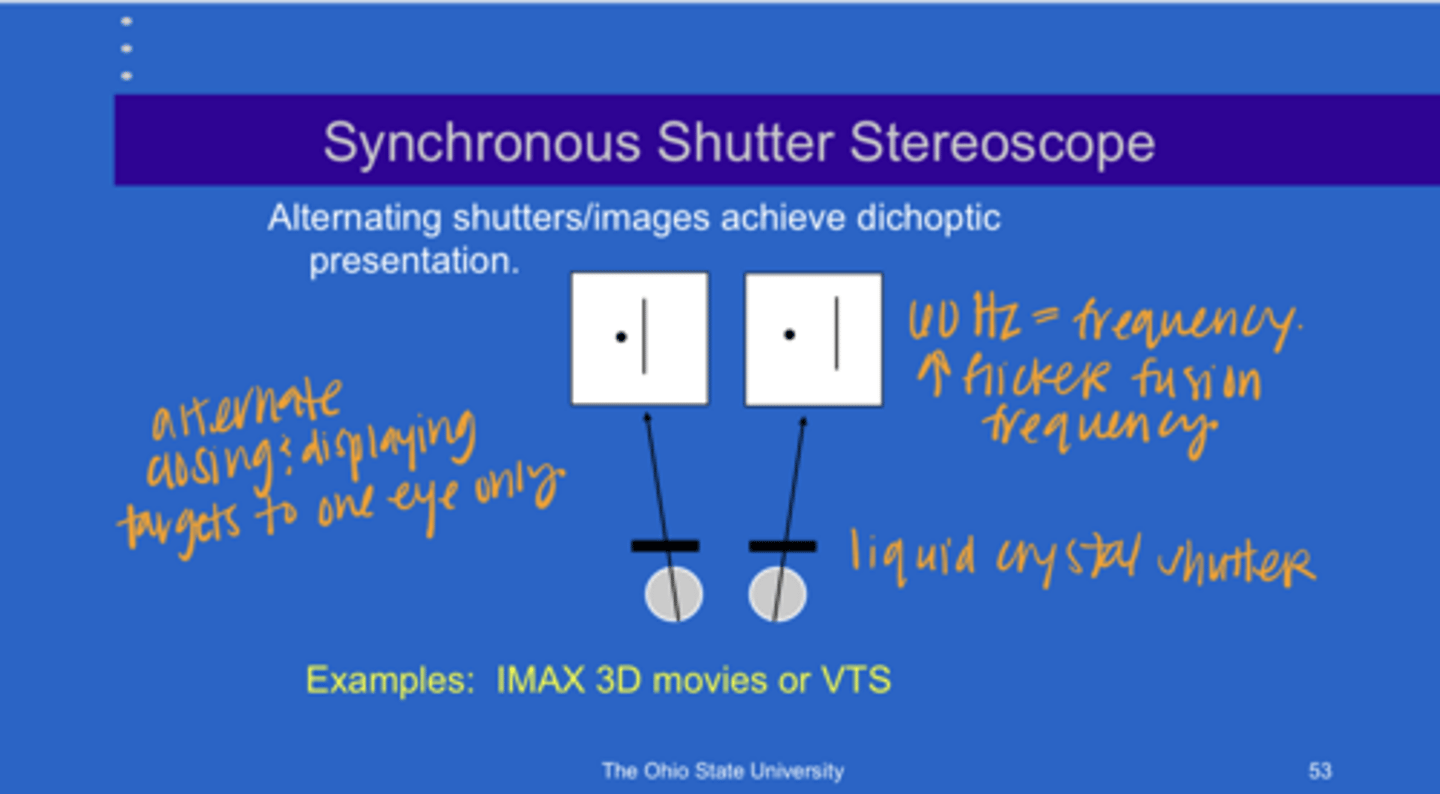
What is the function of a synchronous shutter stereoscope?
alternating shutters/images to achieve dichoptic presentation
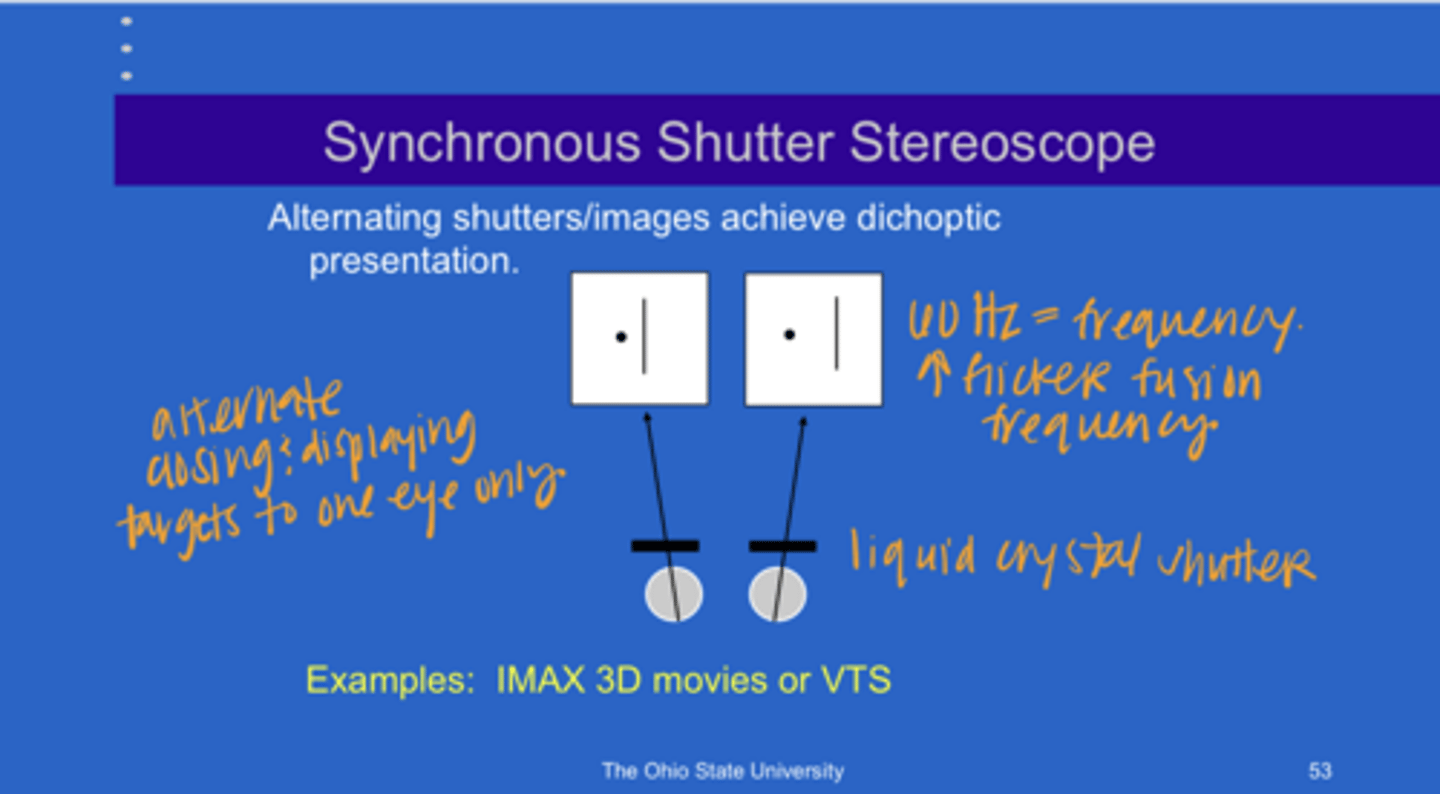
With a synchronous shutter stereoscope, how many eyes see an image at a time?
Only one eye sees an image at a time d/t the shutter function
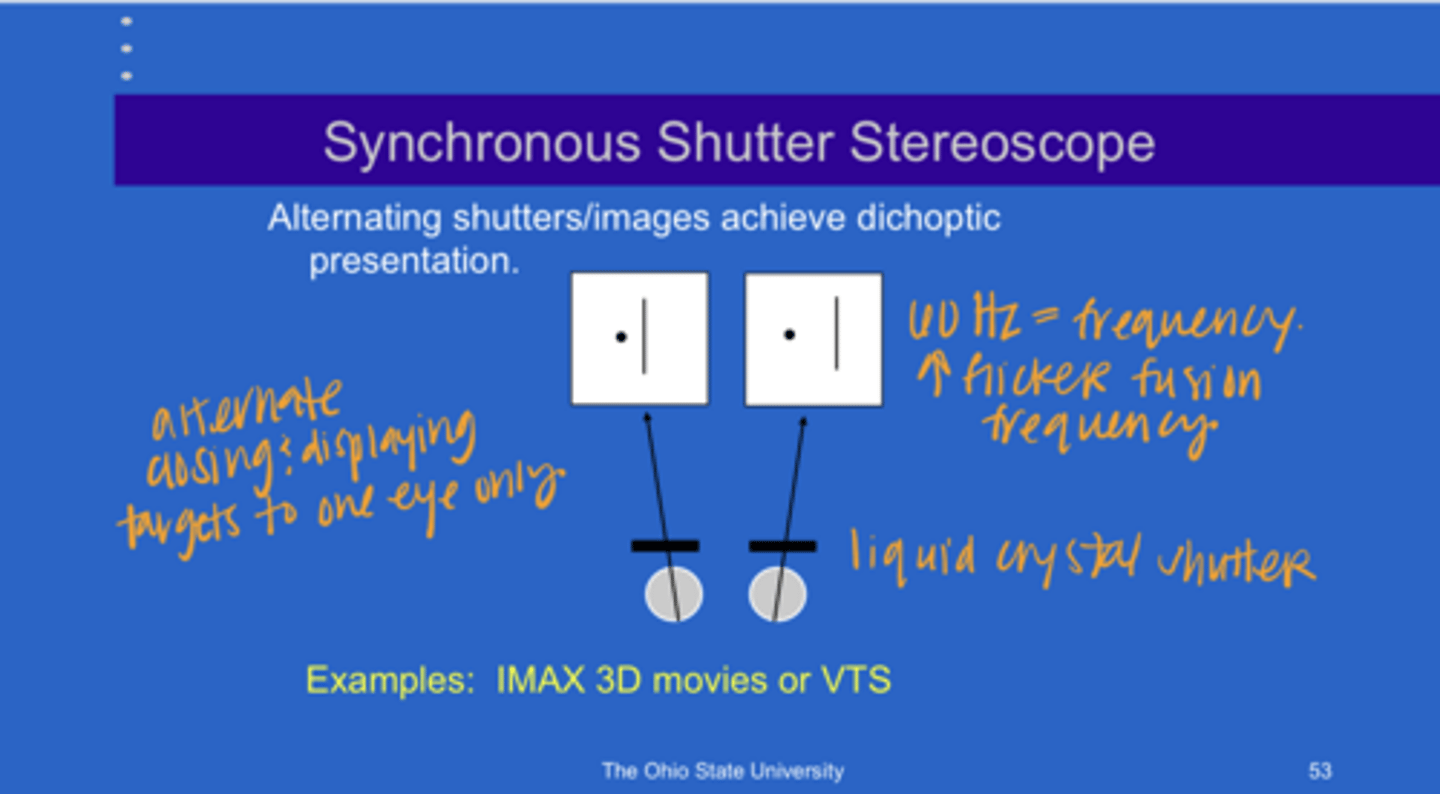
When are synchronous shutter stereoscopes used?
in IMAX 3D movies or in VTS therapy
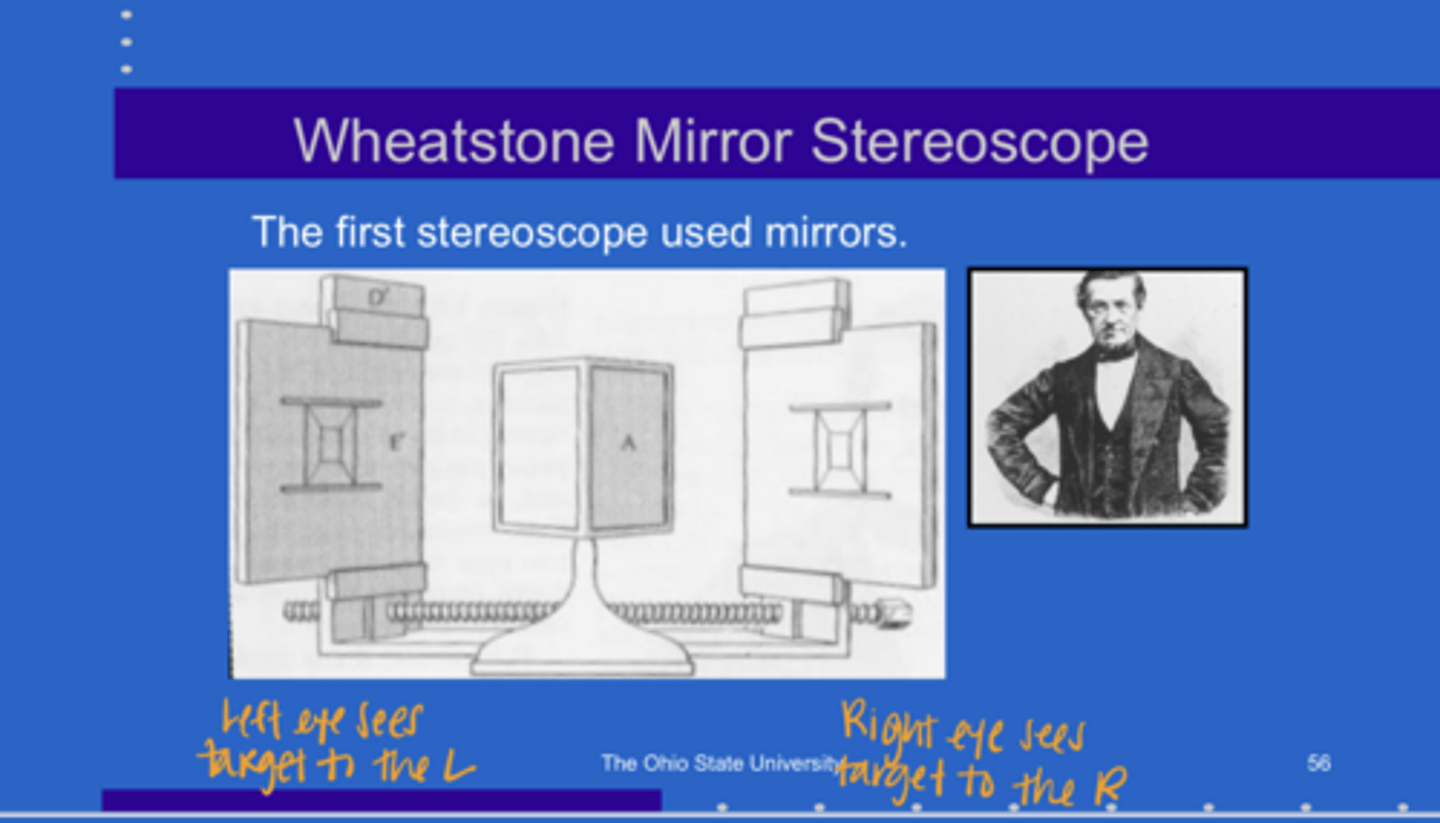
The first stereoscopes used ______
mirrors
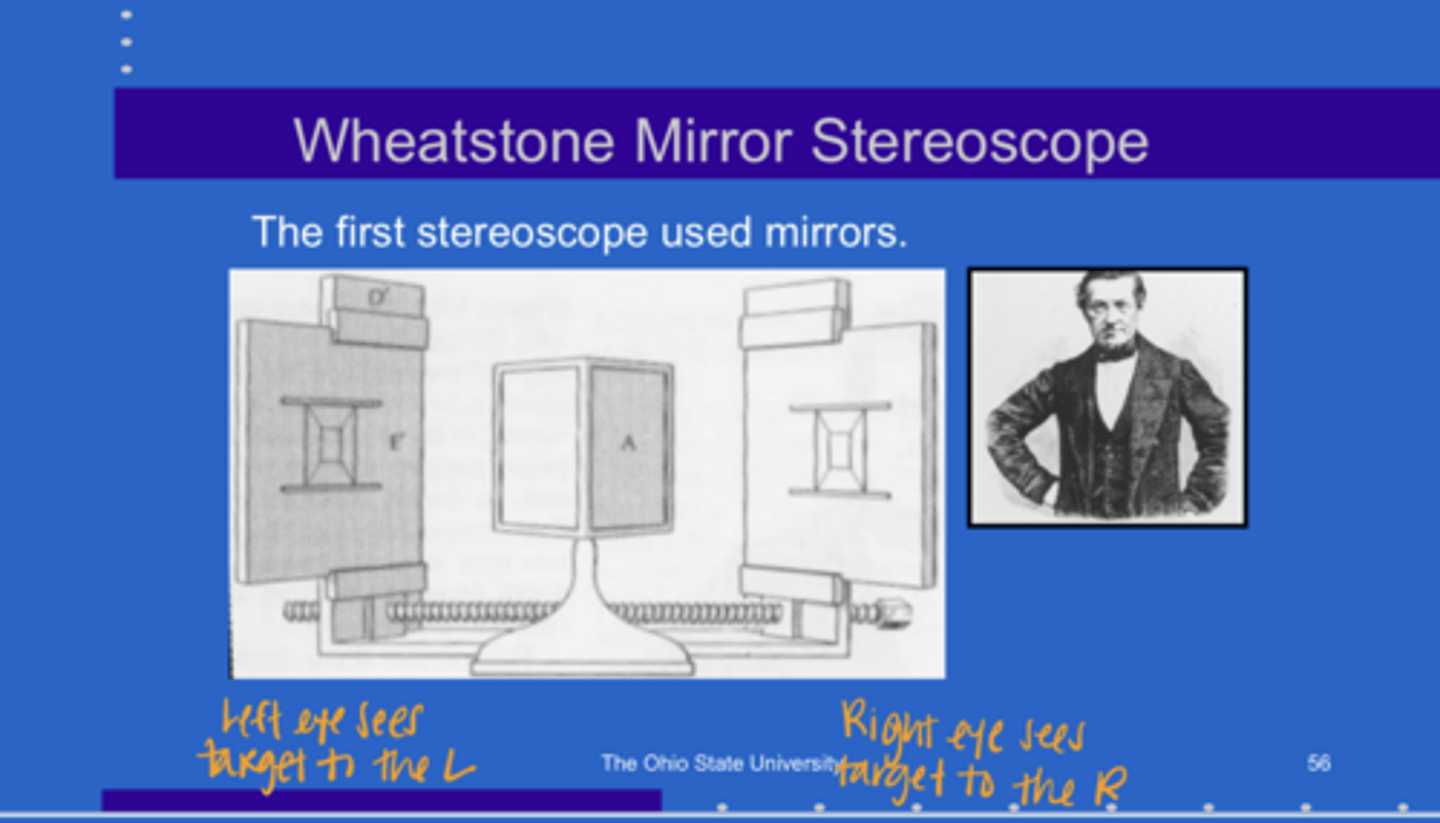
Wheatstone Mirror Stereoscopes (Pic)
Wheatstone Mirror Stereoscopes (Pic)
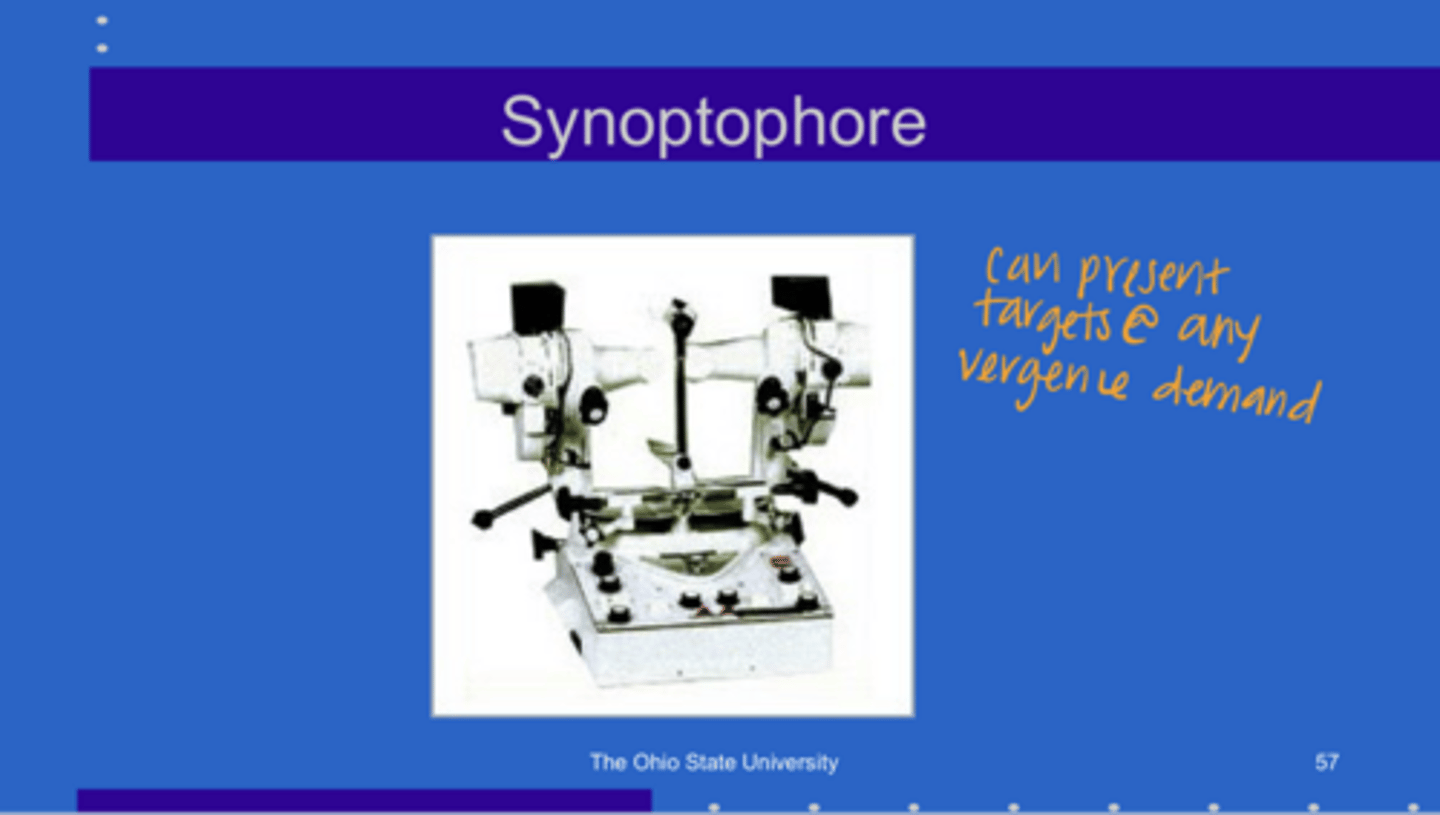
Synoptophore (Pic)
Synoptophore (Pic)
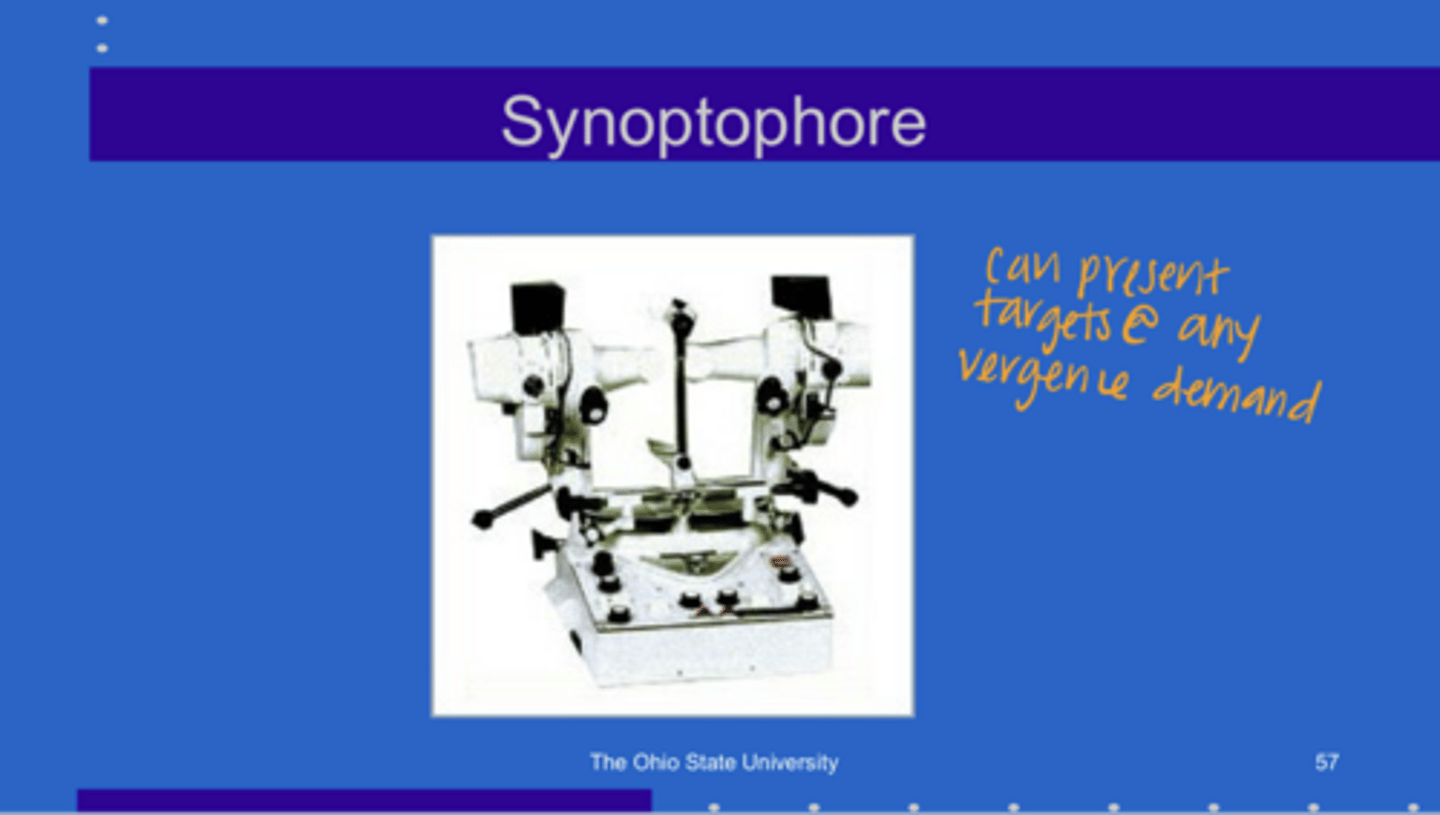
What is important about the Synoptophore?
can present targets at any vergence demand
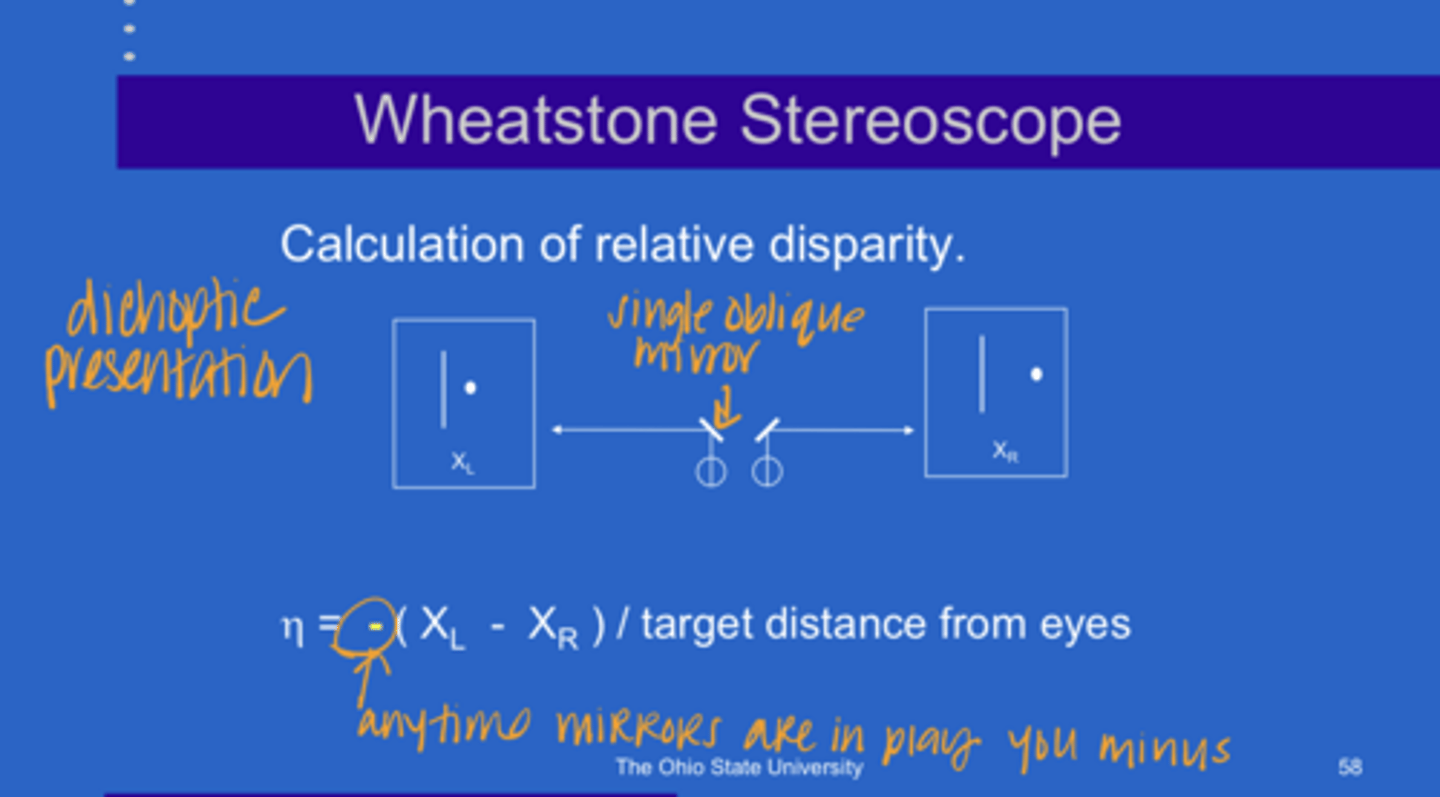
How are images presented in Wheatstone Mirror Stereoscope?
dichoptic presentation of images
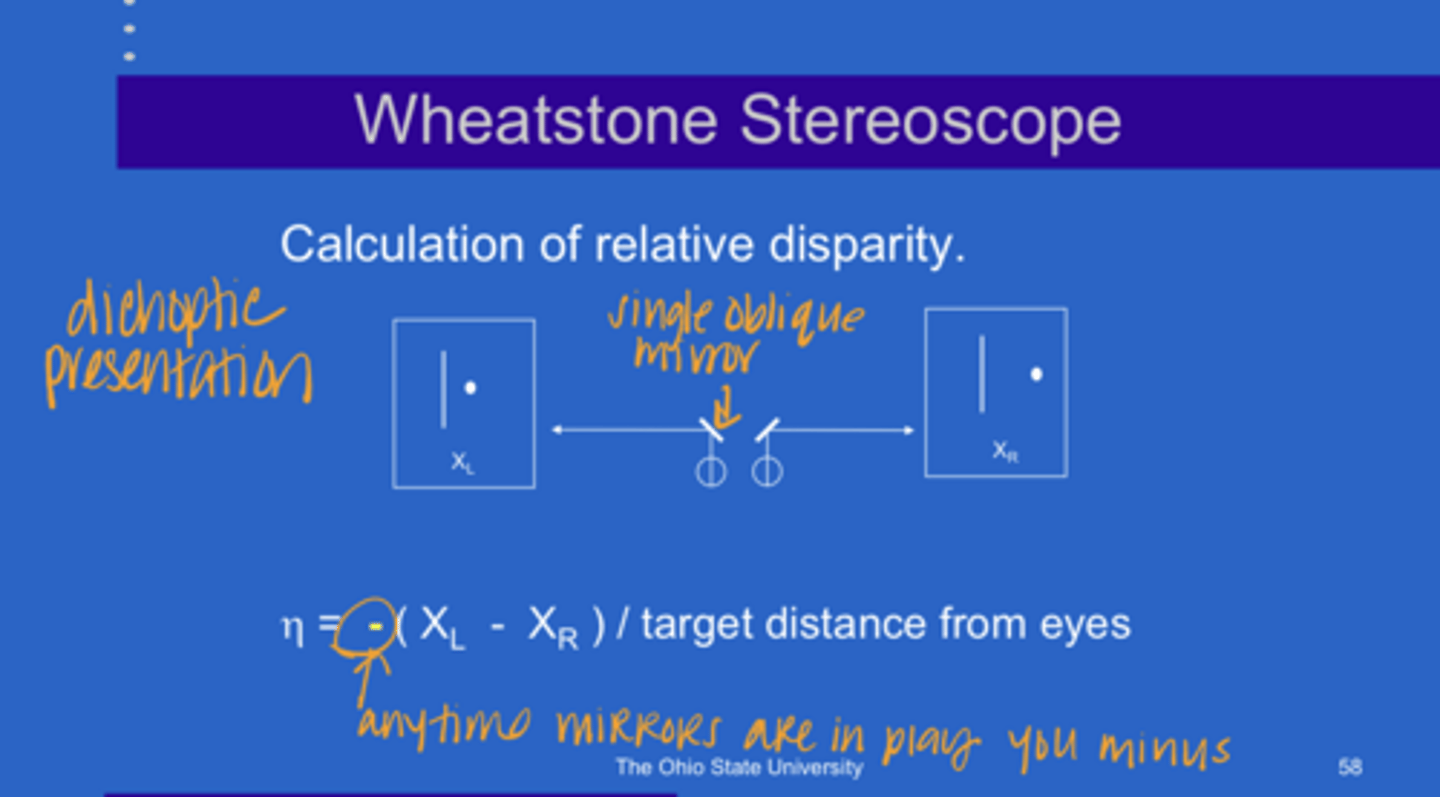
What is the equation used to calculate relative disparity in a Wheatstone Mirror Stereoscope?
η = - (XL - XR) / target distance from the eyes
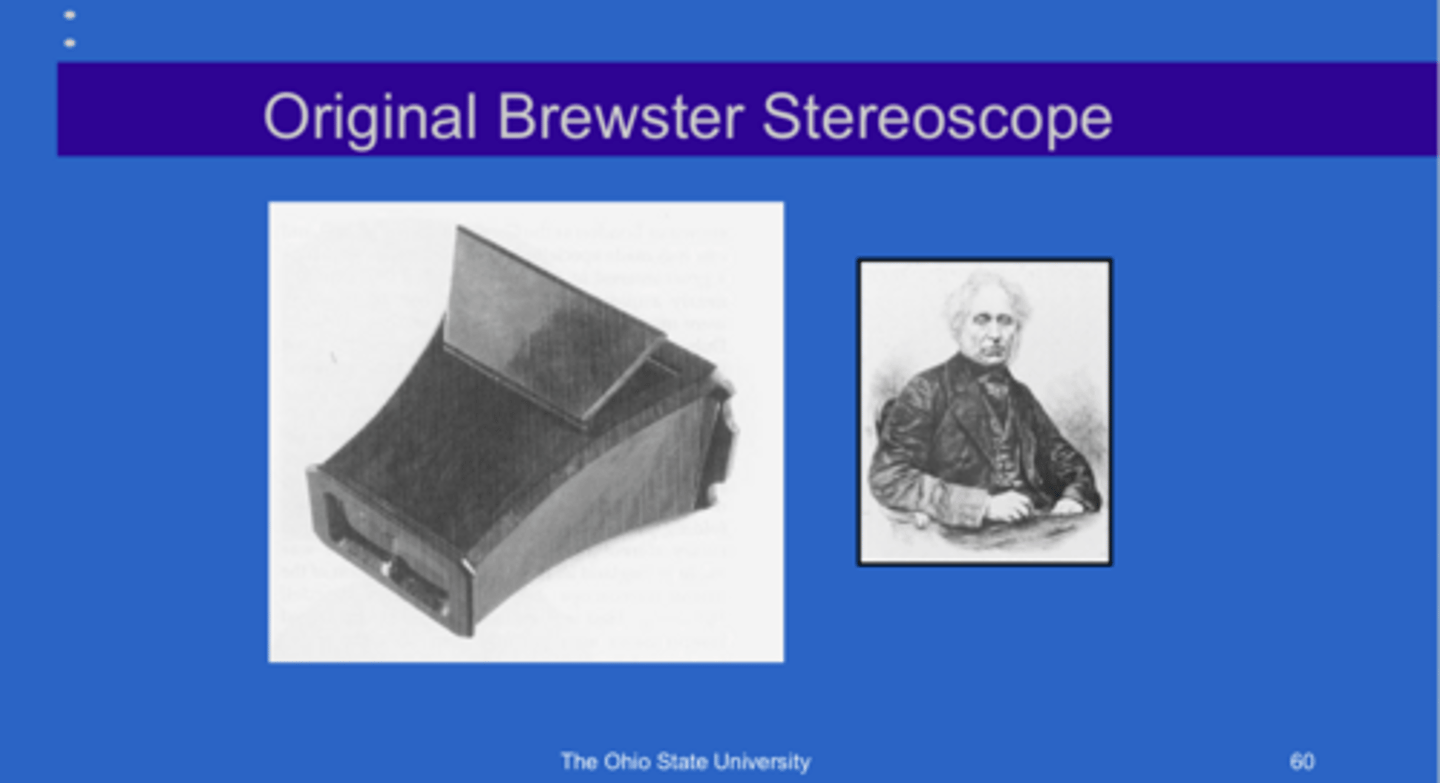
Original Brewster Stereoscope (Pic)
Original Brewster Stereoscope (Pic)

Common Brewster Stereoscope (Pic)
Common Brewster Stereoscope (Pic)
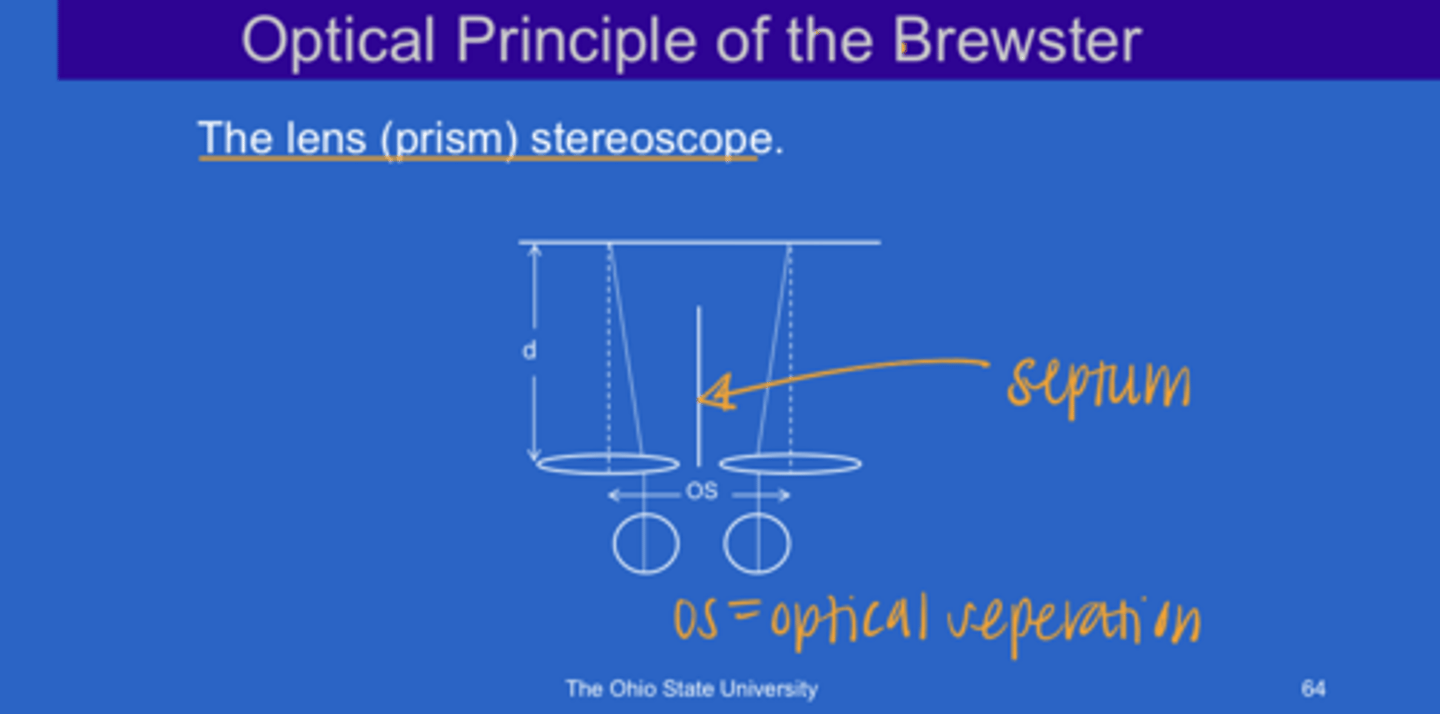
What is the optical principle of the Brewster Stereoscope?
the lens (prism) stereoscope (see pic)
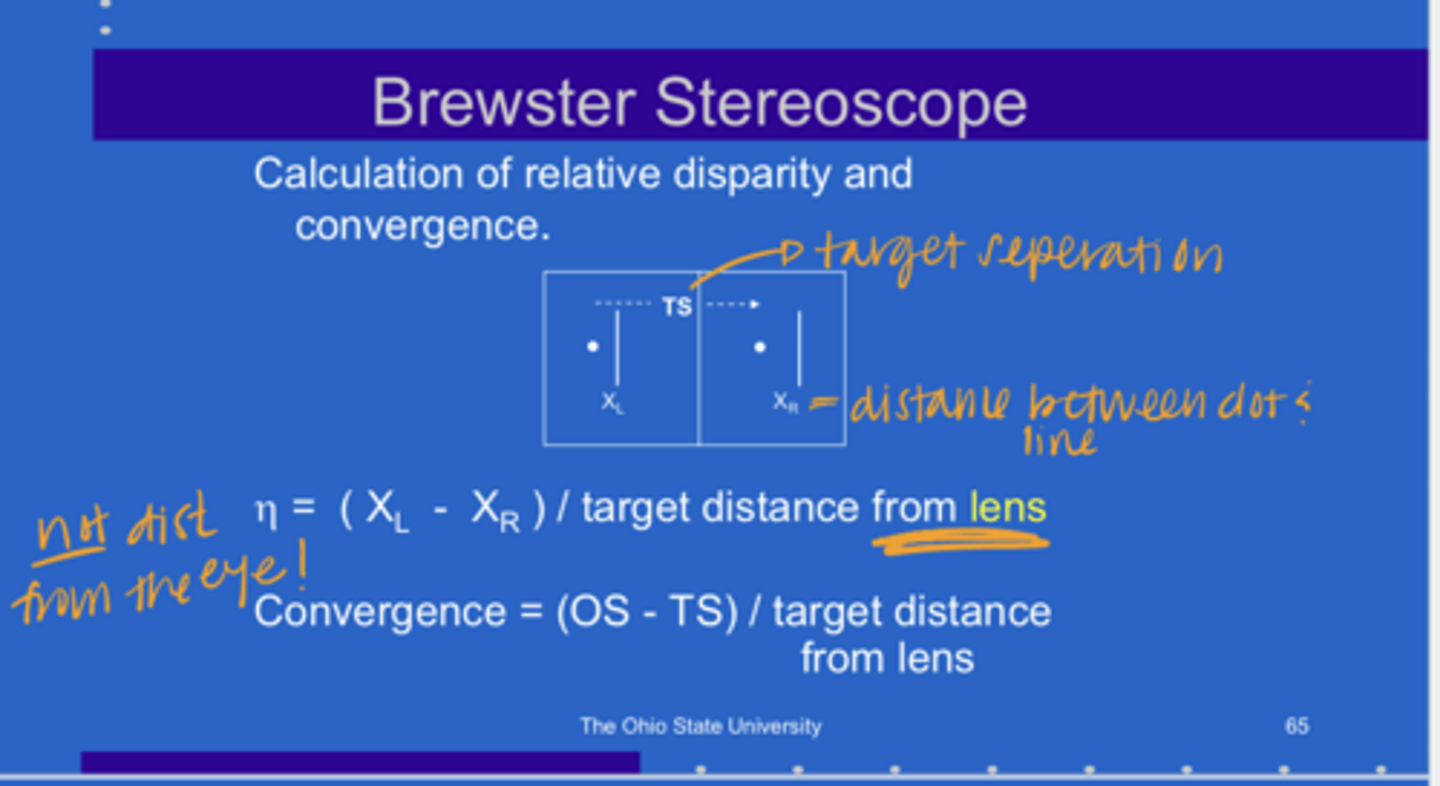
How to calculate relative disparity in Brewster Stereoscope?
η = (XL-XR) / target distance from the LENS
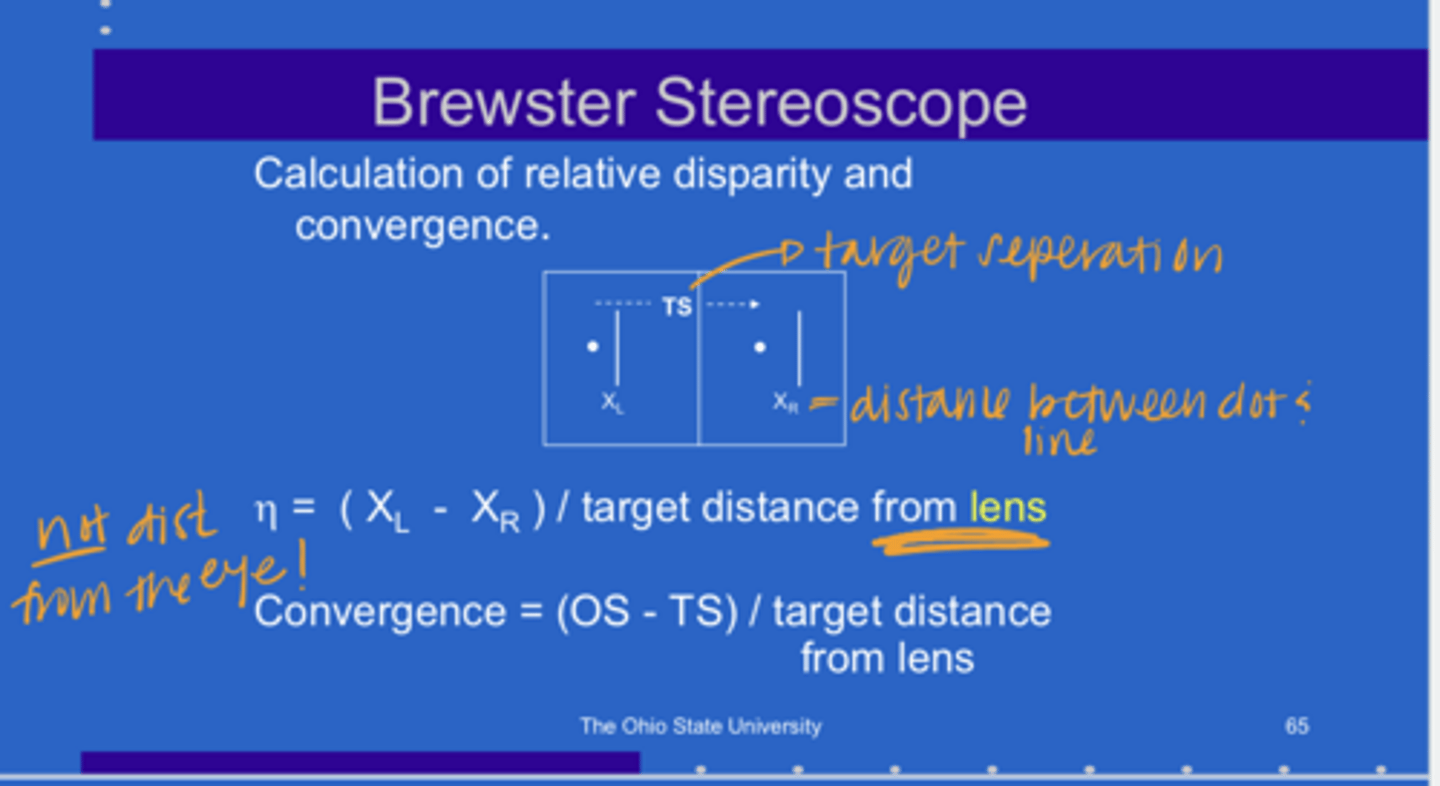
Does the Brewster Stereoscope measure from the eye for the d measurement (entire optical system)?
no
Is stereothreshold a particular value of relative disparity?
No
What is stereothreshold dependent on?
a number of stimulus characteristics
Stereothreshold under the best conditions is slightly (better/poorer) than Vernier acuity threshold
poorer
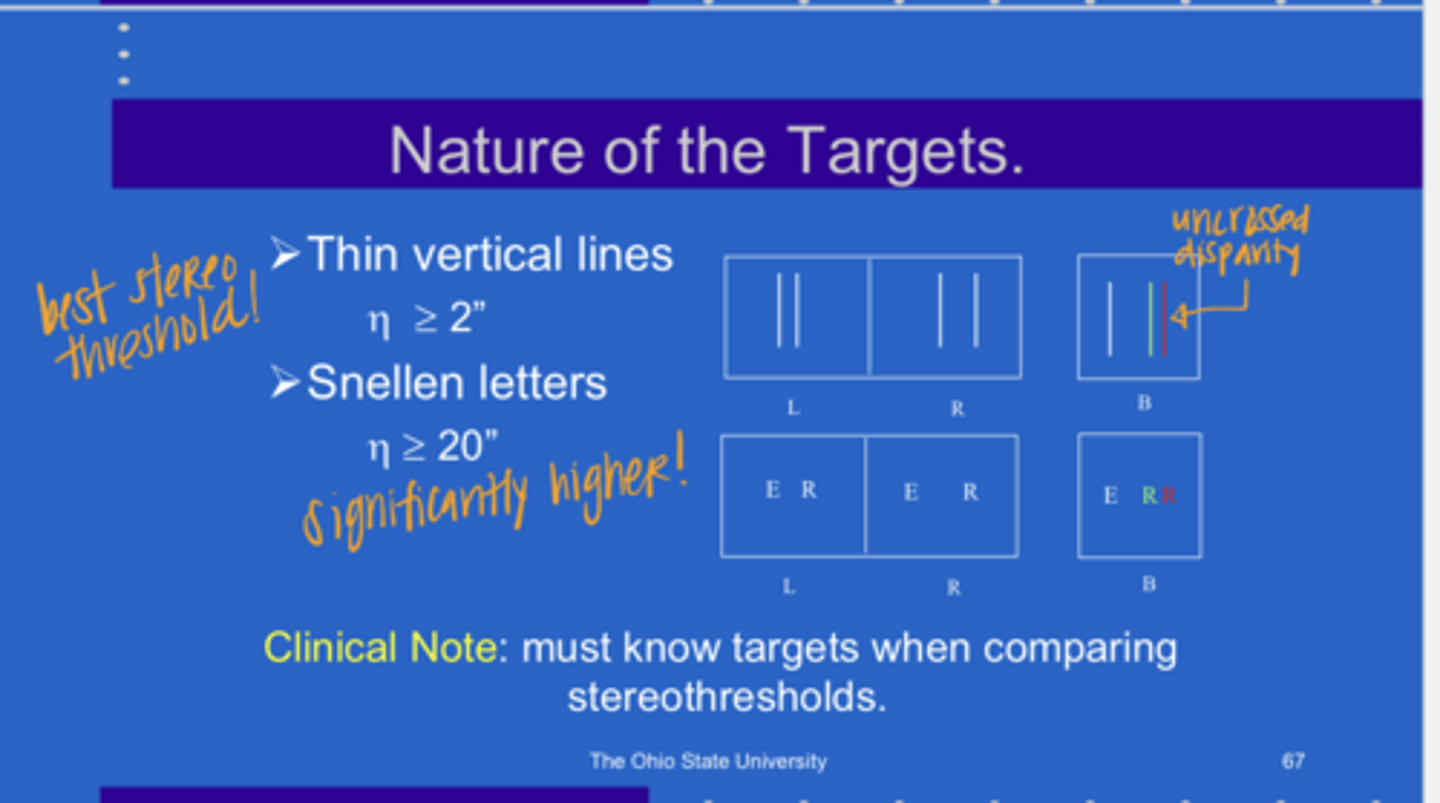
What is the threshold of Stereoacuity for thin vertical lines?
2"
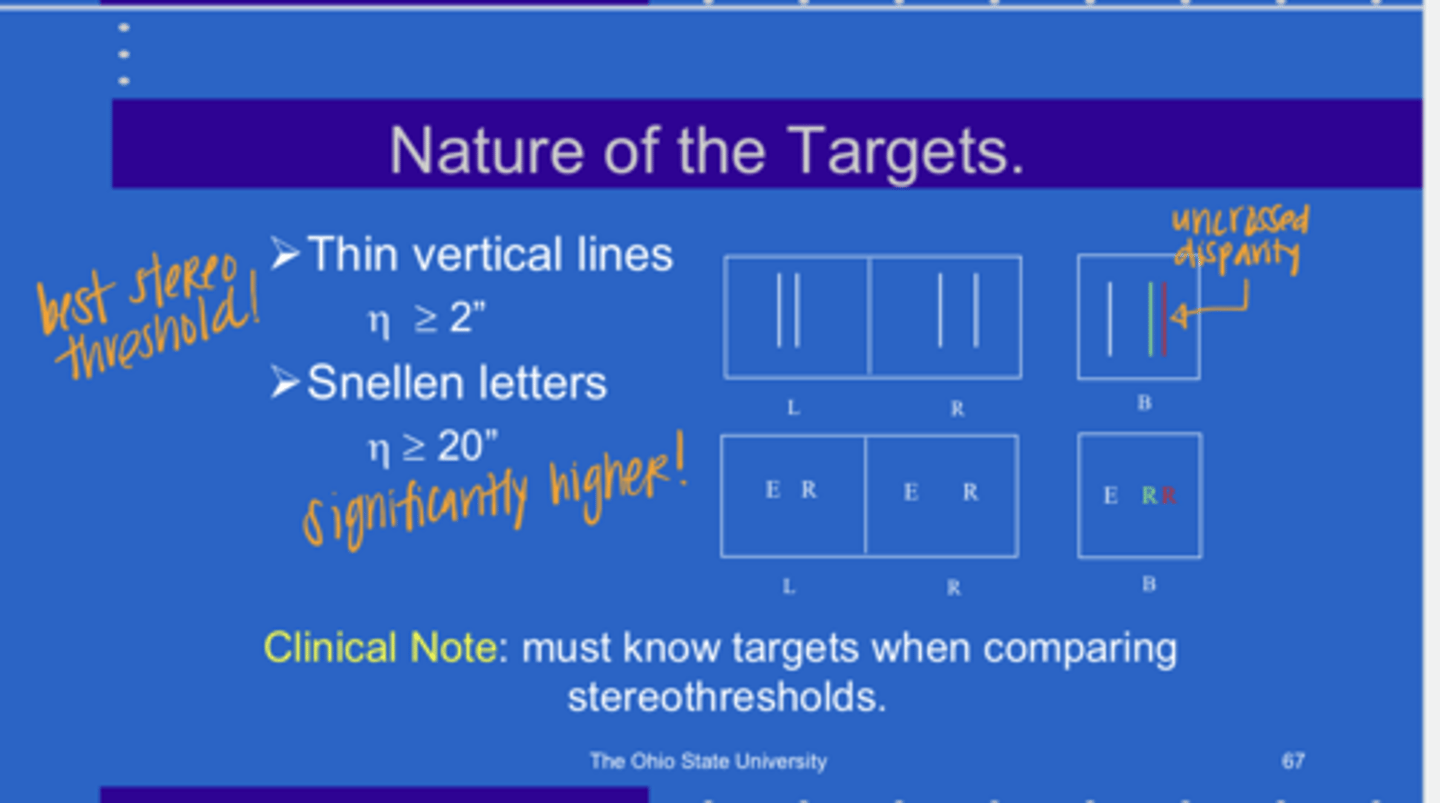
What is the threshold of Stereoacuity for Snellen letters?
20"
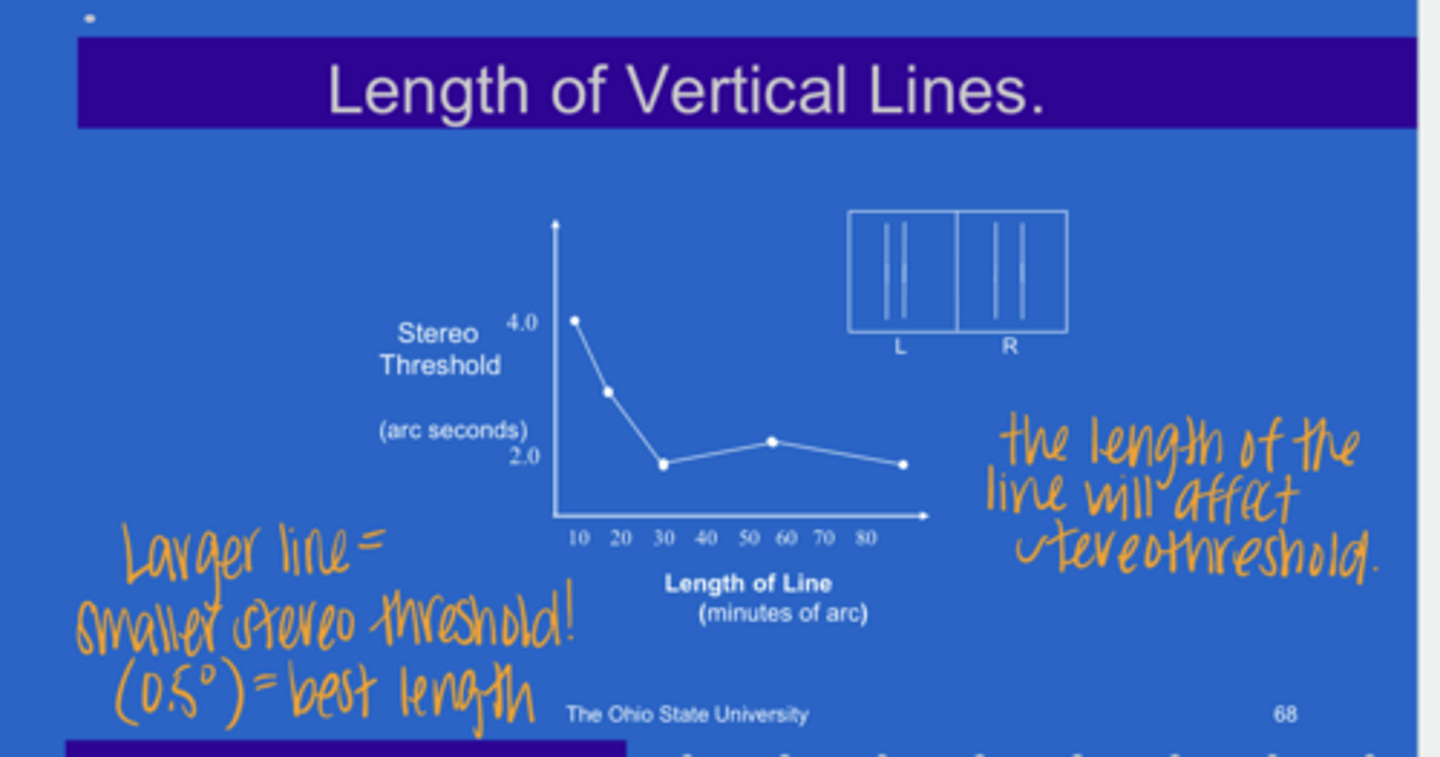
(Shorter/taller) vertical lines will result in better stereoacuity
taller
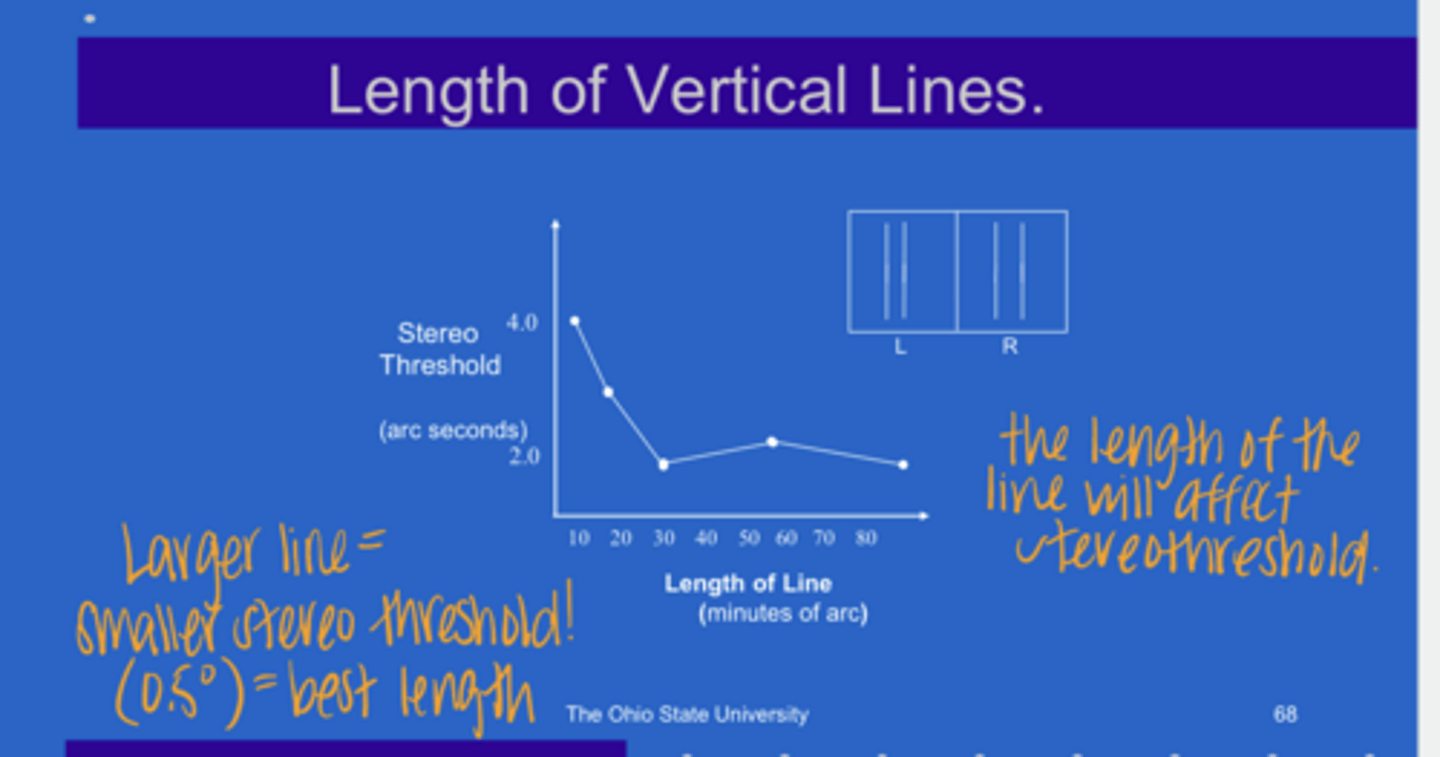
What length of vertical lines will result in the best stereoacuity?
>30 minutes of arc