(2) COGNITIVE PSYCHOLOGY
 Call Kai
 Learn
Learn Practice Test
 Spaced Repetition
 Match
Match Flashcards
 Knowt Play
1/69

Earn XP
Description and Tags
Chapter 2: Cognitive Neuroscience
Name | Mastery | Learn | Test | Matching | Spaced | Call with Kai | Chat |
|---|
No analytics yet
Send a link to your students to track their progress
70 Terms
Cognitive Neuroscience
Def. Studies how does Brain and Aspect of the nervous system connected or linked to the cognitive processing and Behavior.
Localization of Function
Refers to the specific areas of the brain that control specific skills or behaviors.
Facts about particular brain areas and their function are interspersed throughout this chapter and also throughout the whole book.
Nervous System
is the basis for our ability to perceive, adapt to, and interact with
the world around us
Basal Ganglia
Central for “Motor Function”
Part of the “Forebrain”
A Collection of Neurons
Parkinson’s Disease
What you can acquire if you have a deficit when it comes to basal ganglia?
Limbic System
Learning, Emotion, and Memory.
Central for "“Emotion”.
Instinct and survivability
Limbic System
Part of the the forebrain that is for “Suppressing Instinctive Response” (e.g., the impulse to strike someone who accidentally causes us pain).
Septum
Part of the forebrain that Involves in anger and fear
Amygdala
Important also in emotional regulation, particularly anger and aggression.
Enhances the perception of emotional stimuli
Hippocampus
Part of the forebrain
Memory Formation
Greek work “Sea Horse” Because of its shape.
Flexible in learning and spatial memory
Hippocampus
A damage to this part of the brain is that you can still have the memory of your old friends but you cannot form new memories.
Korsakoff Syndrome
A disease that produces loss of memory function.
It is believed caused by hippocampus deterioration and lack of (B1) Thiamine
And can caused by excessive alcohol use, dietary deficiency, and eating disorder.
Korsakoff Syndrome
symptoms include apathy, paralysis of muscles controlling the eye, and Tremors
Apathy - not caring about the others (feeling nothing)
Tremor - uncontrolled shaking
Declarative Memory
What type of memory does deterioration in hippocampus directly targetted?
Remember that deterioration to Hippocampus does not target the procedural memory
Thalamus
Part of the forebrain
relays incoming sensory information through groups of neurons
that project to the appropriate region in the cortex.
Thalamus
Part of the forebrain that is for sorting information, the arrangement of informations needed a division of smaller number of nuclei (groups of neurons of similar function). Each nucleus receives information from specific senses.
Thalamus
When the ____ malfunctions, the result can be pain, tremor, amnesia, impairment of language, and disruptions in waking and sleeping
Thalamus
There is a changes in this brain in connection to schizophrenia, why there is a hallucinations and delusions. What part of the brain is this (Hint: Part of the Forebrain)
Hypothalamus
regulates behavior related to species survival: fighting, feeding, fleeing, and mating. (F3 M)
also helps regulate emotions and react to stress
Narcolepsy
Hypothalamus is reall important when it comes to sleep so the dysfunction of the hypothalamus can result in what disorder?
Hypothalamus
Part of the brain that is also important for stimulating the “Pituitary Glands” and “Endocrine System" (for producing hormones)
Hypothalamus
Cerebral Cortex
Basal Ganglia
Thalamus
Hypothalamus
Amygdala
Septum
Parts of the Forebrain
Superior Colliculi
Inferior Colliculi
Reticular Activating System (RAS)
Gray Matter
Red Nucleus
Substantia Nigra
Ventral Region
Parts of the Midbrain
Cerebellum
Pons
Medulla Oblongata
Parts of the Hind Brain (CPM)
Reticular Activating System
Part of the Midbrain
is a network of neurons essential to regulating consciousness, including sleep; wakefulness; arousal; attention to some extent; and vital functions, such as heartbeat and breathing (Sarter, Bruno, & Berntson, 2003).
Brain Stem
Part of the Hindbrain
Connects forebrain to the spinal cord
Medulla Oblongata
Part of the Hindbrain
controls heart activity and largely controls breathing, swallowing, and digestion.
Controls “Involuntary”
Pons
Part of the hindbrain
contains neural fibers that pass signals from one part of the brain to
another.
Its name derives from the Latin for “bridge,” as it serves a bridging function.
Cerebellum
(from Latin, “little brain”) controls bodily coordination, balance, and muscle tone, as well as some aspects of memory involving procedure-related movements
Parkinson’s Disease
Damage to hindbrain “cerebellum” can create what disease?
Cerebral Cortex
Part of the Forebrain
plays an extremely important role in human cognition. It enables
us to think.
Amygdala
Part of the Forebrain
Definition: enhances emotional stimuli — on how we react externally and internally to our environment.
Thalamus and Reticular Activating System (RAS)
These part of the brain is very essential to our consciousness and awakefulness for our very existence.
Brain Stem
Connects forebrain to the spinal cord
Medulla Oblongata
It controls primarily the Heart beat and Breathing
Swallowing and Digestion
Medulla Oblongata
This part of the brain is also contains RAS what makes up alive.
What makes the right nerves to cross over to the left brain and left brain to the right nerve
Part of the Hind brain
Sulcus
Fissures
Gyrus
3 parts of the cerebral cortex that is in the surface determined as wrinkles and about 1 to 3 millimeter layers
Gray Matter
White matter
The exterior part of the cerebral cortex is known as?
And the Interior part is known as?
Corpus Callosum
This part of the brain where it serve as the connections of hemispheres of the cerebral cortex (Right and left hemis)
Definition: Band of Neural Fibers — if this part is cut the two hemispheres cannot communicate with each others.
Broca’s Area
What area did Paul Broca identified that the damage of the left hemisphere resulted in a Aphasia (loss of speech) — what part of the left hemisphere did Paul mean?
Marc Dax
Who treated 40 patients suffering from Aphasia (loss of speech) ?
Paul Broca
Who is the french scientist who find out that the speech loss or aphasia is particularly on the left hemisphere of the brain and directly on the Broca’s Area?
Carl Wernicke
He is a neurologist who study language deficient patient who can speak but does not have any sense, and trace it back to the left hemisphere.
Broca’s Area
Part of the left hemisphere that contributes to speech
Wernicke’s Area
Part of the left hemisphere that contributes to Language Comprehension
Karl Spencer Lashley
He is the father of neuropsychology and studies Built Electrodes
Split Brain Patients
Severing corpus callosum
Right Hemisphere
What hemisphere is for manipulating Spatial Visualization?
Apraxia
Since the left hemisphere is also for movement, if damage it can cause disorder of skill movement.
such as inability to form letters handwriting
Left Hemisphere
What hemisphere is for examining past experiences to find patterns.
Right Hemisphere
This hemisphere is largely mute
Little understanding of Grammatical and Phonetic
It has a Good Semantic Knowledge
Spatial Visual Ability
Semantic Knowledge
Practical Language
Self Recognition
What are the abilities of Right Hemisphere?
Cannot follow conversation
Make Inferences from context
Lack of understanding of Metaphorical and Humorous Speech.
What are the deficiencies of Right Hemisphere?
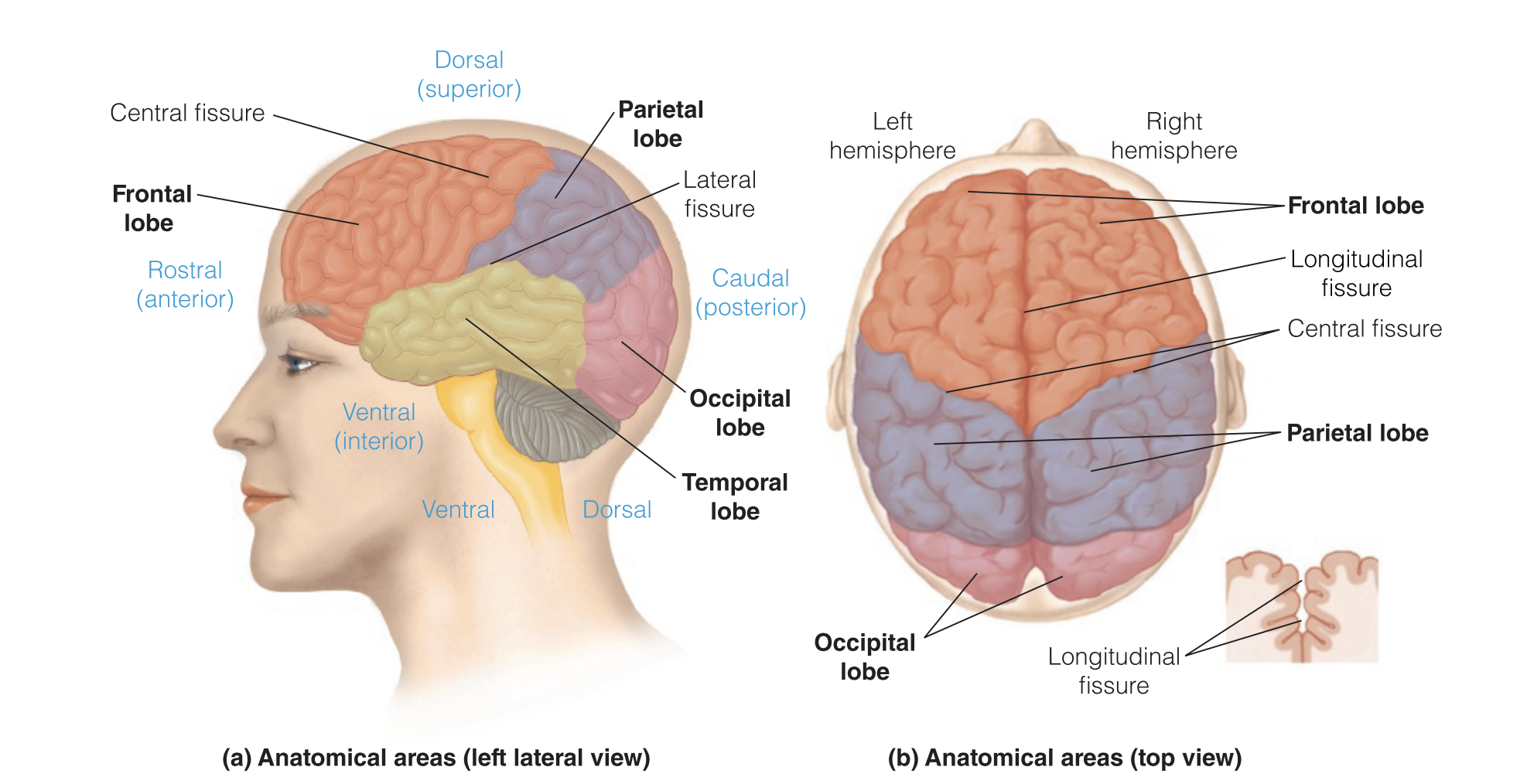
Frontal Lobe
Lobe of the brain that is for for Motor Processing and High Though Processing such as:
Abstract Reasoning
Problem solving
Planning
Judgement
Prefrontal Cortex
Part of the Frontal Lobe that is for complex motor control and tasks and require integration of information over time.
Primary Motor Cortex
The frontal lobe contains of this — for planning, controlling, and execution of movement and movement of any kind of delayed response.
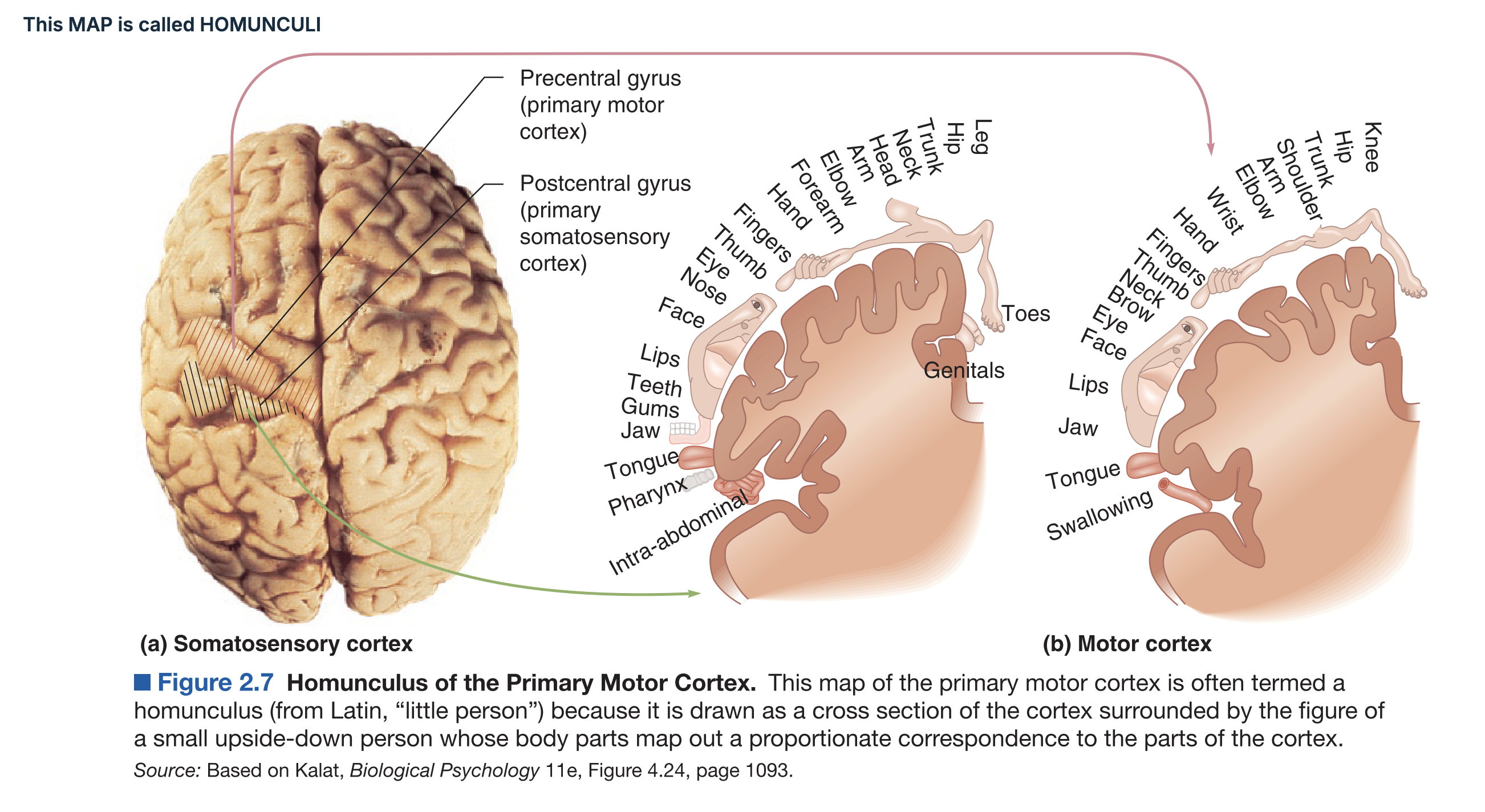
HOMUNCULI
There is a mapping in the primary motor cortex of the brain known in the Latin Word “Little Person” this serve as a map of where exact part of the brain controls the movement of the body.
Parietal Lobe
What lobe is associated with Primary Somatosensory Cortex?
Primary Somatosensory Cortex
This senses of parietal lobe receives the information of the sense about pressure, texture, and pain. (A cortex)
Primary Somatosensory Cortex
When it is electrically stimulated part of the brain is that you feel like you are being touched
Temporal Lobe
This lobe is also for retaining visual memory and auditory
Contralateral
Temporal is what lateral? when the sounds go to the other ear they are equals
Projection Areas
This is an area in the brain where the sensory processing occurs this area are send to the thalamus
Rostral
Ventral
Caudal
Dorsal
_______refers to the front part of the brain (literally the “nasal region”).
_______ refers to the bottom surface of the body/brain (the side of the stomach).
______ literally means “tail” and refers to the back part of the body/brain.
_____refers to the upside of the brain (it literally means “back,” and in animals the back is on the upside of the body).
Neurons
Transmits electrical signals from one location to another of the nervous sytems
Soma
Part of the cell which is on the center and contains nucleus and perform metabolic and reproductive functions of the cells.
It also connects dendrites to axons
Part of a neuron cell where it can defines as long thin tube that extends and splits to the soma and transmit electrochemical signals through the terminus (end of the cell) where signals can be transmitted to the other neurons.