Geog - Unit 1
 Call Kai
 Learn
Learn Practice Test
 Spaced Repetition
 Match
Match Flashcards
 Knowt Play
1/87

There's no tags or description
Looks like no tags are added yet.
Name | Mastery | Learn | Test | Matching | Spaced | Call with Kai | Chat |
|---|
No analytics yet
Send a link to your students to track their progress
88 Terms

what are the 2 types of crusts?
oceanic and continental
which of the 2 crusts is up to 100m thick
continental
which of the 2 crusts is 0-20km thick
oceanic
which of the 2 crusts is more dense
oceanic
which rocks do each of the crusts contain?
oceanic: basaltic
continental: granite (+ rocks with minerals like quartz)
what is the name of the fast cooling, dark colored rock that is also in oceanic crusts?
basaltic rock
name the parts of the earth’s cross section (bottom to top)
inner core, outer core, mantle, crust

what type of current is caused by circulating magma in the mantle?
convection currents
whats the name for the earth’s crust and the very top layer of the manly?
lithosphere
whats the name of the upper part of the mantle.
asthenosphere
why is the asthenosphere called viscous (vis-us)
it is a layer of a very hot rock, bc of the heat it becomes thick and is able to flow slowly
the earth’s crust is made of different ______ plates
tectonic
the pressure from overlying materials and the radioactivity of the materials in the core (such as uranium) causes _______
the earth’s core to be very hot
what are the 4 types of tectonic plates?
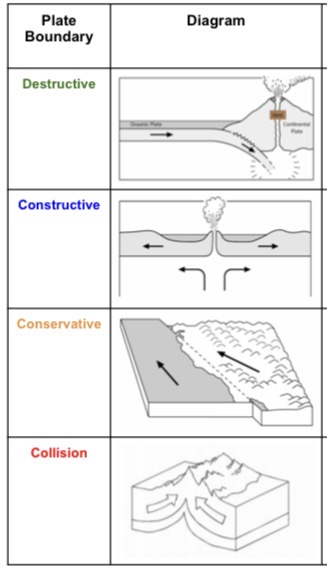
destructive (convergent), constructive (divergent), conservative, collision
define tectonic plates
pieces of the rocky outer layer of the earth, known as the crust
what plates are constantly moving?
tectonic plates
where are volcanoes and earthquakes commonly found?
at plate boundaries, where tectonic plates interact with eachother
where are volcanoes and earthquakes commonly found?
at plate boundaries, where tectonic plates interact with eachother.
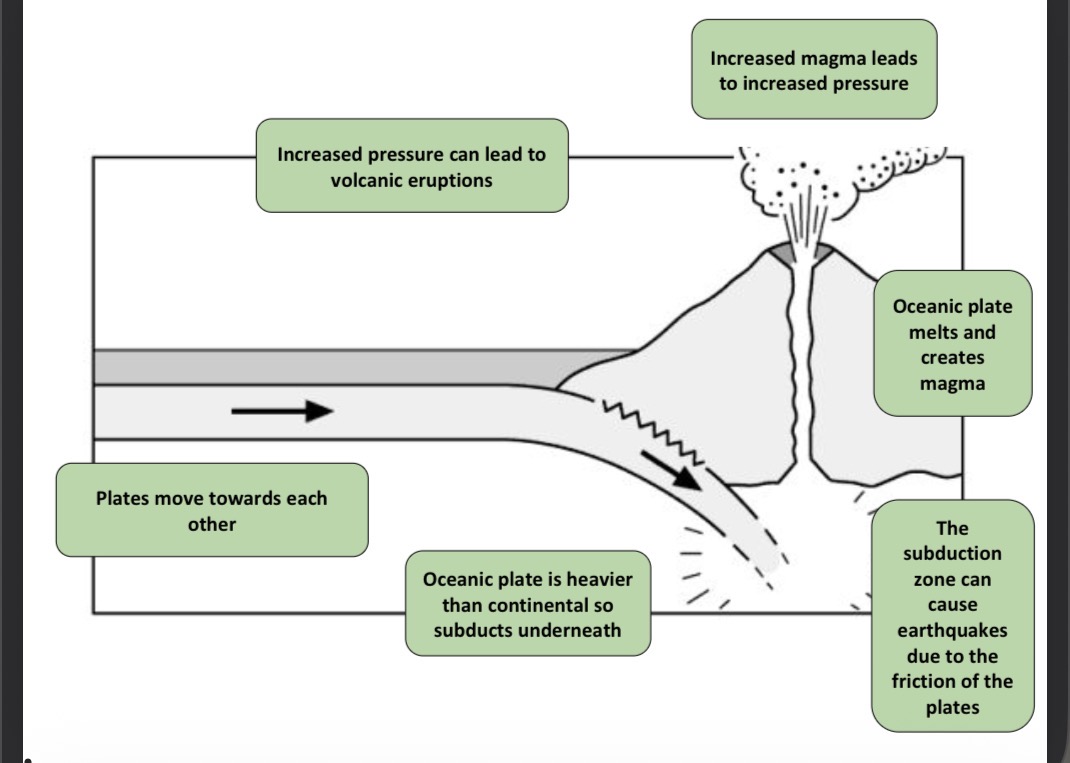
explain why volcanoes occur along the destructive plate boundary?
plates move towards each other, the oceanic pate subducts under the continental plate bc of its heavier. the oceanic plate melts and creates magma which leads to an increase in pressure, causing a volcanic eruption.
in which type of tectonic plates do plates move apart?
constructive
in which type of tectonic plates do plates move towards eachother?
destructive
in which type of tectonic plates do plates move past eachother?
conservative
in which type of tectonic plates do plates collide?
collision
in which 2 types of tectonic plates can volcanoes be formed?
destructive and constructive
how are earthquakes formed in destructive plate boundaries?
the subduction zone causes friction between the plates.
what type of currents move the plates apart in constructive plate boundaries?
convection currents
how are volcanoes formed in a constructive plate boundary?
new land is formed and magma rises to fill the space left by the separated plates.
how are earthquakes formed in conservative plate boundaries?
pressure between the plates build as they get stuck alongside each other, once the pressure is released, this can cause a large earthquake.
the upward movement in collision plate boundaries creates ____ ________
fold mountains
why are the plates forces upwards in collision plate boundaries?
bc they are the same density
how are earthquakes formed in collision plate boundaries?
the friction caused by the plate movement can cause earthquakes
whats the name of this plate boundary?
destructive

whats the name of this plate boundary?
constructive

whats the name of this plate boundary?
conservative

whats the name of this plate boundary?
collision
what are the 4 parts of an earthquake?
the focus, epicene, seismic waves, shockwaves

what is the point inside the crust where pressure is released?
the focus
whats the name for the point on the earth’s surface above the focus?
epicentre
what type of waves spread out from the focus?
earthquake energy is released in ______ waves.
seismic
what is the name for stored energy released in powerful waves from the focus?
shockwaves
whats the difference between shockwaves and seismic waves?
shockwaves - powerful waves of pressure caused by a sudden release of energy (like an explosion).
seismic waves- waves of energy that travel thru the earth during an earthquake

what does this diagram show
earthquake distribution
what machines measure earthquakes and record the shaking on a graph?
seismometers
what scale measures the magnitude (strength) of an earthquake?
richter scale

what scale is this?
the richter scale
what is a tsunami?
a large sea wave caused by the displacement of a large volume of water
how are tsunamis created at destructive plate boundaries?
when 2 plates move towards eachother, one sinks beneath eachother. the friction causes an earthquake. the earthquake makes the ocean floor suddenly move up, the ocean floor pushes water up.
water is ______ in a tsunami creating a wave which ____ out. as the water approaches the shore, the wave height ______ and the wave length ______.
displaced, spreads, increases, decreases.
what happens to the speed of the wave created in a tsunami?
the speed decreases (the wave slows down) bc the water becomes shallower.
what is the name for a spot where hot magma rises through the earth’s crusts, causing volcanic activity.
a hotspot
how do volcanoes form chains?
the plume stays in the same place but as plates move over the hotspot, volcanoes form chains.
what do social impacts directly impact?
people’s daily lives
what do economic impacts directly impact?
the wealth of an area
what do environmental impacts directly impact?
the landscape
earthquakes are caused by the release of ______ ___________ at plate margins.
built-up, pressure
what is the name for things that happen immediately as a result of an earthquake?
primary impact
what is the name for things that happen in the hours, days and weeks after the initial earthquake?
secondary impacts
______ impacts happen bc of ______ impacts.
secondary, primary
what type of response describes actions taken immediately after a distaster.
short term response
what type of response describes actions taken over a long period after a disaster.
long term response
what are the 6 factors that can affect an earthquake?
the size of the earthquake on the richter scale, level of development, depth of focus, distance from epicenter, population density, time of day
what are the 3 p’s
prediction, protection, and preparation
which of the 3 p’s means knowing where and when the earthquake will occur and how powerful it is?
prediction
which of the 3 p’s means building a physical structure which can reduce damage?
protection
which of the 3 p’s means educating people about hazards and training them on what to do?
preparation
an example of _______ is that some scientists believe that animals act strangely before an earthquake occurs.
prediction
an example of _______ is automatic window shutters on buildings to protect glass from shattering .
protection
an example of ________ is practicing emergency and evacuation procedures.
preparation
3 features of a hazard resistant building design includes:
1) Rubber _____-_______ to absorb earth ______.
2) ________ window shutters to prevent falling ______.
3) _____ areas where people can ______ if evacuated.
shock-absorbers, tremors
automatic, glass
open, assemble

how many plates meet at the pacific ring of fire and why can it lead to frequent earthquakes?
several plates meet, the subduction causes friction and pressure
2 immediate examples of an earthquake?
buildings and roads damaged, people died
2 physicals causes of the 2011 tōhoku earthquake and tsunami: the earthquake occurred at a _______ plate boundary, where the _______ plate is being subducted beneath the Okhotsk plate. The plates become _______ due to ______, causing pressure to build up until it was suddenly released, producing a powerful _______.
destructive, pacific, locked, friction, earthquake.
give 2 social impacts and their consequences: homes and schools
homes were damaged, leaving many people homeless and living in temporary shelters.
schools were damaged, so students couldn’t attend school normally.
2 economic impacts and their consequences: factories and infrastructure
factories were damaged, causing businesses to close and workers to lose income.
infrastructure was damaged, costing lots of money to repair.
how did the tsunami and earthquake affect coastal settlements: (3)
________ were flooded.
______ and _______ were swept away.
_______, vehicles and boats were destroyed.
settlements, homes, buildings, roads.
2 immediate responses: search and rescue, emergency shelters
search and rescue teams were sent out.
emergency shelters, food and water were provided
why did the tsunami cause more damage?
the tsunami affected a _____ _________ area. huge ______ flooded _________ and swept away buildings, vehicles and infrastructure. this caused many ______ and ___________.
large coastal, waves, settlements, deaths, homelessness.
give 2 long term responses: sea walls, infrastructure
sea walls were improved to reduce future tsunami damage.
infrastructure was rebuild to help communities recover.
technology helped the incident by:
_____ - ________ systems warned people.
earthquake - resistant buildings _______ damage.
______ were automatically stopped.
early warning, reduced, trains
why were the impacts of the 2011 tohoku earthquake and tsunami severe? : earthquake, tsunami, fukushima
the earthquake was extremely powerful (magnitude 9.0), the tsunami was huge and overwhelmed some defenses. the fukushima nuclear accident caused environmental impacts (coastal impacts were exposed).
3 effects of the fukushima incident:
tsunami flooded the _____
______ systems failed (and backup generators)
_______ melted down and released __________.
plant, cooling, reactors, radiation
2 environmental impacts: radioactive material, coastal ecosystems
radioactive material contaminated air, soil and water.
the tsunami damaged coastal ecosystems and polluted the sea.
what are 3 features japan had that made them prepared?
earthquake resistant buildings, warned systems, evacuation drills.
where are sea walls built along and what do they protect from what?
sea walls are built along the coast to protect coastal areas from the sea.
what are the 2 types of volcanoes?
composite and shield
after the oceanic crust sinks beneath the continental crust (destructive plate boundary), how is a volcano formed?
the oceanic crust sinks into the mantle, it created magma, which forms a volcano
where are composite volcanoes found? (which plate boundary?)
destructive
where are shield volcanoes found? (which plate boundary?)
constructive