Macroeconomics Pearson Etext (Chap 5-9)
 Call Kai
 Learn
Learn Practice Test
 Spaced Repetition
 Match
Match Flashcards
 Knowt Play
1/40

There's no tags or description
Looks like no tags are added yet.
Name | Mastery | Learn | Test | Matching | Spaced | Call with Kai | Chat |
|---|
No analytics yet
Send a link to your students to track their progress
41 Terms
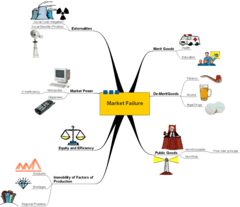
Market Failure
A situation in which the market economy leads to too few or too many resources going to a specific economic activity.
Externality
A consequence of an economic activity that spills over to affect third parties. Pollution is an externality.
Third Parties
Parties who are not directly involved in a given activity or transaction.
Property rights
The rights of an owner to use and exchange property.
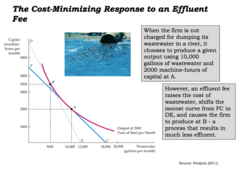
Effluent fee
A charge to a polluter that gives the right to the discharge into the air or water a certain amount of pollution; also called a pollution tax.
Antitrust legislation
Laws that restrict the formation of monopolies and regulate certain anti-competitve business practices.
Monopoly
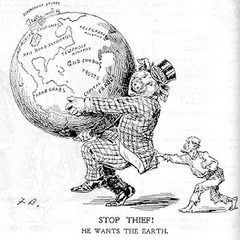
A firm that can determine the market price of a good. In the extreme case, a monopoly is the only seller of a good or service.
Private goods
Goods that can be consumed by only one individual at a time. Private goods are subject to the principle of rival consumption.

Principle of rival consumption
The recognition that individuals are rivals in consuming private goods because one person's consumption reduces the amount available for others to consume.
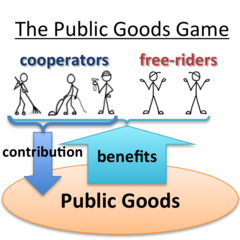
Public goods
Goods for which the principle of rival consumption does not apply and for which exclusion of nonpaying consumers is too costly to be feasible. They can be jointly consumed by many individuals simultaneously at no additional cost and with no reduction in quality or quantity. Furthermore, no one who fails to help pay for the good can be denied the benefit of the good.

Free-rider problem
A problem that arises when individuals presume that others will pay for public good so that, individually, they can escape paying for their portion without causing a reduction in production.
Government-sponsored good
A good that has been deemed socially desirable throughout the political process. Museums are an example.
Government-inhibited good
A good that has been deemed socially undesirable through the political process.
Transfer payments
Money payments made by governments to individuals for which no services or goods are rendered in return. Examples are Social Security old-age and disability benefits and unemployment benefits.
Transfers in kind
Payments that are in the form of actual good and services, such as food stamps, subsidized public housing, and medical care, and for which no good or services are rendered in return.
Collective decision making
How voters, politicians, and other interested parties act and how these actions influence non-market decisions.
Theory of public choice
The study of collective decision making.
Incentive structure
The system of rewards and punishments individuals face with respect to their own actions.

Government or political goods
Goods (and services) provided by the public sector; they can be either private or public goods.
Majority rule
A collective decision-making system in which group decisions are made on the basis of more than 50 percent of the vote. In other words, whatever more than half of the electorate votes for, the entire electorate has to accept.
A proportional rule
A decision-making system in which actions are based on the proportion of the "votes" cast and are in proportion to them. In a market system, if 10 percent of the "dollar votese" are cast for blue cars, 10 percent of the automobile output will be blue cars.
Government budget constraint
The limit on government spending and transfers imposed by the fact that every dollar the government spends, transfers, or uses to repay borrowed funds must ultimately be provided by the user charges and taxes it collects.
Tax base
The value of goods, services, wealth, or incomes subject to taxation.

Tax rate
The proportion of a tax base that must be paid to a government as taxes.
Marginal tax rate
The change in the tax payment divide by the change in income, or the percentage of additional dollars that must be paid in taxes. The marginal rate is applied to the highest tax bracket of taxable income.
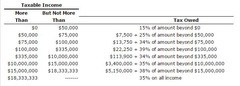
Tax bracket
A specified interval of income to which a specific and unique marginal tax rate is applied.
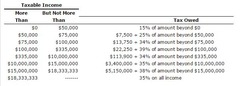
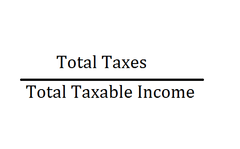
Average tax rate
The total tax payment divided by total income. It is the proportion of total income.
Progressive taxation
A tax system in which, as income increases, a higher percentage of the additional income is paid as taxes. The marginal tax rate exceeds the average tax rate as income rises.
Regressive taxation
A tax system in which as more dollars are earned, the percentage of tax paid on them falls. The marginal tax rate is less than the average tax rate as income rises.
Capital gain
A positive difference between the purchase price and the sale of the price of an asset. If a share of stock is bought for $5 and then sold for $15, the capital gain is $10.
Capital loss
A negative difference between the purchase price and the sale price of an asset.
Retained earnings
Earnings that a corporation saves, or retains, for investment in other productive activities, earnings that are not distributed to stockholders.
Tax incidence
The distribution of tax burdens among various groups in society.
Sales taxes
Taxes assessed on the prices paid on most goods and services.
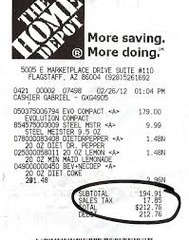
Ad valorem taxation
Assessing taxes by charging a tax rate equal to a fraction of the market price of each unit purchased.
Static tax analysis
Economic evaluation of the effects of tax rate changes under the assumption that there is no effect on the tax base, meaning that there is an unambiguous positive relationship between tax rates and tax revenues.
Dynamic tax analysis
Economic evaluation of tax rate changes that recognizes that the tax base eventually declines with ever-higher tax rates, so that tax revenues may eventually decline if the tax rate is raised sufficiently.
Excise tax
A tax levied on purchases of a particular good or service.
Unit tax
A constant tax assessed on each unit of a good that consumers purchase.
Unemployment
The total number of adults (aged 16 or older) who are willing and able to work and who are actively looking for work but have not found a job.
Labor force
Individuals aged 16 years or older who either have jobs or who are looking and available for jobs; the number of employed plus the number of unemployed.