4 - Nucleic Acids
 Call Kai
 Learn
Learn Practice Test
 Spaced Repetition
 Match
Match Flashcards
 Knowt Play
1/75

Earn XP
Description and Tags
Proverbs 16:3
Name | Mastery | Learn | Test | Matching | Spaced | Call with Kai | Chat |
|---|
No analytics yet
Send a link to your students to track their progress
76 Terms
b. Genetics
[OVERVIEW]
Branch of science which studies heredity and inherited traits in general
a. Biochemistry
b. Genetics
c. Molecular biology
d. Microbiology
d. Nucleic acids
[OVERVIEW]
Biomolecules used for storage and transfer of genetic information
a. Proteins
b. Lipids
c. Carbohydrates
d. Nucleic acids
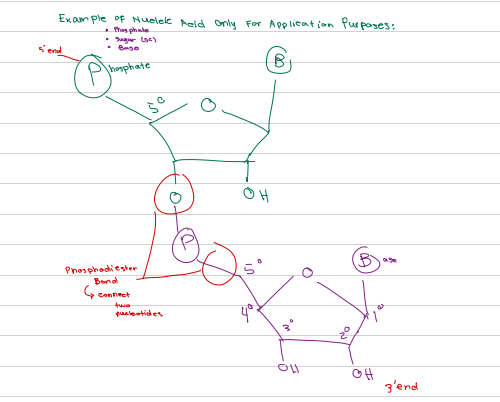
Example of Nucleic Acid for Application Purposes:
d. Nucleic acids
[OVERVIEW]
Acids that can be found in nucleus
a. Proteins
b. Lipids
c. Carbohydrates
d. Nucleic acids
c. Nucleotides
[OVERVIEW]
Building blocks of nucleic acids
a. Amino acids
b. Monosaccharides
c. Nucleotides
d. Fatty acids
b. Polynucleotide chains
[OVERVIEW]
Just like proteins and carbohydrates, nucleic acids exist as building blocks called nucleotides or as _______ that can span from a few to as much as million of nucleotides
a. Polypeptide chains
b. Polynucleotide chains
c. Polysaccharide chains
d. Polyester chains
c. ATP
[OVERVIEW]
The almighty nucleotide that is important in its own right
a. GTP
b. CTP
c. ATP
d. UTP
d. Eukaryotes
[OVERVIEW]
The term nucleic acid is easy to comprehend as they are often produced in the nuclei of _____
a. Prokaryotes
b. Archaea
c. Bacteria
d. Eukaryotes
c. Negative charges
[OVERVIEW]
Nucleic acids are acidic due to their ______
a. Positive charges
b. Neutral charges
c. Negative charges
d. Variable charges
Base (Nitrogenous)
Sugar (5C)
Phosphate
📌Mnemonic: Bangko Sentral ng Pilipinas
Parts of Nucleotide [3]
b. Nucleosides
[NUCLEOTIDES]
Without a phosphate, nucleotides are just called
a. Nucleosomes
b. Nucleosides
c. Nucleoproteins
d. Nucleoplasm
Sugar (5C)
Base (Nitrogenous)
[NUCLEOTIDES]
Parts of Nucleoside [2]
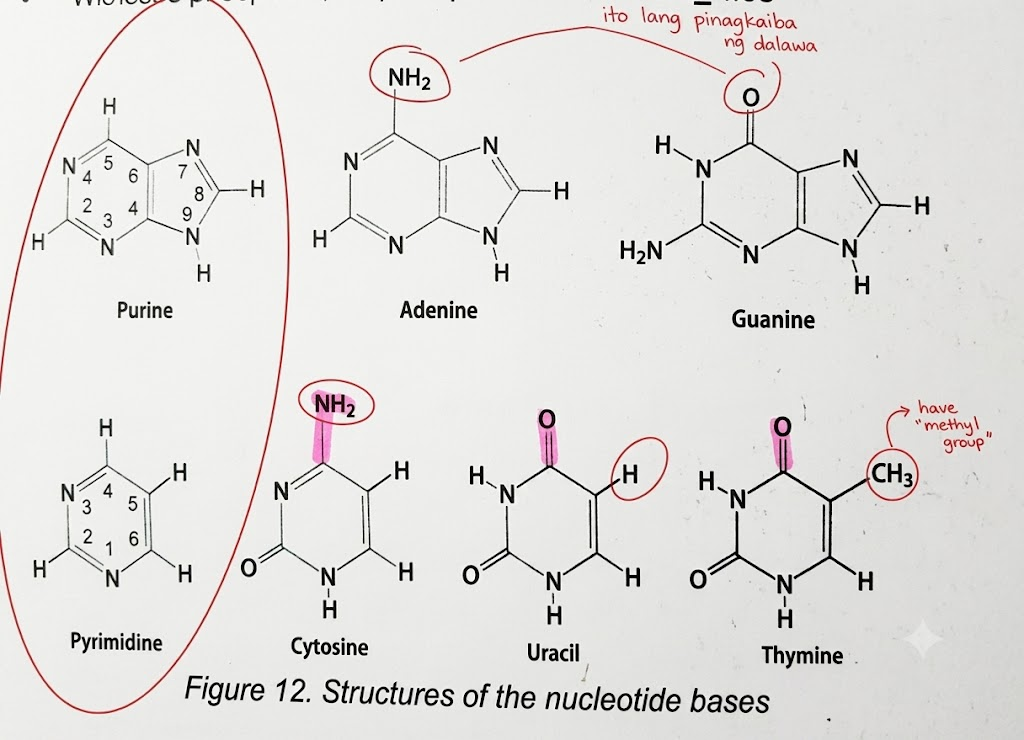
[NUCLEOTIDES]
Figure 12: Structures of the nucleotide bases
Purine
Pyrimidine
[NUCLEOTIDES]
2 general structures of bases
a. Purine and pyrimidine
b. Adenine and guanine
c. Cytosine and uracil
d. Thymine and cytosine
Guanine
Adenine
📌Mnemonic: “PURGA”
[NUCLEOTIDES]
Purines include____ [2]
![<p>[NUCLEOTIDES]</p><p>Purines include____ [2]</p>](https://assets.knowt.com/user-attachments/ccafd8ca-5994-4cc3-9dc4-564a6f37f1d9.png)
Cytosine
Uracil
Thymine
📌Mnemonic: “PYCUT”
[NUCLEOTIDES]
Pyrimidine include ____ [3]
![<p>[NUCLEOTIDES]</p><p>Pyrimidine include ____ [3]</p>](https://assets.knowt.com/user-attachments/fff6661d-edeb-4a18-b10c-a9e8ffec5ecb.png)
d. Adenine
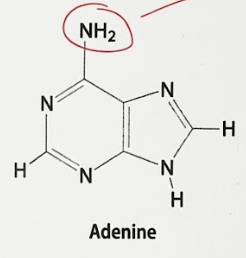
[NUCLEOTIDES]
Purine with NH₂ group
a. Guanine
b. Thymine
c. Cytosine
d. Adenine
c. Guanine
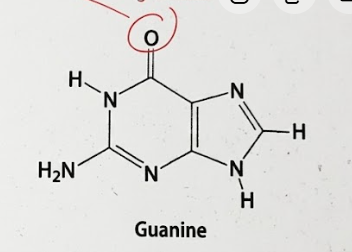
[NUCLEOTIDES]
Purine with O group
a. Adenine
b. Thymine
c. Guanine
d. Cytosine
c. Cytosine
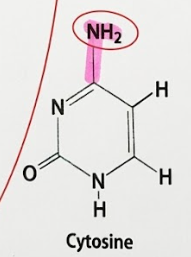
[NUCLEOTIDES]
Pyrimidine with NH₂ group
a. Uracil
b. Thymine
c. Cytosine
d. Guanine
c. Thymine
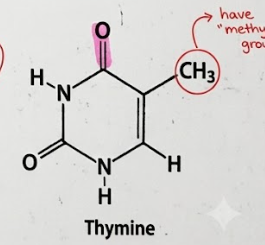
[NUCLEOTIDES]
Pyrimidine that has a methyl group (CH₃)
a. Cytosine
b. Uracil
c. Thymine
d. Adenine
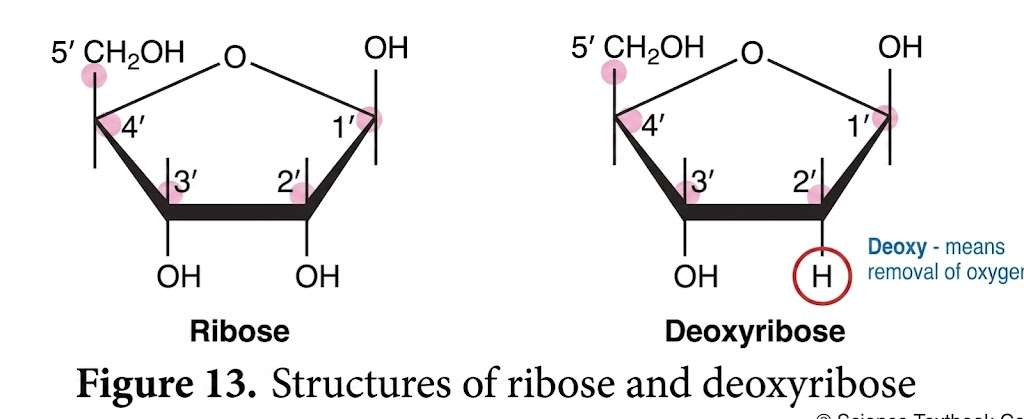
[NUCLEOTIDES]
Figure 13: Structures of ribose and deoxyribose
d. Removal of oxygen
[NUCLEOTIDES]
Deoxy means
a. Addition of oxygen
b. Addition of hydrogen
c. Removal of hydrogen
d. Removal of oxygen
a. True
[NUCLEOTIDES]
We can create trans fat (very harmful for CVD health) from cooking oil by using it again and again
a. True
b. False
d. Anion
[NUCLEOTIDES]
Acid becomes _____ when ionized
a. Cation
b. Neutral
c. Zwitterion
d. Anion
c. Cation
[NUCLEOTIDES]
Basic becomes _____ when ionized
a. Anion
b. Neutral
c. Cation
d. Zwitterion
b. "osine"
[NUCLEOTIDES]
Purine nucleosides will end on this suffix
a. "idine"
b. "osine"
c. "oside"
d. "amine"
d. "idine"
[NUCLEOTIDES]
Pyrimidine nucleosides will end on this suffix
a. "osine"
b. "amine"
c. "oside"
d. "idine"
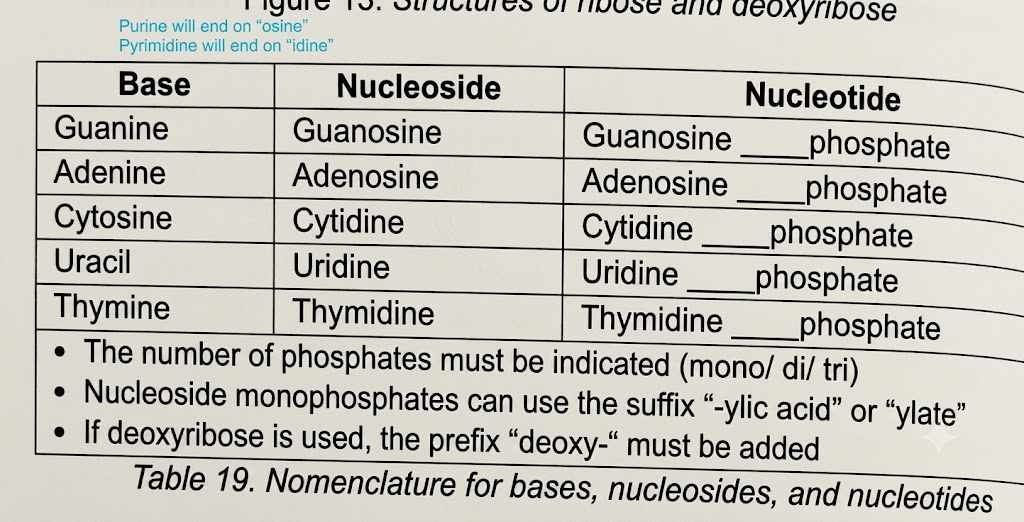
[NUCLEOTIDES]
Table 19: Nomenclature for bases, nucleosides, and nucleotides
[NUCLEOTIDES]
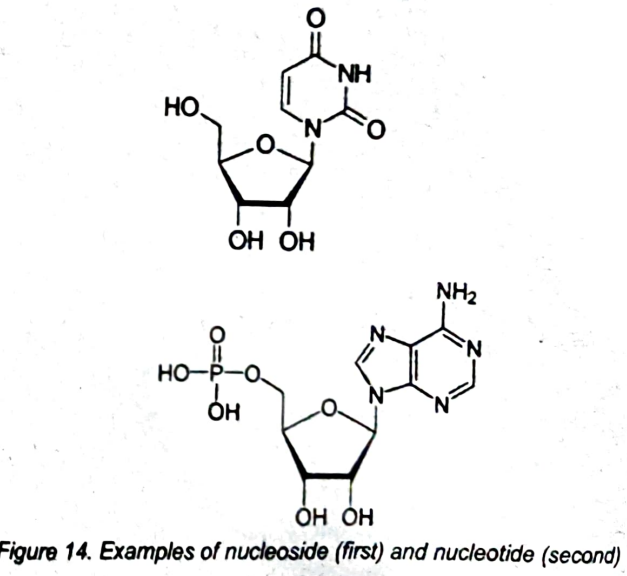
Figure 14: Examples of nucleoside (firsts) and nucleotide (second)
c. N-glycosidic bond
[TYPE OF BOND]
Connects sugar to base
Added at 1' prime of sugar
a. Phosphoester bond
b. Phosphodiester bond
c. N-glycosidic bond
d. Phosphoanhydride bond
d. Phosphoester bond
[TYPE OF BOND]
Connects sugar to phosphate
Added at 5' prime of sugar
a. N-glycosidic bond
b. Phosphoanhydride bond
c. Phosphodiester bond
d. Phosphoester bond
d. Phosphoanhydride bond
[TYPE OF BOND]
Connects two phosphates
a. Phosphoester bond
b. Phosphodiester bond
c. N-glycosidic bond
d. Phosphoanhydride bond
c. Phosphodiester bond
[TYPE OF BOND]
Connects two nucleotides
a. N-glycosidic bond
b. Phosphoanhydride bond
c. Phosphodiester bond
d. Phosphoester bond
b. 5' end to 3' end
[TYPE OF BOND]
Nucleic acids are read from this end to this end
a. 3' end to 5' end
b. 5' end to 3' end
c. 1' end to 3' end
d. 3' end to 1' end
c. Polynucleotide chain
Continuous strand of phosphate-sugar backbones
a. Nucleotide
b. Nucleoside
c. Polynucleotide chain
d. Nucleobase
c. Bases
In Polynucleotide Chains:
The ______ are projected away from the backbone chain
a. Phosphates
b. Sugars
c. Bases
d. Hydrogen atoms
c. Phosphate
In Polynucleotide Chains:
______ contains negative charges
a. Sugar
b. Base
c. Phosphate
d. Backbone hydrogen
b. 5' end to 3' end
Polynucleotide chains strictly follow this direction
a. 3' end to 5' end
b. 5' end to 3' end
c. 1' end to 5' end
d. 3' end to 1' end
b. Deoxyribose
[DNA vs. RNA]
Sugar of DNA
a. Ribose
b. Deoxyribose
c. Glucose
d. Fructose
b. Ribose
[DNA vs. RNA]
Sugar of RNA
a. Deoxyribose
b. Ribose
c. Glucose
d. Galactose
c. A, G, C, T
[DNA vs. RNA]
Bases of DNA
a. A, G, C, U
b. A, U, C, T
c. A, G, C, T
d. G, C, U, T
b. A, G, C, U
[DNA vs. RNA]
Bases of RNA
a. A, G, C, T
b. A, G, C, U
c. G, C, U, T
d. A, U, C, T
b. Double-stranded
[DNA vs. RNA]
Common form of DNA
a. Single-stranded
b. Double-stranded
c. Circular
d. Triple-stranded
c. Single-stranded
[DNA vs. RNA]
Common form of RNA
a. Double-stranded
b. Triple-stranded
c. Single-stranded
d. Circular
b. Starting point of all genetic material
[DNA vs. RNA]
Purpose of DNA
a. (mRNA) transcript in the central dogma
b. Starting point of all genetic material
c. Energy storage
d. Enzyme cofactor
b. (mRNA) transcript in the central dogma
[DNA vs. RNA]
Purpose of RNA
a. Starting point of all genetic material
b. (mRNA) transcript in the central dogma
c. Storage of genetic information
d. Structural support
c. Primary structure
[Levels or Organization of Proteins]
Linear sequence of nucleotides
a. Secondary structure
b. Tertiary structure
c. Primary structure
d. Quaternary structure
b. Secondary structure
[Levels or Organization of Proteins]
Primary + bases hydrogen-bonded (alpha helix and beta sheets)
a. Primary structure
b. Secondary structure
c. Tertiary structure
d. Quaternary structure
c. Tertiary structure
[Levels or Organization of Proteins]
Secondary but twisted (helix) or circular (plasmid)
a. Primary structure
b. Secondary structure
c. Tertiary structure
d. Quaternary structure
d. Quaternary structure
[Levels or Organization of Proteins]
Conjugated with proteins (ex. histones)
a. Tertiary structure
b. Secondary structure
c. Primary structure
d. Quaternary structure
d. Quaternary
[Levels or Organization of Proteins]
Histones is an example of this level of organization
a. Primary
b. Secondary
c. Tertiary
d. Quaternary
b. 50-200 million letter
1 chromosome = _____ million letter
a. 1-50 million letter
b. 50-200 million letter
c. 200-500 million letter
d. 500-1000 million letter
A - DNA
B - DNA
Z - DNA
Types of DNA [3]
b. B-DNA
[Types of DNA]
Common type of DNA
a. A-DNA
b. B-DNA
c. Z-DNA
d. C-DNA
d. Z-DNA
[Types of DNA]
Very rare type of DNA
a. A-DNA
b. B-DNA
c. C-DNA
d. Z-DNA
Complimentary base pairing
Antiparallel
Handedness
📌Mnemonic: “CAH” — isipin mo lang ang CEU
Properties of Double Helix [3]
c. 2
[Complimentary Base Pairing]
Number of hydrogen bonds in A-T base pairing
a. 1
b. 3
c. 2
d. 4
c. U
[Complimentary Base Pairing]
In RNA, this replaces T in base pairing with A
a. G
b. C
c. U
d. I
d. 3
[Complimentary Base Pairing]
Number of hydrogen bonds in C-G base pairing
a. 2
b. 4
c. 1
d. 3
c. Chargaff's rule (%purines = %pyrimidines)
Complimentary base pairing follow ______
a. Watson-Crick rule
b. Central dogma rule
c. Chargaff's rule
d. Complementary base rule
c. Chargaff's rule
[Complimentary Base Pairing]
Rule that says purine and pyrimidine are equal (≈50-50)
a. Watson-Crick rule
b. Central dogma rule
c. Chargaff's rule
d. Complementary base rule
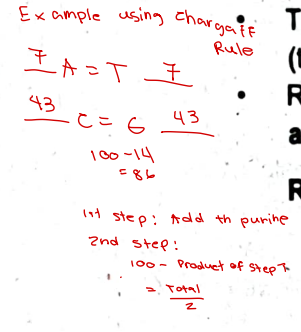
Example Using Chargaff Rule:
c. Antiparallel
[Properties of Double Helix]
Two strands run in opposite direction (movement in opposite direction)
a. Handedness
b. Complementary base pairing
c. Antiparallel
d. Chargaff's rule
b. Handedness
[Properties of Double Helix]
DNA rotates in a certain direction
It can be:
Right-handed (clockwise)
Left-handed (counterclockwise)
a. Antiparallel
b. Handedness
c. Complementary base pairing
d. Chargaff's rule
c. Dische
[Common Qualitative test for Carbohydrates]
Test for Deoxyribose
a. Ammonium molybdate
b. Murexide
c. Dische
d. Wheeler-Johnson
b. Ammonium molybdate
[Common Qualitative test for Carbohydrates]
Test for Phosphate
a. Dische
b. Ammonium molybdate
c. Murexide
d. Wheeler-Johnson
c. Murexide
[Common Qualitative test for Carbohydrates]
Test for Purines
a. Dische
b. Ammonium molybdate
c. Murexide
d. Wheeler-Johnson
d. Wheeler-Johnson
[Common Qualitative test for Carbohydrates]
Test for Pyrimidines
a. Dische
b. Murexide
c. Ammonium molybdate
d. Wheeler-Johnson
b. Diphenylamine
[Common Qualitative test for Carbohydrates]
Main reagent for Dische test
a. Ammonium molybdate
b. Diphenylamine
c. Potassium chlorate in HCl
d. Bromine, barium hydroxide
c. Ammonium molybdate
[Common Qualitative test for Carbohydrates]
Main reagent for Ammonium molybdate test
a. Diphenylamine
b. Bromine, barium hydroxide
c. Ammonium molybdate
d. Potassium chlorate in HCl
d. Potassium chlorate in HCl
[Common Qualitative test for Carbohydrates]
Main reagent for Murexide test
a. Diphenylamine
b. Ammonium molybdate
c. Bromine, barium hydroxide
d. Potassium chlorate in HCl
d. Bromine, barium hydroxide
[Common Qualitative test for Carbohydrates]
Main reagent for Wheeler-Johnson test
a. Diphenylamine
b. Potassium chlorate in HCl
c. Ammonium molybdate
d. Bromine, barium hydroxide
c. Blue
[Common Qualitative test for Carbohydrates]
Positive result for Dische test
a. Yellow ppt
b. Pink color
c. Blue
d. Green with bromine; purple with barium hydroxide
c. Yellow ppt
[Common Qualitative test for Carbohydrates]
Positive result for Ammonium molybdate test
a. Blue
b. Pink color
c. Yellow ppt
d. Green with bromine; purple with barium hydroxide
d. Pink color
[Common Qualitative test for Carbohydrates]
Positive result for Murexide test
a. Blue
b. Yellow ppt
c. Green with bromine; purple with barium hydroxide
d. Pink color
Green with bromine
Purple with barium hydroxide
[Common Qualitative test for Carbohydrates]
Positive result for Wheeler-Johnson test
a. Blue
b. Yellow ppt
c. Pink color
d. Green with bromine; purple with barium hydroxide