3.3.3 Halogenoalkanes
 Call Kai
 Learn
Learn Practice Test
 Spaced Repetition
 Match
Match Flashcards
 Knowt Play
1/15

There's no tags or description
Looks like no tags are added yet.
Name | Mastery | Learn | Test | Matching | Spaced | Call with Kai | Chat |
|---|
No analytics yet
Send a link to your students to track their progress
16 Terms
Are halogenoalkanes soluble or insoluble in water?
Insoluble, as the C-H bonds are non-polar & this not compensated for enough by C-X bond polarity
Are halogenoalkanes polar & explain why?
Yes, as halogens are more electronegative than carbon

Which intermolecular forces do halogenoalkanes have & why?
Permanent dipole-dipole forces & Van der Waals forces of attraction
C-X bond polarity creates permanent dipoles
When would halogenoalkanes have higher boiling points?
Increase in carbon chain length & if halogen is further down group 7
What is the most important factor in determining halogenoalkanes’ reactivity?
Carbon-halogen bond enthalpy: (energy required to break one mole of a particular covalent bond in the gaseous state)
C-F bond is the strongest (highest bond enthalpy) → fluoroalkanes undergo nucleophilic substitution reactions more slowly
C-I bond is the weakest (lowest bond enthalpy) → undergo nucleophilic substitution reactions more quickly

What is the trend in reactivity of halogenoalkanes?
Reactivity increases down group 7:
faster nucleophilic substitution reactions as the bond enthalpy decreases down the group (bonds get weaker, so are easier to break)
What reaction do halogenoalkanes undergo?
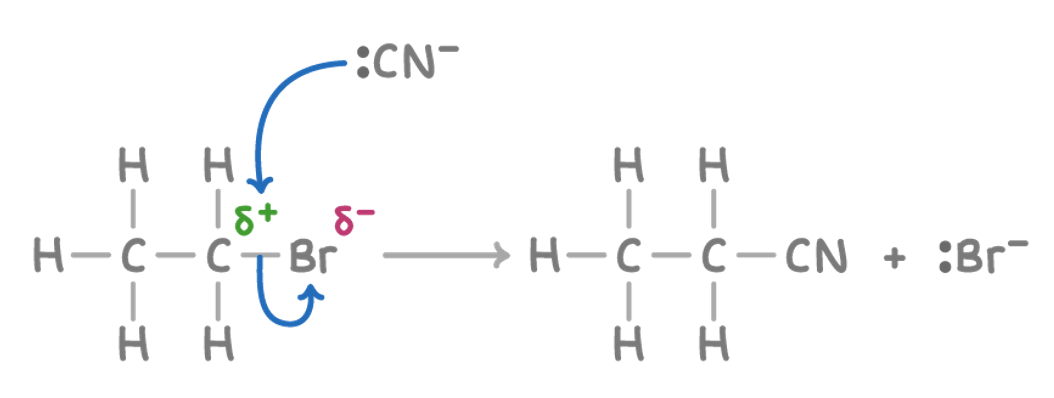
Nucleophilic substitution reactions with nucleophiles
What is a nucleophile?
Electron-pair donor (think → nucleus-loving)
What are 3 examples of nucleophiles?
:OH⁻
:CN⁻
:NH3
What is nucleophilic substitution?
A reaction where a nucleophile attacks a molecule & replaces one of its functional groups (e.g. halogen atom)
How does halogen elimination from a halogenoalkane occur?
If you warm a halogenoalkane with ethanolic OH- ions (instead of water), you get an alkene
What are the conditions for nucleophilic substitution with the 3 different nucleophiles?
Hydroxide (:OH⁻): hot, ethanolic NaOH
Amine (:NH3): excess, ethanolic ammonia (NH3)
Cyanide (:CN⁻): ethanolic KCN under reflux

What is the condition for an elimination reaction?
Hot, ethanolic NaOH
Why is the ozone layer beneficial to humans?
Prevents the Earth from absorbing too much UV radiation
Why are chlorine free radicals dangerous in the upper atmosphere?
They catalyse the decomposition of the ozone layer:
they are formed when UV radiation causes the C-Cl bond in CFCs to break
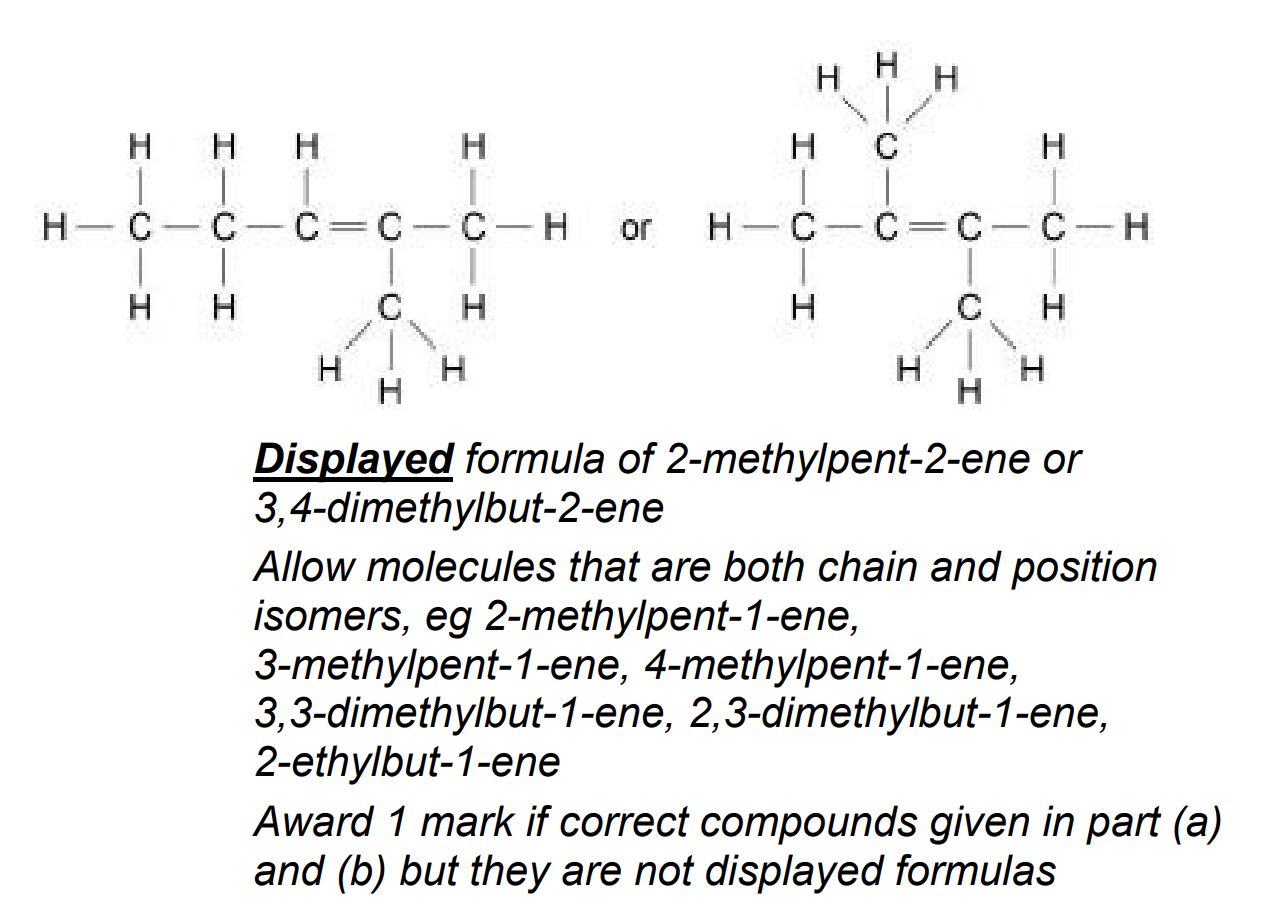
Draw the displayed formula of a chain isomer of hex-2-ene that does not exist as E & Z isomers