Textbook Module 2.2
 Call Kai
 Learn
Learn Practice Test
 Spaced Repetition
 Match
Match Flashcards
 Knowt Play
1/59

Earn XP
Description and Tags
Early Investigative Techniques
Name | Mastery | Learn | Test | Matching | Spaced | Call with Kai | Chat |
|---|
No analytics yet
Send a link to your students to track their progress
60 Terms
Phrenology was originally known as
cranioscopy
Phrenology was first developed in
1796
Phrenology was developed by
Franz Joseph Gall
Despite phrenology being a pseudoscience, it was considered a legitimate science during the nineteenth century. True or false?
True
Franz Joseph Gall believed that
mental abilities and personalities were controlled by 27 specific brain organs that each corresponded to a differing mental ability/personality trait
Where were the brain organ bumps located?
on the surface of the brain
The size of each brain organ in phrenology is determined by
how much that particular trait/ability was used.
The shape and size of the skull in phrenology were thought to…
change size to accomodate the brain changes.
How did phrenologists determine a person’s character, intelligence, and other traits with phrenology?
by examining and feeling lumps, bumps, and indentations on the skull.
In 1800, Franz Joseph Gall acquired a research assistant by the name of
Johann Christoph Spurzheim
What did Johann Christoph Spurzheim do?
changed cranioscopy to phrenology and added an additional 10 brain organs to the original 27
After Franz Joseph Gall and Johann Christoph Spurzheim’s work on brain organs, how many were there in total?
37
Who invented the psychograph?
Henry C. Lavery and Frank P. White
When was the psychograph invented?
1931
How many probes are on the psychograph?
32
The psychograph is _____ powered
electric
What did the psychograph do?
Automatically measured lumps and bumps on a patients head and prints a detailed analysis of the patients traits and intelligence as well as advice for self improvement.
The psychograph is based on the principles of phrenology. True or false?
True
What the overall perception of psychographs according to patients?
Patients found results “amazingly accurate”.
What is a true element of phrenology despite it being a pseudoscience?
Parts of the brain not used deteriorate.
What are case studies?
In-depth studies of behaviour or events through observation, diagnostic tests, interviews, and analysis of medical records.
What is an autopsy?
Surgically opening up a deceased body to examine organs and body systems.
What is Broca’s area named after?
Pierre Paul Broca
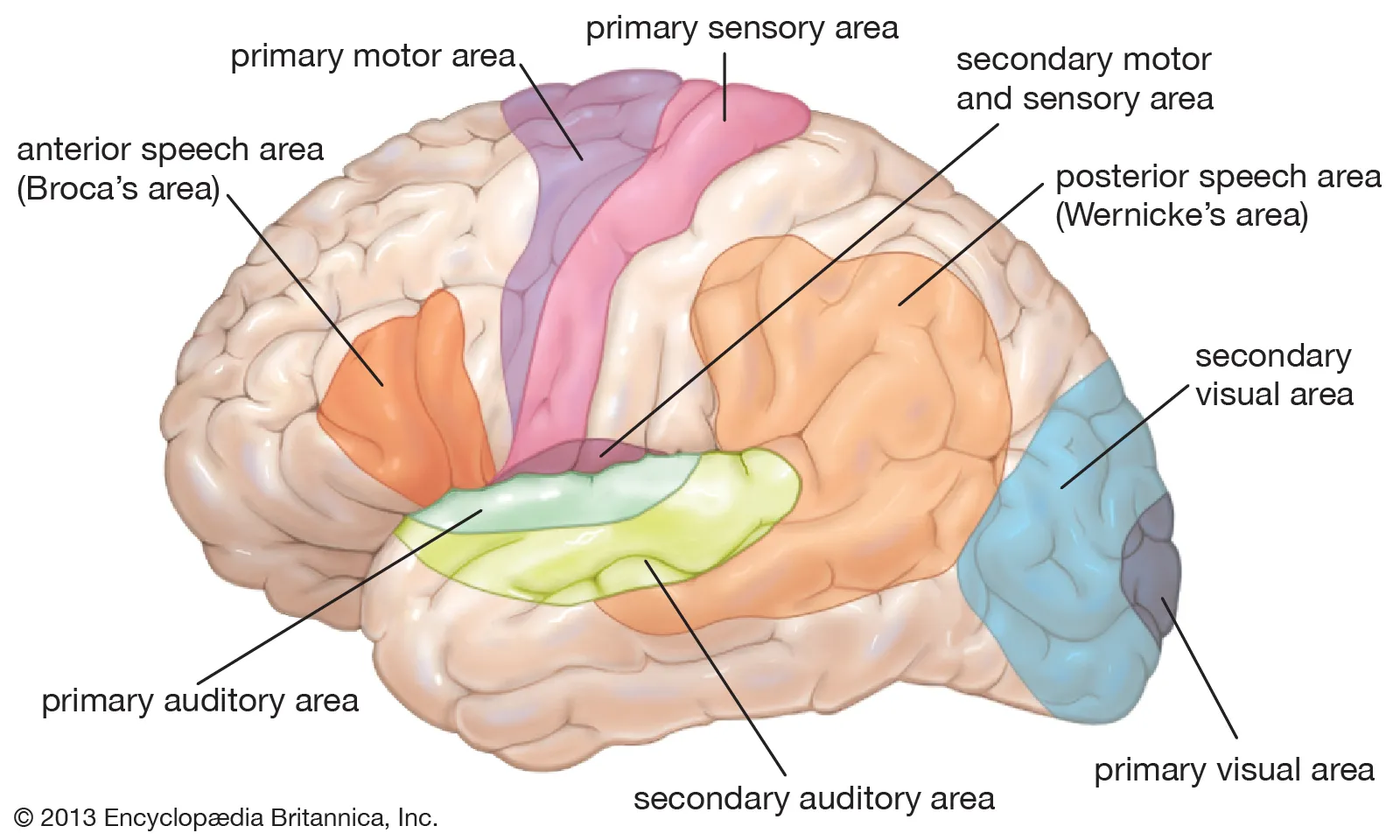
What did Pierre Paul Broca do?
Conduct an autopsy on a deceased patient, finding a deep hollow on the left frontal lobe, close to the primary motor cortex.
What happened when Broca found a secondary patient with similar symptoms?
Hypothesised that the patient had damage to what is now known as Broca’s area
Who was Pierre Flourens?
A French physiologist and founder of experimental brain science.
What is ablating?
To remove
In the 1820’s, Flourens began…
localising and ablating areas of the brain in living animals, mostly rabbits and pigeons.
What was Pierre Flourens intent with his animal experiments?
To determine if localisation existed.
Who was Pierre Flourens inspired by to do his animal experiments to determine if localisation existed?
Franz Joseph Gall
What were Pierre Flourens’ findings of his live animal experiments?
Found evidence that the main areas of the brain were responsible for different functions.
What happened when Pierre Flourens removed the cerebral hemispheres?
All perceptions, motor controls, and judgement were removed from the animals.
What happened when Pierre Flourens removed the cerebellum?
Caused a loss of balance and motor coordination
What did Pierre Flourens conclude?
The cerebral cortex is responsible for higher order thinking and the cerebellum is was implicated in regulating movement.
Pierre Flourens produced the first scientific evidence against phrenology. True or false?
True
Pierre Flourens established the basis of knowledge for neuroanatomy and the workings of the brain. True or false?
True
What is hemispheric specialisation or brain lateralisation?
the tendency for particular brain functions to be carried out by one brain hemisphere
What is a ‘corpus callosotomy’?
a surgical procedure that severs the corpus callosum.
What is the corpus callosum?
a thick band of nerve fibres that connects the two hemispheres of the brain that allows the two hemispheres to communicate
Why is corpus callosotomy mainly done?
For patients experiencing epilepsy.
Why is corpus callosotomy mainly done for patients with epilepsy?
Seizures can develop in one hemisphere and travel to the next, potentially making the seizure more severe.
Who created the corpus callosotomy?
Roger Sperry and Michael Gazzaniga
When was the corpus callosotomy trialled?
Early 1960’s
What was the corpus callosotomy trialled on?
Monkeys
When was the corpus callosotomy conducted on real patients?
1966
The corpus callosotomy had horrible results and is no longer used, true or false?
false
Is the corpus callosotomy still done today?
Yes, in severe cases of epilepsy
The left hemisphere of the brain is dominant for
verbal tasks
the right hemisphere of the brain is dominant for
non - verbal tasks
Who is Wilder Graves Penfield?
An American-Canadian neurosurgeon who is best known for his work on mapping the brain. (1891 - 1976)
How did Wilder Graves Penfield map the brain and documents it’s functions?
He used an electrical stimulation of the brain (ESB) device.
How does an electrical stimulation of the brain (ESB) device work?
By sending a mild electrical impulse through a probe to map the functions of various regions of the brain.
What was Penfield’s new method of treating patients with severe epilepsy called?
The Montreal Procedure
What was the Montreal Procedure?
Opening up a patients skull and lesioning neurons where the seizures originated
How did Penfield avoid damaging unaffected areas of the brain?
By mapping the brain using the ESB device while patients were awake
How did Penfield find out that the left somatosensory cortex controls sensation on the right side and vice versa?
By asking patients permission to probe at their brain and ask them what they feel while numbering and mapping the brain.
Penfield’s research led to the mapping of the cortical homunculus, true or false?
True
What is the cortical homunculus?
A map of the human body along the motor or somatosensory cortex
Penfield and his team were the first to identify that there is a difference between sensory and motor function, they noted that they should
map them separately