Prostate | NURSS230
 Call Kai
 Learn
Learn Practice Test
 Spaced Repetition
 Match
Match Flashcards
 Knowt Play
1/86

There's no tags or description
Looks like no tags are added yet.
Name | Mastery | Learn | Test | Matching | Spaced | Call with Kai | Chat |
|---|
No analytics yet
Send a link to your students to track their progress
87 Terms
what is Benign Prostatic Hyperplasia (BPH)?
non-cancerous enlargement of the prostate that commonly occurs with aging
what causes BPH to develop?
hormonal changes with aging
what is the basic process behind BPH?
prostate hyperplasia (increased number of larges) eventual leads to hypertrophy (prostate grows and expands into the bladder and urethra)
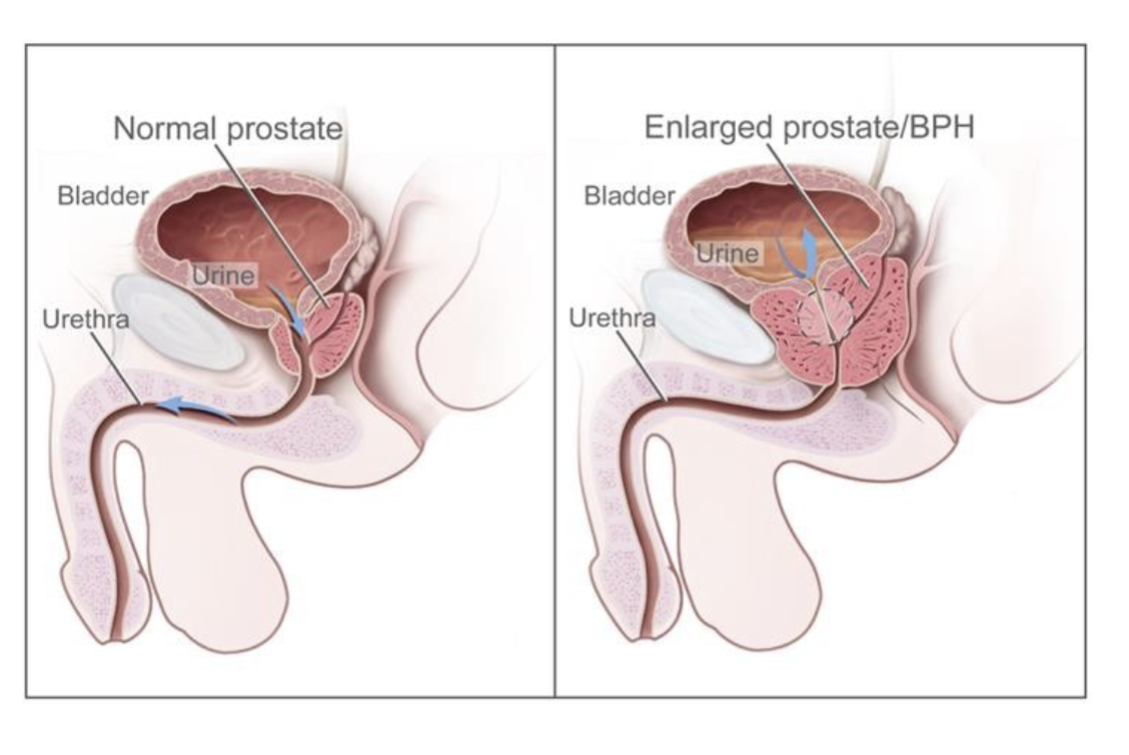
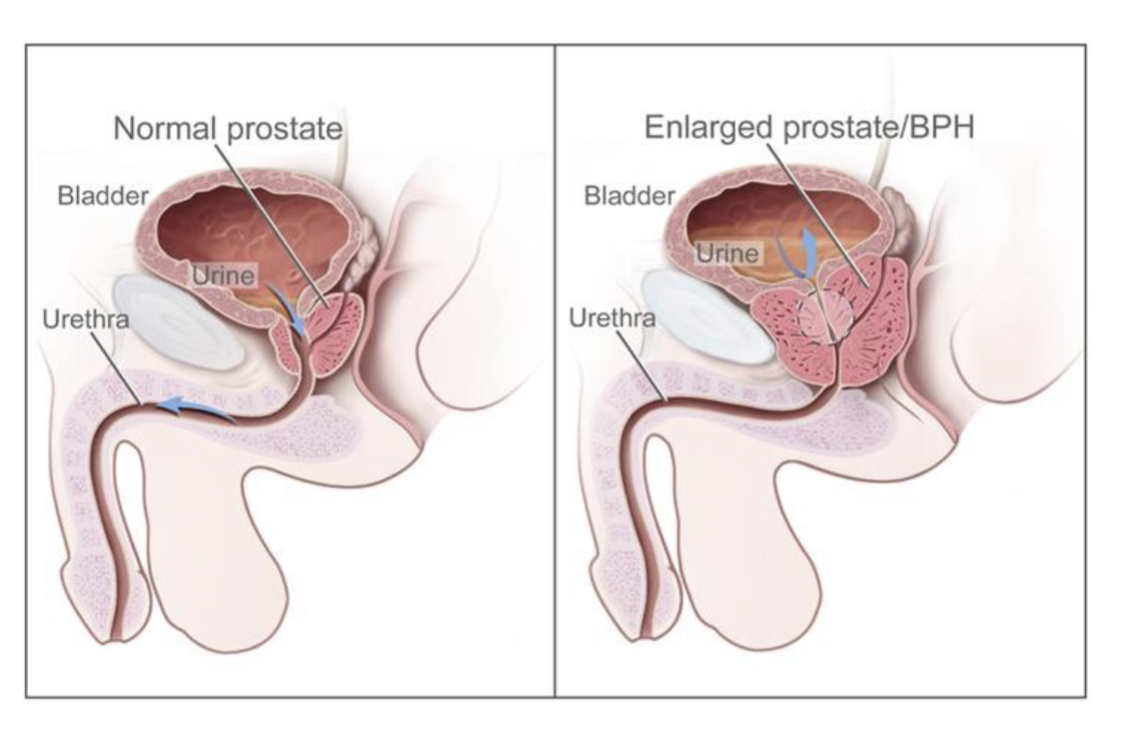
how does BPH affect the bladder and urethra?
the enlarge tissue pushes into/presses on the bladder and urethra, slowing or blocking urine flow
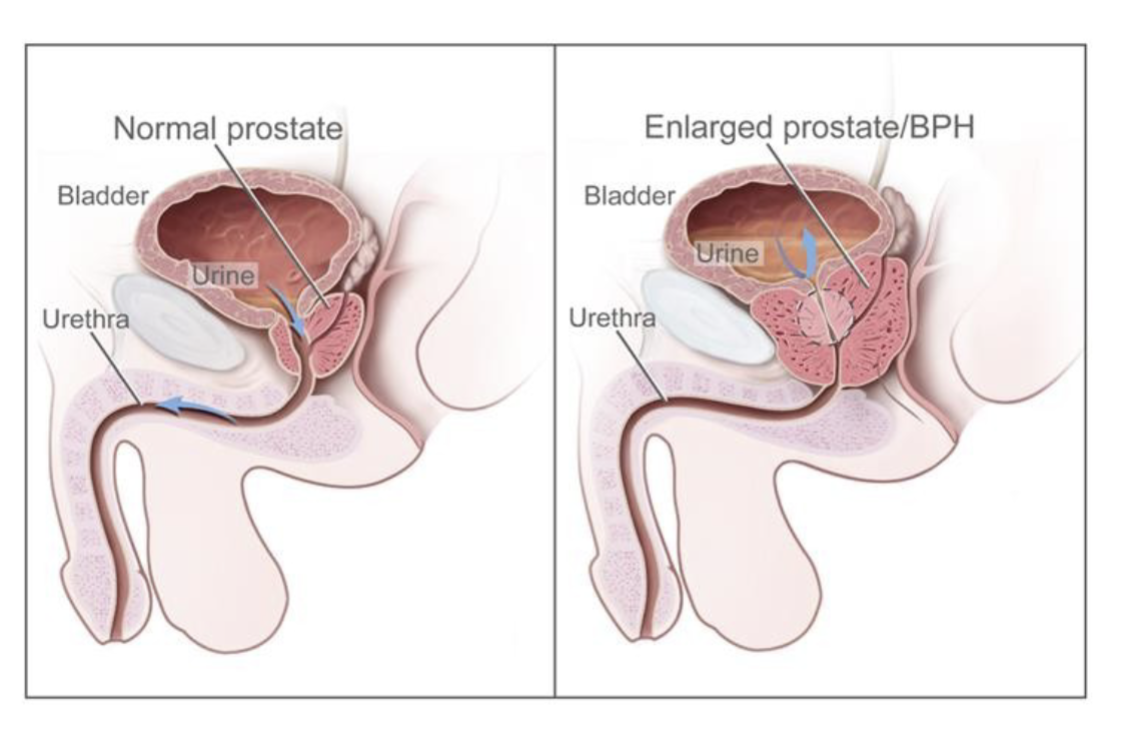
what is the major complication of BPH?
bladder irritation
obstruction/urinary retention
incomplete emptying → overflow incontinence
what tool is sued to assess BPH symptoms? what does it measure? what are the symptoms odes the I-PSS measure the severity for?
the I-PSS (International Prostate Symptom Score) which test for the severity of urinary symptoms related to prostate enalrgement
sense of incomplete emptying
frequency
intermittency
urgency
decreased force/caliber of stream
straining hesitancy
nocturia
what is the first physical assessment for suspected BPH?
palpate the bladder or use a bladder scan to check for urinary retention and then we can go on and find the cause of which a digital rectal exam would be the first one to be done to check for an enlarged prostate
what exam is is used to feel the prostate?
digital rectal exam
what lab tests are used in BPH assessment?
Urinalysis (infection/hematuria)
CBC
BUN & creatinine (kidney function)
PSA (prostate-specific antigen)
what radioly tests help evaluate BPH?
Transrectal ultrasound (TRUS)
Urodynamic studies
Cystoscopy
Biopsy (if needed to rule out cancer)
what is the first-line non-surgical approach for mild BPH?
active surveillance (“watchful waiting”)
what lifestyle changes help reduce BPH symptoms?
avoid drinking large amounts of fluid at once
limit alcohol, caffeine, and diuretics
void when you feel the urge
what medications should BPH patients avoid?
meds that worsen urinary retention such as antihistamine (especially the first generation with significant anticholinergic effects) and decongestants
what are the two main medication classes used to treat BPH?
5-alpha-reductase inhibitiors and alpha-1 selective blockers
how do 5-alpha-reductase inhibitors help with BPH?
they shrink the prostate over time
they block the enzyme that turns testosterone into DHT, the hormone that makes the prostate grow (less DHT = smaller prostate = improve urine growth)
how do alpha-1 selective blockers help with BPH?
they relax the smooth muscle in the prostate and bladder neck which help the urethra opens more easily which in turn improve urine flow
true or false: alpha-1 selective blockers works fast (from days to weeks) while 5-alpha-reductase can take months to work because they change the size not the muscle tone of the prostate
true
when are surgical treatments considered for BPH?
when symptoms are severe, medication fails, or urinary rention/complications occur
what is TURP and how does it help with BPH?
transurethral resection of the prostate
a scope is inserted through the urehthra to cut away excess prostate tissue to relieve obstruction
VERY BLOODY! because it cut each small area of tissues at a time
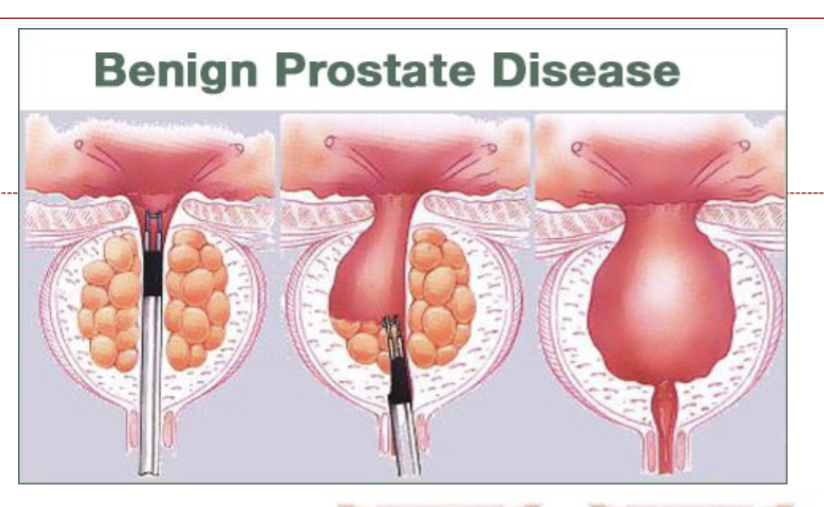
what is HoLEP and how does it help with BPH?
holmium laser enucleation of the prostate
A laser is used to remove obstructing prostate tissue (cut the whole thing once)
less bleeding and more effective for large prostate
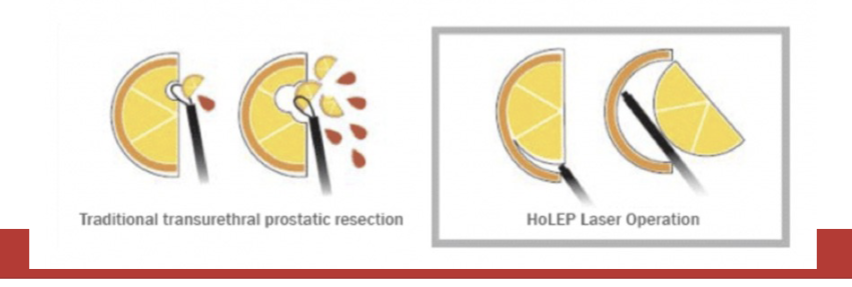
what key teaching is needed before TURP or HoLEP?
catheter teaching — explain that they will wake up with a catheter and why it’s important.
what kind of catheter is used after TURP/HoLEP?
a 3-way Foley catheter for continuous bladder irrigation.
why is traction applied for to the catheter after TURP/HoLEP? how long is this traction applied for?
traction is applied for 24 hours to help compress the prostate bed and reduce bleeding.
what is overhead irrigation (OHI) used for after TURP/HoLEP?
to continuously flush the bladder, prevent clots, and keep urine flowing freely.
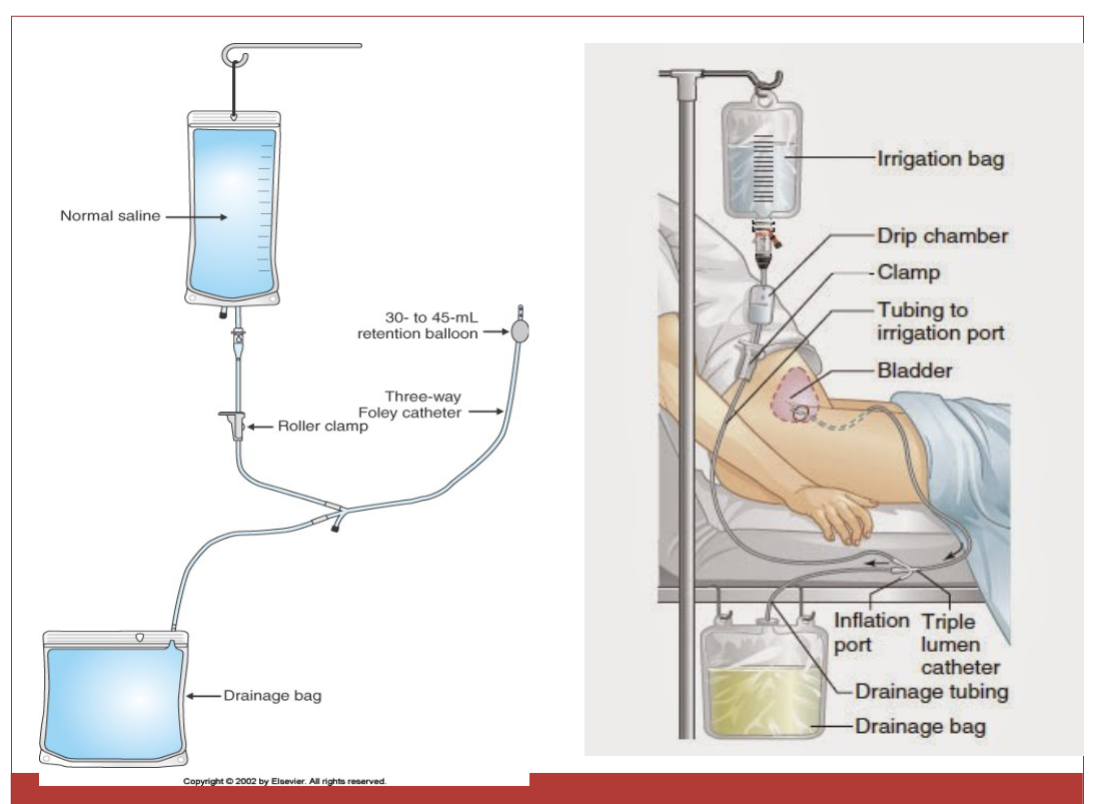
what urinary symptoms are normal after TURP/HoLEP once the catheter is removed?
Burning with urination
Frequency
Dribbling or leakage
Passing small clots for a few days
what activity restriction should be followed after TURP/HoLEP?
avoid strenuous activity for 2-3 weeks to reduce bleeding risk
what are the major surgical complications after TURP/HoLEP?
infection and post-operative bleeding
how often should urine be assessed for bleeding after prostate surgery?
every 2-4 hours to check for color, clots, and urine flow
what irrigation methods are used to manage post-op bleeding?
overheat irrigation
intermitten catheter irrigation
why might traction tape need to be reapplied after surgery?
to compress the prostate bed and reduce ongoing bleeding
what labs should be monitored for bleeding after TURP/HoLEP?
hemoglobin and hematocrit to watch for blood loss
true or false: prostate cancer is one the slowest growing cancer
true
what type of tumor makes up most prostate cancers?
Adenocarcinomas, many of which are androgen-sensitive (grow with male hormones).
Adenocarcinomas are tumors that begin in the glandular cells of the prostate — the cells that make prostate fluid (part of semen).
These cancers grow from secretory/gland-forming tissue, which is why the majority of prostate tumors follow the same predictable pattern.
where do most prostate adenocarcinomas originate?
in the peripheral zone of the prostate. Because this area does not affect the urethra early, the cancer often goes unnoticed until later stages, unless detected by PSA screening or DRE.
how is prostate cancer classified?
almost all prostate cancers are adenocarcinomas arising from glandular cells. They are not labeled as “small cell” or “non–small cell” (those terms only apply to lung cancers).
what is the strongest risk factor for prostate cancer?
increasing age - most cases occur in men over 65
how does family history affect prostate cancer risk?
having a first-degree relative (father, brother) with prostate cancer greatly increases risk
which racial/ethnic group has the highest and which have the lowest risk of prostate cancer?
African American men have the highest incidence and mortality
Asian/Pacific Islander men have the lowest
what inherited gene mutations increase prostate cancer risk?
BRCA1 and BRCA2
RNASEL (a tumor suppressor gene)
when should averge-risk men start discussing prostate cancer screening with thier provider?
at the age of 50
when should screening discussion begin for African American men or men with one first-degree relative with prostate cancer?
at age 45
when should men with more than one first-degree relarive with prostate cancer start the discussion?
at age 40
what is the life expectancy requirement for prostate cancer screening discussions?
screen discussion should only occur if the man has a life expectancy of at least 10 years (if the patient have less than 10 years to live due to the cancer already being so advance then there is really no point)
what are the two main screening tools for prostate cancer?
DRE (Digital Rectal Exam)
PSA (Prostate-Specific Antigen) blood test
what do you do if PSA is 2.5 ng/mL or lower?
Recheck every 2 years.
(Low number → longer interval)
What do you do if PSA is above 2.5 ng/mL?
Recheck every year.
(Higher number → closer follow-up)
what is the normal range for PSA (prostate-specific antigen)
0-4 ng/mg
what additional testing (beside from DRE) is recommended if PSA is elevated?
Free PSA (fPSA)
Transrectal ultrasound (TRUS)
Prostate biopsy (if needed)
CT/MRI to check for metastasis if cancer is suspected or confirmed
why check free PSA (fPSA) after an elevated PSA?
A lower % free PSA = higher risk of prostate cancer.
(Used to help decide whether biopsy is needed.)
what does a Digital Rectal Exam (DRE) detect?
hard nodules, asymmetry, or irregularities in the peripheral zone where most prostate cancers form.
what is the prostate cancer screening pathway?
PSA + DRE
If PSA ≤ 2.5 → repeat every 2 years
If PSA > 2.5 → repeat yearly
If elevated → fPSA, TRUS + biopsy, CT/MRI if needed
what are early signs/symptoms of prostate cancer?
Difficulty starting urination (hesitancy)
Urinary retention
Recurrent bladder infections
(These happen because the tumor eventually presses on the urethra.)
why might early prostate cancer have few symptoms?
most prostate cancers start in the peripheral zone (prostate cancer are mostly adenocarcinoma), far from the urethra, so symptoms often appear late.
what are late signs of prostate cancer?
Blood in urine or semen
Persistent pain in the back, hips, or pelvis
Unexpected weight loss
Leg weakness or numbness
Loss of bladder or bowel control
(These usually indicate metastasis, especially to bone or spine.)
what does bone pain + leg weakness + weight loss usually suggest in prostate cancer?
advanced disease or metastasis, often to the bone or spinal column.
what does staging tell you in cancer?
How far the cancer has spread.
Staging describes the size of the tumor, if it’s in lymph nodes, and if it has metastasized. → how much of the body is involved?
what does grading tell you in cancer?
How abnormal the cancer cells look under the microscope and how fast they are likely to grow.
Think: Grading = Growth speed + cell appearance
(“How aggressive does it look?”)
what’s the difference between staging and grading?
Staging = where the cancer is.
Grading = how the cancer behaves.
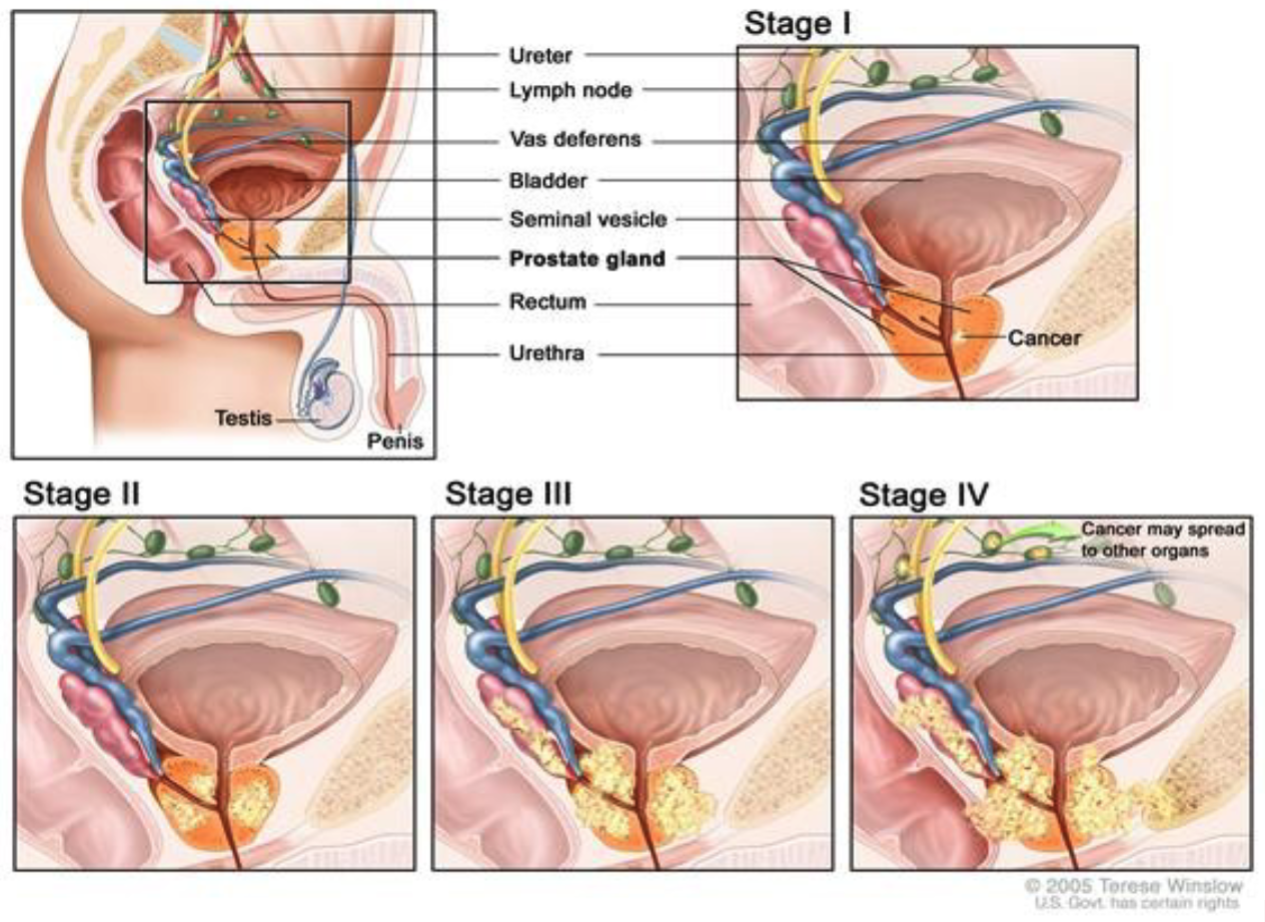
how do staging and grading apply to prostate cancer?
Stage: TNM system (tumor size, lymph nodes, metastasis)
Grade: Gleason score, based on how abnormal the prostate cells look
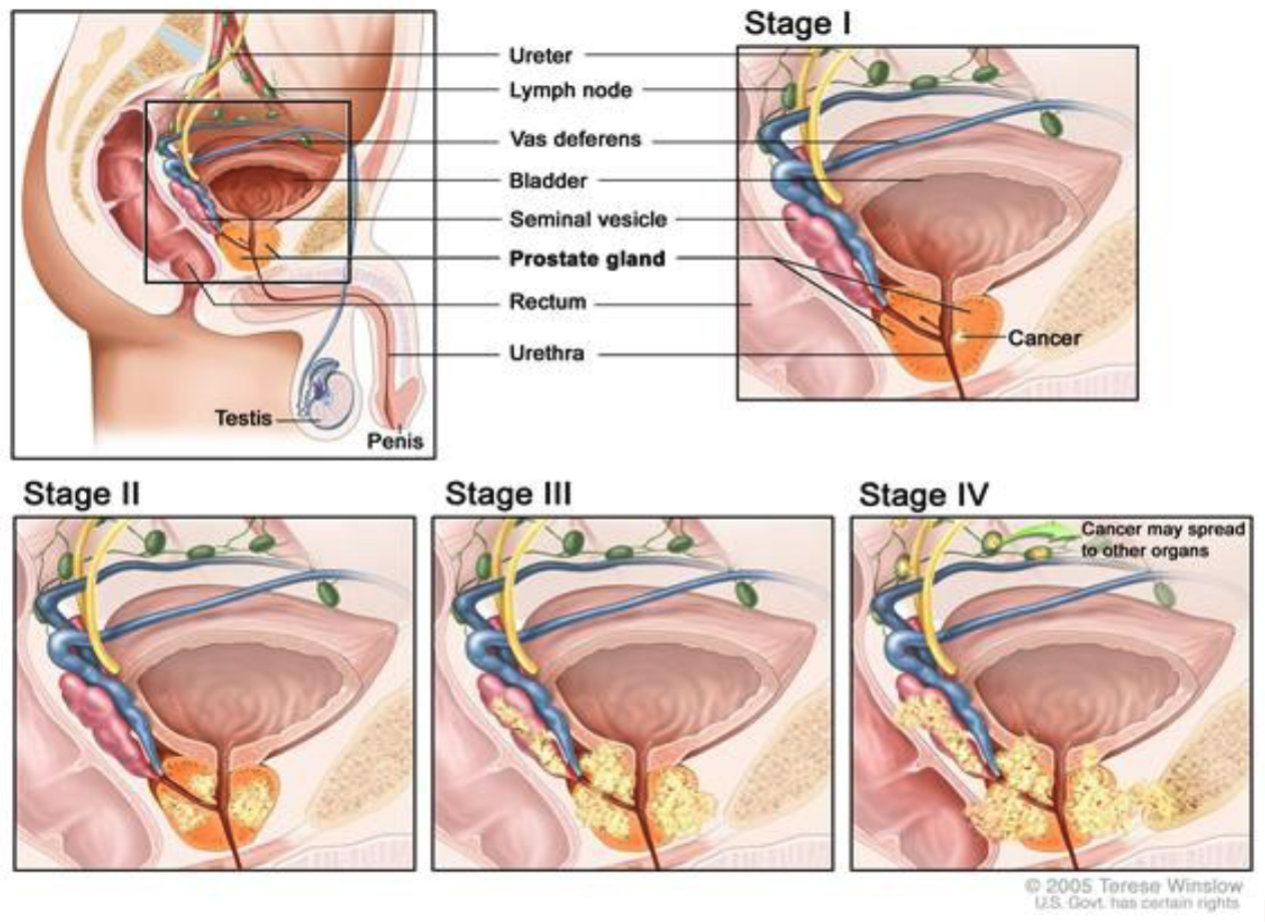
what is active surveillance for prostate cancer?
“Watchful waiting”—regular monitoring (PSA, DRE, imaging) without immediate treatment, used when cancer is slow-growing or patient has limited symptoms.
what are the main radiation therapy options for prostate cancer?
External beam radiation and low-dose brachytherapy.
what are the two types of external beam radiation used for prostate cancer?
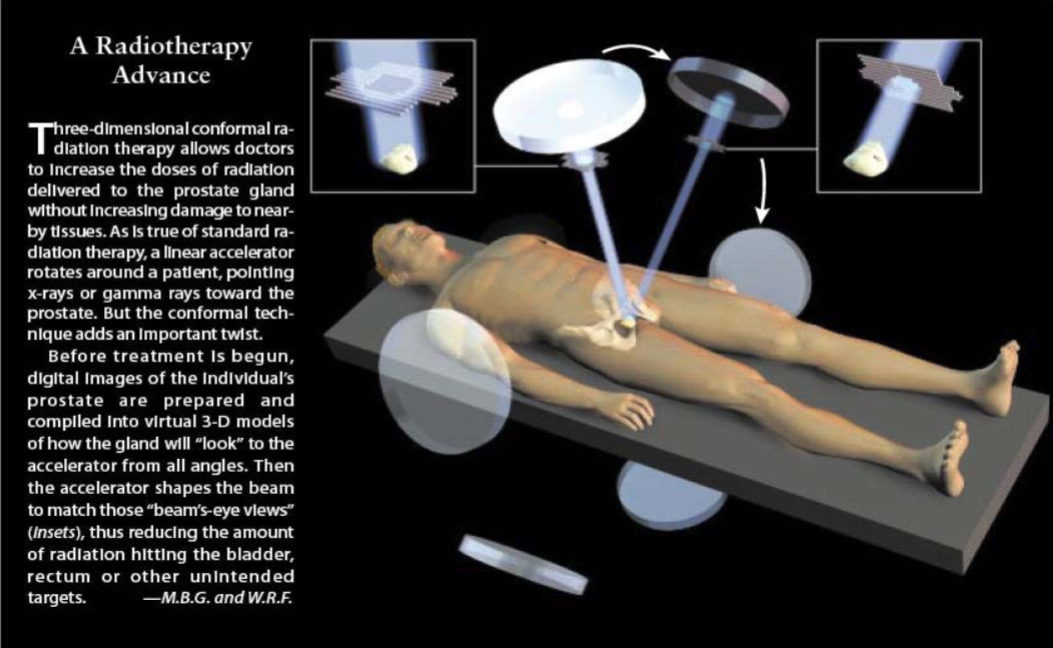
3D-CRT (3D-conformal radiation therapy): Shapes radiation beams to the prostate.
IMRT (Intensity-Modulated Radiation Therapy): More precise; adjusts beam intensity to spare healthy tissue.
what is low-dose brachytherapy for prostate cancer?
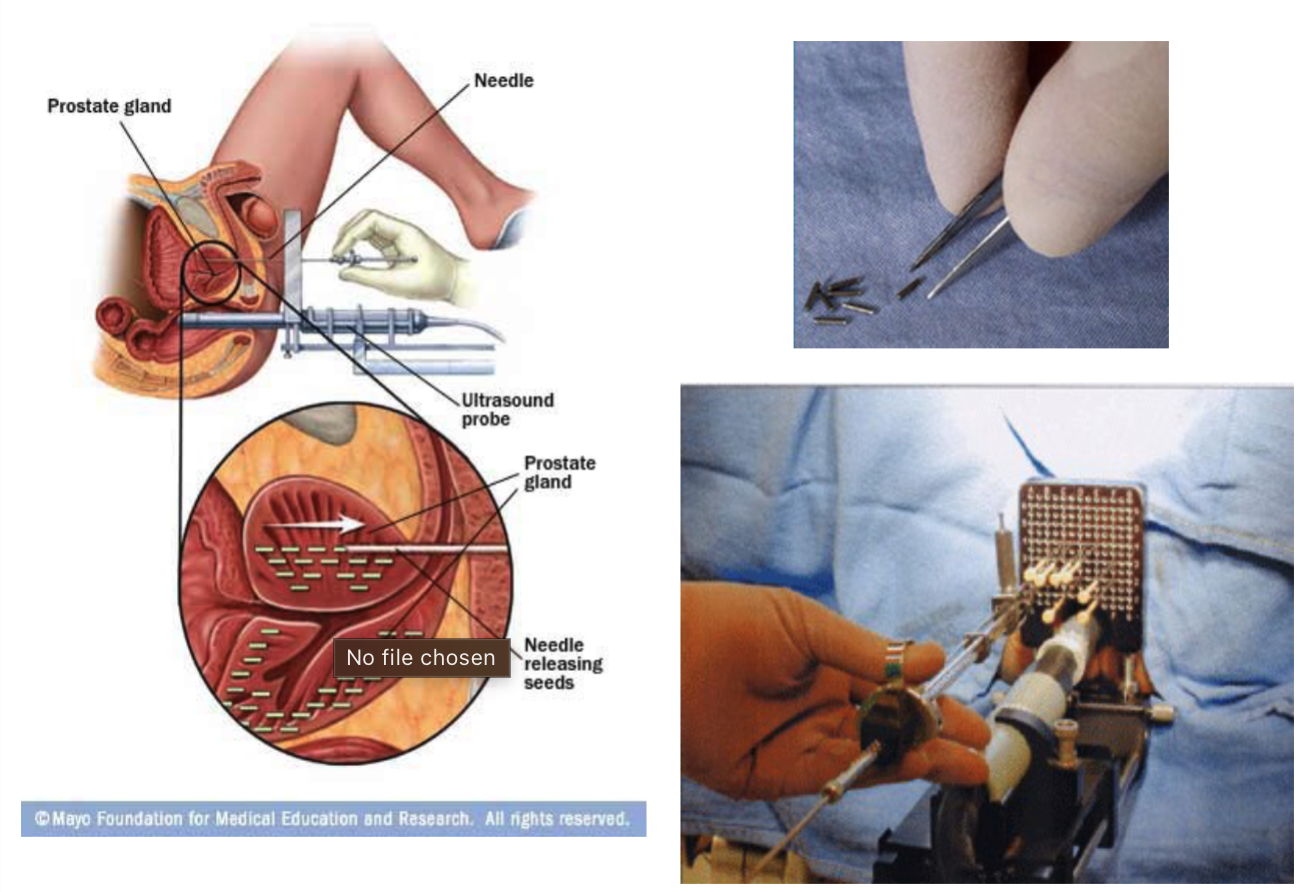
Tiny radioactive seeds implanted directly into the prostate, delivering continuous low-dose radiation over time.
what is the main surgical treatment for prostate cancer?
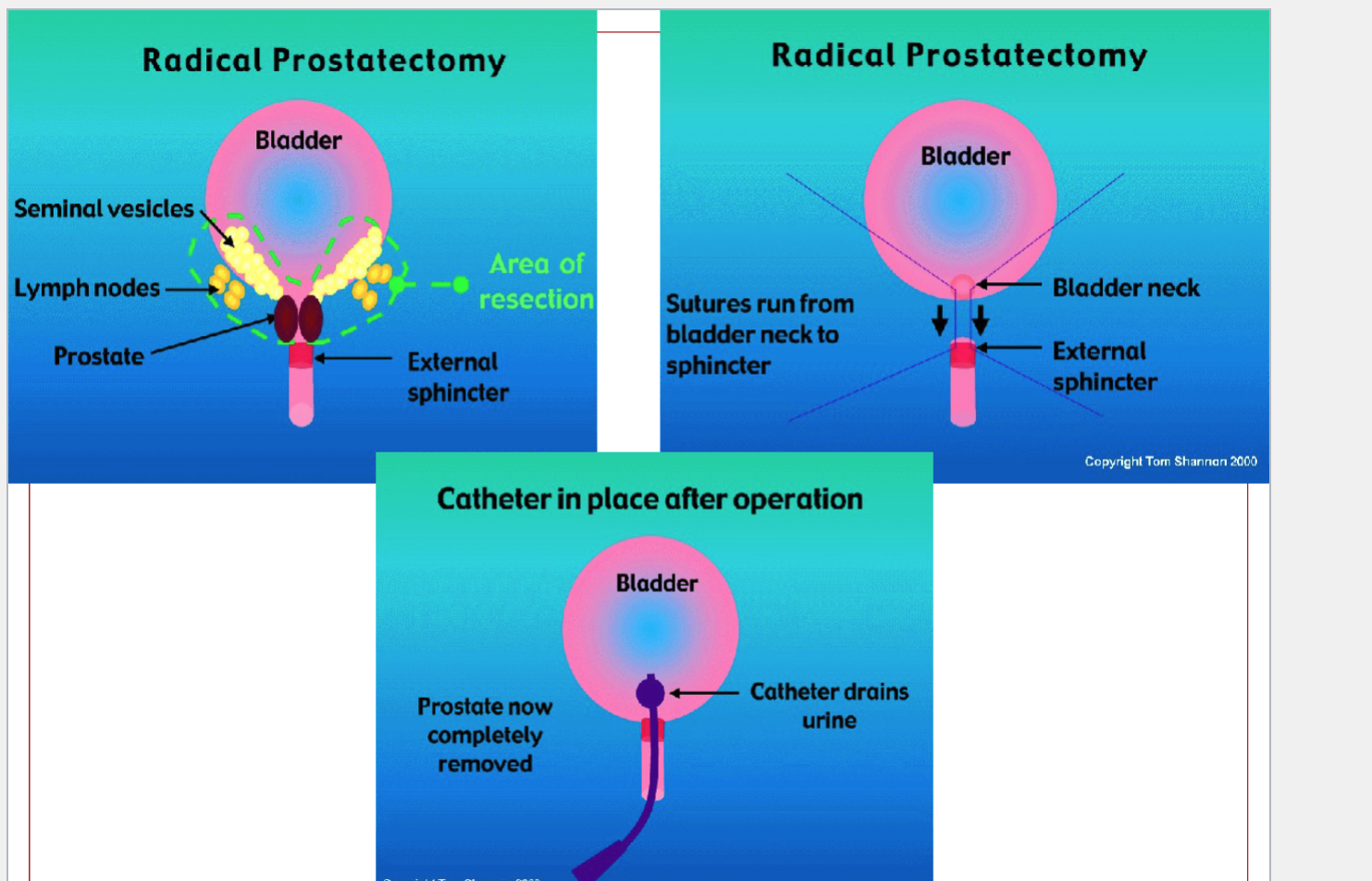
Radical prostatectomy with lymph node dissection (LND).
what is a laparoscopic radical prostatectomy (LRP)?
A minimally invasive surgery done through small incisions; may be done with or without robotic assistance —> remove the entire prostate gland
what is the open surgical approach for prostate cancer?
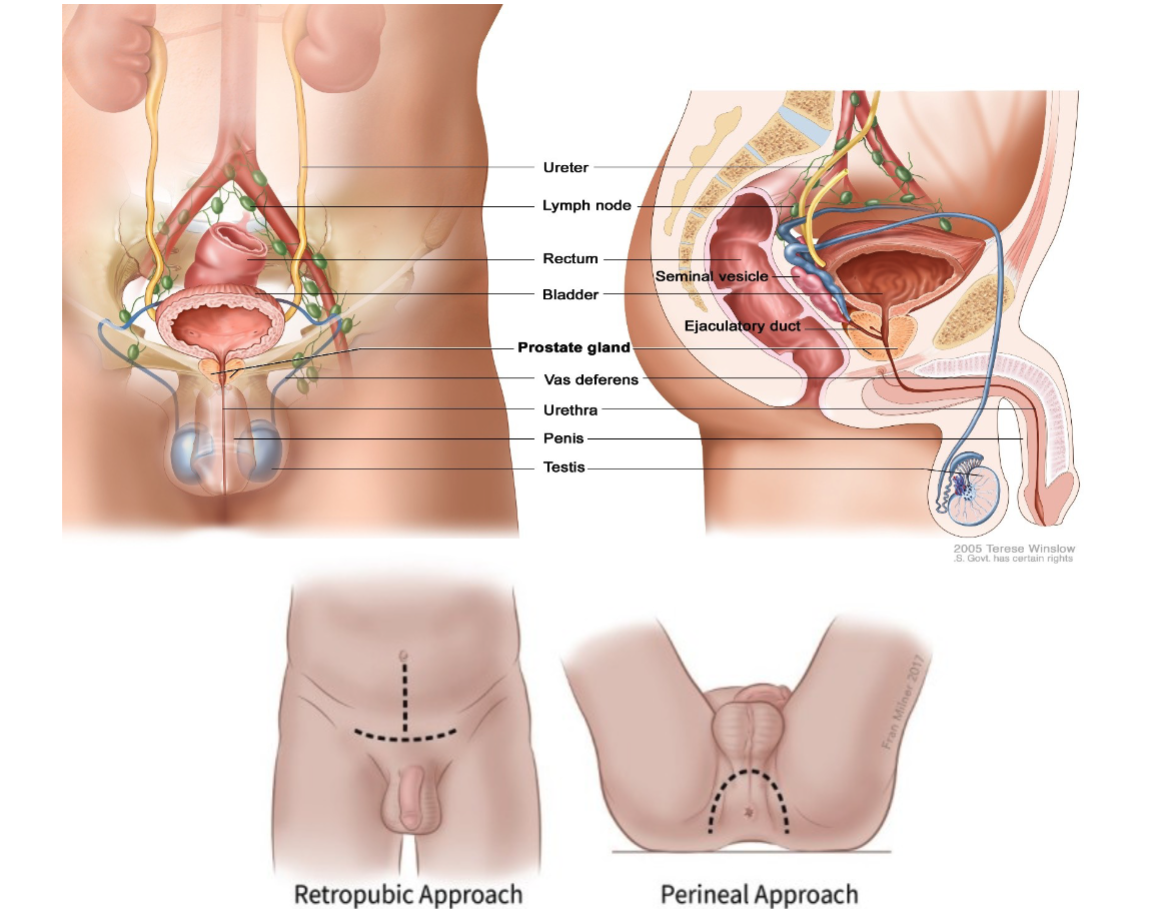
A radical prostatectomy, performed through one large incision (either radical retropubic or transperineal), where the entire prostate gland is removed along with some surrounding tissue and often nearby lymph nodes.
do they remove the whole prostate in an open prostatectomy?
YES!
what is a laparoscopic radical prostatectomy (LRP)? Is it different from the open approach?
Laparoscopic Radical Prostatectomy (LRP)
A minimally invasive version of the same surgery.
Key features:
Several small incisions (instead of one large one)
A camera and fine instruments are used
Can be done with or without robotic assistance (e.g., Da Vinci robot)
How it differs from the open approach
Feature | Laparoscopic Radical Prostatectomy (LRP) | Open Radical Prostatectomy |
|---|---|---|
Incisions | Small (keyhole) | One large incision |
Recovery | Faster | Longer |
Blood loss | Less | More |
Pain | Less postoperative pain | More pain |
Visualization | Excellent (camera magnification) | Normal |
What is removed? | Same: entire prostate + surrounding tissues | Same: entire prostate + surrounding tissues |
➡ Both surgeries remove the whole prostate—the only difference is the surgical method and recovery.
what are the main nursing priorities after prostate cancer surgery?
catheter care, watching urine/wound drainage, and managing pain.
why is catheter care essential after a prostatectomy?
the urethra needs time to heal; the catheter keeps urine flowing so the surgical site isn’t stressed.
what should you assess in the urine after prostatectomy?
color, amount, presence of clots, and signs of bleeding or infection.
what wound signs should be monitored post-op
redness, swelling, drainage, and any signs of infection.
what is the goal of pain management after prostate surgery?
keep discomfort controlled so the patient can breathe, ambulate, and heal effectively.
what complications may occur after prostate cancer surgery?
sexual dysfunction (ED) and urinary incontinence.
what key discharge teachings follow a prostatectomy?
catheter care at home, activity restrictions, wound monitoring, hydration, and when to notify the provider.
what is the goal of hormone therapy in prostate cancer?
to lower testosterone levels because testosterone fuels prostate cancer growth
when can hormone therapy be used for prostate cancer?
before, during, or after, radiation or alone for recurrent prostate cancer
how does hormone therapy reduce testosterone?
throughh medications or surgical removal of the testes (orchiectomy)
when is chemotherapy used in prostate cancer?
typically for advanced or hormone-resistant prostate cancer (when cancer no longer responds to testosterone-lowering therapy)
what is erectile dysfunction (ED)?
the inability to get or keep an erection firm enough for sexual intercourse
how does age affect ED?
incidence increases with age
what commonly causes ED in older men?
disease, injury, or medications, psychological factors, smoking, and low testosterone
what is the first step in treating erectile dysfunction?
review and adjust any medications that may be causing ED.
what are the common oral medications for ED?
Sildenafil (Viagra), vardenafil (Levitra), tadalafil (Cialis), and avanafil (Stendra) (all of the -fil)
what locally injected medication can treat ED?
Alprostadil (injected into the penis to increase blood flow).
how does a vacuum erection device help with ED?
It creates suction to draw blood into the penis and maintain an erection with a constriction ring.
what is the surgical treatment for ED?
penile implants (inflatable or semi-rigid devices placed inside the penis).