histology of the musculoskeletal system
 Call Kai
 Learn
Learn Practice Test
 Spaced Repetition
 Match
Match Flashcards
 Knowt Play
1/84

There's no tags or description
Looks like no tags are added yet.
Name | Mastery | Learn | Test | Matching | Spaced | Call with Kai | Chat |
|---|
No analytics yet
Send a link to your students to track their progress
85 Terms
what does haemotoxylin stain and what colour ?
nucleus , purple
what does eosin stain and what colour?
cytoplasm , pink
what does the intensity of the staining depend on?
how long the slides are exposed to the solution
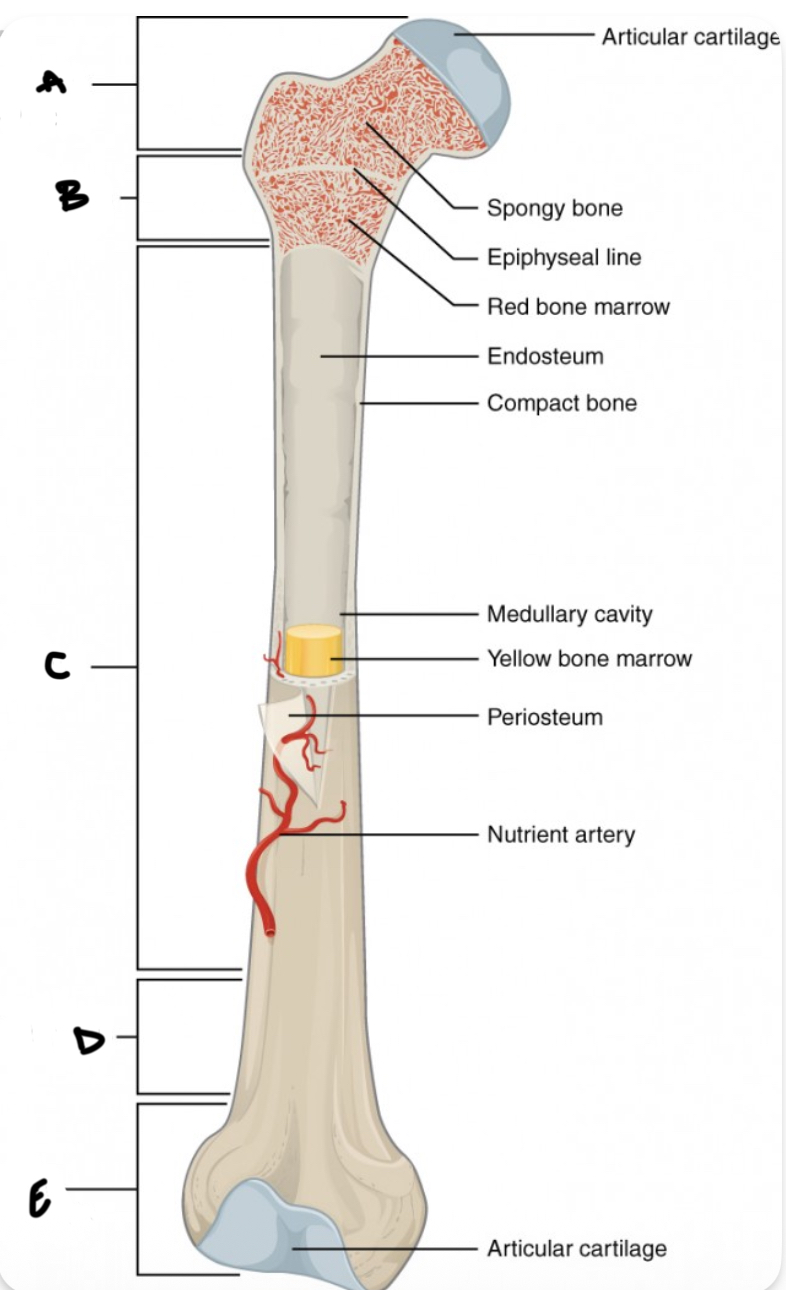
what is A?
Proximal epiphysis
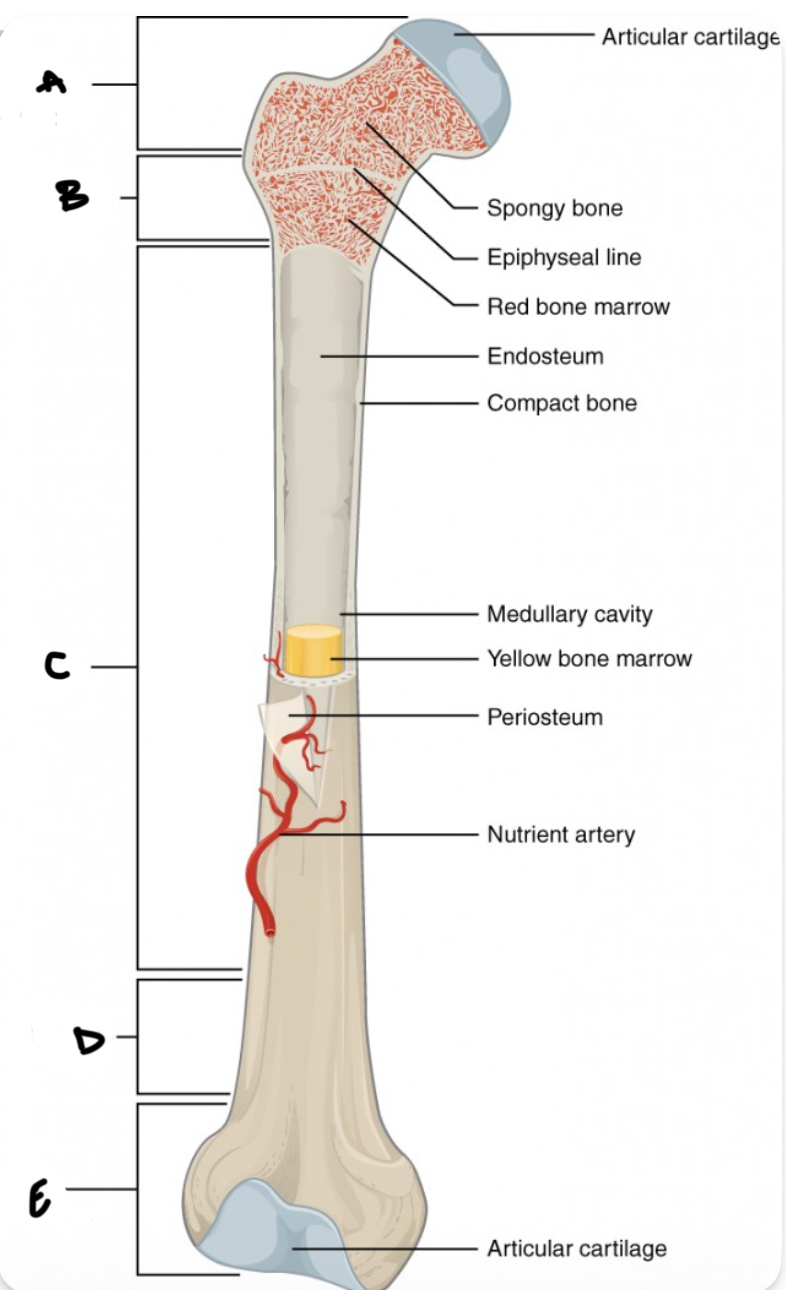
What is B?
Metaphysis
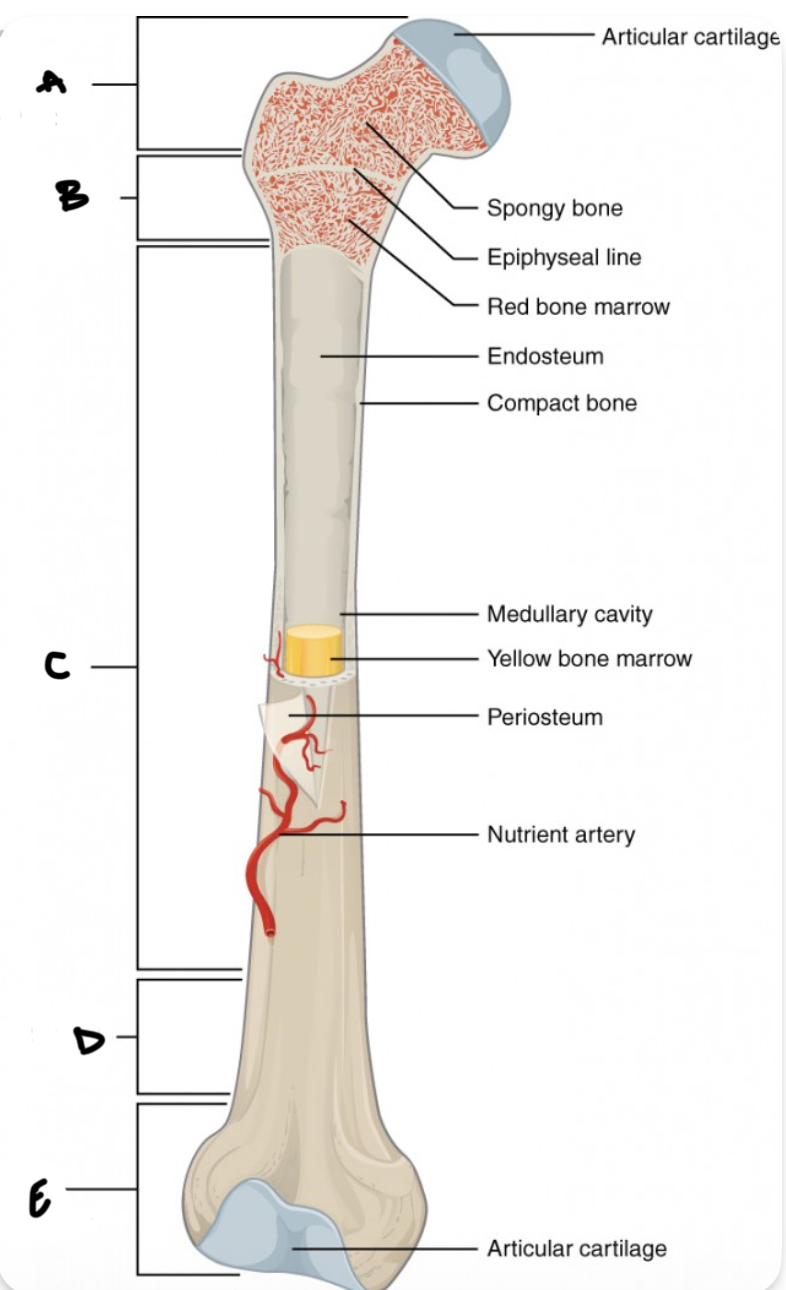
What is C?
Diaphysis
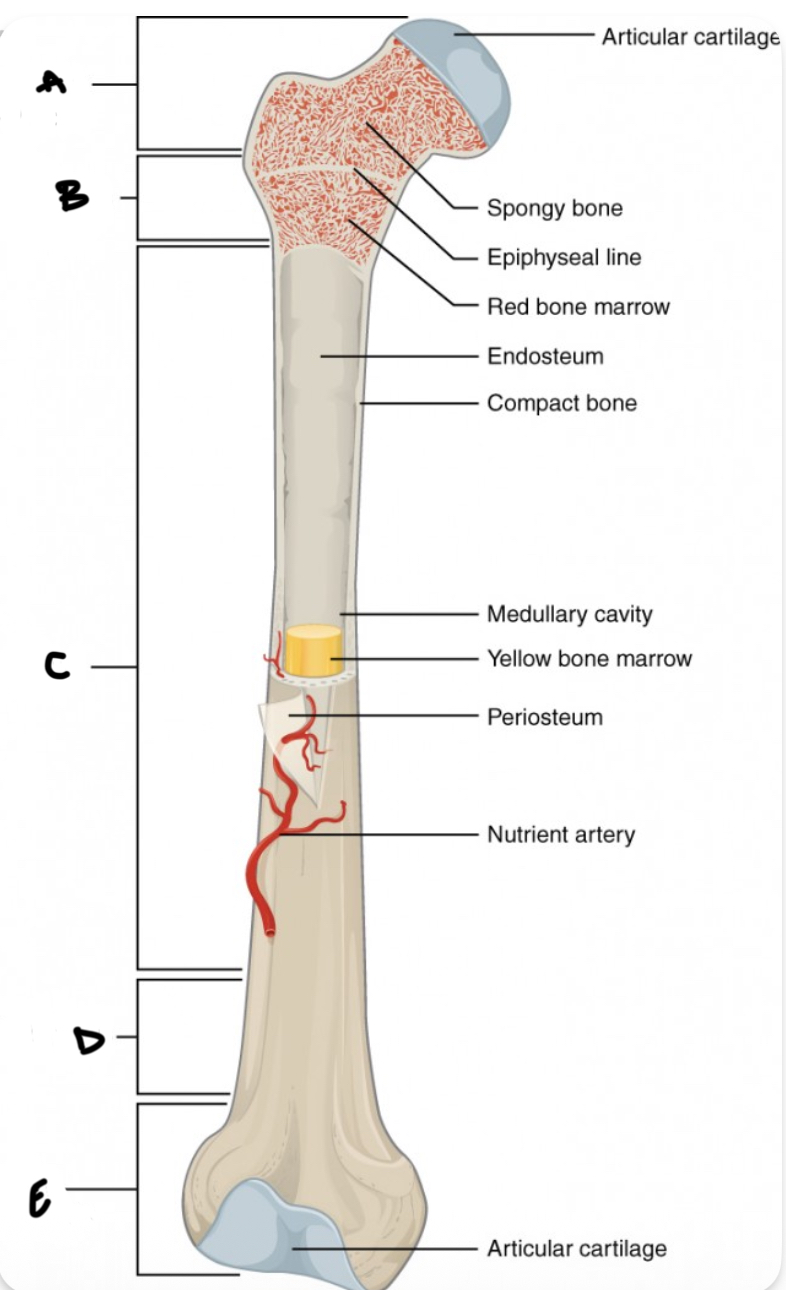
What is D?
Metaphysis
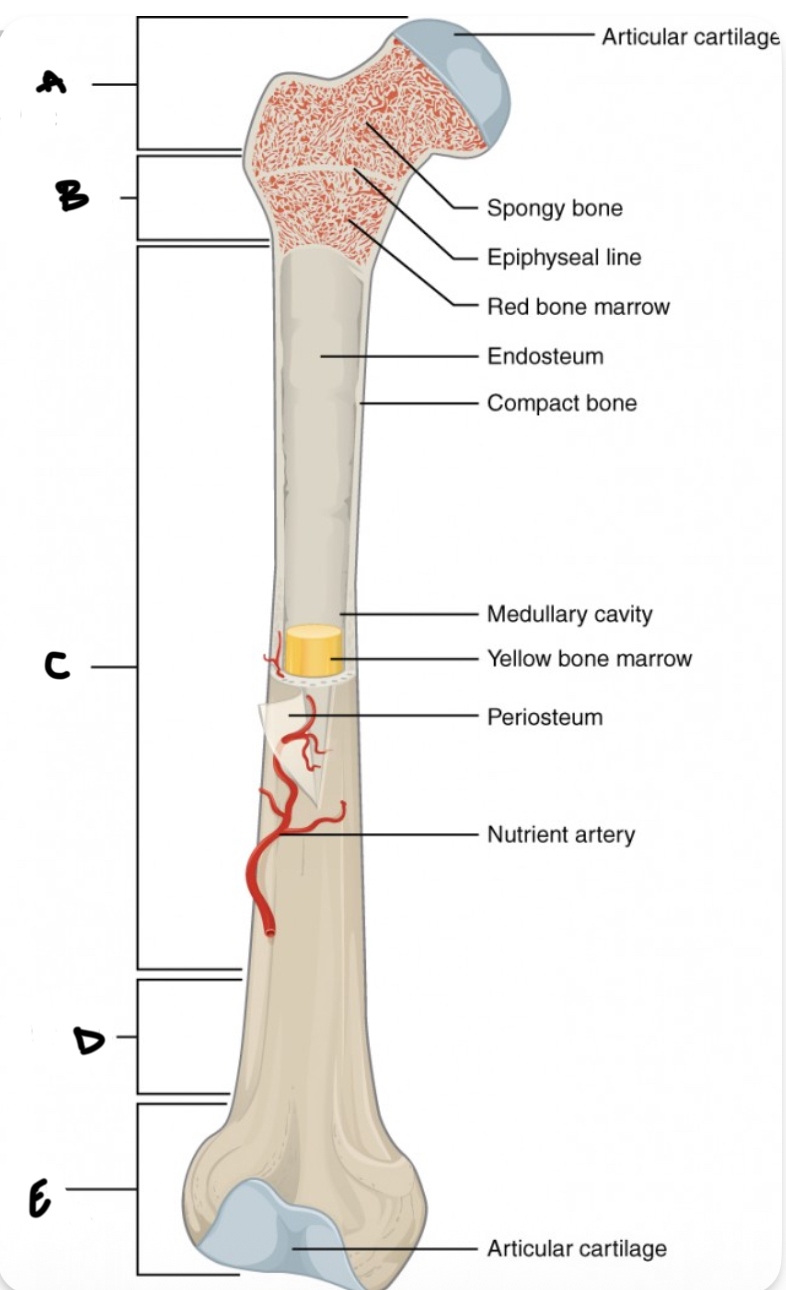
What is E?
Distal epiphysis
What is the periosteum?
Lining of the bones
What is the bone marrow?
Centre of diaphysis , has cells that are important in hematopoiesis or production of blood cells
What is trabecular bone?
Bony struts or bridges that run along central region of the bone inside the cortex it’s lighter as there’s less osteopenia meaning less bone tissue
What is red (hematopoetic) marrow?
produces red blood cells, its haemopoetic in nature (produces blood cells)
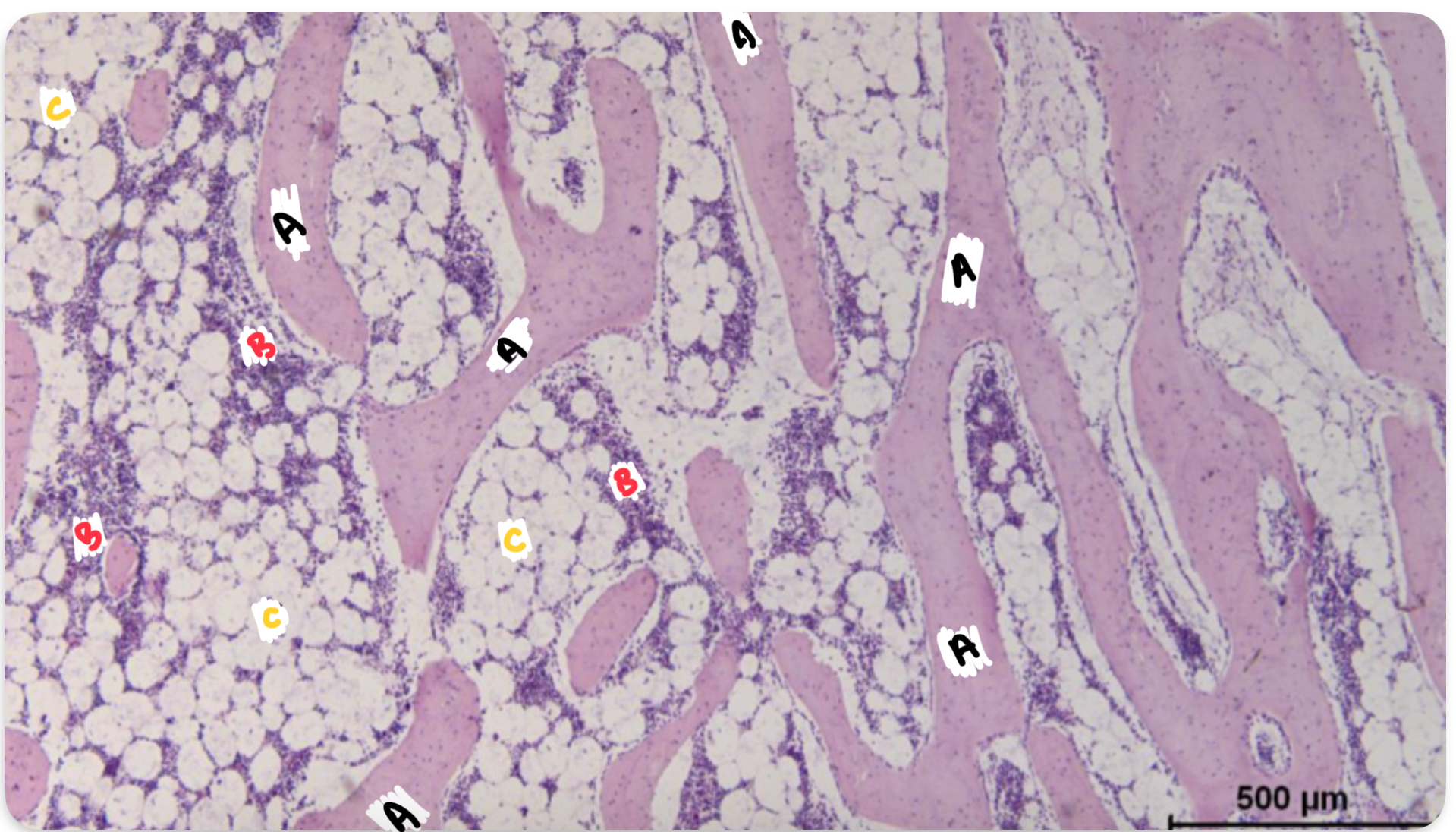
What part of the long bone is labelled A?
Trabecular bone
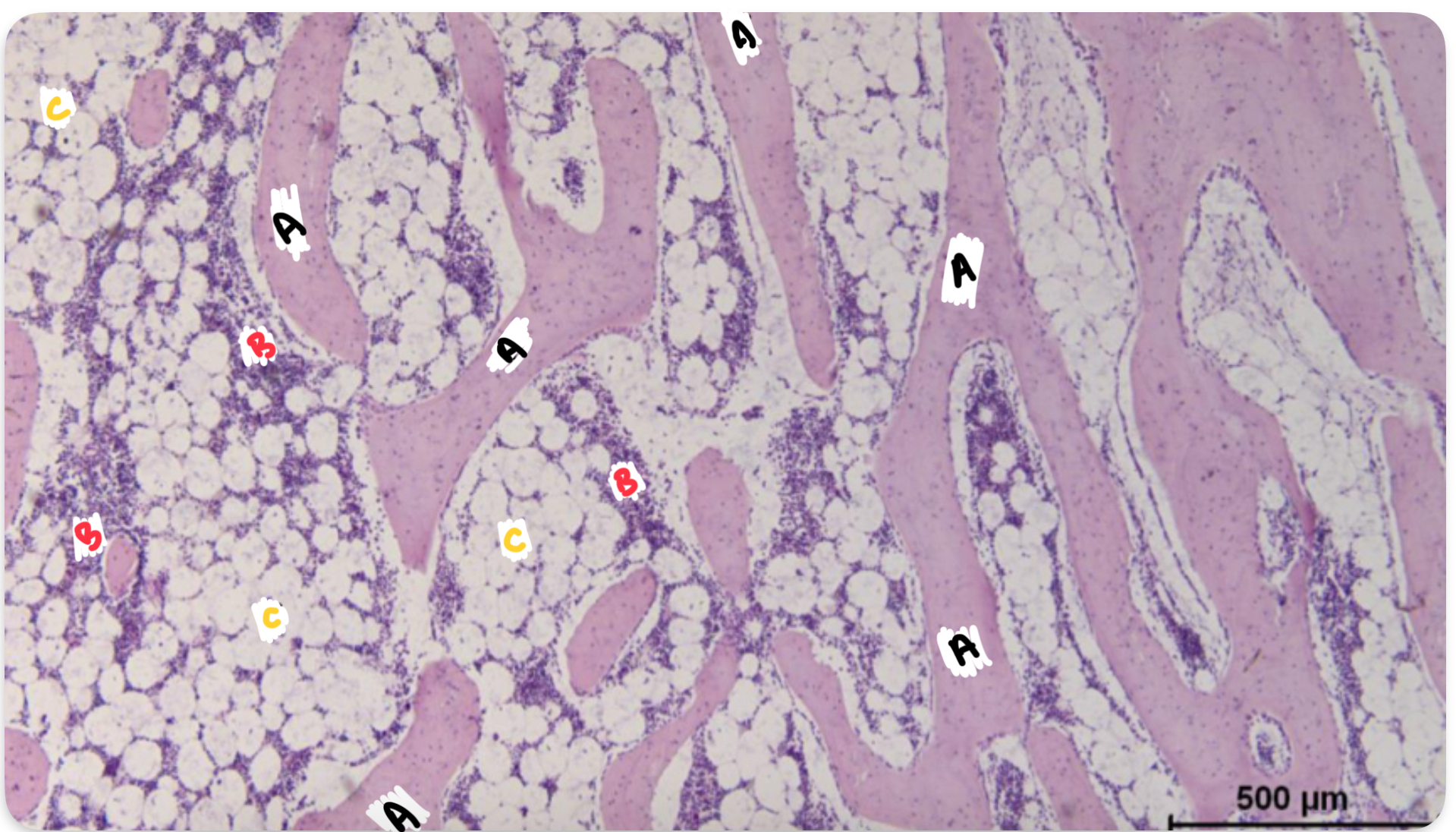
What part of the long bone is labelled B?
red (hematopoetic) marrow
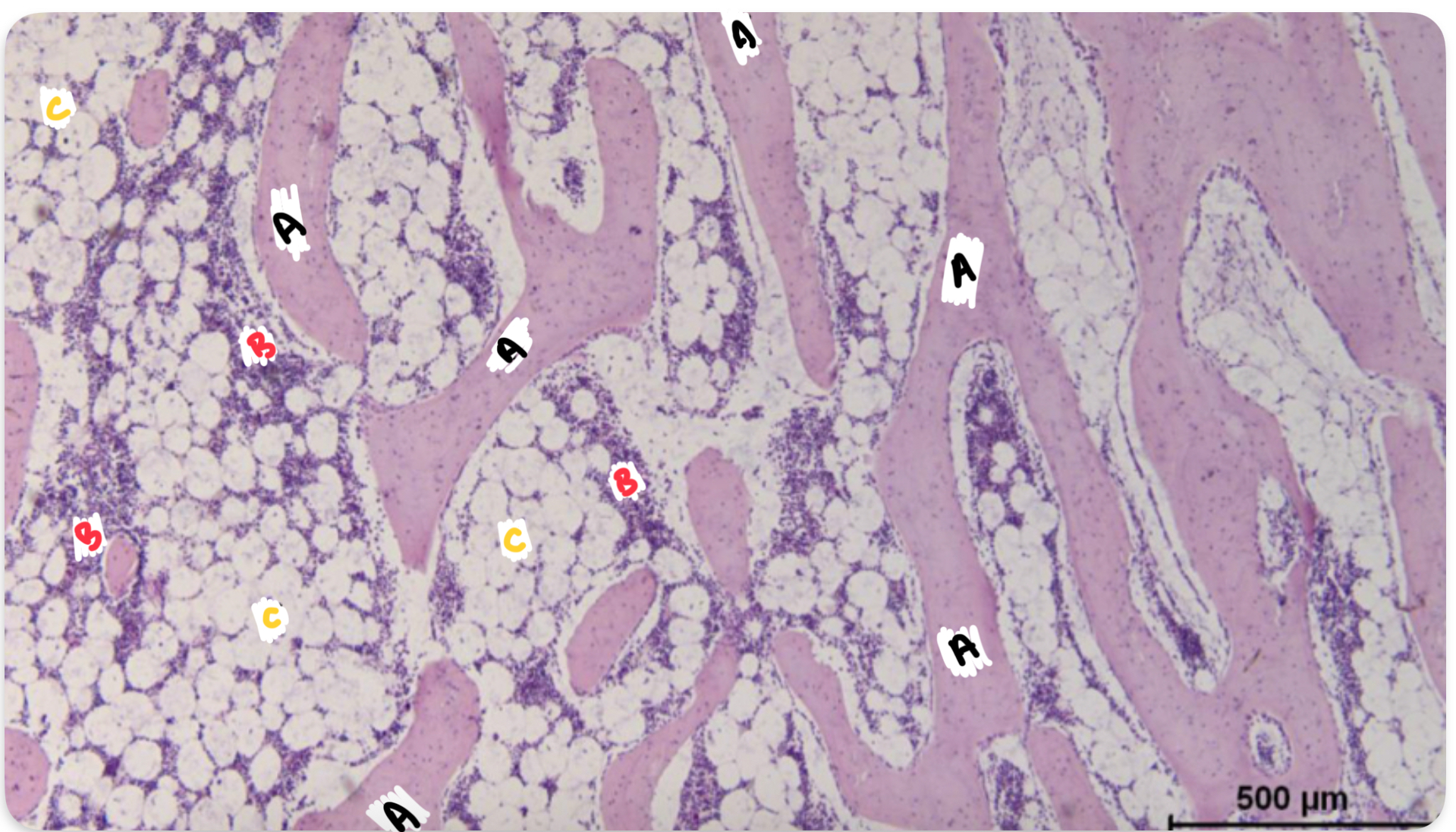
what part of the long bone is labelled C?
Yellow (fatty) marrow
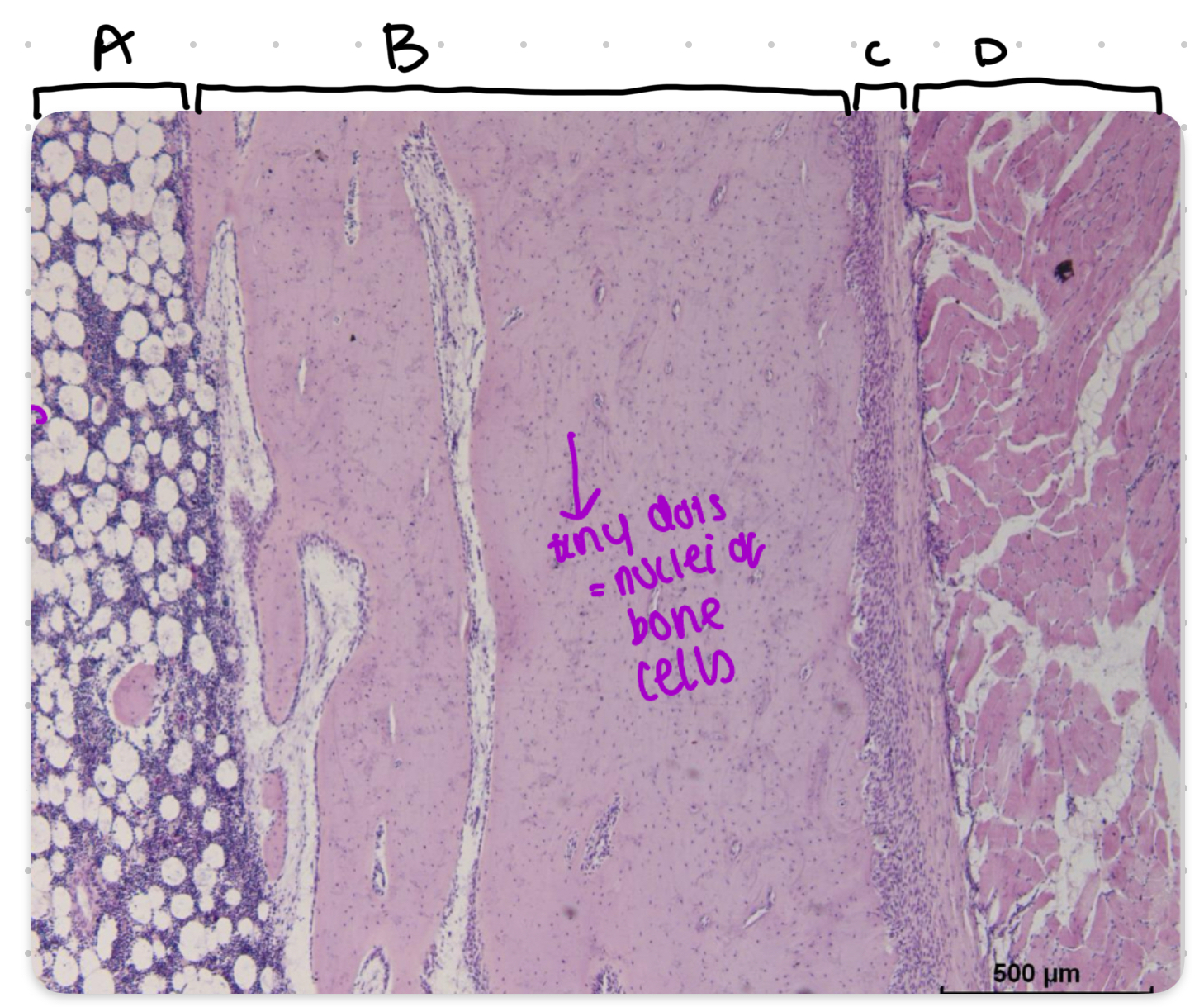
what is A?
Bone marrow
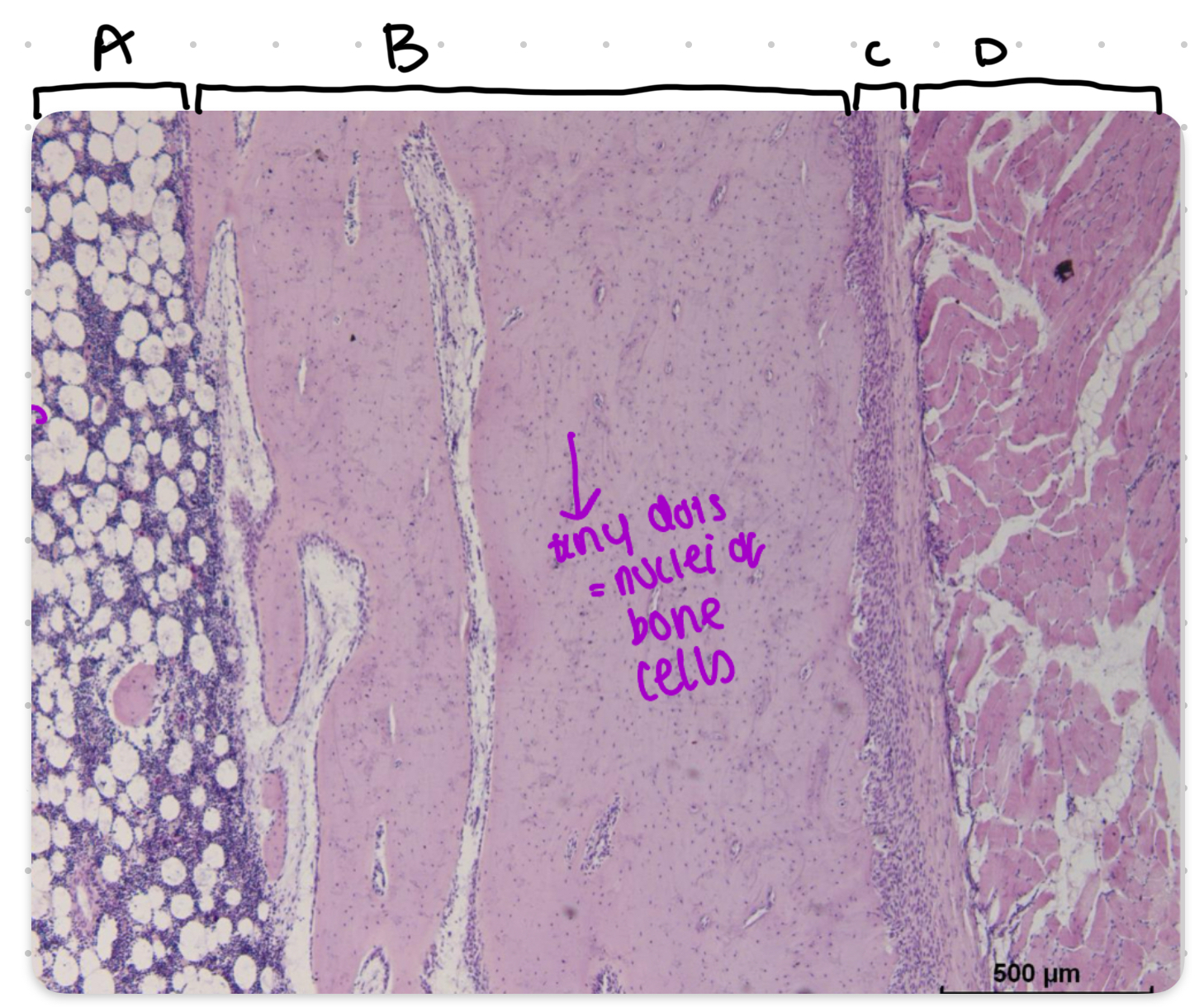
What is B?
Compact bone
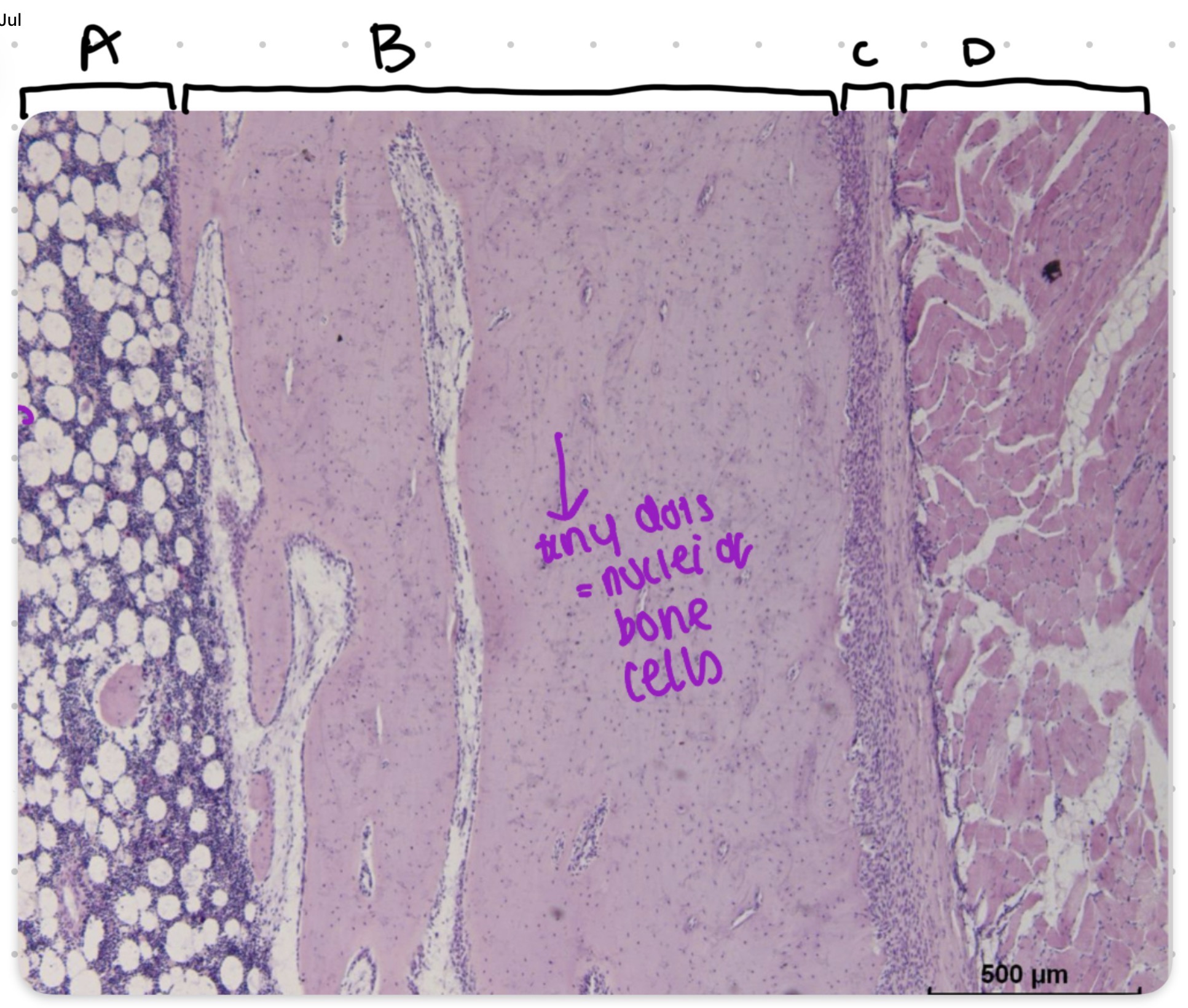
What is C?
Periosteum
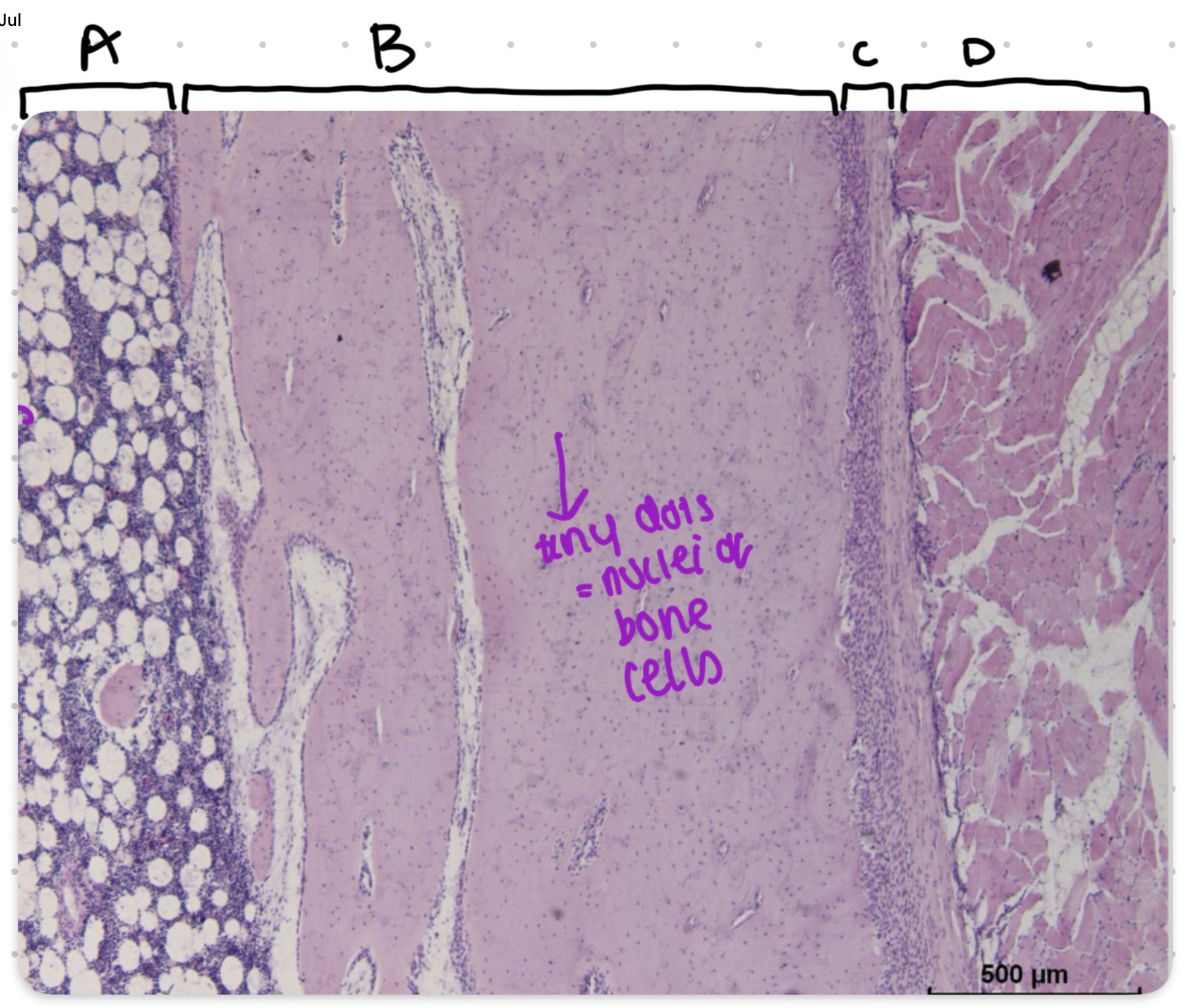
What is D?
Muscle
what do osteoblasts do?
Produce bone
What are some features of osteoblasts ?
One nuclei , sit on bone surface
How do osteoblasts produce bone matrix?
Bone matrix is inorganic in nature , subsequently gets mineralised by deposition of calcium + phosphate , osteoblasts secrete bone matrix to cell surface , therefore that part of the bone is denser / thicker resulting in an increased strength
What do osteoclasts do?
Engulf bone matrix and remove it
How do osteoclasts remove bone matrix
Reabsorb and secrete acid onto bone surface to break down bone matrix , engulf matrix and remove it, therefore reducing amount of bone matrix present making the bone smaller and lighter and less dense
Why does activity between osteoblasts and osteoclasts need to be balanced?
If we don’t want the amount of bone present changed
What balances osteoclasts and osteoblasts?
Osteocytes
What do osteocytes do?
connect to bone surface , able to sense strain placed on bone, signal to recruit osteoblasts and osteoclasts
Why are osteocytes well placed?
To regulate amount of bone production vs bone reabsorption, therefore regulating remodelling process
What do we do if we want to reduce the amount of bone present?
More osteoclastic activity needed to break bone down and release calcium , negative effect on strength of skeleton as breaking bone down
How would we increase levels of bone present?
More osteoblastic activity needed to increase bone present and suppress calcium, positive effect on strength of skeleton as increasing bones present
Why would we want to reduce the amount of bone?
To release calcium into the system
What is a lacunae ?
a space
Why are osteocytes surrounded by lacunae?
It’s fluid filled which is important for the sensing mechanisms that allow osteocytes to detect strain
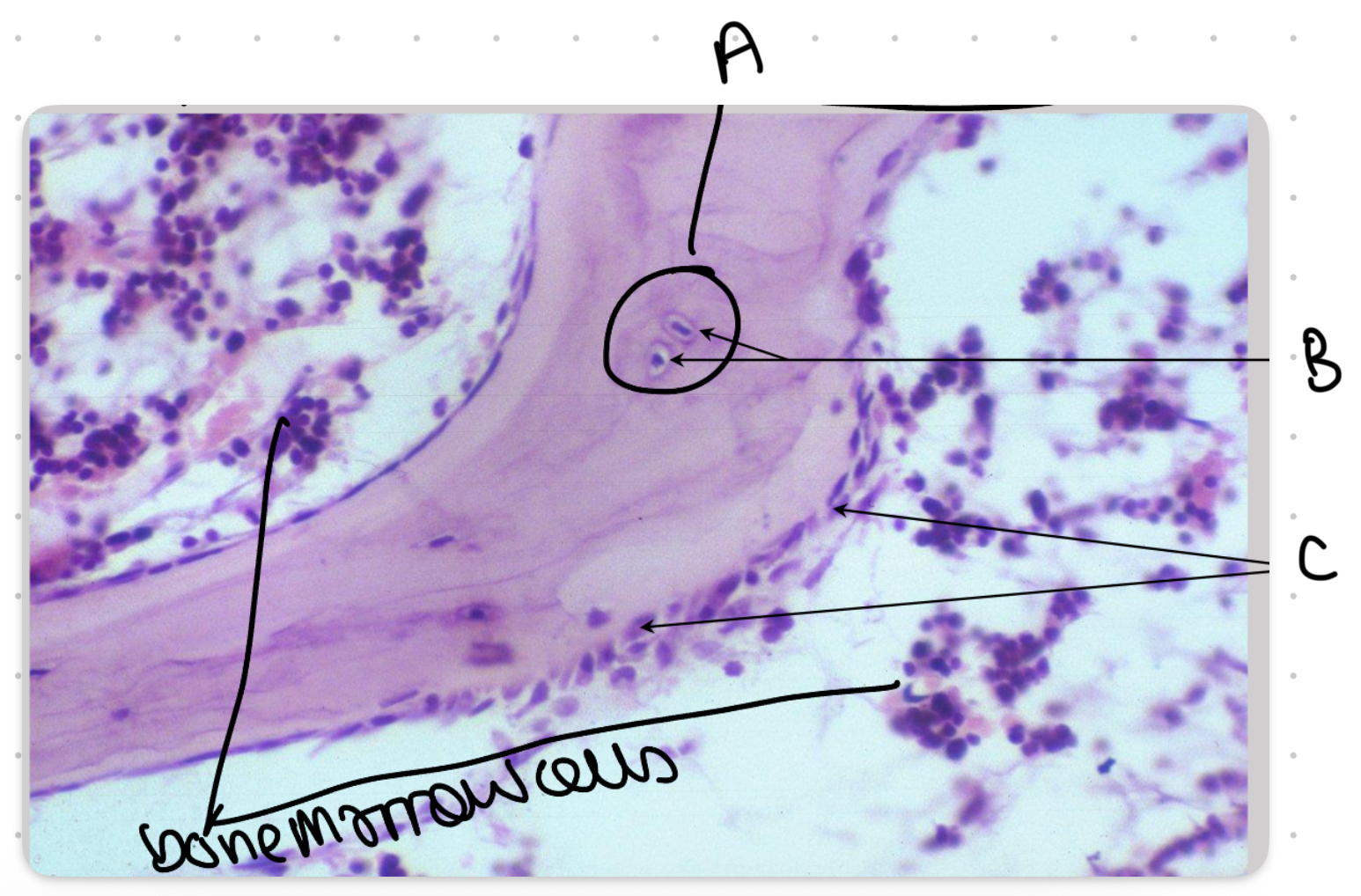
what is A?
Lacunae
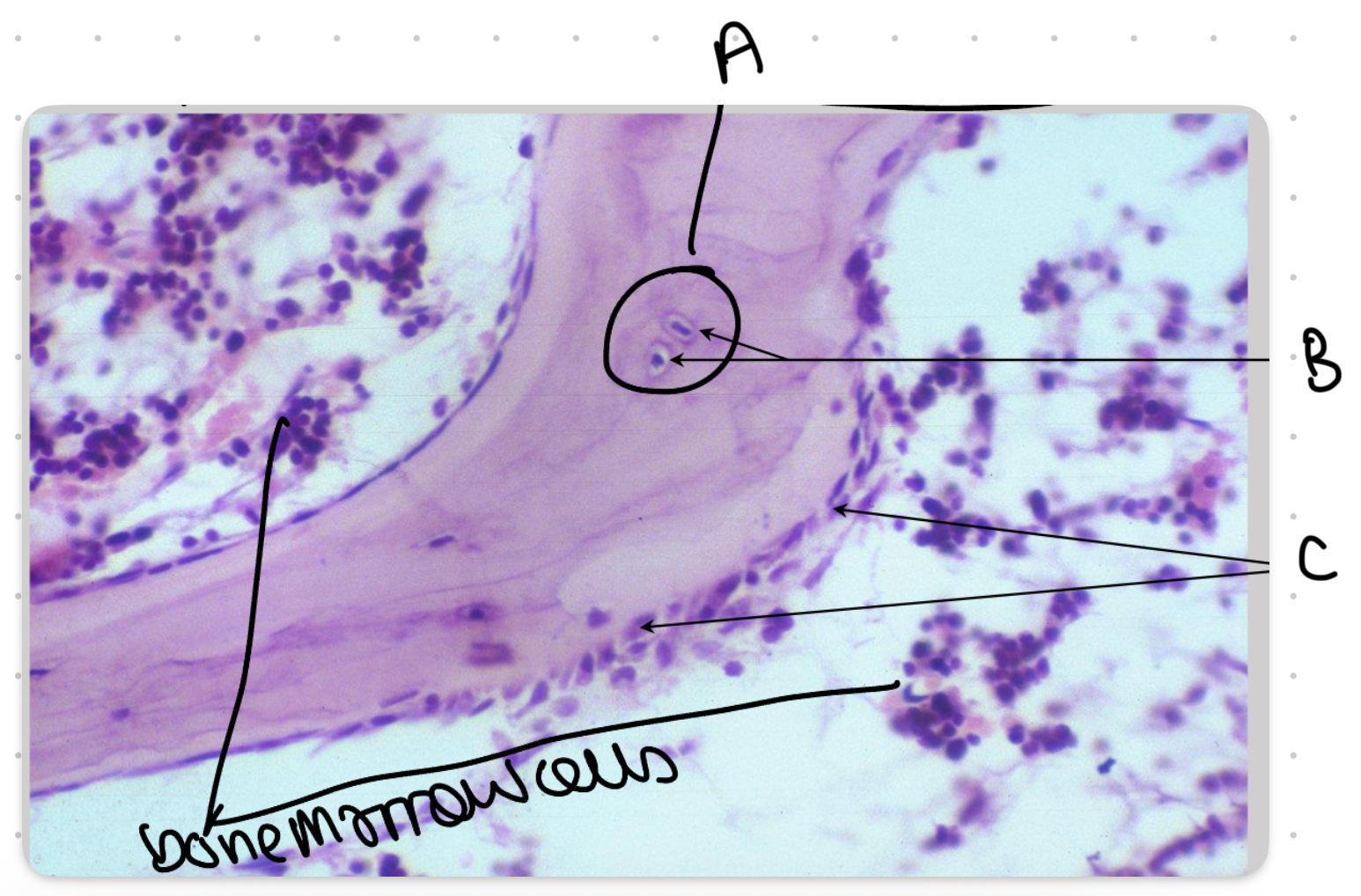
What’s B?
Osteocytes
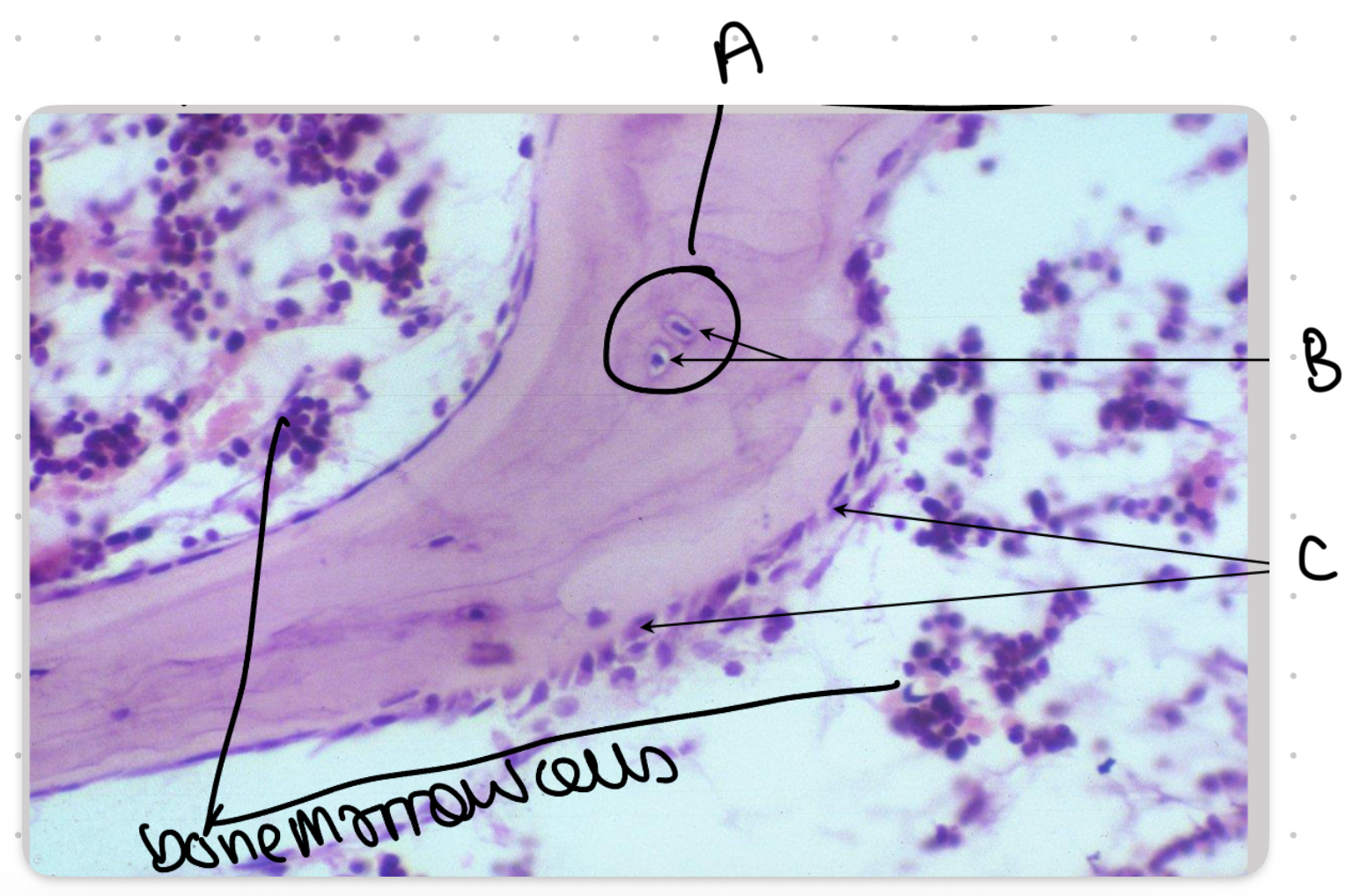
what is C?
Osteoblasts
What is the epiphysis?
End of bone where it would articulate a joint with another bone
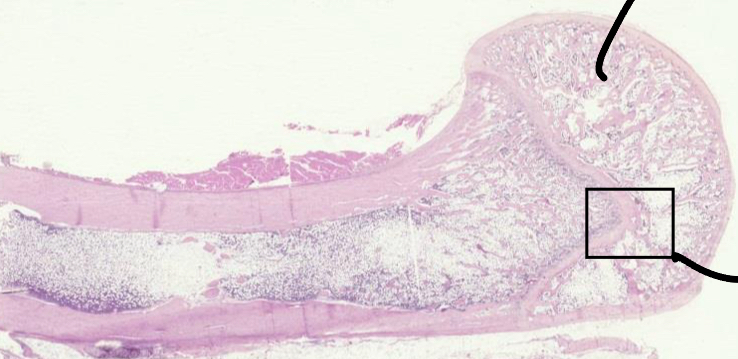
What is the black box?
Growth plate
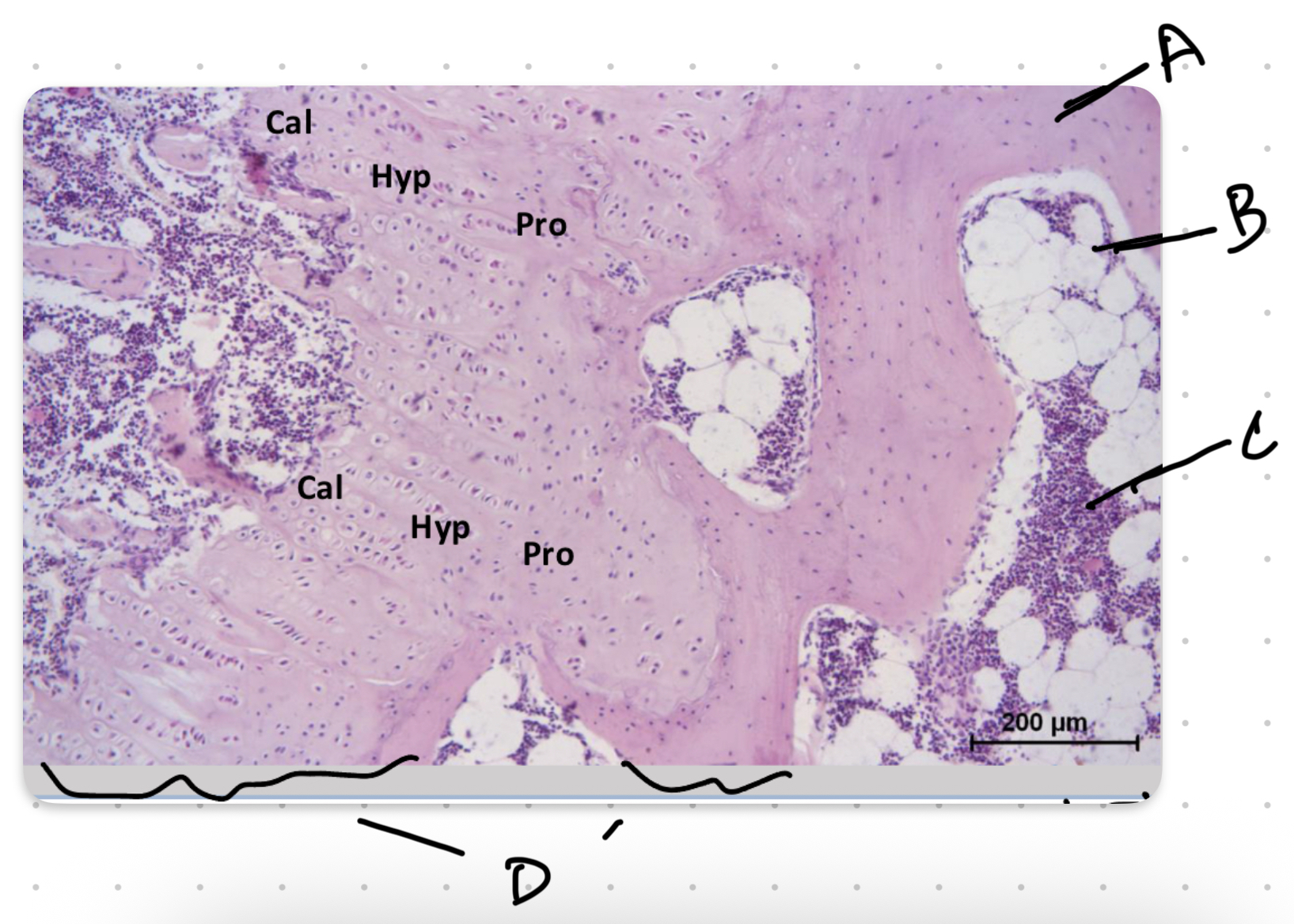
What is A?
Bone
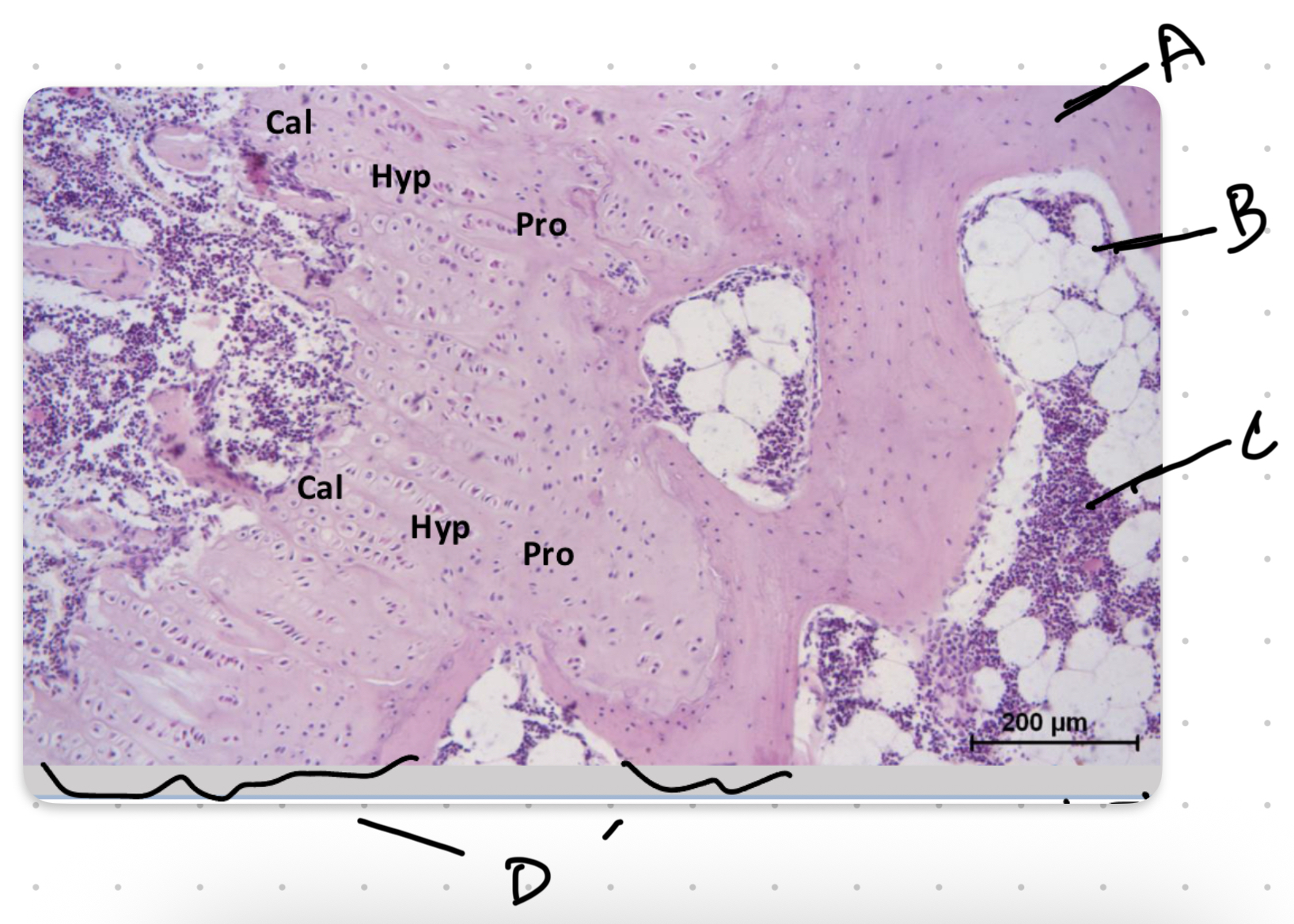
What is B?
Bone marrow
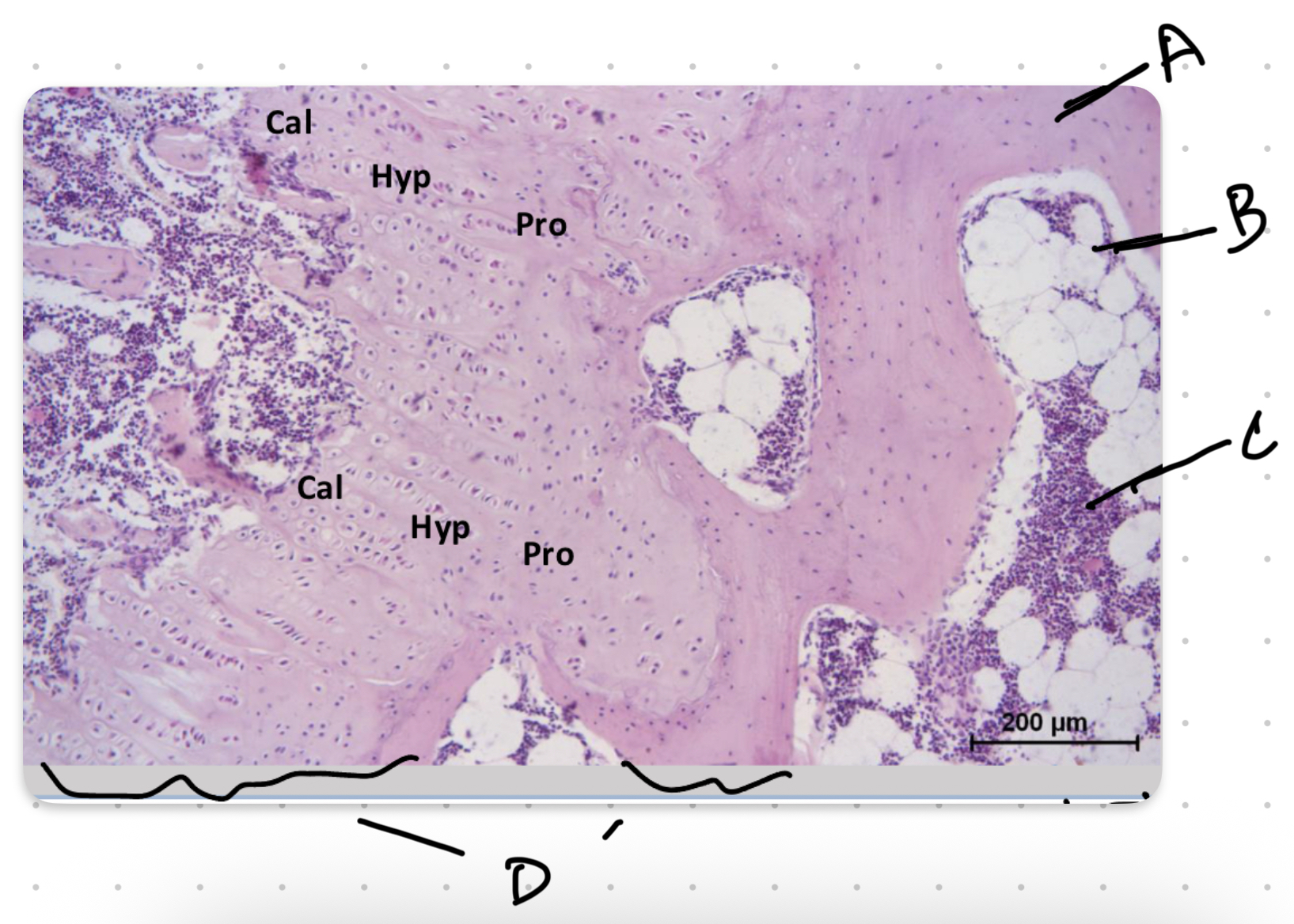
What is C?
Osteocytes
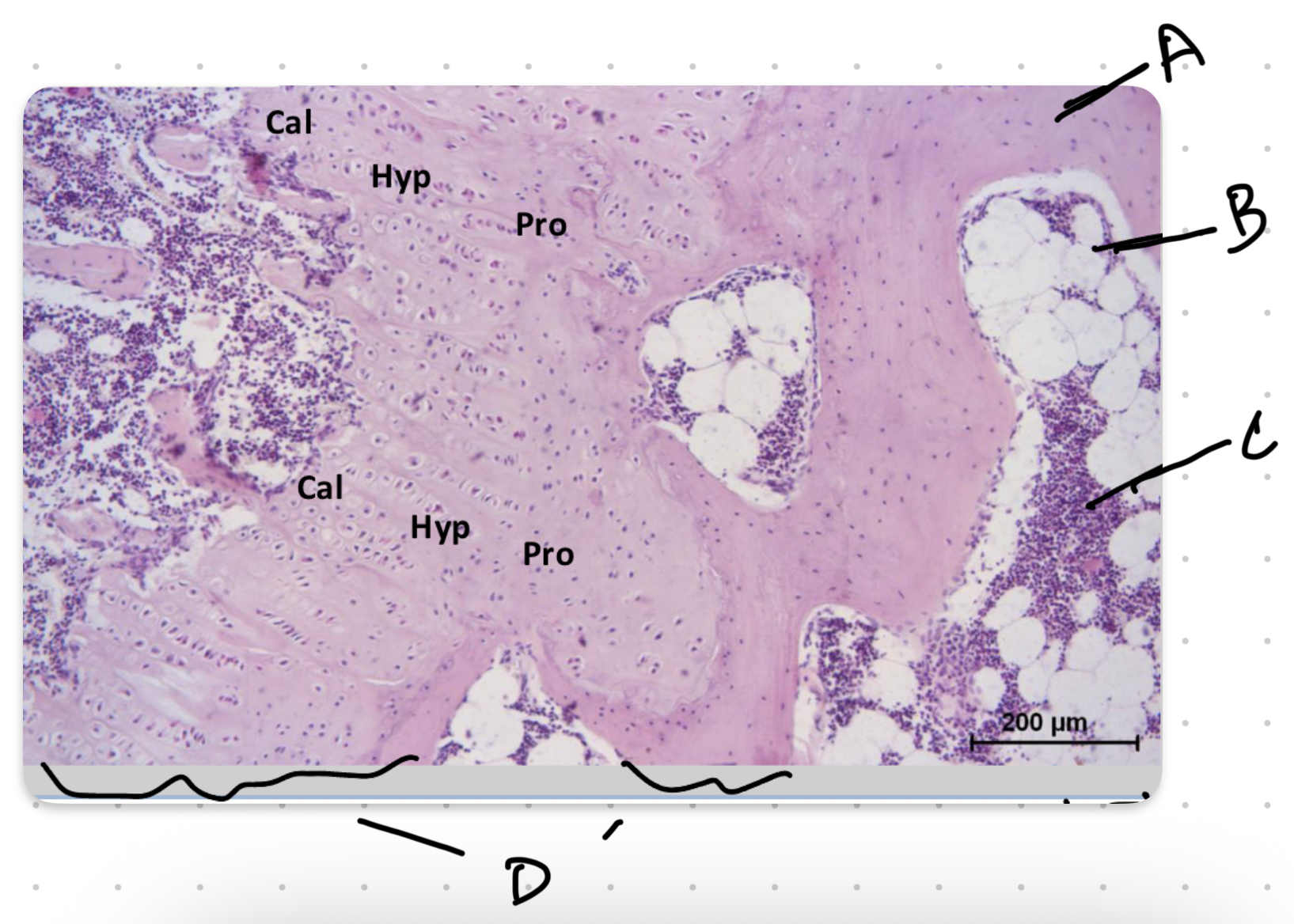
What is D?
Central region
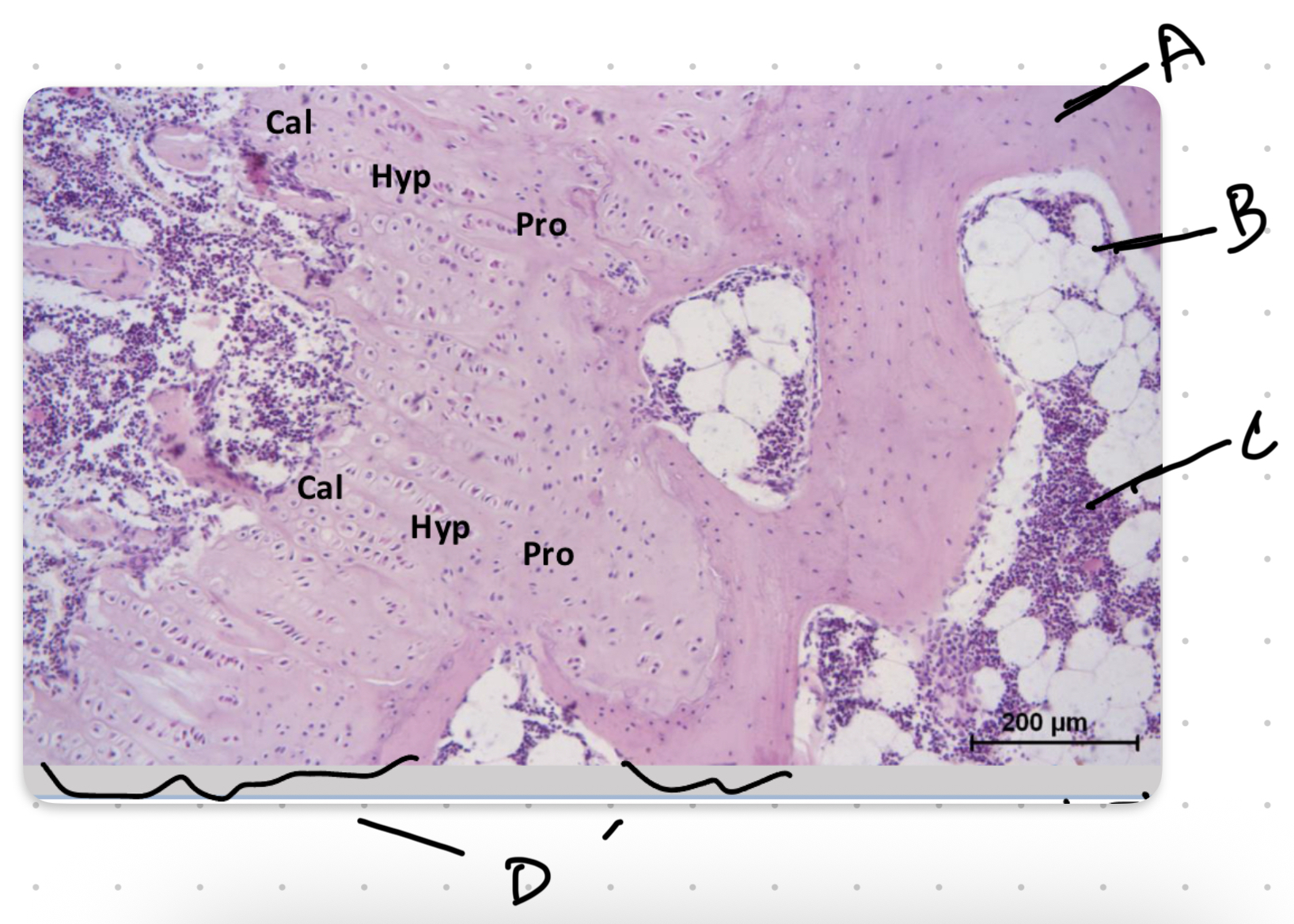
Why does cal stand for ?
Calcifying chondracytes
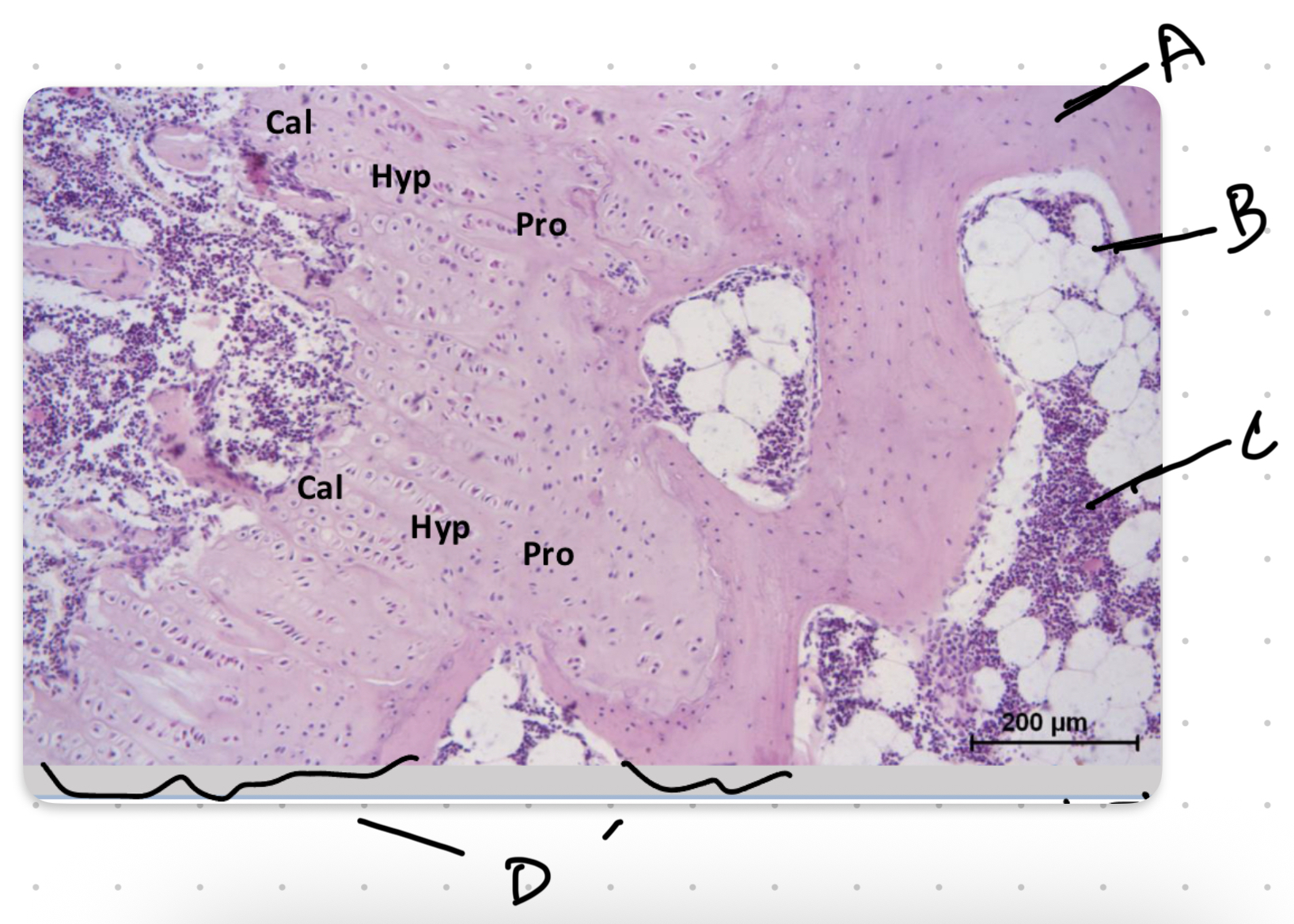
What does hyp stand for ?
Hypertrophic chondracytes
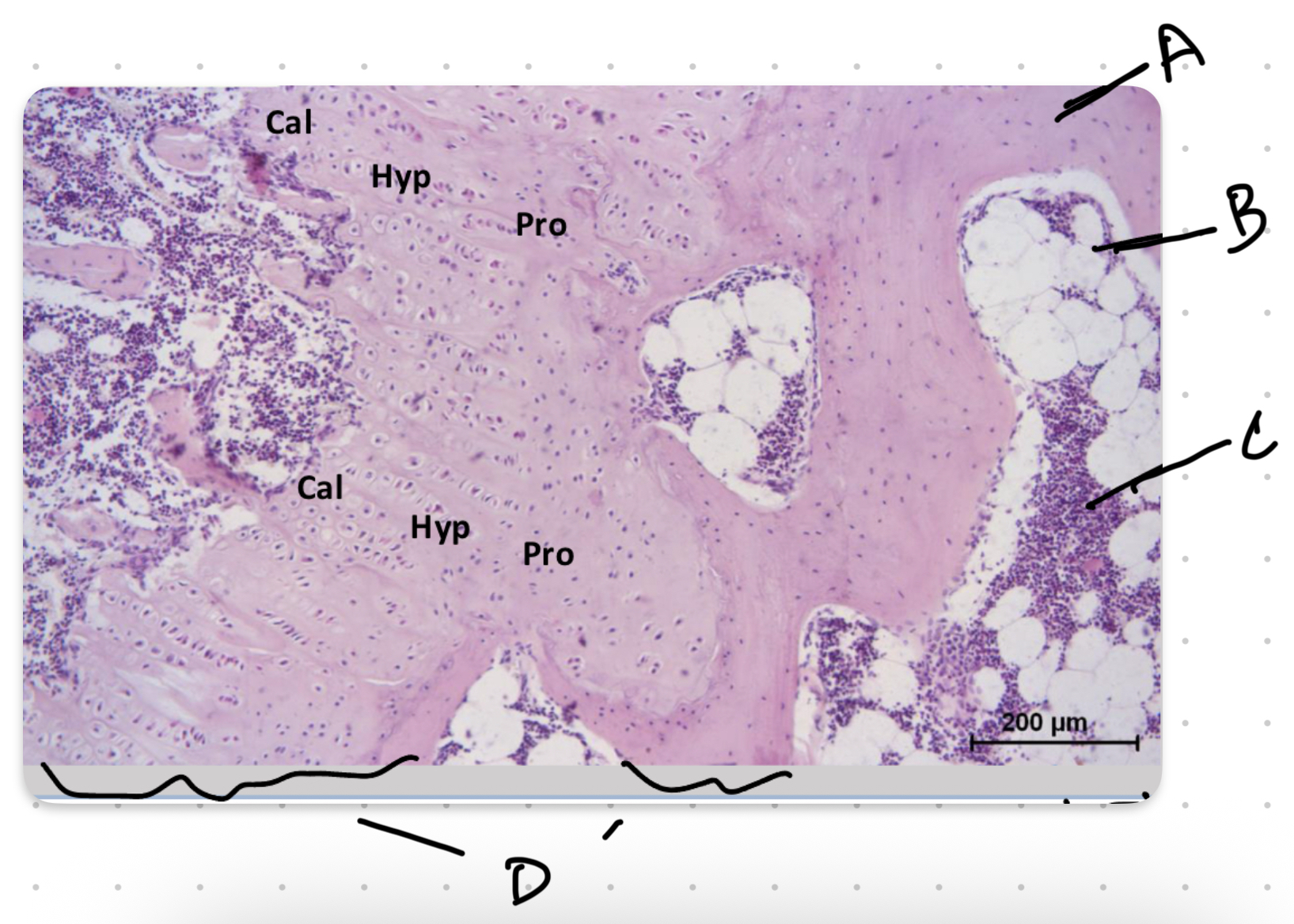
What does pro stand for ?
Proliferating chondracytes
How do chondracytes allow an increase in long bone length?
Undergo proliferation , all the cartilage cells on chondracytes increase in number and all line up, become hypertrophy , as they nearer to diaphysis they calcify which adds length to the long bone at the growth plate. The long bone has grown in length as calcification has meant that that area has been mineralised, subsequently its remodelled, to create new bone tissue, increase in number and size of chondrocytes are calcified and replaced by bone, this results in the length of long bone when an animal grows
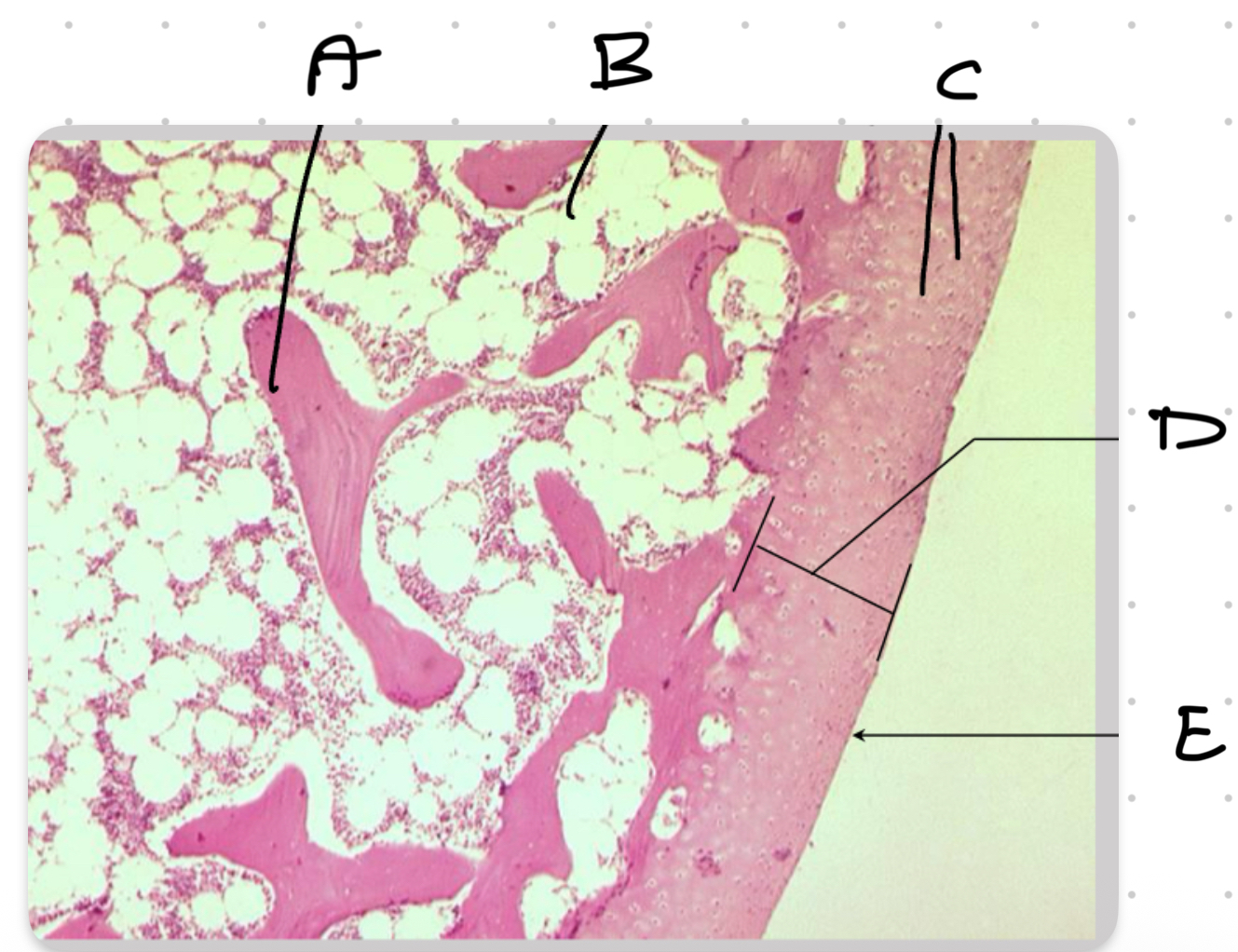
What is A?
Bone
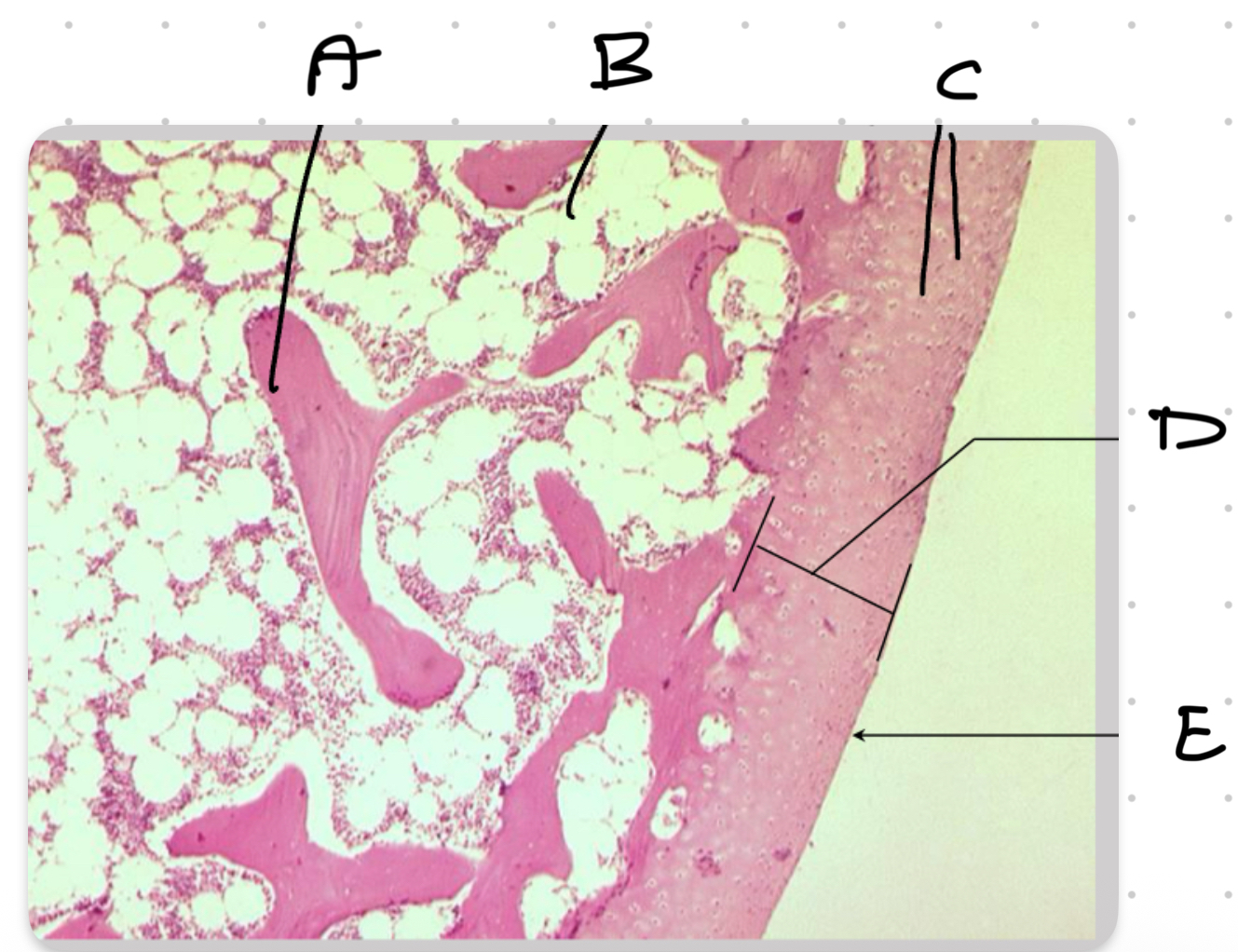
What is B?
Bone marrow
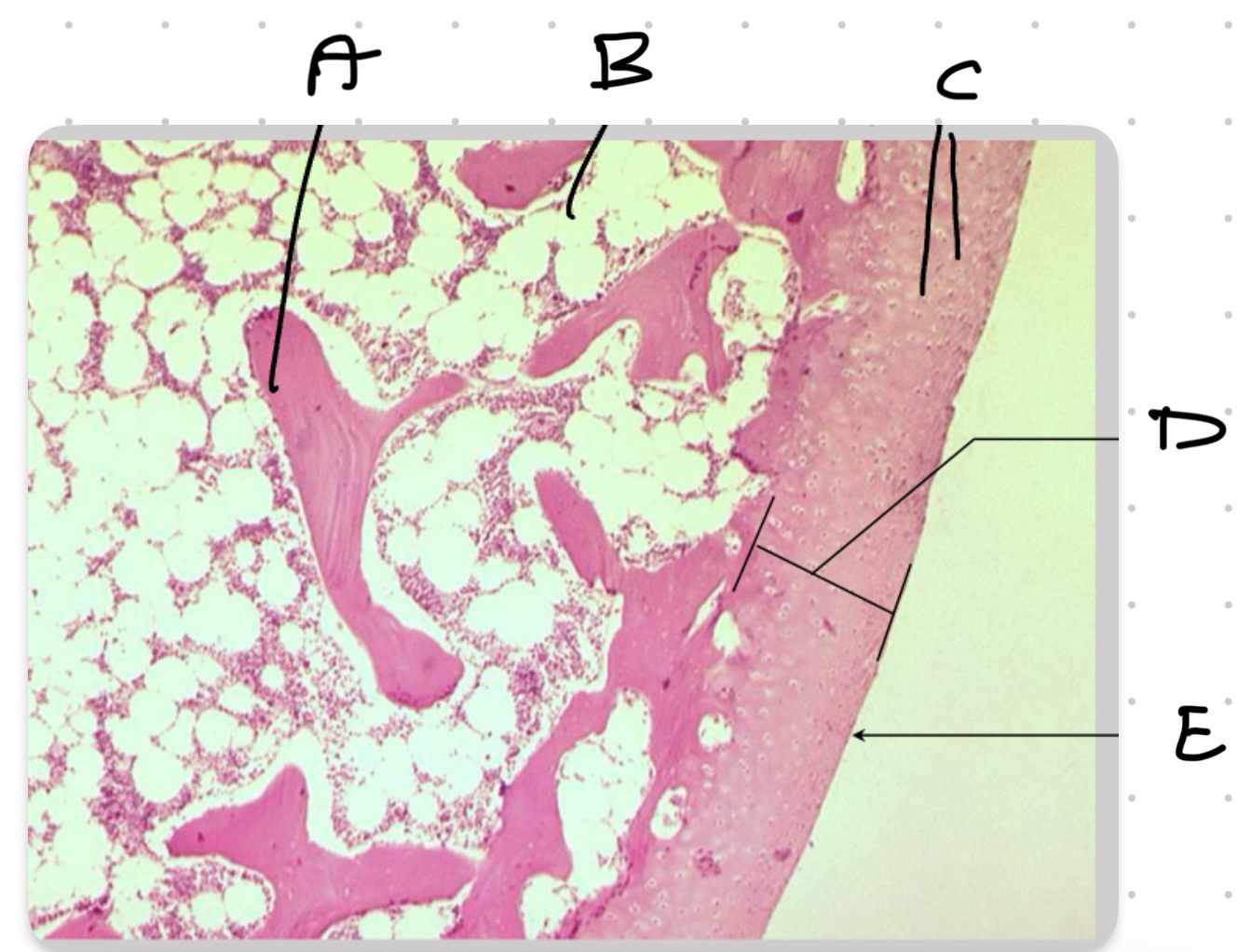
What is C?
chondrocytes
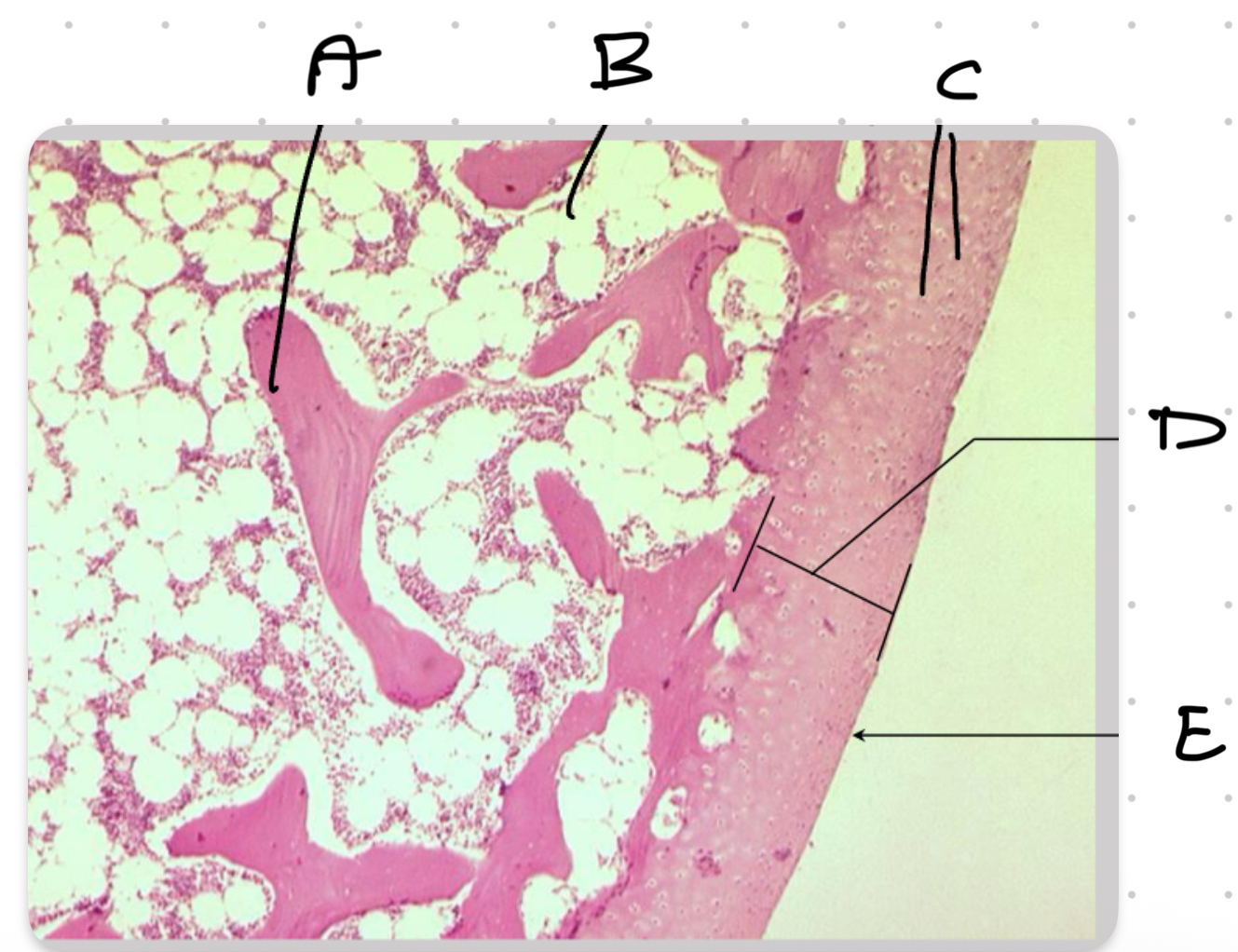
What is D?
Hyaline cartilage
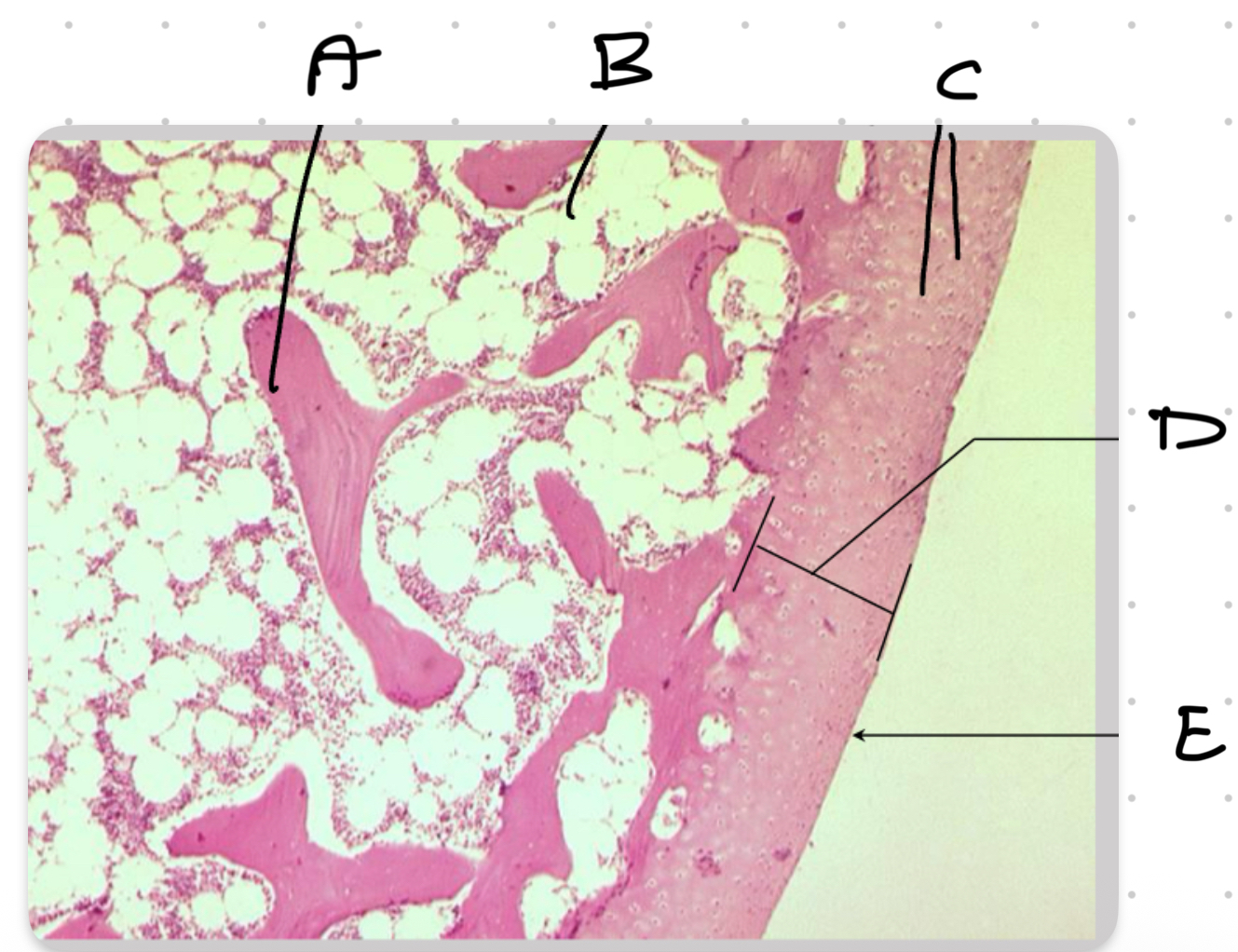
What is D?
Hyaline cartilage
Why is the articular surface smooth?
to create sliding surface so 2 bones can move over each other , cartilage creating ‘cushion’ , smooth gliding surface
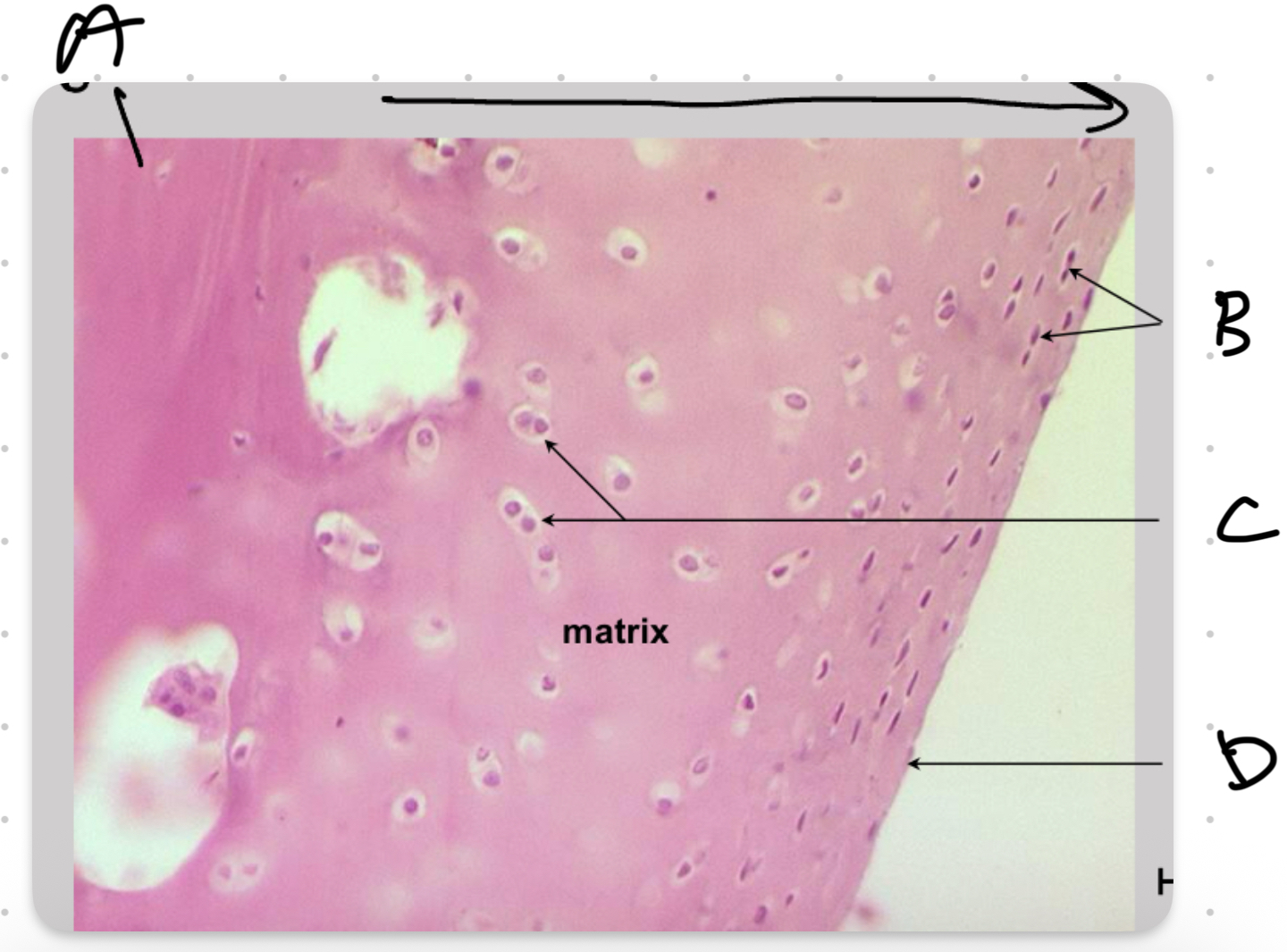
what happens to the chondracytes as you move in the direction of the arrow?
They flatten
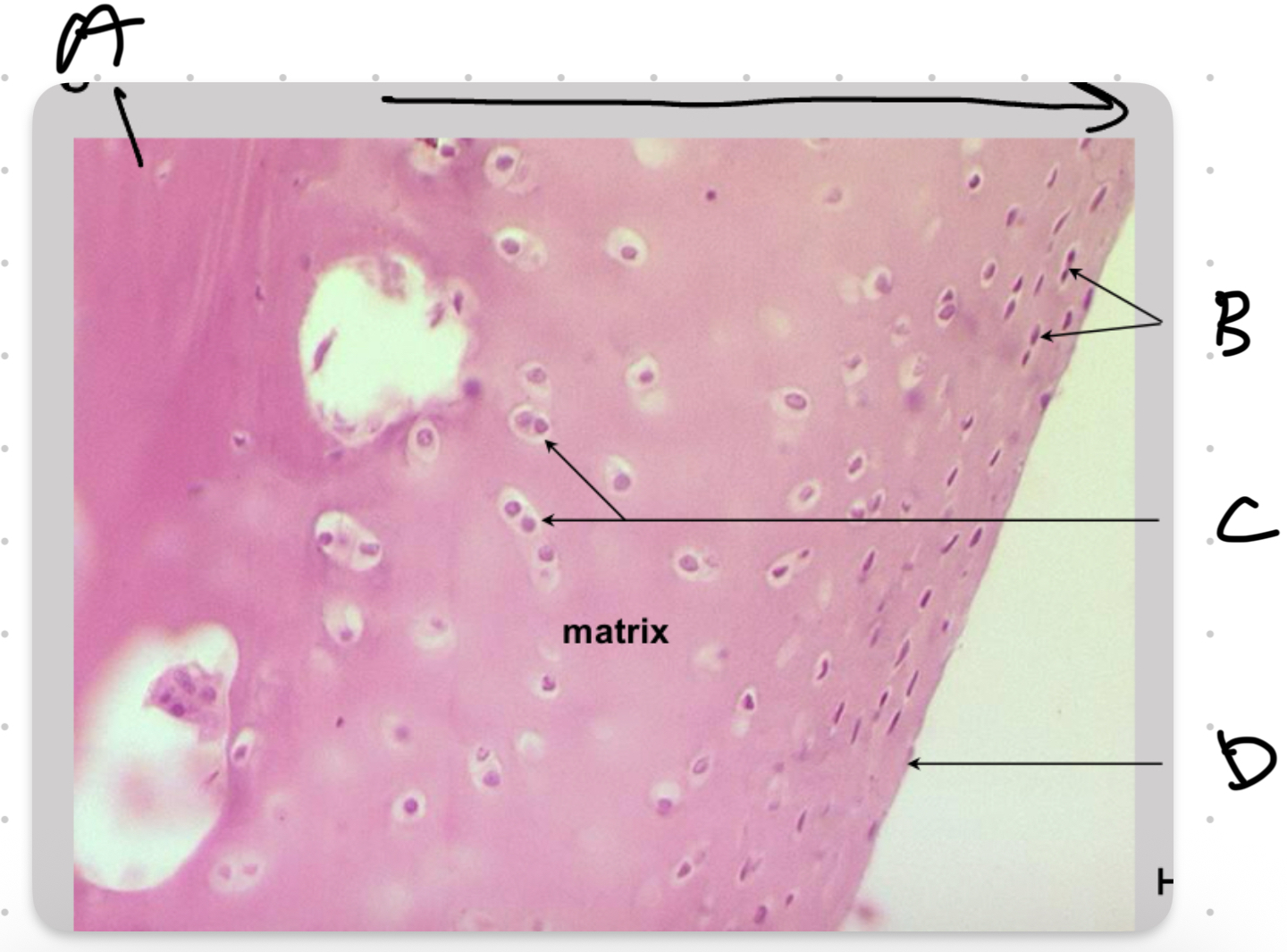
What is A?
Bone
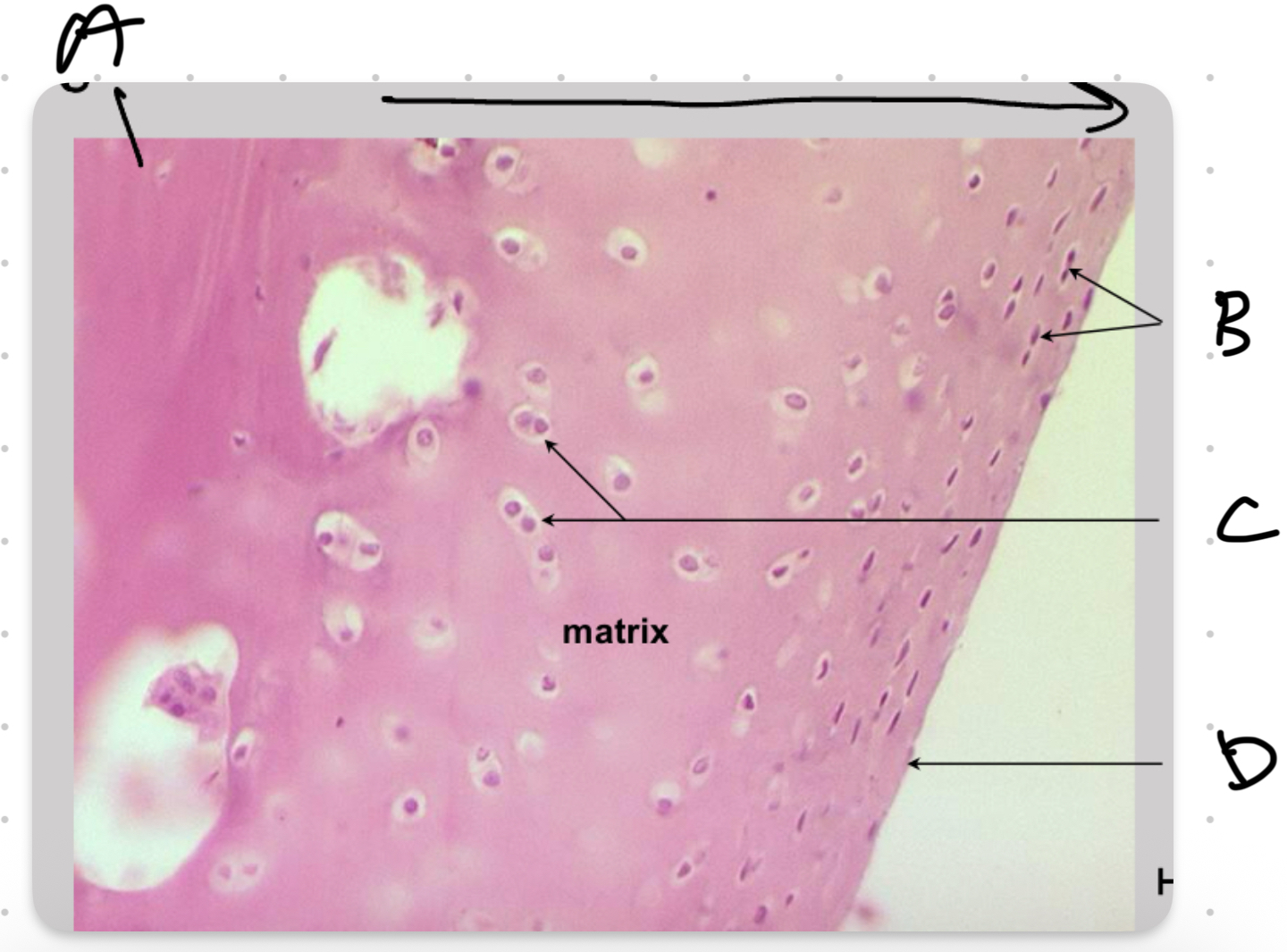
What is B?
flattened chondrocytes
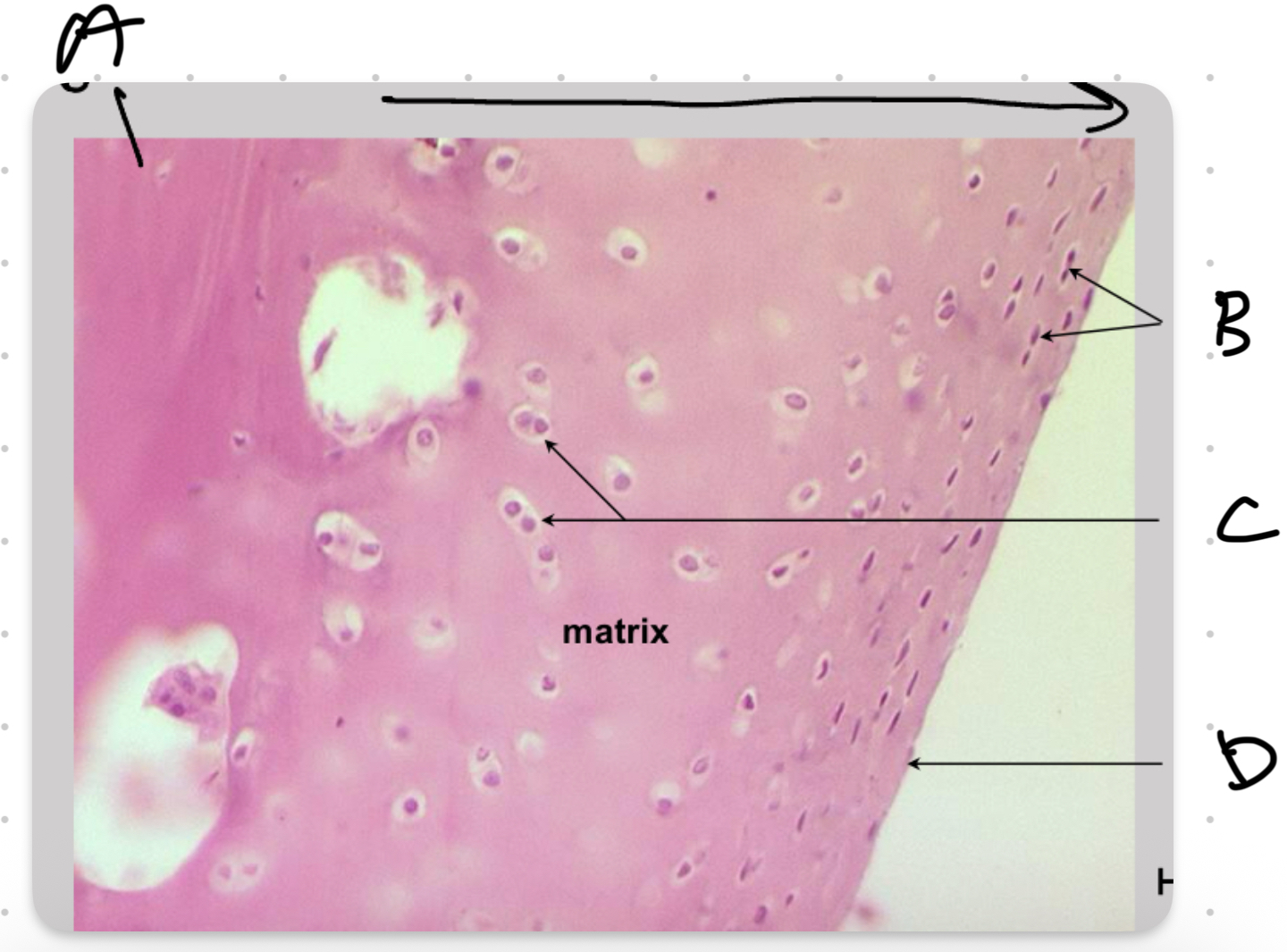
What is C?
Multiple chondrocytes in single lacunae
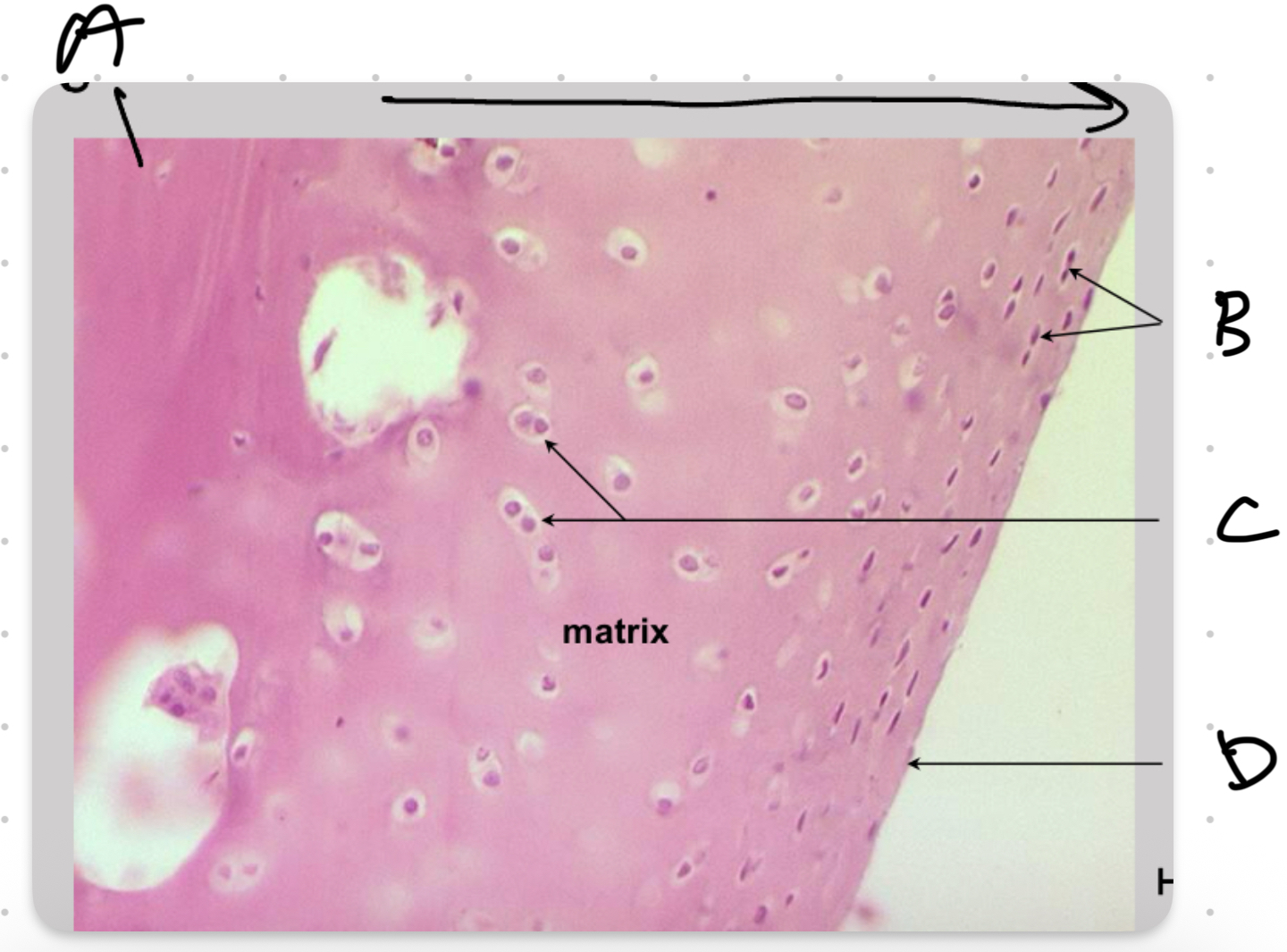
What is D?
Articular surface
What is skeletal muscle ?
Attaches to skeleton , allows us to move around, supports locomotion and causes movements about our joints
Why do striations on muscle show us ?
Fiber directions
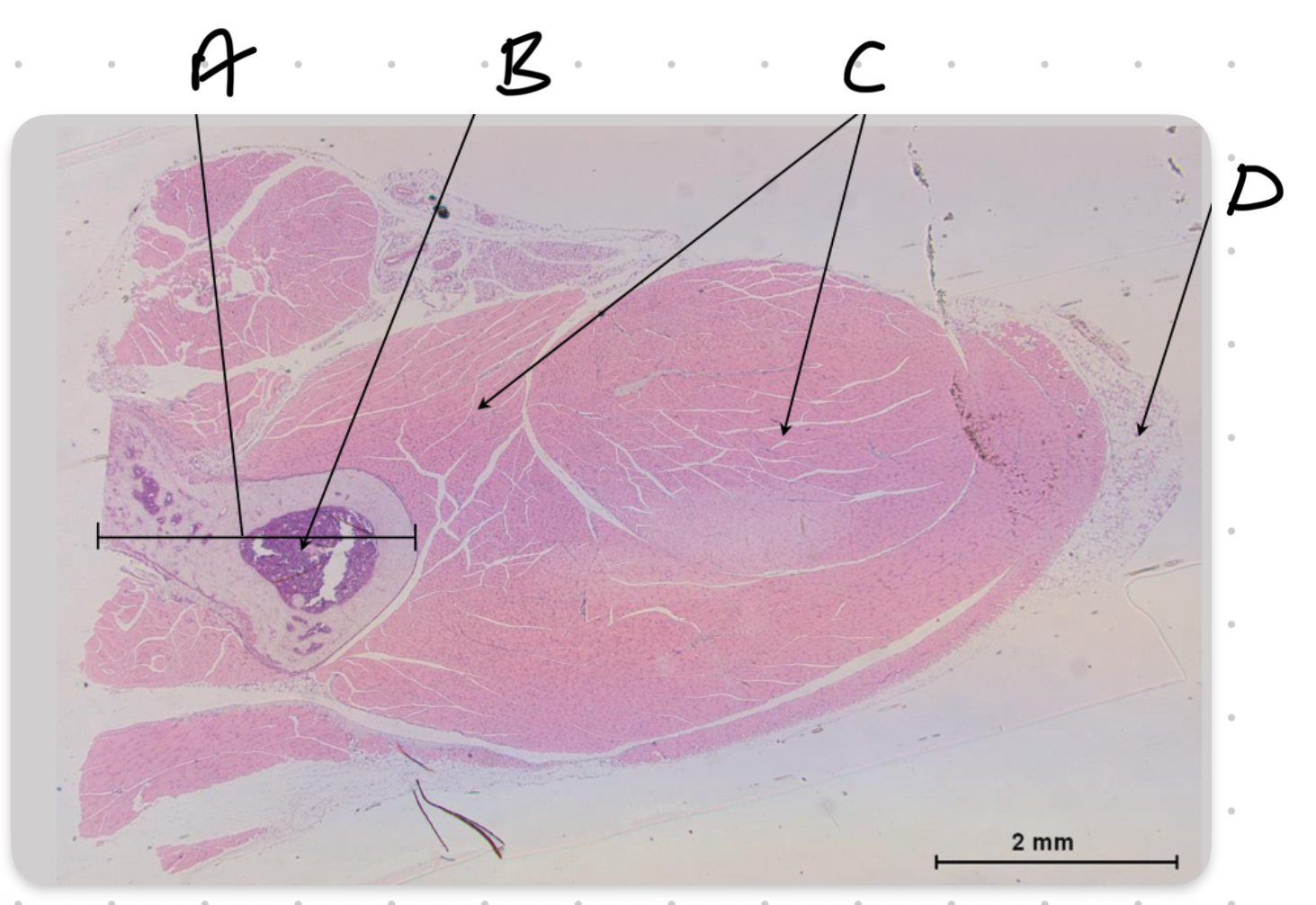
What is A?
Bone
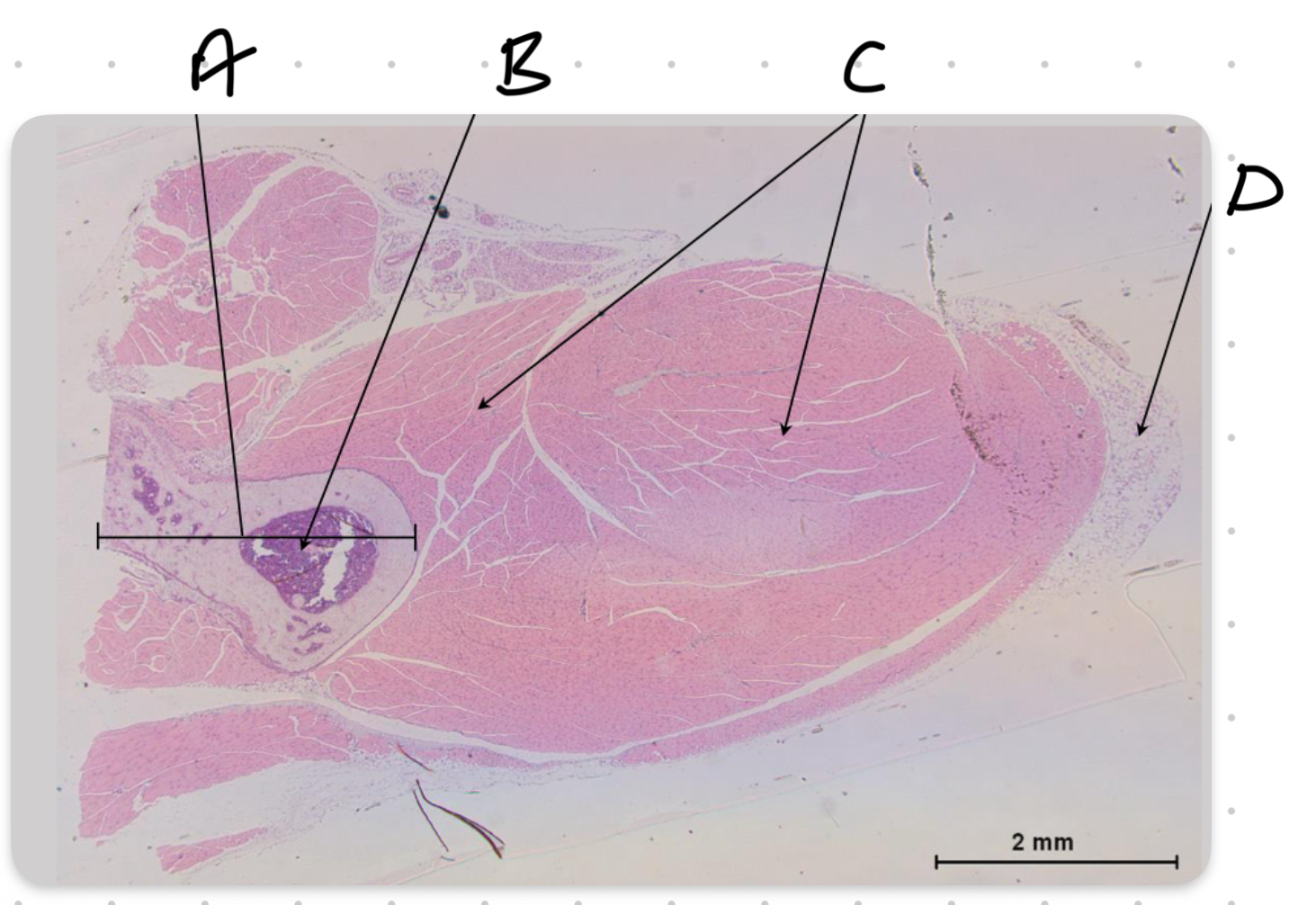
What is B?
Bone marrow
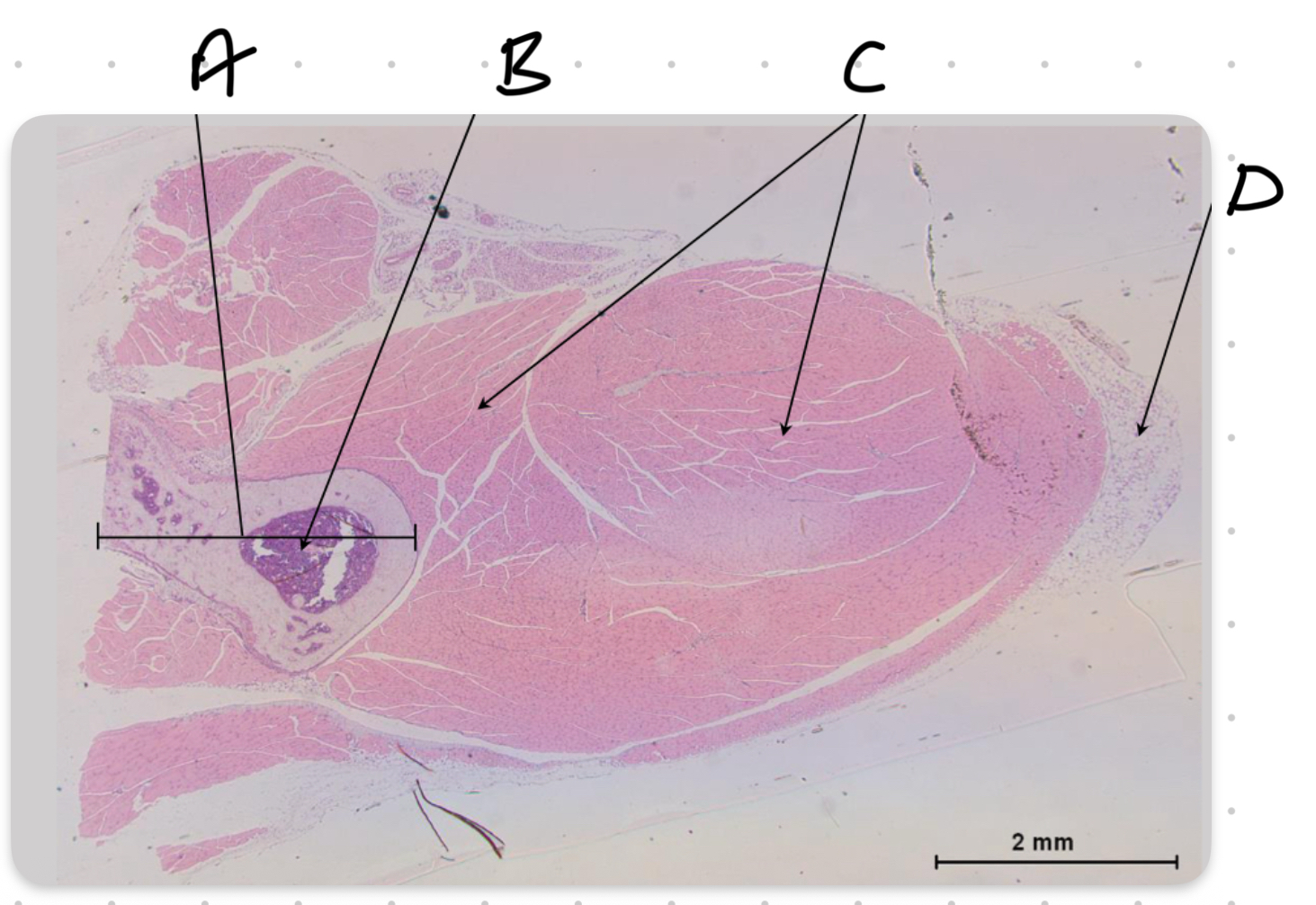
What is C?
Muscle
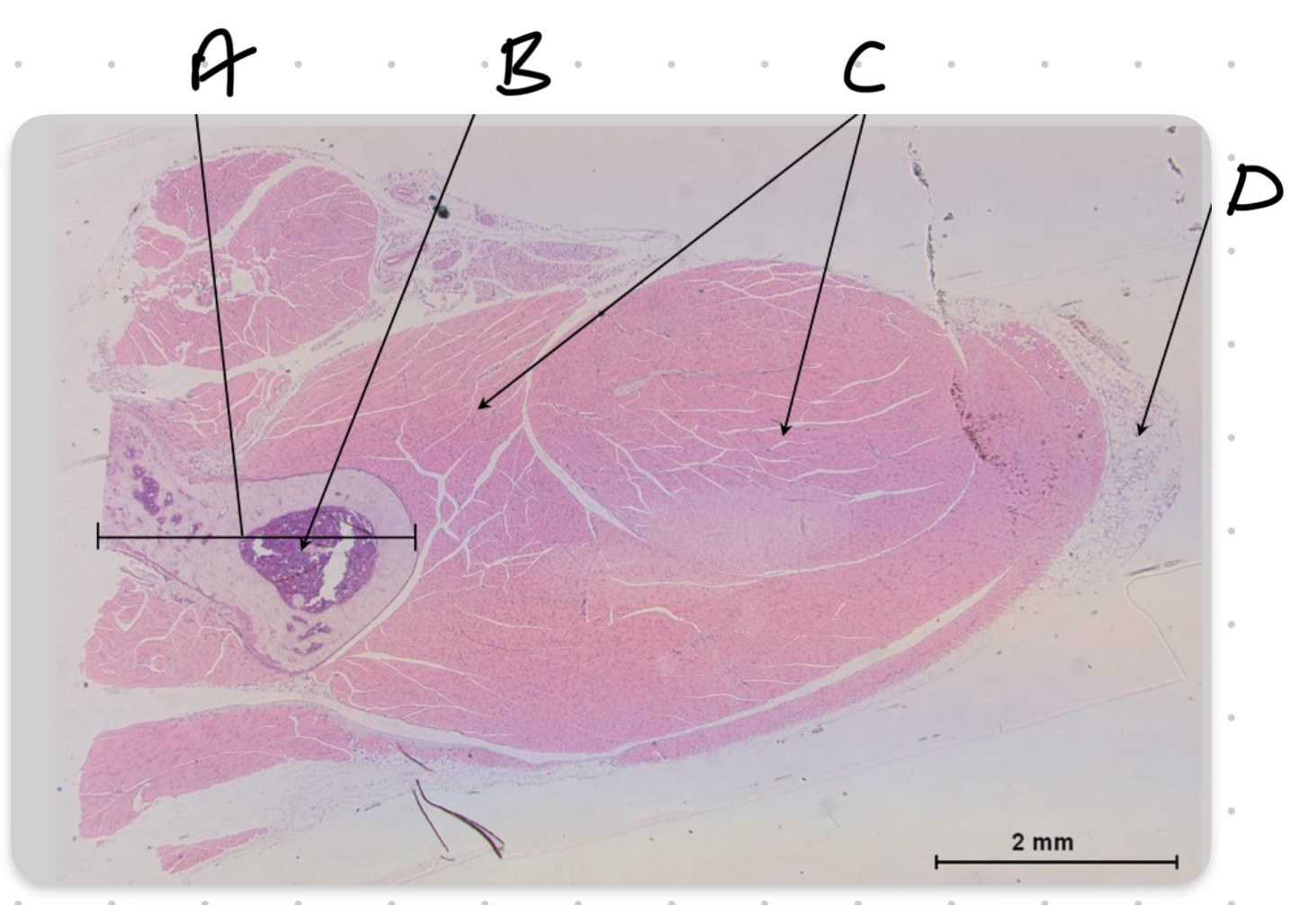
What is D?
Epimysium
What is epimysium?
Layer that runs round outside of muscle
Fill in the blank: muscles use ______ like levers to support locomotion
Bones
What are intercalated discs made up of ?
Desmosome and gap junction
What is a gap junction ?
Space or gap between cells that allow for ions to flow freely between cells
Why do ions need to flow freely between cells ?
Allows propagate electrical impulse, therefore contraction of muscles allows beating in synchrony
What is the function of desmosomes in intercalated discs?
Holding cells together
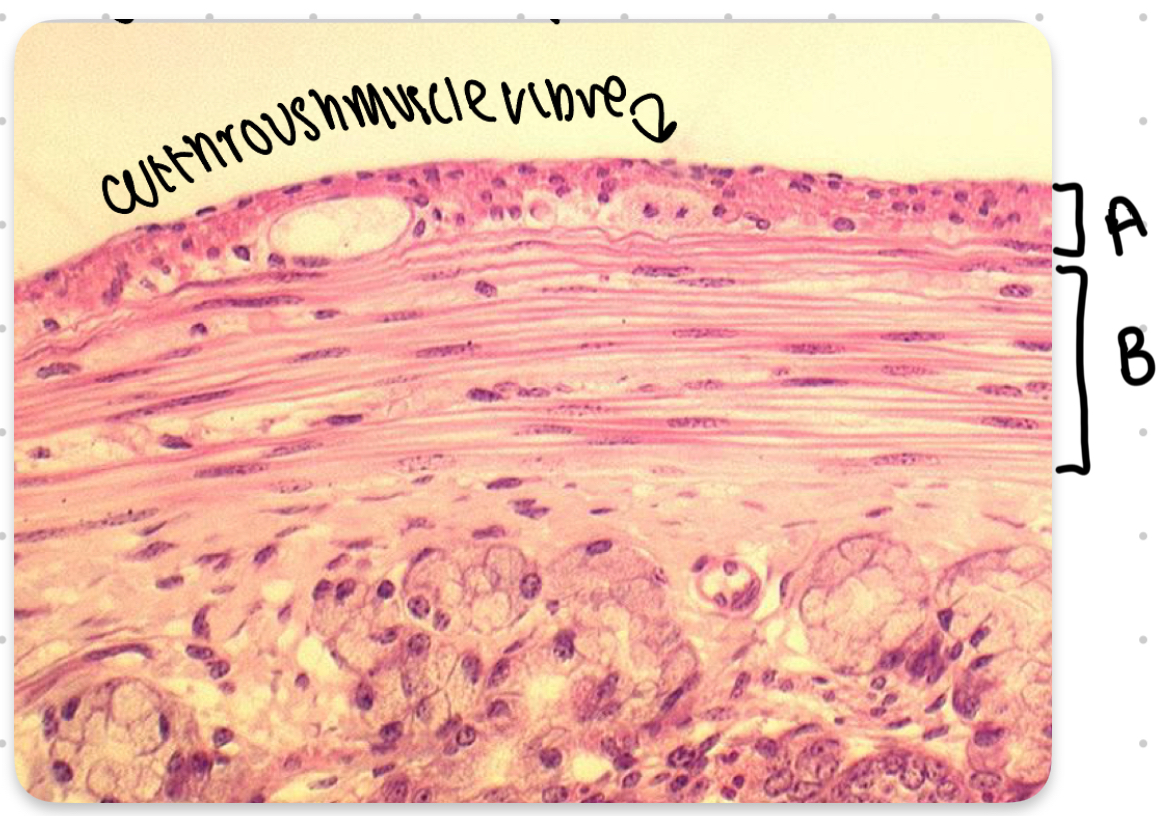
This is smooth muscle duodenum, What is A?
Transversely sectioned smooth muscle cells of the outer longitudinal layer
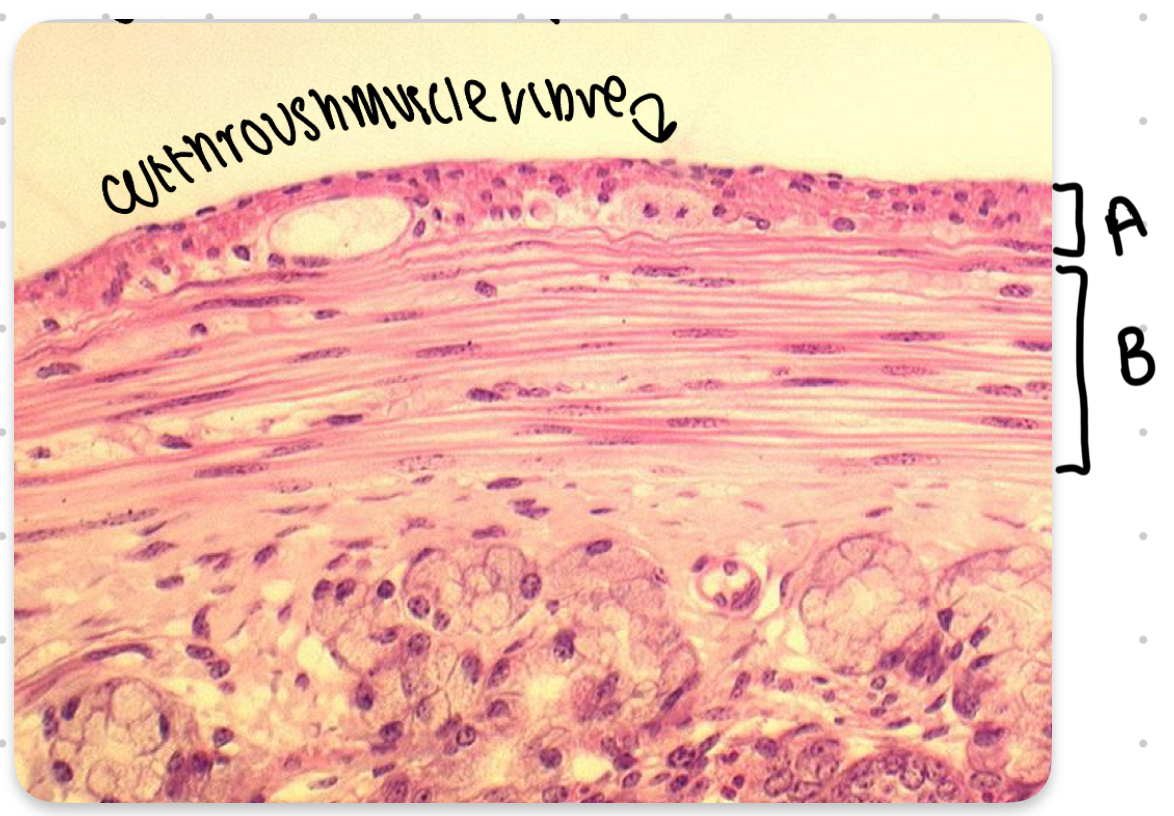
This is smooth muscle duodenum, what is B?
Longitudinally sectioned smooth muscle cells of the inner circular layer
What do tendon connect?
Muscle to bone
what is the use of force created by muscle?
It can be conveyed to bone which it’s important for locomotion
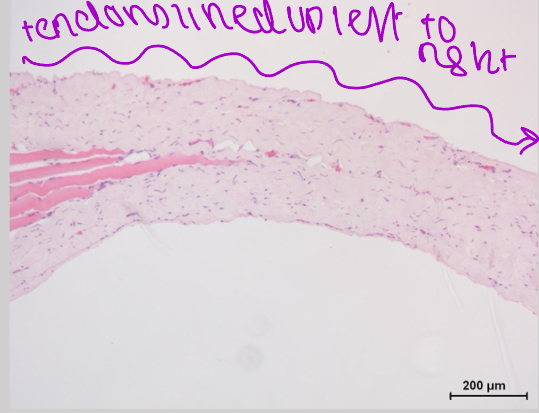
what are some features of tendons?
Dense regular connective tissue
Crimp elongates under extension
How are tendons highly organised?
Tendon fibres line up with the direction of force the tendon experiences
How do tendons reduce the muscular effort required for locomotion?
architecture and organisation which allows more efficient locomotion through storage of elastic energy
What happens when a tendon is put under load during locomotion?
crimp is straightened, tendon stretched
What happens when a load is released from off a tendon?
Tendon returns to original length, creating pull on the bone and adding to muscular activity during locomotion
What happens to a healthy tendon if it’s overstretched ?
Injury
What is the state of a tendon when under no load ?
Crimp
Why is it useful that tendons have a rich blood supply running through?
Good for normal function and healing
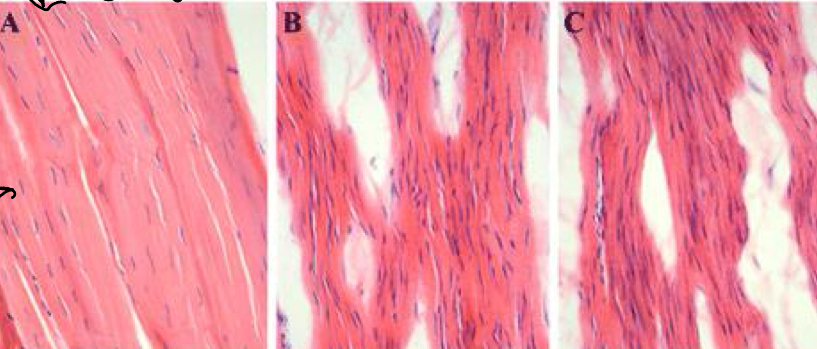
A, B and C show a longitudinal section of ligament, describe the differences between them
A = healthy ligament , normal ACL
B = sutured ACL, injured increased cellularity , more nuclei and cells present meaning less organisation in fibre direction and width
C = sutured ACL with SIS