All wrong answers URR RVT
 Call Kai
 Learn
Learn Practice Test
 Spaced Repetition
 Match
Match Flashcards
 Knowt Play
1/475

There's no tags or description
Looks like no tags are added yet.
Name | Mastery | Learn | Test | Matching | Spaced | Call with Kai | Chat |
|---|
No analytics yet
Send a link to your students to track their progress
476 Terms
normally what changes occur in the waveform of the SMA post prandial
resistance decreases
resistance to flow _____ as blood travels distally through the abdominal aorta
increases
what is the best technique to visualize and locate the IMA
transverse approach, locate renal arteries and slide inferior
a normal mesenteric aortic ratio is
1.0 or less
as pressure increases, resistance must ____ to maintain constant flow volume
increase
normal hepatic venous flow will demonstrate
2 large antegrade diastolic and systolic waves followed by a small retrograde component that corresponds with the atrial contraction
what flow characteristic is seen in a normal hepatic vein doppler tracing
cardiac pulsatility and respiratory phasicity
what vessel doesn’t drain into the IVC
splenic vein
in cases of an interrupted IVC, how does the blood from the distal IVC and lower extremities reach the right atrium
azygous vein serves as a collateral pathway and empties into the SVC
how is acceleration time measured
place cursor at the start of systolic upstroke and at the earlies systolic peak
which of the following describes a cardiovascular application of the bernoulli principle
explains the turbulence and layers of flow separation within the carotid bulb
the primary mechanisms that control arterial flow volume changes during the cardiac cycle are
cardiac output, peripheral resistance
normal flow in the splenic artery
demonstrates reynold’s number >2000
which of the following is directly related to the calculated peak doppler velocity in an artery
doppler shift frequency
which of the following normally demonstrates a low resistance doppler flow profile
hepatic artery and renal artery
which of the following terms can be used to describe the normal doppler waveform in the portal vein
mild pulsatility with respiratory variation
what imaging plane is preferred when measuring the AP dimension of the aorta
sagittal
hemodynamically significant stenosis of the celiac axis is diagnosed with the PSV greater than
2.0 m/s
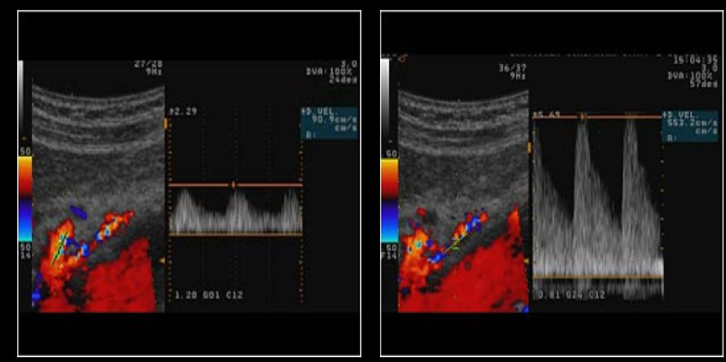
Mesenteric doppler with NPO patient. The IMA was evaluated and had monophasic, high resistance waveform with a peak velocity of 150 cm/s. What do the findings indicate?
SMA stenosis
when measuring the AP diameter of the true lumen of an aneurysm, where should the caliper be placed at the anterior edge?
Should be placed the outer edge of the true anterior edge of the aorta not the AAA itself
which of the following can lead to systolic flow reversal in the hepatic veins
significant tricuspid regurgitation
which renal arteries are evaluated with doppler that is used to perform an indirect evaluation for renal artery stenosis
segmental and parenchymal arteries
what term refers to the phenomenon of a PW doppler tracing displaying a wider distribution of the velocity of blood cells with varying degrees of blockage
spectral broadening
a patient complains of bilateral pain and color changes in the legs. When he lies down, both legs become pale. When he sits on the edge of the bed, both legs become red. These findings suggest
significant aortic stenosis
what is the most suggestive of renal transplant rejection
oliguria or anuria
what correctly describes a IVC aneurysm
most IVC aneurysms are saccular
the resistive index of the renal parenchymal arteries in cases of main renal artery stenosis will _____ and the resistive index renal parenchymal arteries in cases of renal parenchymal disease will ____
decrease, increase
what is caput medusae?
tortuous vessels around the umbilicus caused by portal HTN
which renal arteries are evaluated with doppler in an ultrasound exam that is used to perform a direct evaluation for renal artery stenosis?
main renal artery
if a patient has a history of ____, they have an increased risk of carotid dissection
marfan syndrome
which of the following is associated with spectral broadening?
increased bandwidth
flow distal to a significant stenosis will exhibit which of the following characteristics?
lower resistance flow
which of the following is least likely to be associated with renal artery stenosis?
may thurner syndrome
an aortic dissection most commonly originates:
in the ascending aorta
if a patient complains of a recent onset of uncontrollable systemic HTN with average BP readings exceeding 170/90, what vascular cause should be suspected?
renal artery stenosis
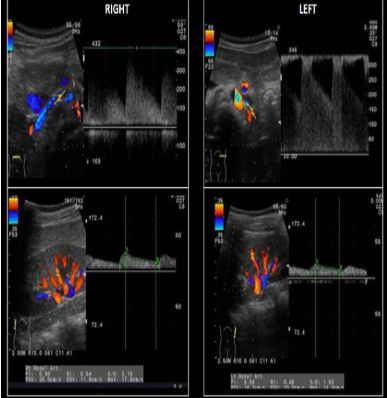
images from a 15 year old with significant HTN. What is the most likely cause for the abnormality demonstrated?
fibromuscular dysplasia
which statement regarding the aorta is true?
rupture is the most common complication of an aortic aneurysm
which of the following describes the proper way to measure an abdominal aortic aneurysm?
outer wall to outer wall
which of the following is an autosomal dominant disorder that can lead to AVM in the liver?
hereditary hemorrhagic telangiectasia
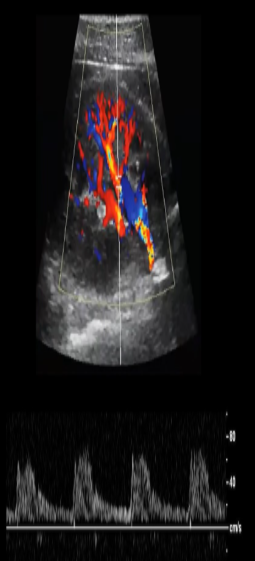
why is this wrong?
no angle correction was used so the segmental artery will have inaccurate velocity measurements
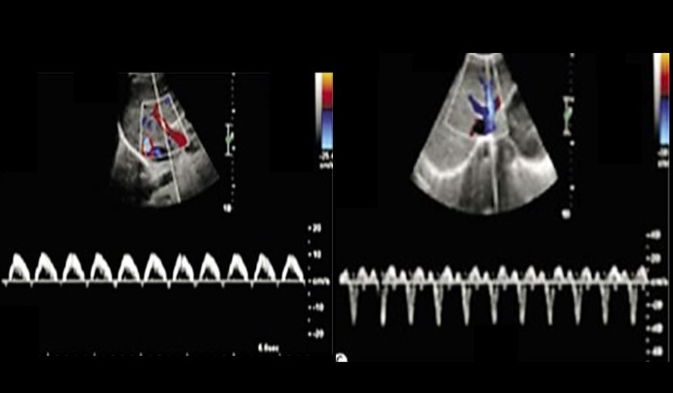
what is a potential cause for these doppler findings?
congestive heart failure or severe tricuspid regurgitation
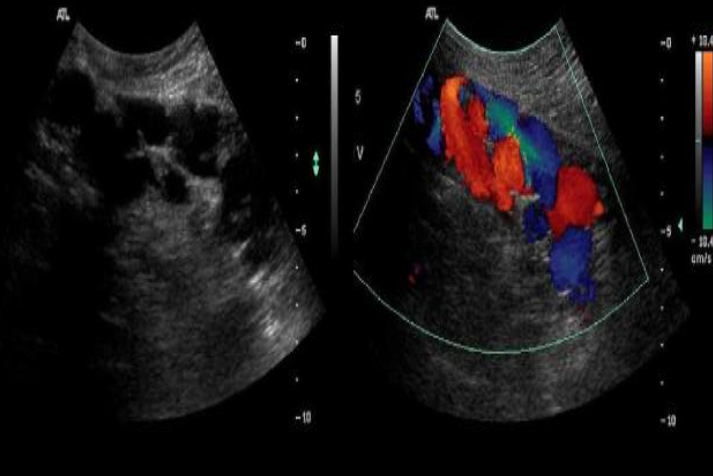
long images of the anterior abdomen just superior to the umbilicus. What is the most common cause of the abnormality seen on the images?
portal hypertension
a patient presents with a script that requests an aortic doppler eval due to Leriche syndrome. What are you looking for?
extensive diffuse atherosclerotic disease causing obstruction of the distal aorta
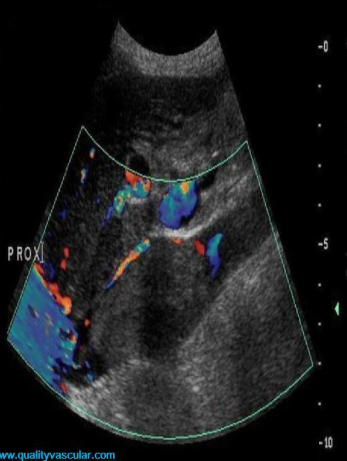
the image demonstrates a complication that is most common with what carcinoma?
renal
which of the following vessels will be abnormally dilated with significant portal HTN?
main portal vein and left gastric vein
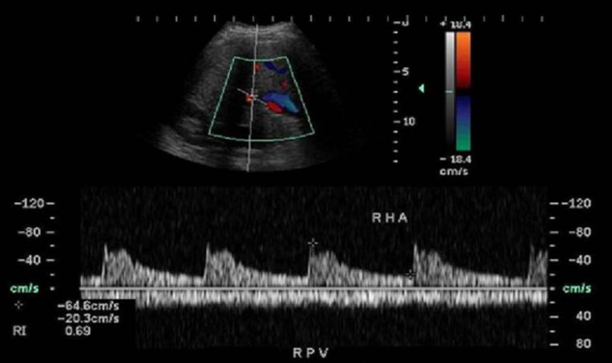
the doppler evaluation displays a waveform from the hepatic artery and portal vein. What can be said about it?
the tracing is abnormal because both vessels should display hepatopetal flow
blue toe syndrome is a complication typically seen with what disease?
AAA due to possible emboli reaching a small digit
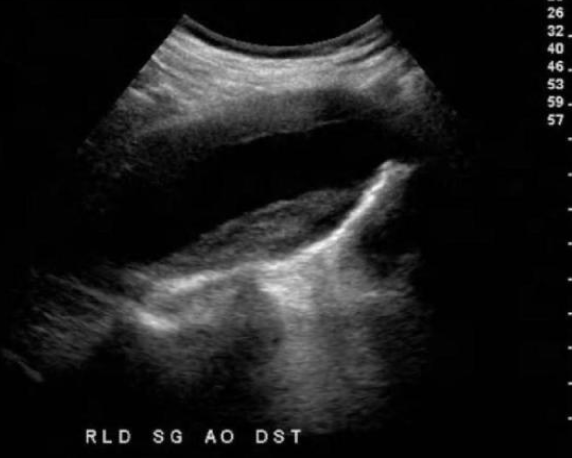
what statement correctly describes this image of the aorta?
the total AP dimension of the AAA size is the distance between the actual vessel walls
what indicates a significant SMA stenosis?
dilated IMA that is easily visualized on ultrasound
where is the doppler cursor placed in the aorta to obtain the velocity used in the renal aortic ratio?
at the level of the renal artery origins
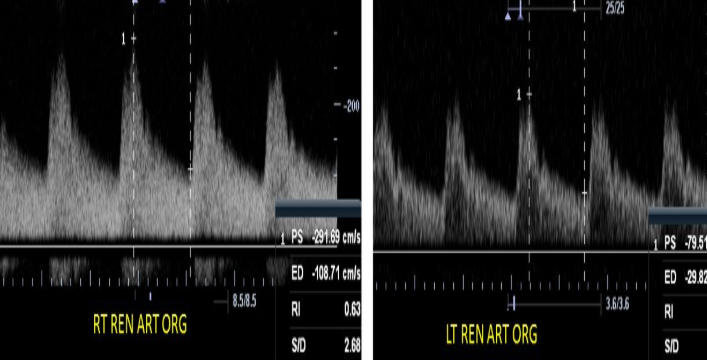
this image is from a RA duplex, what waveform is expected for the right renal parenchymal arteries?
tardus parvis waveform, low velocity with slow acceleration and deceleration
RRA has significant stenosis
which branch of the circle of willis supplies the corpus callosum and CSP with arterial blood?
ACA
when scanning the ICA which way should you angle the probe to locate the ECA?
medial and/or anterior
the supraorbital artery is a branch of the _____. Branches of the supraorbital artery connect with branches of the ____, which is a branch of the ECA. This is a common collateral pathway from the ECA to the ICA
ophthalmic artery, superficial temporal artery
during a TCD the depth is set to 100 mm in the suboccipital window. What vessel will be interrogated and what direction will the flow be moving?
basilar, away from the transducer
which of the following is considered an abnormality that causes turbulence in a vessel?
myointimal hyperplasia
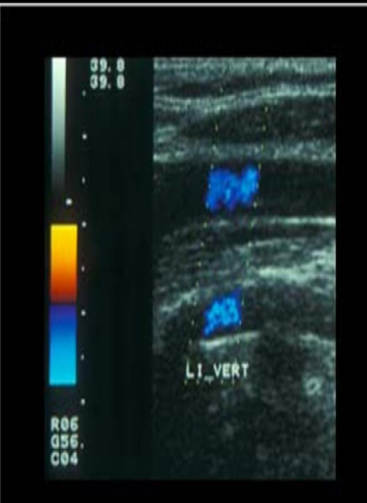
what is demonstrated on the image?
normal carotid artery and vertebral artery flow
which of the following describes the probe placement for a doppler evaluation of the frontal artery?
near the inner canthus of the eye
which of the following is the best patient position for performing a transcranial doppler exam to obtain a waveform from the basilar artery?
left lateral decubitus with left hand placed under the head for support
at what level in the neck does the CCA normally bifurcate?
at the upper border of the thyroid cartilage
branches of the ______ connect to branches of the vertebral arteries to allow collateral flow from the anterior circulation to the posterior circulation?
occipital artery
which of the following are branches of the distal ICA?
middle cerebral artery, anterior cerebral artery and posterior communicating artery
which transcranial window is most commonly used to evaluate the carotid siphon and the ophthalmic artery?
orbital
which of the following is a potential collateral pathway for extracranial to intracranial blood flow?
facial and maxillary artery branches connect to small branches of the orbital artery
what describes the proper technique for evaluating the ACA through the temporal window?
anterior angulation with 65mm depth
what artery courses cephalad on the anterior right side of the trachea to bifurcate at the level of the sternoclavicular joint?
innominate artery
the suboccipital window is used in TCD exams to evaluate which of the following arteries?
vertebral and basilar
which of the following anatomic variants of ICA anatomy is most often associated with symptoms of cerebral ischemia?
kinking
the posterior communicating artery connects the:
anterior and posterior cerebral vessels
the highest velocity in the normal common carotid artery is usually identified
in the first 3 cm of the vessel
which of the following describes the normal appearance of a waveform obtained in the middle cerebral artery?
low resistance with spectral broadening
which of the following statements is true regarding the vertebral arteries?
the right vertebral artery is normally smaller than left
the carotid siphon:
supplies to the ophthalmic artery
the angular artery is the terminal branch of the
facial artery
the most common normal variant in the external/internal carotid artery anatomy is:
the ECA lies posterior and lateral to the ICA
the profunda artery:
courses posterior and lateral to the femoral artery
how do you test the capillary blush response on the upper extremity?
press your finger into the fleshy part of the arm to create pallor, then release to time the return of normal skin coloring
the normal brachial artery waveform should resemble the flow in the normal ________.
peroneal artery
what describes the correct way to measure the width of the iliac artery?
transverse view, outer to outer
what sonographic landmark is used to identify the distal end of the common iliac artery?
the bifurcation into the external and internal iliac artery
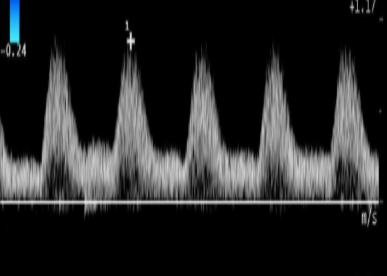
where does the doppler tracing most likely come from in the body?
most consistent with organ flow
low resistance, monophasic
a branch of which artery joins the terminal ulnar artery to form the superficial palmer arch?
radial branch
diastolic flow reversal is normal in what vessel?
common iliac artery
high resistance leads to reversal and multiphasic waveform
the pulsatility index in a normal aorta should be ____ the PI in the normal popliteal artery?
lower than
which of the following correctly describes a normal doppler waveform of an artery from the lower extremity?
the triphasic waveform has 2 components of antegrade flow during the cardiac cycle
the lateral plantar arch artery originates at the ____
posterior tibial artery
if the systemic blood pressures rises but flow remains constant, what happens to the resistance in the vascular beds?
increases
ohm’s law of electrical current is also used to describe:
arterial blood flow volumes
what can vasodilation do?
cause a triphasic waveform to become biphasic
you receive an order for a pre-op arterial mapping to evaluate the internal mammary artery. What vessel should you evaluate to locate the origin of the internal mammary artery?
subclavian artery
which of the following describes the normal response to a doppler evaluation for erectile dysfunction?
normally the PSV and EDV of the cavernosal arteries will increase post injection, but dorsal venous flow will remain unchanged
which of the following statements is true regarding the tunica intima?
an intimal dissection requires generation of a preliminary report and a stat review by a doctor
a weak pulse on the PTA will be described as ___, while a bounding pulse in the ATA will be described as ___
1+, 4+
2 = good, 3 = strong, 0 = none
if the acceleration time in the common femoral artery is 110 ms:
the vessels are normal
abnormal is >140 ms
which of the following describes how to correctly measure the AP diameter of the iliac artery?
long view, outer to outer
while performing an arterial duplex, the patient complains they are cold. What effect could this have on the exam?
increase pulsatility in the vessels evaluated
cold causes vasoconstriction which leads to increased resistance and pulsatility
what affect will increased hematocrit levels have on an arterial duplex?
decreased blood flow velocities
increased hematocrit = increased viscosity = decreased flow
a pulsatility index of > 5 in the extremities indicates:
normal resistance
extremities are >5, organs are <1.5
bank tellers, teachers, cashiers, and assembly line workers have an increased risk of all of:
jugular vein thrombosis
standing still for several hours causes blood to pool causes stasis and increases venous pressure and can lead to thrombis formation
example of a superficial communicator vein:
vein of giacomini
connects the GSV and SSV