FF - NPTE Special Tests
 Call Kai
 Learn
Learn Practice Test
 Spaced Repetition
 Match
Match Flashcards
 Knowt Play
1/130

There's no tags or description
Looks like no tags are added yet.
Name | Mastery | Learn | Test | Matching | Spaced | Call with Kai | Chat |
|---|
No analytics yet
Send a link to your students to track their progress
131 Terms
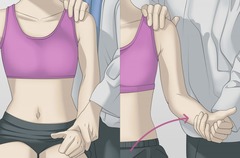
Yergason's Test (Shoulder)
Resist supination and ER with elbow flexed 90°; checks transverse ligament integrity.
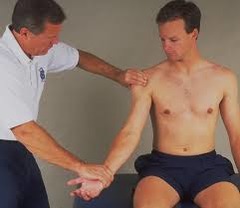
Speed's Test (Shoulder)
Resist shoulder flexion with arm extended and supinated; identifies bicipital tendinopathy.
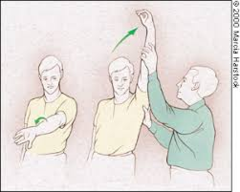
Neer Impingement Test (Shoulder)
Passive elevation in scapular plane with IR; checks supraspinatus/biceps tendon impingement.
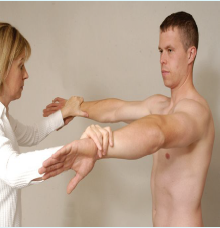
Empty Can / Jobe Test (Shoulder)
The patient's arm is abducted to 90°
with neutral (no) rotation, and the examiner provides
resistance to abduction. The shoulder is then medially
rotated and angled forward 30° ("empty can" position)
so that the patient's thumbs point toward the floor in the
plane of the scapula. Differentiate if pain is present
between two positions
Identify tear/ impingement of supraspinatus
tendon or suprascapular nerve neuropathy
Drop Arm / Codman's Test (Shoulder)
Patient slowly lowers arm from 90° abduction; positive indicates rotator cuff rupture.
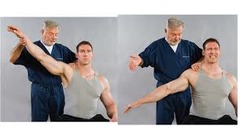
Posterior Internal Impingement Test
Supine passive 90°-110° abduction, extension, max ER; checks posterior glenoid/labrum impingement.
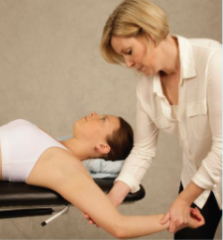
Hawkins-Kennedy Test (Shoulder)
Passive 90° flexion in scapular plane, then forced IR; identifies sub-acromial impingement.

Yocum Test (Shoulder)
Hand on opposite shoulder, examiner elevates elbow; modification for sub-acromial impingement.
Hornblower's Sign (Shoulder)
Resist ER in 90° abduction/scapular plane; detects teres minor rotator cuff tears.
Active Compression Test of O'Brien (Shoulder)
Resist downward force at 90° flexion/10° adduction in IR vs ER; detects SLAP lesions.
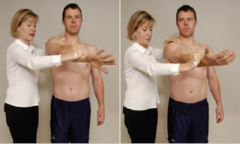
Biceps Load Test II (Shoulder)
Resist elbow flexion at 120° abduction/max ER; checks superior labrum (SLAP) integrity.
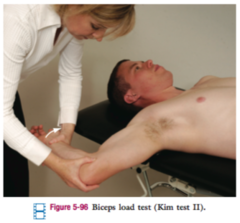
Lateral Rotation Lag Sign (Shoulder)
Spring-back test at 90° abduction/max ER; tests teres minor and infraspinatus.

Belly-Press / Napoleon Test (Shoulder)
Patient presses hand into abdomen while bringing elbow forward; checks subscapularis muscle.
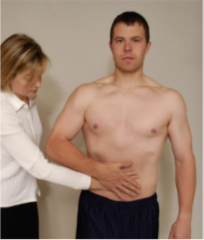
Gerber's Lift-Off Test (Shoulder)
Patient lifts dorsum of hand away from back pocket; detects subscapularis lesion.
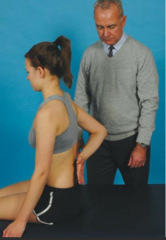
Jerk Test (Shoulder)
Axial load on humerus at 90° flexion/IR, horizontal adduction; tests posterior instability.
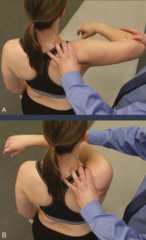
Sulcus Sign (Shoulder)
Distal traction on relaxed arm; indicates inferior shoulder instability or GH laxity.
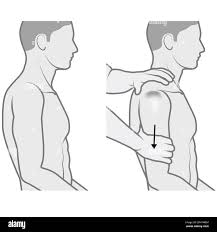
Pectoralis Major Contracture Test
Supine, hands behind head, elbows lowered; positive if elbows cannot touch table.
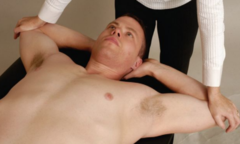
Halstead Maneuver (Shoulder)
Downward traction on extremity, neck hyperextended, head rotated opposite; checks thoracic inlet.
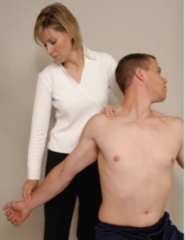
Clunk Test (Shoulder)
Supine, full abduction, anterior glide of humerus with ER; identifies glenoid labrum tear.
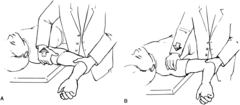
Fulcrum Test (Shoulder)
Apprehension test with hand under GH joint acting as fulcrum; checks past anterior dislocation.
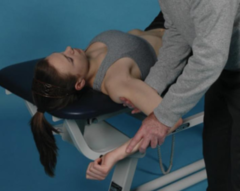
Posterior Apprehension Sign (Shoulder)
Posterior force on elbow during 90° flexion/IR/adduction; checks past posterior dislocation.
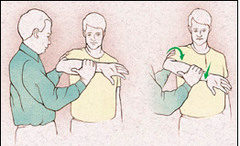
Acromioclavicular Shear Test
Squeeze heels of hands together over clavicle and scapula spine; identifies AC dysfunction.
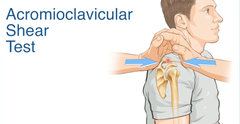
Adson's Maneuver (Shoulder)
Head rotated to test side/extended, deep breath held with shoulder ER/extended; checks thoracic inlet.
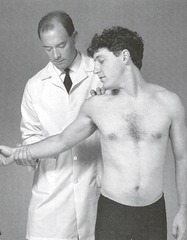
Military Posture / Costoclavicular Test
Draw shoulder down and back while palpating radial pulse; identifies thoracic inlet pathology.

Wright Test / Allen Maneuver
Shoulder in max abduction and ER; checks thoracic inlet pathology via radial pulse.

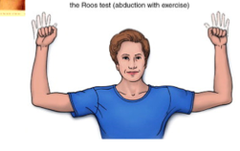
Roos Test / EAST (Shoulder)
90° abduction/ER, 90° elbow flexion, open/close hands for 3 minutes; checks thoracic outlet.
Elbow Ligament Instability Tests
Valgus force at 20°-30° flexion tests UCL; varus force tests RCL.
Cozen's Test (Elbow)
Resisted wrist extension/radial deviation with pronated forearm; identifies lateral epicondylopathy.
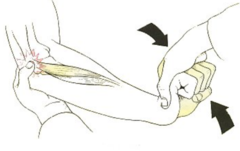
Mill's Test (Elbow)
Passive forearm pronation, wrist flexion, and elbow extension; identifies lateral epicondylopathy.

Maudsley's Test (Elbow)
Resisted extension of the third digit distal to PIP; identifies lateral epicondylopathy.
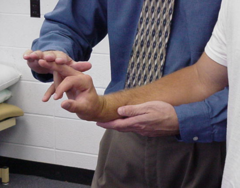
Elbow Flexion Test
Full elbow flexion, wrist extension, 90° shoulder abduction/depression for 3-5 minutes; checks cubital tunnel.
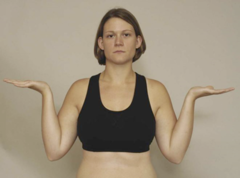
Golfer's Elbow Test
Passive forearm supination, elbow/wrist extension while palpating medial epicondyle; identifies medial epicondylopathy.
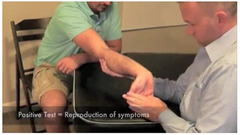
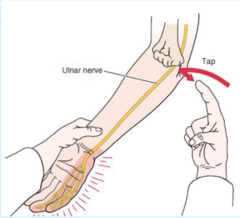
Tinel's Sign at the Elbow
Tap ulnar nerve in olecranon groove; identifies ulnar nerve dysfunction/regeneration.
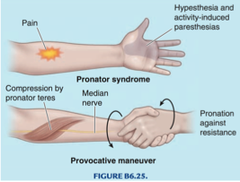
Pronator Teres Syndrome Test
Resisted pronation during elbow extension from 90° flexion; identifies median nerve entrapment.
Finkelstein's Test (Wrist)
Fist with thumb inside, then ulnar deviation; identifies de Quervain disease.

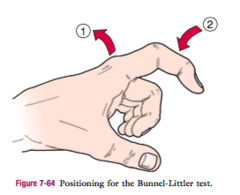
Bunnell-Littler Test (Hand)
Differentiates tight intrinsic muscles from capsule contracture at the MCP and PIP joints.
Watson's / Retinacular Test (Hand)
PIP held neutral while DIP is flexed; identifies tight retinacular ligaments/PIP capsule.
Ligament Instability Test (Fingers)
Varus/valgus stress applied to PIP/DIP joints; tests collateral ligament integrity.

Froment's Sign (Hand)
Grasp paper between thumb/index; flexion of thumb terminal phalanx indicates adductor pollicis paralysis.
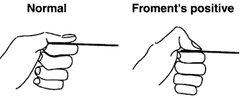
Jeanne's Sign (Hand)
Hyperextension of the thumb MCP joint during Froment's paper grip; indicates ulnar paralysis.
Wartenberg's Sign (Hand)
Inability to squeeze the little finger back to the hand; indicates ulnar neuropathy.
Hoffmann's Sign (Hand)
Flick distal phalanx of middle finger; flexion/adduction of thumb indicates UMN dysfunction.
Grind Test (Hand)
Axial compression and rotation of thumb MCP joint; identifies degenerative joint disease.
Murphy's Sign (Hand)
Make a fist; head of third metacarpal level with others indicates lunate dislocation.
Tinel's Sign at the Wrist
Tap over carpal tunnel; tingling in median nerve distribution indicates carpal tunnel syndrome.
Phalen's Test (Wrist)
Maximal wrist flexion held for 1 minute; identifies carpal tunnel median nerve compression.
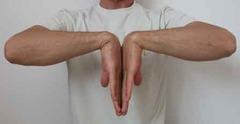
Two-Point Discrimination Test (Hand)
Measures sensory innervation level; normal fingertip discrimination distance is less than 6 mm.
Allen Test (Wrist)
Compress radial/ulnar arteries, open/close hand, release one artery; identifies vascular compromise.

Patrick's (FABER) Test (Hip)
Passive flexion, abduction, ER of hip; positive if knee remains above opposite leg.
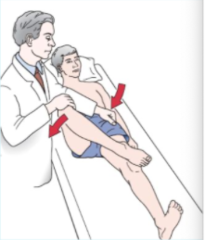
Grind / Scouring Test (Hip)
Passive hip flexion/adduction with axial compression; identifies degenerative joint disease of hip.
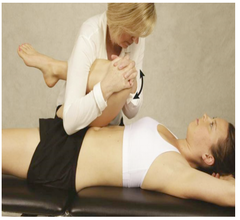
Trendelenburg Test (Hip)
Stand on one leg; pelvis drops on opposite side if stance gluteus medius is weak.
Thomas Test (Hip)
Bring one knee to chest while supine; opposite thigh rising indicates hip flexor tightness.

Ober's Test (Hip)
Side-lying passive abduction/extension of upper leg; failure to lower indicates TFL/IT band tightness.
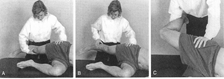
Ely's Test (Hip)
Prone passive knee flexion; spontaneous hip flexion indicates tight rectus femoris.
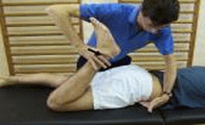
90-90 Straight Leg Raise Test
Hips at 90° flexion, actively extend knee; positive for hamstring tightness if >10° short of full extension.
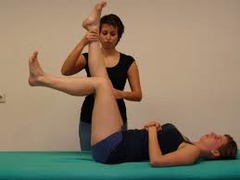
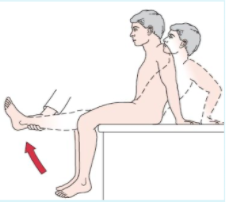
Tripod Sign (Hip)
Seated passive knee extension; trunk extension to relieve tension indicates hamstring tightness.
Piriformis Test
Side-lying test hip flexed 60°, knee flexed, downward pressure; identifies piriformis syndrome.
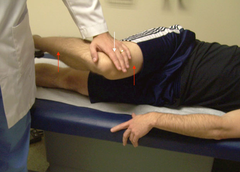
True Leg Length Discrepancy Test
Measure from ASIS to medial/lateral malleolus; normal difference is 1 to 1.3 cm.
Craig's Test
Prone knee flexed 90°, rotate hip until greater trochanter is parallel with table; measures femoral anteversion.
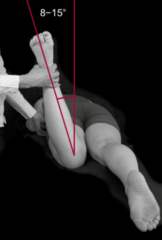
Lachman Test (Knee)
Knee at 0°-30° flexion, anterior tibial translation with femur stabilized; indicates ACL integrity.
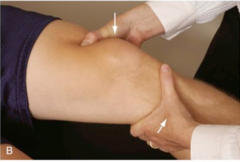
Pivot Shift Test (Knee)
Medial tibial rotation and valgus stress during flexion/extension; indicates ACL rotary instability.
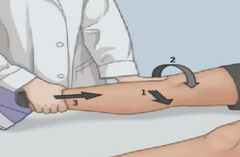
Posterior Sag Sign (Knee)
Supine, hip flexed 45°, knee flexed 90°; gravity-induced tibial drop indicates PCL tear.
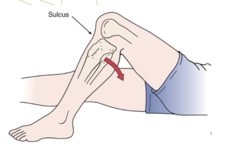
Slocum Test (Knee)
Anterior drawer with foot in 30° IR (ALRI) or 15° ER (AMRI); tests rotary instability.
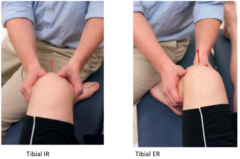
Posterior Drawer Test (Knee)
Hip flexed 45°, knee flexed 90°, passive posterior tibial glide; checks PCL integrity.
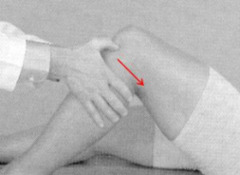
Godfrey's / Reverse Lachman Test
Prone knee flexed 30°, pull tibia posteriorly; tests posterior cruciate ligament integrity.
McMurray Test (Knee)
Knee fully flexed, rotate tibia, passively extend; IR tests lateral meniscus, ER tests medial meniscus.

Apley's Test (Knee)
Prone knee flexed 90°, tibia distraction vs compression with rotation; differentiates ligament vs meniscus.
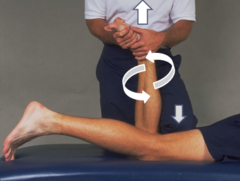
Bounce Home Test (Knee)
Fully flexed knee passively extended; rubbery end feel/incomplete extension indicates meniscus lesion.
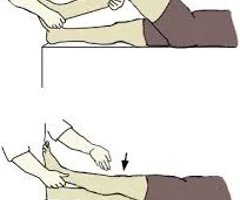
Thessaly Test (Knee)
Single-leg standing, knee flexed 5° and 20°, rotate femur on tibia; identifies meniscus tear.

Hughston's Plica Test
Flex/extend knee while pressing patella medially and rotating tibia medially; checks plica dysfunction.
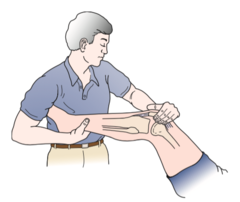
Patellar Apprehension Test
Passive lateral glide of patella; positive if patient resists or contracts quadriceps.
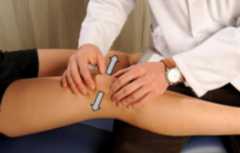
Clarke's Sign (Knee)
Press proximal patella, resist quadriceps contraction; retropatellar pain indicates patellofemoral dysfunction.
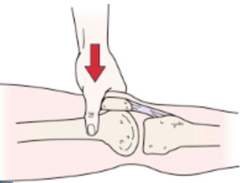
Patellar Tap / Ballottement Test
Tap patella with knee extended; floating patella indicates infrapatellar effusion.
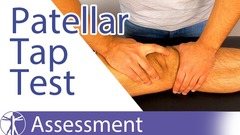
Fluctuation Test (Knee)
Press suprapatellar pouch and anterior joint; fluid movement indicates significant knee joint effusion.
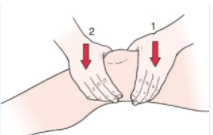
Q-Angle (Knee)
Angle between ASIS-to-patella and tibial tubercle-to-patella lines; normal is 13° (males), 18° (females).
Noble Compression Test (Knee)
Pressure to lateral femoral epicondyle during passive knee extension; identifies distal IT band friction syndrome.

Tinel's Sign at the Fibular Head
Tap posterior to fibular head; tingling in common fibular nerve distribution is positive.
Talar Tilt Test (Ankle)
Inversion tests calcaneofibular ligament; eversion tests deltoid ligament.
Kleiger / Lateral Rotation Test
Passive lateral rotation stress to foot in plantigrade; evaluates syndesmosis or deltoid ligament injury.
Squeeze Test (Ankle)
Squeeze tibia and fibula at midcalf; pain indicates syndesmosis injury.
Thompson Test (Ankle)
Squeeze calf muscle in prone; absence of plantar flexion indicates ruptured Achilles tendon.
Tinel's Sign at the Ankle
Percuss anterior deep peroneal or posterior tibial nerve; tingling distally indicates nerve dysfunction.
Morton's Test (Foot)
Squeeze metatarsal heads together; pain indicates stress fracture or neuroma.
Vertebral Artery Test (Cervical)
Passive extension, side flexion, and ipsilateral rotation; assesses vertebro-basilar vascular integrity.
Hautant's Test (Cervical)
Differentiates articular (nonvascular) vs vascular dizziness using arm drift and head rotation.
Transverse Ligament Stress Test
Glide C1 anteriorly in supine; soft end feel/neurological symptoms indicate positive test.
Sharp-Purser Test (Cervical)
Backward palm pressure on forehead during head flexion; determines subluxation of atlas on axis.
Spurling's Test (Cervical)
Side flex head, press straight down; dermatomal pain indicates cervical nerve root compression.
Distraction Test (Cervical)
Passive head distraction; decreased neck/arm pain indicates facet or neurological pathology.
Shoulder Abduction (Bakody's) Test
Elevate arm to rest hand on head; symptom relief indicates extradural compression (C4-C6).
Lhermitte's Sign (Cervical)
Passively flex head and hip; electric shock down spine indicates dural irritation or myelopathy.
Slump Test (Spine)
Sequential thoracic/lumbar slump, neck flexion, knee extension, foot dorsiflexion; checks dural impingement.
Femoral Nerve Stretch Test
Side-lying, hip extended 15°, knee flexed; pain in anterior thigh indicates femoral nerve compression.
Valsalva Maneuver (Spine)
Bear down to increase intrathecal pressure; increased pain indicates space-occupying lesion.
Babinski Test (Spine)
Stroke plantar aspect of foot; big toe extension and splaying of other toes indicates UMN lesion.
Kemp's / Quadrant Test (Lumbar)
Extension, side flexion, and rotation with overpressure; identifies intervertebral foramen/facet compression.
Stork Standing Test (Lumbar)
Stand on one leg and extend spine; back pain indicates spondylolisthesis.
Bicycle Test of van Gelderen
Pedal leaning back vs leaning forward; differentiates spinal stenosis (relieved leaning forward) from claudication.
Prone Instability Test (Lumbar)
P-A pressure on spine with feet on floor vs lifted; symptom reduction with feet lifted is positive.
Gillet's Test (SIJ)
Palpate PSIS during single-leg knee raise; minimal/upward movement indicates hypomobile SIJ.