Homeostasis & Feedback Mechanisms
 Call Kai
 Learn
Learn Practice Test
 Spaced Repetition
 Match
Match Flashcards
 Knowt Play
1/37

There's no tags or description
Looks like no tags are added yet.
Name | Mastery | Learn | Test | Matching | Spaced | Call with Kai | Chat |
|---|
No analytics yet
Send a link to your students to track their progress
38 Terms
Homeostasis
A tendency to maintain a balanced or constant internal state within a continually changing environment.
Stimulus
A change in the internal or external environment that produces a change in the regulated variable.
Variable
The regulated factor or event that acts as a signal or stressor that a cell or organism responds to.
Control Center
The area that determines set point, analyzes information, determines appropriate response.
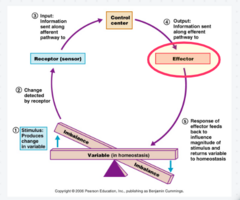
Effector
Typically a muscle or gland that provides the means for the control center's recommended reponse.
Negative Feedback
The mechanism for maintaining homeostasis in the human body that reduces the effect of the stimulus and prevents sudden severe changes.
Positive Feedback
The mechanisms that drives physiological process that must escalate to a definitive resolution.
Homestatic Imbalance
The disturbance of homeostasis or the body's normal functioning, which is synonymous with disease.
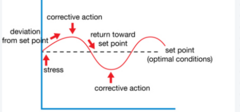
Negative Feedback Regulation
Postive Feedback Regulation

Stimulus & Variable in the Feeback Loop

Receptor in the Feedback Loop
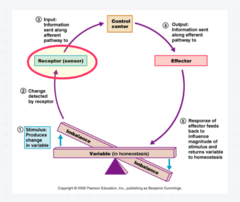
Control Center in the Feedback Loop

Effector in the Feedback Loop
Pressure from the baby stretches the uterus. This triggers the release of oxytocin. Oxytocin causes stronger contractions. The cycle repeats until birth occurs. Is this positive or negative feedback?
positive feedback
A high temperature causes sweating and vessel widening to cool the body. A low temperature causes shivering and vessel narrowing to warm the body. Is this positive or negative feedback?
negative feedback
High pressure makes the heart slow down and blood vessels widen. Low pressure makes the heart beat faster. Is this positive or negative feedback?
negative feedback
High blood sugar after a meal causes the pancreas to release insulin. Insulin helps cells absorb glucose. Low blood sugar causes the release of glucagon to raise sugar levels. Is this positive or negative feedback?
negative feedback
A ripe fruit releases ethylene gas. This gas causes nearby fruits to ripen faster. Is this positive or negative feedback?
positive feedback
A damaged blood vessel activates platelets. Platelets release chemical signals. More platelets rush to the site to form a plug. Is this positive or negative feedback?
positive feedback
High blood osmolarity (dehydration) stimulates osmoreceptors in the hypothalamus. The brain releases Antidiuretic Hormone (ADH) from the posterior pituitary. ADH adds aquaporin water channels to the kidney collecting ducts. The kidneys reabsorb more water back into the blood to lower concentration. Is this positive or negative feedback?
negative feedback
A baby suckling stimulates mechanoreceptors in the nipple. The hypothalamus signals the posterior pituitary gland. The gland secretes the hormone oxytocin. Oxytocin contracts breast tissue cells to eject milk. More suckling triggers more oxytocin release. Is this positive or negative feedback?
positive feedback
Estrogen levels rise steadily during the menstrual cycle's follicular phase. This accumulation triggers the brain to release a massive pulse of Luteinizing Hormone (LH). The acute LH surge causes the follicle to rupture and release an egg. Is this positive or negative feedback?
positive feedback
Decreased tissue oxygenation (hypoxia) is detected by specialized cells in the kidneys. The kidneys respond by producing and secreting the hormone erythropoietin (EPO). EPO travels to the red bone marrow to accelerate red blood cell production. Increased cells carry more oxygen to end the hypoxia. Is this positive or negative feedback?
negative feedback
Sodium channels open during a nerve impulse. Sodium ions (\(Na^{+}\)) rush into the neuron cell. This movement depolarizes the cell membrane further. More voltage-gated sodium channels open as a result. The cycle rapidly amplifies the signal until peak voltage closes the gates. Is this positive or negative feedback?
positive feedback
Homeostatic Imbalance
Caused by an organism's inability to maintain internal stability against internal disruptions, external stressors, or genetic flaws. When the body's control systems fail to correct these shifts, cellular damage occurs, leading to illness, disease, or death.
Stressors that Cause Homeostatic Imbalance
nutritional deficiencies, toxic exposure, pathogenic infections, physical trauma, aging, genetic mutations & chronic stress
Low blood calcium levels cause the parathyroid glands to release parathyroid hormone (PTH). PTH stimulates bone-destroying osteoclasts to dissolve bone matrix and release calcium. It also increases calcium reabsorption in the kidneys. What is the stimulus?
blood calcium levels drop
Low blood calcium levels cause the parathyroid glands to release parathyroid hormone (PTH). PTH stimulates bone-destroying osteoclasts to dissolve bone matrix and release calcium. It also increases calcium reabsorption in the kidneys. What is the receptor?
Calcium sending receptors located in the parathyroid gland.
Low blood calcium levels cause the parathyroid glands to release parathyroid hormone (PTH). PTH stimulates bone-destroying osteoclasts to dissolve bone matrix and release calcium. It also increases calcium reabsorption in the kidneys. What is the control center?
Parathyroid glands synthesize PTH.
Low blood calcium levels cause the parathyroid glands to release parathyroid hormone (PTH). PTH stimulates bone-destroying osteoclasts to dissolve bone matrix and release calcium. It also increases calcium reabsorption in the kidneys. What is the effector?
Osteoclasts dissolve bone & kidneys & small intestines reabsorb more calcium.
An infant begins suckling at the mother's breast. This physical action applies mechanical pressure and friction to the nipple and areola. Sensory nerve endings in the skin of the nipple detect this touch and stretch. These signals travel along sensory nerves up the spinal cord to the hypothalamus via the afferent pathway. The hypothalamus integrates the information and signals the posterior pituitary gland to release the hormone oxytocin. Oxytocin reaches the capillaries supplying the breast tissue. The muscles contract strongly. This pushes the stored milk into the out through the nipple pores. This event is called the milk let-down reflex. The let-down of milk provides a reward to the infant, causing the baby to suckle more aggressively. What is the stimulus?
Tactile suckling by the infant on the nipple and areola
An infant begins suckling at the mother's breast. This physical action applies mechanical pressure and friction to the nipple and areola. Sensory nerve endings in the skin of the nipple detect this touch and stretch. These signals travel along sensory nerves up the spinal cord to the hypothalamus via the afferent pathway. The hypothalamus integrates the information and signals the posterior pituitary gland to release the hormone oxytocin. Oxytocin reaches the capillaries supplying the breast tissue. The muscles contract strongly. This pushes the stored milk into the out through the nipple pores. This event is called the milk let-down reflex. The let-down of milk provides a reward to the infant, causing the baby to suckle more aggressively. What is the receptor?
Touch receptors located in the skin of the nipple.
An infant begins suckling at the mother's breast. This physical action applies mechanical pressure and friction to the nipple and areola. Sensory nerve endings in the skin of the nipple detect this touch and stretch. These signals travel along sensory nerves up the spinal cord to the hypothalamus via the afferent pathway. The hypothalamus integrates the information and signals the posterior pituitary gland to release the hormone oxytocin. Oxytocin reaches the capillaries supplying the breast tissue. The muscles contract strongly. This pushes the stored milk into the out through the nipple pores. This event is called the milk let-down reflex. The let-down of milk provides a reward to the infant, causing the baby to suckle more aggressively. What is the control center?
The hypothalamus in the brain. It integrates the nerve signals and instructs the posterior pituitary gland to secrete the hormone oxytocin into the bloodstream.
An infant begins suckling at the mother's breast. This physical action applies mechanical pressure and friction to the nipple and areola. Sensory nerve endings in the skin of the nipple detect this touch and stretch. These signals travel along sensory nerves up the spinal cord to the hypothalamus via the afferent pathway. The hypothalamus integrates the information and signals the posterior pituitary gland to release the hormone oxytocin. Oxytocin reaches the capillaries supplying the breast tissue. The muscles contract strongly. This pushes the stored milk into the out through the nipple pores. This event is called the milk let-down reflex. The let-down of milk provides a reward to the infant, causing the baby to suckle more aggressively. What is the effector?
Milk-producing cells within the mammary glands.
Can positive feedback maintain homeostasis?
No, positive feedback does not maintain homeostasis. Instead, positive feedback loops amplify changes and push a system further away from its starting point or set point. They drive specific biological events to a rapid endpoint rather than keeping conditions stable.
Characteristics of Negative Feedback
Reversal of Change: The system moves in the opposite direction of the stimulus (e.g., cooling down when body heat rises).
Set Point Regulation: It aims to maintain a specific physiological value or narrow normal range.
Self-Stabilizing: Continuous monitoring stops the response once balance returns, preventing overcorrection.
High Prevalence: It is the primary and most common control mechanism used in human physiology
Characteristics of Positive Feedback
Amplification of Stimulus: The system moves in the same direction as the initial change to intensify the response.
Self-Amplifying Cycle: It creates a "snowball effect" where each step reinforces and strengthens the next.
Definite Endpoint: The loop does not stop on its own; it requires an external brake or event to terminate.
Non-Homeostatic Nature: It temporarily disrupts steady-state balance rather than preserving it.
Relative Rarity: It is used selectively for urgent, one-way biological events rather than continuous regulation.