BB questions I got wrong
 Call Kai
 Learn
Learn Practice Test
 Spaced Repetition
 Match
Match Flashcards
 Knowt Play
1/112

There's no tags or description
Looks like no tags are added yet.
Name | Mastery | Learn | Test | Matching | Spaced | Call with Kai | Chat |
|---|
No analytics yet
Send a link to your students to track their progress
113 Terms
Interpret these ABO/Rh reactions:
FORWARD Type
Anti-A: 3+
Anti-B: 0
Anti-D: 3+
REVERSE Type
A1 cells: 1+
B cells: 3+
Invalid - further testing required
Of the following, which best displays the genetic pathway for the creation of ABO phenotypes and the antigens displayed on the RBCs?
Precursor substance - H gene/H antigen - A, B, or O gene - A, B, or H antigen
What is the immunodominant sugar(s) that results in A antigen being displayed?
N-acetylgalactosamine
Which statement regarding routine ABO testing is correct?
Forward and reverse grouping should be performed concurrently, and the results must agree before an ABO type is assigned
The most significant blood group antibodies belong to which immunoglobulin classes?
IgG and IgM
Which statement about the D antigen is correct?
There is no d antigen; "d" represents the absence of the D antigen.
Why is the Hardy-Weinberg equation useful in blood banking?
It estimates blood group allele and phenotype frequencies within populations.
A MLS accidentally adds twice the recommended amount of patient serum during an antibody screen. Which phenomenon could reduce agglutination despite the presence of antibody?
Prozone
Which statement correctly distinguishes competency assessment from proficiency testing?
Competency assessment evaluates individual employee performance, whereas proficiency testing evaluates laboratory performance using external samples.
Interpret these ABO/Rh reactions:
FORWARD Type
Anti-A: 4+
Anti-B: 4+
Anti-D: 0
REVERSE Type
A1 cells: 0
B cells: 0
AB Negative
A mislabeled specimen results in an incorrect blood type being reported. After correcting the patient's result, the laboratory investigates why the error occurred and modifies the specimen labeling process. This investigation is an example of:
Root-cause analysis
A patient develops an anti-D following exposure to D-positive red blood cells. Which mechanism is most likely responsible for clearance of these antibody-coated RBCs?
Extravascular hemolysis through IgG-coated RBC removal by macrophages
The ABO system is the most dangerous blood group system because the predictably present antibodies are:
Capable of activating complement
Which characteristic makes a red blood cell antigen more likely to stimulate antibody production?
High molecular complexity and foreignness to the recipient
Which ABO phenotype has the lowest amount of H antigen on the red blood cell membrane?
Group A1B
Which phase of testing is used to determine an individual's ABO group?
Immediate spin (IS)
A patient's Rh genotype is DCe/dce. This patient is:
Heterozygous for c
A patient receives an RBC transfusion for the first time and develops anti-E several weeks later. If exposed to E-positive RBCs again, which response is expected?
Rapid IgG production with increased antibody affinity
Which characteristic is typical of Rh antibodies?
Usually IgG and clinically significant
The order of immunogenicity for the 5 major Rh antigens from most immunogenic to least immunogenic are:
D > c > E > C > e
A Caucasian individual's red cells gave the following reactions with antisera:
D+ C+ E- c+ e+
The most probable genotype is
R1r
The most common ABO group is ______ while _______ is the least common.
O/AB
Which of the following type(s) of packed RBCs could be transfused to a group B patient?
B, O
An anti-C demonstrates dosage. A red blood cell with which genotype would be expected to show the weakest reaction with this antibody?
DCe/dce
Interpret these ABO/Rh reactions:
FORWARD Type
Anti-A: 0
Anti-B: 0
Anti-D: 0
REVERSE Type
A1 cells: 4+
B cells: 3+
O negative
The Rh antigen that is routinely tested for when determining blood type is:
D
The best specimen to use for ABO and Rh determination is
EDTA
A patient has an anti-K and anti-Fya. Approximately, how many units would you have to screen in order to find 4 units that are negative for both antigens?
Positive antigen frequency for K: 9%
Positive antigen frequency for Fya: 66%
13 units
What is the purpose of incubating patient RBCs with anti-D at 37 C during weak D testing?
To allow anti-D igG to bind to weakly expressed D antigens on RBCs
The ABO forward grouping tests a person's ______ with ______ to detect ______.
RBCs/anti-sera/antigens
If one partner is Group A and the other partner is Group B, what are the possible phenotypes of their offspring?
A, B, AB, and O
According to Landsteiner's Rule, which statement is correct?
If an individual has an antibody in their plasma, their red blood cells will lack the corresponding antigen.
Interpret these ABO/Rh reactions:
FORWARD Type
Anti-A: 4+
Anti-B: 0
Anti-D: 2+
REVERSE Type
A1 cells: 0
B cells: 3+
A positive
Which of the following populations require the weak D test if testing at the IS (immediate spin) phase is negative?
Blood, organ, and tissue donors
What are all the possible genotypes for a patient with the following Rh phenotype?
D+ C+ E+ c+ e-
RzR2, Rzr", R2ry
Each of the following genotypes is possible for an individual whose red cells react as indicated below except:
D+ C+ E+ c+ e+
R0r'
An individual has both A and B antigens on the RBCs. Which ABO antibody(-ies) should be present in that individual's plasma?
None
The addition of Low Ionic Strength Solution (LISS) to the testing environment when performing an indirect antiglobulin test is designed to do what?
Lowering the zeta potential
Which antibody might be produced if a unit of blood with Rh genotype DCe/dce is transfused to a patient with Rh genotype DCe/DCe?
Anti-c
If a child inherited RHD and RHCe genes from his mother, and Rhce from his father, what is the child's genotype?
DCe/dce
Why is the Rh blood group system considered one of the most clinically important blood group systems after ABO?
Rh antigens are highly immunogenic, and Rh antibodies are clinically significant because they can cause hemolytic transfusion reactions.
What Rh type(s) are the reverse grouping reagent RBCs?
Rh Negative
The ABO reverse grouping tests a person's ______ with reagent ______ to detect ______.
plasma/RBCs/antibodies
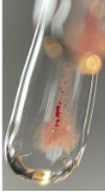
A MLS observes numerous small agglutinates with a cloudy/turbid background after centrifugation. How should this reaction be graded?
1+
The primary antibody response takes an average of how many days?
5-10
Why is it dangerous to transfuse a blood group O person with a unit of blood group A?
The patient's anti-A would destroy the donor's cells with severe consequences to the patient.
The O gene is _____ to the A and B genes.
Recessive
A plasma sample containing anti-D is tested against 4 different Rh(D) positive RBCs at the 37 C phase of testing with the following results:
Cell 1 = 3+
Cell 2 = 2+
Cell 3 = 1+
Cell 4 = 4+
What accounts for the different strengths of reactivity seen with this antibody?
Antigen variability
In the gene interaction form of weak D, expression of the D antigen is limited because
The RhCe gene is in trans position to the RhD gene
The proper cell suspension concentration for ABO/Rh testing in a test tube is
2-5%
What immunoglobulin class reacts best at room temperature in the immediate-spin phase?
IgM
Reagent antibody screening cells are:
Group O cells with known phenotypes
What reagent contains antibodies to multiple antigenic epitopes?
Polyclonal-based
What is the approximate probability of finding a compatible unit of blood for a D-positive patient with antibodies to C, E, and K, if the frequency (% positive) of C is 70%, E is 30%, and K is 10%?
2 out of 10 units
What is an advantage of Nucleic Acid Testing (NAT) for viral marker testing?
A small amount of DNA or RNA can be detected
What percentage of the group A population is type as A2 or some other A subgroup
20%
A blood sample from a 90-year-old man was submitted to the blood bank for a type and screen before surgery. The forward type demonstrates as a group A, whereas the reverse type appears to be group AB. What is the most probable cause of the discrepancy?
That patient has low-titer isoagglutinins
To distinguish between an A1 and A2 blood type, which reagent is used?
Dolichos biflorus lectin
When performing weak D testing, if the reagent control is positive, this indicates
the patient or donor has IgG antibody coating their red cells.
The LW antigen expression is typically stronger on _____________ red cells.
D-positive
What is required for a facility to implement a computer (electronic) crossmatch?
There must be two ABO/Rh typings on file for the recipient
A recipient has a confirmed anti-K antibody. What is the standard protocol for selecting donor units?
Provide units that have been phenotyped and are K-negative
On which glycophorin are the M and N antigens located?
Glycophorin A
When selecting RBCs to compose an antibody identification panel, all RBCs should be Group ______, Rh ______ and possess a variety of other common antigens.
Group O, both Rh Positive and Rh Negative
Of the following, which is known to demonstrate antigen variability?
Lua
Which of the following groups of patient history items may be helpful when attempting to identify an unknown alloantibody?
Transfusion history, ethnicity, pregnancy history
Most automated blood bank instruments are capable of performing which of the following specialized tests?
Antibody identification panels
Why are Lewis antigen-negative red cells often not required for a patient who has Lewis antibodies?
Lewis antigens can dissociate from donor RBCs and be neutralized by patient plasma.
Of the following, which is most likely to activate complement?
Anti-Jka
Once an antibody has been identified, one should confirm the identification by
Antigen typing the patient's RBCs
Which of the following antigens does not have an antithetical antigen?
Leb
Which of the following is a high prevalence antigen?
Lub
Which of the following antibody groups are typically enhanced by enzyme treatment of red cells?
Rh, Kidd, Lewis, I, P
A patient is undergoing a massive transfusion, defined as a total volume exchange of blood within:
24 hours
Which of the following is a characteristic of high-titer, low-avidity (HTLA) antibodies?
They react weakly at the AHG phase and are generally not clinically significant
Which step is considered the most important for preventing hemolytic transfusion reactions?
Patient identification and correct sample labeling
Under what circumstance must apheresis platelets be crossmatched?
If the product contains more than 2 mL of red blood cells
An individual with the genotype "sese" and "LeLe" will have which of the following in their secretions?
Lea antigen only
Of the following, which antibody is known to display dosage?
Anti-M
Which of the following describes the typical agglutination pattern seen with Lua antibodies?
Mixed-field pattern
When performing rule-outs on an antibody panel, one should eliminate all specificities using the cells that
Failed to react (negative reaction)
A MLS observes agglutination during the immediate spin phase of a crossmatch but not at the AHG phase. Which of the following is a likely cause?
An ABO incompatibility or cold-reacting IgM antibody
What is the role of Protein A when used in solid phase testing?
It has a high affinity for the Fc portion of immunoglobulins.
Which reagent is commonly used to denature Kell system antigens on red blood cells?
DTT
An MLS performs an antibody screen using the tube method with LISS enhancement. The MLS is called to respond to a trauma/massive transfusion protocol and the antibody screen is left to incubate at 37 C for 47 minutes. Once the trauma has ended, the MLS returns and continues on with their antibody screen by centrifuging and reading tubes at 37 C, washing tubes 3 times, adding AHG reagent, centrifuging and reading at AHG, and addition of check cells to appropriate tubes. Are the results of this antibody screen acceptable and able to be reported?
No, test incubated too long for this enhancement reagent
Of the following, which set of antibodies are all known to be clinically significant?
Anti-Jka, Anti-K, Anti-S
If an individual is missing an antigen from their RBCs, they will automatically have the corresponding antibody in their serum.
False
A patient's secretor status is "se/se" and they have the Lewis gene (Le). What is their expected Lewis phenotype?
Le(a+b-)
Which antibody in the P system is associated with Paroxysmal Cold Hemoglobinuria (PCH)?
Anti-P
A patient was transfused two days ago. For how long is their current pretransfusion sample considered valid for further crossmatching?
3 days
A patient of African ethnicity is S-negative and s-negative. They have developed an antibody to a high-prevalence antigen. Which antibody should be suspected?
Anti-U
What is the physiological function of the Kidd blood group glycoproteins?
Urea transporter
An antibody reacting at the immediate spin phase (IS) is most often a ______ antibody. An antibody reacting at the antiglobulin (AHG) phase is most often a ______ antibody.
Cold (IgM); warm (IgG)
What happens to Duffy system antigens when the red cells are treated with proteolytic enzymes?
The antigens are destroyed
An alloantibody to a high-frequency antigen should be suspected if which of the following occurs?
Most panel cells are positive while the autocontrol is negative
A crossmatch shows 2+ agglutination at the AHG phase. What is the most appropriate next step?
Investigate for a potential IgG antibody or a positive DAT on the donor unit
In Solid Phase Red Cell Adherence (SPRCA) technology, what is used to coat the bottom of the microtiter wells?
RBC membranes or stroma
What is the purpose of performing a control in parallel with an antibody neutralization procedure?
To ensure negative reactions are due to neutralization and not simple dilution
The Duffy antigens Fya and Fyb serve as receptors for which human pathogen?
Plasmodium vivax (Malaria)
Which of the following donor units must be re-typed by the transfusion service before being added to the inventory?
All units for ABO, and Rh-negative units for D