MICRO CHAPTER 1
 Call Kai
 Learn
Learn Practice Test
 Spaced Repetition
 Match
Match Flashcards
 Knowt Play
1/86

There's no tags or description
Looks like no tags are added yet.
Name | Mastery | Learn | Test | Matching | Spaced | Call with Kai | Chat |
|---|
No analytics yet
Send a link to your students to track their progress
87 Terms
Who discovered microscopes and visualized tiny animal (microorganisms) ?
Antoni Van Leeuwenhoek
What is a prokaryote?
A cell that does not have a nucleus or other membrane-bound organelles.
What are the two types of prokaryotes
bacteria, archaea
What is a eukaryote?
A cell that has a nucleus containing its DNA and has membrane-bound organelles
What are the 4 types of eukaryotes
fungi, protozoa, algae, small multicellular plants
What is fungi
are organisms that include mushrooms, molds, and yeasts.
What is protozoa
microscopic, single-celled eukaryotic organisms that are usually found in water, soil, or inside other organisms.
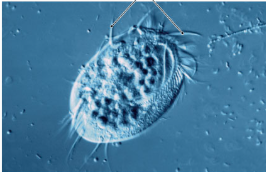
what is the arrow pointing to?
Cillia
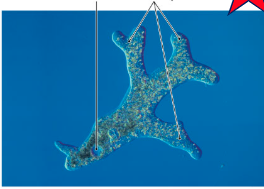
What is the first arrow pointing to?
nucleus
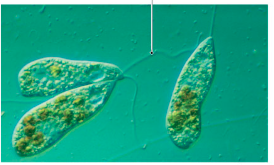
What is the arrow pointing to ?
Flagellum

what is arrow one and two pointing to?
1.) hyphae 2.) spores
what is algae
Eukaryotic organisms that use photosynthesis to make their own food. They are commonly found in water and can be unicellular or multicellular.
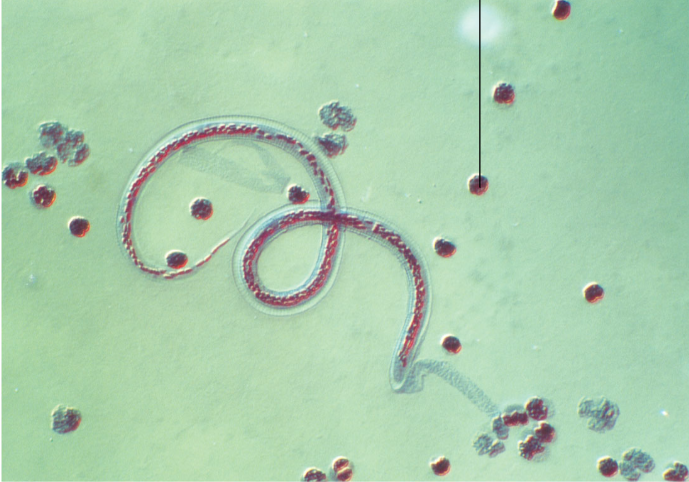
What is this organism and what is the arrow pointing to?
Parasitic worm and a red blood cell
What is a virus?
A nonliving infectious agent made of genetic material (DNA or RNA) surrounded by a protein coat. Viruses must enter a living host cell to reproduce.
What are the two types of viruses
naked virus and enveloped virus
What are viruses that infect bacteria called?
Bacteriophages (phages).
What was Robert Koch known for?
showing that specific microorganisms cause specific diseases and developing Koch's postulates.
Q: What is a bacterial capsule?
A: A protective outer layer around some bacteria.
Why is a capsule important?
A: It helps bacteria attach to surfaces, form biofilms, and avoid immune defenses.
Q: What is a biofilm?
A: A community of microorganisms attached to a surface and surrounded by a protective matrix.
What is replication?
Making a copy of DNA.
What is transcription?
Making RNA from DNA.
Q: What is translation?
Making a protein from mRNA.
What is blood plasma?
A: The liquid part of blood that contains clotting factors.
Q: What is blood serum?
A: The liquid part of blood without clotting factors.
Q: What are flagella?
A: Structures used for bacterial movement.
Q: What are axial filaments?
A: Internal structures used for movement in spirochetes.
Q: What type of bacteria have axial filaments?
A: Spirochetes.
Q: What are the 3 basic bacterial shapes?
Coccus = round
Bacillus = rod
Spiral = spiral/curved
Q: What is chemotaxis?
A: Movement of bacteria toward helpful chemicals or away from harmful chemicals.
Q: What is a sex pilus?
A: A structure used to transfer DNA between bacteria.
Q: What is conjugation?
A: DNA transfer from one bacterium to another, usually through a sex pilus.
Q: Where is ATP produced in bacteria?
A: At the cell membrane.
Q: Where are proteins made in bacteria?
A: Ribosomes.
Q: Where are lipids made in bacteria?
A: Mainly at the cell membrane.
Q: Where is most ATP produced in eukaryotic cells?
A: Mitochondria.
Q: Where are proteins made in eukaryotic cells?
A: Ribosomes.
Q: Where are lipids made in eukaryotic cells?
A: Mainly in the smooth endoplasmic reticulum (smooth ER).
Q: What are bacterial endospores
A: Highly resistant survival structures formed by some bacteria.
Q: Are endospores used for bacterial reproduction?
A: No! They help bacteria survive harsh conditions.
Q: What does a bright-field microscope use?
A: Visible light to view stained specimens.
Q: Advantage of bright-field microscopy?
A: Simple and useful for viewing stained cells.
Q: Disadvantage of bright-field microscopy?
A: Many cells need to be stained, which usually kills them.
Q: What is phase-contrast microscopy good for?
A: Viewing living, unstained cells.
Q: What is dark-field microscopy good for?
A: Viewing thin organisms that are difficult to see with bright-field, such as spirochetes.
Q: What does SEM show?
A: The surface of a specimen with a 3D-like appearance.
Q: What does TEM show?
A: The internal structures of a specimen.
Q: What is a disadvantage of electron microscopy?
A: Specimens must be specially prepared and cannot be viewed alive.
1 millimeter = how many micrometers?
1,000 µm
1 micrometer = how many nanometers?
1,000 nm
1 millimeter = how many nanometers?
1,000,000 nm
Which is biggest: milli, micro, or nano?
Milli > Micro > Nano
What is the first step of the Gram stain
A: Crystal violet
Q: What is the second step?
Iodine
Q: What is the third step?
A: Alcohol/acetone (decolorizer)
Q: What is the fourth step?
Safranin
Q: What color is Gram-positive bacteria?
A: Purple
Q: What color is Gram-negative bacteria?
PINK/RED
Q: What is the major difference in Gram-positive vs. Gram-negative cell walls?
Gram-positive: thick peptidoglycan
Gram-negative: thin peptidoglycan + outer membrane
What is catabolism
A: Breaking down molecules to release energy.
Q: What is anabolism?
A: Building larger molecules using energy.
Q: What is an exergonic reaction?
A: A reaction that releases energy.
Q: What is an endergonic reaction?
A: A reaction that requires energy.
Q: What is aerobic respiration?
A: Cellular respiration that uses oxygen.
Q: What is anaerobic respiration?
A: Cellular respiration that does not use oxygen as the final electron acceptor.
Q: What is fermentation?
A: A process that makes ATP without oxygen or an electron transport chain.
Q: How much ATP does fermentation produce per glucose?
2 ATP
How much ATP does aerobic respiration produce
Prokaryotes = 38 ATP
Eukaryotes = 36 ATP
How much ATP does anaerobic respiration produce?
Less than aerobic respiration; the amount varies
What is an autotroph?
An organism that makes its own food.
What is a heterotroph?
An organism that gets food/energy from other organisms or organic matter.
Q: Name 3 toxic forms of oxygen.
A: Superoxide, hydrogen peroxide, hydroxyl radical.
Q: What enzyme breaks down hydrogen peroxide?
Catalase
Q: What happens in a positive catalase test?
bubbles
Q: What causes the bubbles in a catalase test?
A: Catalase breaks down H₂O₂ into water + oxygen gas.
Q: What is a psychrophile?
A: A microorganism that likes cold temperatures.
: What is a mesophile?
A microorganism that likes moderate temperatures.
What is a thermophile?
: A microorganism that likes hot temperatures
What is an acidophile
A microorganism that likes acidic environments.
What is a neutrophile?
A microorganism that prefers a near-neutral pH.
What is a halophile?
: A microorganism that likes high-salt environments
What is selective media?
Media that allows some bacteria to grow while inhibiting others.
What is differential media?
Media that allows bacteria to grow but shows differences between them
What are the 4 phases of bacterial growth?
Lag → Log → Stationary → Death
Q: What happens during the lag phase?
A: Bacteria adjust to their environment and prepare to grow.
During which phase is penicillin most effective?
LOG (exponential) phase