Consumer Behavior Exam #1 - Jessup
 Call Kai
 Learn
Learn Practice Test
 Spaced Repetition
 Match
Match Flashcards
 Knowt Play
1/50

There's no tags or description
Looks like no tags are added yet.
Name | Mastery | Learn | Test | Matching | Spaced | Call with Kai | Chat |
|---|
No analytics yet
Send a link to your students to track their progress
51 Terms
What disciplines does consumer behavior have roots in?
- psychology
- sociology
- economics
- anthropology
- medicine
- marketing
From what disciplines did Marketing spring from?
economics and psychology
What are some benefits of studying consumer behavior?
1. To improve business performance
2. To influence public policy
3. To help consumers make better decisions
What are the consumer responses of interest in consumer behavior research?
1. Affective (emotional) responses
2. Mental (cognitive) responses
3. Behavioral responses
Affective responses
emotions, moods, and feelings in response to good or service
Cognitive/Mental Responses
- beliefs (non-evaluative)
- opinions (expression of judgement)
- attitudes (evaluation)
- intentions (inclinations)
Behavioral responses
inquiring, trying, buying, recommending
phases in the consumer decision making process.
1. Problem recognition
2. Information search
3. Evaluation of alternatives
4. Purchase decision
5. Post-purchase evaluation
Problem recognition stage
- want-got gap exists (gap between a desired situation (want) and current situation (got)
- needs: psychological state of felt deprivation
- motives: internal drives pushing us to solve problems
- wants: need satisfiers shaped by consumers personality, experiences
Information search stage
- once a problem is recognized, consumers often gather information to inform their purchase decision
What are the different types of search?
1. Internal
2. External
3. On-going
4. Pre-purchase
Internal
low involvement decisions, happens day to day
External
when you engage personal sources to aid in your decision
On-going
problem hasn't been recognized, continuously gathering information like browsing the internet for clothes
Post-purchase decisions
- consumer satisfaction: determined by consumer's post-purchase evaluation of their choices
- dissonance-reduction: consumers attempt to reduce post-purchase feelings of uneasiness by comparing the selected brand to the rejected alternative
- expectancy disconfirmation: consumers compare perceptions of a brand's performance with their expectation (satisfaction = performance - expectation)
Buyer's journey/AIDA
- awareness: consumer notices product
- interest: they want to learn more
- desire: they want it
-action: they buy it
What factors influence the amount of time used in search?
Motivation and Ability
What are the two broad classes of where people can search?
1. Other People
2. Internet
What are the 2 types of search involvement?
1. Enduring involvement
2. Situational involvement
Heuristics
rules of thumb, shortcuts to follow to minimize cognitive efforts; should lead to same conclusion that in-depth processing would
3 kinds of heuristics
persuasion, prediction, choice (influence)
Persuasion heuristics:
- influence consumers beliefs and attitudes
- "Should I believe this?"
- length implies strength, longer list of good qualities, bandwagon effect
Prediction heuristics:
- used to form likelihood judgements
- "what will happen?"
- 5 kinds of prediction heuristics: representative, gambler's fallacy, availability, simulation, anchor and adjustment
Representative heuristic (Prediction heuristic)
- making predictions based on perceived similarities between a specific target and a general company
- if smth looks alike, it's interpreted as similar
- ex: Dr. pepper and Dr. Thunder
Gambler's fallacy (prediction heuristic)
- assuming non-independence between sequential outcomes, even when the outcomes are independent
- thinking past events change the odds of the next event, even when they don't
- ex: flipping a coin 5x and ppl think a tails is "due" but the odds are still 50/50
Availability heuristic (prediction heuristic)
- predictions made on how easily information can be retrieved from memory
- judging how likely smth is based on how easily we can think of an example
- ex: saw news about plane crash so ppl think flying is more dangerous than driving, even tho car crashes are more common
Simulation (prediction heuristic)
- we jude the likelihood of an event by how easily we can imagine it happening
- ex: missing a flight by 2 mins feels worse than missing by 2 hrs bc you can easily imagine the "what if" where you made it on time
Anchor-and-adjustment Heuristic
- we rely too heavily on the first piece of information (the anchor) and don't adjust enough away from it
- ex: If a car salesman says a car is $30,000, you might negotiate down — but your counteroffer is still influenced by that starting price, even if the car is really worth $20,000.
Choice heuristics
- directly affect consumers decisions
- "what should I pick?"
- 3 kinds of choice heuristics: lexicographic (single attribute), elimination by aspects, conjunctive
Lexicographic (choice heuristics)
The consumer chooses based on the most important attribute and picks the option that scores highest on it — ignoring everything else.
✅ Example: If price is most important when buying a phone, the consumer picks the cheapest one, no matter the features.
Elimination by aspects (choice heuristics)
consumers reject all brands that do not have a key feature that they want
✅ Example: When buying a car: must have Bluetooth → must cost under $30,000 → must get 30+ mpg. Any option failing a step is eliminated.
Conjunctive (choice heuristics)
consumers set a minimum value for all relevant attributes and select the first brand that meets the minimum on all attributes.
✅ Example: A buyer wants a laptop with at least 8GB RAM, at least 10-hour battery, and under $1,000. They pick any laptop that meets all three.
Compensatory rules
- compensation of poor attributes acceptable
- allows for trade-offs
- ex: marrying the best choice all around, not just the prettiest
Non compensatory rules
- strict guidelines prior to selection
- what someone should do; like a prescription
- ex: refusing to marry someone who isn't a Christian if you're a Christian
Expected value theory
- a compensatory, normative model used to calculate the expected value of a purchase decision
- EVi=sigma pij x Xij (the probaility of the outcome x the outcome; sum every answer)
- purely objective, based on numerical payoff
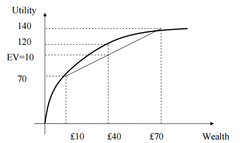
Expected utility theory
- a compensatory (allows trade-offs), normative model (prescriptive)
- used to calculate the utility of a purchase decision, RATIONAL CHOICE. (better describes human behavior)
- Theoretical framework for modern economic theory
- subjective, based on personal satisfaction or psychological value
Expected utility predicts...?
diminishing marginal utility (the difference between 0 and $100 feels bigger than the difference between $100 and $1100)
What are the expected utility theory axioms?
- dominance principle
- cancelation
- transitivity
- invariance
dominance principle (expected utility axiom)
- alternative gambles can be ranked from best to worst in terms of expected utility
- If one option is better or equal in every possible outcome and strictly better in at least one — you should choose that option.
cancelation (expected utility axiom)
- stages of gambles should cancel out if they're identical for two gambles
- ex: Option A: 50% chance of $100, 50% chance of $0
Option B: 50% chance of $100, 50% chance of $20The 50% chance of $100 cancels out — so you're really choosing between $0 and $20.✅ B is better.
Transitivity (expected utility theory axiom)
- preferences should be transitive (transfer)
- if you prefer A over B and B over C, you must prefer A over C
- your preferences must be consistent and not form a loop
- Example:
A > B (you prefer $100 over $50)
B > C (you prefer $50 over $20)✅ Then you must prefer A > C ($100 over $20).
Invariance/framing principle
- preference should remain invariant or stable no matter how choices are described
- If two options are logically identical, how they're framed shouldn't affect your decision.
- Example:
A surgery has a 90% survival rate.
The same surgery has a 10% mortality rate.
✅ A rational decision-maker would feel the same about both — but many people prefer the "90% survival" frame even though they are identical.
Prospect theory
- PT = expected utility theory + tweaks
- reference dependent: all outcomes are evaluated with respect to a reference point and preferences change as reference points change ($100 is a lot to the poor but little to the rich)
- loss aversion: losses have a bigger impact on people than do equivalent gains (pain from losing $100 is greater than the joy of winning $100)
- risk reflection: risk seeking for losses but risk averse for gains
- overweighting of rare events: unlikely events are treated as much more likely than in actuality, the opposite it true for likely events (health insurance)
St. Petersburg Paradox
- A coin-flip game with an infinite expected payout, but people are only willing to pay a small amount to play.
- This shows people don't make decisions by expected value alone; decisions shaped by feelings, perceived value, and probability distortion
- explained by these models:
- expected utility theory: ppl make decisions based on subjective satisfaction (utility), not money
- prospect theory: ppl undervalue unlikely big rewards
- bounded rationality: ppl use realistic limits and shortcuts
Attraction effect
- whenever there is a dominant decoy thrown in to make the other options seem more appealable
- For example: Web-only subscription: $59, Print-only subscription: $125, Web + Print subscription: $125. The web and print option seems like the best option, but they were to take out the decoy (print-only) then people would go for the web-only option since it is cheaper.
- shows how context and irrelevant alternatives can influence our decisions, revealing that humans often don't make purely rational choices
Anchoring effect
- people are tied to the initial piece of information that they are given about a product.
- They use it as a reference point and compare the following information they learn to it whether that's the right thing to do or not.
- ex: using the last two digits of someone's SSN then asking them how much they would pay for a poetry reading (their SSN anchors the dollar amount they say)
Endowment Effect
- people's tendency to overvalue something simply because they own it.
- once individuals possess an item, they are likely to place a higher value on it than they would if they didn't own it, even if the item is identical.
The power of social norms vs. market norms
- Social norms: unwritten rules and expectations that govern how people act in social settings. these are expectations based on relationships, community, and trust. People act out of a sense of goodwill, cooperation, or a desire to maintain a positive social relationship
- Market norms: these are expectations based on economic transactions, where interactions are governed by the rules of trade, contracts, and compensation
- irrationality of switching between the two (i want to help vs what's in it for me?)
Fallacy of FREE!
- people overvalue free items, leading to irrational decisions
- "free" triggers an emotional appeal, overriding logical thinking
- removes pain of paying making perceived value higher than actual value
The power of price
- expectations (especially price) shape the way we experience products
- placebo - our minds have the power to change our bodies
- price creates value in our minds and bodies (higher cost=stronger effect)
The context of our character
- fudge factor: psychological factor that allows us to cheat a little while still thinking of ourselves as honest
- rationalization: the mental process of justifying small dishonest actions
- self-concept maintenance: our need to protect how we see ourselves as good and moral
- cheating in context: how dishonesty increases or decreases depending on the situation
- we cheat a little with big things and a lot with small things
- morals and self-perception are greater deterrents than punishment