MCB 244 Exam 2
 Call Kai
 Learn
Learn Practice Test
 Spaced Repetition
 Match
Match Flashcards
 Knowt Play
1/242

There's no tags or description
Looks like no tags are added yet.
Name | Mastery | Learn | Test | Matching | Spaced | Call with Kai | Chat |
|---|
No analytics yet
Send a link to your students to track their progress
243 Terms
Epithelial tissue
Sheet of closely adhering cells and one or more cells thick
What way do epithelial tissues face?
The upper surface is exposed to the environment or an internal space in the body
Where does the epithelium cover?
Body surface (skin), lines body cavities, forms external/internal linings of many organs, and constitutes most gland tissue
What are the functions of the epithelial tissue?
Protection, secretion, excertion, absorption, filtration, and sensation
What does the epithelia protect?
Deeper tissues from invasion and injury
What does epithelia secrete?
Mucus, sweat, enzymes, and hormones
What does epithelia excrete?
Removes wastes from tissues such as CO2 or bile
What does epithelia absorb?
Chemicals and nutrients from adjacent medium,
Where does epithelia filtrate?
All substances leaving the blood go through the epithelia lining blood vessels, urinary waste goes through the kidney lining
How does epithelia have sensation?
Nerve endings that detect stimulation ranging from a touch on the skin to irritation of the stomach
Where is the basement membrane
Between an epithelium and the underlying connective tissue
What does basement membrane contain?
Collagen, glycoproteins, carbohydrate complexes, and proteins of connective tissue
What does basement membrane do?
Anchors epithelium to the connective tissue, controls exchange of materials between the epithelium and underlying tissues, and binds growth factors from below to regulate development
Basal surface
Surface of an epithelial cell facing the basement membrane
Apical surface
Uppermost surface of an epithelial cell exposed to the lumen of an organ
Laterall surface
Sidewall of a call between apical and basal surface

What class of epithelium is this?
Simple
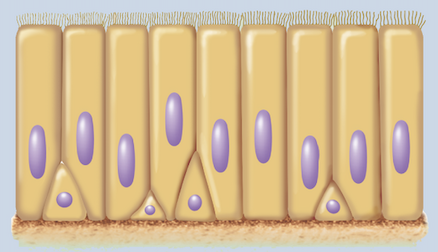
What class of epithelium is this?
Pseudostratified columnar

What class of epithelium is this?
Stratified

What cell shape is this?
Squamous

What cell shape is this?
Cuboidal

What cell shape is this?
Columnar

What is the class and shape of this epithelia
Simple squamous

What is the class and shape of this epithelia
Simple cuboidal
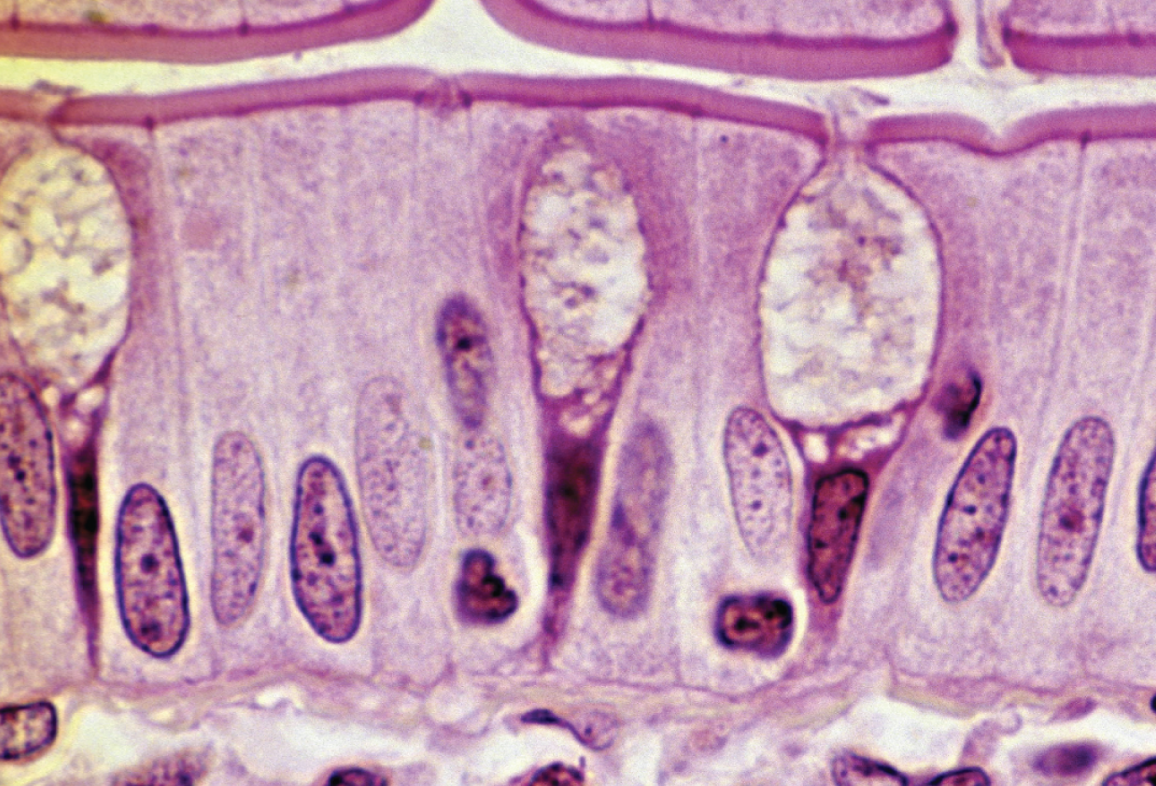
What is the class and shape of this epithelia
Simple columnar

What is the class and shape of this epithelia
Pseudostratified columnar
Where can simple squamous epithelium be found?
Air sacs of lungs, kidneys/kidney tubules, heart and blood vesels, stomach membranes, and intestines
Where can simple cuboidal epithelium be found?
Liver, thyroid, mammary, salivary, bronchioles, and other glands
Where can simple columnar epithelium be found?
Stomach inner lining, intestines, gallbladder, uterus/uterine tubes, and some kidneu tubules
Where can pseudostratified columnar epithelium be found?
Respiratory tract from nasal cavity to bronchi and portions of male urethra
What is the function of simple squamous epithelium?
Allows rapid diffusion or transport of substances through membrane, secreting lubricating serous fluid
What is the function of simple cuboidal epithelium?
Absorbs, secretes, produces protective mucous coat, and moves respiratory mucus
What is the function of simple columnar epithelium?
Absorbs, secreates mucus, and moves egg/embryo in uterine tube
What is the function of pseudostratified columnar epithelium?
Secretes and propels mucus
Startified epthelia cell structure
Ranges from 2 to 20 or more layers of cells, with some restinf dierctly on others, only the deepest layer is attached to the basement membrane

What is the class and shape of this epithelia?
Keratinized stratified squamous
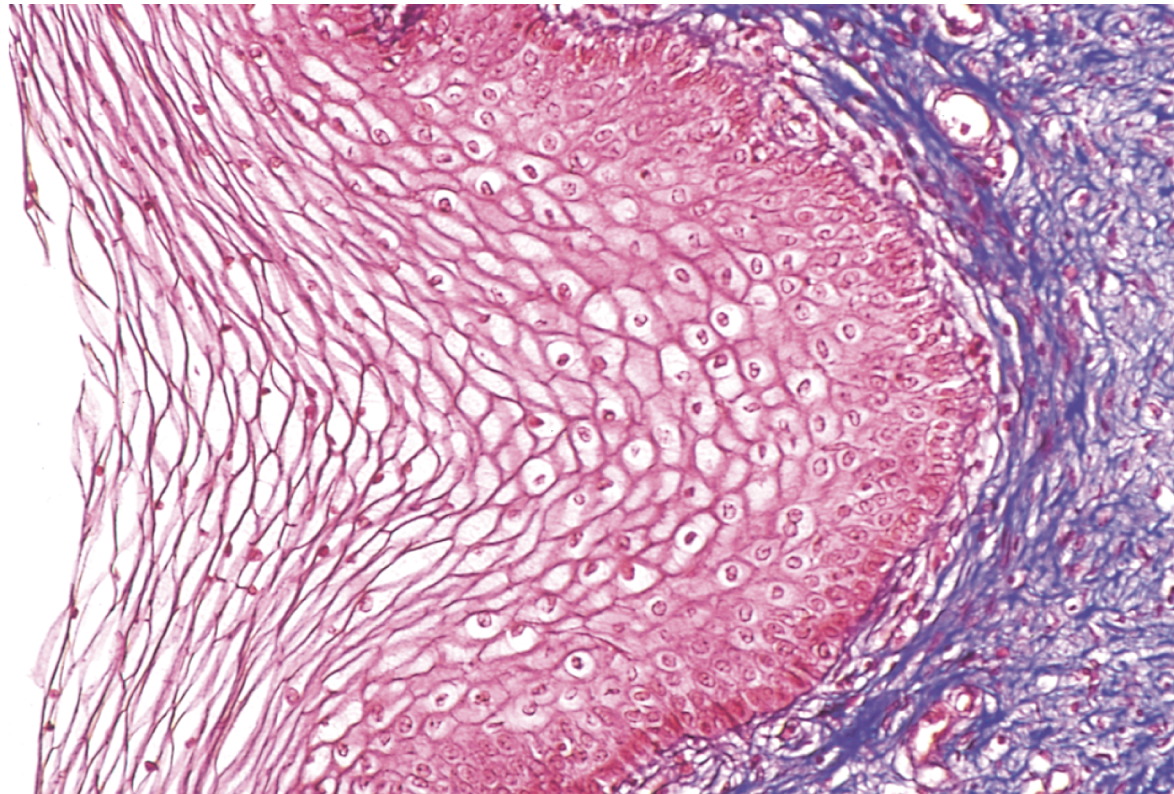
What is the class and shape of this epithelia>
Nonkeratinized stratified squamous

What is the class and shape of this epithelia?
Stratified cuboidal

What is the class and shape of this epithelia?
Urothelium
Where can keratinized stratified squamous epithelium be found?
Epidermis, especially the palms and soles
Where can nonkeratinized stratified squamous epithelium be found?
Tongue, oral mucosa, esophagus, anal canal, and vagina
Where can stratified cuboidal epithelium be found?
Sweat gland ducts, egg-producing vesicles of ovaries, and sperm-producing ducts of testis
Where can urothelium be found?
Urinary tract, part of kidney, ureter, bladder, and part of the urethra
What is the function of keratinized stratified squamous epithelium?
Resist abrasion and penatration by pathogenic organism and retards water loss through skin
What is the function of nonkeratinized stratified squamous epithelium?
Resists abrasion and penetration by pathogenic organisms
What is the function of stratified cuboidal epithelium?
Sweat secretion, ovarian hormone secretion, produces sperm
What is the function of urothelium?
Stretches to allow urinary tract filling and protects underlying tissues from osmotic damage by urine
Connective tissues are…
Abundant, widely distributed, and histologically variable
What do connective tissues include?
Fibrous tissue, adipose tissue, cartilage, bone, and blood
True or false: Connective tissues vary greatly in vascularity
True
What are the types of cells of fibrous connective tissue?
Fibroblasts, macrophages, leukocytes (white blood cells), plasma cells, mast cells, and adipocytes
What are fibroblasts
Large, fusiform or stellate cells with slender, wispy branches
What do fibroblasts do?
Produce the fibers and ground substance that form the matrix of the tissue
What are macrophages?
Large phagocytic cells wandering through connective tissues
What do macrophages do?
Engulf and destroy bacteria, foreign particles, and dead/dying cells of our body. Also activate immune system when they sense antigens, arise from monocytes
Antigens
Foreign matter
Monocytes
White blood cells that macrophages arise from
What are leukocytes/white blood cells?
Travel briefly in the bloodstream, crawl out through the walls of small blood vessels, and spend most of their time in the connective tissue
What are the two most common types of leukocytes?
Neutrophils and lymphocytes
What do neutrophils do?
They wander around attacking bacteria
What do lymphocytes do?
They react against bateria, toxins, and other foreign agents, often forming dense patches in the mucous membrane
Where do plasma cells come from?
Lymphocytes that turn into plasma cells when they detect foreign agents
What do plasma cells do?
They synthesize disease-fighting proteins called antibodies
Where are plasma cells found?
Lymph nodes, intestine wall, and inflamed tissue
Where are mast cells found?
Along blood vessels
What do mast cells secrete?
Heparin and histamine
What does heparin do?
Inhibit blood clotting
What does histamine do?
Increase blood flow by dilating blood vessels
Where are adipocytes found?
Small clusters in some fibrous connective tissues
Adipose tissue
Adipocyte dominated tissue in singly or small clusters in areolar tissue
What are the three types of protein fibers found in fibrous connective tissues?
Collagenous, reticular, and elastic fibers
Collagenous fibers are…
Tough, flexible, and stretch resistant
What fiber is the body’s most abundant protein, constituting to 25% of the total?
Collagen
What parts of the body are mainly made of collagen?
Tendons, ligaments, and dermis of the skin
What form and colors does collagen take in tissue section imaging?
Coarse, wavy bundles dyed pink, blue, or green
Where is less visible collagen?
Matrix of cartilage, bone, and muscles
What are reticular fibers?
Thin collagen fibers coated with glycoprotein forming spongelike framework
Where are reticular ribers found?
Spleen, lymph nodes, and part of basement membranes underlying epithelia
What are elastic fibers?
Thinner, collagenous fibers that branch and rejoin each other along their course
What protein makes up elastic fibers?
Coiled elastin coated with glycoprotein (fibrilin) to allow stretching and recoiling
Where are elastic fibers accounted for?
Skin, lungs, and arteries for spring back after being stretched
Elasticity
Tendency to recoil when tension is released
What are the two categories of fibrous connective tissue
Loose and dense
Loose connective tissue
Occupied by ground substance, dissolves out of tissue during histological fixation, leaves empty space in prepared tissue sections
What are the two kinds of loose connective tissue
Areolar and reticular
Dense connective tissue
Occupies more space than the cells and ground substance, appears closely packed in tissue sections
What are the two types of dense connective tissue
Regular and irregular

What kind of loose connective tissue is pictured
Areolar

What kind of loose connective tissue is pictured
Reticular
Where is areolar tissue mostly found
Surrounding blood vessels, nerves, esophagus, trachea, fascia between muscles, and underlying nearly all epithelia
What are the functions of areolar tissue
Loosely binds epithelia to deeper tissues, allows nerve and blood passage through other tissues, ready supply of leukocytes for immune defense, and nutrient and waste removal for overlying epithelia
Where are reticular tissues mostly found
Lymph nodes, spleen, thymus, and bone marrow
What is the function of reticular tissues
Form supportive stroma (framework) for lymphoid organs

What kind of dense connective tissue is pictured
Dense regular connective
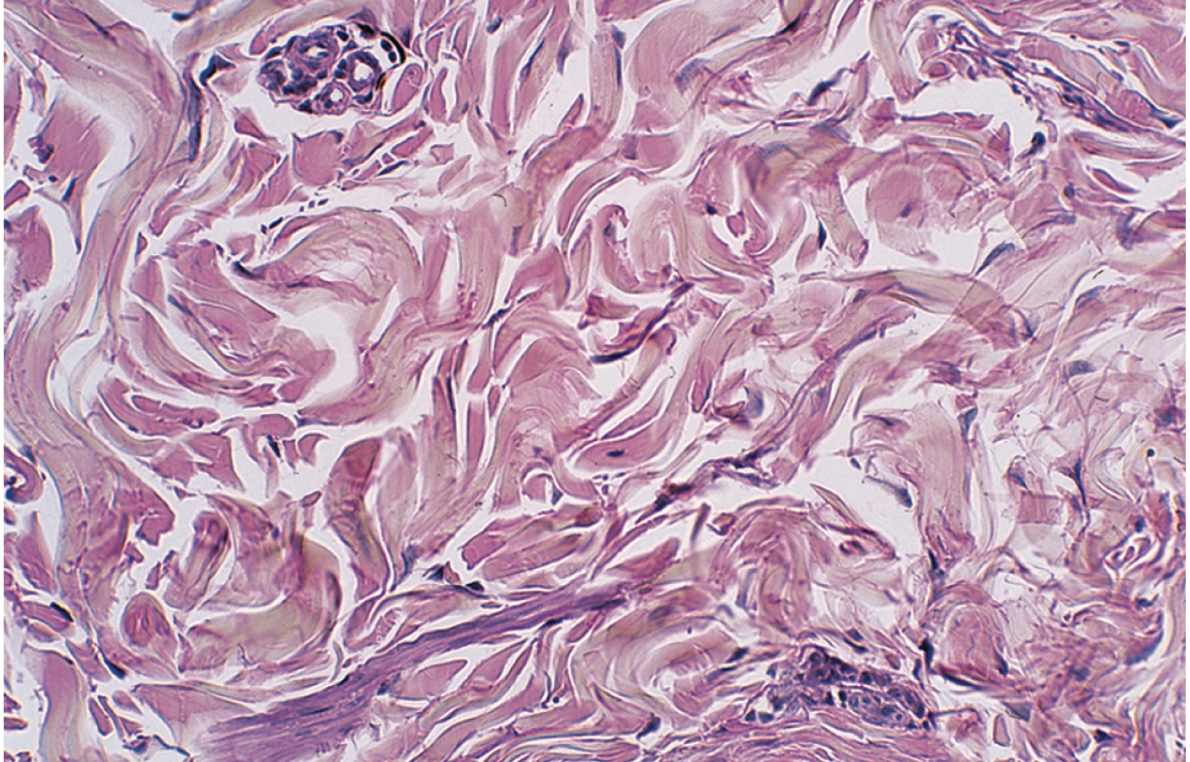
What kind of dense connective tissue is pictured
Dense irregular connective tissue
Where are dense regular connective tissues mostly found
Tendons and ligaments
What is the function of dense regular connective tissues
Ligaments tightly bind bones together and resist stress, tendons attach muscle to bone and transfer muscular tension to bones
Where are dense irregular connective tissues mostly found
Deeper portion of dermis of skin, capsules around viscera like the liver, kidney, spleen, and around fibrous sheaths of cartilage and bones
What is the function of dense irregular connective tissues
Withstand stresses applied in unpredictable directions and imparts durability to tissues