Lecture 2: Orthotic and Prosthetic Considerations for Diabetes
 Call Kai
 Learn
Learn Practice Test
 Spaced Repetition
 Match
Match Flashcards
 Knowt Play
1/18

There's no tags or description
Looks like no tags are added yet.
Name | Mastery | Learn | Test | Matching | Spaced | Call with Kai | Chat |
|---|
No analytics yet
Send a link to your students to track their progress
19 Terms
Why Are Feet So Important?
Many patients receive a diagnosis of diabetes when they present a nonhealing foot ulcer
The mortality rate after amputation is 50% within 3 to 5 years
The rate of contralateral amputation is 50% within 4 years
90% eventually lose Protective Sensation
15% of all diabetics will develop a foot ulcer
Foot problems account for more hospital admissions of diabetic patients than any other long term complication
Studies show that up to 50% of all amputations and foot ulcers can be prevented with effective identification and patient education
Amputation rates have not decreased in the past 20 years despite advances in wound and foot care
Peripheral Neuropathy
(sensory, motor, autonomic, cause)
Sensory
Lack of pain and pressure sensations
Motor
Loss of intrinsic muscles
Results in claw toes and foot drop
Autonomic
Decreased sweat and oil production
Results in dry, brittle skin
Diabetes is a leading cause of Peripheral Neuropathy
Ulcers causes
Ischemic Necrosis
Low pressure over a long period resulting in tissue death
Trauma
High pressures, caused by heat, chemicals, foreign objects
Inflammation
Repetitive moderate pressures, weakens tissues and leads to callus formation
Osteomyelitis (or other infection)
Ulcers Prevalence Patterns
Highest incidence of ulceration occurs at sites of previous ulcers.
71% of ulcers occur on the forefoot
Most Common
3rd metatarsal head
Great toe
1st metatarsal head
5th metatarsal head
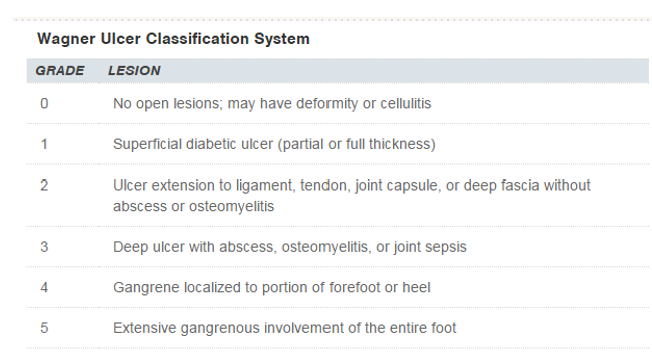
Wagner Ulcer Classification System
describes the depth of the ulcer, the presence of osteomyelitis or gangrene, and the extent of tissue necrosis
Foot Lesion Prevention
Patient Education
Daily Foot Inspection
Proper Footwear
Prevention of an initial or subsequent foot lesion is crucial to avoiding amputation.
Patient Education Do’s and Don’ts
Never soak feet
Dry between toes
No lotion, petroluem-ointment between toes
No creams with perfume/alcohol
Never walk barefoot
Don’t wear socks with elastic
Have professional trim nails and scrape calluses
Conservative Treatment of Neuropathic Foot Ulcers
Evaluation and Wound care
Off-Loading
Protective Footwear and Orthotics
Footwear for diabetic patients
Soft leather
Extra depth – to accommodate inserts
Length = ½’’- ¼’’ space past longest toe
Width = ball of foot should be in widest part of the shoe, instep should not be taut
No stitching over forefoot
Foot Orthoses for Diabetic Patients
Distribute pressure and reduce forces on areas of potential breakdown
Accommodative
Soft: (pelite®, plastazote®, PPT®, OVA®, Spenco®, etc.)
For ulcer grades 0-2
Unweight prominent areas
Decrease local shear stress
Provide general shock absorption
Charcot Arthropathy
Painless, progressive, degenerative arthropothy caused by underlying neuropathy
Can be single or multiple joints
Clinical Observations
Limb is painless, swollen, hot, and red
Unhealed factures seen on x-ray
Leads to changes in shape and stability of affected joints
Neuropathic Walkers
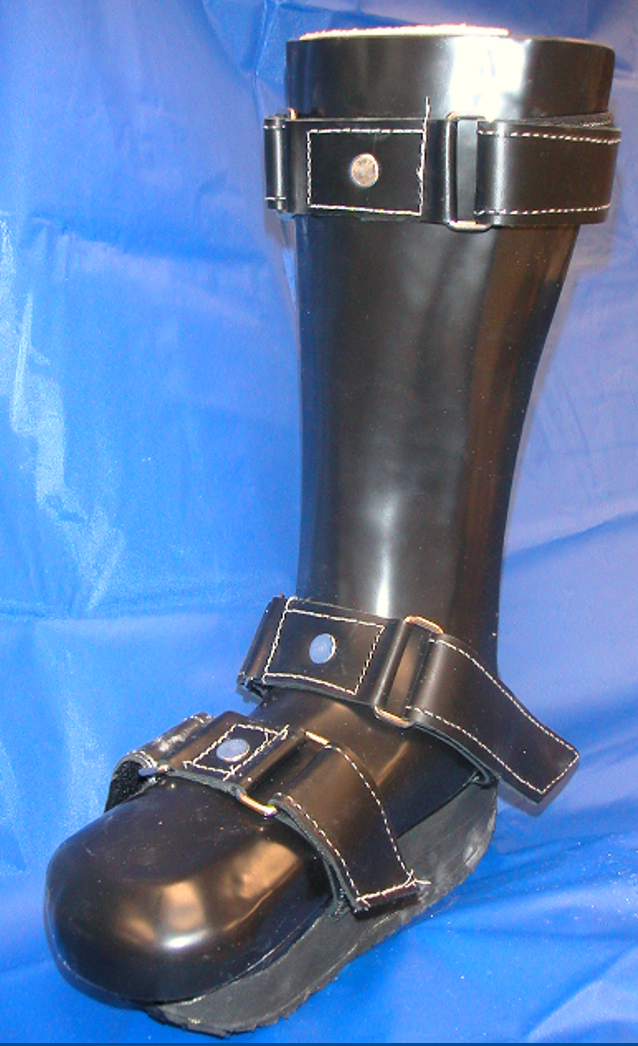
Charcot resistant orthotic walker (CROW)
Custom fabricated
Total contact
equivalent to total contact cast
Rocker bottom sole
Ankle Foot Orthoses
Compensate for muscle weakness
Commonly foot drop secondary to Peripheral Neuropathy
Prevent motion
Diabetic Amputation Stats
54,000 diabetes related lower extremity amputations/year
86% preventable with patient education and appropriate footwear
50-84% of lower extremity amputations preceded by a foot ulcer
Diabetes Related Causes of Amputation
Gangrene
Infection
Non-healing ulcer
Gangrene
Dry: loss of nourishment to affected area
Area is dry, black, ‘mummified’
Can result in autoamputation
Wet: tissue necrosis caused by excessive moisture
Area is painful, purple, swollen
Common with infection
Partial Foot Orthoses
Shoe filler
FO with toe filler
AFO with toe filler
Partial Foot ‘Prosthosis’
Clamshell style AFO with toe filler
Provides toe lever
Redistributes pressure proximally, away from the fragile soft tissues of the distal foot and over the large pressure tolerant areas of the anterior leg.
Fills/supports shoe

Prosthetic Considerations for Diabetic Patients
Total Contact
Minimize shear
Distribute Pressures