IPS1-Introduction to Nucleic Acids p2
 Call Kai
 Learn
Learn Practice Test
 Spaced Repetition
 Match
Match Flashcards
 Knowt Play
1/107

There's no tags or description
Looks like no tags are added yet.
Name | Mastery | Learn | Test | Matching | Spaced | Call with Kai | Chat |
|---|
No analytics yet
Send a link to your students to track their progress
108 Terms
Central Dogma of Molecular Biology
____ of Molecular Biology is defined as the flow of information from DNA to RNA to protein.
Replication
[Central Dogma]
DNA → new DNA
Transcription
[Central Dogma]
DNA → mRNA
Reverse Transcription
[Central Dogma]
mRNA → DNA
Translation
[Central Dogma]
mRNA → Protein
DNA replication
A process of making new DNA
DNA replication
____- happens during the S phase of the cell cycle in eukaryotes
DNA polymerase
In DNA replication
A group of proteins, including ______helps with this process.
template
In DNA replication
Each original DNA strand serves as a _____ to make a matching new strand.
G1 phase
[CELL CYCLE OF EUKARYOTIC CELLS]
In the _____, cells get ready to copy their chromosomes
S phase
[CELL CYCLE OF EUKARYOTIC CELLS]
In the _____ , the cell makes a copy of its DNA
G2 phase
[CELL CYCLE OF EUKARYOTIC CELLS]
In the ____, cells get ready to divide
M phase
[CELL CYCLE OF EUKARYOTIC CELLS]
In the _____ , the cell actually divides.
True
[T/F]
Cells can go through the cell cycle many times.
G0
Some cells leave the cycle and stop dividing, entering a resting phase called____
True
[T/F]
Some cells leave the cycle and stop dividing, entering a resting phase called G0. If they get the right signal, these resting cells can start dividing again.
DNA replication
___-
Is semiconservative
This means that each new DNA molecule is made of one old strand and one brand new strand.
The old strand separates and serves as a template to make the new strand.
How DNA replication works ?
DNA replication
The old strand separates and serves as a template to make the new strand.
old strand
In Semi conservative Replication of DNA
The ____ strand splits apart and acts as a template
template
In Semi conservative Replication of DNA
The old strand splits apart and acts as a ___
daughter strands
In Semi conservative Replication of DNA
Both ____ strands are composed of one of the old strands and one comprised out of new nucleotides
a) Initiation
b) Elongation
c) Termination
Steps in Replication of Prokaryotes [3]
origins of replication (Ori)
[Initiation]
It begins at special spots called _____
A and T bases
[Initiation]
These spots have lots of_____ bases, which helps the DNA strands separate easily
Prokaryotes
Eukaryotes
[Initiation]
____- have one origin per chromosome.
____- have many origins on each chromosome.
Replication forks
[Initiation]
____- are the spots where DNA is being copied.
True
[Initiation]
[T/F]
DNA copying happens in both directions from the starting point at the origin.
True
[Unwinding Process]
[T/F]
The two original DNA strands separate, and the helix unwinds ahead of the replication fork
Helicase
[Unwinding Process]
____- is an enzyme that attaches to single strands near the fork and moves along the double-stranded DNA, pulling the strands apart to unwind the helix
DNA helicase
During DNA replication
____- unwinds the double helix
helix destabilizing proteins
During replication within the fork, ______ bind to the single-stranded regions preventing the strands from rejoining.
Single-stranded DNA-binding (SSB) proteins
During DNA replication
____- keep the two strands of DNA separate
DnaA protein
Single-stranded DNA-binding (SSB) proteins
DNA helicases
Three main proteins required for DNA separation such as ___
DnaA protein
[Proteins Required for DNA separation]
_____-
It binds to a specific starting point on the DNA.
It causes the double-stranded DNA to "melt," which means the two strands separate to form a small bubble of single-stranded DNA.
DnaA protein
[Proteins Required for DNA separation]
These proteins attach to the single-stranded DNA
Single-stranded DNA-binding (SSB) proteins
[Proteins Required for DNA separation]
____-
They keep the two strands separated and prevent them from sticking back together.
They also protect the single-stranded DNA from being cut by enzymes.
Single-stranded DNA-binding (SSB) proteins
[Proteins Required for DNA separation]
These proteins bind near the replication fork.
DNA helicases
[Proteins Required for DNA separation]
____-
They unwind the double helix ahead of the fork to keep the process moving.
This unwinding action requires energy, which is provided by ATP.
Supercoiling
The risk of unwinding of the DNA strand is ____
positive supercoils
When the two DNA strands separate, the DNA ahead of the replication fork gets twisted too tightly called ____
negative supercoils
When the two DNA strands separate, the DNA behind the replication fork becomes loosely twisted called ____
True
[T/F]
The accumulating positive supercoils interfere with futher unwinding of the double helix
Supercoiling
It is like a twisting rope
positive supercoils
In Supercoiling
If you twist the rope tighter, it coils up on itself and forms_____
negative supercoils
In Supercoiling
If you twist it the other way, loosening the coils, it wraps the opposite way and forms ____
Topoisomerases
____- stop the DNA from getting too twisted when it unwinds during replication.
Topoisomerases
They can cut the DNA strands and then rejoin them to relieve the twisting.
Topoisomerase
____- is the enzyme that wraps around the DNA and makes a cut (producing a “nick”), permitting the helix to spin.
Type I Topoisomerase
[Type I / Type II Topoisomerase]
___- cuts one strand of a DNA double helix, relaxation occurs, and then the cut strand is reannealed
Type II Topoisomerase
[Type I / Type II Topoisomerase]
___- cuts both strands of one DNA double helix, passes another unbroken DNA helix through it, and then reanneals the cut strands
DNA gyrase
____-
Is a topoisomerase inhibited by the quinolone family of antibiotics
Found only in prokaryotes.
quinolone
DNA gyrase, a topoisomerase inhibited by the ____ family of antibiotics
DNA copying starts and new strands get longer.
RNA primers are removed and replaced with DNA.
Replication bubbles form, and the new DNA pieces are joined together
Elongation Steps
Initiation
Elongation
During ____ [2] process , it is important to note are the functions of RNA primer and DNA Polymerases.
True
[T/F]
DNA polymerase can’t start copying DNA on a single strand by itself
RNA primer
DNA polymerase can’t start copying DNA on a single strand by itself.It needs a short piece of______ that sticks to the to the DNA, making a double-stranded section
RNA Primer
This primer is made by an enzyme called primase
primase
RNA Primer is made by an enzyme called ____
primase
____-is an enzyme that builds a short RNA piece (~10 bases) matching the DNA strand
first acceptor
The free hydroxyl group on the 3’-end of the RNA primer serves as the _____ [first /second] acceptor of a deoxynucleotide by DNA polymerase.
deoxynucleotide
The free hydroxyl group on the 3’-end of the RNA primer serves as the first acceptor of a ____by DNA polymerase.
DNA polymerases (Pol)
_______- are enzymes that make new DNA
DNA polymerases (Pol)
______- can only read the template strand from 3′ to 5′ and make the new strand from 5′ to 3′
DNA polymerases (Pol)
______-
They add one DNA building block at a time to the 3′ end of the new strand.
This creates two types of new DNA strands during replication.
Pol I
Pol II
Pol III
Type of Prokaryotes DNA Polymerase [3]
Pol III
[Type of Prokaryotes DNA Polymerase]
______- copies most DNA during replication
Pol I
[Type of Prokaryotes DNA Polymerase]
____- helps repair DNA and works on the lagging strand.
Leading strand
[Leading vs. Lagging Strand]
Copied continuously in the same direction as the replication fork moves.
Lagging strand (Okazaki fragments)
[Leading vs. Lagging Strand]
Copied in pieces going away from the fork.
Okazaki fragments
Lagging strand is made in small pieces callled ____
Lagging strand
_____-
Is made in small pieces called Okazaki fragments.
These small pieces are later joined together by an enzyme called DNA ligase to make one continuous strand.
DNA ligase
Lagging strand is made in small pieces called Okazaki fragments.These small pieces are later joined together by an enzyme called _____ to make one continuous strand.
Chain Elongation and Processivity
Proofreading
DNA Polymerases 2 Important Properties such as __
DNA Polymerase III (DNA pol III)
[Chain Elongation and Processivity]
____- adds DNA building blocks to the 3’ end of the RNA primer
deoxyribonucleoside triphosphates
DNA Polymerase III (DNA pol III) uses molecules called _______ (dATP, dTTP, dCTP, dGTP) to build the new strand.
Deoxyadenosine Triphosphate (dATP)
Deoxythymidine Triphosphate (dTTP)
Deoxycytidine Triphosphate (dCTP)
Deoxyguanosine Triphosphate (dGTP)
Deoxyribonucleoside triphosphates [4]
5' to 3' direction
[Chain Elongation and Processivity]
The new DNA strand grows from the_____direction, which is opposite to the direction of the original parent stran
phosphodiester bond
Each precursor pairs with the corresponding base on the template strand. It then forms a_______ with the hydroxyl group on the 3'-carbon of the sugar at the end of the growing chain.
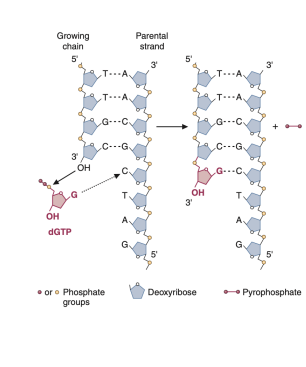
deoxyribonucleoside triphosphates
______- serve as the precursors, or building blocks, that the DNA polymerase enzyme uses to lengthen the DNA chain.
DNA polymerase
____- is an enzyme that copies the original DNA template strand by reading it in the 3'-to-5' direction. As it reads the template, the new DNA strand is built and grows in the 5'-to-3' direction.
Proofreading
_______- ensures the replication fidelity
DNA polymerase III
[Proofreading]
____- “doublechecks” each added nucleotide in new DNA.
DNA polymerase III
[Proofreading]
______ -
It uses a special activity called 3' to 5' exonuclease to remove mistakes.
This allows it to go backward along the strand and fix errors.
nucleus
mitochondria
plant chloroplasts
In eukaryotic cells, DNA is found in the____ [3]
Prokaryotic cell
[Prokaryotic cell /Eukaryotic cell]
______ - don’t have a nucleus and usually have one chromosome, plus extra DNA called plasmids.
Plasmids
______-
Are small, circular DNA molecules outside the chromosome.
Are used as tools in genetic engineering.
Plasmids
They carry genes and can copy themselves, sometimes separately from the main chromosome
Base | Nucleoside | 5'-Nucleotide |
|---|---|---|
Adenine | 2'-Deoxyadenosine | 2'-Deoxyadenosine-5'-monophosphate |
Cytosine | 2'-Deoxycytidine | 2'-Deoxycytidine-5'-monophosphate |
Guanine | 2'-Deoxyguanosine | 2'-Deoxyguanosine-5'-monophosphate |
Thymine | 2'-Deoxythymidine | 2'-Deoxythymidine-5'-monophosphate |
Names of DNA Base Derivatives
Hydrogen Bonding
This is the force that holds the two base pairs together in the middle of the DNA double helix.
Van der Waals and Hydrophobic Interactions
These are forces between the stacked, adjacent base pairs that help stabilize the DNA structure.
Major Groove and Minor Groove
These are the two spaces that spiral around the DNA double helix, which are important for proteins to recognize and bind to specific DNA sequences
True
[T/F]
Changing the pH or heating the DNA can break the hydrogen bonds, causing the two strands to unzip.
phosphodiester bonds
Changing the pH or heating the DNA can break the hydrogen bonds, causing the two strands to unzip. However, the sugar-phosphate backbone, which is held together by ______ , stays intact.
melting temperature (Tm)
_____ - is the specific temperature when half of the DNA strands have separated.
lower temperature
DNA with lots of A and T bases separates at a ________ [ lower / higher] temperature than DNA with many G and C bases.
20 Å.
The width of the double helix is _____
34 Å
10 base pairs
In DNA
One complete turn of the helix is _____ long and contains ____ base pairs.
3.4 Å
In DNA
The rise is____, which is the distance between one base pair and the next.