📸 Bio 208 Ch 20 (The Cardiovascular System: The Heart)
 Call Kai
 Learn
Learn Practice Test
 Spaced Repetition
 Match
Match Flashcards
 Knowt Play
1/26

There's no tags or description
Looks like no tags are added yet.
Name | Mastery | Learn | Test | Matching | Spaced | Call with Kai | Chat |
|---|
No analytics yet
Send a link to your students to track their progress
27 Terms
Contractility can be decreased by _____________________.
-increased end-diastolic volume.
-presence of positive inotropic substances.
-decreasing inflow of calcium ions.
-increased end-diastolic volume and presence of positive inotropic substance.
-increased end-diastolic volume, presence of positive inotropic substance, and decreasing inflow of calcium ions.
decreasing inflow of calcium ions.
The amount of blood ejected from either ventricle every minute is called:
-stroke volumn
-end-diastolic volumn
-cardiac output
-after load
-heart rate
cardiac output
Which vessel does not supply the myocardium with blood?
-coronary sinus
-left coronary artery
-circumflex branch
-marginal branch
-posterior interventricular branch
coronary sinus
Which of the following statements is false in reference to heart regulation?
-at rest, parasympathetic stimulation predominates
-baroreceptors measure the amount of sodium ions present in the blood
-sympathetic stimulation triggers the release of norepinephrine
-the movement of limbs is monitored by proprioceptors
-parasympathetic fibers travel via the vagus nerve
barboreceptors measure the amount of sodium ions present in the blood
The intercalated discs seen in cardiac myocytes
1. have desmosomes which help to hold the muscle fibers together.
2. have gap junctions which allow action potentials to conduct from one muscle fiber to the next.
3. are the result of actin/myosin overlap.
1 only
2 only
3 only
1 and 2 are correct.
1, 2 and 3 are correct.
1 and 2 are correct
The term used to describe a backflow of blood from the left ventricle into the left atrium is:
-aortic stenosis
-mitral/bicuspid valve prolapse
-semilunar valve prolapse
-mitral/bicuspid valve stenosis
-aortic insufficiency
mitral/bicuspid valve prolapse
What occurs after the QRS phase of the ECG?
-the atria contract.
-the atria relax.
-the ventricles contract.
-the ventricles relax.
-diastole occurs.
The ventricles contract
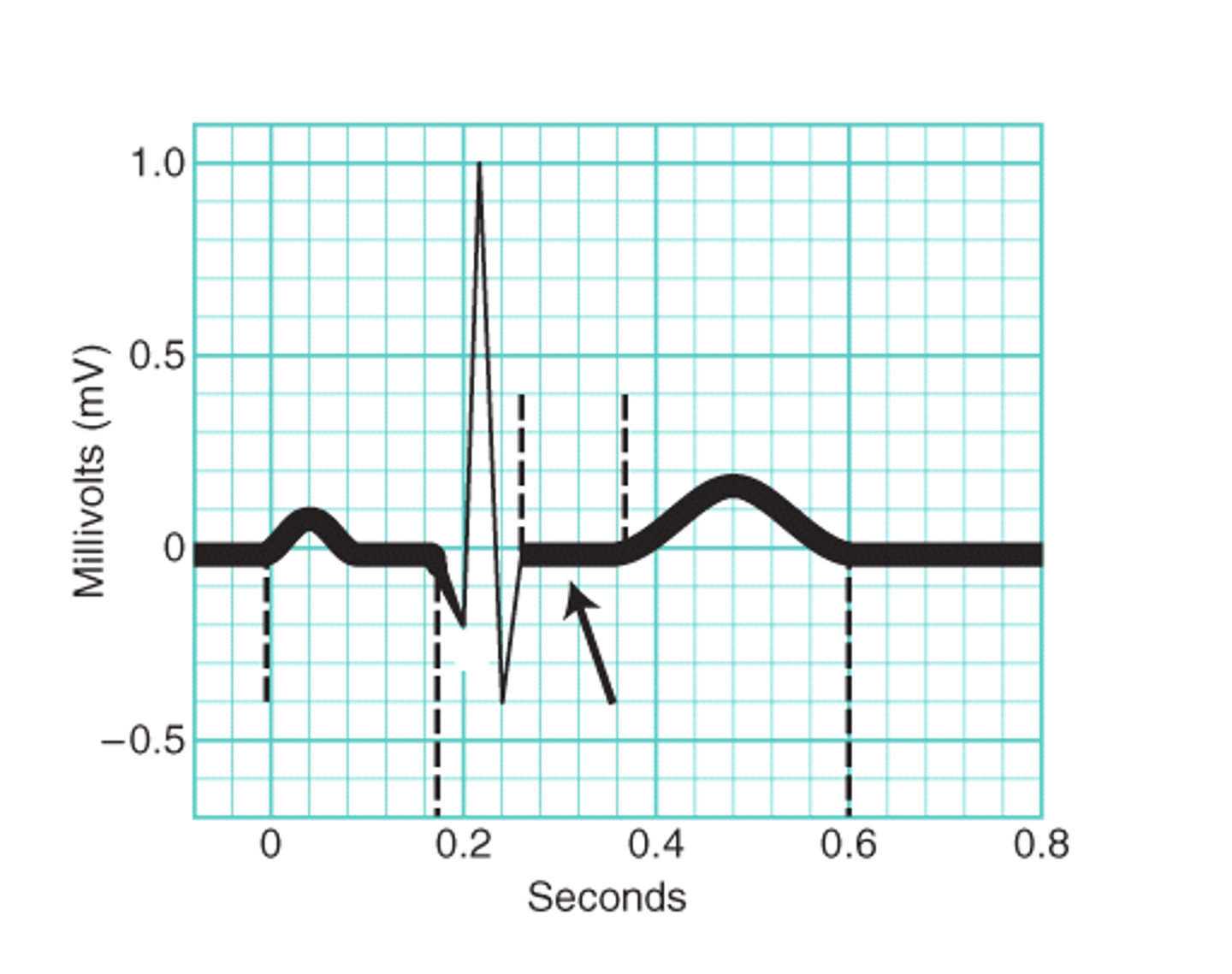
Which of the following statements is NOT correct?
-The walls of the ventricles are thicker because the ventricles pump blood under higher pressure over greater distances.
-The walls of the atria are thicker because the atria receive blood under pressure.
-The wall of the right ventricle is thinner than that of the left ventricle because the right side of the heart pumps blood a shorter distance at lower pressure.
-Although the right side of the heart has a smaller workload, the right and left ventricle simultaneously eject the same amount of blood.
-All of these choices are correct.
The walls of the atria are thicker because the atria receive blood under pressure
Which wave is matched correctly with the heart's activity?
-QRS complex - atrial repolarization
-P wave - ventricular repolarization
-T wave - ventricular depolarization
-S-T segment - the ventricles are depolarized
S-T segment - the ventricles are depolarized
The ventricles must produce enough force to move the residual blood in the aorta before it can eject the blood from the ventricle. The aortic pressure is called
-preload
-afterload
-contractility
-relaxation
afterload
A patient with high blood pressure is prescribed a calcium channel blocker to lower blood pressure. This drugs acts as a
-parasympathetic inhibitor
-sympathetic accelerator
- positive inotropic agent
-negative inotropic agent
negative inotropic agent
All of the following statements concerning cardiac output (CO) are true except
-decreased contractility will increase CO
-if preload decreases, CO is decreased
-if a person hemorrhages, heart rate will increase to try and maintain CO
-if blood pressure rises, hormonal influence will attempt to compensate by decreasing blood volume and decrease CO
decreased contractility will increase CO
Frank-Starlings law of the heart explains a relationship between
- preload and contractility
-afterload and contractility
-stroke volume and volume of blood ejected
-preload and afterload
preload and contractility
The sympathetic nerve extends from the medulla oblongata to
-interventricular septum
-Purkinje fibers
-SA (sinoatrial node)
-bundle of HIS
SA (sinoatrial node)
All of the following are true of sympathetic nerves extending from the cardiac accelerator nerve of the medulla oblongata except
- it is composed of two neurons- a short and a long one
-it innervates the SA node, AV node, and myocardium
-innervation of the heart speeds up the rate of depolarization at the SA node
-the neurons release epinephrine which binds the beta 1 receptors
the neurons release epinephrine which binds the beta 1 receptors
Parasympathetic nerve fibers that innervate the SA node release
- norepinephrine
-epinephrine
-dopamine
-acetylcholine
acetylcholine
Which of the following is true?
-the majority of the blood filling the ventricles enters during atrial systole.
-More blood is ejected from the right heart verses the left heart.
-The same volume of blood is ejected from the right and left ventricles.
-More blood is ejected from the left heart verses the right heart.
The same volume of blood is ejected from the right and left ventricles
After a frightening experience is over, how does the heart restore normal heart rate?
- SA node fires at its own innate rate.
-The adrenal medulla adjusts the heart rate by releasing epinephrine.
-The cardiac inhibitor activates parasympathetic impulses to the SA node.
-The cardiac accelerator activates sympathetic impulses to the SA node.
The cardiac inhibitor activates parasympathetic impulses to the SA node
During isometric contraction, which of the following occurs?
-All of the choices are correct.
-Atrioventricular valves are closed.
-Ventricular pressures rises.
-Blood volume in the ventricles remain the same.
All of the choices are correct
One sign of hyperthyroidism is tachycardia. Which of the following can occur because of tachycardia?
- an increase in cardiac output
-an increase in stroke volume
-an increase in contractility
-decreased EDV (end diastolic volume)
decreased EDV (end diastolic volume)
All of the following are indicators of increased afterload except
-increase in ESV
-decrease in stroke volume
-decrease in ESV
-hypertension
decrease in ESV
When heart rate exceeds 160 BPM, all of the following occurs except
-stroke volume decreases
-venous return increases
-cardiac output decreases
-end diastolic volume decreases
Venous return increases
An analysis of the electrocardiograph can reveal all except
- stroke volume
-damaged areas in the heart
-an enlarged heart
-abnormalities in the conduction pathway
stroke volume
Desmosomes function to
-anchor fibers together
-transmit ions from cell to cell
-bind the sarcolemma of cardiac cells together
-act as receptors for neurotransmitters
anchor fibers together
Which component of the conduction system provides the only electrical connection between the atria and the ventricles?
-AV node
-bundle of HIS
-Purkinje fibers
-SA node
All of the following modify the timing or rate of the heart, except
- parasympathetic nerve
-sympathetic nerve
-sinoatrial node
-hormones
SA (sinoatrial) node
Autorhythmicity of the cardiac pacemaker cells occurs because
- the SA node is innervated by the sympathetic nervous system
-the SA node has an unstable resting potential
-the SA node has a stable resting potential
-the SA node is innervated by the parasympathetic nervous system
the SA node has an unstable resting potential