Cytology-microscopic eval
 Call Kai
 Learn
Learn Practice Test
 Spaced Repetition
 Match
Match Flashcards
 Knowt Play
1/30

There's no tags or description
Looks like no tags are added yet.
Name | Mastery | Learn | Test | Matching | Spaced | Call with Kai | Chat |
|---|
No analytics yet
Send a link to your students to track their progress
31 Terms
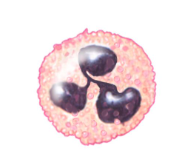
Neutrophils
type of white blood cell
Arrive first to site of inflammation and phagocytize the dead tissue and organisms
what is Inflammation
A normal physiologic response to tissue damage of invasion of microorganisms
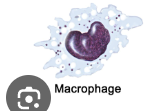
Macrophage
type of white blood cell
Arrive after neutrophils and continue phagocytic activity
Monocyte
Circulate in the bloodstream
matured macrophage

Eosinophilic inflammation
A type of WBC
Present in less than 10%
Usually found in parasitic infections but also neoplastic disorders
Lympocyte
Type of WBC
Produce antibodies

Basophil

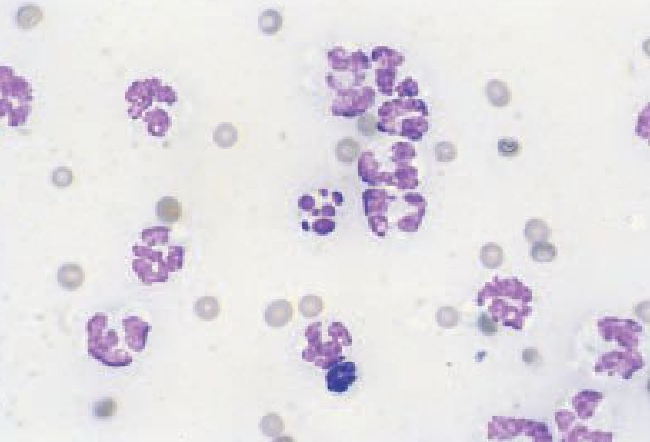
Suppurative/ purulent inflammation
Large number of neutrophils
less than 85% of total nucleated cells
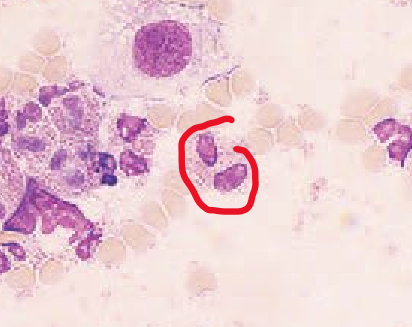
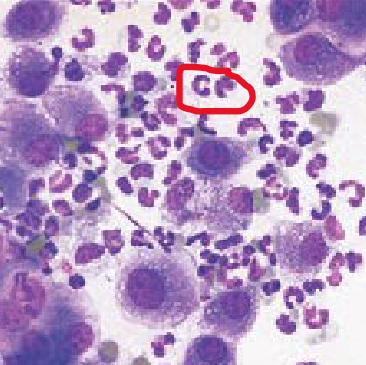
Granulomatous or pyogranulomatous inflammation
significant number of macrophages (circled red) present
Fungal or parasitic infections manifest this way
Karyolysis
Rapid cell death
swollen ragged nucleus without intact nuclear membrane
Karyorrhexis
cell fragmentation
Pyknosis
slow cell death (aging)
Small, condensed, dark nucleus
Neoplasia
contains a homogenous population of a single cell type
present cells are of the same tissue type as the tissue origin
Benign
no criteria of malignancy
Malignant cells
must display at least three abnormal configurations of nuclear criteria
Nuclear criteria
Ansiolaryosis
Pleomorphism
high variable nucleus/cytoplasm ratio
coarse chromatin pattern
multinucleation
nucleoli that very in size, shape, and number
nuclear molding
Anisokaryisis
Any unusual variation in overall size of the nucleus
Pleomorphism
variability in size and shape of the same cell type
Nuclear molding
Deformation of nuclei by other nuclei
Epithelial cell tumors
called carcinoma or adenocarcinoma
Highly cellular and exfoliate in sheets or clumps
Mesenchymal cell tumors
called sarcoma
Less cellular, exfoliate singly or in spindles
Discrete round cell tumors
include:
histiocytoma
lymphoma
mast cell tumors
plasma cell tumors
transmissible venereal tumors
melanoma
Cells exfoliate well but not usually in clumps or clusters
Histiocytoma
not usually highly cellular
Lymphoma
deals with the lymph cells
Mast cell tumors
cells have prominent purple/black granules
Plasms cell tumors
large number of cells with eccentrically located nucleus and prominent perinuclear zone
Transmissible venereal tumors
similar to histiocytoma but increased cellularity
Melanoma
cells with prominent dark granules
Yeast under the microscope
Bigger than rods or cocci and will sometimes be grouped up so they look like a snowman
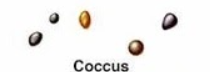
Staphylococcus (Cocci) under the microscope
Individual little balls
Strep under the microscope
Cocci in chains