Lecture 1.3 & 1.4: Protein Folding & Quaternary Structure
 Call Kai
 Learn
Learn Practice Test
 Spaced Repetition
 Match
Match Flashcards
 Knowt Play
1/77

There's no tags or description
Looks like no tags are added yet.
Name | Mastery | Learn | Test | Matching | Spaced | Call with Kai | Chat |
|---|
No analytics yet
Send a link to your students to track their progress
78 Terms
What is the format of a primary structure?
N terminus…MLKKLG… C terminus
As proteins fold what two things are decreased?
Free energy and entropy
How can free energy and entropy decrease simultaneously?
1) Hydrophobic effect
2) Hydrogen bonding
3) Van Der Waals Interactions
4) Electrostatic Interactions
What is the Hydrophobic effect and how does it contribute to protein folding?
Protein folding allows water to interact & move more freely — increases the net entropy of the surrounding water solution
What is the hydrogen bonding effect and how does it contribute to protein folding?
Interaction of N-H & C=O of the peptide bond leads to local regular structure such as a-helix and b-sheets
What van der waals effect and how does it contribute to protein folding?
Small, weak, temporary dipole moments as electrons within atoms move around which creates a weak attraction to each other
Folding = atom’s close proximity = increased van der waal
What are electrostatic interactions and how do they contribute to protein folding?
Permanently charged groups stablize the protein — ionic bonds
Define dielectric constant
How “shielded” or weakned an electrostatic interaction is in that specific solution
The dielectric constant inside the core of a protein is _____ than outside. Which means ionic bonds are ____
Lower ; stronger
What two of the four listed rules of protein folding make folding a spontaneous reaction and why?
Rule 1 (hydrophobic effect) and 2 (hydrogen bonding).
Hydrophobic effect: protein folding = water molecules release from structured salvation layer = increased Δ S of solution = TΔS negative = ΔG negative
Hydrogen bonding: protein folding = increased H-bonding = release of energy w/ each bond = exothermic = -ΔH (exothermic and favorable)
Peptide bonds have _____ bond characteristics because of ______
double ; resonance
What is the atom sequence of a peptide bond?
N-Ca-C
The 6 atoms on either side of the peptide bond (CCOCHC) are in different planes (T/F)
False — peptide bonds are locked in place meaning they cannot rotate or have different planes
What makes up a psi (ψ) bond?
Ca - C
What makes up a phi (Φ) bond?
N-Ca
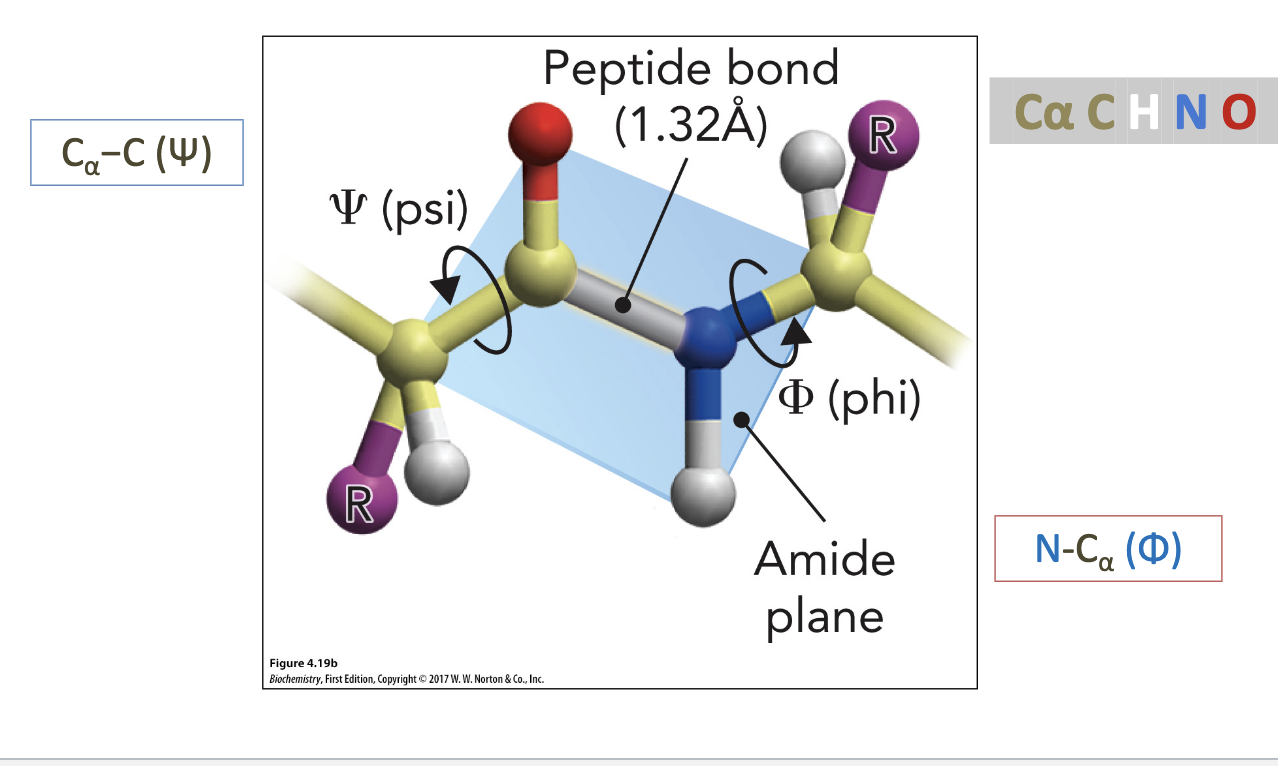
What is a dihedral angle?
The angle between the 4 atoms that make up psi and phi
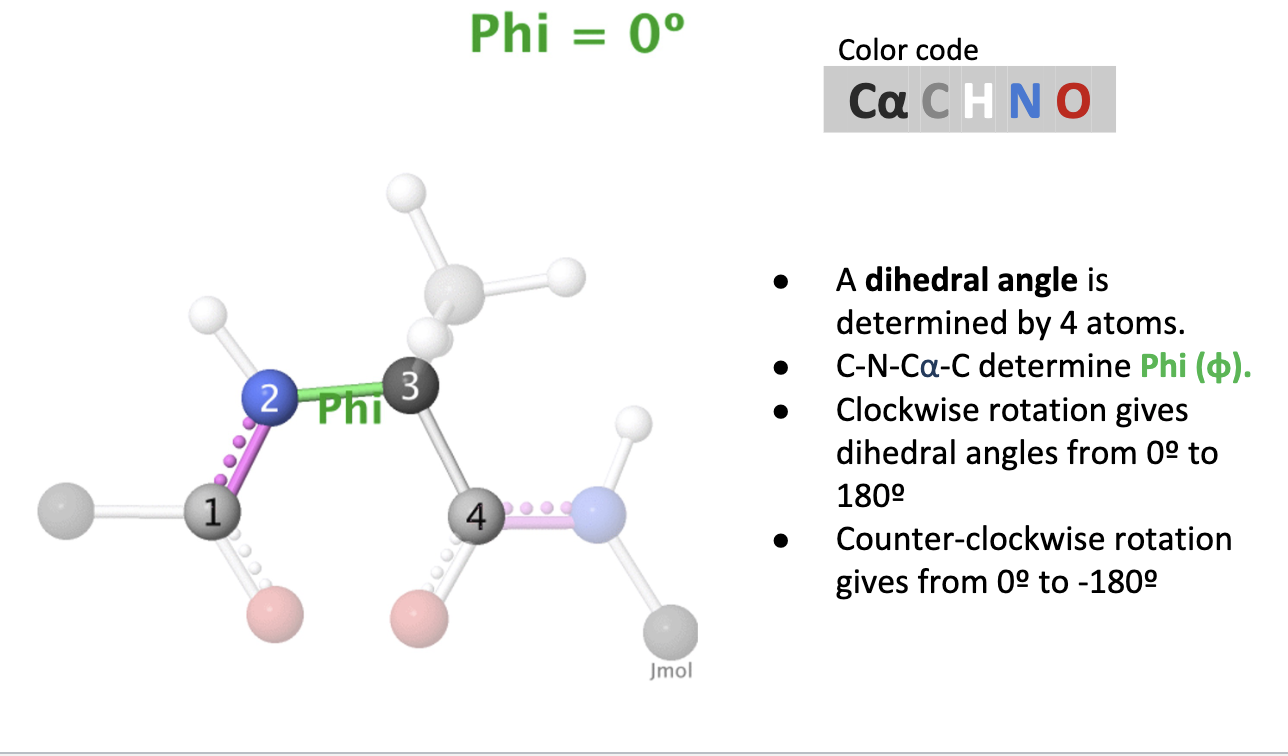
What happens when the psi bond is fixed at 165?
Most phi angles create steric clash
What happens when the phi bond is fixed at 0?
Most psi bonds create a steric clash
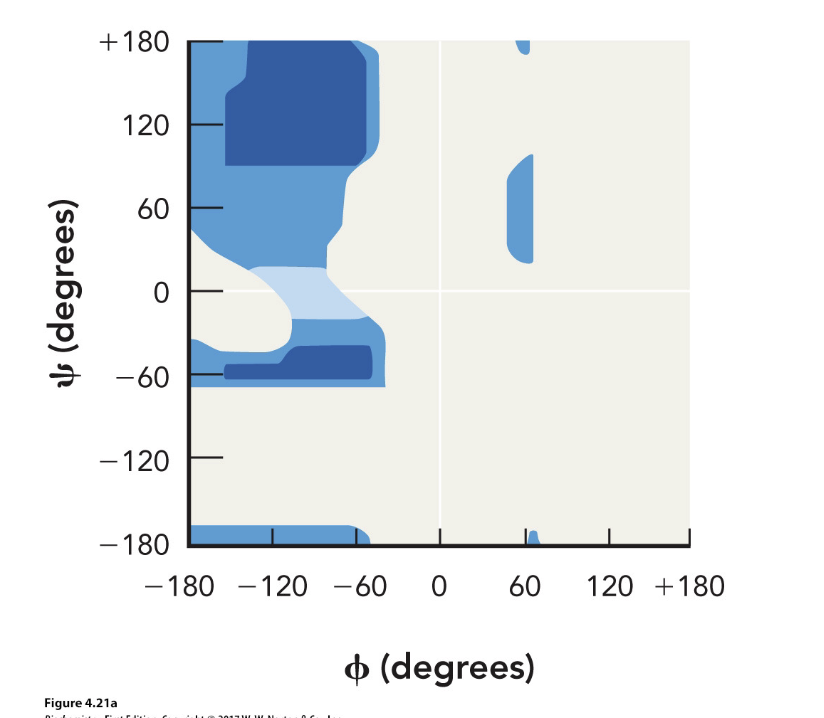
What does dark blue mean represent?
Psi and Phi confirmation with the most ridged algorithm, atoms CANNOT overlap
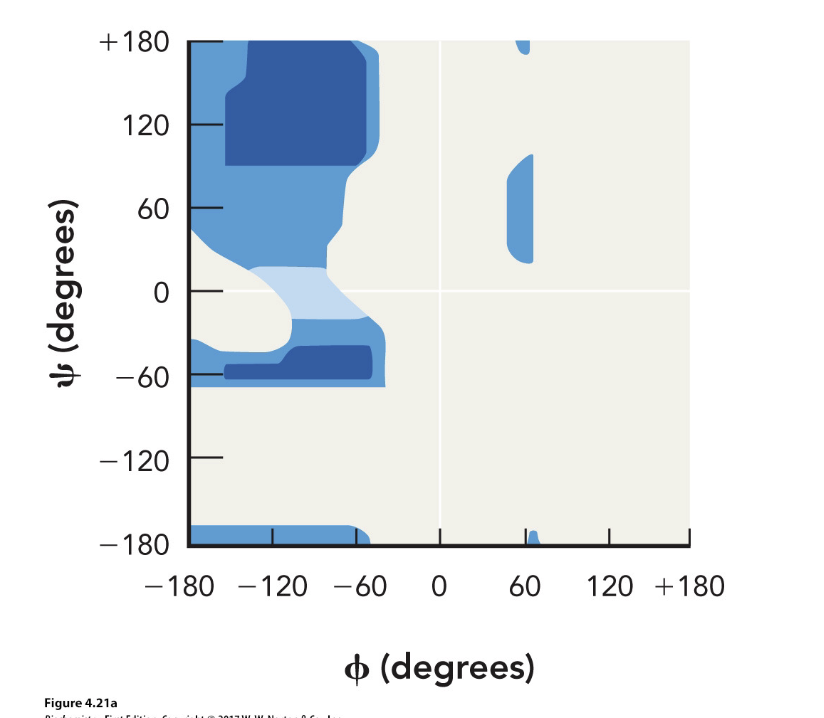
What does medium blue mean represent?
Conformation of psi and phi that allow atoms are a little closer, slight overlap
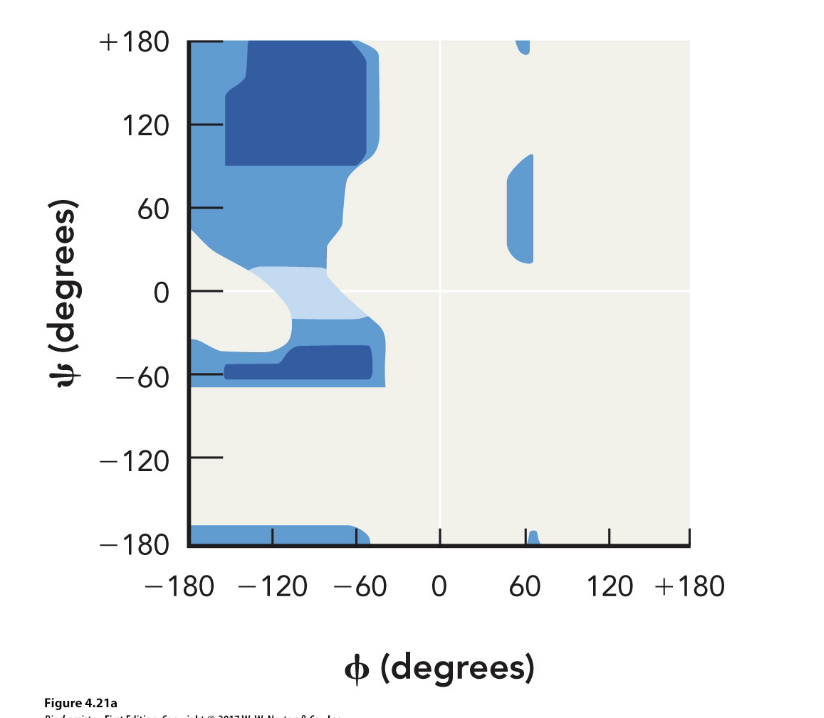
What does light blue mean represent?
Conformation of psi and phi that is allowed if peptide bond is a little flexible
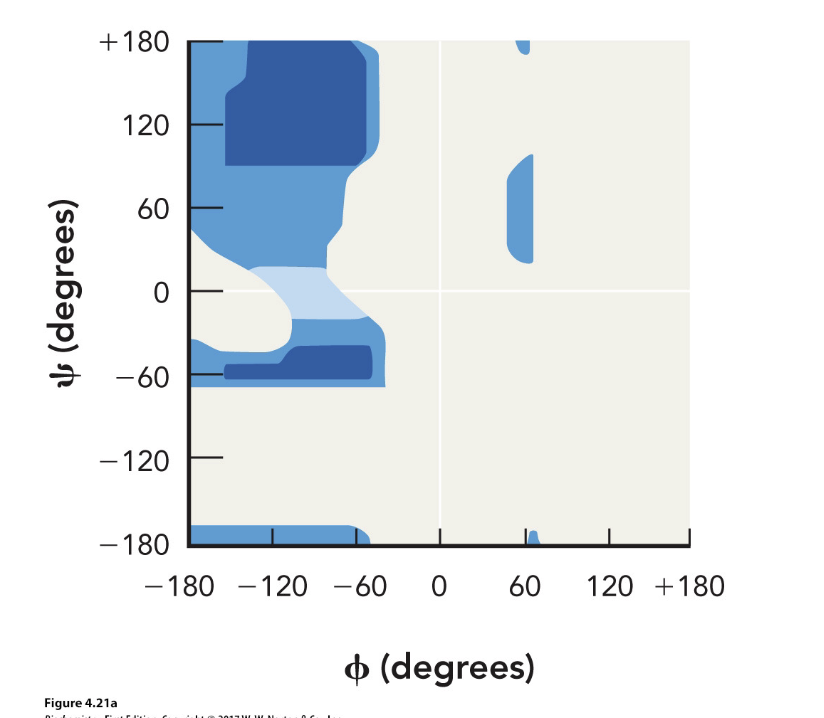
What does white mean represent?
angle not possible
What makes up an a-helix?
Single long polypeptide chain spiraling around the helical axis
Why are a-helices the most abundance secondary structure?
H-bonding in an a-helix occurs every 4 residues in a linear sequence (this creates the spiral shape). This is a significantly stable structure making it very favorable
How many amino acids per helical turn
3.6
Where do AA side chains point on a-helixs?
All side chains point outward
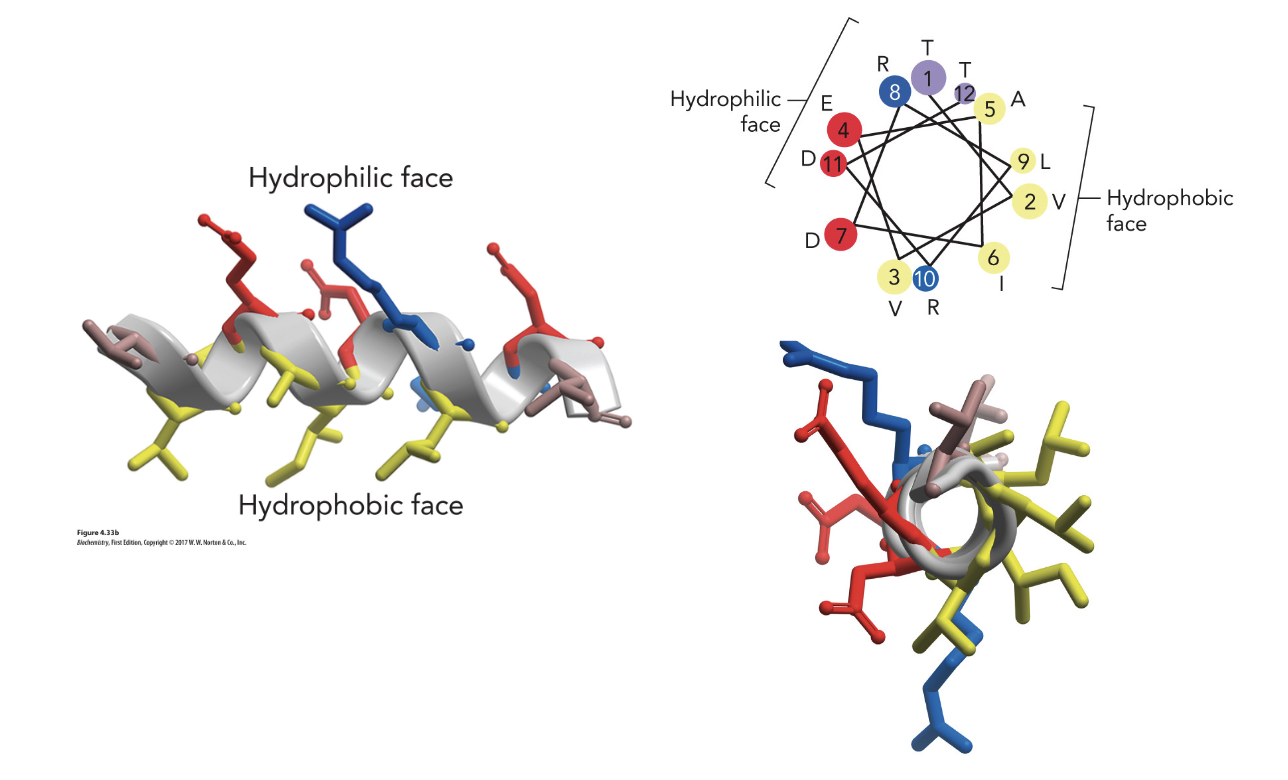
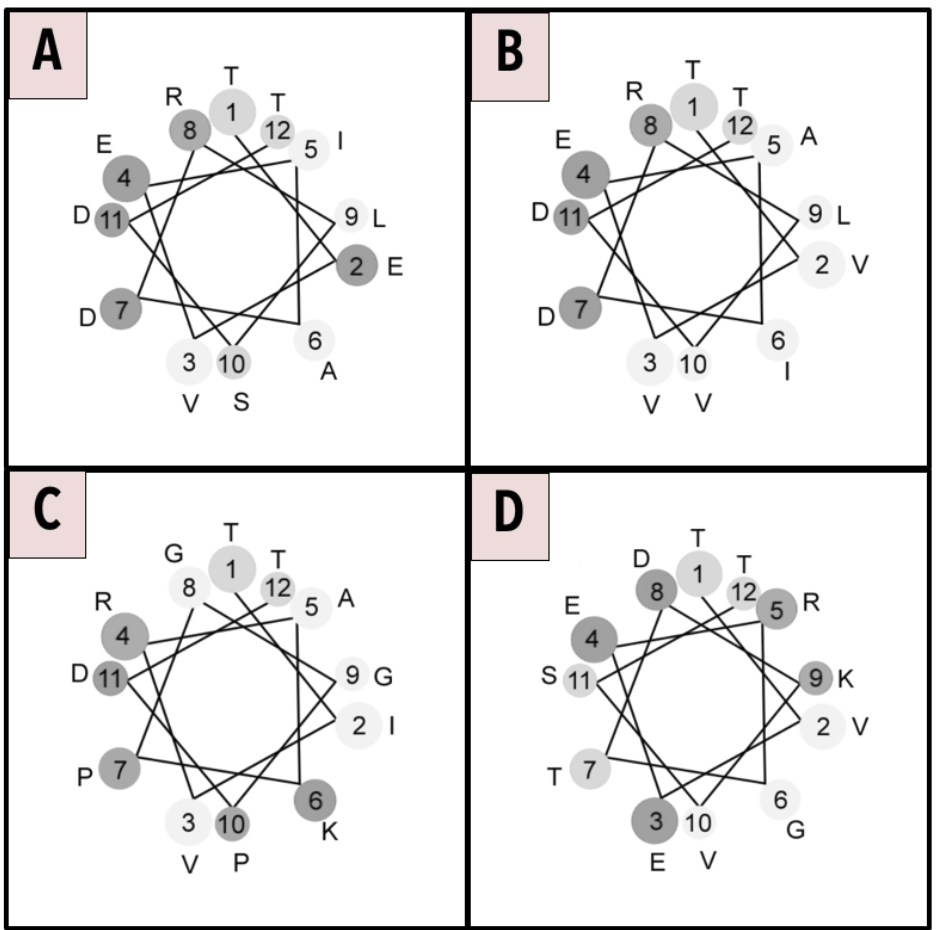
Which of the following amino acid sequences forms an amphipathic helix with hydrophobic and hydrophilic faces of approximately the same size?
TVVEAIDRLVDT
Step 1) find the ring with the most consecutive AA with similar solubilities going clockwise
Step 2) find position 1 and follow the lines to create the alphabetical answer
For example, B has ALVIVV consecutively (all nonpolar) then DDERTT consecutively (all polar/charged). Therefore, is the best answer
ΔΔG is the difference in free energy change, relative to alanine, required to take up α-helical conformation.
The thermodynamic metric used to predict the difficulty for an AA to take on the a-helix conformation
How to calculate ΔΔG
ΔΔG = ΔGAA - ΔGAlanine
A large ΔΔG means?
Increasing difficulty taking up α-helix confirmation
A small ΔΔG means?
Decreasing difficulty taking of α-helix conformation
Proline has a ΔΔG = 4 and Glycine has a ΔΔG = 3.6. What does this show about their ability to become an a-helix?
Proline is too ridged for an α-helix and glycine is too flexible
What two AA disrupt α-helix conformation?
Proline and Glycine
What makes proline bad for α-helix conformation?
It lacks an amide hydrogen for H-bonding
Proline's nitrogen is secondary (part of its pyrrolidine ring), so it has no N-H hydrogen to donate. In an α-helix, the backbone is held together by hydrogen bonds between the C=O of residue i and the N-H of residue i+4.
Its ring locks the backbone geometry
The proline side chain attaches back onto the backbone nitrogen, fixing the phi dihedral angle at around -65°. The α-helix requires φ ≈ -57°
What makes glycine bad for a-helix conformation?
Glycine's side chain is just a hydrogen atom making it very flexible. Because glycine has so many accessible backbone conformations in the unfolded state, forcing it into the single, specific psi/phi conformation required by an α-helix costs a large amount of conformational entropy (unfavorable)
What does multiple b-strands next to each other create?
b-sheet
Which type of beta sheet is more stable, Antiparrallel or parallel and why?
Antiparallel — the hydrogen bonding aligns linearly
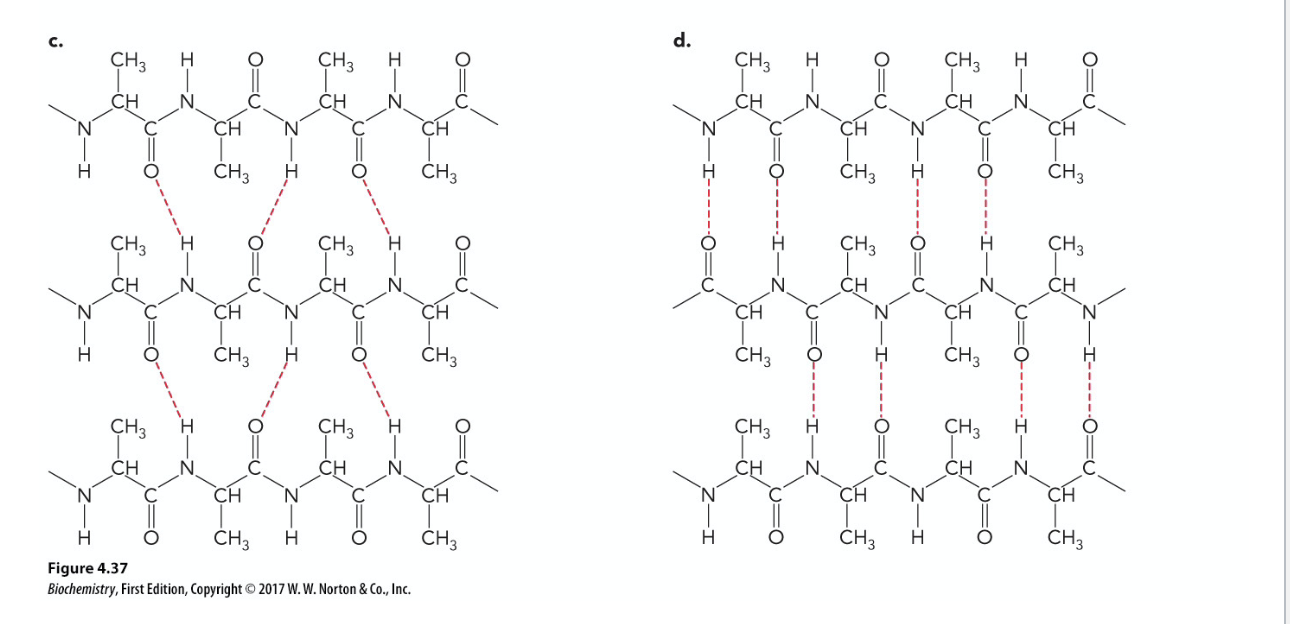
What is pattern for AA side chains in a b-strand/sheet?
R-group alternate in solubilty and point in opposite directions. Ex. Phe-Gln-Ile-Asp-Met-Glu-Leu…
What are b-turns?
4 AA loops that connect b-strands
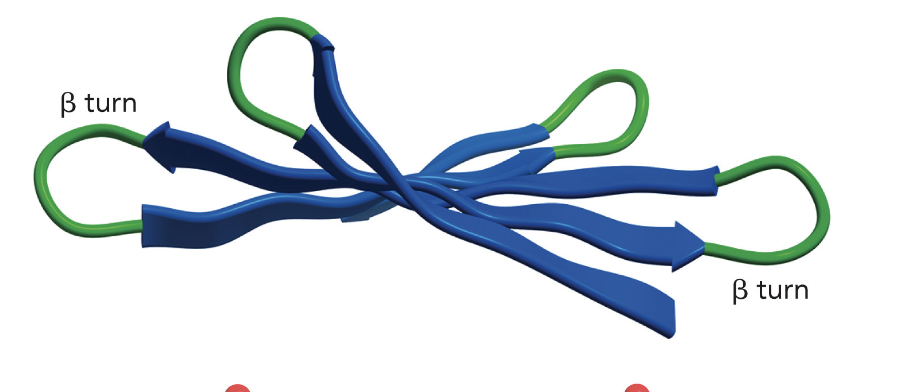
Breakdown the hydrogen bonding of b-turns
β-turns are stabilized by a intramolecular hydrogen bond between the backbone carbonyl oxygen of the first amino acid (residue i) and the backbone amide nitrogen of the fourth amino acid (residue i+3)
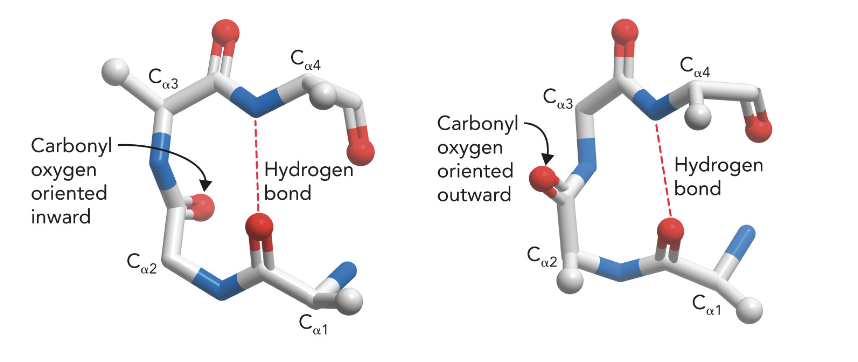
How many AA are in each β-turns?
4
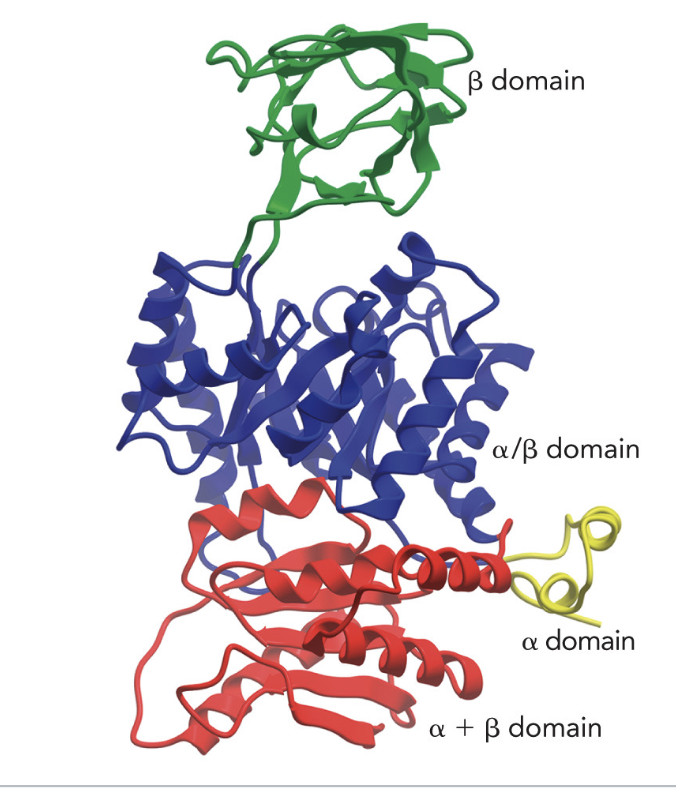
What is a tertiary structure consist of?
Multiple secondary structures linked together
What are the 4 main types of tertiary strucutres?
1) Predominantly a-helix
2) Predominantly b-sheet
3) a/b combined
4) a + b
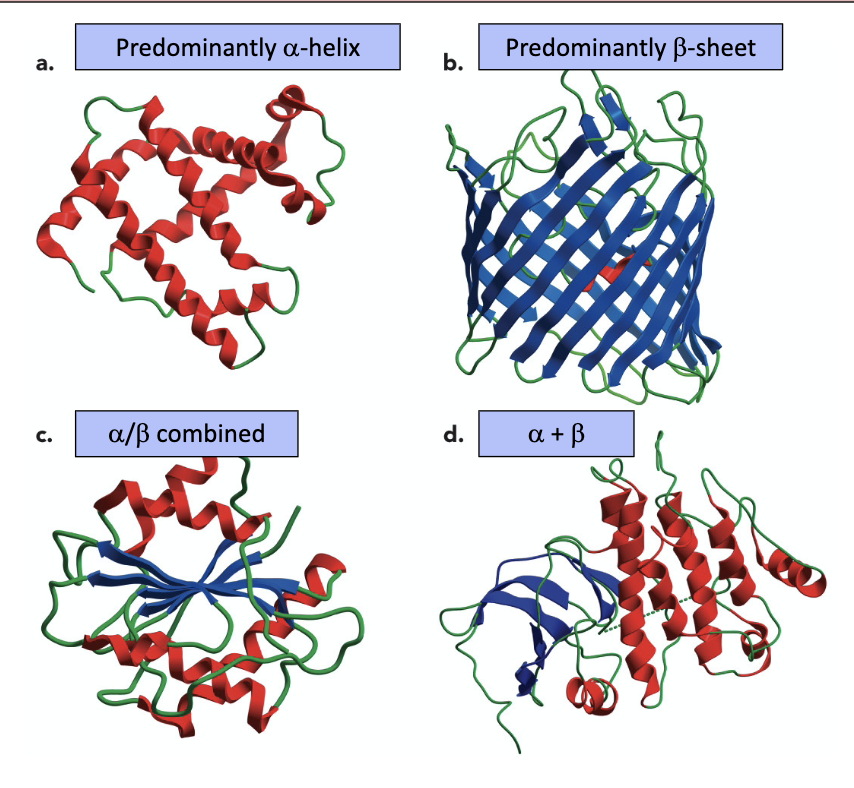
What is each fold on a tertiary structure called?
a motif
How many structures are required per motif?
Each motif consists of 2 or more secondary structures
What is a domain?
An independent, folded module within the polypeptide chain
How are tertiaty strucures stabilized?
Tertiary structures are stabilized by the interaction of R-groups.
1) Hydrophobic effect
2) Hydrogen bonding
3) Van Der Waals Interactions
4) Electrostatic Interactions
What kind of strong covalent bond is found only in tertiary structures (2 Cysteine AA)?
Disulfide bond
What is a quaternary strcuture?
Combination of multiple tertiary structures
What is the naming for 2,4, and 6 subunits
Dimer, tetramer, hexamer
What is the naming for same and different subunits?
Homo - same
Hetero - different
What is a heterodimer of homotrimers
2 different sets of the identical trimer (A3B3)
What is the nomenclature for 6 identical subunits?
Homohexamer
Quaternary structures increase _____ of a protein and how?
functionality — they provide structural properties not present in individual subunits, provide a mechanism for regulation of protein function through conformational change, bring linked function components into close proximity
What is a subunit?
An individually folded polypeptide chain (tertiary structure)
Protein folding is spontaneous because _________
a) ΔG is positive
b) decreased entropy of protein folding balanced by increase in entropy of water
c) increased entropy of protein balanced by decrease in entropy of water
d) bonds stabilizing fold contribute to favorable enthalpy
e) bonds stabilizing fold contribute to favorable entropy
ANSWER: b and d
What drives protein folding and overcomes the cost of decreasing entropy? (soluble protein - select all)
a) Van der Waals between non-polar molecules
b) Hydrophobic effect avoiding water
c) Hydrogen bonds for secondary and tertiary structures
d) Ionic interactions between charged groups
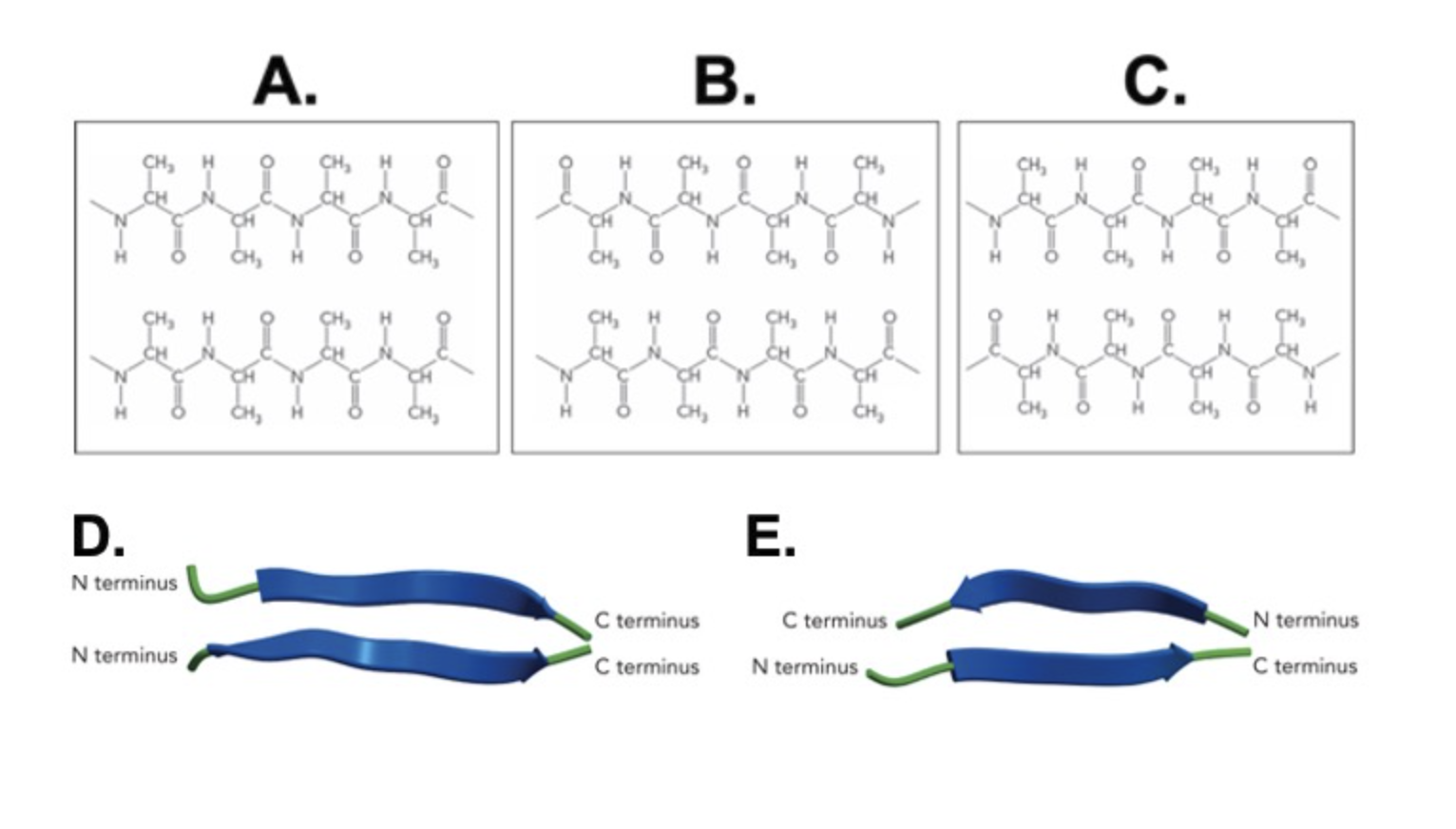
Which diagrams depict antiparallel beta sheets? (select all)
a) A
b) B
c) C
d) D
e) E
ANSWER: a, c , & e
Which statement is TRUE about beta strands and beta sheets?
a) All side chains on same side
b) Side chains protrude above and below backbone
c) Formed by ionic interactions COO- and NH3+
d) Stable mainly due to van der Waals
e) Backbone CO H-bonded to NH 4 residues away
f) ALL psi and phi angles favored
g) Side chains in same plane as CO and N-H
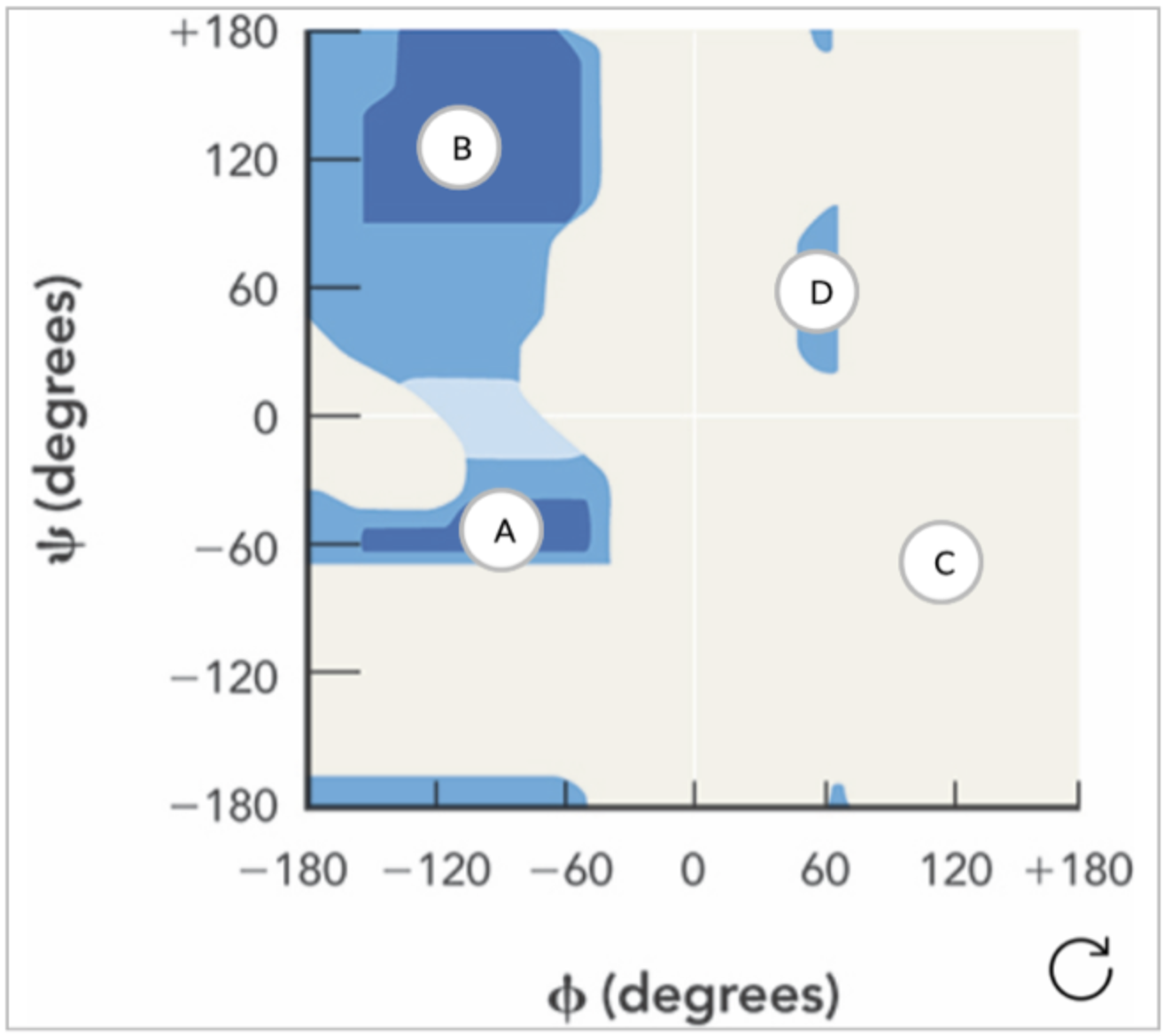
On a Ramachandran plot which region corresponds to phi and psi angles for a beta sheet?
ANSWER: B — for beta sheet region, phi is approximately -120 degrees and psi is approximately +120 degrees
Q8: Why are antiparallel beta sheets more stable than parallel beta sheets?
Antiparallel sheets form more linear hydrogen bonds between C=O and N-H on adjacent strands (perpendicular to strand direction). Parallel sheets have tilted less optimal H-bond geometry.
More linear = stronger bonds = greater stability
Q9: Which sequence could form a beta strand with one hydrophobic face and one hydrophilic face? |
1) Asp-Gln-Leu-Glu-Lys-Glu-Leu-Gln-Ala-Leu-Glu-Lys-Glu-Leu-Ala
2) Phe-Gln-Ile-Asp-Met-Glu-Leu-Lys-Val-Asn-Leu-Asp-Phe-Arg-Ala
3) Ala-Gln-Tyr-Gly-Pro-Asn-Leu-Phe-Ala-Val-Ile-Lys-Asn-Cys-Ala
4) Phe-Asn-Ser-Val-Leu-Gln-Asp-Ile-Glu-Gln-Phe-Met-Ser-Cys-Ala
ANSWER: Sequence 2 — Phe-Gln-Ile-Asp-Met-Glu-Leu-Lys-Val-Asn-Leu-Asp-Phe-Arg-Ala.
hydrophobic (Phe;Ile;Met;Leu;Val;Leu;Phe) and hydrophilc (Gln;Asp;Glu;Lys;Asn;Asp;Arg) alternate to opposite faces
Q11: Match each description to the correct protein structure level
A) Amino acids linked by covalent bonds with no side chain interactions
B) Antiparallel beta sheet within a globular protein
C) Folded single polypeptide chain with four discrete domains
D) Multi-subunit fibrous protein
A) Primary | B) Secondary | C) Tertiary | D) Quaternary
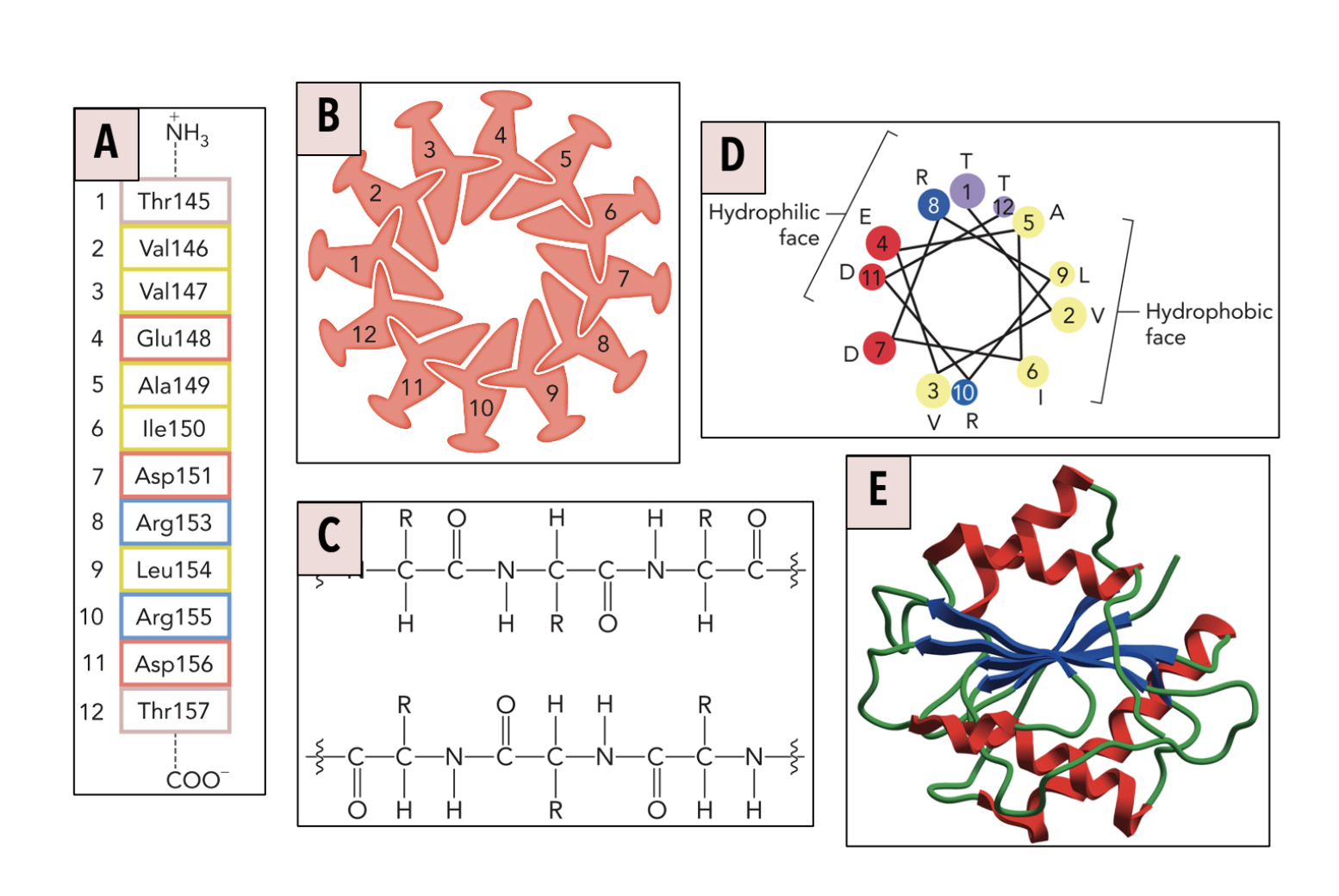
Q12: Which image (A-E) best represents TERTIARY protein structure?
Answer: E — Tertiary structure = 3D folding of a SINGLE polypeptide chain
Q13B: Given that hair is soft and fingernails are hard and both have high keratin levels — which is true?
a) Hair: fewer Cys so more S-S than fingernails
b) Hair: more Cys so more S-S than fingernails
c) Hair: more Cys so fewer S-S than fingernails
d) Hair: fewer Cys so fewer S-S than fingernails
ANSWER: D) — Hair keratin has fewer cysteines and therefore fewer disulfide bonds than fingernail keratin. More Cys = more S-S = harder material. Fingernails are harder, so fingernails have more keratin therefore more Cys and more S-S bonds
Q13C: A perm involves breaking S-S bonds then reshaping hair then re-forming S-S bonds. Which steps does a perm involve?
a) Reduction then reshaping then oxidation
b) Oxidation then reshaping then reduction
ANSWER: A — Reduction then Reshaping then Oxidation. Step 1 - Reduction: reducing agent breaks S-S bonds making hair flexible. Step 2 - Reshaping: hair wrapped into new shape. Step 3 - Oxidation: oxidizing agent re-forms S-S bonds locking in new shape
Q14A: What is the quaternary structure notation for a hexamer made of three DIFFERENT homodimers?
a) ABC
b) A3B3C3
c) A2B2C2
d) A6
e) A3B3
ANSWER: c) A2B2C2. Three different homodimers (AA + BB + CC) = 2 copies each of A; B; and C. Total = A2B2C2 (6 subunits = hexamer)
ANSWER: A3B3. Homotrimer 1 = A3; Homotrimer 2 = B3. Combined hexamer = A3B3 (6 subunits total)
What class structure is a folded large protein that consists of a single polypeptide chain with four discrete domains
Tertiary
What class of structure has multi-subunit fibrous protein
quaternary
Structure that has a antiparallel beta sheet within a globular protein
Secondary
What kind of structure has several amino acids linked through covalent bonds but with no interactions between side chains
primary
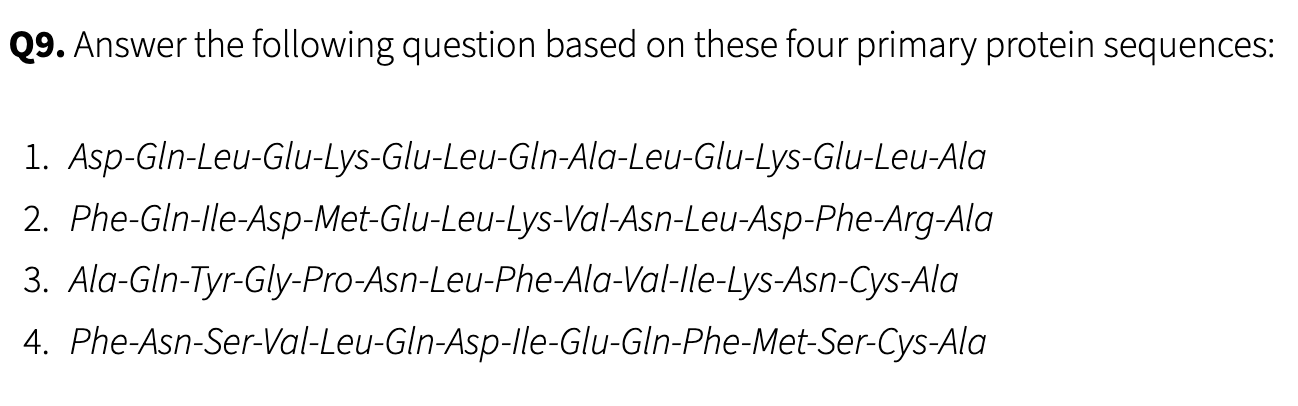
How of these 4 sequences which one would not form an a-helix. Explain your reasoning and how to fix it
Sequence 3 — because of the proline and glycine interrupting the chain. In order to fix this problem you must look at the surrounding AA and their solubility properties. To ensure the pattern of alternating AA stays true, glycine must be replaced with a charged/polar AA and Pro must be replaced with a hydrophobic AA other than G or P.
For example: Tyr-Gly-Pro-Asn ——> Tyr-Cys-Met-Asn (Hydrophobic, Hydrophilic, Hydrophobic, Hydrophilic)
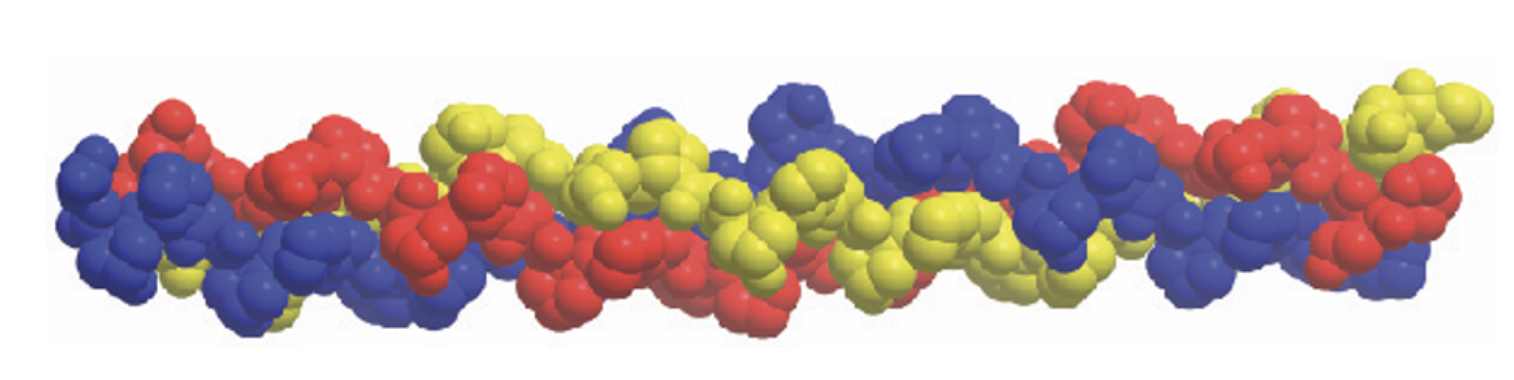
Collagen (pictured below) is an important component of connective tissue, like skin and bone. As depicted in the image, it is a trimer. The quaternary structure of collagen is help together by:
a) Hydrogen bonds between backbone atoms.
b) Many non-covalent interactions between R-groups from the same polypeptide.
c) Many non-covalent interactions between R-groups from different polypeptide subunits.
d) Peptide bonds between amino acids.
e) Beta sheets.
B — Many non-covalent interactions between R-groups from different polypeptide subunits.
All a-helix’s are amphipathic (T/F)
False — Amphipathicity is a special case that arises only when the sequence has a specific periodic pattern of polar/nonpolar that create a clustering into opposing faces.