Cell Biology Module 3 Quiz
 Call Kai
 Learn
Learn Practice Test
 Spaced Repetition
 Match
Match Flashcards
 Knowt Play
1/50

There's no tags or description
Looks like no tags are added yet.
Name | Mastery | Learn | Test | Matching | Spaced | Call with Kai | Chat |
|---|
No analytics yet
Send a link to your students to track their progress
51 Terms
Acidification of endosomes is important in dissociating:
Iron from ferrotransferrin
A tail-anchored protein will have a hydrophobic amino acid residue at its:
C-terminal end
The topology of membrane proteins can often be predicted by computer programs that identify____________topogenic segments.
Hydrophobic
An individual suffers from a mutation in the transferrin receptor. The mutation alters the receptor in such a way that it can't sense the neutral pH and respond to neutral pH by changing its conformation. But the receptor's activity in acidic pH did not alter. Which of the following statements is FALSE in the above-mentioned condition:
A. Apotransferrin can't be dissociated from the receptor on the cell surface
B. The person will probably suffer from iron deficiency
C. None of the answer choice is false, they are all true
D. Ferrotransferrin, if present, will not be able to bind to the receptor on the cell surface
C. None of the answer choice is false, they are all true
Which of the following statements regarding clathrin-coated vesicles is FALSE:
A. Clathrin coat subunits recognize Tyr-X-X-Φ sequence on membrane proteins and bind onto them for clathrin-coated vesicle formation.
B. Clathrin-coated vesicle assembly is mediated by the GTPase ARF.
C. Adapter complexes provide the specificity of vesicle cargo.
D. Dynamin is required for pinching off clathrin-coated vesicles.
A. Clathrin coat subunits recognize Tyr-X-X-Φ sequence on membrane proteins and bind onto them for clathrin-coated vesicle formation.
In the absence of any signal or targeting sequence, the expected location for any protein after synthesis is:
Cytosol
The mannose 6-phosphate residue is important, as it is required to target soluble enzymes to the lysosome. The two enzymes responsible for attaching this residue onto these soluble enzymes reside in the:
Cis-Golgi
Which of the following is required for cotranslational translocation of a secretory protein into the ER?
1. hydrophobic signal sequence
2. signal recognition particle
3. signal recognition particle receptor
4. GTP
5. ATP
6. translocon
1, 2, 3, 4 and 6
In hepatocytes, the process by which apically destined proteins travel from the basolateral region across the cell before fusing with the apical membrane is called:
Transcytosis
In the process of transcytosis of the antibodies; the Fc receptors have ____________for antibodies at pH 6.0 in the____________to capture antibodies; but have ___________for antibodies at pH 7.0 in the ____________to aid the release of the antibodies.
High-affinity, intestinal-lumen, low-affinity, blood or interstitial fluid
Post-translational translocation of some secretory proteins in yeast is powered by:
ATP hydrolysis by BiP
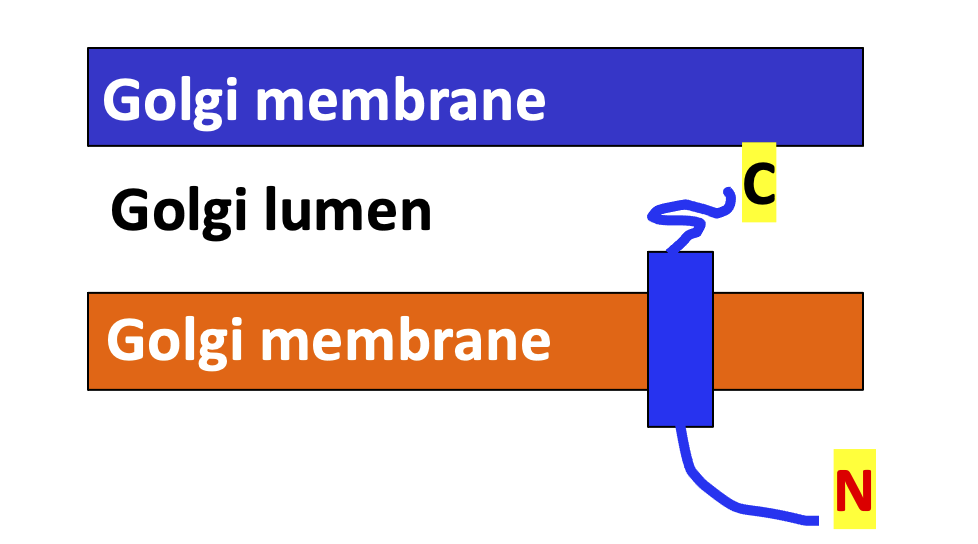
Which of the following statement/s is/are correct based on your observation of the figure below:
A. None of the answer choices is correct
B. The protein contains a stretch of membrane-spanning hydrophilic amino acids
C. If the protein becomes a lipid raft resident protein, the N-terminus will face the extracellular environment when the protein reaches its final destination
D. The protein had an N-terminal cleavable signal sequence removed by signal peptidase in the ER.
A. None of the answer choices is correct
In a cell-free protein synthesis system utilizing microsomes from fragmented ER, under which condition could you determine if the new protein was imported into the microsome?
Ribosomes and mRNA are incubated with microsomes, then a protease is added and the results are analyzed.
Which of the following events in vesicular transport occurs at the very end:
A. Association of Rab with Rab effector
B. Assembly of the v and t SNARE complex
C. Disassembly of the SNARE complex by NSF
D. Disassembly of vesicular coats
C. Disassembly of the SNARE complex by NSF
Which of the following is NOT a property of the mammalian signal recognition particles (SRP):
A. It targets secretory polypeptides in the cytosolic translating ribosomes and brings the translating ribosomes to the cytosolic face of the ER membrane
B. It contains both RNA and several proteins
C. It binds to a terminal or internal hydrophobic signal sequence of a protein
D. It targets secretory polypeptides in the cytosolic translating ribosomes and brings the translating ribosomes to the exoplasmic face of the ER membrane
E. It temporarily arrests translation
D. It targets secretory polypeptides in the cytosolic translating ribosomes and brings the translating ribosomes to the exoplasmic face of the ER membrane
GPI-anchoring serves a special function, especially in polarized epithelial cells, because this modification serves to target proteins to the:
Plasma membrane
All the following proteins interact with exposed amino acids during protein folding in the ER EXCEPT:
A. PDI
B. BiP
C. Calnexin
D. Prolyl isomerase
C. Calnexin
As part of an early experiment on the secretory system, an in vitro translation system consisting only of mRNA and ribosomes resulted in secretory proteins that were larger than the identical protein when translated in a cell. Why?
Signal sequence cleavage requires ER entry and action of ER-resident proteins.
If Sar1 is inserted into the membrane, it is:
Bound to GTP and recruits COPII coat proteins.
Protein insertion into the mammalian ER membrane is typically:
Cotranslational
An important molecule for generating fatty acids in the cell enters via receptor-mediated endocytosis. The complex formed between the receptor on the plasma membrane and the important molecule is stable only at neutral pH. Based on this knowledge, you would predict that:
The molecule is released from the receptor in the endosome
Which protein involved in the cotranslational translocation of proteins into the ER membrane is NOT a GTP-binding protein?
Sec61 translocon
Soluble and membrane proteins advance through the Golgi complex by:
Cisternal progression through vesicle formation and fusion
A transmembrane receptor that functions at the cell membrane has an exoplasmic N-terminal sequence, a signal-anchor sequence, and a stop-transfer-anchor sequence. Where was this protein first inserted into the membrane?
In the ER
Which of the following steps in vesicular transport of proteins requires the hydrolysis of ATP?
Disassembly of the SNARE complex
Which of the following is the most appropriate function of an LDL receptor:
A. It is responsible for receptor-mediated endocytosis of cholesterol
B. It is a receptor for apolipoprotein B and is responsible for the receptor-mediated exocytosis of LDL
C. All of the answer choices are correct
D. It is a receptor for apolipoprotein B and is responsible for the receptor-mediated endocytosis of LDL
E. It is responsible for initiating cholesterol synthesis
D. It is a receptor for apolipoprotein B and is responsible for the receptor-mediated endocytosis of LDL
Proteins that function in the ER will encounter which of the following by chance or random occurrence?
Anterograde transport in COPII-coated vesicles
Synthesis of a protein with high affinity to lipid rafts may use which of the following enzymes/proteins:
A. All of the choices are correct
B. Signal Peptidase
C. SRP
D. Translocon
E. GPI-transamidase
A. All of the choices are correct
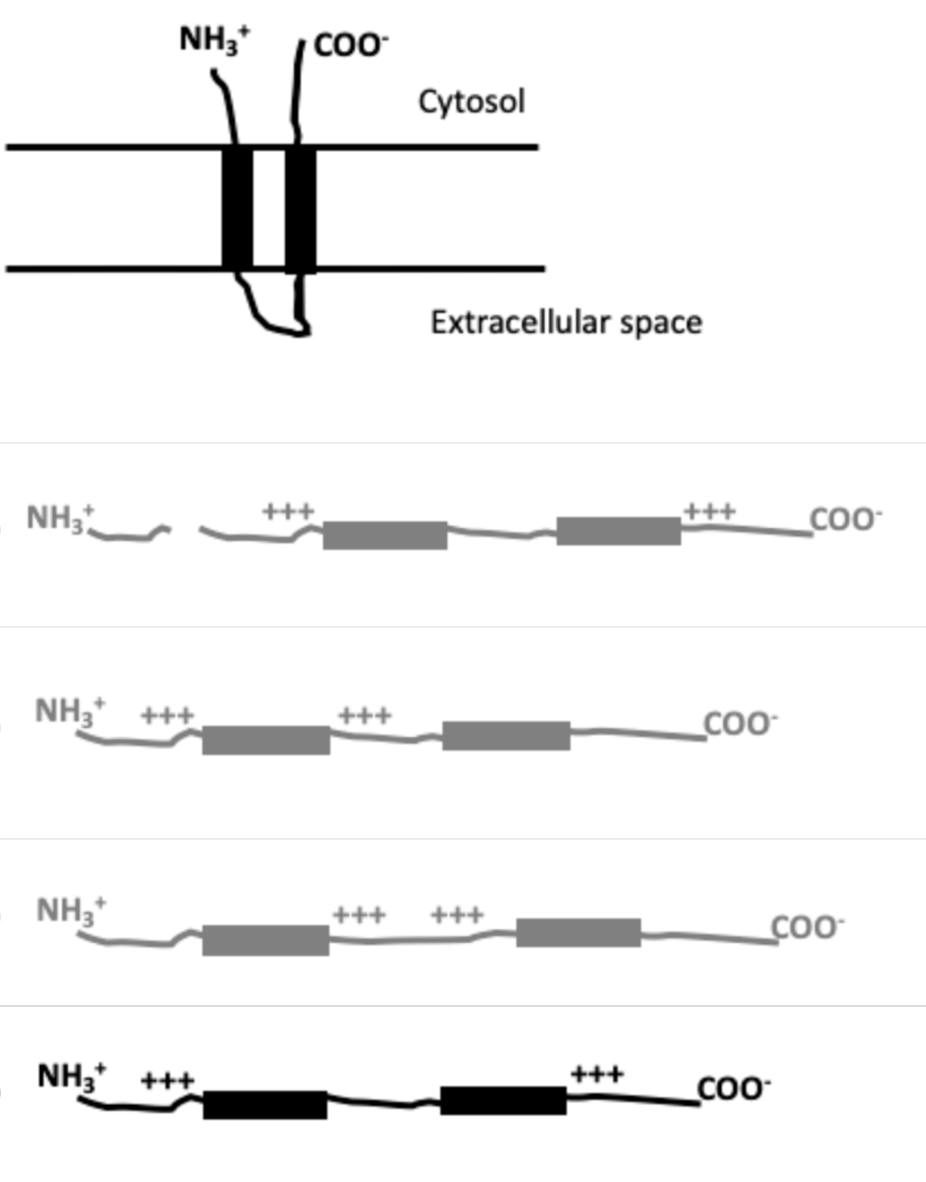
Which of the following linear sequences corresponds to the protein drawn below?
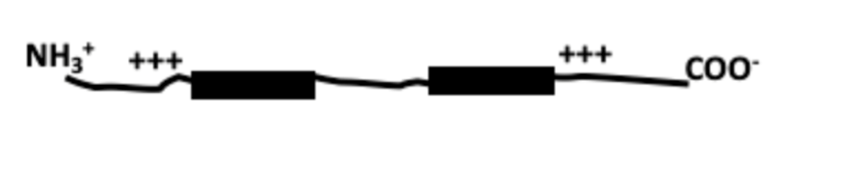
Which of the following proteins will not have a signal sequence:
A. Proteins targeted to the Cytosol
B. Proteins targeted to the Mitochondria
C. Proteins targeted to the Rough ER
D. Proteins targeted to the Nucleus
E. Proteins targeted to the Chloroplast
A. Proteins targeted to the Cytosol
Please choose the correct sequence of events that occur due to the unfolded protein response in the ER and the cytoplasm.
Dimerization of Ire1
Translation of the Hac1 mRNA into a transcription factor that regulates genes involved in unfolded protein response.
Splicing of unspliced Hac1 mRNA by endonuclease activity of dimerized Ire1
Dissociation of binding protein (BiP) from Ire1 monomers and subsequent association with unfolded proteins in the ER lumen.
4, 1, 3, 2
Which of the following statements about the function of a vesicle fusion protein is correct:
A. v-SNAREs provide the energy for vesicle fusion.
B. t-SNAREs localize to vesicles and generate appropriate membrane curvature.
C. NSF is responsible for vesicle-membrane specificity.
D. Rab proteins are responsible for the docking of vesicles on target membranes.
D. Rab proteins are responsible for the docking of vesicles on target membranes.
Which of the following is not an important ER-resident enzyme that modifies proteins in the secretory pathway:
A. Sec61
B. Peptidyl-prolyl isomerase
C. Protein Disulfide Isomerase
D. BiP
E. Glycosyltransferase
A. Sec61
Which statement about ER import is TRUE:
A. Signal recognition particles (SRPs) are needed during co-translational protein import.
B. GTP hydrolysis by the Sec61 translocon causes ribosomal translation to begin again after it is halted by SRP binding.
C. N-terminal signal sequences have been determined to be necessary for ER import because if they are added to sequences which are not normally targeted to the ER, they will end up in the ER.
D. Ribosomal translation of a 6-12 amino acid sequence on the N-terminus of a protein will initiate the process through interactions with SRP.
D. Ribosomal translation of a 6-12 amino acid sequence on the N-terminus of a protein will initiate the process through interactions with SRP.
What phenotype would be observed in a cell containing a nonhydrolyzable form of GTP with respect to the vesicles of the secretory pathway?
Coated vesicles would accumulate.
Which of the following proteins should coat a vesicle that contains the KDEL receptor:
A. Clathrin
B. Adaptin
C. COP II
D. All of the answer choices are correct
E. COP I
E. COP I
Which of the following protein/protein complexes can bring the translating polyribosomes to the ER in the absence of GTP:
A. Signal Recognition Particle Receptor
B. None
C. Signal Recognition Particle (SRP)
D. Get3 Protein complex
E. Translocon
B. None
Which small GTPase is NOT involved in vesicle budding or docking?
Ras
Protein sorting of anterograde cargo to different destinations within the Golgi complex occurs in the:
Trans-Golgi
Cell-free transport assays:
A. Often probe for changes in the glycosylation state of transported proteins.
B. Complement genetic approaches to the secretory pathway.
C. All of the answer choices are correct.
D. Provide a means to test the effect of added purified proteins.
C. All of the answer choices are correct.
Vesicle budding recruits proteins that are needed for subsequent:
Selective vesicle targeting and fusion.
The two enzymes ______________________ and _________________ are responsible for attaching mannose-6-phosphate onto the soluble proteins/enzymes, targeted to the ________________, and reside in the _______________________.
N-acetylglucosamine phosphotransferase; phosphodiesterase; lysosome; Golgi
Endoglycosidase D is a useful reagent because it allows scientists to distinguish glycosylated proteins that:
Remain in the ER
Which of the following statements regarding COP vesicle budding is FALSE:
A. COPI and COPII vesicles are composed of completely distinct coat proteins.
B. Both Sar1 and ARF undergo conformational changes to insert into the ER or Golgi membranes in order to carry out their functions in vesicle assembly and budding.
C. Hydrolysis of GTP to GDP by Sar1 or ARF triggers assembly of the COP coat.
D. COPII vesicles travel from the endoplasmic reticulum to the cis -Golgi.
C. Hydrolysis of GTP to GDP by Sar1 or ARF triggers assembly of the COP coat.
Which of the following statements about LDL internalization is FALSE:
A. Endosomal pH is crucial for dissociation of LDL from its receptor after endocytosis.
B. Mutations in the LDL receptor cause familial hypercholesterolemia.
C. The LDL receptor transits the secretory pathway.
D. The LDL receptor and its bound LDL are ultimately delivered to the lysosome.
D. The LDL receptor and its bound LDL are ultimately delivered to the lysosome.
Glycosylation, a post-translational modification of secretory proteins, occurs in the:
A. ER
B. Mitochondria
C. Golgi
D. More than one answer choices are correct
D. More than one answer choices are correct
Lipoproteins are effective in transporting lipid molecules in an aqueous environment because their surface layer is:
Amphipathic
Which of the following steps in vesicular transport occurs first?
Assembly of vesicular coats
COPI coat proteins mediate _____________ transport between the Golgi apparatus and other organelles.
Retrograde
The presence of clathrin mediates vesicular transport:
From trans -Golgi to endosome
Which of the following statements regarding secretory protein translocation is NOT true:
A. Type IV membrane proteins contain a mixture of both stop transfer anchor sequences and signal anchor sequences, the order of which determines the protein's orientation in the membrane.
B. Hydropathy profiles are used to computationally identify secreted proteins.
C. Type II membrane proteins have a signal sequence targeting them to the ER as well as a signal anchor sequence.
D. Type I membrane proteins contain two signal sequences; one targets the protein to the ER, and one is a stop-transfer anchor sequence.
C. Type II membrane proteins have a signal sequence targeting them to the ER as well as a signal anchor sequence.