3. Pure tone threshold audiometry, tympanometry. List of subjective and objective hearing tests. Tuning forl tests
 Call Kai
 Learn
Learn Practice Test
 Spaced Repetition
 Match
Match Flashcards
 Knowt Play
1/24

There's no tags or description
Looks like no tags are added yet.
Name | Mastery | Learn | Test | Matching | Spaced | Call with Kai | Chat |
|---|
No analytics yet
Send a link to your students to track their progress
25 Terms
What is pure tone audiometry
subjective hearing test
depends on cooperation of the patient
tests air and bone conduction- AC, BC
Describe the procedure of PTA
performed in soundproof room with audiometer that generates pure tone signals
pure tone= sound containing only 1 frequency
Air- headphones on ear
Bone- vibrator on mastoid
How is the hearing loss in PTA expressed
hearing loss expressed in dB
-10 to 20 dB = normal hearing
20 to 40 dB = mild hearing loss
40 to 60 dB = moderate hearing loss
60 to 90 dB = severe hearing loss
>90 dB = profound hearing loss
What are the results of a PTA
normal AC= BC
CHR AC> BC
BC in normal range
AC outside normal range
AB gap between >10dB
SNHL AC=BC
hearing threshold is decreased
both below normal
gap is <10dM- no air-bone gap
mixed hearing loss AC > BC
hearing threshold is decreased
both below normal
AB gap >10dB
What is tympanometry
Pure tone signal of known intensity is directed into external auditory canal via ear probe
Used to screen OME in children
Describe the procress of tympanometry
microphone in probe measures the reflected sounds from tympanic membrane
normally air pressure in ear canal and middleear are equal = atmospheric P
in this condition tympanic membrane has lowest resistance and highest compliance- absorbds sound better
Describe how different pressures affect the tympanic membrane
decreased or increased air P in EAC
stiffening of tympanic membrane
increased acoustic impedance and decreased compliance
decreased sound absorption
more sound is reflected
What is a tympanogram
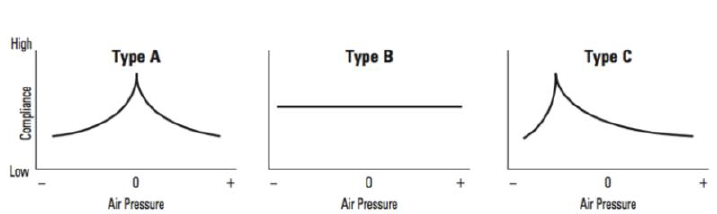
graphic representation of compliance change sin middle ear against pressure gradient from -400 to +200mmH2O
peak at maximum compliance → where pressure in external= middle
What are the results on tymapnogram
normal -100 to +50mmH2O
type A curve
normal pressure peak at maximum compliance at 0 air pressure
abnormal
type B
no pressure peak → fluid in tympanic cavity
eg tympanic perforation or OME
type C
negative pressure peak
eg eustachian tube dysfunction or early OM without effusion
What is the difference between subjective and objective hearing tests
subjective- communication and active cooperationn with patient
objective- without cooperation with patient
What are subjective hearing tests
Conversation, repeat words
Tuning fork tests
Audiometry- with measuring instrument
Pure tone audiometry
Speech test
What are objective hearing tests
Impedance audiometry
Evoked responses
Reflex- stapedius reflex
Acoustic response- otoacoustic emission
Electrical responses
Electrocochleaography, brainstem response, cortical response
What are some hearing tests based on reflexes
Orientation reflex:
child turns towards a sound stimulus
Stapedial reflex:
contraction of the stapedius muscle in response to loud sound
Classic Pavlovian conditional reflex:
child turns to the sound stimulus and a puppet lights up to reward (reinforce) the child’s listening behavior
Auricle reflex:
movement of the ears (in animals) in response to a sound
Auro-palpebral reflex:
contraction of the palpebral orbicularis muscle in response to loud sound
What are hearing tests based on otoacoustic emission
spontaneous and evoked OAE
OAE is a low level sound caused by the motion of the cochlea’s sensory hair cells in response to sound
The OAE is recorded by a probe after a series of click stimuli is given
Absence of emissions can be due to hearing loss or fluid in the middle ear
Often used in newborn screening
What are hearing tests bsed on electrical activity
Electrical response audiometry (ERA):
Electrocochleography
Brainstem evoked response audiometry (BERA)
Cortical evoked response audiometry (CERA)
Auditory steady state response (ASSR)
What are tuning fork tests
performed to distinguish between CHL or SNHL
tests
Weber
Rinne
Gelle
What is conductive hearing loss- CHL
from failure of transmission of sound waves across the outer or middle ear
prevents sound energy for reaching cochlear fluids
involves outer ear, tympanic membrane or ossicles
increased air conduction and bone conduction
What is sensorineural hearing loss- SNHL
from defective function of cochlea or cochlear nerve
involves inner ear, vestibulocochlear nerve and upper auditory pathways
both air and bone conduction decreased
What is mixed hearing loss
Combination of conductive and sensorineural hearing loss
What is the Weber test
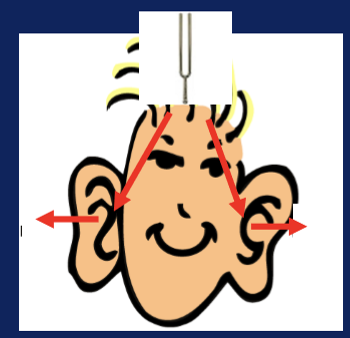
comparison of bone conduction in both ears
place vibrating tuning fork on middle of forehead and ask which ear is louder
What are the results of the Weber test
Normal
Middle, equally
Conductive hearing loss
In the "wrong" defective ear
Lateralisation to the worse hearing ear
Sensorineural hearing loss
In the "good" normal ear
Lateralisation to the better hearing ear
What is the Rinne test
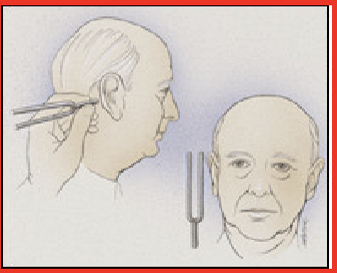
comparison of air and bone conduction in one ear
tuning fork on mastoid process of ear and in front of ear- ask where the sound is the loudest
What are the results of Rinne test
Normal
Air conduction is better
Rinne positive R+
Conductive hearing loss
Bone conduction is better
Rinne negative R-
Sensorineural hearing loss
false negative- test appears negative because sound vibrates and its picked up by healthy ear!
What is the Gelle test
fork against forehead and auditory canal is sealed using pneumatic speculum
creates positive pressure in external auditory canal
positive pressure pushes tympanic membrane and ossicles inwards → increases immobility of basilar membrane of cochlea → decreases hearing
What are the results of Gelle test
positive
sound of fork is perceived weaker with speculum than without
NORMAL!
negative
no change in hearing in patient → otosclerosis or discontinuation