Animal Genetics Exam 2
 Call Kai
 Learn
Learn Practice Test
 Spaced Repetition
 Match
Match Flashcards
 Knowt Play
1/103

There's no tags or description
Looks like no tags are added yet.
Name | Mastery | Learn | Test | Matching | Spaced | Call with Kai | Chat |
|---|
No analytics yet
Send a link to your students to track their progress
104 Terms
Population Genetics
_____: The study of populations over time with particular attention paid to the genetic structure.
Populations
Population Genetics
_____: Group of individuals of the same species that can interbreed.
Genetic Structure
Population Genetics
_____: Alleles (A,a) & Genotypes (AA, Aa, aa) → Gene and genotypic frequencies
Allele and gene frequency mean the same thing.
Gene Frequency
________: proportion of the total loci for a particular allelic series occupied by a particular allele.
abundance
Gene Frequency
The relative ____ or rarity of an allele in a population as compared to the other alleles in that population.
probability
Gene Frequency
Also the _______ of any one gamete carrying a particular gene.
Codominance
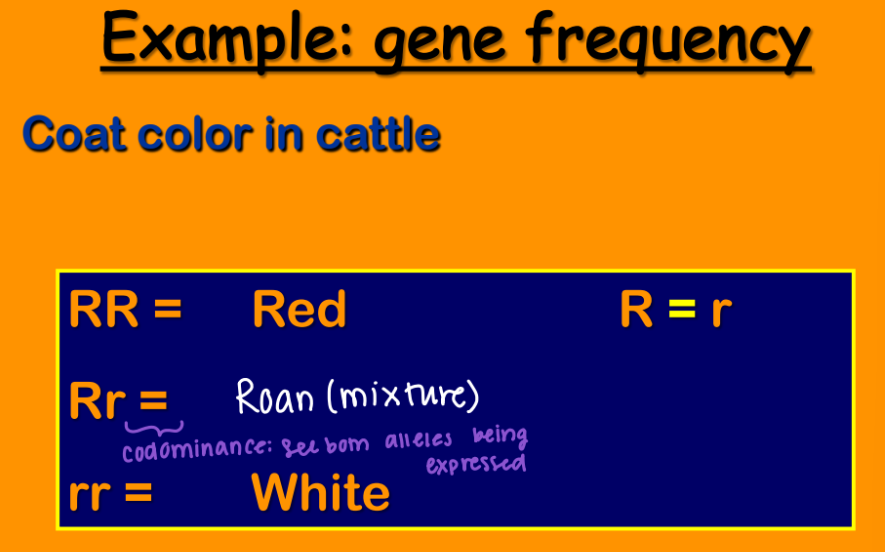
Example Gene Frquency : Coat color in cattle
RR= Red
Rr = Roan (Mixture)
rr= White
R = r (this is an example of _______, which is seen when both alleles are expressed)
Gene Frequency
The probability of drawing the gene at random from all possible genes at that locus in the population.
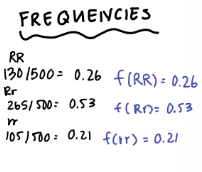
Assume a herd of 500 Shorthorns:
130 reds, 265 roans, and 105 whites.
What are the frequencies?
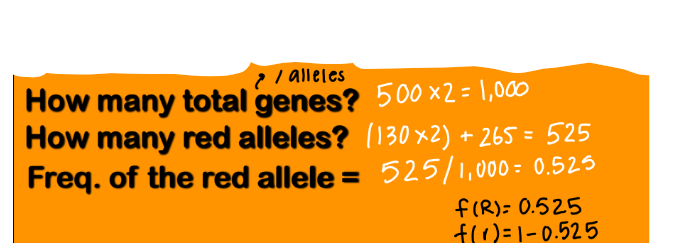
How many total genes/alleles?
How many red alleles?
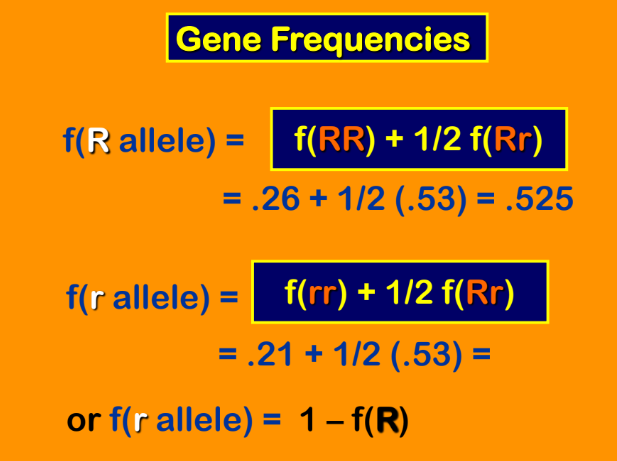
Frequency of the red and white allele?
codominance
Gene and Genotypic Frequency
With _____ (like past example) → easy to calculate frequencies (both gene and genotypic)
Both alleles in a heterozygote are fully expressed, with niether one being dominant or recessive to the other.
Gene Frequencies Summary
Gene Frequencies Summary
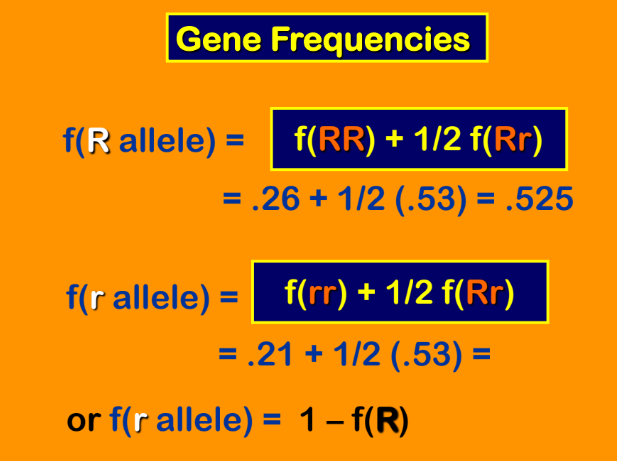
One to One
Gene or Genotypic Frequency
Codominance
_________ relationship between the phenotypes and genotypes → each genotype expresses one phenotype.
Easy calculations of gene and genotypic frequencies.
NOT
Gene or Genotypic Frequency
Dominance
____ a one-to-one relationship
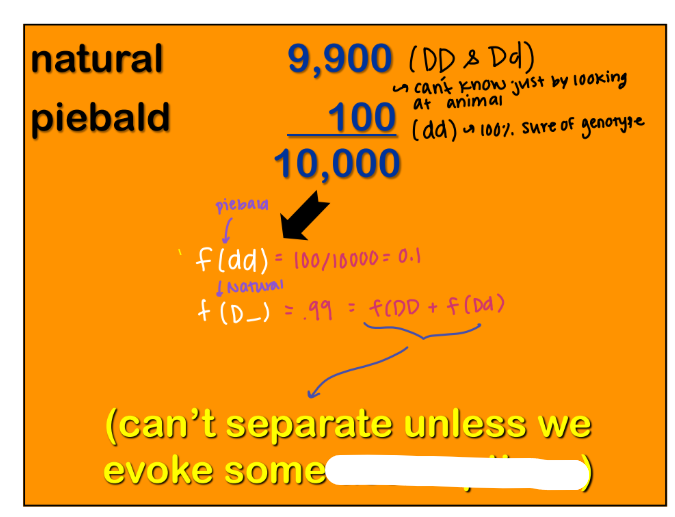
calculations of gene and genotypic frequencies are NOT straightforward

assumptions
Dominance
Cannot separate the two dominant genotypes unless we evoke some ____
Hardy-Weinberg Law
_________ (1908)
In a large, random mating population, in the absence of forces which change gene frequencies, both gene and genotypic rations ratios remains constant from one generation to the next.
Hardy-Weinberg Equilibrium
If a population meets the conditions of the Hardy-Weinberg Law the population is said to be in ____________
Large population
Hardy-Weinberg Lab (1908)
**Assumptions for this to true:
__________ - ensures limited change by chance alone (genetic drift)
equal opportunity
Random mating - every individual has an _________ of mating with another individual of the opposite gender. Defined by TRAIT, not SPECIES.
Mutation
Migration
Selection
No forces to change gene frequency
(______, _______, ________)
heritable change
Forces that can change Gene Frequency
1) Mutation - sudden ______ (happens all the time) in genetic material
at equilibrium theoretically no mutations are occuring.
breeding animals
Forces that can change Gene Frequency
2) Migration - movement of ____ animals from one population to another.
genotypes, phenotypes
Forces that can change Gene Frequency
3) Selection (artifical or natural) - relative success in becoming a parent based on ______ or ______.
**all genotypes and phenotypes are able to mate.
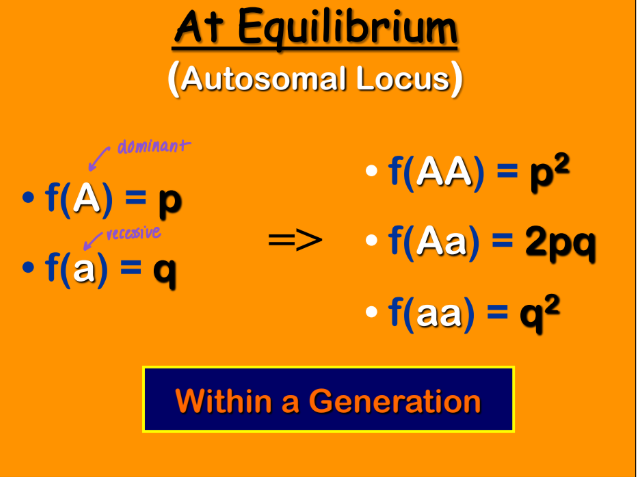
p
Nomenclature
__ = f(D) → frequency of dominant allele
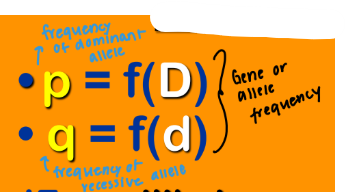
q
Nomenclature
_____ = f(d) → frequency of recessive allele
1
p + q = ____
p²
Genotype - DD
Frequency - ___
2pq
Genotype - Dd
Frequency - ____
q²
Genotype - dd
Frequency - ____
H-W equilibrium
Assuming ____________ we can now press on


Review Math
Review Math

p
p²
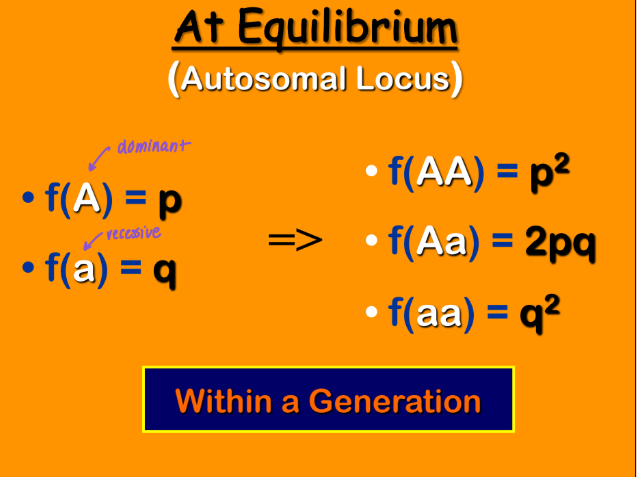
At Equilibrium
With a generation:
there is a relationship between gene and genotypic frequencies such that if the f(A) is ____ then f(AA) is ____
constant
At Equilibrium
Across generations:
gene and genotypic frequencies remain _____
If a population is at equilibirum and there are no forces gene and genotypic rations remain the same year after year (generation after generation)
At equilibrium review
At equilibrium review
randomly
Important to know when and if a population is in equilibirum!
Assume a population not in equilibrium begins to mate _____.
How does this affect the gene and genotypic frequenciesn at autosomal loci?
one generation
Returning to Equilibrium
For any single autosomal locus, with any number of alleles, it takes just _______ of random mating for a population to return to equilibrium.
Condition: IF the allele freqeuncies are the SAME IN MALES AND FEMALES!
two generations
Returning to Equilibrium (Autosomal Locus)
When allele frequences in males and females are NOT the same, returning to equilibrium requires _________ of random mating.
avergae
Two Generations of Random Mating
In the first generation, male and female gene frequencies become equal to the ____ of the frequencies in the parents.
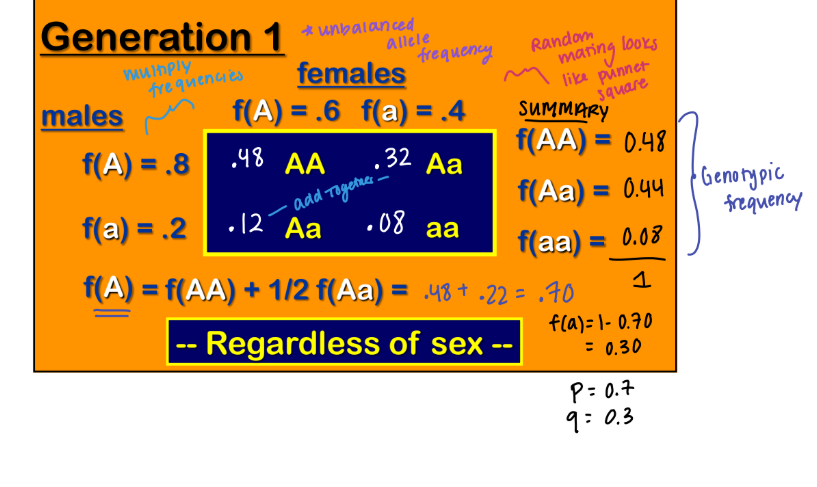

equilbrium
Two Generations of Random Mating
In the second generation the population reaches _____.
