Blood Physiology, Components, and Hematological Disorders
 Call Kai
 Learn
Learn Practice Test
 Spaced Repetition
 Match
Match Flashcards
 Knowt Play
1/38

Earn XP
Description and Tags
Vocabulary flashcards covering blood components, complete blood count ranges, leukocyte differential values, anemia classifications, and ABO/Rh blood grouping systems.
Name | Mastery | Learn | Test | Matching | Spaced | Call with Kai | Chat |
|---|
No analytics yet
Send a link to your students to track their progress
39 Terms
Whole Blood pH
The normal pH range of whole blood, which is strictly maintained between 7.35 and 7.45.
Plasma
The fluid portion of whole blood comprising 55% of total blood volume, composed of 91% water, 7% proteins, and 2% other solutes.
Formed Elements
The cellular and solid components of blood comprising 45% of total blood volume, including red blood cells, white blood cells, and platelets.
Centrifuged Sample of Blood
A sample of whole blood separated into plasma (55%), formed elements (45%), and a middle buffy coat containing leukocytes and platelets.
Erythrocytes
Red blood cells responsible for transporting oxygen and carbon dioxide, with normal counts ranging from 4.2 million to 6.2 million per mm3.
Leukocytes
White blood cells that function as part of the immune system, with a normal range of 5,000 to 11,000 per mm3.
Platelets
Cell fragments involved in blood clotting, with normal count ranges of 150,000 to 450,000 per mm3.
Albumins
The most abundant plasma proteins, representing 57% of all plasma proteins.
Globulins
Plasma proteins that make up 38% of total plasma protein volume.
Fibrinogen
A clotting-related plasma protein that constitutes 4% of total plasma proteins.
Prothrombin
A plasma protein involved in blood clotting that accounts for 1% of total plasma proteins.
Differential Count
A clinical measure of the percentage of each type of circulating leukocyte used to detect changes caused by infection, inflammation, or allergic reactions.
Neutrophils
The most abundant leukocytes in circulating blood, accounting for 60% to 70% of all white blood cells.
Lymphocytes
Leukocytes that make up 20% to 25% of circulating white blood cells.
Monocytes
Leukocytes that make up 3% to 8% of total circulating white blood cells.
Eosinophils
Leukocytes that make up 2% to 4% of total circulating white blood cells.
Basophils
The least common circulating white blood cells, representing 0.5% to 1% of leukocytes.
Hematocrit
The percentage of red blood cells in centrifuged whole blood, normally 39%−49% for males and 35%−45% for females.
Hemoglobin Level
The mass concentration of hemoglobin per volume of whole blood, normally 12−16g/dl for females and 14−18g/dl for males.
Anemia
A condition characterized by low numbers or abnormal RBCs, or low/defective hemoglobin (below 9g/100mL), causing reduced tissue oxygen levels.
Hemorrhagic Anemia
Anemia resulting from blood loss, categorized as acute (immediate loss from surgery or trauma) or chronic (gradual loss over time from ulcers or cancer).
Iron Deficiency Anemia
Anemia caused by a deficiency or inability to absorb iron required for hemoglobin synthesis, characterized by microcytic and hypochromic red blood cells.
Hemolytic Anemia
Anemia caused by a decreased RBC lifespan or increased RBC destruction, leading to symptoms like jaundice, swollen spleen, and gallstones.
Sickle Cell Anemia
A genetic disease resulting in abnormal hemoglobin (HbS) that causes fragile, sickle-shaped RBCs when oxygen levels decrease.
Agglutinogens
Cell surface proteins (antigens) on red blood cells that identify them to the immune system and can potentially cause cell clumping (agglutination).
Type A Blood
Blood type defined by red blood cells displaying surface antigen A and plasma containing anti-B antibodies.
Type B Blood
Blood type defined by red blood cells displaying surface antigen B and plasma containing anti-A antibodies.
Type AB Blood
Blood type defined by red blood cells displaying both surface antigens A and B, with plasma containing neither anti-A nor anti-B antibodies.
Type O Blood
Blood type defined by red blood cells displaying neither surface antigen A nor B, with plasma containing both anti-A and anti-B antibodies.
ABO Blood Type System
A genetically determined system categorizing blood into types A, B, AB, and O based on the presence or absence of RBC surface antigens A and B.
Rh Factor (D Antigen)
A specific RBC surface antigen separate from the ABO system; anti-Rh antibodies are present in plasma only after an Rh-negative person becomes sensitized.
Blood Type Test
A laboratory procedure testing blood samples against Anti-A, Anti-B, and Anti-D antibodies to observe agglutination patterns and determine blood type.
Erythroblastosis Fetalis
A hemolytic disease of the newborn caused by Rh factor incompatibility between an Rh-negative mother and an Rh-positive fetus during a subsequent pregnancy.
RhoGAM
A monoclonal antibody administered to Rh-negative mothers to prevent maternal sensitization against fetal Rh-positive red blood cells.

What type of leukocyte is presented ?
eosinophils
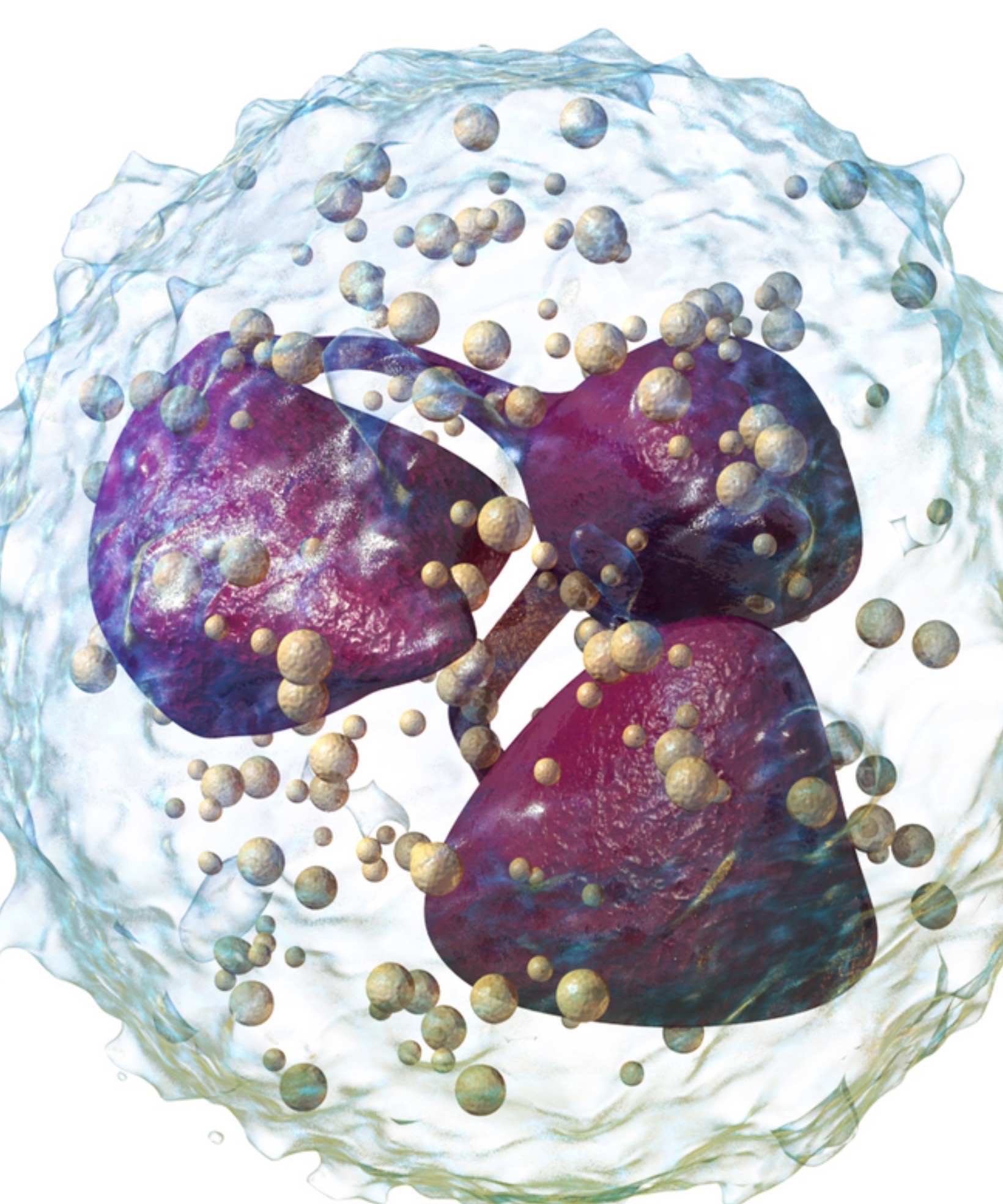
What type of leukocyte is presented ?
Neutrophil

What type of leukocyte is presented ?
Basophil

What type of leukocyte is presented ?
Monocytes

What type of leukocyte is presented ?
Lymphocyte