ANAT 150 Lab Practical 2: Skeletal System Review
 Call Kai
 Learn
Learn Practice Test
 Spaced Repetition
 Match
Match Flashcards
 Knowt Play
1/29

Earn XP
Description and Tags
Comprehensive practice flashcards covering the axial and appendicular skeletons, compact bone anatomy, and specific landmarks of the adult and fetal skull based on Exercises 9 and 10.
Name | Mastery | Learn | Test | Matching | Spaced | Call with Kai | Chat |
|---|
No analytics yet
Send a link to your students to track their progress
30 Terms
The skeletal system is divided into two primary sections: the axial skeleton and the __________ skeleton.
Appendicular

What is this rainbow colored backbone?
Vertebral column
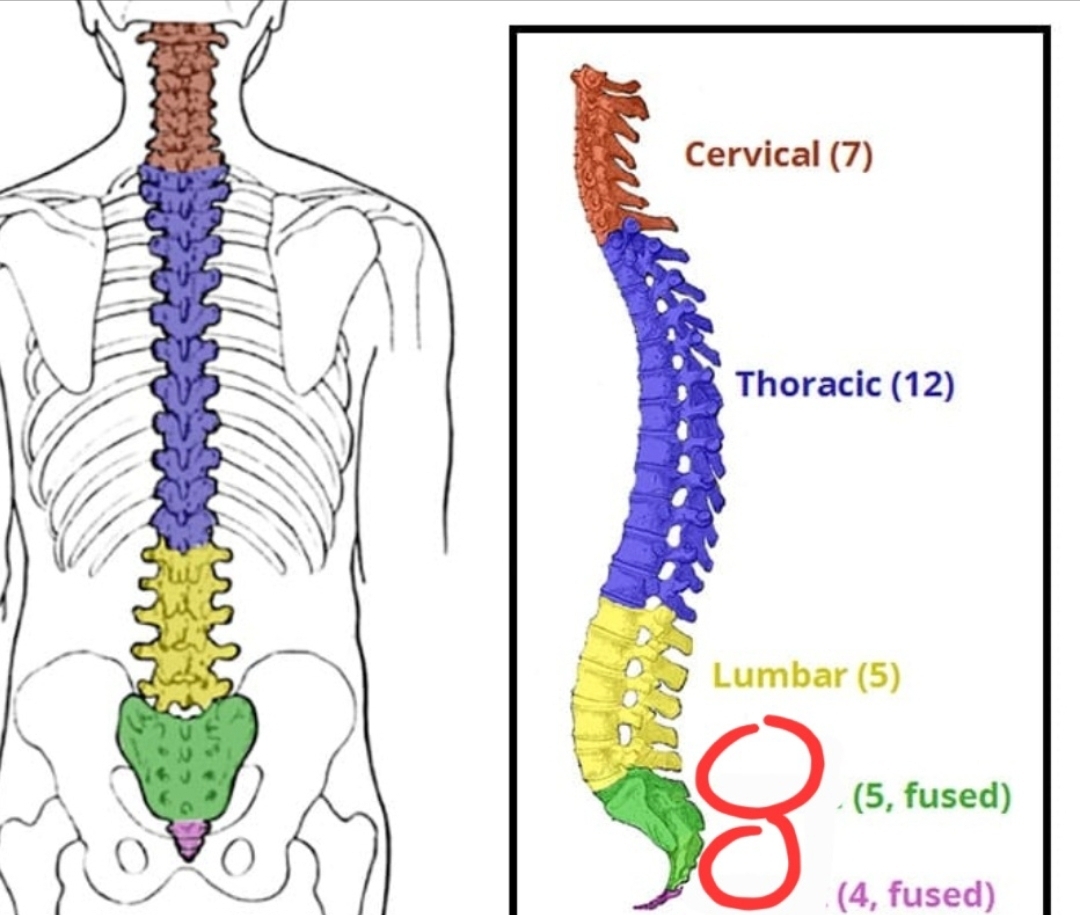
What is the green and pink bones in the vertebral column at the bottom?
The sacrum (green) and coccyx (pink)
In the upper extremity, there are __________ carpal bones, __________ metacarpal bones, and __________ phalangeal bones.
8, 5, 14
The pelvic girdle and lower extremity consist of the pelvic bone, femur, tibia, fibula, patella, and __________ tarsal bones.
7
The lower extremity contains __________ metatarsal bones and __________ phalangeal bones.
5, 14
The microscopic structures of compact bone include the central canal, lacuna, osteocyte, canaliculus, and three types of __________.
Lamella

What is the bones we are looking at here (the entire thing)?
Rib Cage
While most skull bones are single, there are two __________ bones and two __________ bones in the adult skull.
Parietal, Temporal
The __________ bone contains features such as the superior nuchal line, inferior nuchal line, and the occipital condyle.
Occipital
The __________ bone includes the external auditory canal, mastoid process, styloid process, mandibular fossa, and petrous portion.
Temporal
The __________ bone is characterized by the greater wing, lesser wing, and the sella turcica.
Sphenoid
The __________ bone consists of the crista galli and the cribriform plate.
Ethmoid
The zygomatic arch is formed by the zygomatic process of the temporal bone and the __________ process of the zygomatic bone.
Temporal
Skull canals involve the optic, carotid, hypoglossal, and both the external and internal __________ canals.
Auditory

What is the middle bone here, located in the rib cage?
Sternum

The two types of fissures found in the eye orbit are the __________ orbital fissure and the __________ orbital fissure.
Superior, Inferior
The two paranasal sinuses identified in Exercise 10 are the __________ sinus and the __________ sinus.
Frontal, Sphenoidal
The nasal septum is composed of the vomer bone, nasal cartilage, and the __________ plate of the ethmoid bone.
Perpendicular
There are three nasal conchae: the superior, middle, and __________ nasal concha.
Inferior
The hard palate is formed by the horizontal plate of the palatine bone and the __________ process of the maxillary bone.
Palatine
The __________ process of the maxillary bone holds the teeth.
Alveolar

Identify from 1-8.
Clavicle 2. Scapula 3. Humerus 4. Radius 5. Ulnar 6. Carpal bones 7. Metacarpals 8. Phalanges

In the fetal skull, the four fontanels are the frontal, occipital, sphenoidal, and __________ fontanels.
Mastoid
The mandible contains several landmarks: the body, angle, ramus, mandibular notch, and the __________.
Mandibular foramen
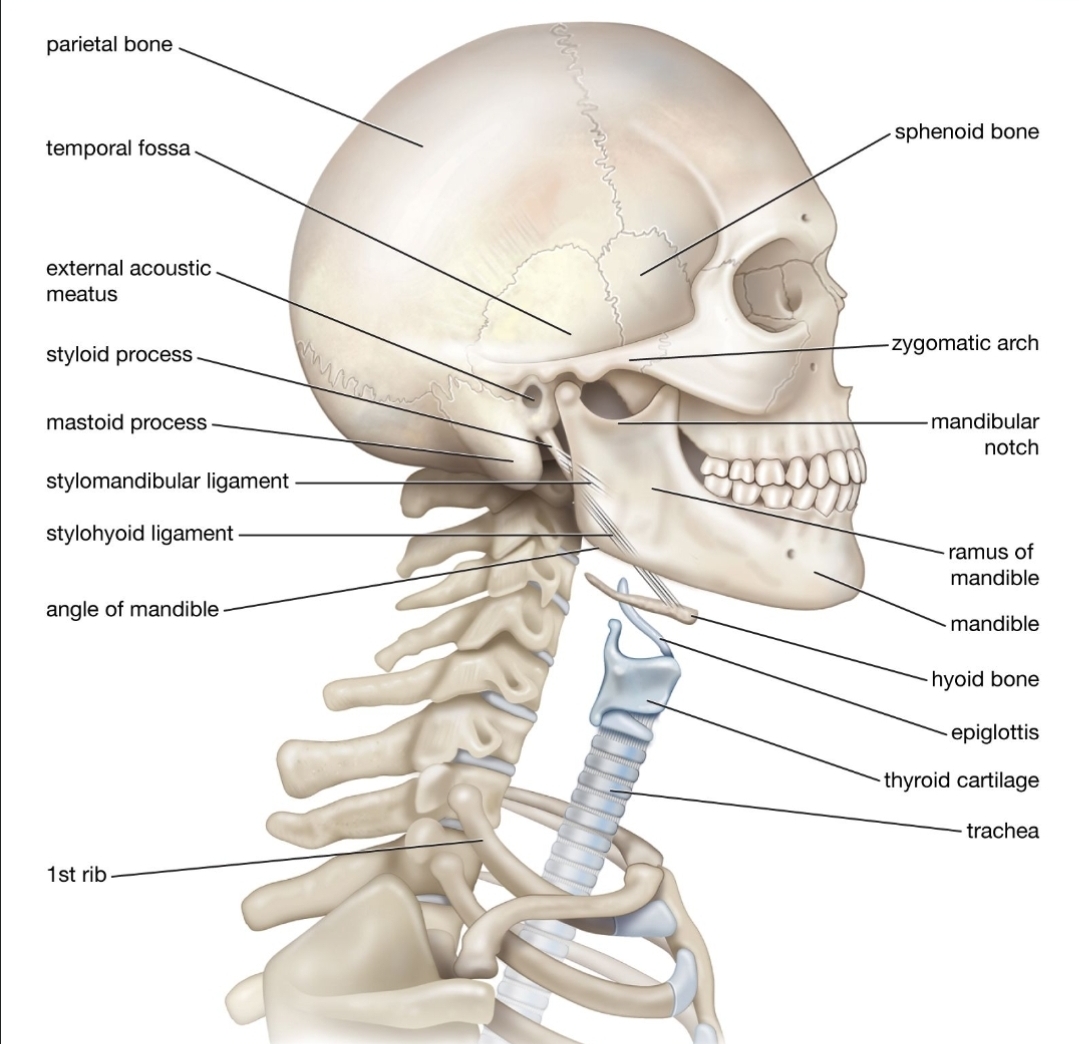
Located in the axial skeleton, what are these set of bones apart of?
Skull

What is the top and bottom bone located in this skull?
The mandible (top) and hyoid bone (bottom)