Chemistry A Level - Bonding and Structure summary questions
 Call Kai
 Learn
Learn Practice Test
 Spaced Repetition
 Match
Match Flashcards
 Knowt Play
1/14

There's no tags or description
Looks like no tags are added yet.
Name | Mastery | Learn | Test | Matching | Spaced | Call with Kai | Chat |
|---|
No analytics yet
Send a link to your students to track their progress
15 Terms
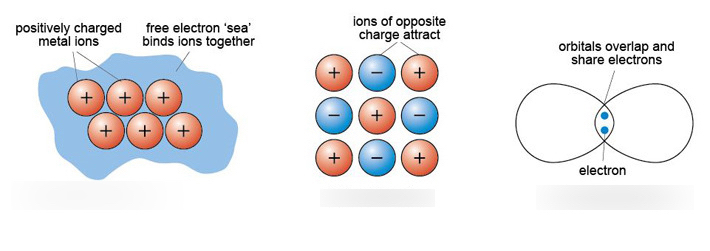
Define ionic, covalent and metallic bonding using diagrams to aid explanation.
Ionic bond: Strong electrostatic force of attraction between oppositely charged ions (transfer of electrons)
Covalent bond: Electrostatic force of attraction between a shared pair of electrons and two positive nuclei (sharing of electrons)
Metallic bond: Electrostatic force of attraction between the nuclei of metal cations and the ‘sea’ of delocalised electrons
What are the two factors that affect the strength of ionic bonding? How do they affect it?
Size of the ions: the smaller the ions the more energy required to overcome the electrostatic forces of attraction between them as smaller ions can pack closer together.
Charge of ions: The greater the charge of the ions the more energy required to overcome the electrostatic forces of attraction between them as the forces of attraction are stronger
… so overall, influenced by CHARGE DENSITY
Explain the trend in ionic radii down a group and across a period.
Down a group - increases as no. of electron shells increases down a group
Across a period - for isoelectronic ions (ie. same electron config.), ionic radius decreases across a period as atomic no. increases. This is because the ions have the same no. of electron but different no. of protons, hence more protons in nucleus = stronger force of attraction between electrons and nucleus and smaller ionic radius.
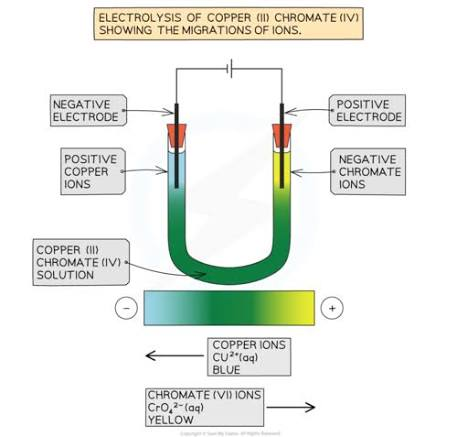
Outline evidence for the existence of ions and ionic compounds.
Electrolysis of CuCrO4: Separates the blue Cu2+ ions to the negative electrode and the yellow CrO42- ions to the positive electrode.
Explain how bond length is determined and how it affects bond enthalpy.
The strength of a covalent bond is determined by the balance between the attractive forces between the positively charged nuclei and the negatively charged shared electrons and the repulsive forces between the two nuclei and between the electrons. The bond length decides the bond enthalpy.
The more electron density shared between the atoms, the stronger the forces of attraction and hence the shorter the bond length. ie. Double bonds are stronger than single bonds.
Draw a table with the structure for any combination of bonding pairs and lone pairs for molecules with up to six outer pairs of electrons. Name each structure.
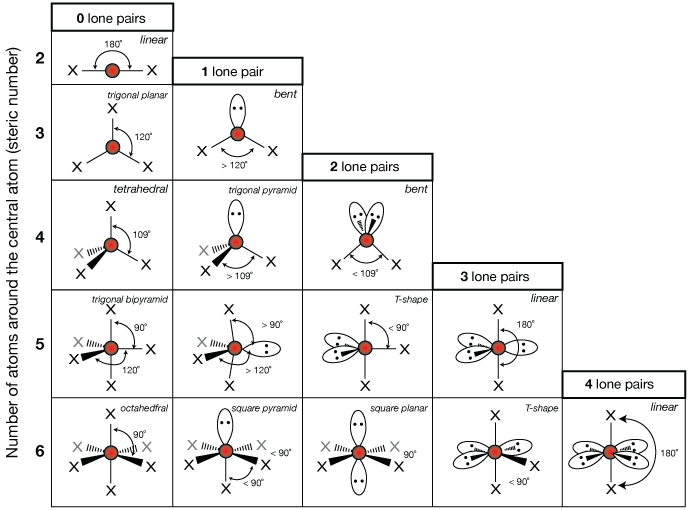
What determines the 3D shapes and bond angles of these molecules and ions?
Molecules adopt their shapes to reduce repulsion and ensure maximum stability.
The electron pairs in a molecule will repel each other until they have reached a position of maximum separation and minimum repulsion.
Lone pairs exert a stronger repelling force than bonding pairs.
Bond angles: 1 lone pair: 109.5º, 2 lone pairs: 107º
Define electronegativity, bond polarity and polar molecules. Hence, explain why most bonds are not simply ‘ionic’ or ‘covalent’.
Electronegativity: The ability of an atom to attract a covalently bonding pair of electrons and distort the electron cloud. Can be influenced by nuclear charge density.
Bond polarity: The difference in the electronegativity of two atoms in a bond. The greater the difference, the more polar the bond and the more distorted the electron cloud.
Polar molecule: molecules with regions of d+ and d- atoms where the dipoles do not cancel out (not symmetrical)
Polar bonds can be considered as covalent bonds with some degree of ionic characteristic (as electrons are not shared evenly between the two atoms)
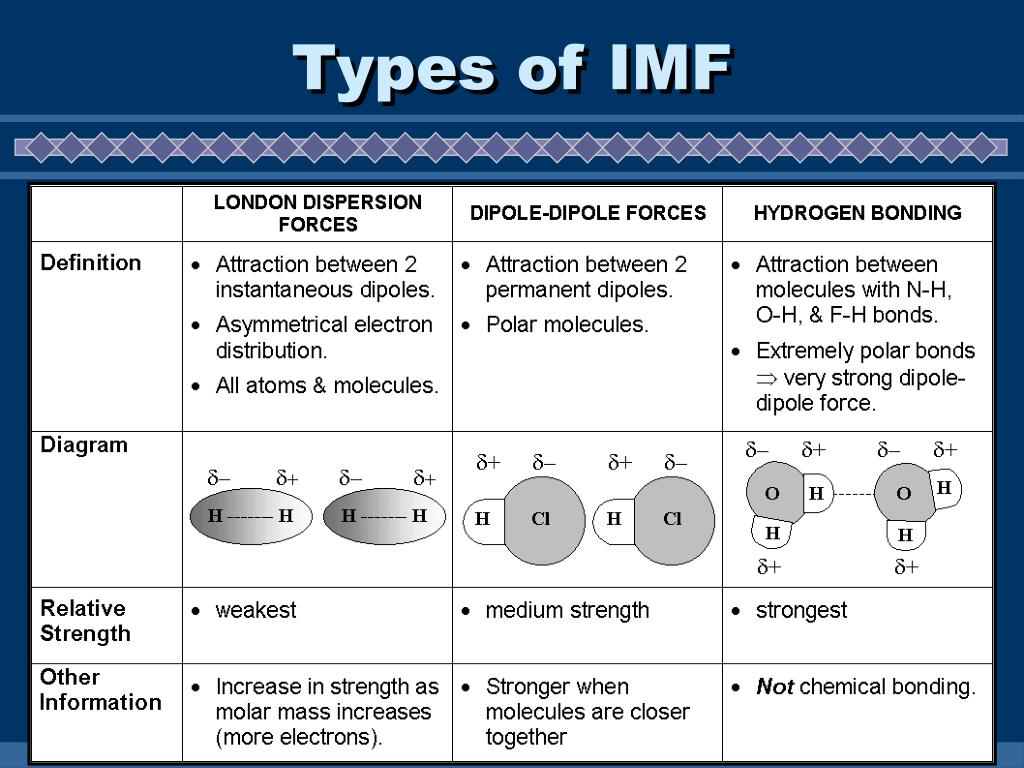
Describe the three types of intermolecular forces and how they arise.
London dispersion forces (LDFs)- all molecules display this type of IMF as the random movement of electron can result in temporary dipoles arising, inducing dipoles in adjacent particles. Individually weak, but strength is determined by no. electrons per molecule (as there is a greater separation of charge and hence larger dipole induced) and no. of contact points.
Permanent Dipole Dipole forces (PDDs) - exist between polar molecules with dipoles that result in electrostatic attraction between molecules.
Hydrogen bonding (H bonds) - force of attraction between a d+ hydrogen atom and a lone pair of electrons on a highly electronegative atom (N, O or F) in an adjacent molecule.
Explain how the presence of hydrogen bonding in water affects its properties.
Boiling point: H2O has 4 H bonds per molecule, a perfect ratio of d+ H to lone pairs on O atom. For this reason it has a very high boiling point relative to similar molecule that also exhibit hydrogen bonding (eg. HF) and molecule that cannot H bond (eg. H2S)
Density of ice: In ice, each of the water molecules are held together by h bonds creating an open structure where water molecules are further away from each other than they would typically be in liquid form.
Good solvent: water is a good polar solvent because it has the ability to dissolve ionic compounds by separating the ions and interacting with them ie. d+ dipoles surround anions and d- dipoles surround cations. This is known as hydration of ions and releases energy
Outline the factors that influence the choice of solvent between water and non-polar solvents like hexane.
Water/ethanol = polar so is a good solvent for polar substances such as ionic compounds as H2O molecules can separate and hydrate the ions by forming interactions with them. Any substance that has dipoles or can H bond will be soluble in water.
Bromine/Hexane = nonpolar so is good for dissolving non-polar substances like lipids. Non-polar solvents for LDFs with non-polar substances to dissolve them, however the IMFs of the solute and the solvent must be similar.
Describe how chain length and branching affect boiling point.
Chain length - Longer chain = more atoms in each molecule = more electrons per molecule so LDFs are greater the longer the chain gets. Therefore, longer chain hydrocarbons have higher boiling points.
Branching - Branched hydrocarbons cannot pack as closely as straight chain hydrocarbons, hence their LDFs are weaker and their boiling points are lower than their straight chain isomers.
Name and describe the four different types of molecular structures. What are their physical properties?
Giant ionic lattice- no IMFs, high melting point and boiling point, only conducts when molten (as ions are free to move around and carry charge when they are out of the rigid lattice structure), generally soluble in water.
Giant Covalent lattice- no IMFs, very high melting point and boiling point, doesn’t conduct, insoluble in water
Simple molecular - IMFs between molecules, low boiling and melting point, non-conductor, generally insoluble in H2O except if they can H bond or react with water.
Giant metallic lattice - no IMFs, high melting and boiling point, good conductor, insoluble in water except for when the metal reacts with water eg. sodium.