9.10 Enzyme Kinetics and Inhibition
 Call Kai
 Learn
Learn Practice Test
 Spaced Repetition
 Match
Match Flashcards
 Knowt Play
1/30

There's no tags or description
Looks like no tags are added yet.
Name | Mastery | Learn | Test | Matching | Spaced | Call with Kai | Chat |
|---|
No analytics yet
Send a link to your students to track their progress
31 Terms
k
Unit of rate constant; Units of k=M1-order/S
Enzyme substrate reaction equation

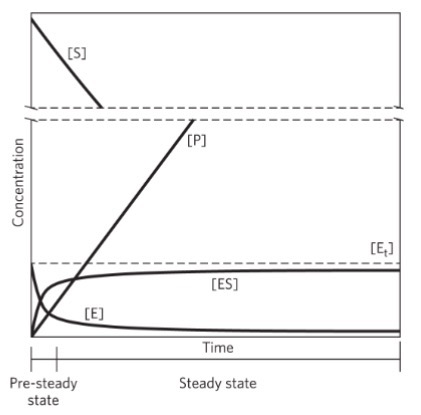
Pre-steady state
Initial period where [ES] builds up
Steady state
Period where [ES] and other intermediates remain constant
Steady-state kinetics, understand kinetics charts
Equilibrium assumption
Assume P is produced more slowly than ES dissociates; meaning k2«k-1 and that ES formation reaches equilibrium quickly

Steady-state assumption
Probability of P → S is very low and can be ignored; Therefore, steady-state assumes ES formation equals ES loss (Either to reverse reaction or product formation)
Initial rate and formula
Initial velocity (V0); Stays constant no matter concentration (Because S is regarded as constant at the beginning); V0 = k2[ES]
Low S vs High S effect on V0
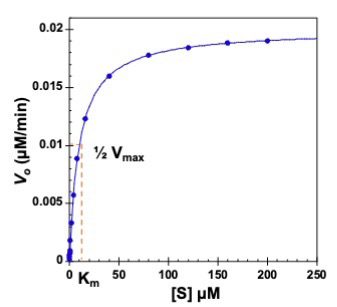
Low S, increases linearly as most E spots are empty; High S, increases until plateau as most E spots are filled
Michaelis and Mentee Theory
E + S forms reversible ES, ES breaks down to yield free enzyme and product (Slower, irreversible); Because P formation is slower, it limits overall reaction rate to be proportional to [ES] formation
Total enzyme concentration formula
[Et] = [E] + [ES]; rearranging terms can help determine other values (ex. V0)
![<p>[E<sub>t</sub>] = [E] + [ES]; rearranging terms can help determine other values (ex. V<sub>0</sub>)</p>](https://knowt-user-attachments.s3.amazonaws.com/477d8cc0-d2f0-46a1-9f95-5078581e6e66.png)
Michaelis constant
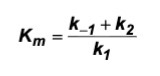
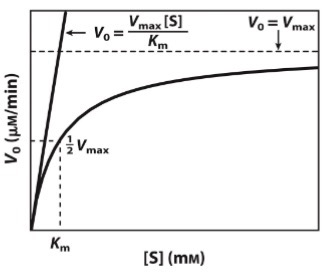
Km, point in which reaction velocity is Vmax/2, Smaller is better (Less S needed to reach Vmax/2)
kcat; V0 equation using kcat
Limiting rate constant for a general catalysis reaction, max # of S an enzyme can convert to product per unit of time; kcat=k2; considering this… (Refer to image*); Higher kcat faster turnover;
kcat = Vmax/[Et]
![<p>Limiting rate constant for a general catalysis reaction, max # of S an enzyme can convert to product per unit of time; k<sub>cat</sub>=k<sub>2</sub>; considering this… (Refer to image*); Higher k<sub>cat</sub> faster turnover;</p><p>k<sub>cat</sub> = V<sub>max</sub>/[E<sub>t</sub>]</p>](https://knowt-user-attachments.s3.amazonaws.com/fb11c00a-81cc-44a3-a205-4a0950ad2dae.png)
Michaelis-Menten Equation
At low [S] concentrations, Km + [S] = Km
![<p>At low [S] concentrations, K<sub>m </sub>+ [S] = K<sub>m</sub></p>](https://knowt-user-attachments.s3.amazonaws.com/8b86db86-0668-469f-93bb-268919e7e6eb.png)
Vmax
Point at which enzyme is saturated and [ES] = [Et]; Means Vmax = kcat[Et]
Visual representation of Km, V0, and Vmax
Kd
Dissociation constant; rate of reverse reaction/rate of forward reaction; Kd = k-1/k1; Km = Kd when k-1»k2
kcat/Km
Specificity constant for different E same S or different S same E; Higher value = higher efficiency
Upper limit of enzyme activity
108 - 109 M-1s-1 (Limited by diffusion rate of E and S)
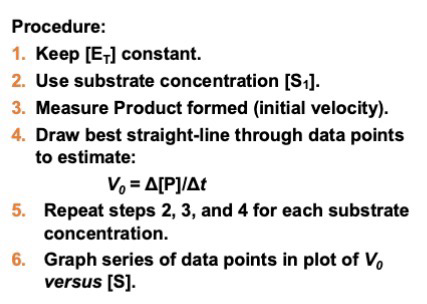
experimental procedure to determine Km and Vmax
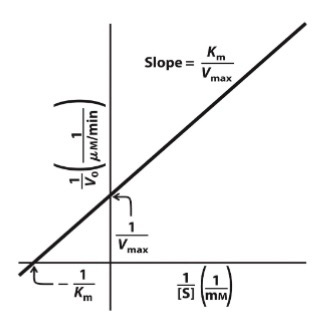
Lineweaver-Burk Plots
Double reciprocal;

Factors that affect enzyme activity
pH, number and types of substrate
Types and subtypes of inhibitions
Noncovalent (Reversible) inhibition
Non-competitive: Reversibly binds at alternate site
Competitive: Binds at active site, can be made based on knowledge of E reaction mechanism
Uncompetitive: Binds at alternate site to interfere with catalysis, only on ES
Mixed competitive: Combination of the types of activity above
Covalent (Irreversible) inhibition: Completely kills enzyme.
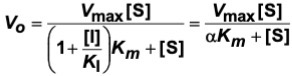
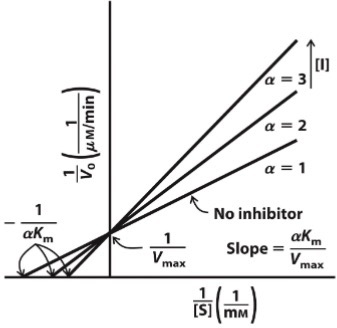
Competitive inhibitor
Reversible; aKm = apparent Km; more inhibitor = less enzyme activity; Uses substrate site; Higher slope = Stronger inhibition
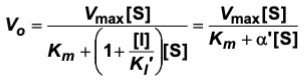
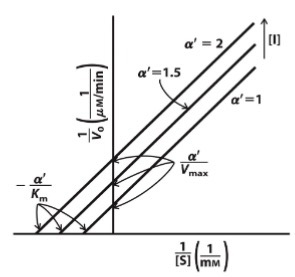
Uncompetitive inhibitor
Does not use substrate site (Hence entire slope shift); Higher slope = Stronger inhibition
Mixed inhibition
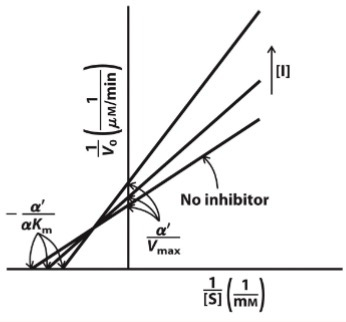
Substrate vs transition-state analogs designs: What about noncompetitive and uncompetitive inhibitors
Substrate is based on structure of substrate and predicted interaction with proteins/ES structure
Transition-state binds better than substrate
Other inhibitors are harder to design and are often discovered rather than created
Ternary vs tertiary complex
Ternary is Inhibitor + E + S
Tertiary is just E + S
Suicide inactivator
Mechanism-based inactivators that undergoes the first few steps of the reaction before forming covalent bond with the enzyme.
Irreversible enzyme for chymotrypsin
Diisopropyl fluorophosphate (DIFP)
Irreversible enzyme
Binds covalently with/destroys functional group of protein or forms high stable noncovalent association