Operations Exam/Final
 Call Kai
 Learn
Learn Practice Test
 Spaced Repetition
 Match
Match Flashcards
 Knowt Play
1/77

There's no tags or description
Looks like no tags are added yet.
Name | Mastery | Learn | Test | Matching | Spaced | Call with Kai | Chat |
|---|
No analytics yet
Send a link to your students to track their progress
78 Terms
Operations and supply chain management (OSCM)
The design, operation, and improvement of the systems that create and deliver the firm’s primary products and services
Operations
Manufacturing and service processes used to transform the resources employed by a firm into products desired by customers
Supply Chain
Processes that move information and material to and from the manufacturing and service processes of the firm
Processes
One or more activities that transform inputs into outputs
Planning
Determining how to meet expected demand with available resources while measuring supply chain efficiency, quality and customer value
Sourcing
Selecting suppliers and managing the purchasing, receiving, verification and payment of needed goods and services.
Making
Producing the product or providing the service by scheduling workers, materials and equipment while monitoring speed, quality and productivity
Delivering (logistics processes)
Managing logistics: moving products to warehouse/customers, coordinating orders and transportation and collecting customer payments
Returning
Handling defective, worn-out or excess products and providing customers with after-sale support
Intangible
Cannot be weighed or measured (haircut, customer service)
Tangible
Something physical that can be seen, touched, measured or weighed (car, phone, shirt)
Tangible/Intangible
Interaction with customer
Services are inherently heterogeneous (they vary from day to day)
Perishable and time dependent
Package of design features
Five essential differences between services and goods
Pure Goods
Food Products
Chemicals
Mining
Core Goods
Appliances
Automobiles
Data storage systems
Core Services
Hotels
Airlines
Internet Service Providers
Pure Services
University
Medical’
Investment
Product-Service Bundling
When a firm builds service activities into its product offerings to create additional value for the customer
Efficiency
A ratio of the actual output of a process relative to some standard. Also, being “efficient” means doing something at the lowest possible cost.
Effectiveness
Doing the things that will create the most value for the customer.
Value
The attractiveness of a product relative to its price.
Manufacturing strategy
Emphasizes how a factory’s capabilities could be used strategically to gain advantage over a competing company.
Just-in-time (JIT)
An integrated set of activities designed to achieve high-volume production using minimal inventories of parts that arrive exactly when they are needed.
Total quality control (TQC)
Aggressively seeks to eliminate causes of production defects.
Lean manufacturing
To achieve high customer service with minimum levels of inventory investment.
Total quality management (TQM)
Managing the entire organization so it excels in all dimensions of products and services important to the customer.
Business process reengineering (BPR)
An approach to improving business processes that seeks to make revolutionary changes as opposed to evolutionary (small) changes.
Six Sigma
A statistical term to describe the quality goal of no more than 3.4 defects out of every million units. Also refers to a quality improvement philosophy and program.
Mass customization
The ability to produce a unique product exactly to a particular customer’s requirements.
Electronic commerce
The use of the Internet as an essential element of business activity.
Sustainability
The ability to meet current resource needs without compromising the ability of future generations to meet their needs.
Triple bottom line
Evaluating the firm against social, economic, and environmental criteria.
Business analytics
The use of current business data to solve business problems using mathematical analysis.
Internet of Things
The billions of devices that are connected to the internet
Artificial Intelligence (AI)
The intelligence of machines or software and the application to OSCM processes.
Shareholders
Individuals or companies that legally own one or more shares of stock in the company
Stakeholders
individuals or organizations that are influenced, either directly or indirectly, by the actions of the firm
Sustainability
The ability to meet current resource needs without compromising the ability of future generations to meet their needs.
Social responsibility
fair and beneficial business practices toward labor, the community, and the region in which a firm conducts its business
Economic prosperity
the firm is obligated to compensate shareholders who provide capital through stock purchases and other financial instruments via a competitive return on investment
Environmental stewardship
refers to the firm’s impact on the environment
Operations and supply chain strategy
The setting of broad policies and plans that will guide the use of the resources needed by the firm to implement its corporate strategy.
Operations effectiveness
Performing activities in a manner that best implements strategic priorities at minimum cost.
Initiatives
the major steps that need to be taken to drive success in the firm
Straddling
When a firm seeks to match what a competitor is doing by adding new features, services, or technologies to existing activities. This often creates problems if trade-offs need to be made.
Order winners
One or more specific marketing-oriented dimensions that clearly differentiate a product from competing products. (decision maker)
Order qualifiers
Dimensions used to screen a product or service as a candidate for purchase.(gets you to the table)
Activity-system maps
Diagrams that show how a company’s strategy is delivered through a set of supporting activities.
Supply chain risk
The likelihood of a disruption that would impact the ability of a company to continuously supply products or services.
Productivity
A measure of how well resources are used. According to Goldratt’s definition (see Chapter 22S, Theory of Constraints), all the actions that bring a company closer to its goals.
Productivity = Outputs / Inputs
Productivity Formula:
(Output / Labor) or (Output / Capital) or (Output / Materials)
Partial measure:
(Output / Labor + Capital + Energy) or (Output / Labor + Capital + Materials)
Multifactor measure:
(Output / Inputs) or (Goods and Services produced / All resources used)
Total Measure:
Role of Operations
The role of operations is to manage the resources and capabilities of the firm. Operations, along with finance, marketing and other functions use strategy for purposeful alignment to create value, compete, and win
Market Priorities
Order winners and qualifiers signal customer decision criteria. “Qualifiers“ are minimum requirements and “winners” are differentiating features. These are market-based (a.k.a., voice of the customer) considerations that a firm aspires to meet.
(new - old) / (old)
% Change Formula:
Manufacturing Processes
Used to make everything that we buy ranging from a building to an ink pen
Customer order decoupling point
Where inventory is positioned in the supply chain.
Make-to-stock
A production environment where the customer is served “on-demand” from finished goods inventory.
Assemble-to-order
A production environment where preassembled components, subassemblies, and modules are put together in response to a specific customer order.
Make-to-order
A production environment where the product is built directly from raw materials and components in response to a specific customer order.
Engineer-to-order
Here the firm works with the customer to design the product, which is then made from purchased material, parts, and components.
Lean manufacturing
To achieve high customer service with minimum levels of inventory investment.
Process Selection
The strategic decision of selecting which kind of production processes to use to produce or provide a service
Project layout
A setup in which the product remains at one location, and equipment is moved to the product.
Workcenter
An area in a business where productive resources are organized to complete work.
Manufacturing cell
Groups dissimilar machines to work on products that have similar shapes and processing requirements.
Assembly line
A setup in which an item is produced through a fixed sequence of workstations, designed to achieve a specific production rate.
Continuous process
A process that converts raw materials into finished product in one continuous process.
Product–process matrix
A framework depicting when the different production process types are typically used, depending on product volume and how standardized the product is.
The Horizontal Dimension (Product–process matrix)
Relates to the volume of a particular product or group of standardized products
The Vertical Dimension (Product–process matrix)
Standardization is shown and refers to variations in the product that is produced
break-even analysis
A standard approach to choosing among alternative processes or equipment
break-even chart
visually presents alternative profits and losses due to the number of units produced or sold
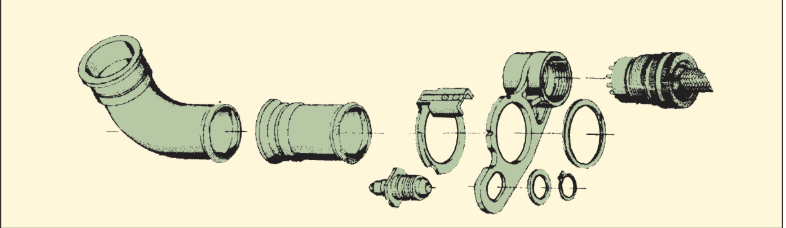
Assembly drawing
an exploded view of the product showing its component parts
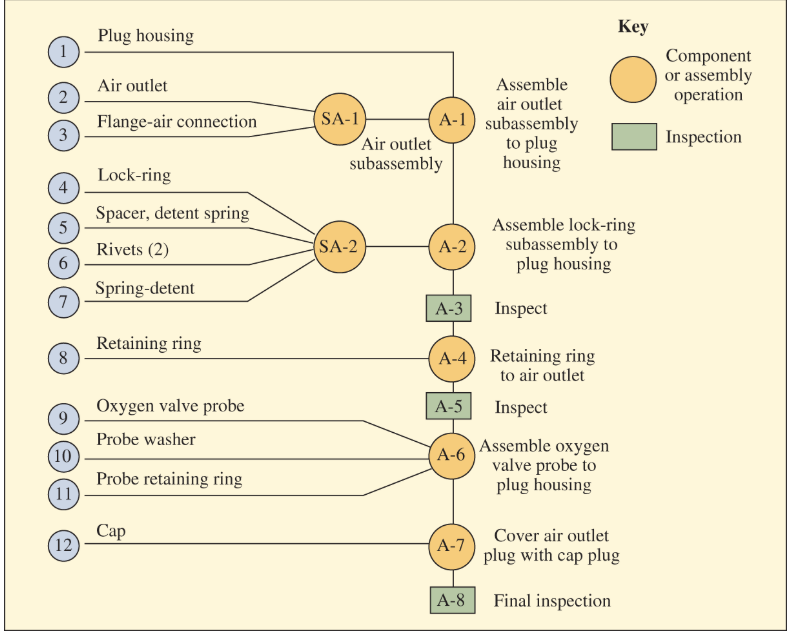
Assembly chart
uses the information presented in the assembly drawing and defines how parts go together, their order of assembly and often the overall material flow pattern
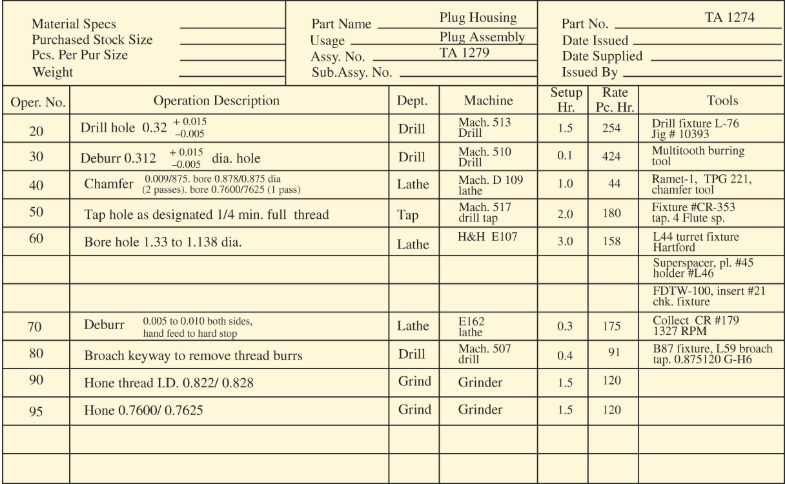
Operation and route sheet
specifies operations and process routing for a particular part. It conveys such information as the type of equipment, tooling and operations required to complete the part
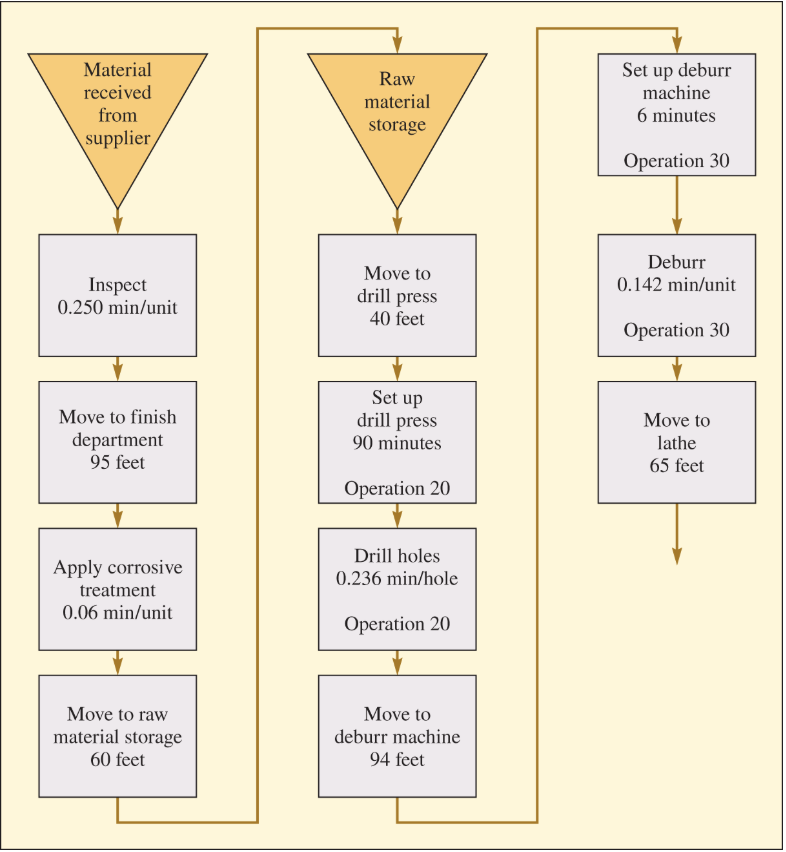
Process flowchart
denotes what happens to the product as it progresses through the productive facility